Yuval Noah Harari, an evolutionist, and globalist is a lead spokesperson for the World Economic Forum (WEF). He could well be the most dangerous man alive because of his ideas and scope of influence. Also, a homosexual, transhumanist atheist, he outlines the globalist plans for taking over the world and for transforming people into something other than human. In this video by Nelson Walters of Harari’s ideas, he lays out how the WEF plans to do it. Harari’s own plans include writing children’s books to reach the very young with his godless ideas. He is just one of the many false prophets that will arise to lead many astray before Jesus returns to put things right.
Jesus warned us that the events that we see playing out in our world now. The casting off of the Judaeo-Christian values and increasing persecution of Christians will only intensify as we approach Jesus’ return to earth.
“And you will hear of wars and rumors of wars. See that you are not alarmed, for this must take place, but the end is not yet. For nation will rise against nation, and kingdom against kingdom, and there will be famines and earthquakes in various places. All these are but the beginning of the birth pains. Then they will deliver you up to tribulation and put you to death, and you will be hated by all nations for my name’s sake. And then many will fall away and betray one another and hate one another. And many false prophets will arise and lead many astray. And because lawlessness will be increased, the love of many will grow cold. But the one who endures to the end will be saved.” Matthew 24:6-13
As usual, Nelson has done a great job of keeping up to date on world events as they relate to the many “end times ” prophecies given to us in God’s Word, the Bible.
Could it be they are a people group, a nation, that God established for His purposes and that the Prince of this World, Satan, is intent on destroying them to prevent them from fulfilling His purposes?
What about the horrors of Auschwitz and the Jewish Holocaust? It is hard to comprehend how six million Jews could be exterminated and the German people and even the church were silent.
How many people do you know that understand the truth of the following Scripture?
“For we do not wrestle against flesh and blood, but against the rulers, against the authorities, against the cosmic powers over this present darkness, against the spiritual forces of evil in the heavenly places.” Ephesians 6:12
Children at an Iranian Islamic school in North London were taught to sing a song about massacring the Jews. What is behind this madness, this evil, except for demonic forces?
The UK’s Jewish Chronicle (JC) recently exposed an Iranian propaganda video shot about a mile from the New London synagogue in which school children sing a horrific song about killing Jews.
The British paper received access to a video filmed several months ago, showing dozens of children ages 8-15 in the Islamic Republic of Iran School (IRIS) in London, standing in rows and mouthing lyrics that pledge an “oath of loyalty as a warrior and servant” to the Mahdi. The Mahdi is a messianic figure in Islamic belief who is to appear at the end of times to rid the world of evil and injustice. “It is antisemitic to its core”, he said, “because it holds that before the Mahdi can return, Israel must be destroyed and all the world’s Jews put to death.”
In the video, boys, and girls aged eight to 15 pledge their allegiance to Ayatollah Khamenei, leader of the Islamic Republic of Iran.
Over the course of the last several months, Khamenei’s regime has overseen the massacre of protesters demonstrating against the murder of Mahsa Amini, who was killed while in custody for not properly wearing the hijab.
According to Kasra Aarabi, who oversees the Iran Programme at the Tony Blair Institute, the doctrine summarized in the song “is antisemitic to its core” and is the foundation of Iran’s policy.
Israel is surrounded by hostile nations all intent on its elimination and yet their judgement is foretold.
“Hasten and come, all you surrounding nations, and gather yourselves there. Bring down your warriors, O Lord. Let the nations stir themselves up and come up to the Valley of Jehoshaphat; for there I will sit to judge all the surrounding nations... The Lord roars from Zion, and utters his voice from Jerusalem, and the heavens and the earth quake. But the Lord is a refuge to his people, a stronghold to the people of Israel.” ” Joel 3:11-12,16
“Israel continues to be a world leader in drone technology…Israel serves as a model of a country that develops regulations and technologies to enable the management and control of the operation of multiple drones for various needs, and is rapidly approaching a continuous operating model that will enable low-altitude flights throughout the country,” said IIA CEO Dror Bin.
Nehemiah Shalem, acting director of the Civil Aviation Authority of Israel, said that the organization was committed to fully supporting all of the entities involved in the project.
“Additionally, the CAAI will promote the critical legislative actions required for developing a thriving aviation industry that serves as a world leader while never compromising on flight safety,” said Shalem
In the not-too-distant future, Jesus will be ruling and reigning all the nations from Jerusalem. The psalmist summarized and emphasized the eternality of God’s covenant promise to Israel regarding the land to which they returned in 1948 but at present, they only partially occupy a small portion of what God promised them.
“He is the LORD our God; his judgments are in all the earth. He remembers his covenant forever, the word that he commanded, for a thousand generations, the covenant that he made with Abraham, his sworn promise to Isaac, which he confirmed to Jacob as a statute, to Israel as an everlasting covenant, saying, “To you, I will give the land of Canaan as your portion for an inheritance.” Psalm 105:7-11
The Hebrews had to obey God’s voice and meet their obligations in order to obtain the blessings of the Mosaic Covenant (Exodus 19:5). This is not the case with the Promised Abrahamic Land Covenant.
The Bible reveals God will regather the Jews from all the Nations and on Jesus’ return, with Him ruling and reigning, Israel will realize her destiny as head of the Nations.
The promises that God made to Israel at the beginning through Moses will then be fulfilled:
“If you fully obey the Lord your God and carefully follow all his commands that I give you today, the Lord your God will set you high above all the nations on earth. All these blessings will come on you and accompany you if you obey the Lord your God: You will be blessed in the city and blessed in the country. The fruit of your womb will be blessed, and the crops of your land and the young of your livestock – the calves of your herds and the lambs of your flocks. Your basket and your kneading trough will be blessed. You will be blessed when you come in and blessed when you go out.
The Lord will grant that the enemies who rise up against you will be defeated before you. They will come at you from one direction but flee from you in seven. The Lord will send a blessing on your barns and on everything you put your hand to. The Lord your God will bless you in the land he is giving you.
The Lord will establish you as his holy people, as he promised you on oath, if you keep the commands of the Lord your God and walk in obedience to him. Then all the peoples on earth will see that you are called by the name of the Lord, and they will fear you. The Lord will grant you abundant prosperity – in the fruit of your womb, the young of your livestock and the crops of your ground – in the land he swore to your ancestors to give you.
The Lord will open the heavens, the storehouse of his bounty, to send rain on your land in season and to bless all the work of your hands. You will lend to many nations but will borrow from none. The Lord will make you the head, not the tail. If you pay attention to the commands of the Lord your God that I give you this day and carefully follow them, you will always be at the top, never at the bottom. Do not turn aside from any of the commands I give you today, to the right or to the left, following other gods and serving them.” Deuteronomy 28:1-14
The regathering began in 1948 when Israel was miraculously re-established as a nation. This was the first major prophesied “end-times” sign.Many of the other “end times” signs are also occurring in our time. Jesus said that when you see them we will know His return is near.
“So also, when you see these things taking place, you know that the kingdom of God is near.” Luke 21:31
And then they will see the Son of Man coming in a cloud with power and great glory. Now when these things begin to take place, straighten up and raise your heads, because your redemption is drawing near.” Luke 21: 27
Only at the end of Jesus’ Millennial reign, will come “the end”, only then, the second resurrection followed by the White Throne judgement and then a new heaven and new earth where only the righteous dwell.
“Then comes the end, when he delivers the kingdom to God the Father after destroying every rule and every authority and power. For he must reign until he has put all his enemies under his feet.” 1 Corinthias 15:24-25
Just read what the third-time re-elected premier of our second-largest State has to say about his victory and then read what laws he has instituted over the last three terms of his government.
Re-elected Victorian Premier Daniel Andrews has declared his state is Australia’s “centre of big ideas“. Speaking on Sunday morning as he prepares to commence a third term, Mr. Andrews told reporters Victoria was the “progressive state” across a number of facets and was “well in front” of the rest of the nation.
“We are a thoughtful state. We are the centre of critical thinking. We are the centre of all the big ideas in our nation,” he said. “We’re out in front, leading our nation and in so many different agendas, mental health, family violence, early childhood education, renewable energy, climate change action – not climate change talk – climate change action and many other areas. “Big ideas make a big difference in everyone’s life. And that’s exactly what we are going to deliver over these next four years”.
Mr Andrews maintained his government would support those who did not back Labor. “We’ll make sure that we govern for all Victorians – no matter where you live, what you do for a living, or how you voted. We’ve always done that and we recommit today to doing that important work.” That is of course all but those that stand on the authority of God’s Word and what it says about abortion, euthanasia, marriage, family, homosexuality, and gender.
The Australian Christian Lobby (ACL) has done a great job to assemble together what Daniel Andrews claims are his big achievements:
He appointed a full-time Gender and Sexuality Commissioner in 2015 to advocate for LGBTIQ+ issues and they have the ear of the Premier himself.
Same sex-adoption was legalised in 2015 so that a child can be placed in a motherless or fatherless home by design. Andrews was the first Premier ever to walk in a Pride March. He led the Melbourne Pride March in his first year in government and he hasn’t missed one since. Now, in 2021, he has promised that Melbourne Pride will become one of the largest LGBTQ events that there is.
He opposed there being a vote on same-sex marriage in 2017 because he said it would unleash hate and bigotry. (So, that’s what he thinks of those who opposed same-sex marriage).
Laws were passed in 2019 to allow a person to change their sex on their birth certificate – whether or not they’ve had any medical treatment – and a child’s sex can be altered on their birth certificate at will.
A discussion paper was released on a whole-of-government LGBTQI strategy in 2020. Andrews is very clear he wants this to shape every part of his government.
The Andrews government provided $15M in funding for a Pride Centre that is to be opened in St Kilda in 2021. It will be a government space in which to host LGBTQ advocacy.
Also in 2021, the ‘Change and Suppression’ Bill was passed without amendments. It imposes massive criminal penalties on doctors, medical professionals, pastors, people of faith, and parents for things as mild as giving advice, praying, or having conversations with gay people that do not confirm their alternative lifestyle.
“Some faith leaders have been critical of a law to ban the worst form of bigoted quackery imaginable. This is not kindness and love or the protection of a vulnerable and persecuted group. This is not something to be proud of.”
A government Gender Equality Strategy was released recently. It is something of a Marxist creed, talking at length about colonialism, transgender diverse empowerment, and it attacks gendered clothing and gender stereotypes.
Rainbow flags have been raised over government buildings on several occasions. Andrews says,
“Pride is not a cold acceptance, it’s a celebration. If you’re a member of the LGBT community and there’s someone in your life that you love, then do me a favour. Next time you’re on a tram in Melbourne, hold their hand. Do it with pride and defiance because you have that freedom. Here in the progressive capital, I can think of nothing more Victorian than that.”
Daniel Andrews will never say something like that to a person of faith. He’ll never say, “Go out there and live out what you believe.”
This is not about equality. It’s not about tolerating everybody. This is about Pride at the expense of everybody else. That is what Daniel Andrews – and his whole government – is all about.
Now, let’s consider his record in relation to life…
In 2008, Andrews was the Health Minister in Victoria and that’s when abortion to birth was legislated. Victoria led the nation in this respect and, as Health Minister, Andrews played a major role in getting the abortion to birth legislation passed.
Andrews voted against all of the following amendments… Providing pain relief to a foetus that can feel pain while being dismembered during an abortion;
Rendering medical care to a child born alive as a result of a failed abortion;
Banning partial birth abortion – the practice of partially delivering a baby and then killing it;
Requiring mandatory reporting of suspected child abuse victims at abortion clinics;
Requiring information to be provided about the health risks of abortion;
Offering women impartial decision-making counselling;
Notifying the custodial parent of a child who is seeking an abortion.
I repeat, these are all amendments that Daniel Andrews voted against. He said afterward, “I’m not a Catholic Health Minister, I’m a Victorian Health Minister.” In other words, he doesn’t believe his faith has real application in the public realm.
Dozens of babies have been born alive and left to die since these laws were passed, unamended.
In 2015 the Andrews government was involved in the legislation of “safe access zones.” That is a 100-metre buffer around all abortion clinics where communication on the subject of abortion in a way that could be seen or heard was banned. This directly resulted in the criminal conviction of a sidewalk counsellor, whose quiet counselling ministry had seen hundreds of babies saved and their mothers helped. Their work is now illegal.
Victoria became the first state in Australia to legalise euthanasia in 2017 (apart from the brief episode in NT in 1995). Andrews gave the Health Minister, Jill Hennessy, a hug when that passed.
The Andrews government was responsible for removing Special Religious Education from schools in 2015 and then made Respectful Relationships compulsory (with content similar to Safe Schools). Tens of thousands of students once received SRI in Victoria, now it is rare
The Safe Schools program was funded and established by the Victorian governmentin 2010. The program included explicit advice on sexual activity, being trans, chest binding, and worse. When the federal government announced it would review the material, Andrews said,
“If the [federal] government decides to cut the funding for this program, I’m proud to announce that the Victorian government will make up the shortfall. ‘Safe Schools’ is officially saved in Victoria… I get my policy advice from experts not bigots.”
Guidelines were issued to Victorian schools in 2015 which banned children from singing traditional Christmas carols that “glorified God.” Students were not to sing any carols which welcomed the birth of Christ including Silent Night, Away in a Manger, and others
Andrews is responsible for the Doctors in Secondary Schools.One hundred high schools are visited by GPs and students can get health care without their parents’ knowledge. There are issues like abortion, STIs, gender dysphoria – and doctors don’t necessarily have to tell parents.
Requirements were changed in Victoria in 2019 so that chaplains no longer have to be Christians – they can be people with any faith, or no faith.
The Andrews government attempted to change religious freedom laws in 2016 so that religious institutions could not hire staff that would support their ethos exclusively. This was one of the rare occasions early in his tenure when a proposal failed – and Andrews wasn’t happy about it. Most recently, we saw Daniel Andrews’ attitude toward Margaret Court. She was to receive Australia Day honours and Andrews said,
“I don’t want to give this person’s disgraceful bigoted views any oxygen. Grand slam wins don’t give you some right to spew hatred and create division. Nothing does.”
(While he bullied a 70-year-old woman to hundreds of thousands of Twitter followers).
This is the legacy of one man’s political career. He has radically changed Victoria, and his influence has changed the Labor party.Nobody in this country has a more radical and aggressive social engineering agenda than Daniel Andrews.
Daniel Andrews will stand before God at the White Throne judgement where he will be judged accordingly for what he has done which includes being thrown into the Lake of Fire.
“Then I saw a great white throne and him who was seated on it. From his presence earth and sky fled away, and no place was found for them. And I saw the dead, great and small, standing before the throne, and books were opened. Then another book was opened, which is the book of life. And the dead were judged by what was written in the books, according to what they had done. And the sea gave up the dead who were in it, Death and Hades gave up the dead who were in them, and they were judged, each one of them, according to what they had done. Then Death and Hades were thrown into the lake of fire. This is the second death, the lake of fire. And if anyone’s name was not found written in the book of life, he was thrown into the lake of fire.” Revelation 20:11-15
God is loving, but He is not only loving. Isaiah says, “I saw the Lord seated on a throne, high and exalted…. Above him were seraphs, each with six wings…. And they were calling to one another: ‘Holy, holy, holy is the LORD Almighty”Isaiah 6:1–3 Notice that the angels before his face day and night do not cry, “Love, Love, Love is the LORD Almighty.”
Lest we believe that God’s love in the New Testament eclipses His holiness in the Old Testament, the final book of the Bible reveals the present and future in a picture similar to Isaiah’s vision: “Each of the four living creatures had six wings and was covered with eyes all around, even under his wings. Day and night they never stop saying: ‘Holy, holy, holy is the Lord God Almighty, who was, and is, and is to come.” Revelation 4:8
God did not cease to be uncompromisingly holy when Jesus came into the world. God’s eternal character does not change (see Malachi 3:6; James 1:17). That means the following Old Testament declarations remain just as true now as when they first appeared in Scripture:
“Who is like you – majestic in holiness, awesome in glory, working wonders?” Exodus 15:11
“Who can stand in the presence of the LORD, this holy God?” 1 Samuel 6:20
“Your ways, O God, are holy.” Psalm 77:13
“Exalt the LORD our God and worship at his footstool; He is holy…. You were to Israel a forgiving God, though you punished their misdeeds. Exalt the LORD our God and worship at his holy mountain, for the LORD our God is holy.” Psalm 99:5, 8–9
Of course, holiness is not God’s only other attribute, which makes it all the more important that we refuse to reduce Him only to love. But we can distinguish holiness from love, so it serves as a good example. Notice how Joshua appealed to God’s holiness, not His love:
“You are not able to serve the LORD. He is a holy God; he is a jealous God. He will not forgive your rebellion and your sins. If you forsake the LORD and serve foreign gods, He will turn and bring disaster on you and make an end of you, after He has been good to you.” Joshua 24:19–20
To demons, God’s defining characteristic is His holiness. A demon said to Jesus, “What do you want with us, Jesus of Nazareth? Have you come to destroy us? I know who you are—the Holy One of God!” Mark 1:24
Only one attribute of God forms part of the name of a member of God’s triune person—not the Loving Spirit, but the Holy Spirit. The angel announcing Messiah’s incarnation referred to all three members of the Trinity. Note the prominence of God’s holiness and power:
“The Holy Spirit will come upon you, and the power of the Most High will overshadow you. So the holy one to be born will be called the Son of God” Luke 1:35
When Paul alludes to two godlike qualities, the Lord’s righteousness and holiness come to his mind:
“Put on the new self, created to be like God in true righteousness and holiness” Ephesians 4:24
It is imperative we remember that God cares as much that we share in His holiness as in His love:
“God disciplines us for our good, that we may share in his holiness…. Make every effort to live in peace with all men and to be holy; without holiness, no one will see the Lord” Hebrews 12:10, 14
Biblical prophecy reveals that persecution of Christians will escalate as we get closer to Jesus return. We are already seeing intense persecution of Christians. Apostasy is one of the major “end times” signs and we see that occuring at a rapid rate as much of the institutional church compromises with the world’s values that are contrary to God’s Word: gay marriage and homosexual pastors are just two that standout.
“Then they will deliver you up to tribulation and put you to death, and you will be hated by all nations for my name’s sake. And then many will fall away and betray one another and hate one another. And many false prophets will arise and lead many astray. And because lawlessness will be increased, the love of many will grow cold. But the one who endures to the end will be saved. And this gospel of the kingdom will be proclaimed throughout the whole world as a testimony to all nations, and then the end will come.” Matthew 24:9-14
Make sure you are one of those that proclaims the Gospel until the end, whatever that might be, knowing that He will be with you no matter what.
Extracted from an article by Randy Alcorn “God Is as Just and Holy as He Is Loving” on http://www.patheos.com November 21, 2022.
Great Editorial by Don Batten in Creation magazine Vol 44, No.4. I have extracted segments for this post but get the magazine you will be blessed by the content.
God creates life; Satan works to destroy life like he did at the beginning with the first humans, Adam and Eve. Jesus said of Satan to the Scribes and Pharisees:
“You are of your father the devil, and your will is to do your father’s desires. He was a murderer from the beginning and does not stand in the truth, because there is no truth in him. When he lies, he speaks out of his own character, for he is a liar and the father of lies.“John 8:44
Should we be surprised then that when nations turn their back on God they reap a harvest of death and misery? Whenever Israel abandoned God and followed after false Gods, they ended up with death and bondage. They did so many times (see Judges and Kings) with the same result. Can countries that were based on Christian values and laws expect to avoid the same consequences if they turn their back on God? No! Of course not! Western nations like my own country Australia, America, and most of Europe have abandoned God aided by the grand lie of evolution promoted by the educational establishment that we no longer need God.
We see it in the developing culture of death in these nations:
Unrestricted abortion even up to full term
Euthanasia (voluntary assisted suicide)
Family can be whatever you want. Children do not need a father and mother committed to a lifelong marriage.
Indoctrinating children with gender-bending ideology, creating confusion, disaffection with life, and suicidal urges.
Extremist ‘deep green’ ideology identifies humans as a plague on the earth that need to be culled.
The world needs to know that there is only one answer to this world’s problems and that is Jesus.
“I am the way the truth and the life” John 14:6 and “The thief comes only to steal, kill and destroy, I came that they might have life and have it abundantly.” John 10:10
Satan’s grand lie is that God is withholding all of the good things of life from us and makes us miserable with rules and regulations:
Marriage is only for a man and a woman.
You are what God made you a male or female and there is no choice in the matter.
Life is sacred; abortion is murder and euthanasia is suicide.
Christians: our job is to make Jesus’ Good News known, that is the Great Commission.
The Great Commission, that is, the making of disciples of all nations by going, baptizing, and teaching them to obey all that Christ commands us, has been pushed aside as the church scrambles after various social and political causes to make itself relevant.
People in churches are seeing and hearing virtually everything else except their need for repentance and faith in Jesus Christ and what life really submitted to Jesus Christ really looks like. They are being taught to look to external measures to solve issues in our world, rather than asking the Holy Spirit (the third person of the Trinity) who is our counsellor, teacher, and comforter. Jesus made it clear that what He accomplished for us on The Cross was life-changing. He made it possible for our Heavenly Father to send the Holy Spirit to enable us to live the Christian life. Proverbs 20:27 tells us that our Spirit was always meant to be the lamp of the Lord which requires oil, the Holy Spirit to function as God intended.
The spirit of man is the lamp of the Lord, searching all his innermost parts.Proverbs 20:27
Instead of people hearing that the problem of mankind is endemic—that each individual is culpable for their own sin before a holy and just Lord, they hear that the largest issue of our day is systemic racism (Critical Race Theory and Black Lives Matter). Instead of recognizing issues bound within homes due to selfishness and fatherlessness many wish to relegate issues to a lack of money, education, or healthcare. Instead of shunning every instance of sexual immorality, impurity, and sensuality, our culture and entertainment promote them as exciting and desirable.
The natural result is half the populace is confused about what the gospel is, with roughly another half confused about how the gospel applies to all of life. The second group wants a seat at the table in the cultural marketplace. Nearly ten years ago Carl Trueman challenged the Reformed world with these words: “…the beautiful young things of the reformed renaissance have a hard choice to make in the next decade. You really do kid only yourselves if you think you can be an orthodox Christian and be at the same time cool enough and hip enough to cut it in the wider world. Frankly, in a couple of years, it will not matter how much urban ink you sport, how much fair trade coffee you drink, how many craft brews you can name, how much urban gibberish you spout, how many art house movies you can find that redeemer figure in, and how much money you divert from gospel preaching to social justice: maintaining biblical sexual ethics will be the equivalent in our culture of being a white supremacist.”
Peruse any Reformed group on Facebook and you’ll see that these words are equally as applicable as they were when Trueman first gave them, which means they’ve been largely unheeded. Even many who hold strictly to their confessional documents are wildly inconsistent with a rigorous Christian worldview. Simply ask a piece of basic advice and see how many different prospective teachers offer up counsel that is not only unbiblical but often anti-biblical.
Obviously, this is not all Reformed Christians, nor all Evangelicals for that matter, but I have to wonder at what point people will stop scratching their heads when they see surveys that reveal most people don’t “get” the gospel. At what point, will people drop the convenient talking points and blame-shifting, and take a long, hard look at what has happened? Proper discipleship still demands a comprehensive biblical worldview born out of the gospel. Therefore, we now need to target those in our churches who reject parts of the Biblical worldview for whatever reason. We need to focus our efforts and funds on the proclamation of the gospel.
How many young people in the Reformed island of conservative Christianity are wedded to degenerate worldviews opposed to that of the Bible and enjoying it? How many of them no longer believe that the proclamation of the gospel is the primary mission of the church? How many of them are lying to themselves about why the majority of people in the broader church cannot articulate a saving gospel?
Jesus told us that in the last days there will be a great falling away (apostasy) in the church. This is evident now even in Reformed and Evangelical circles.
The world’s tallest ceramic statue (11.5 metres tall and 6,5 metres wide arms) has now been installed in Cornwall. A statue called the Earth Goddess was put up in the town centre of the Cornish town of St Austell. It has been called “offensive to God” by a group of 7 church leaders who have written to the Town Council asking for it to be removed. Pete Godfrey from the Light and Life Church decided to write the letter which has also been signed by leaders of the local Methodist church and Salvation Army among others. He said he thinks the statue is inappropriate. “Scripturally as Christians, God wants us to be able to do life with him. And one of the things that He says is that we’re to have no other gods but him. That’s the first commandment, and the second is that we’re to have no idols, no craven images of Gods. But I think it’s also not reflective of the community of St Austell.
The statue was designed and created by the artist Sandy Brown who said that she felt “saddened and disappointed” at the reaction, explaining that her work was meant to represent a love of mother earth and not a religious statement. There have been a number of statements that she’s made but she has very clearly made the statement that the ‘earth goddess’ represents our eternal and collective roots with nature and Mother Earth. You may or may not argue that that’s a religious statement, but it’s certainly a spiritual one. “The key point is where it is positioned. If it was in a private place of worship, there would be no issue.”
A statue of an ‘earth goddess’ is offensive to many people within the community and divides instead of unites. This is not something that the vast majority of people are able to celebrate and will actually cause some to feel far less comfortable coming into the town. While it may not be a view that is shared by those who have no faith, our second concern is that the statue is offensive to God. As Christians, we desire for St Austell to thrive. We regularly meet to pray for God’s blessing on the town and specifically for the council and town leaders and for local businesses.”
The letter continued “The choice to erect a statue of an ‘earth goddess’ means that as the leaders of the town you are actually choosing to bring the town under the spiritual influence of an ‘earth goddess. We understand this may not be language that you are comfortable with. However, as Christians, we believe there is a spiritual reality to our world and this choice has the potential to impact negatively on the town.
It is another sign of the times as the world turns away from God. Thank goodness Christians have spoken the truth to the town leaders however as it was commissioned by St Austell Bay Economic Forum (SABEF) and is on private land in the White River Place shopping centre. The Town Council corresponded with the church leaders in July 2022 explaining that the Town Council has no powers to remove or rename the statue and has no responsibility for its ongoing maintenance.”
If you have not already taken a look, let me suggest that you check out my first post CREATIVITY IN THE MILLENNIALKINGDOM PART 1 posted yesterday on the 23rd of November, where I reported on ENERGY and TRANSPORT
We are made in God’s image by the creator of this Cosmos and were given dominion by Him over Earth. We lost that dominion at The Fall when Adam and Eve disobeyed God. Satan, a spiritual demonic being, is now the Prince of this World. Regardless, we still have the God-given ability to create using the abundant materials He created, within the boundaries of the complex physical laws God has established to control His universe.
Based on Biblical prophecy we are fast approaching the time of Jesus’ return to this earth to rescue the Saints and to pour out His wrath on an unrepentant world. The world has turned its back on God and His values and His commandments. One of the most significant Biblical end-times prophecies tells us that prior to Jesus’ return God’s nation, Israel would be re-established. Against all odds, the Jews are back in their land with the Hebrew language reborn. This occurred back in 1948. We are now starting to see many of the other prophesied end times signs, wars, and rumours of wars, apostasy in the church as it compromises with the world and its distorted values, gay marriage, homosexual and transgender priests, pestilences, famines, lawlessness and more. What this site is about, is preparing people for Jesus’ Millennial reign on this earth when Jesus and the resurrected Saints will be ruling the nations with a “rod of iron”. There is no doubt in my mind that new technologies will be developed in the Millennium that enhance living standards. Technologies such as Robotics and the use of Computers and AI.
INDUSTRY – Robotics
The race this year between artificial intelligence (AI) giants like DeepMind, Nvidia, Tesla, Google AI, Meta, and OpenAI has been something to watch. Every few weeks has brought a major breakthrough with applications in this incredible technology. This time, it’s a breakthrough in something called imitation learning from OpenAI. Imitation learning is exactly what it sounds like: an AI that learns by imitating. The implications of this kind of imitation learning are incredible and will become very relevant next year.
When I think of a wide range of general tasks where a robotic arm or dexterous humanoid robot could be useful, imitation learning makes perfect sense. Whether at home or the workplace, imagine being able to show an AI-powered robot what task(s) need to be performed. An AI could learn by watching. Then it could supplement that learning by going to the internet and finding more learning material, and soon master any given task(s).
That’s what makes OpenAI’s announcement so incredible. It’s the beginning of robots being able to learn by watching, rather than through weeks of programming and testing.
Flocks of assembler robots show potential for making larger structures. This report comes from the Massachusetts Institute of Technology (MIT). Researchers from MIT’s Center for Bits and Atoms (CBA) make progress toward groups of robots that could build almost anything, including buildings, vehicles, and even bigger robots.
The new work builds on years of research, including recent studies demonstrating that objects such as a deformable airplane wing and a functional racing car could be assembled from tiny identical lightweight pieces — and that robotic devices could be built to carry out some of this assembly work. Now, the team has shown that both the assembler bots and the components of the structure being built can all be made of the same subunits, and the robots can move independently in large numbers to accomplish large-scale assemblies quickly.
As in previous experiments, the new system involves large, usable structures built from an array of tiny identical subunits called voxels (the volumetric equivalent of a 2-D pixel). But while earlier voxels were purely mechanical structural pieces, the team has now developed complex voxels that each can carry both power and data from one unit to the next. This could enable the building of structures that can not only bear loads but also carry out work, such as lifting, moving and manipulating materials — including the voxels themselves.
“When we’re building these structures, you have to build in intelligence,” Gershenfeld says. While earlier versions of assembler bots were connected by bundles of wires to their power source and control systems, “what emerged was the idea of structural electronics — of making voxels that transmit power and data as well as force.” Looking at the new system in operation, he points out, “There’s no wires. There’s just the structure.”
The robots themselves consist of a string of several voxels joined end-to-end. These can grab another voxel using attachment points on one end, then move inchworm-like to the desired position, where the voxel can be attached to the growing structure and released there.
Gershenfeld explains that while the earlier system demonstrated by members of his group could in principle build arbitrarily large structures, as the size of those structures reached a certain point in relation to the size of the assembler robot, the process would become increasingly inefficient because of the ever-longer paths each bot would have to travel to bring each piece to its destination. At that point, with the new system, the bots could decide it was time to build a larger version of themselves that could reach longer distances and reduce the travel time. An even bigger structure might require yet another such step, with the new larger robots creating yet larger ones, while parts of a structure that include lots of fine detail may require more of the smallest robots.
Aaron Becker, an associate professor of electrical and computer engineering at the University of Houston, who was not associated with this research, calls this paper “a home run — [offering] an innovative hardware system, a new way to think about scaling a swarm, and rigorous algorithms.”
Becker adds: “This paper examines a critical area of reconfigurable systems: how to quickly scale up a robotic workforce and use it to efficiently assemble materials into the desired structure. … This is the first work I’ve seen that attacks the problem from a radically new perspective — using a raw set of robot parts to build a suite of robots whose sizes are optimized to build the desired structure (and other robots) as fast as possible.”
INFORMATION – Computing power
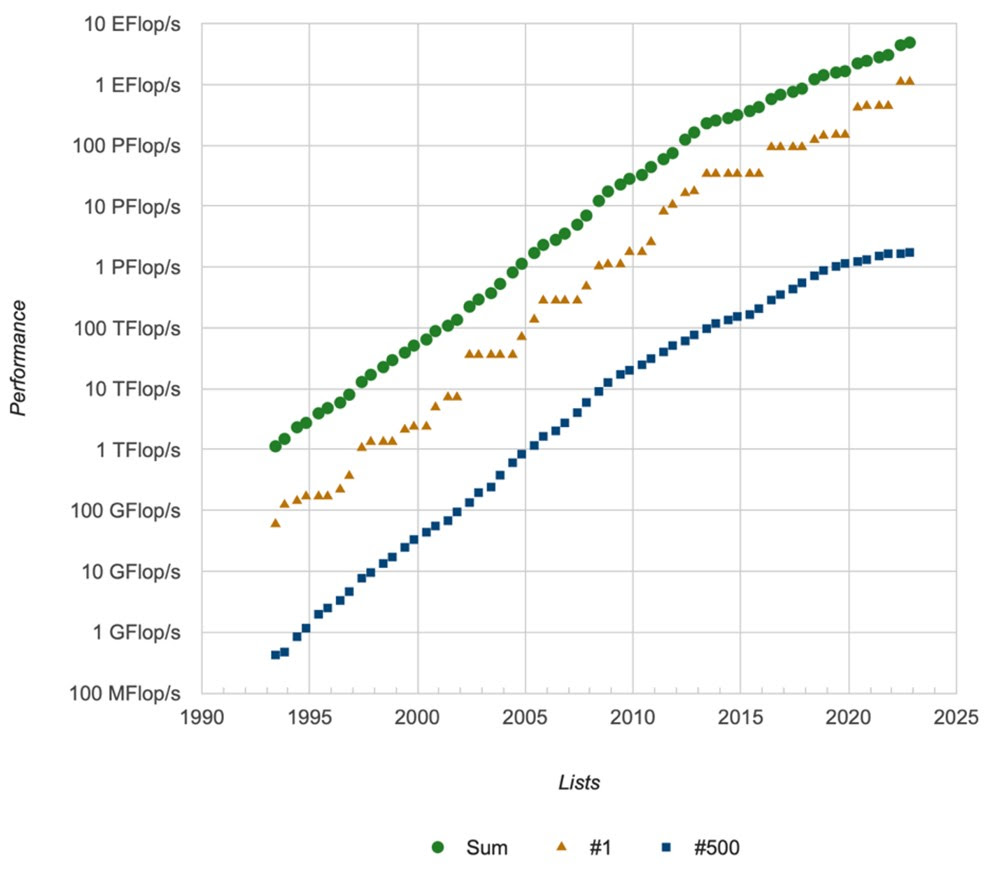
This year was a banner year in the world of supercomputing. The first major breakthrough was the commissioning of Frontier – the world’s first exaflop supercomputer. It’s capable of doing over a quintillion (1,000,000,000,000,000,000) operations per second.
Then this fall, Tesla announced its artificial intelligence (AI) supercomputer, Dojo, which also performs at more than an exaflop.
And just days ago, AI-centric semiconductor company Cerebras announced that it had commissioned its own AI exaflop supercomputer for just $30 million.
The chart above is extraordinary. It’s in log scale, with each vertical tick representing a 10-fold increase in computing power.
The next major performance level will come out next year at the Los Alamos National Laboratory, when Nvidia launches its 10 exaflop supercomputer Venado.
The exponential growth of computing power has resulted in an abundance of both computer processing and data. But the rapid growth created a problem. The International Systems of Units (SI) started running out of SI prefixes like “exa” (1018) to denote the ever-increasing magnitude of the numbers.
After “exa,” there was only “zetta” (1021) and “yotta” (1024). At the current pace, it won’t be long before we blow past those prefixes too.
That’s why, at the 27th meeting of the General Conference on Weights and Measures, Resolution 3 extended the range of SI prefixes to account for even greater numbers in the future:
ronna (1027).
quetta (1030).
Technology is moving so fast right now, it won’t be long before we’re hearing words like “ronnabytes,” or “quettaflop supercomputers.”
The transgender craze is growing and metastasizing in America and worldwide. Confusion is abounding. And while Western cultures celebrate and elevate gender chaos, the societal and cultural costs are quickly mounting. That’s why enterprising journalist Brandon Showalter of The Christian Post is offering a no-holds-barred exploration of the topic in “Generation Indoctrination,” a new documentary-style podcast series aimed at exploring the roots and impact of the transgender debate.
Through in-depth interviews and investigative chops, Showalter, an intrepid reporter at the forefront of covering the movement, helps reframe peoples’ understanding of why our cultural devolution matters and what’s truly at stake.