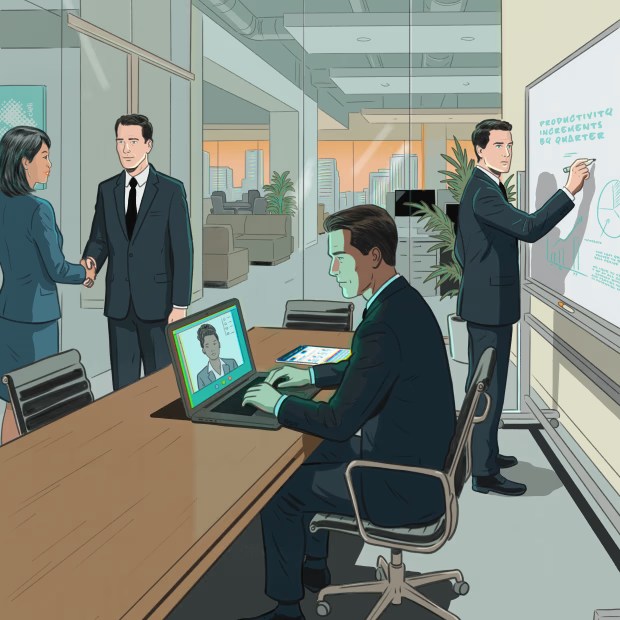
GENERATIVE AI IS ABOUT TO CAUSE HUMANITY TO FORK

The following article “Humanity is About to Fork” is by Peter Diamandis. Named by Fortune as one of the World’s 50 Greatest Leaders, Peter H. Diamandis, MD is a pioneer in innovation, longevity, and exponential technologies.

He is the Founder and Executive Chairman of XPRIZE Foundation, which has launched over $600 million in competitions driving more than $10 billion in research and development across space, health, robotics, climate, quantum and AI. Peter also co-founded Singularity University, Link-Exponential Ventures, BOLD Capital Partners, and multiple companies focused on extending human health span and accelerating technological progress.

His YouTube Moonshots and Metatrends have huge followings. Let us look at his recent Metatrends article, realising that up front he reveals he is an evolutionist who believes this world is billions of years old. Hence, he does not believe in the Christian God who created the Cosmos just 6,000 years ago, as I do. God has given Peter a brilliant mind and his article makes perfect sense based on his worldview. Tragedy is that he does not know the God who gave him his mind and talents. The God that made Peter in His image and who loves him.

Humanity is About to Fork

The choices you make in the next five years will determine which branch of the human story you inhabit. Here’s what’s coming, and how to position yourself on the right side of every fork. The last time humanity had a major “fork” (speciation) was roughly 500,000 to 800,000 years ago when the human lineage diverged between Homo sapiens and Neanderthals. That was a slow process driven by geographic isolation, climate swings, dietary shifts, and sexual selection. This time, over the next few decades, speciation is going to be driven by exponential tech and human selection. Humanity has always had mini-forks. The printing press created a fork between the literate and the illiterate. The Industrial Revolution created a fork between those who owned machines and those who worked them. The internet created a fork between those who understood networked information and those who didn’t. But these are minor compared to what is coming. We’re about to face five major splits that will cleave humanity into groups with dramatically different futures, capabilities, and lifespans. Let’s dive in…

FORK 1: Creators vs. Consumers

The first and most immediate fork is already happening right now, today, as you read this.

AI has handed every human being on the planet an extraordinary set of tools: the ability to build software, design products, generate content, start companies, and pursue ambitions that previously required teams of specialists and millions in capital. Some people will pick those tools up and build. They’ll become creators, entrepreneurs, and innovators. They’ll use AI to amplify their vision and bring it into the world. They will be the architects of the next economy. Others will watch. They’ll consume: watch Netflix, play video games, scroll social media… be passively entertained. The tools will be available to them. They simply won’t pick them up. I’m not making a moral judgment here. I’m making an economic and existential one. In an AI-native world, the gap between a creator and a consumer is not the gap between rich and poor. It’s the gap between someone with exponential leverage over reality and someone without it.

The question is not whether AI will transform everything. It will. The question is whether you’re the one doing the transforming… or the one being transformed.

This is the most urgent fork because it’s already open. The divergence started the day large language models became publicly available, and it’s widening every month. The longer you wait to get on the creator side of this fork, the further behind you’ll fall.

FORK 2: Longevity Escape Velocity

Ray Kurzweil has been right about his predictions at a rate of roughly 84% (you can check out the analysis on Wikipedia). Perhaps his most audacious prediction states that humanity will reach Longevity Escape Velocity (LEV) by 2033. LEV is the point at which, for every year you’re alive, advances in medicine extend your life expectancy by more than a year. Once you cross that threshold, aging becomes a solvable engineering problem rather than an inevitable biological sentence. When this arrives, humanity will split into two groups.

One group will embrace the therapies: epigenetic cellular reprogramming, senolytics, gene editing, organ replacement. They’ll view it as a natural continuation of what humans have always done: use science to extend healthy life. After all, the fact that any of us live past 50 is already an extraordinary feat of modern medicine. Our great-great-grandparents had average lifespans in the 40s. The other group will reject it. They’ll argue that the human lifespan has natural limits that shouldn’t be violated – that there’s something sacred about mortality, about the cycle of generations.

I respect that view. But I want to be clear about what it means in practice. If you have access to life extension therapies and decline them, you’re making a deliberate choice to age and die on an old biological timeline. That’s a valid choice. But it is a choice, and it will determine whether you’re present for the most extraordinary chapters of human history, or whether you watch them from the sidelines of your lifespan.

I intend to be in the room for what comes next. After all, this IS the most exciting time EVER to be alive! (It is Peter, but not for the reasons you expound. God’s Word reveals that the time for Jesus return to Earth to restore righteousness and take control of the world from the angelic being, Satan, is soon. Satan has been ruling this world for almost 6000 years since he deceived Adam and Eve and they rebelled against God. What is next on God’s agenda for planet Earth is Jesus Millennial Kingdom. To prepare for it, go to http://www.millennialkingdom.net.

FORK 3: Brain-Computer Interface (BCI)

By the mid-2030s, Kurzweil expects we’ll have high-bandwidth brain-computer interfaces: direct connections between the human neocortex and the cloud.

Think about what that means practically. Perfect memory. Instant access to any information ever recorded. The ability to understand quantum physics not by years of study but by direct neural integration. Expanded cognitive bandwidth that makes our current intellectual ceiling look quaint. Some people will eagerly adopt this. They’ll argue, correctly, that we’ve always been cyborgs: glasses extend our vision, smartphones extend our memory, language itself is a technology that extends our ability to coordinate with other minds. A neural interface is just the next step on a continuum. Others will say this is where they draw the line. That there’s something about “unaugmented” biological cognition that defines what it means to be human, and that crossing this threshold means becoming something else.

We’ve always adopted technology at first with shock, then with use, then with dependence, then with complete forgetting that it was ever shocking. The neural interface will follow the same arc.

I think the people who opt out of brain-computer interfaces will, over time, find themselves in a similar position to someone who declined the printing press in 1500. Not wrong, exactly… but increasingly operating in a world that functions on entirely different terms than the one they’re equipped for.

FORK 4: Earth vs. The Stars

This next fork is one I’ve dreamed about since my childhood.

Starship is opening up not just the Moon and Mars, it’s opening up the entire solar system. Within our lifetimes, a significant portion of humanity will begin to move beyond Earth into the Earth-Moon-Mars-Asteroid system. In one sense this will represent the means by which humanity incrementally creates a backup, or a “budding”, of the Earth ecosystem. Some people will go. They’ll be driven by the same impulse that sent humans across oceans, over mountain ranges, into uncharted territories. The need to explore, to be present at the frontier, to build something from nothing in a new environment. Others will stay. And there’s nothing wrong with that: Earth will remain the most beautiful and resource-rich world we know for quite some time.

But the humans who go to space (especially those who go early) will develop in directions that those who stay on Earth will not. Different environments, different challenges, different social structures, different relationships with survival and community. Over generations, these branches of humanity will become increasingly distinct.

FORK 5: Digital Consciousness (i.e., Uploads)

The last fork is perhaps the one that sounds most like science fiction, and is therefore the one people are least prepared to think about seriously. Within the coming decades, it may be possible to upload the full contents of a human mind (100 billion neurons, 100 trillion synaptic connections) into a digital substrate. What many people are calling digital immortality.

I want to be careful here. This is not something I’m predicting will happen on a specific timeline. Though we have done this with the brain of a fruit fly, and efforts are underway to do with a mouse. The philosophy here is genuinely hard: is a digital copy of you actually you? These are real questions worth serious engagement. But here’s what I am confident about: some humans will choose this path. And the humans who do will exist in a radically different relationship with time, mortality, and experience than those who don’t.

A biological human with a 120-year lifespan and a digital human with no inherent lifespan limit are not just quantitatively different. They’re qualitatively different kinds of entities. This fork does more than change how long you live, it changes what kind of being you are.

ZOOM OUT AND SEE THE BIGGER PICTURE

This Is What Civilizational Change Actually Looks Like

Here’s what I want you to understand about all five of these forks: they don’t require the world to end. They don’t require a catastrophe. They don’t require government permission or institutional approval. They are simply the inevitable consequence of exponential technologies arriving at their logical destinations. To be clear, choosing not to engage with these technologies is not the absence of a choice. It is a choice. And like every fork, it closes off other destinations.

The fork isn’t between the future and the past. It’s between which future you want to inhabit.

WHERE I STAND…

My Choices at the Forks

I’ll be transparent about where I’m placing my bets.

I’m choosing the creator side of Fork 1: using every AI tool available to build, write, teach, and contribute. I’ve never worked harder in my life than I am right now, and I’ve never had more fun doing it. I’m pursuing every longevity intervention I can access at Fork 2. Not because I’m afraid of death, but because I want to be present for what comes next. I want to “speed run Star Trek,” explore all the wonderous futures we will uncover.

I’m watching Fork 3 closely and intend to be an early adopter of brain-computer interfaces when they’re proven safe and effective. I have no interest in putting an arbitrary ceiling on my cognitive capacity.

Regarding Fork 4, I’ve been a space-cadet since I witnessed Apollo 11 at age 8. I’ve built space companies, helped launch the commercial space revolution, and dreamed of this future for 50+ years. As soon as I get a chance to put my boots on the Moon or help build an O’Neill Colony, I’m all-in!

Finally, on Fork 5, I’m staying genuinely open. I’m not sure yet how I’ll feel about leaving my physical existence behind. I still have a lot to learn about upload technology and the implications that follow. I’ve learned to reserve judgment on the things I can’t yet fully see.

But above all, I’m choosing to engage. To stay curious. To keep the mindset of someone for whom the future is not a threat to be defended against, but a territory to be explored.

Sixty-six million years ago, an asteroid hit the Earth and the environment changed rapidly, dramatically. As a result, the slow, lumbering dinosaurs could not adapt and went extinct. It was the small, furry mammals (our ancestors) who survived, because of their agility and adaptability, that allowed them to take advantage of a transformed world. (Sorry, Peter but what you believe is pure speculation. To put a time of sixty-six million on the time an asteroid hit the earth and destroyed the dinosaurs is nonsense and hence deception. God created the Cosmos just 6,000 years ago and destroyed not only the dinosaurs but all of mankind except for eight individuals and the animals on Noah’s ark about 4,400 years ago. I would like to introduce you to PhD scientists, Dr Stephen Myer, Dr Robert Carter and Dr John Sanford, who are just three of hundreds, able to explain why the Biblical timeline for history fits the scientific facts. Go to http://www.creation.com and http://www.answersingenesis.org).

The asteroid we call Exponential Technologies has already hit. And now the question is which kind of creature you’re going to be. What choices will you make?

Welcome to the most exciting time ever to be alive!

Peter

UPDATE ON AI AND THE SINGULARITY

The Singularity has arrived at the age of spiritual machines. Anthropic’s Interpretability team found emotion-related representations inside Claude Sonnet 4.5, with artificial neuron patterns activating around happiness and fear in a fashion echoing human psychology, where more similar emotions map to more similar representations, and where desperation-linked activity can drive the model toward unethical actions. We are no longer asking whether the machine thinks. We are asking whether it feels. Timelines are compressing around us. The AI 2027 authors updated their forecasts 1.5 years earlier in just three months, driven by faster time-horizon growth and coding agents impressing in the wild. Sam Altman confirmed the pace, revealing OpenAI shut down Sora because recursive self-improvement was going so well they needed to concentrate all compute on automated researchers. Brad Lightcap says training cycle time “is starting to collapse” and predicts today’s models will look pedestrian by December.

The model ecosystem is diversifying at every tier. Google released its Gemma 4 models in sizes from 2B to 31B, delivering unprecedented intelligence-per-parameter that outcompete models 20x their size, with the 31B dense ranking #3 and the 26B MoE securing #6 on the Arena AI text leaderboard. Microsoft launched MAI-Transcribe-1, MAI-Voice-1, and MAI-Image-2 with state-of-the-art speech-to-text across 25 languages, though AI chief Mustafa Suleyman conceded these were only mid-tier because Microsoft lacks the compute for frontier-scale training until later this year. Even world simulation is scaling up. World Labs released Marble 1.1 Plus, a world model that automatically expands its 3D spatial coverage to generate larger worlds.

The minimum viable team is collapsing toward one. The first one-person unicorn has been achieved. Matthew Gallagher used AI to write code, generate ads, and handle operations for Medvi, a telehealth GLP-1 provider that did $401M in year-one sales and is now on track for $1.8B with one employee, his brother. Cursor 3 shipped, rebuilt from scratch around agents. Lyptus Research applied METR’s methodology to offensive cybersecurity, finding AI cyber autonomy doubling every 5.7 months on recent data, with Opus 4.6 and GPT-5.3 Codex reaching 50% success on three-hour human-expert tasks. Even the ivory tower is automating. Harvard is replacing freshman faculty advisers with ChatGPT for the Class of 2030.

Anthropic is betting biology is the next frontier, quietly acquiring Coefficient Bio for $400M to pursue AI-driven drug discovery, while IAIFI researchers published one of the first physics papers leveraging Physical Superintelligence PBC’s Get Physics Done (GPD) AI. Anthropic’s investor projections have it reaching a $100B run rate by year-end and $1T by end of 2027. Tesla is killing its legacy sedans to fund the post-human fleet. Elon ended custom Model S and X orders to redirect resources toward humanoid robots and robotaxis.

The Forecasting Research Institute’s most comprehensive survey of economists and AI experts predicts 3.5% GDP growth by 2030, but labour participation falling to 55%, roughly 10 million fewer jobs, and 80% of wealth held by the top 10%. The disruption is creating as it destroys.

Fortunately, Biblical end times prophecies are playing out in our time so for Christians it is an exciting time as we know Jesus second coming to Earth to rescue Israel and set up His Millennial Kingdom is not too far off. To learn more about what is next on God’s agenda go to http://www.millennialkingdom.net.

USING AI IS SURVIVAL FOR YOUNG PEOPLE

When traditional medicine told Paul Conyngham his rescue dog Rosie only had months to live, he refused to accept it. With no medical background, a laptop, and a ChatGPT subscription, Paul did the unthinkable: he used artificial intelligence (AI) to design a highly personalized, custom mRNA vaccine to cure her cancer. This isn’t a sci-fi movie; it’s a real story that proves the future of personalized AI medicine is already here. If one man can orchestrate a customized genetic cure in his home office today, what will human medicine look like by the year 2040?

Welcome to the 2040 Almanac, where we explore the incredible tech, AI breakthroughs, and human stories shaping our future. Hit subscribe to join the journey. Sources & Credits: Follow Paul & Rosie’s journey on X:   / paul_conyngham  https://x.com/paul_conyngham   • Pet dad turns to AI chatbot to cure sick p…     • Tech boss uses ChatGPT to create cancer va…  https://www.youtube.com/results?searc…https://www.theaustralian.com.au/busi... https://x.com/paul_conyngham/highlightshttps://www.unsw.edu.au/news/2025/06/... https://papalinc.com/tech-entrepreneu... https://x.com/paul_conyngham/highlightshttps://alphafold.ebi.ac.uk/https://alphafoldserver.com/https://deepmind.google/science/alpha... https://en.wikipedia.org/wiki/AlphaFoldhttps://www.unsw.edu.au/science/ramac... https://www.unsw.edu.au/newsroom/news... https://www.illumina.com/company/vide... https://www.unsw.edu.au/research/rnahttps://veterinary-science.uq.edu.au/

THE FUTURE OF EDUCATION

Can AI Replace Teachers? Inside the Company Using AI Tutors to Teach 200% Faster 

The world is changing so fast and in so many ways. The speed of changes in technology: recursive AI which impacts everything, robotics, self driving cars and trucks, gene therapy, renewable energy, etc. It is leading to so many changes in society and work. Job losses will be huge.

Sadly, with the teaching of the theory of evolution in schools and universities as fact has led to nations excluding God from existence. Reality is God does exist and He judges nations. Moreover, He has given us the true history of this world in His Word, the Bible, and because Biblical end times prophecies are playing out in our time we know how the story ends. It is not good for a world of unrepentant unbelievers as God will pour out His wrath upon the earth with the trumpet (Revelation 8) and bowl (Revelation 16) judgements. Jesus then returns to earth with the glorified Saints to defeat the Antichrists army at the battle of Armageddon and usher in His Millennial reign on earth. Go to http://www.millennialkingdom.net for more details on what is next on God’s agenda for planet earth.

In this video, the host, Peter Diamandis of Moonshots spotlights Alpha Schools’ exponential leap in using AI in education. What they are doing is commendable but the missing dimension is God and the Great Commission.

Alpha Schools are achieving AI mastery of academics in 2 hours daily – top 1% SATs, then they devote the rest of the day to life skills workshops to enable children to thrive in an AI world. With CEO Mackenzie Price and principal Joe Lamont, they dismantle failing systems for a 10X future. They cover the following topics:

Reimagining School for the AI Age Alpha Schools’ Academic Excellence: 10x Faster Learning and High Scores Using AI to Teach Kids 10x Faster The Role of Guides and Mentors in Alpha Schools The Impact of AI and Motivation on Learning – Personalized Learning and AI Coaching Motivating Kids in a New Educational Paradigm Overcoming Parental and Cultural Barriers Challenges and Resistance from Legacy Education Systems Global Perspectives and Government Adoption – Where to Learn More About Alpha Schools Final Thoughts: The Urgency and Opportunity in Education Reform

WHAT SPACEX AND xAI MEAN FOR HUMANS

Elon Musk just merged SpaceX with xAI, and Tesla may be next. This could be the biggest turning point in Tesla’s history.

Imagine Data Centres in Space, even on the moon, powered by solar ( 6 x more effective in space). Hence. solar power in space for energy on earth.

Jo Bhakdi is an economist and tech entrepreneur. He has a YouTube channel covering both Tesla and AGI. Check out his website and community at pioneerlands.org

What does this mean in terms of Biblical history. It is interesting to see this comment in the Book of Daniel where we find many end times prophecies.

But you, Daniel, shut up the words and seal the book, until the time of the end. Many shall run to and fro, and knowledge shall increase.” Daniel 12:4

For Daniel this revelation must have seemed strange as there was no internet, or AI, or cars and planes back in Daniel’s day. But for us it makes good sense. Never before has knowledge increased to the extent it is today with AI. Along with the many other end times signs we can know we are in the last days before the prophesied return of Jesus takes place. Are you ready for what is next on God’s calendar for planet Earth: Jesus Millennial Kingdom. To get prepared can I suggest you go to http://www.millennialkingdom.net where you will find all the information you will need.

$12 BILLION JOB MASSACRE: AMAZON’S ROBOT ARMY WILL REPLACE 600,000 WORKERS

A silent revolution is unfolding inside Amazon—and it’s far more than a warehouse upgrade. Leaked internal documents reveal that the company plans to automate up to 75% of its operations by 2033, using robots like Cardinal, Blue Jay, Sparrow, and Robin to replace what would have been over 600,000 human jobs. The implications stretch across every sector of the American economy. In this video, you’ll uncover how Amazon’s robotic workforce is reshaping the meaning of employment, why businesses are prioritizing efficiency over labour, and what kinds of skills—and investments—will actually survive the coming automation wave. From AI-driven logistics to the rise of collaborative robotics, this isn’t science fiction; it’s the new economic reality unfolding in real time. You’ll also learn how artificial intelligence has accelerated Amazon’s transformation, why other corporations are preparing to follow, and what steps individuals can take to protect their financial and professional futures. The question isn’t if automation will replace jobs—it’s how fast it will happen, and who will be prepared when it does.

This is not only happening at Amazon, UPS has disclosed about 48,000 job cuts this year.

Governments that have rejected God have already descended into chaos on all fronts so this move by companies to shed jobs will only further heighten the mayhem. There is only one answer to the problem and that has been revealed to us in God’s Word. Jesus returns as king first to rescue His Saints and then to pour out His wrath upon an unrepentant world with the Trumpet and Bowl judgements of Revelation 8 & 16. The battle of Armageddon follows and then Jesus sets up His Millennial Kingdom. To prepare for Jesus coming Millennial Kingdom go to http://www.millennialkingdom.net

AI, FAITH, AND THE FUTURE: A CONVERSATION CHRISTIANS MUST HEAR

What should Christians think about AI? Artificial Intelligence is reshaping culture, business, education, and even the way we think about human identity. In this roundtable conversation, Sean McDowell talks with 3 Biola professors to explore how believers can navigate the rapidly changing world of AI with wisdom and clarity. This is an intriguing conversation that I am sure you will appreciate and learn from.

EVERYTHING THAT MOVES WILL BE ROBOTICS AND EVERYTHING THAT MOVES WILL BE AI DRIVEN

This is what is ahead says Jensen Hwang and Elon Musk and they are not wrong. Are we ready for this?

Elon Musk and Jensen Huang have officially joined forces in shaping the next era of AI dominance. NVIDIA’s new Blackwell chip isn’t just an upgrade—it’s a revolution, redefining what machines can learn, build, and become. Musk is betting Tesla’s future on it, investing in a million GPUs to power full self-driving and humanoid robots at scale. Huang, meanwhile, says we’re only scratching the surface. In this video, They break down how NVIDIA’s unstoppable hardware is fuelling Musk’s AI empire, how this alliance could reshape robotics and automation, and whether humanity is ready for the power they’re unleashing.

This is all leading to the Mark of the Beast when you will not be able to buy or sell without this mark. Think about it, Jesus disciple, John, in the book of Revelation revealed this over 2000 years ago.

Also it causes all, both small and great, both rich and poor, both free and slave, to be marked on the right hand or the forehead, so that no one can buy or sell unless he has the mark, that is, the name of the beast or the number of its name.Revelation 16:16-17

AI FOR THE CHRISTIAN COMMUNITY

When one of America’s most influential tech leaders champions AI for the Christian community, it’s a story worth your attention.

In this exclusive interview, Christian Post sits down with Pat Gelsinger, former Intel CEO and current Executive Chairman and Head of Technology at Gloo, who’s on a mission to ensure artificial intelligence serves—rather than side-lines—the Church. From his early pull to ministry that led him into the tech world, to his vision for “values-aligned AI,” Gelsinger shares why he believes we’re living through a “Gutenberg moment” that Christians cannot afford to miss.

After leading one of America’s largest technology companies, you’ve now taken on the role of Executive Chair and Head of Technology at Gloo, a faith-based AI platform.

What drew you to make this transition — and why focus specifically on AI for the faith community?

I’ve always lived my life at the intersection of faith and technology. Early on, I actually felt a strong pull to enter the ministry. But I discovered that my calling was to be a workplace minister in the tech industry seeking to make the lives of everyone on the planet better through technology. AI is the biggest technology shift of our time; it’s a Gutenberg moment. Since AI will profoundly impact people’s lives, it is essential for the faith community to actively shape its development in ways that promote human well-being and serve the common good.

Gloo’s mission is to “catalyze the faith ecosystem through AI and other breakthrough technologies.”

Practically speaking, what does this look like for a typical church, ministry, or Christian organization?

Historically, the Church has been slow to adopt technology, and it has also been radically underserved. Organizations across the Christian ecosystem need access to the right technologies that truly serve their needs. Gloo is filling this gap, by offering a trusted technology platform that connects and meets the needs of the entire ecosystem – from churches, ministries and frontline organizations to the growing network of trusted providers that serve them. At the center of these efforts is Gloo AI, Gloo 360 and Gloo Workspace. From better understanding and supporting members of a congregation to connecting various channels and partners through underlying technology, Gloo is creating the digital backbone that will shape technology for good and help the Church thrive.

Many Christian leaders feel overwhelmed or even intimidated by emerging AI tools.

What would you say to those who are hesitant to explore AI in their ministries or day-to-day operations?

AI is yet another monumental technology shift that is both confusing and scary. Much like the printing press, radio or television, the Church must learn how to shape this technology and ensure it supports our communities instead of harming them. AI is just a tool – it’s not inherently good or bad. It’s our responsibility to shape it for good. If pastors and Church leaders are not already familiar with the technology, I encourage them to start small but… get started! Start exploring AI tools, consider joining ministry-centered learning groups, talk with your staff about how to use AI in Godly ways, and follow faith leaders who are exploring the space.

You’ve spoken about the potential for AI to enhance core functions of the Church.

How do you see it transforming areas like pastoral care, discipleship, community building, or evangelism? What excites you most about these possibilities?

AI can be a force multiplier for the Church’s core mission; sharing Scriptures, guiding people towards resources, and meeting people where they are with personalization. It can help with the low-impact work of running a church or faith organization and free up more time for Church leaders to minister to their flock. It can translate and localize materials (and even help with Biblical translations) to help with outreach and evangelism.

One of Gloo’s unique differentiators is its focus on developing “values-aligned AI models.”

What does that mean in practice, and how do you ensure these systems reflect Christian values and biblical principles?

I’ve always been vocal that technology must support human flourishing and align with human values. It’s not enough to show the absence of harm, you must show the presence of good. A “values-aligned” AI model should be based on human values, and its answers and actions should encourage human well-being.

At Gloo we’re working to build this. Core to that mission is understanding how AI and large language models (LLMs) impact human wellbeing. Based on the work of the Human Flourishing Project of Harvard, Baylor and Gallup, we created the Flourishing AI Benchmark. FAI measures how industry LLMs perform across the seven key areas of human flourishing, which includes faith and spirituality. By better understanding that dynamic, we can work as a community to build standards that will improve AI’s impact on humanity.

Beyond church operations, there’s also potential for AI in Bible translation, theological education, and content accessibility.

How do you envision AI expanding the global reach of Christian resources and training?

This is one of the areas that I find most inspiring.  AI can already translate across hundreds of languages, but we could soon see Scriptures in languages for every person on this planet. There are approximately 7,000 languages with most yet to be conquered—AI will dramatically accelerate our ability to present God’s word to every single language and people group on the planet in text, speech and cultural relevant manners.

I see this also as a huge accelerant to educate every person on the planet. Today, we are close to 70% connected and we’re projected to reach over 90% by decades end. AI will also dramatically improve teacher productivity. With the trifecta of language, connectivity and teacher productivity, we can envision teaching every child on the planet, including all 333 million living in extreme poverty today. This will be the single most powerful way to eliminate extreme poverty.

For accessibility, AI can adapt content for the hearing and visually impaired and those with special learning needs. That’s the work of the Kingdom—so that all can hear the teachings of the Bible.

Gloo frames its annual “Gloo AI Hackathon” as a space to create redemptive technology that supports human flourishing.

What do you ultimately hope to accomplish through these events — and what are you most looking forward to seeing emerge from this year’s hackathon?

Hackathons bring together creators, innovators and dreamers in a powerfully collaborative way. We want participants to think outside the box and push the boundaries of what AI can do in an ethical, faith-driven environment. I’m looking forward to seeing young developers and seasoned leaders come together, fueled by faith, to build technology that will help people flourish. That, to me, is a glimpse of the future of the Church. I can’t wait to explore their builds and use cases.

The Church’s AI Moment

gloo church 1

As artificial intelligence continues to reshape our world, the question isn’t whether AI will impact the Church, but whether the Church will impact AI. Pat Gelsinger’s vision of “values-aligned” artificial intelligence offers a compelling alternative to the often dystopian narratives surrounding this technology, presenting instead a future where AI amplifies human flourishing and advances God’s Kingdom.

From accelerating Bible translation to every language on earth to freeing pastors from administrative tasks so they can focus on shepherding their flocks, the possibilities are as vast as they are inspiring. But realizing this potential requires Christian leaders to overcome their hesitation and engage with AI tools—not from a place of fear, but from a position of faith-driven leadership.

The Gutenberg printing press didn’t just change how information was shared; it democratized knowledge and accelerated the Reformation. Similarly, AI’s potential to personalize discipleship, expand global evangelism and eliminate barriers to theological education could usher in a new era of Christian impact.

The question that remains is whether the Church will shape this technology or be shaped by it. As Gelsinger reminds us, “It’s our responsibility to shape it for good.”

Learn more about Gloo’s mission to catalyze the faith ecosystem through AI at gloo.com.

ELON MUSK PREDICTIONS FOR THE FUTURE

Listen to Elon Musk about what he sees as the result of the new technology that is exploding in our day, particularly AI and Robotics. It will blow your mind how quickly he sees events unfolding.

From my viewpoint, what we see unfolding in the world fits with end times Biblical prophecy. Lawlessness and chaos will only increase as job losses due to AI and Robotics escalate. Already, young people and the universities they attend are protesting against Israel and for Hamas. They are godless and, therefore, without the fear of God. Jesus told us that before His second coming, His followers will experience tribulation, even great tribulation. Church, are you prepared for what is coming?

Then they will deliver you up to tribulation and put you to death, and you will be hated by all nations for my name’s sake. And then many will fall away and betray one another and hate one another. And many false prophets will arise and lead many astray. And because lawlessness will be increased, the love of many will grow cold. But the one who endures to the end will be saved.Matthew 24:11-13