We are living in a time of moral, spiritual, and civilization polarization, where Western civilization is decoupling itself from the faith and the worldview to which it has been joined for nearly two thousand years. Its mainstream culture is purging itself of Judeo-Christian values, beliefs, laws, practices, worship, ways, and culture just as God prophesied would happen in His Word, the Bible before Jesus’ second coming to Earth.
Children that should be in school marching in Sydney, Australia: “Stop Israel’s Genocide Now”?Hamas had invaded Israel and killed innocent people including babies, women, children, and the elderly.
We see it, in its deification of the material world, its desanctification of life, its religious syncretism, its moral relativism, its sexualization of popular culture, its abuse of life, its worship of images, and its overturning of biblical standards, values, and precepts.
So, it was in the days of the man known in the Bible as Josiah. Josiah was born into a kingdom, Israel, that had known God but had fallen from His ways. It had come into existence for the purposes of God but had detached itself from those purposes. It became a civilization turned in upon itself and against the foundation of which it stood, an inverted kingdom, a civilization in a state of spiritual schizophrenia. It still invoked His name but lived in opposition to His ways. Such is the culture in which we now live. American civilization was founded on the reality of God and established for its purposes (In God We Trust on its bank notes). But, as with ancient Israel, it has fallen and now exists in a state of spiritual schizophrenia—as does its parent, Western civilization.
Josiah was not afraid or intimidated by the evil that had taken possession of his culture because he knew that the power of God was far greater. Spiritual darkness did not discourage Josiah from acting, rather it inspired him. He could never have accomplished what he did, had he sought the approval of man or feared the wrath of the majority. He broke customs, conventions, and the status quo. He did what others had thought to do, had felt to do, and believed to do, but of fear, did not do.
The people of God must now make the most of every moment and circumstance to impact their world—in their homes, their workplaces, their schools, in their positions of power and influence, their skills and abilities, their experiences and resources, their coming and going, all times and places. They must use all means and resources at their disposal to fulfill the purposes of God. And they must always remember that their most powerful of means are not of this world but spiritual—that of prayer, the Word, the presence and power of the Holy Spirit. In times of repression or persecution, there may be no other power. If then, their only means are spiritual, it will be enough. For no instrument of man, no force of government, no power on earth is strong enough to stop the means given by the Spirit of God.
Post adapted from a section of Jonathan Cahn’s book The Josiah Manifesto.
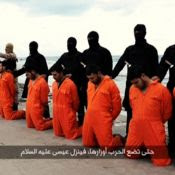
Let’s look at how Christians are reacting in real-time to Great Tribulation-like persecution. The primary responses we see in Arab Spring countries, some of which Jesus endorsed, include:
1. Running from the persecutors.
2. Remaining on-site and taking up arms.
3. Remaining on-site and insisting on legal protection.
4. Yielding to persecutors while actively ministering to them
Option 1: This has occurred in several Middle Eastern countries over the past decade and threatens the extinction of Christianity in that region of the world. Even prominent government leaders are beginning to acknowledge this fact. Option 2: Sadly, this option has gained a little headway, due to calls like Greek Orthodox Bishop Lukas al-Khoury in Syria to have Christians take up arms “to protect Syria, churches, and convents.” Some believers undoubtedly have, but the loudest voices have decried this exhortation, saying that it violates the spirit of Christianity. Syrian Catholic Archbishop Jacques Behnan Hindo responded to the call to arms in this way: “As men of the Church, we cannot incite Christians to take up arms and to take part in the conflict. We cannot say these things; it is insane. It goes against the gospel and Christian doctrine.” I have not come across any reports that indicate Syrian Christians are standing and being resistant militarily to Islamist attacks.
Jesus certainly didn’t condone option 2 as He spoke in Matthew 24. He recommended option 1, in this specific circumstance: “Then let those who are in Judea flee to the mountains. Let no one on the housetop go down to take anything out of the house. Let no one in the field go back to get their cloak. How dreadful it will be in those days for pregnant women and nursing mothers! Pray that your flight will not take place in winter or on the Sabbath.” Matthew 24:16-20
But in other passages involving persecution, He argued for option 4. Christ never encourages a running towards martyrdom. Paul, too, never seemed to advocate seeking to be killed for Christ’s sake. Rather, he fled several times when he knew that his life was threatened, twice within the space of a few verses in Acts 9 (Acts 9:25, 30; 14:6, 17:10)! We know of Paul purposefully leaving at least four towns because of threats to his life. If you count other places where he left soon after starting an uproar, that number could climb to nearly ten. Don’t let anyone tell you that Paul never ran. He did! Self-preservation, the most basic human instinct, seems to be compatible with sold-out Christian living. I think we can make a very strong biblical case for running in the midst of persecution. In a similar way, I do not see convincing biblical evidence for having a death wish and actively seeking martyrdom, something Muslims do to “guarantee” a place in paradise. God does not call us to be cowardly, but Christ Himself advocated flight, and Paul lived out that commandment many times in his ministry. Remember these truths when the heat turns up and someone near you is insisting that God wants everyone to stand and fight, be outgunned, and go down in a blaze of glory. Once you are gone from this earth, you are gone, and you won’t be able to win anyone else to Christ. You also might leave your family heartbroken and in great need. We need to be careful that we don’t adopt a martyr complex, as Muslims have heartily done around the world.
Reverend Khalil Fawzi, the pastor of the largest evangelical congregation in the Middle East, Kasr El Dobara Evangelical Church, said recently that Muslim Brotherhood supporters in Egypt want to begin a civil war and would be helped in their quest by Christians turning violent. “They hoped the Christians will retaliate by killing and a civil war would start. I praise Christians for their patriotic attitude.”
Turkey’s defense of its mass killing of Armenians in the early twentieth century is a prime example. So if we do stand and fight, Muslims will have an easy out for killing men, women, and children who would otherwise be innocent bystanders.
Options 3 & 4: We can learn much from our brothers and sisters in the Middle East who have selected options 3 and 4. Here are the primary lessons I see from where Christians are being persecuted by Muslims: 1. They understand once and for all that the church is not a building. Two days after the famed Archangel Michael Church was destroyed in Cairo, Coptic Orthodox Pope Tawadros II reminded his flock of what Jesus preached: “If the hands of evil kill, destroy and torch, then God’s hands are greater and they build. Christ’s commandments to us are to love your enemy, bless those who curse you, and do good to those who abuse you.” The reaction to this charge, and other similar exhortations, has been Christians calmly meeting for worship in the areas of their churches that have not been completely burned to the ground, as seen in the 60 Minutes segment on Coptic Christians. The moving sight of Christians sitting in a room with one wall missing and the smell of burned wood still lingering, worshipping Jesus in a simple service, speaks volumes about understanding that the church is not a building. I think many Americans have come to realize this truth, as small groups have gained popularity over the past twenty years or so. That is a good realization to hold onto because we could very well come to a time when we are not allowed to meet in buildings.
Ralph Stice, author of Arab Spring, Christian Winter recounts this story: “I was struck by this possibility as I toured a literal underground church in Turkey’s Cappadocia region, mentioned in Acts 2:9 and 1 Peter 1:1. Our Muslim tour guide took us down a hole through which the four members of my family could barely squeeze. We walked among intricate hallways carved from stone and were told where meals were prepared and where people slept. It was an incredible experience to imagine living under the earth with brothers“.
In these last days as persecution intensifies we need to heed the warnings of Jesus in Matthew 24 and 25. Be watchful. Be ready. Be found faithful. Be on His mission, to spread the Good News.
Remember, Biblical prophecy tells us that Jesus is coming back and we are already seeing many of the prophecies playing out in our time. You can use these prophecies in your evangelism efforts to show unbelievers that God’s Word is true. We know the end of the story and for believers it is wonderful but for unbelievers, they will undergo the terrible wrath of God; the Trumpet Judgements outlined in Revelation 8 and the Bowl Judgements outlined in Revelation 16.
The following article is by Michael J. Vlach, Professor of Theology, at The Master’s Seminary. The Master’s Seminary opened its doors in 1986 to provide post-graduate theological training on the campus of Grace Community Church. He specializes in the areas of Systematic Theology, Historical Theology, Apologetics, and World Religions.
It is concerning that some churches today don’t take eschatology seriously. The very fact that God has revealed so many details about events to come in both testaments tells us that it is important. At the center of biblical eschatology is the blessed hope of the appearing of our great God and Savior, Jesus Christ (Titus 2:13). Not only should we be interested in prophetic events to come but, we are also looking for our Savior, with whom we will spend eternity.
Why do some churches neglect serious study of eschatology? One issue is complexity. There are many eschatological details in the Bible to work through and harmonize. So there is hard work to do in this area. Also, when we see godly men disagreeing on prophetic issues, it can be disheartening. Another reason might be that some don’t want to be linked with those who have abused eschatology. There are those who have become obsessed with the end times by offering a date for Jesus’ return, or treating many current events as fulfillments of biblical prophecy. Thus, some have swung from the abuse of eschatology to no interest whatsoever.
But these are not good reasons to avoid the study of eschatology. Here are 7 reasons churches should take eschatology seriously:
1. Eschatology is a major part of the Christian storyline
Eschatology is a major part of the Bible’s story. By “story,” I’m not talking about fiction. I’m talking about the narrative of the Christian worldview. Since Christianity is rooted in history and real historical events, God’s story includes past, present, and future events. All should be taught. We simply should not ignore prophetic events that are future from our standpoint—events such as the Rapture, the Day of the Lord, the Second Coming, the Millennium, and the Eternal State. We must also talk about heaven and hell, and the coming New Earth. To avoid discussion of eschatology is to avoid an important part of the Christian worldview.
2. We are called to preach and heed the whole counsel of God
There are large sections of Scripture devoted to prophesy, many of which still need to be fulfilled from our current standpoint. For example, the events of Ezekiel 36–48 still need to occur. In the New Testament, passages like Matthew 24-25, Mark 13, much of Luke 21, 1 Thess. 4-5, 2 Thess 1-2, 2 Peter 3, and Revelation 6-22 describe events that still need to happen. We cannot ignore these passages. Paul says in Acts 20:27, “I did not shrink from declaring to you the whole purpose of God.”
If your church does not teach what the Bible says about the future, the whole counsel of God is not being taught.
3. People are interested in the future
Christians are interested in what the future holds. But if we do not teach eschatology, we are denying important biblical information for those who want to know what the Bible has to say about the future. We are also withholding a major source of the hope that the Scripture wants us to have.
4. Eschatology is a motivation for believers
Eschatology changes our lives because what we do now impacts our future. Paul viewed everything he did in light of his standing before Jesus someday. In 2 Timothy 4:7-8 Paul wrote, “I have fought the good fight, I have finished the course, I have kept the faith; in the future, there is laid up for me the crown of righteousness, which the Lord, the righteous Judge, will award to me on that day; and not only to me but also to all who have loved His appearing.”
5. Eschatology has a purifying effect on the believer
Eschatology is meant to transform our lives in the present. Why should we live sensibly, righteously and godly? Because Jesus is coming again. 1 John 3:2-3 states, “Beloved, now we are children of God, and it has not appeared as yet what we will be. We know that when He appears, we will be like Him, because we will see Him just as He is. And everyone who has this hope fixed on Him purifies himself, just as He is pure.”
James 5:8-9 also says, “You too be patient; strengthen your hearts, for the coming of the Lord, is near. Do not complain, brethren, against one another, so that you yourselves may not be judged; behold, the Judge is standing right at the door.”
The study of biblical eschatology is a motivation for godly living
6. Eschatology gives perspective to the troubles and trials of this age
We live in a fallen and tragedy-soaked world. We are all physically decaying and dying. Evil seems to triumph. Without Jesus, there is no hope, only despair. But for the Christian, there is the hope of resurrection and the restoration of all things (1 Cor. 15:20-28; Acts 3:21). Romans 8:18 states, “For I consider that the sufferings of this present time are not worthy to be compared with the glory that is to be revealed to us.”
The sufferings of this present time are real, but they are not comparable to the glory that is to come.
2 Peter 3:13 says, “But according to His promise we are looking for new heavens and a new earth, in which righteousness dwells.”
The coming of Jesus and the restoration of all things are future realities that give Christians hope and the joyful realization that the turmoils and trials of this age will not last forever. Righteousness and goodness win in the end. Christians need that message.
7. Eschatology warns the unbeliever of coming judgment
Biblical eschatology does not teach that the story ends well for everyone. It exists as a frightening warning to those who have not believed in Jesus. Eschatology warns all people that there is eternal punishment and banishment from God’s kingdom and the presence of God for those who do not repent. We should do what John the Baptist did—warn people to flee the wrath that is to come (Luke 3:7-8). Just as there is both judgment and resurrection for the righteous, there is also resurrection and judgment for the unbeliever.
In sum, biblical eschatology is an important part of Christianity. For these reasons, all true churches should embrace the importance of biblical eschatology and share its truths with Christians and unbelievers alike.
8. I would add to Michael’s reasons, an eighth,Apocalyptic Evangelism.
There are more prophecies about Jesus second coming than there were of His first coming and yet there were many of those. Christians who understand the prophetic events that are to unfold prior to Jesus return, first to rapture the church, and then after God’s wrath has been poured out on the earth with the Scroll, Trumpet and Bowl judgements, He will return to this earth and rescue Israel. He has unfinished business with His nation. All the O.T. prophets prophesied their Messiah would rule the nations from Jerusalem. Jesus will rule and reign with the resurrected saints on this earth for 1000 years. Obviously, we are in a unique position to use this knowledge in evangelism. To explain to unbelievers what is unfolding in our day and to warn the church of the coming tribulation, even great tribulation. “Then they will deliver you up to tribulation and put you to death, and you will be hated by all nations for my name’s sake. And then many will fall away and betray one another and hate one another. And many false prophets will arise and lead many astray. And because lawlessness will be increased, the love of many will grow cold. But the one who endures to the end will be saved.” Matthew 24:8-13. Jesus spoke these words and Mark recorded them as follows ” For in those days there will be such tribulation as has not been from the beginning of the creation that God created until now, and never will be. And if the Lord had not cut short the days, no human being would be saved. But for the sake of the elect, whom he chose, he shortened the days.Mark 13:19-20



 LIVING ETERNAL NOW