Recent developments in creationist cosmology offer an elegant explanation of the distant starlight question which is consistent with the Genesis account of creation and is based on recent astronomical observations and Einstein’s General Relativity equations. Whilst a detailed explanation of this new cosmology is beyond the scope of this Feedback article, it is explained more fully in Harnett’s article “Has dark matter really been proven?” http://www.creation.com
This article provides a framework for understanding the answer to the distant starlight question. The key elements are time dilation, the recent observations showing that we live in a galactocentric universe, and the Scriptural references to God ‘stretching out the heavens’ on Day 4 of the Creation Week.
An experimentally verified prediction of Einstein’s General Relativity Theory is a phenomenon called gravitational time dilation. It has long been established that gravity affects the rate at which time flows in any particular location in the universe.
Another mechanism for time dilation is a rapid acceleration of the fabric of space in an expanding universe. This is explained more fully in Hartnett’s article referenced above.
We live in a galactocentric universe: Standard Big Bang theory has it that the universe has neither a centre nor an edge which is an assumption, called the Cosmological Principle, designed to avoid the earth being a special place. If the Earth was special in any way, it would imply design and thus a Designer which flies in the face of atheistic evolutionary belief. When Edwin Hubble discovered the redshift in the spectra of stars and galaxies and interpreted them as distance (known as the Hubble Law), he was horrified at the implication that the Earth could be in a special place. He wrote: ‘Such a condition [red shifts] would imply that we occupy a unique position in the universe … But the unwelcome supposition of a favoured location must be avoided at all costs … [and] is intolerable … moreover, it represents a discrepancy with the theory because the theory postulates homogeneity.’1
Recent surveys3,4 have measured the galactic redshift for around 250,000 galaxies and have revealed an over abundance of galaxies at certain redshifts in which the data departs from the expected theoretical distribution in a series of large spikes. A straightforward interpretation of this data is that the galaxies are distributed with a spherical shell-like symmetry with the Milky Way galaxy at or near the centre! Such a result is entirely consistent with the biblical picture but is at odds with standard big bang beliefs and is not consistent with the Cosmological Principle.
In at least 11 places, the Scriptures speak of God ‘stretching out the heavens’ (e.g. Job 9:8, Isaiah 40:22 and 42:5, Jeremiah 10:12, Zechariah 12:1) and in Genesis 1:15 the words ‘And it was so.’ are recorded in connection with the events of Day 4 of Creation Week, implying the completion of the events described on that Day. It is a reasonable conclusion to draw that God stretched out the heavens to the vast extent of the observable universe in just one 24 hour day and then ceased the action of ‘stretching out’. This is more rational than the inflation fudge of big bangers discussed above. That is, where the universe just happened to expand much faster than light, although there is no known physical cause for starting or stopping this superluminal expansion.
We should also note that God created the Earth first before the sun, moon and stars (and by inference the planets etc) so it would seem reasonable to assume the universe was stretched out with the Earth at or very near its centre. Furthermore, Psalm 147:4 and Isaiah 40:26 imply that there is a finite number of stars in the universe. So, the Bible seems to teach that we live in a finite universe that has, at the very least, our Milky Way galaxy at its centre.
We now have the keys to understanding how starlight can reach us from such vast distances in just a few thousand years of Earth time. The days of the Creation Week were recorded from the point of view of an observer on the earth so the time reference in Genesis is Earth time. On Day 4, as God commenced stretching out the heavens, the mass of the universe (presumably including the ‘waters above’ which were separated out on Day 2) would have been confined to a much smaller volume of space than is the case today. Assuming the Hartnett–Carmeli theory is correct, the Universe rapidly expanded with massive time dilation as a result of very rapid acceleration of the fabric of space on Day 4. By the end of Day 4, when God completed his work of creating the sun, moon and stars, and had stretched out the heavens to their vast extent, billions of years of cosmic time could have elapsed at the outer edges of the cosmos in just one 24 hour earth day. There would have been more than enough time for the light from distant stars to have reached the earth so that when Adam gazed at the night sky on that sixth night he would have seen much the same as what we see today.
6,000 years have passed since the Creation Week. If the models outlined above are correct, the light we see today from any star that is greater than 6,000 light years away from the earth will have originated on Day 4 itself. This would include most of the visible stars, all of which are part of the Milky Way galaxy. We are effectively looking at God’s creative activity on Day 4 as we gaze into the universe!
So what do we make of supernova 1987A? At 170,000 light years away we are looking at an event that occurred on Day 4 but whose light did not reach us until 1987.
Is an exploding star consistent with a perfect creation? God said that the stars were created to be for signs and seasons (Genesis 1:14) and God foreknew all that would happen right from the very beginning. What to us seems to be destruction is actually just a physical process which does not necessarily denote any lack of perfection in the original creation. Importantly, there is no loss of biblical life involved (the creatures affected by death brought about by the Fall were those the Bible calls נֶפֶשׁ חַיָּה (nephesh chayyāh)).6
Another excellent resource on the light travel dilemma is previewed in the video below.
The American Bible Society will be closing down its Faith and Liberty Discovery Center, around three years after the Philadelphia, Pennsylvania-based museum, which cost around $60 million, had opened.
The museum held its grand opening ceremony in July of 2021, coinciding with the city’s annual Wawa Welcome America Festival, with the ABS proclaiming that “guests can explore 25,000 square feet of interactive gallery space featuring groundbreaking technology.”
The press release cited “structural limitations,” the impact of the COVID-19 lockdowns, and “other factors impacting sustainability” as the reasons for closing.
The center struggled from the onset, receiving only around $54,000 in ticket sales for the tax year of July 1, 2021, to June 30, 2022, while reporting total expenses of around $11 million, according to a statement of revenue.
The new Bible Society CEO Jennifer Holloran said, “The Faith and Liberty Discovery Center has served as a place of exceptional learning and inspiration since its doors opened.” and “We look forward to reimagining what the future of content could look like through a publicly accessible, digitized format,” she added. I suppose she had to say something positive.
The Faith and Liberty Discovery Centre Executive Director Rob Wonderling was quoted in the press release as saying that it had been “an honor to serve the Faith and Liberty Discovery Center and witness the many ways it has spurred inspiration, engagement, and personal discovery over the years at the heart of Independence Mall.” “The center was an innovative vision for sharing the importance of Scripture and I’m proud of the role our dedicated staff played in its mission,” Wonderling continued.
Opened in May 2021, the center was located on Philadelphia’s Independence Mall and sought to educate people of all religious views about the impact of Christianity on American history. The fact it has closed just 3 years after opening is a sad indictment on the Bible Society and no doubt the reason it now has a new CEO.
It is also clear from the lack of interest in the Faith and Liberty Discovery Centre that the USA no longer honours God’s Word. “IN GOD WE TRUST” is on the USA currency but the nation no longer believes God is in control of world events, and Gen Z does not believe that He even exists.
Modern, mainstream Christianity teaches that our bodies die, but we live on as souls. So why does the Bible teach something else entirely? Knowing what your soul is—and what happens to it after you die—is a core concept of Christianity. Join Gary Black as he explains both the biblical teaching of the soul and how that teaching became corrupted over the centuries.
“Then when death comes to a man, the mortal part, it seems dies, but the immortal part goes away unharmed and undestroyed withdrawing from death.” Plato, Phaedo 106e
Understanding the soul is not immortal is critical to understanding that eternal conscious torment is not the fate of the unrepentant.
“Then Death and Hades were thrown into the lake of fire. This is the second death, the lake of fire. And if anyone’s name was not found written in the Book of Life, he was thrown into the lake of fire.” Revelation 20:14-15
“But as for the cowardly, the faithless, the detestable, as for murderers, the sexually immoral, sorcerers, idolaters, and all liars, their portion will be in the lake that burns with fire and sulfur, which is the second death.”Revelation 21:8-9
“And do not fear those who kill the body but cannot kill the soul. Rather fear him who can destroy both soul and body in hell.” Matthew 10:28
Fifty years ago last week, Aleksandr Solzhenitsyn’s The Gulag Archipelago was released in Paris. Far more than simply an account of the Soviet prison camps, Solzhenitsyn’s work still stands both as an extraordinary testimony about the past and as a stark warning for the present.
Like all of Solzhenitsyn’s prodigious output, the questions at its heart echo those Leo Tolstoy posed in War and Peace: “What does it all mean? Why did it happen? What made these people kill their own kind?”
And, it is precisely because Solzhenitsyn focused on those questions that The Gulag Archipelago is not merely a searing indictment of Soviet communism but a work of moral analysis.
The Bolsheviks’ murderous mindset did not emerge from thin air. Rather, it was the outcome of the philosophy that gained absolute sway over the “progressive” Russian intelligentsia of the 19th century. Epitomised by Nikolay Chernyshevsky’s What Is To Be Done? (1863), which Lenin considered a masterpiece, that philosophy rejected God, the notions of free will, human nature and personal responsibility, instead asserting that people’s behaviour depended entirely on their circumstances.
Chernyshevsky’s reasoning, which became an integral part of Soviet Marxism’s dogma, left no room for any transcendental morality. The contention that some actions could be absolutely right or wrong was, said Lenin, “moralising vomit”; all that mattered was their results. And since “there can be no middle course” between communism and reaction, “nothing, however vile, should be condemned that (advances) the working people’s struggle against the exploiters”.
Seen within that prism of Manichean logic, incarcerating and even executing those who might undermine “the struggle against the exploiters” was more than justifiable: it was, regardless of their actual conduct, an obligation. So when Dmitri Kursky was formulating the new Soviet legal code, Lenin cautioned him that“the law should not abolish terror; it should be legalised, without evasion or embellishment”.
The code therefore treated potential crime as crime, extending culpability to “(1) the guilty, (2) persons under suspicion and (3) persons potentially under suspicion”, with NKVD chief Nikolai Yezhov’s infamous Order No.00486 specifying that the wives of “traitors of the motherland” were to be sentenced to forced labour, and even their children, who might wish to take revenge, were to be imprisoned.
The goal of mercilessly “hanging bloodsuckers” was, wrote Lenin, to ensure “that for hundreds of miles around the people can see, tremble and cry: they are and will go on killing”. But that, explained Lenin’s close associate, Nikolai Bukharin, was not terror’s only objective: “Proletarian compulsion, beginning with shootings and ending with labour conscription, is a method of producing a communist humankind out of the detritus of the capitalist era”: millions of inmates were to be “moulded into a new type of human being”.
There was, however, a fundamental problem with this attempt to play God: even under the most horrifying conditions, its victims might resist its delusions of omnipotence. At some point, Solzhenitsyn observes, every prisoner faced a choice: should one “survive at any price”, that is, “at the price of someone else”?
“There lies the great fork of camp life. The roads go right and left: to the right – you lose your life; to the left – your conscience.”
Reality thereby put Marxism’s claim that it could secure the “total surrender of our souls” to the ultimate test – and more often than one might have imagined, when utterly powerless convicts had “to declare the great Yes or the great No”, the claim failed.
Never did it fail more frequently than with people of faith, who were largely the humble of this earth. Like the self-effacing Alyosha, the gentle Baptist in Solzhenitsyn’s A Day in the Life of Ivan Denisovich, they were the ones with the moral courage to choose the path of truth over that of living a lie.
And while the regime’s pre-eminent intellectuals “all too often turned out to be cowards, quick to surrender, and, thanks to their education, disgustingly ingenious in justifying their dirty tricks”, ordinary “zeks” (as the convicts were known) led mass rebellions, which Solzhenitsyn scrupulously documented, for the first time, in The Gulag Archipelago’s magnificent third volume.
But there is, Solzhenitsyn well knew, “this terrible strength of man, his desire and ability to forget”; and he also knew that “a people which no longer remembers has lost its history and its soul”. He therefore dedicated The Gulag Archipelago, as record, tribute and threnody (dirge or funeral song), to “those who did not live to tell it: and may they please forgive me for not having remembered it all”.
That is why Solzhenitsyn would have been appalled by the Putin regime’s whitewashing of Soviet history, which culminated late last year in the unveiling of a monument to Felix Dzerjinski, the founder of Lenin’s secret police and of the Gulag, that Solzhenitsyn branded a mass murderer.
The duty of bearing witness also impelled Solzhenitsyn’s stark warnings to the West. To say he despised the West is nonsense. It was because he valued it so highly that he feared for its condition.
The fact that so many of its “leading thinkers (are) against capitalism”; that “under the influence of public opinion, the Western powers (have) yielded position after position”, hoping “that their agreeable state of general tranquillity might continue”; the supineness to “brutally dictatorial” China; the intelligentsia’s “fierce defence of terrorists”, “greater concern for terrorists’ rights than for victims’ justice” and habit of calling terrorists “militants” (in response to Hamas brutal attack on Israeli civilians, we get children marching for the Palestinian cause) – all these are symptoms of calamitous moral decay.
That “fashionable ideas are fastidiously separated from those that are not fashionable, and without ever being forbidden, have little chance of being heard in colleges”, only made the rot deeper and more pervasive.
Little wonder that Solzhenitsyn, having expressed those views, was savaged for ignoring America’s “vibrantly pluralistic society”, with The New York Times ridiculing his reminder that moral relativism leads to moral oblivion as the ravings of a “religious enthusiast”. And little wonder today’s Australian students are far less likely to have read Solzhenitsyn than to have pored over the idiotic scribblings of Leninism’s contemporary epigones.
Yes, Solzhenitsyn had his failings. But five decades after The Gulag Archipelago’s publication, the verdict of that other brilliant Russian Nobel laureate, Iosif Brodsky, who disagreed with Solzhenitsyn on many things, fully retains its validity.
“It is possible that two thousand years from now reading The Gulag will provide the same insight as reading the Iliad does today,” Brodsky wrote. “But if we do not read The Gulag today, there may, much sooner than two thousand years hence, be no one left to read either.”
Article by Henry Ergas AO in The Weekend Australian 05/01/2024 Fifty years on, a warning the West still needs to heed. Ergas is an economist who spent many years at the OECD in Paris before returning to Australia. He has taught at several universities, including Harvard’s Kennedy School of Government.
I would have liked Ergas to have made reference to how the Bible, God’s Word was treated by Communist leaders. It had to be burned/destroyed which shows they were demonically driven. They were totally under the power of Satan and his demons. Moreover, it is obvious to Ergas and should be to Christians that we are in prophesied end times and that God is refining His church, luke-warm Christians (Laodicean church) will not be raptured, before the wrath of God is poured out on an unrepentant world.
“Then they will deliver you (Christians) up to tribulation and put you to death, and you will be hated by all nations for my name’s sake. And then many will fall away and betray one another and hate one another. And many false prophets will arise and lead many astray. And because lawlessness will be increased, the love of many will grow cold. But the one who endures to the end will be saved.” Matthew 24:9-13
Democracy without the Ten Commandments, without God’s morality, is destined to fail. Whilst Americans were Bible-based, democracy was great but without it, America is becoming lawless. The professors at prestige universities that were started by Bible-believing Christians are now morally bankrupt including those teaching Theology. The Bible is no longer considered to be God’s Word and therefore inerrant. Evolution and the Big Bang are considered adequate to explain the origins of the Cosmos and yet the evidence of complex design, irreducible complexity, and the universe obeys certain rules—laws to which all things must adhere, prove they are totally inadequate. These laws are precise, and many of them are mathematical in nature. The law of biogenesis states that life always comes from life. Both observational science and Genesis 1 tell us that organisms reproduce after their own kind.
Natural laws are hierarchical in nature; secondary laws of nature are based on primary laws of nature, which have to be just right in order for our universe to be possible. But, where did these laws come from, and why do they exist? If the universe were merely the accidental by-product of a big bang, then why should it obey orderly principles—or any principles at all for that matter? Such laws are consistent with Biblical creation. Natural laws exist because the universe has a Creator God who is logical and who has imposed order on His universe.
Despite billions of dead things buried in rocks all over the world and the abundance of fossil fuels the worldwide flood of Noah’s day is considered a myth. Also, stories about a worldwide flood are found in historical records all over the world? According to Dr. Duane Gish in his popular book Dinosaurs by Design, there are more than 270 such stories, most of which share a common theme and similar characters. So many flood stories with such similarities surely prove they come from the Flood of Noah’s day.
It is important to remember why God destroyed all of mankind with a worldwide flood.
“Now the earth was corrupt in God’s sight, and the earth was filled with violence. And God saw the earth, and behold, it was corrupt, for all flesh had corrupted their way on the earth. And God said to Noah, “I have determined to make an end of all flesh, for the earth is filled with violence through them. Behold, I will destroy them with the earth” Genesis 6:11-13
It is also important to remember that the Bible tells us that in the last days before Jesus returns, scoffers will deliberately overlook the fact that God destroyed mankind except for eight people by the flood of Noah’s day. Moreover, He tells us how the story ends.
“Knowing this, first of all, that scoffers will come in the last days with scoffing, following their own sinful desires. They will say, “Where is the promise of his coming? For ever since the fathers fell asleep, all things are continuing as they were from the beginning of creation.” For they deliberately overlook this fact… the world that then existed was deluged with water and perished. But by the same word, the heavens and earth that now exist are stored up for fire, being kept until the day of judgment and destruction of the ungodly.” 2 Peter 3:3-5
Revelation, the Bible’s last book is God’s final word to mankind—and the breathtaking revelation of our Lord Jesus Christ and His return to Earth to fulfill God’s promises to the nation He established for His purposes. Though Revelation describes depravity, devils, destruction, and God’s wrath, it also provides an incredible portrait of our almighty God, delivering profound insights into who He really is and how He will end the story of planet Earth and the Cosmos He created.
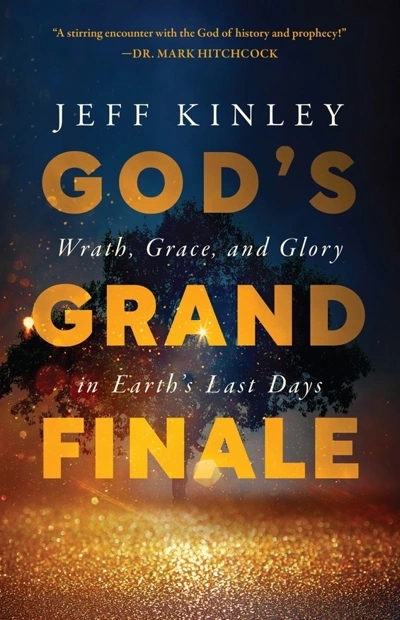
Christian Post interviews Jeff Kinley, the author of GODS GRAND FINALE – Wrath, Grace, and Glory in Earth’s Last Days. I have added my own views on Revelation’s seven churches, its seven seals, and Jesus’ Millennial Kingdom.
KINLEY: We try to make God in our own image. We customized Jesus, if you will, to fit our preconceived thoughts about Him or emotions. We want to express love for God, but the basic premise of worship is that we cannot worship a God that we do not know. And it goes back to John 4 when Jesus told the woman at the well that God is searching for worshipers who will worship Him in spirit and in truth. And so, there has to be a theological foundation for Who God is before we can ever even love that God. In order to truly love God, we have to first do a little bit of theology.
CHRISTIAN POST: Regarding the book of Revelation, you wrote that it is not “a riddle to be solved, but a revelation to be believed. It’s not a metaphoric tale laced with undecipherable symbols, but rather, a literal scene-by-scene depiction of history, to be written down in advance of its fulfillment.” Do you believe a lot of churches have this misunderstanding about the Book of Revelation?
KINLEY: I do. I think people view Revelation as sort of being off-limits to Christians because of its apocalyptic language, and some of its symbolism that’s in there. Also, it’s ironic because number one, it is the last book God ever wrote and He tells us that everyone who reads it will be blessed. Also, the very word, “Revelation,” means to uncover or reveal or to unveil, not to hide. So, the irony is that people think that it’s a book of hidden knowledge when the very title of the book tells us that it is a book that tells us Who God is and tells us what’s going to happen.
And with a little bit of study and a little bit of guidance, it really isn’t that hard to understand.
CHRISTIAN POST: You dedicated two full chapters to the topic of the letters sent to the seven churches mentioned in Revelation. Why did you believe that the topic needed to be covered in two chapters rather than just one?
KINLEY: I think because Jesus’ heart is for His bride, the Church. He loves His Church, He loves believers very, very much, and the thing He wanted most for those first-century churches is for them to get their relationship, their doctrine, and their lives calibrated to Who God is, to God’s character. The only way He could do that was to send some messages to them that would rebuke them for their error and then offer them a way back to Himself.
And so, five of the seven churches received severe rebukes from Christ, two did not. But I think they mirror many churches today. And so, that’s why it’s so relevant for today because those seven churches, we can look around us today and say, ‘Wow, there’s that church, there’s Ephesus, there’s Smyrna, there’s Sardis, there’s Philadelphia, and so it’s a relevant section of the book. So, I wanted to spend more time on it.
EDWARDS: Sadly, Jeff Kinley misses the fact that the seven churches are prophetic, they represent the church in each of the last seven years prior to Jesus’ return. Just as the seven seals are prophetic of what is unfolding/happening on Earth during the last seven years. It is obvious the church of Philadelphia in the sixth year is the church that is raptured and the seventh church of Laodicea (spew you out of my mouth) is the church that is left behind. Just as at the sixth seal, we see the Celestial signs that precede Jesus’ return and the announcement that the wrath of God has come.
CHURCH OF PHILADELPHIA: “I know your works. Behold, I have set before you an open door, which no one is able to shut. I know that you have but little power, and yet you have kept my word and have not denied my name… Because you have kept my word about patient endurance,I will keep you from the hour of trial that is coming on the whole world, to try those who dwell on the earth.” Revelation 3:8,10
SIXTH SEAL: “When he opened the sixth seal, I looked, and behold, there was a great earthquake, and the sun became black as sackcloth, the full moon became like blood, and the stars of the sky fell to the earth as the fig tree sheds its winter fruit when shaken by a gale. The sky vanished like a scroll that is being rolled up, and every mountain and island was removed from its place. Then the kings of the earth and the great ones and the generals and the rich and the powerful, and everyone, slave and free, hid themselves in the caves and among the rocks of the mountains, calling to the mountains and rocks, “Fall on us and hide us from the face of him who is seated on the throne, and from the wrath of the Lamb, for the great day of their wrath has come, and who can stand?” Revelation 6:12-17
CHRISTIAN POST At Armageddon, you note that “The risen Christ is the hero of the ages, a conqueror for all time. The world knows virtually nothing about this Jesus described in Revelation. And sadder still is that the church knows very little of this side of Jesus as well.” Why do you believe that the church knows very little about this End Times side of Jesus?
KINLEY: Two reasons. Number one, we tend to spend most of our time about Christ in the Gospels. And we get our vision, our image, our view of God from the Gospels. But the rest of the New Testament really tells us more about the character of God and Who Christ is. And when we get to Revelation, specifically chapter one, there’s a vision of Christ there, but it’s unlike anything we hear preached in most churches today.
By the time we get to Revelation 19, the close of the age, we see a Christ coming back to essentially, get rid of sin, get rid of sinners, to set the world right again. Which is really something that everybody wants to happen in their heart. They want evil to go away, they want righteousness to reign, justice and fairness, and Christ is going to bring that kind of Kingdom immediately following his second coming.
EDWARDS: I have not read Kinley’s book so do not know if he understands that what is next on God’s agenda is Jesus’ Millennial reign on the Earth. When Jesus returns to Earth it is to rule and reign with the Saints with a rod of iron for 1000 years. Jesus’ Millennial Kingdom is a transition era when the covenants with Abraham, David, and the New Covenant are fulfilled. Also, Satan is bound for most of the thousand years but when he is released his still able to raise an army like the sand of the sea to come against Jesus and the Saints. Fire from heaven quickly disposes of Satan and the rebels. What follows is the White Throne judgement and then a new Heaven and a new Earth where only the righteous dwell.
“Then I saw a great white throne and him who was seated on it. From his presence earth and sky fled away, and no place was found for them. And I saw the dead, great and small, standing before the throne, and books were opened. Then another book was opened, which is the Book of Life. And the dead were judged by what was written in the books, according to what they had done.” Revelation 20:11-12
CHRISTIAN POST: What do you hope people take away from your book?
KINLEY: The main thing is that they just know God and love Him more. Revelation is the last book of the Bible and God wants us to know Who He is. And Revelation was written so that we could know our God better. And so, that’s what I want people to do: to know God, to love Him more as a result of this book.
The Bible’s first five books—Genesis, Exodus, Leviticus, Numbers, and Deuteronomy—are known as the Torah, Law, or Pentateuch. The Torah has long been ascribed to Moses. Indeed, the books’ internal evidence points to Moses, claiming his authorship, e.g., Exodus 17:14; 24:4–7; 34:27; Numbers 33:2; Deuteronomy 31:9, 22, 24.
Other Old Testament books affirm Moses’ authorship, e.g., Joshua 1:7–8; 8:32–34; Judges 3:4; 1 Kings 2:3; 2 Kings 14:6; 21:8; 2 Chronicles 25:4; Ezra 6:18; Nehemiah 8:1; 13:1; Daniel 9:11–13. New Testament writers likewise with John 1:17; Acts 6:14; 13:39; 15:5; 1 Corinthians 9:9; 2 Corinthians 3:15; Hebrews 10:28.
Finally, Jesus cited Moses as the author, frequently speaking of Moses’ writings or the Law of Moses without any disclaimer, e.g., Matthew 8:4; 19:7–8; Mark 7:10; 12:26; Luke 24:27, 44; John 7:19. Indeed, Jesus stressed the seriousness of denying Moses several times, including:
“If you believed Moses, you would believe me, for he wrote about me. But since you do not believe what he wrote, how are you going to believe what I say?” John 5:46, 47
Similarly, today’s liberal theologians who doubt Moses often doubt what Jesus said (aside from selective and twisted use to support their agreements with politically correct causes).
In Luke 16:19–31, Jesus relates how a rich man in hell begged someone to return from the dead to warn his brothers. But as Jesus explains further:
He [Abraham] said to him [the rich man], “If they do not listen to Moses and the Prophets, they will not be convinced even if someone rises from the dead.” Luke 16;31
This is extremely serious. Jesus said that rejectors of Moses would not be persuaded even by a resurrection. Not surprisingly, churches and seminaries rejecting the historicity of Moses’ writings often also reject the Lord Jesus Christ’s literal bodily resurrection.
Indeed, Jesus affirmed the absolute authority of Moses’ writings in Matthew:
“I tell you the truth, until heaven and earth disappear, not the smallest letter, not the least stroke of a pen, will by any means disappear from the Law until everything is accomplished.” Matthew 5:18
Jesus affirmed Scripture’s inspiration even down to the smallest letter—“jot” (Greek iotaι the equivalent Hebrew yod י) — or a letter — “tittle” (e.g., the smallest stroke of a pen differentiating between beitℶ kaphℶ, daletℸ, reshℸ
MOSES AS EDITOR OF GENESIS
Although included in the Torah as a ‘Book of Moses’, Genesis is a special case. While Moses eye-witnessed the events of Exodus to Deuteronomy, Genesis’ events occurred long before his time. Moses is not named as the book’s author; the best explanation is he was the editor of Genesis.
Internal evidence includes many editorial comments (e.g., Genesis 26:33, 32:32), to explain events to his readers living centuries after the events of Genesis. (Moses often uses Egyptian reference points in the Pentateuch (Genesis 13:10, Numbers 13:22), strong internal evidence that he wrote for people who had just escaped Egypt and were unfamiliar with the Promised Land.) But highlighting how Genesis preserves events from long before Moses, sometimes the ancient sources were left alone. For example, Genesis 10:19 states: The territory of the Canaanites extended from Sidon as you go toward Gerar, as far as Gaza; as you go toward Sodom and Gomor rah and Admah and Zeboiim, as far as Lasha.
Note, “as you go toward Sodom and Gomorrah”. Consider a New York City guidebook providing directions “as you go towards the Twin Towers”. The natural conclusion is that the guidebook was written when these great landmarks were still standing, i.e., before the terrorist attack on 11 September 2001. Similarly, the internal evidence of Genesis 10:19 points to it being written before God destroyed Sodom and Gomorrah (Genesis 19:24), at or even before Abraham’s time. These two wicked cities had been lost under the Dead Sea for centuries by Moses’ time.
11-TOLEDOT STRUCTURE
Genesis’ real sources are eleven family documents headed by toledot. The phrase ‘ēllĕh tôləḏôṯ (אֵ֚לֶּה תּוֹלְדֹ֣ת) is usually translated as “these are the generations of …”. This takes the preceding section’s results and propels it forward in the narrative. Genesis’ toledots tell us what followed from the named person.
There is also a repeated historical pattern moving from blessings to curses. For example:
Toledot of the heavens and earth, Genesis 2:4–4:26. ‘What followed from creation’, particularly what became of creation’s crowning point (man and woman), their fall from perfection into sin, and the curse on the cosmos.
Toledot of Adam, Genesis 5:1–6:8. ‘What followed from Adam’ continues the further degeneration of man into utter wickedness. We see the two main lines of descendants: Cain’s and Seth’s. This toledot starts in 5:1–2 with blessing but ends in God’s intention to blot out mankind in 6:7.
Toledot of Noah, Genesis 6:9–9:29. ‘What followed from Noah’. God’s curse on the wicked earth in the Flood, but the blessing of saving Noah’s family on the Ark. But then the righteous Noah becomes drunk, leading to Canaan’s curse.
Toledot of Noah’s three sons, Genesis 10:1–11:9. ‘What followed from Shem, Japheth, and Ham’, the descendants of these patriarchs’ founding nations. This account starts with the blessing of the population expansion and ends with the curse of the confusion of languages at Babel “in the days of Peleg” (10:25). This confusion led to the dispersion into nations.
BIBLICAL PROPHECY PROOF OF THE BIBLES INSPIRATION
Even before the Israelites went into the Promised Land, Moses told them their entire future checkered history, including their being cast out of the land and dispersed throughout the nations but also the end of the story when God would regather them and their Messiah will rule the nations and they will be a people, “holy to the Lord your God”. Could this be the reason there are still Jews in the world today? They are hanging onto God’s future promises.
“And if you faithfully obey the voice of the LORD your God, being careful to do all his commandments that I command you today, the LORD your God will set you high above all the nations of the earth.” Deuteronomy 28:1
“And the Lord will make you the head and not the tail, and you shall only go up and not down if you obey the commandments of the LORD your God, which I command you today, being careful to do them.” Deuteronomy 28:13
“And the Lord has declared today that you are a people for his treasured possession, as He has promised you, and that you are to keep all his commandments, and that He will set you in praise and in fame and in honour high above all nations that He has made, and that you shall be a people holy to the Lord your God, as He promised.”Deuteronomy 26:18-19
“And when all these things come upon you, the blessing and the curse, which I have set before you, and you call them to mind among all the nations where the Lord your God has driven you, and return to the Lord your God, you and your children, and obey his voice in all that I command you today, with all your heart and with all your soul, then the Lord your God will restore your fortunes and have mercy on you, and He will gather you again from all the peoples where the Lord your God has scattered you.“Deuteronomy 30:1-3
“And the Lord yourGod will bring you into the land that your fathers possessed, that you may possess it. And He will make you more prosperous and numerous than your fathers. And the Lord your God will circumcise your heart and the heart of your offspring so that you will love the Lord your God with all your heart and with all your soul, that you may live.” Deuteronomy 30:5-6
“On the day that I cleanse you (House of Israel) from all your iniquities, I will cause the cities to be inhabited, and the waste places shall be rebuilt. And the land that was desolate shall be tilled, instead of being the desolation that it was in the sight of all who passed by. And they will say, ‘This land that was desolate has become like the garden of Eden, and the waste and desolate and ruined cities are now fortified and inhabited.’ Then the nations that are left all around you shall know that I am the Lord; I have rebuilt the ruined places and replanted that which was desolate. I am the Lord; I have spoken, and I will do it.” Ezekiel 36:33-36
We are told that prior to Jesus’ return that there will be a great falling away. Apostasy will be rampant. Already, we are seeing Institutional churches compromising with the world on Biblical inerrancy, gay marriage, and homosexual leadership. The church needs to get back to the House church model expounded in the Book of Acts. Church as God intended. We have seen the effectiveness of the House Church model in China when all Mission groups were expelled at the time Chairman Mao came to power. We are also seeing it in Iran and other Middle Eastern countries where Christians are being persecuted.
Practical House Church Functioning, Disciplining, & Multiplying:
Can I challenge you to search for Biblical answers to the following questions? You will be challenged about the way you think about church.
Why the symbolic elements in the Lord’s Supper are important.
Why wine vs grape juice.
Why a full meal during the Lord’s Supper versus only taking a bit of bread and a cup.
Why have the Lord’s Supper with a full meal every week?
Why does trying to imitate an unbiblical traditional church model kill the Lord’s New Testament house church model?
Why and how we need to have everyone contribute in the Word, the meal, and prayer – how this impacts spiritual growth and discipleship far more than any modern-day, man-made discipleship program.
Why baptism* as described in Scripture is so important. Infant baptism and sprinkling with water do not achieve God’s purpose for baptism.
Why modern traditional churches resist God’s ordinance of head coverings related to men and women praying and prophesying in church versus God’s headship – in church, family, and society.
Why and what about music.
Why teaching children Biblical history including Noah’s worldwide flood versus Evolution and billions of years is so important.
Why about when, how long, and what order of activity during church, and scheduling vs Spirit leading.
Why and what to do about problem people.
Why traditional church leadership & leaders versus N.T. leadership & leaders.
Why, when, where, and with whom should we break off to start another house church.
Can I encourage you to get Jim McCotter’s book Church Revolution Today – How N.T. Christians Reached The World. You will find all the answers you need on church as Jesus intended in Jim’s book.
*The scriptural examples of baptism, such as Jesus’ baptism in the Jordan River (Matthew 3:16) and the Ethiopian eunuch’s baptism in a body of water (Acts 8:36-39), indicate immersion demonstrates one dying to self and emerging a new creation in Christ. “Repent and be baptized, every one of you, in the name of Jesus Christ for the forgiveness of your sins.” Acts 2:38. This Scripture reveals baptism is a symbolic act representing the cleansing of one’s sins through faith in Jesus Christ.
The Gospels—Matthew, Mark, Luke, and John—are four accounts of Jesus’s life and teachings while on earth. But are they historically accurate?
New Testament scholar, Dr Peter Williams, presents a powerful case for the historical reliability of the Gospels. He compares different accounts of the same events, assesses how accurately the four biblical accounts reflect the cultural context of their day, considers how the texts were handed down throughout the centuries, and examines evidence from non-Christian sources.
Dr Williams applies a series of tests covering topics which range from geography to personal names, tax to language, and weights and measures to botany. His conclusion is clear: It is highly rational to trust the Gospels.
Contents 1. What Do Non-Christian Sources Say? 2. What Are the Four Gospels? 3. Did the Gospel Authors Know Their Stuff? 4. Undesigned Coincidences 5. Do We Have Jesus’s Actual Words? 6. Has the Text Changed? 7. What about Contradictions? 8. Who Would Make All This Up?
This book’s title, Can We Trust the Gospels?, is carefully chosen. It addresses the question by looking at evidence of the Gospels’ trustworthiness. The great thing about trust is that it is something we all understand to a degree because we all exercise it. … It is a version of [this] everyday sort of trust that we are going to consider in this book as we ask whether we can trust the accounts of Jesus’s life …
Trusting the Gospels is both the same as trusting other things and different. It is the same in that we often have to evaluate the credibility of people and things in daily life. It is different in that the Gospels contain accounts of miracles and of a man, Jesus Christ, who is presented as the supernatural Son of God who can rightfully claim ownership of our lives. But before we consider such claims, we need to ask whether the Gospels show the signs of trustworthiness we usually look for in things we believe.
ABOUT THE AUTHOR
Peter J. Williams (Ph.D., University of Cambridge) is the principal of Tyndale House, one of the world’s leading institutes for biblical research. Previously a senior lecturer in New Testament at the University of Aberdeen, he is the chair of the International Greek New Testament Project and a member of the ESV Translation Oversight Committee.
For the present, by God’s grace and kindness, people can reject God but still receive the benefits of His common grace, including the enjoyment of loving relationships, natural and artistic beauty, and pleasure. However—and we need to be so warned—we live on borrowed time. This temporary situation will come to an abrupt end. Death but also judgement follows.
Have you accepted God’s offer of eternal life through the sacrifice of His Son, Jesus? If not you need to seriously consider first the following two Scriptures then open or purchase God’s Word, a Bible. This is the only way you can discover the truth about the world in which we live and answers to the big questions, like why there is pain, death, and suffering. Below I have also given you three paragraphs from the Book of John to consider why you need to get a Bible if you do not have one. A New King James, ESV or a New American Standard are all excellent translations from my experience.
“And just as it is appointed for man to die once, and after that comes judgment,so Christ, having been offered once to bear the sins of many, will appear a second time, not to deal with sin but to save those who are eagerly waiting for him.“ Hebrews 9:27-28
This first Scripture reveals that Jesus is returning to earth to “save those who are eagerly waiting for him“. Revelation 8 and 15 reveal that He is also going to pour out His wrath upon those that have rejected Him with the trumpet and bowl judgments. God has given us many prophetic scriptures revealing the events that will proceed Jesus’ return. Those events are already happening, the first major one was the reestablishment of Israel as a nation back in 1948.
“Then I saw a great white throne and him who was seated on it. From his presence, earth and sky fled away, and no place was found for them.And I saw the dead, great and small, standing before the throne, and books were opened. Then another book was opened, which is the book of life. And the dead were judged by what was written in the books, according to what they had done… And if anyone’s name was not found written in the book of life, he was thrown into the lake of fire.” Revelation 20:11-12,15
This second Scripture shows those that had died and been raised to life to face Jesus at the white throne judgement.
BOOK OF JOHN
“In the beginning was the Word, and the Word was with God, and the Word was God. He was in the beginning with God. All things were made through him, and without him was not anything made that was made. In him was life, and the life was the light of men. The light shines in the darkness, and the darkness has not overcome it.” John 1:1-5
“The true light, which gives light to everyone, was coming into the world. He was in the world, and the world was made through him, yet the world did not know him. He came to his own, and his own people did not receive him. But to all who did receive him, who believed in his name, he gave the right to become children of God, who were born, not of blood nor of the will of the flesh nor of the will of man, but of God.” John 1:9-13
“And the Word became flesh and dwelt among us, and we have seen his glory, glory as of the only Son from the Father, full of grace and truth. (John bore witness about him, and cried out, “This was he of whom I said, He who comes after me ranks before me, because he was before me.’”) For from his fullness, we have all received, grace upon grace. For the law was given through Moses; grace and truth came through Jesus Christ. No one has ever seen God; the only God, who is at the Father’s side, he has made him known.” John 1:14-18