When a team of modern salvage divers recently plunged into the Red Sea, they weren’t chasing treasure. They were chasing a mystery nearly 50 years old – a legend that the chariot wheels that once belonged to a Pharaoh lay buried beneath the waves. What they found left them stunned. Scattered across the seabed were shocking discoveries of remains of chariots and many human bones that would confirm a Biblical story that a lot of people have dismissed as fiction. But here’s the thing: what the divers saw suggests that something shocking happened in the Red Sea, confirming the Biblical Exodus story.
This confirms what Ron Wyatt reported many years before. I met Ron Wyatt when I was Chairman of Ark Search, and Dr Alan Roberts of Australia was working with Ron Wyatt on a search for Noah’s Ark. Sadly, that search ended in failure; however, an article by Ken Griffiths and Darryl K White in the Journal of Creation, Volume 35, Issue 3, 2021, shows a credible site for Noah’s Ark on the Mountain Karaca Dag in Turkey.
While researching a Babel candidate site near Diyarbakir, Turkey, on 3 October 2019, they found a complex of sites on the mountain Karaca Dag that, upon further examination, seem to match the description of the landing site of Noah’s Ark, along with a tomb, possible altar, and much more. The tomb is a 60-m-square, rough stone mastaba, oriented to the winter solstice sunrise, with two extensions that make it into roughly a 160-m-long boat shape. The site is marked by six or more geoglyphs, situated along an arc 5 km distant on the northwest side of the mountain. The possible remains of the Ark appear to have had a modern school built on them, now collapsed.
We would expect to find the landing site of the Ark near the centre of the oldest post-diluvial distribution of humans and domesticated plants. The site presented in this paper lies upon a mountain between the Tigris and Euphrates Rivers at the centre of the Pre‑Pottery Neolithic A (PPNA) Culture.
In this fascinating sequel to ‘Is Genesis History?‘, Del Tackett follows the journey of two creation scientists rafting through the Grand Canyon to examine enormous folds of solid rock. What caused these massive formations? And when did they happen? Conventional scientists say they are millions of years old, but no one has actually studied them… until now.
Del Tackett’s first documentary provided an overview of creation science. In this unique sequel, he explore how creation science actually works. What did the Flood do to re-form Earth? How did it shape the world we see around us? And why is Genesis so important to modern science? If Andrew Snelling’s theory is correct, his findings will directly challenge the conventional view that the earth is hundreds of millions of years old. Instead, they will provide clear evidence for a recent global Flood. ‘Mountains After the Flood’ is very different from Del’s first film. It reveals the inner workings of creation science and shows how creation scientists link their discoveries to the history recorded in Genesis. It will give Christians everywhere a deeper understanding of the relationship between science and the Bible.
1. Introduction – 0:00 2. How Creation Science Works – 3:56 4. Taking the First Sample – 9:03 5. Overview of the Project – 10:14 6. Map of Grand Canyon – 17:45 7. Carbon Canyon Fold – 19:56 8. Cross-Sections & Monument Fold – 22:33 9. Regional Samples & Helipad Fold – 27:50 10. Uinta Mountains & Post-Flood World – 31:20 11. Flaming Gorge & Tilted Layers – 36:33 12. Sheep Creek Canyon & Folds – 41:31 13. Geomorphology & Catastrophe – 43:52 14. Fossil Butte & Green River Basin – 47:34 15. Digging for Fossils – 51:35 16. Thin Sections & Scanning Electron Microscopy – 58:10 17. Flying Over the Grand Canyon – 1:07:41 18. Cedarville: Reviewing the Thin Sections – 1:20:01 19. Cedarville: Examining the SEM Slides – 1:27:57 20. Pikes Peak: The Future of Creation Science – 1:35:45 21. Credits – 1:43:00 Support creation science by donating to the Genesis Fund: https://bit.ly/genesis_fund
How Large Was Noah’s Ark? The length of the ark 300 cubits, its breadth 50 cubits, and its height 30 cubits. (Genesis 6:15) Unlike many whimsical drawings that depict the ark as some kind of overgrown houseboat (with giraffes sticking out the top), the ark described in the Bible was a huge vessel. Not until the late 1800s was a ship built that exceeded the capacity of Noah’s ark.
The dimensions of the ark are convincing for two reasons: the proportions are like that of a modern cargo ship, and it is about as large as a wooden ship can be built. The cubit gives us a good indication of size.1 Using the most likely cubit length, an ancient royal cubit of at least 20.4 inches (0.518 m), we know that the ark must have been no less than 510 feet (155 m) long, 85 feet (26 m) wide, and 51 feet (16 m) high. In the Western world, wooden sailing ships never got much longer than about 330 feet (100 m), yet the ancient Greeks built vessels at least this size 2,000 years earlier. China built huge wooden ships in the 1400s that may have been as large as the ark. The biblical ark is one of the largest wooden ships of all time—a mid-size cargo ship by today’s standards.
A Korean study was performed at the world-class ship research center (KRISO) in 1992. The team of nine KRISO researchers was led by Dr. Hong, now the research center’s director-general. The study confirmed that the ark could handle waves as high as 98 feet (30 m) and that the proportions of the biblical ark are near-optimal—an interesting admission from Dr. Hong, who believed in evolutionary ideas. The study combined analysis, model wave testing, and ship standards, yet the concept was simple: compare the biblical ark with 12 other vessels of the same volume but modified in length, width, or depth. Three qualities were measured—stability, hull strength, and comfort.
The Biblical verse below tells us Noah didn’t have to search or travel to faraway places to bring the animals on board. The world map was completely different before the flood, and based on Genesis 1, there may have been only one continent. The animals arrived at the ark as if called by a “homing instinct” (a behavior implanted in the animals by their Creator) and marched up the ramp themselves.
“But I will establish my covenant with you, and you shall come into the ark, you, your sons, your wife, and your sons’ wives with you. And of every living thing of all flesh, you shall bring two of every sort into the ark to keep them alive with you. They shall be male and female. Of the birds according to their kinds, and of the animals according to their kinds, of every creeping thing of the ground, according to its kind, two of every sort shall come in to you to keep them alive.” Genesis 6:18-20
Juveniles of even the largest land animals do not present a size problem, and, being young, they have their full breeding life ahead of them. Even most dinosaurs were not very large — some were the size of a chicken (although absolutely no relation to birds, as many evolutionists are now saying). Most scientists agree that the average size of a dinosaur is actually the size of a bison. As far as the number of different types of dinosaurs, it should be recognized that, although there are hundreds of names for different varieties (species) of dinosaurs that have been discovered, there are probably only 60–80 different kinds.
Was Noah’s Flood Global? “And the waters prevailed so mightily on the earth that all the high mountains under the whole heaven were covered. The waters prevailed above the mountains, covering them fifteen cubits deep.” Genesis 7:19–20
Noah’s flood was much more destructive than any 40-day rainstorm ever could be. Scripture says that the “fountains of the great deep” broke open. In other words, earthquakes, volcanoes, and geysers of molten lava and scalding water were squeezed out of the earth’s crust in a violent, explosive upheaval. These fountains were not stopped until 150 days into the flood—so the earth was literally churning underneath the waters for about five months! The duration of the flood was extensive, and Noah and his family were aboard the ark for around a year.
Scientists once understood the fossils buried in water-carried sediments of mud and sand—to be mostly the result of the great flood. Wanting to debunk the Bible and the worldwide flood of Noah’s day, Charles Lyell of Darwin’s era introduced the ideal of slow gradual change over millions, now billions of years. Geologists now realise the evidence for catastrophism is everywhere. It can be seen all over the earth, from seabeds to mountaintops. Whether you travel by car, train, or plane, the physical features of the earth’s terrain clearly indicate a catastrophic past, from canyons and craters to coal beds and caverns. Some layers of strata extend across continents, revealing the effects of a huge catastrophe. The earth’s crust has massive amounts of layered sedimentary rock, sometimes miles (kilometers) deep! These layers of sand, soil, and material—mostly laid down by water—were once soft like mud, but they are now hard stone. Encased in these sedimentary layers are billions of dead things (fossils of plants and animals) buried very quickly. The evidence all over the earth is staring everyone in the face.
There are hundreds of stories and legends about a worldwide flood. Why do diverse cultures share a strikingly similar story? Did you know that stories about a worldwide flood are found in historic records all over the world? According to Dr. Duane Gish in his popular book Dinosaurs by Design, there are more than 270 such stories, most of which share a common theme and similar characters. So many flood stories with such similarities surely come from the flood of Noah’s day.
Stories of the flood—distorted though they may be—exist in practically all nations, from ancient Babylon onward. This evidence must not be lightly dismissed. If there never was a worldwide flood, why are there so many stories about it?
The reason for these flood stories is not difficult to understand. When we turn to the history book of the universe, the Bible, we learn that Noah’s descendants stayed together for approximately 100 years until God confused their languages at Babel (Genesis 11:1–9). As these people moved away from Babel, their descendants formed nations based on the languages they were given by God. Through those languages, the story of the flood was shared until it became embedded in their cultural history.
The Bible declares that the earth-covering cataclysm of Noah’s day is an obvious fact of history. People “deliberately overlook this fact, that . . . the world that then existed was deluged with water and perished” (2 Peter 3:5–6). The flood left much evidence—from the fact that over 70% of the rocks on continents were laid down by water and contain fossils to the widespread flood legends. Both of these evidences provide compelling support for this historical event.
God clearly sent a worldwide flood to punish humankind for their evil and corrupt ways (Genesis 6:5, 11). Even though flood-affirming evidence from geology and other areas of study is abundant, we don’t need this evidence to know what happened. Starting with the Bible and the history that God faithfully recorded there, Christians have a tool to interpret the evidence that evolutionists and non-Christians do not. We have the record of what happened from the one who was there.
Get all this information and more in a free booklet, Noah’s Ark – A Biblical and Scientific look at the Genesis account produced by Answers in Genesis (www.answersingenesis.org)
God chose the man Moses to establish His nation to bring them out of captivity in Egypt with great miracles. His life is miraculous from the beginning but note how God had to humble Moses after his time in Pharaoh’s court.
Pharaoh, shortly before Moses’ birth, decreed the death of all Hebrew male children. Moses’ mother Jochebed carried out a plan to save her child. She put him in a small ark and placed it in the reeds along the river hoping someone would find Moses and let him live. Pharaoh’s daughter finds the baby and immediately adopts him. Miriam (Moses’ sister), who serves the princess, suggests and arranges for her mother to nurse the child.
Moses grew up taught and trained in Pharaoh’s court. From the age of twenty to forty he was “mighty in words and deeds” (Acts 7:22). He, according to historian Josephus, became general of the Egyptian army and led a successful campaign against the Ethiopians (Antiquities of the Jews, Book 2, Chapter 10).
God then humbled him with 40 years in the wilderness as a herdsman before commissioning him through the burning bush experience. Nevertheless, he now needs Aaron as his spokesman.
After bringing the Jews out of Egypt, because of unbelief, Moses had to lead them another 40 years in the wilderness until that generation died. Because of one significant act of disobedience, God did not allow Moses to go into the Promised Land. Mind you, Moses eventually went into the Promised Land about 1400 years later with Elijah in glorified bodies to meet Jesus and three disciples on the Mount of Transfiguration.
What is astounding is that God shows Moses Israel’s future and tells him to tell it to the people before he dies and they go into their land. It is called the Song of Moses and it includes them departing from God’s commandments and being cast out of the land and scattered throughout the world. Fortunately, Moses was shown that God would eventually regather them from all around the world back to the land He had promised them. Note how the Song of Moses ends.
“For the Lord will vindicate his people and have compassion on his servants, when he sees that their power is gone and none is remaining, bond or free... Rejoice with him, O heavens; bow down to him, all gods, for he avenges the blood of his children and takes vengeance on his adversaries. He repays those who hate him and cleanses his people’s land. “Deuteronomy 32:36, 41-43
Before Israel went into the Promised Land under Joshua they were told their entire history. No wonder Jews are still Jews regardless of where God has scattered them. Moreover, God has begun to bring them back to their land and whilst they will go through intense persecution under the Antichrist we know from Biblical prophecy that Jesus will return to rescue them at the Battle of Armageddon and set up His Millennial Kingdom.
“And he seized the dragon, that ancient serpent, who is the devil and Satan, and bound him for a thousand years, and threw him into the pit, and shut it and sealed it over him, so that he might not deceive the nations any longeruntil the thousand years were ended. After that, he must be released for a little while. Then I saw thrones, and seated on them were those to whom the authority to judge was committed. Also, I saw the souls of those who had been beheaded for the testimony of Jesus and for the word of God, and those who had not worshiped the beast or its image and had not received its mark on their foreheads or their hands. They came to life and reigned with Christ for a thousand years. The rest of the dead did not come to life until the thousand years were ended. This is the first resurrection. Blessed and holy is the one who shares in the first resurrection! Over such the second death has no power, but they will be priests of God and of Christ, and they will reign with him for a thousand years.” Revelation 20:2-6
In 1980, Mount St. Helens (in Washington State, USA) erupted, blasting the top and side off the mountain. Then, as volcanoes do, it began to rebuild. In 1992, samples of new volcanic rock—KNOWN to be only about 10 years old—were dated using standard radiometric dating techniques (3 samples from the same rock, 350,000 years, 900,000 years, and 2,800,000 years). The results were eye-opening. Radiometric dating is not all it’s cracked up to be! In fact, it’s fair to ask: “Can radiometric dates be trusted at all?” Join geologist Dr Tas Walker for a discussion of the Mount St. Helens eruption and its aftermath, the fundamental flaws in radiometric dating methods, and the relevance of the age of the earth to people’s view of the world.
TIMESTAMPS ⌛ 00:00 Teaser 00:40 Introduction: What’s the deal with Mount St. Helens? 02:33 Dating rocks from Mount St. Helens 04:34 Assumptions underlie radiometric dating 05:57 Three samples, three dates: 350,000 – 2.8 million years 07:36 Story-telling accompanies radiometric dating 11:10 How can we get ACCURATE dates? 12:29 How were the Mount St. Helens dates received? Handling objections 17:05 Carbon dating gives good evidence for a YOUNG earth! 18:37 The only way to be sure of the age of something 19:58 Different kinds of radiometric dating 21:19 Radiometric dating seems so SCIENTIFIC – How can it not be right? 23:00 What to do when the dates don’t fit the expectations 27:56 Is it okay to publish dates/perspectives that don’t match existing expectations? 31:51 The age of the earth is a critical part of people’s worldview 33:38 So, what do long-age geologists think of Mount St. Helens? 35:55 Other lessons from Mount St. Helens: 36:09 → Geologic layers can be deposited rapidly 36:59 → Erosion can happen rapidly 38:02 Geologists are now more accepting of catastrophism, but won’t let go of long ages 39:17 In conclusion: The age of the earth matters to both the biblical and the naturalistic worldviews
The authors survey the ancient chroniclers for durations to the Flood and to Creation. We find that the ancient chroniclers unanimously placed the Flood in the twenty-fourth century BC. Several durations to Creation also agree with Ussher’s date within ten years (The Ussher chronology is a 17th-century chronology of the history of the world by James Ussher, the Archbishop of Armagh and Primate of All Ireland)
We were surprised to find how closely chroniclers from ancient nations agree with each other and the Ussher chronology. Not only are there precise durations to the Flood and Creation from several civilizations, but a considerable amount of history from the antediluvian era has been preserved, albeit now covered under layers of superstition and idolatry.
The Hindu texts preserve a great deal of chronological and historical data, which has been overlaid and interpreted through the lens of much later Gnosticism. The Hindu word buddha originally meant a sage or prophet, millennia before it came to mean a particular god (Hamilton 1820, 289).
The oldest Hindu texts describe Adam, Enoch, and Noah as buddhas, which originally meant prophets (Hamilton 1820, 114–120). However, they also refer to the first ten generations of prediluvian patriarchs as “avatars” or incarnations of God, (Hamilton 1820, 10) which we obviously reject.
The Chinese remember the first ten patriarchs as legendary emperors, and also preserve surprisingly detailed chronological details about some of them, as well as the history of Noah’s post-flood career.
Stellar Observations: Chinese and Babylonian sources seem to indicate that the earliest astronomical observations after the Flood date back to 2295 B.C. (Spineto 1845, 404). The Shû King records that Emperor Yâo ordered the construction of four observatories as the first priority after the Flood. In Griffith and White (2023), we calculated the date of Yâo’s reign as having begun in 2347 B.C. Some Chinese scholars calculate it as 2357 B.C.
Chinese: Alexander Hamilton states: “the Chinese annalists . . . place the deluge of Yau in the same year that the Hebrews place the flood of Noah, . . .” (Hamilton 1820, 345). This calculation was based on the reigns of the first three post-Flood dynasties, as opposed to astronomical calculations.
Hindu Astrological: “the year 2352 was obtained by the Hindus from a purely astronomical calculation . . . for this implies their opinion that the history of the world went back no further” (Browne 1844, 567). The Flood generally marks the beginning of known world history, as the Hindus considered the era before the Flood as the reign of the gods. Browne suggests this calculation was made in 204 B.C., which happens to be when the vernal equinox was leaving Aries. If so, this suggests the Hindus believed the vernal equinox was in the cusp of Taurus at the time of the Flood. We will repeat what we believe this calculation to have been in the astronomical section of this paper.
Diodorus states that the Egyptian priests maintained that “when mankind first appeared on the earth [after the Flood]; . . . but from the Trojan War, less than twelve hundred [years]” (Diodorus 1935, Book 1, §24.2). Since the Trojan war ended 1184/1183 B.C., less than 1,200 years yields a date below 2383 B.C. for the date of the Flood. Assuming Diodorus rounded to the nearest hundred, the Flood probably occurred between 2383 and 2333 B.C.
Eusebius cites Varro as computing that the Flood was 1,600 years before the Olympic aera, (Eusebius 2002, PrEv. 10.10) which yields 2376 B.C., plus or minus 50 years.
Censorinus dates the flood of Ogyges as less than 1,600 years before the first olympiad (Williams 1789, 250). He seems to have confused the much later flood of Ogyges with the Deluge, as several other Greek sources did with both the floods of Ogyges and Deucalion. This section is confusing; however, he gives values that sum up to between 1,400 to 1,514 years prior to the first Olympiad (Censorinus 2000, 30–31).
Bunsen quotes Censorinus as being more precise: “same year is referred to by Censorinus, about 238 A.D., who states, on the authority of Varro, ‘the most learned of the Romans,’ born 116 B.C., that the Flood took place about the year 2360” (Bunsen 2017, 11).
“This Nembrot [Nimrod], says Berosus, built Babylon 130 years after the flood” (Raleigh 1829, chapter 8). One hundred and thirty years before 2233 B.C. yields 2363 B.C. However, he may be referring to the Dispersion, in which case, 2191 + 130 yields 2321 B.C.
We find that the sources who used Berossus to determine the date of the Flood measured 1,000 years before the Fall of Troy, and then added 163 years to the date of the Flood. 1184 + 1,000 + 163 = 2347 B.C.
Nevertheless, 2363 B.C. is consistent with the testimonies of Diodorus, Varro, and Censorinus.
Polyhistor used this value also: “a kingdom at Babylon, 163 years after the flood, according to Polyhistor” (Williams 1789, 250).
Assuming that Polyhistor used 1,000 years before the Fall of Troy in 1183 B.C. as the date for the first kingdom in Babylon, then 163 years before 2184 B.C. yields 2347 B.C., matching Ussher’s date for the end of the Flood.
However, according to our triangulations from Griffith and White (2023), the first kingdom in Babylon after the Dispersion started in 2192/2191 B.C., yielding 2354 B.C. for the Flood using this 163-year duration.
756 Years after the Kali Yuga: Confucius dated the Flood as occurring in the 757th year of the Kali Yuga (Hamilton 1820, 316). This value is given as 3,267,000 ages from the Kali Yuga, which, divided by the 4,320-cipher of the Hindus and Chinese, yields 756.25 years (Hamilton 1820, 332). The Hindus calculated time before the Flood in double hours, reported as “years.” We demonstrated that the astronomical date for the Kali Yuga was 3104 B.C. in Griffith and White (2023), by counting from three different events: the Hijrah, the birth of Moses, and the Usurpation of Pradyato, all of which occurred after the Flood. Counting 756 whole years from 3104 B.C. gives 2348 B.C. for the Flood, agreeing exactly with Ussher.
The Deluge occurred in the 47th year of a Grand Cycle: “the world by the Hindus and Chinese, and the commencement of their cycles agree, each placing the deluge in the 47th year of a cycle” (Hamilton 1820, vol. 1, 332). The year 2349/8 was the forty-seventh year of the fourteenth sixty-year cycle from the start of the Grand Cycle in 3176 B.C. (Griffith and White 2023, 151.
Cush’s Reigns: 62/55/42 years: Belus, whom we believe to have been Cush, ruled Babel until 2192/2191 B.C., and is said to have reigned 62 years (Russell 1865, 379) by Scaliger and 55 years by Syncellus quoting Africanus (Clinton 1824, vol. 1, 267), all three of whom were redactors of Ctesias. We believe both values refer to events in the reign of Cush, called Belus, or Bel Marduk.
Cush could only have ruled in the city of Babel from the time it was founded in 2234/2233 B.C. until the Dispersion in 2192/2191 B.C. or 42/43 years, since, “At the end of forty two years after the building of the Tower, Ninus son of Belus took the kingship of the world” (Macalister 1941, §13).
However, the Babel project must have been the result of many years of planning and organization. This is evidenced by its founding on the conjunction of the New Moon with the Vernal Equinox in 2233 B.C. (Cullimore 1833, 167, 180). This suggests they anticipated this conjunction and deliberately waited for this date to establish the city or its temple. Therefore, it is not unreasonable to postulate that Belus/Cush began to rule in some fashion a decade or more before the city was founded.
Cullimore (1833, 165) states “The building of this tower is by profane writers uniformly ascribed to Belus.” Cush’s rule over his tribe would have started earlier when the land was divided around the time of Peleg’s birth. The two longer durations for his length of reign, which predate the founding of Babel, may be explained by two divisions of territory as reported in the Book of Jubilees (Charles 1913, Jubilees 8.8-10).
Berossus gives 34,080 days, which is 93.3 Julian years, or 94.6 years of 360 days then used by ancient Babylon, from the Flood until the first dynasty of Babylon, when by inference, Belus/Cush began to rule. 94.6 plus 62 is 156.6 years; 156 years before the Dispersion in 2192/2191 B.C. yields 2348/2347 B.C. for the Flood, and 2254/2253 B.C. for the First Territorial Division.
The Hindu records give 150 years from the Division of the Earth until the Usurpation of Pradyato (Hamilton 1820, 124). Pradyato was a Cushite who conquered the nascent Indus civilization and took over the government. This Usurpation was also given as 1,000 years after the Kali Yuga. Subtracting 756 years to the Flood from the Kali Yuga, as well as the 150 years of self-rule by the Hindus, we find that the division of the world was 94 years after the Flood began, which is 93 years after the end of the Flood. This triangulates, confirming that our interpretation of the 34,080 days is correct.
Syncellus cites Africanus in his epitome of Ctesias who gives the reign of Belus, whom we consider to have been Cush, as 55 years (Clinton 1824, 267), which by our reckoning would be from the birth of Peleg in 2247 BC (Ussher 2005, 21, §47) to the Dispersion in 2192/2191 B.C. Thus, it appears territorial division may have been a seven-year process that began in 2254 B.C. and was finalized in 2247 B.C., both confirming the Flood was in 2348/2347 B.C. Adding 101 years from the Flood to Peleg in the MT to the 55 years of Belus gives 156 years from the end of the Flood to the Dispersion, again triangulating 2348/2347 B.C. for the Flood.
Semiramis I: 312/313 years: The Annals of Clonmacnoise state that Semiramis’ rule started 313 years after the Great Flood. “Ireland long time after the flood lay waste until . . . after the flood 313 years . . . in the 1st year of the Raigne of Semiramis then monarchs of the world in Assiria” (McGeoghagan 1896, 12–13). The Irish Annals of Clonmacnoise state that Semiramis began to rule 312 years after the Flood (Percy 1823, 270).
2036/2035 BC, AP-21 Reign of Semiramis I; plus, 313 years; gives: 2349/2348 BC for the Flood
Emperor Yâo’s Reign 2347 BC: We found in a previous paper (Griffith and White 2022b, 422) that Yu of the Xia Dynasty of China began to reign in 2197 B.C. His predecessors Yâo and Shun reigned for a total of 150 years. Emperor Yâo’s reign was said to have begun when the Flood had ended.
2197 B.C., AP-4 Reign of Yu/Xia; plus, 150 years of Yâo and Shun; gives: 2347 B.C. end of Flood
The Bible teaches a worldwide Flood. It destroyed all people and land vertebrates off the Ark. Many creatures were buried quickly, forming fossils all around the world. But could the fossils be the result of local floods instead of a global Flood? In many cases, this is not possible because they are in rock layers covering huge areas—rocks clearly laid down catastrophically by water.
Sometimes they span whole continents and even across different continents around the world. Geologists use the term mega sequence for some of them (mega is Greek for ‘big’). If the layers are extremely wide, then whatever caused them must also have been extremely wide. Let’s see some examples from around the world.
One of the most famous natural wonders in the USA is the Grand Canyon in northern Arizona. It is 446 km (277 miles) long, over 1.6 km (1 mile) deep, and 6.4 km (4 miles) to 29 km (18 miles) wide. Standing on one rim and looking at the opposite wall, the layers of rock look like a giant stack of pancakes.
One of the easiest layers to spot is the almost-white Coconino Sandstone. From the other side, it looks thin (arrow, pictured below). But it is actually about 96 m (315 ft) thick. It is so wide that it covers 519,000 km² (200,000 square miles)—almost twice the size of Colorado! It contains 41,700 km³ (10,000 cubic miles) of sand.
Where did all this sand come from, and how did it get there? The sandstone has slanting lines, called crossbeds (‘fossil’ sand dunes). The slope is at a particular angle—the angle of a sand slope under water. The crossbeds are so large that deep flowing water, covering a vast area, must have formed them.
In my own city of Sydney, Australia there is another large formation. It is called the Hawkesbury Sandstone, or just Sydney Sandstone. The sandstone is quite hard and strong, and it was used for many of Sydney’s public buildings.
The Sydney Sandstone is 350 km (220 miles) long, 250 km (150 miles) wide, and nearly 300 m (1,000 ft) thick in places. This also contains large crossbeds. One secular geologist said that the sandstone was deposited by huge waves of water mixed with sand. How big? 250 km (150 miles) wide—about the same as the sandstone deposit—and 20 m (66 ft) high, travelling about 100 km (60 miles) per hour. We don’t see them happening now. But the worldwide Flood of Noah’s day when God first poured out His wrath upon this earth explains them.
God tells us that in the last days before Jesus’ second coming to earth to rescue His Saints before pouring out His wrath on Earth once again, people will deny that the worldwide flood of Noah’s day that destroyed mankind (except 8 people) ever happened.
“You should remember the predictions of the holy prophets and the commandment of the Lord and Savior through your apostles, knowing this first of all, that scoffers will come in the last days with scoffing, following their own sinful desires. They will say, “Where is the promise of his coming? For ever since the fathers fell asleep, all things are continuing as they were from the beginning of creation.” For they deliberately overlook this fact, that the heavens existed long ago, and the earth was formed out of water and through water by the word of God, and that by means of these, the world that then existed was deluged with water and perished.”2 Peter 3:2-6
People you need to accept God exists and you can know Him. He tells us we are without excuse. Look at the following Scripture: God tells us, we just need to look around us, take a look in any garden at the beautiful flowers.
“For his invisible attributes, namely, his eternal power and divine nature, have been clearly perceived, ever since the creation of the world, in the things that have been made. So they are without excuse.”Romans 1:20
Also, fulfilled Bible prophecies should be enough for you to believe that all the two thousand prophecies of Jesus second coming to earth will be fulfilled as well. You need to know that these Bible prophecies tell us that we are not too far from Jesus’ second coming and the second time God pours out His wrath upon an unrepentant lawless world.
I know that Jesus returns first to take believers in Him to heaven before God pours out His wrath upon the world. I will be one of those who is saved. What about you? If you want to know how to get saved then go to either of these two websites http://www.answersingenesis.com or http://www.creation.com.
Part of this real history is the bad news that the rebellion of the first man, Adam, against God’s command, brought death, suffering, and separation from God into this world. We see the results all around us. All of Adam’s descendants are sinful from conception (Psalm 51:5) and have themselves entered into this rebellion (sin). They, therefore, cannot live with a holy God but are condemned to separation from God. The Bible says that “all have sinned, and come short of the glory of God” (Romans 3:23) and that all are therefore subject to “everlasting destruction from the presence of the Lord and from the glory of His power” (2 Thessalonians 1:9).
The good news is that God has done something about it. “For God so loved the world, that He gave His only begotten Son, that whoever believes in Him should not perish, but have everlasting life” (John 3:16). Jesus Christ the Creator, God the Son, though totally sinless, took on human nature, so He could become our Redeemer. Then He suffered, on behalf of mankind, the penalty of mankind’s sin, which is death and separation from God. He did this to satisfy the righteous demands of the holiness and justice of God, His Father. Jesus was the perfect sacrifice; He died on a cross, but on the third day, He rose again, conquering death, so that all who truly believe in Him, repent (repentance = a change of mind) of their sin and trust in Him (rather than their own merit), are able to come back to God and live for eternity with their Creator.
Sadly, the world no longer takes the Bible as God’s Word divinely inspired by its Creator. Despite the overwhelming evidence of a worldwide flood: billions of dead things were buried quickly all over the world including abundant fossil fuels formed from buried vegetation, we do not want to believe there is a God to whom we are responsible for our actions. A god who judged the world just 4,000 years ago with the worldwide flood of Noah’s day. Look at the following two prophetic Scriptures written over two thousand years ago telling us that what we see happening in the world today will happen.
“You should remember the predictions of the holy prophets and the commandment of the Lord and Savior through your apostles, knowing this first of all, thatscoffers will come in the last days with scoffing, following their own sinful desires. They will say, “Where is the promise of his coming?… For they deliberately overlook this fact, that the heavens existed long ago, and the earth was formed out of water and through water by the word of God, and that by means of these, the world that then existed was deluged with water and perished.” 2 Peter 3:2-3,5-6
“But you must remember, beloved, the predictions of the apostles of our Lord Jesus Christ. They said to you, “In the last time there will be scoffers, following their own ungodly passions.” It is these who cause divisions, worldly people, devoid of the Spirit.” Jude 1:17-19
Jesus came to earth, two thousand years ago, to redeem us and there were 300-plus prophecies to warn the religious leaders of the day but they missed it. Likewise, there are almost 2000 Biblical prophecies about Jesus’ soon second coming to earth and many of the religious leaders of our day are missing it. Jesus is coming to take believers to heaven for a period whilst God pours out His wrath a second time on an unrepentant world. The end times Biblical prophecies are already playing out in our day and we are not too far off the prophesied last seven years of this age. The Bible gives us a lot of information about the events that will occur during those last seven years. Make sure you take advantage of God’s offer of redemption in Jesus Christ and avoid the coming wrath of God.
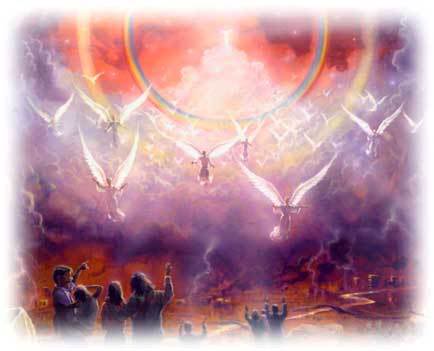
“When the Lord Jesus is revealed from heaven with his mighty angels in flaming fire, inflicting vengeance on those who do not know God and on those who do not obey the gospel of our Lord Jesus.” 2 Thessalonians 1:6b-8
“When he opened the sixth seal, I looked, and behold, there was a great earthquake, and the sun became black as sackcloth, the full moon became like blood, and the stars of the sky fell to the earth as the fig tree sheds its winter fruit when shaken by a gale. The sky vanished like a scroll that is being rolled up, and every mountain and island was removed from its place. Then the kings of the earth and the great ones and the generals and the rich and the powerful, and everyone, slave and free, hid themselves in the caves and among the rocks of the mountains, calling to the mountains and rocks, “Fall on us and hide us from the face of him who is seated on the throne, and from the wrath of the Lamb, for the great day of their wrath has come, and who can stand?”Revelation 6:12-17
Returning to a no-frills practice of following Jesus will be good for all of us. We will remember what our faith is all about. This is why in the last days before Jesus returns He needs to purify His church. Apostasy in denominational churches is rife as demonstrated by the acceptance of gay marriage and homosexual pastors. They no longer believe in the inerrancy of God’s Word. Like the world, they have been caught up in the evolutionary myth of billions of years of Earth’s history. They no longer believe that God judged mankind with the worldwide flood of Noah’s day and yet it is the only explanation for the existence of billions of dead things buried quickly all over the world, including the fossil fuels: coal, oil, and natural gas (the result of buried forests). They have discounted both Noah’s flood and the short timescale of Scripture determined by Genesis 1-11. When you study geology from a biblical standpoint and use the geological model of the Flood to connect the real-world observations of geology you discover it is superior to the prevailing old-earth frameworks in explaining the data. (Biblical Geology 101 by Michael Oard and Robert Carter 2021).
An exciting training development, one which could help us prepare for church without buildings, has gained great popularity in the body of Christ over the past several years by readying people for possible service on the mission field, particularly among Muslims. TOAG, or “Training Ordinary Apprentices to Go,” (Global Mobilisation Network). It seeks to teach people to “do church” in small group settings, away from large worship gatherings that will not be available abroad. Participants spend ten months learning how to reach unreached people groups and develop an authentic community in a small group setting. Families with children are welcomed in, and future workers for Christ are much better prepared than earlier generations of believers. I’ve heard from a few that have participated in TOAG that it is difficult, yet rewarding. The method’s founders state the goal of the training: During TOAG, interns learn to be a Kingdom Community without including Western structures that often hinder movements. They experience life in community with other interns, something more akin to the Book of Acts. By taking them out of present ecclesiastical structures, which include powerful (& professional) music, well-crafted homilies (by highly trained professionals) in safe, comfortable surroundings (expensive buildings), interns experience first-hand what is and is not required for believers to be a ‘Kingdom-Community,’ experimenting with simple, organic structures capable of sharing the life-changing power of God’s Kingdom and reproducing into movements. … These are just some of the reasons why many Americans benefit from the hands-on learning experience of TOAG.
We need to prepare for the prophesied persecution that is coming and expect God to grow us through it as never before. Literally, millions of Christians around the world can testify to this truth, as Paul testified clearly in this Scripture.
“We also glory in our sufferings, because we know that suffering produces perseverance; perseverance, character; and character, hope. And hope does not put us to shame, because God’s love has been poured out into our hearts through the Holy Spirit, who has been given to us.” Romans 5:3-5:
Whether you use TOAG or some other training method you need to get with like-minded believers who understand the times and get into step with what God is calling us to do in these last days to make sure we complete the Great Commission in the community where God has placed us.
Check out http://www.lastdaysovercomer.org for the free ebook Prepare for the Last Days – Fulfilling God’s Purposes at the End of the Age.
The notion of a ‘wet Sahara’ in the recent past is controversial among secular researchers since they struggle to adduce a mechanism to explain it. However, much evidence exists for it and has recently been bolstered by the discovery of ancient shorelines. And unlike the conditions proposed by secular researchers, the conditions produced by a post-Flood Ice Age in the biblical perspective provide mechanisms for explaining the existence of a ‘wet Sahara’. Further, proof of the inerrancy of God’s Word.
Field and satellite pictures record evidence of large ancient lakes and rivers. Paleolake Chad lies at the boundary between the Sahara and the Sahel. Evidence indicates it was once much larger than today, covering an area of 340,000 km2 (130,000 mi2).7 Countless human artifacts, and fossils of large animals, such as elephants, giraffes, buffaloes, antelopes, rhinoceroses, and other animals have been found. In low-lying areas, there are fossils of aquatic animals like hippopotamuses, crocodiles, fish, and clams. These are post-Flood fossils, from the Ice Age period.
Both creation and secular geologists agree that the earth’s deserts and semi-arid areas were once well-watered. Creation scientists largely attribute this to the warmer ocean water just after the Flood, warmed by the enormous volcanic eruptions that took place during the Flood. Warmer oceans generated vast amounts of evaporation, which caused the great ice sheets to build up rapidly over many parts of the world, leading to the Ice Age.
At the same time, the extra water vapour in the atmosphere caused high rainfall at lower latitudes where it was not cold enough to form snow and ice. Thus, the post-Flood Ice Age explains why the earth’s deserts and semi-arid areas were once well-watered.
Judging by the thousands of rock petroglyphs, the population of the Sahara was quite large. James Wellard states: The Sahara is a veritable art gallery of prehistoric paintings. … The evidence is enough to show that the Sahara was one of the well-populated areas of the post-flood world. … in the most inaccessible corners of the desert, [there are] literally thousands of figures of tropical and aquatic animals, enormous herds of cattle, hunters armed with bows and boomerangs, and even ‘domestic’ scenes of women and children and the circular huts in which they lived.
Extract from the article “Ice Age Megalakes did exist in the Sahara” by Michael J. Oard in Journal of Creation Vol 37. Issue 1, 2023




 LIVING ETERNAL NOW