ANCIENT HISTORIANS RECORD A WORLDWIDE FLOOD

by Kenneth C. Griffith and Darrell K. White Published on September 20, 2023 Answers Research Journal 16 (2023): 475–489.

The authors survey the ancient chroniclers for durations to the Flood and to Creation. We find that the ancient chroniclers unanimously placed the Flood in the twenty-fourth century BC. Several durations to Creation also agree with Ussher’s date within ten years (The Ussher chronology is a 17th-century chronology of the history of the world by James Ussher, the Archbishop of Armagh and Primate of All Ireland)

We were surprised to find how closely chroniclers from ancient nations agree with each other and the Ussher chronology. Not only are there precise durations to the Flood and Creation from several civilizations, but a considerable amount of history from the antediluvian era has been preserved, albeit now covered under layers of superstition and idolatry.

The Hindu texts preserve a great deal of chronological and historical data, which has been overlaid and interpreted through the lens of much later Gnosticism. The Hindu word buddha originally meant a sage or prophet, millennia before it came to mean a particular god (Hamilton 1820, 289).

The oldest Hindu texts describe Adam, Enoch, and Noah as buddhas, which originally meant prophets (Hamilton 1820, 114–120). However, they also refer to the first ten generations of prediluvian patriarchs as “avatars” or incarnations of God, (Hamilton 1820, 10) which we obviously reject.

The Chinese remember the first ten patriarchs as legendary emperors, and also preserve surprisingly detailed chronological details about some of them, as well as the history of Noah’s post-flood career.

Stellar Observations: Chinese and Babylonian sources seem to indicate that the earliest astronomical observations after the Flood date back to 2295 B.C. (Spineto 1845, 404). The Shû King records that Emperor Yâo ordered the construction of four observatories as the first priority after the Flood. In Griffith and White (2023), we calculated the date of Yâo’s reign as having begun in 2347 B.C. Some Chinese scholars calculate it as 2357 B.C.

Chinese: Alexander Hamilton states: “the Chinese annalists . . . place the deluge of Yau in the same year that the Hebrews place the flood of Noah, . . .” (Hamilton 1820, 345). This calculation was based on the reigns of the first three post-Flood dynasties, as opposed to astronomical calculations.

Hindu Astrological: “the year 2352 was obtained by the Hindus from a purely astronomical calculation . . . for this implies their opinion that the history of the world went back no further” (Browne 1844, 567). The Flood generally marks the beginning of known world history, as the Hindus considered the era before the Flood as the reign of the gods. Browne suggests this calculation was made in 204 B.C., which happens to be when the vernal equinox was leaving Aries. If so, this suggests the Hindus believed the vernal equinox was in the cusp of Taurus at the time of the Flood. We will repeat what we believe this calculation to have been in the astronomical section of this paper.

Diodorus states that the Egyptian priests maintained that “when mankind first appeared on the earth [after the Flood]; . . . but from the Trojan War, less than twelve hundred [years]” (Diodorus 1935, Book 1, §24.2). Since the Trojan war ended 1184/1183 B.C., less than 1,200 years yields a date below 2383 B.C. for the date of the Flood. Assuming Diodorus rounded to the nearest hundred, the Flood probably occurred between 2383 and 2333 B.C.

Eusebius cites Varro as computing that the Flood was 1,600 years before the Olympic aera, (Eusebius 2002, PrEv. 10.10) which yields 2376 B.C., plus or minus 50 years.

Censorinus dates the flood of Ogyges as less than 1,600 years before the first olympiad (Williams 1789, 250). He seems to have confused the much later flood of Ogyges with the Deluge, as several other Greek sources did with both the floods of Ogyges and Deucalion. This section is confusing; however, he gives values that sum up to between 1,400 to 1,514 years prior to the first Olympiad (Censorinus 2000, 30–31).

Bunsen quotes Censorinus as being more precise: “same year is referred to by Censorinus, about 238 A.D., who states, on the authority of Varro, ‘the most learned of the Romans,’ born 116 B.C., that the Flood took place about the year 2360” (Bunsen 2017, 11).

This Nembrot [Nimrod], says Berosus, built Babylon 130 years after the flood (Raleigh 1829, chapter 8). One hundred and thirty years before 2233 B.C. yields 2363 B.C. However, he may be referring to the Dispersion, in which case, 2191 + 130 yields 2321 B.C.

We find that the sources who used Berossus to determine the date of the Flood measured 1,000 years before the Fall of Troy, and then added 163 years to the date of the Flood. 1184 + 1,000 + 163 = 2347 B.C.

Nevertheless, 2363 B.C. is consistent with the testimonies of Diodorus, Varro, and Censorinus.

Polyhistor used this value also: “a kingdom at Babylon, 163 years after the flood, according to Polyhistor” (Williams 1789, 250).

Assuming that Polyhistor used 1,000 years before the Fall of Troy in 1183 B.C. as the date for the first kingdom in Babylon, then 163 years before 2184 B.C. yields 2347 B.C., matching Ussher’s date for the end of the Flood.

However, according to our triangulations from Griffith and White (2023), the first kingdom in Babylon after the Dispersion started in 2192/2191 B.C., yielding 2354 B.C. for the Flood using this 163-year duration.

756 Years after the Kali Yuga: Confucius dated the Flood as occurring in the 757th year of the Kali Yuga (Hamilton 1820, 316). This value is given as 3,267,000 ages from the Kali Yuga, which, divided by the 4,320-cipher of the Hindus and Chinese, yields 756.25 years (Hamilton 1820, 332). The Hindus calculated time before the Flood in double hours, reported as “years.” We demonstrated that the astronomical date for the Kali Yuga was 3104 B.C. in Griffith and White (2023), by counting from three different events: the Hijrah, the birth of Moses, and the Usurpation of Pradyato, all of which occurred after the Flood. Counting 756 whole years from 3104 B.C. gives 2348 B.C. for the Flood, agreeing exactly with Ussher.

The Deluge occurred in the 47th year of a Grand Cycle: “the world by the Hindus and Chinese, and the commencement of their cycles agree, each placing the deluge in the 47th year of a cycle” (Hamilton 1820, vol. 1, 332). The year 2349/8 was the forty-seventh year of the fourteenth sixty-year cycle from the start of the Grand Cycle in 3176 B.C. (Griffith and White 2023, 151.

Cush’s Reigns: 62/55/42 years: Belus, whom we believe to have been Cush, ruled Babel until 2192/2191 B.C., and is said to have reigned 62 years (Russell 1865, 379) by Scaliger and 55 years by Syncellus quoting Africanus (Clinton 1824, vol. 1, 267), all three of whom were redactors of Ctesias. We believe both values refer to events in the reign of Cush, called Belus, or Bel Marduk.

Cush could only have ruled in the city of Babel from the time it was founded in 2234/2233 B.C. until the Dispersion in 2192/2191 B.C. or 42/43 years, since, “At the end of forty two years after the building of the Tower, Ninus son of Belus took the kingship of the world” (Macalister 1941, §13).

However, the Babel project must have been the result of many years of planning and organization. This is evidenced by its founding on the conjunction of the New Moon with the Vernal Equinox in 2233 B.C. (Cullimore 1833, 167, 180). This suggests they anticipated this conjunction and deliberately waited for this date to establish the city or its temple. Therefore, it is not unreasonable to postulate that Belus/Cush began to rule in some fashion a decade or more before the city was founded.

Cullimore (1833, 165) states “The building of this tower is by profane writers uniformly ascribed to Belus.” Cush’s rule over his tribe would have started earlier when the land was divided around the time of Peleg’s birth. The two longer durations for his length of reign, which predate the founding of Babel, may be explained by two divisions of territory as reported in the Book of Jubilees (Charles 1913, Jubilees 8.8-10).

Berossus gives 34,080 days, which is 93.3 Julian years, or 94.6 years of 360 days then used by ancient Babylon, from the Flood until the first dynasty of Babylon, when by inference, Belus/Cush began to rule. 94.6 plus 62 is 156.6 years; 156 years before the Dispersion in 2192/2191 B.C. yields 2348/2347 B.C. for the Flood, and 2254/2253 B.C. for the First Territorial Division.

The Hindu records give 150 years from the Division of the Earth until the Usurpation of Pradyato (Hamilton 1820, 124). Pradyato was a Cushite who conquered the nascent Indus civilization and took over the government. This Usurpation was also given as 1,000 years after the Kali Yuga. Subtracting 756 years to the Flood from the Kali Yuga, as well as the 150 years of self-rule by the Hindus, we find that the division of the world was 94 years after the Flood began, which is 93 years after the end of the Flood. This triangulates, confirming that our interpretation of the 34,080 days is correct.

Syncellus cites Africanus in his epitome of Ctesias who gives the reign of Belus, whom we consider to have been Cush, as 55 years (Clinton 1824, 267), which by our reckoning would be from the birth of Peleg in 2247 BC (Ussher 2005, 21, §47) to the Dispersion in 2192/2191 B.C. Thus, it appears territorial division may have been a seven-year process that began in 2254 B.C. and was finalized in 2247 B.C., both confirming the Flood was in 2348/2347 B.C. Adding 101 years from the Flood to Peleg in the MT to the 55 years of Belus gives 156 years from the end of the Flood to the Dispersion, again triangulating 2348/2347 B.C. for the Flood.

Semiramis I: 312/313 years: The Annals of Clonmacnoise state that Semiramis’ rule started 313 years after the Great Flood. “Ireland long time after the flood lay waste until . . . after the flood 313 years . . . in the 1st year of the Raigne of Semiramis then monarchs of the world in Assiria” (McGeoghagan 1896, 12–13). The Irish Annals of Clonmacnoise state that Semiramis began to rule 312 years after the Flood (Percy 1823, 270).

2036/2035 BC, AP-21 Reign of Semiramis I; plus, 313 years; gives: 2349/2348 BC for the Flood

Emperor Yâo’s Reign 2347 BC: We found in a previous paper (Griffith and White 2022b, 422) that Yu of the Xia Dynasty of China began to reign in 2197 B.C. His predecessors Yâo and Shun reigned for a total of 150 years. Emperor Yâo’s reign was said to have begun when the Flood had ended.

2197 B.C., AP-4 Reign of Yu/Xia; plus, 150 years of Yâo and Shun; gives: 2347 B.C. end of Flood

BIBLICAL AGE OF THE UNIVERSE

Exodus 20:11—An Insurmountable Stone Wall Against Adding Millions of Years to the Bible

God’s commentary on the Sabbath refutes all long-age theories.

by Dr. Terry Mortenson Sept. 22, 2023, featured in Answers in Depth (www.answersingenesis.org)

In Exodus 20:8–10, God gave the children of Israel the fourth commandment: work for six days and then on the seventh day, take a Sabbath rest. He could have given the command without providing a reason for the command, as he did in the first and the fifth through the tenth commandments and other times when he commanded a Sabbath rest. Or he could have given a different reason for the Sabbath command (e.g., so their animals could rest, to avoid death for disobedience, to humble their souls, to remember their exodus from slavery in Egypt, or simply because he is the Lord. But as in the second and third commands in Exodus 20, God gave a reason for the Sabbath command. The Israelites should work six days and rest on the seventh, “For in six days the Lord made heaven and earth, the sea, and all that is in them, and rested on the seventh day. Therefore the Lord blessed the Sabbath day and made it holy.” And he repeated that reason in Exodus 31:15–17.

In Exodus 20:11, God used the same Hebrew word for “days”11 (yamim, the plural form of yom [day]) that he used in verse nine, showing that God’s days of creation in Genesis 1 were the same kind of days (the same length) as the days of the week for the Israelites. It is doubtful if any faithful Jew ever interpreted it any other way until the idea of millions of years started to take control of people’s minds about two centuries ago.

We should note that if God really created over the course of millions of years (as most Christians around the world today believe), he could have clearly indicated that in the Hebrew. He could have used the Hebrew word dor (דּוֹר), which is translated in English Bibles as time, period, or generation.12 Or he could have borrowed an Aramaic word, as he did in the books of Nehemiah and Daniel, such as zeman (זְמָ֑ן) or iddan (עִדָּן), which are translated as season, time, or period.13 Or he could have used some phrase such as “after many days,”14 “after some years,”15 “after thousands of ten thousand years,”16 or “after years of many generations.”17 But instead, God used the only Hebrew word, yom (יוֹם), which means a literal, 24-hour day, and it means that (or the light portion of a literal, 24-hour day, in contrast to night) in the majority of the 2,320 times it is used in the Old Testament.

One more point for this discussion: Exodus 20:8–11 clearly implies that the days of Genesis 1 (and therefore the events on those six days) are in sequential order, just as the days of a human week are. Sunday always comes before Monday, which always comes before Tuesday, etc. So, in Genesis 1, God created the earth completely covered with water and then he created light (day 1), then the expanse (firmament) to separate the water into two parts (day 2), and then the dry land and all kinds of land plants (day 3). After that, he created the heavenly bodies to serve as timekeepers for man (day 4), then the sea creatures and birds and other flying creatures (day 5), then all the kinds of land animals and, finally, the first man and woman to be the progenitors of mankind (day 6). Given that truth, we can readily see the many contradictions between the order of creation and the order of events in the evolution story.18 We cannot remove those contradictions no matter where we might try to fit millions of years.

It is clear: God created everything in the beginning in six literal, sequential, 24-hour days. The events on those days were not normal but were unique and supernatural as God spoke things into existence (Genesis 1:3691114202426Psalm 33:6–9). He didn’t speak and then wait millions of years for things to happen. But the days were normal days (approximately 24 hours), just like our days, “all the days” of Adam’s 930 years of life (Genesis 5:5), and “all the days” of Noah’s 950 years of life (Genesis 9:29).

No Place to Put the Millions of Years

So, we can’t spread the millions of years over “figurative” or “symbolic” creation “days” (ages), as in the day-age view. And because God equated the human workweek with his creation week, there is no basis for saying that, in Genesis 1, long stretches of time (millions of years) transpired between the literal days, as in the “day-gap-day” view of John Lennox.

But we also can’t fit millions of years before the six literal days, as in the old gap theory, the more recent “promised land” view of John Sailhamer, the view of John Lennox, or the “analogical day” view of C. John Collins. Nor can we fit the millions of years before Genesis 1:1, as in the “cosmic temple view” of John Walton and others. There was no time before the six days, because notice what God said he created in those six days: the heaven,20 the earth, the sea, and all that is in them. He didn’t make anything before the six days. He made everything during those six days. But when did God make the earth according to Genesis 1? He made it in verse 1, not in verse 3, which is where many Christians try to say that the six days begin. So, combining Exodus 20:11 with Genesis 1:1 unmistakably informs us that the six days begin in Genesis 1:1, not in 1:3.

There simply is no place to put millions of years of geological and cosmological time into or before Genesis 1—not in the days, between the days, or before the days of creation. Exodus 20:11 completely rules out those interpretations. There are many biblical, historical, philosophical, and scientific reasons to reject the millions of years, but Exodus 20:11 is a very important biblical reason. Another very important reason that nearly all old-earth proponents ignore is the problem of accepting millions of years of animal predation, death, disease, extinction, and other natural evils. This is seriously incompatible with the Bible’s teaching regarding the original “very good” creation, regarding God’s curse on the whole creation when Adam sinned, and regarding the future removal of the curse on creation when Jesus comes again to create a new heaven and earth.

Evasions of Exodus 20:11

As I said at the beginning, I have found in my reading and experience that most Christians who accept millions of years have not thought very carefully, if at all, about what Exodus 20:11 says in relation to the question of the age of the creation.

To see the truth and importance of Exodus 20:11 more assuredly, let’s now consider how some influential Christian scholars who accept the millions of years have handled this verse.

Through his 1955 book, The Christian View of Science and Scripture, Baptist theologian Bernard Ramm moved many to accept millions of years as he advocated the day-age view of Genesis 1. This is all he said about verse 11 in the fourth commandment: “The argument against the [day-age, progressive-creation] theory on the grounds of Exodus 20:11 is not at all significant. The verse simply means that the human week of seven days takes its rise from the divine week of seven creative epochs.”24 Following the scientific consensus by faith, he had already interpreted the days of Genesis 1 as “epochs.” Then he used this to silence Exodus 20:11. This is not a sound interpretation of Scripture, for he ignored God’s own commentary.

Millard Erickson’s Christian Theology is widely used in seminaries in English and other languages. In his first edition in 1983, he showed no awareness of recent young-earth creationist literature, gave a shallow treatment of the view, and undogmatically leaned toward the day-age view of Genesis 1. But his only mention of Exodus 20:8–11 was not in his chapter on creation but in the chapter on Christology regarding Jesus’ view on keeping the Sabbath. In spite of saying in his 1983 first edition that the subject of creation warranted further study, his third edition in 2013 showed no improvement on his awareness of young-earth literature or our biblical and scientific arguments, and he still ignored Exodus 20:8–11.25

In his book, Genesis in Space and Time, the great apologist Francis Schaeffer devoted merely a single paragraph to the question of the length of the creation days and said he did not know how long they were (p. 57). His book makes no reference to Exodus 20:8–11.

Gleason Archer was a leading evangelical Old Testament scholar in the twentieth century. In an article defending the day-age view, he stated about Exodus 20:11 in regard to the six days of Genesis 1, “By no means does this [verse] demonstrate that 24-hour intervals were involved in the first six ‘days,’ any more than the eight-day celebration of the Feast of Tabernacles proves that the wilderness wanderings under Moses occupied only eight days.” This argument fails because Leviticus 23:33–43 does not connect the number of days of the feast to the number of years Israel wandered in the wilderness. Rather those verses link the command for the Israelites to dwell in booths during the feast with the fact that they dwelt in tents in the wilderness after they left Egypt.

Another influential, twentieth-century Old Testament scholar was E. J. Young. In his Studies in Genesis One, he says that the first chapter of the Bible is a “straightforward trustworthy history.” He asserts that Exodus 20:8–11 tells us the days of creation were “consecutive” and “chronological.” But he says the Bible does not tell us how long the days were and how old the earth is, thereby leaving the door open to the acceptance of millions of years as secular geologists claim.27 It is no surprise then that his son, Davis Young, went on to get his PhD in geology and teach for decades at Calvin College, convincing many students and evangelical theologians to believe in millions of years.

The late John Sailhamer is another prominent evangelical Old Testament professor who has had an impact on many, including John Piper, to accept millions of years. In Genesis Unbound, he argues that Genesis 1:1 refers to the creation of nearly everything over the course of millions of years. But verses 2–31 describe the creation of the promised land (which he equated with the garden of Eden) and the creatures in, above, and around the promised land. He said that Exodus 20:8–11 refers to six literal days of “preparing the [earth’s] sky, the land, and the sea,” but not the earth and universe. His novel interpretation of Genesis is seriously flawed.

The highly respected British apologist John Lennox and well-known Old Testament professor C. John Collins try to evade the implications of Exodus 20:11 by saying that God’s work is different from man’s work. True, unlike man’s work, God’s work in Genesis 1 is supernatural, out-of-nothing, and not repeated, and God doesn’t get tired. But Exodus 20:8–11 is not comparing and contrasting man’s work and God’s work. Rather, the commandment is equating man’s week with God’s week of creation. Lennox and Collins have missed the point completely.

Wayne Grudem is arguably the most influential evangelical theologian in the world as a result of his many helpful writings, especially his Systematic Theology, which is translated into more than 12 major languages. He tries to get around Exodus 20:11 by saying that in the very next verse “‘day’ means ‘a period of time’”—so, since yom is used non-literally in the context, it therefore is not necessarily literal in verse 11. But two points expose the fallacy of this argument. First, yamim (plural of yom and used in 20:8–12) always means literal days everywhere else in the Old Testament. Second, in 20:12 it is not the word “days” (yamim) that is non-literal (figurative). Rather, it is the verb “may be long” (ESV, or “may be prolonged” as in NASB) that is used figuratively. In other words, verse 12 does not mean that if Israelites would keep the Sabbath, they would have longer days (say, 36-hour days) but that they would have many more (literal, 24-hour) days in the promised land to which they were going. Their disobedience would shorten their time of prosperity and residence in the promised land. Their obedience to God would enable them to stay and thrive as a nation in the land for a long time. Verse 12 simply does not say or imply that the six days referred to in Exodus 20:11 are figurative of long periods of time rather than being literal days.

In A Biblical Case for an Old Earth, David Snoke says, “It may sound trite to say that ‘with the Lord one day is as a thousand years’ (2 Peter 3:8; see also Ps. 90:4), but we do well to remember that God’s timing is not always our time.” It is indeed trite and irrelevant. Peter is referring to the second coming of Christ, not defining the length of the days in Genesis 1 or Exodus 20:8–11. Moses’ words in Psalm 90:4 are (in the context of 90:1–3) referring to the eternal nature of God, not defining the days of creation. The rest of Snoke’s argument quotes Leviticus 25:2–11 to say that “the Sabbath law was clearly not restricted to periods of seven twenty-four-hour days. Leviticus 25 gives the Sabbath year law, as well as the Jubilee law, which was a Sabbath of Sabbath years, a period of seven times seven years.”34 Of course Scripture speaks of more than one kind of Sabbath. But those Sabbath years are literal years, just like the Sabbath day of Exodus 20:11 is literal. Furthermore, in Exodus 20:11, the question is not how to interpret “Sabbath” but “day.” And the Israelites did not have or take the liberty of deciding whether they would work six literal days before a Sabbath rest or work six long, indefinite periods of time and then rest a seventh long, indefinite period of time. Leviticus 25 is as irrelevant to the correct meaning of Exodus 20:11 as is 2 Peter 3:8 and Psalm 90:4.

John Walton is a famous Old Testament scholar at Wheaton College. His influence in the church is growing in America as well as in other countries. In his book, The Lost World of Genesis One, he argues that God didn’t create anything in Genesis 1—it is not an account of material origins. Rather, he says, it is a description of God giving or assigning function to a preexisting creation. Everything was created before Genesis 1:1, and the Bible is silent about when and how God created. So, he contends, we can accept whatever the scientific majority says is true about the origin and history of the creation. His brief comments about Exodus 20:11 focus completely on persuading his readers that “made” (asah, עָשָׂה) means “gave function to” or “assigned function to” something that was made earlier. Walton’s view fails on so many points. He assumes cosmological, geological, and biological evolution over millions of years are proven scientific facts, which they are not. He assumes that all Ancient Near-Eastern cultures had the same worldview and that ancient Israelites shared that view, which they did not. And then he uses the ancient pagan thinking as the grid through which he interprets Genesis 1–11. Furthermore, Genesis 1 does not say that God transformed the preexisting creation to become a cosmic temple in which to reside. In fact, Isaiah 66:1–2 says,

Thus says the Lord: “Heaven is my throne, and the earth is my footstool; what is the house that you would build for me, and what is the place of my rest? All these things my hand has made, and so all these things came to be, declares the Lord. But this is the one to whom I will look: he who is humble and contrite in spirit and trembles at my word.”

Walton and others using the same hermeneutical approach are “trembling at” (believing) the words of scientists, rather than humbly trembling at (believing) the Word of God.

Furthermore, Genesis 1:14 says that the sun, moon, and stars were to serve a function—for man to measure time (literal days, years, and seasons). God assigns a function for Adam and Eve—to rule over the creation (1:28). But God doesn’t assign a function for the firmament (made on day 2), or for sea creatures, birds, or land animals (made on days 5 and 6). And Genesis 1 says nothing about the creation functioning as a cosmic temple at the end of day 6. But also, if God really created the sun, moon, and stars to exist for billions of years before man (as Walton believes), then for most of their existence, they did not fulfill the purpose for which he created them. Or are we to think that, for billions of years, the heavenly bodies also did not function to separate the day and night until God gave them that function just before he created Adam and Eve? Isaiah 45:12 and 18 says that God created the earth to be inhabited by man. So, if God really created the earth 4.5 billion years before man, it did not fulfill the purpose to which God created it. What kind of God declares purposes like this and then waits billions of years to fulfill it? Not the God revealed in Scripture. Neither Genesis 1 nor Exodus 20:11 says or even suggests, “For in six days, God gave function to the heavens and the earth and the sea and all that is in them which he had made before the six days.”

Finally, I want to comment on Hugh Ross’ handling of Exodus 20:11, because so many Christian leaders and scholars have endorsed his work that promotes the acceptance of the big bang, billions of years, death before the fall, and a local flood of Noah. Ross tries to neutralize this verse with two points. First, he says that of the five passages addressing the Sabbath command, three make no connection to God’s creation week and man’s week. But that doesn’t tell us anything about the meaning of Exodus 20:11 (and 31:17) which does make that connection. The fact that God gives more than one reason (or no reason) for keeping the Sabbath, does not negate the reason he gives in Exodus 20:11 and 31:17.

He then says, “For the remaining two passages, the ‘proof’ would hold only if neither the word for ‘day’ nor the word for ‘Sabbath’ were ever used with reference to any time period other than 24 hours.” Relying on Archer’s fallacious argument about the Feast of Tabernacles (noted above), Ross says there is more than one kind of Sabbath (e.g., a Sabbath day, a Sabbath year), just as in his many writings he contends that yom (“day”) doesn’t always mean a literal day, which young-earth creationists have always acknowledged. And so he says, “day” and “sabbath” in Exodus 20:11 can be understood to allow Christians to insert billions of years into Genesis 1.

But sound Bible interpretation is not done by looking up all the possible meanings of a word and then picking the one we want to insert into the verse(s) we are studying. That is eisegesis (reading into Scripture our opinion or belief), not exegesis (reading out of Scripture what God wants us to understand, do, or believe). No, we correctly interpret the Bible by looking at the context around the word in the verse(s) we are studying and by considering other verses that relate directly to that verse. When we do that, it is obvious biblically that the days of Genesis 1 and Exodus 20:8–11 are literal, normal, 24-hour days.

Conclusion

More attempts to ignore or evade the clear truth of Exodus 20:11 could be discussed. But the failed attempts discussed here reinforce the obviously correct interpretation. God made everything in the beginning in six literal, normal days just like ours.

It should also be noted that nobody has any trouble understanding the other nine commandments (although everyone has trouble obeying all of them). So, why all the convoluted arguments in order to explain away the obvious meaning of Exodus 20:11? Because these Christians have allowed the scientific consensus (i.e., the majority view of geologists and astrophysicists) about the age of creation to control their interpretation of God’s Word. The fallible opinions of sinful human beings (who don’t know everything, who make mistakes requiring revisions of their textbooks, and who weren’t there to observe the origin and history of the creation) have trumped the inerrant Word of our eternal, omnipresent, omniscient, infallible Creator in their mind.

If God really created over millions of years, then Exodus 20:8–11 could not be more misleading. Conversely, if God did create in six literal days, he could not be more clear in this commandment and in Genesis 1.

Exodus 20:11 stands as an insurmountable stone wall against any attempt to fit millions of years anywhere into Genesis 1, either in the days, between the days, or before the days of creation. And Scripture is clear that those literal days of creation were just a little more than 6,000 years ago

BUILDING A RIGHT WORLDVIEW

How can we build the right worldview? There is only one way and that is to start with the origins of this complex universe with its multitude of living things that require many scientific laws to make it function correctly. Those inter-related laws could not have constructed themselves. Science has discovered that DNA (complex information) controls all of the machinery in living cells instructing them what to do. Both the information and the machinery have to be complete and functional at the beginning. They cannot evolve. Moreover, information only comes from intelligence, not matter or energy, hence proof there is an Intelligent Designer. Even better still the Intelligent Designer has revealed Himself to us both by Word, and the person of Jesus Christ, God incarnate.

Down through the ages God has spoken to and worked with individuals so we know He created us in His image to be in a relationship with Him. As a result, we have His Word (Bible) most of which is now fulfilled prophecies so that we know it is God’s Word and that the many end times prophecies will also be fulfilled.

Why is church attendance decreasing SO drastically? In this presentation, Ken Ham discusses the mass exodus that churches are experiencing in Western society and what Christians can do about it.

Ken Ham’s talk is based on his book, Divided Nation: Cultures in Chaos and a Conflicted Church. The good news is that there is a link to download Ken’s slides (in four different formats) so you can use them to help get this message of biblical authority out to more believers! He also includes notes with each slide. You can find that resource on the Answers in Genesis online bookstore.

THE REAL ORIGIN AND HISTORY OF THE WORLD AND MANKIND

Part of this real history is the bad news that the rebellion of the first man, Adam, against God’s command, brought death, suffering, and separation from God into this world. We see the results all around us. All of Adam’s descendants are sinful from conception (Psalm 51:5) and have themselves entered into this rebellion (sin). They, therefore, cannot live with a holy God but are condemned to separation from God. The Bible says that “all have sinned, and come short of the glory of God” (Romans 3:23) and that all are therefore subject to “everlasting destruction from the presence of the Lord and from the glory of His power” (2 Thessalonians 1:9).

 The good news is that God has done something about it. “For God so loved the world, that He gave His only begotten Son, that whoever believes in Him should not perish, but have everlasting life” (John 3:16). Jesus Christ the Creator, God the Son, though totally sinless, took on human nature, so He could become our Redeemer. Then He suffered, on behalf of mankind, the penalty of mankind’s sin, which is death and separation from God. He did this to satisfy the righteous demands of the holiness and justice of God, His Father. Jesus was the perfect sacrifice; He died on a cross, but on the third day, He rose again, conquering death, so that all who truly believe in Him, repent (repentance = a change of mind) of their sin and trust in Him (rather than their own merit), are able to come back to God and live for eternity with their Creator.

Sadly, the world no longer takes the Bible as God’s Word divinely inspired by its Creator. Despite the overwhelming evidence of a worldwide flood: billions of dead things were buried quickly all over the world including abundant fossil fuels formed from buried vegetation, we do not want to believe there is a God to whom we are responsible for our actions. A god who judged the world just 4,000 years ago with the worldwide flood of Noah’s day. Look at the following two prophetic Scriptures written over two thousand years ago telling us that what we see happening in the world today will happen.

You should remember the predictions of the holy prophets and the commandment of the Lord and Savior through your apostles, knowing this first of all, that scoffers will come in the last days with scoffing, following their own sinful desires. They will say, “Where is the promise of his coming?For they deliberately overlook this fact, that the heavens existed long ago, and the earth was formed out of water and through water by the word of God, and that by means of these, the world that then existed was deluged with water and perished.2 Peter 3:2-3,5-6

But you must remember, beloved, the predictions of the apostles of our Lord Jesus Christ. They said to you, “In the last time there will be scoffers, following their own ungodly passions.” It is these who cause divisions, worldly people, devoid of the Spirit.Jude 1:17-19

Jesus came to earth, two thousand years ago, to redeem us and there were 300-plus prophecies to warn the religious leaders of the day but they missed it. Likewise, there are almost 2000 Biblical prophecies about Jesus’ soon second coming to earth and many of the religious leaders of our day are missing it. Jesus is coming to take believers to heaven for a period whilst God pours out His wrath a second time on an unrepentant world. The end times Biblical prophecies are already playing out in our day and we are not too far off the prophesied last seven years of this age. The Bible gives us a lot of information about the events that will occur during those last seven years. Make sure you take advantage of God’s offer of redemption in Jesus Christ and avoid the coming wrath of God.

When the Lord Jesus is revealed from heaven with his mighty angels in flaming fire, inflicting vengeance on those who do not know God and on those who do not obey the gospel of our Lord Jesus.2 Thessalonians 1:6b-8

When he opened the sixth seal, I looked, and behold, there was a great earthquake, and the sun became black as sackcloth, the full moon became like blood, and the stars of the sky fell to the earth as the fig tree sheds its winter fruit when shaken by a gale. The sky vanished like a scroll that is being rolled up, and every mountain and island was removed from its place. Then the kings of the earth and the great ones and the generals and the rich and the powerful, and everyone, slave and free, hid themselves in the caves and among the rocks of the mountains, calling to the mountains and rocks, “Fall on us and hide us from the face of him who is seated on the throne, and from the wrath of the Lamb, for the great day of their wrath has come, and who can stand?” Revelation 6:12-17

LOCATION OF SOLOMONS TEMPLE

Many Christians now believe that Solomon’s Temple was located in the City of David, rather than in the traditional location on the Temple Mount. I have posted previously on Martin and Conuke’s findings supporting the old city of David site for Solomons’ temple.

Ernest Martin sparked the alternate temple site movement when he published The Temples that Jerusalem Forgot in 2000. Bob Cornuke published Temple in 2014 to promote the same idea, although with a much smaller temple and temple mount. Both authors claim to be following the Bible, historical sources, and archaeology to uncover truths that have been forgotten for centuries. However, when we compare their claims to the Bible, history, and archaeology, we find that Martin and Cornuke have been highly selective in their use of each of these sources. While a more detailed article is forthcoming from AIG that addresses many of the major arguments for this position, this brief article will highlight a few examples of where these alternate temple site proponents misuse Scripture, history, and archaeology. We will also see the impossibility of placing the temple in the city of David as Martin and Cornuke advocate.

Moreover, I believe that AIG debunked all of the myths that attempted to prove their claims, and I suggest you go to the AIG website to see the evidence.

Then Solomon began to build the house of the Lord in Jerusalem on Mount Moriah, where the Lord had appeared to David his father, at the place that David had appointed, on the threshing floor of Ornan the Jebusite.2 Chronicles 3:1

According to this verse, Solomon built the temple on Mount Moriah. Since this is so clearly stated in the text, one would expect Martin and Cornuke to discuss this fact, but they do not. Martin does not mention the verse in his nearly 500-page book. He even includes a chapter titled “Where Did Solomon Build the Temple?” in which he does not cite a single verse of Scripture. Instead, he wrote nine pages to debate the meaning of a passage from Josephus that is not even about the temple’s location.

UNDERSTANDING THE TIMES WE LIVE IN

If the foundations are destroyed what can the righteous do?Psalms 11:3

God has raised up Answers in Genesis for a time such as this to re-establish the foundations of the true history of planet Earth. I am delighted to learn that Martin Isles has joined Answers in Genesis. Martin was previously with Australian Christian Lobby (ACL) and God used him mightily to preach the Gospel in all States of this country.

There is no doubt that Satan has used the big lies that the Big Bang was the cause of the universe and evolution (natural selection and mutations) as the mechanism for the existence of all that lives on this planet. And yet so many aspects of evolution are scientifically impossible (e.g. nobody has proposed a tenable natural way that any of the following could have occurred: the requisite proteins for the first cell, or DNA, or DNA arranged in a useful code, or structures that can read and act on encoded DNA, or single-celled organisms transitioning to multi-celled, or asexual reproduction transitioning to sexual, etc

Despite all the evidence for intelligent design in the Cosmos, God’s history for His cosmos and for the people He made in His image has been discarded as myth and fables. You destroy the foundations established in Genesis and there is no need for our Saviour, Jesus Christ:

  1. God created a perfect world with Adam and Eve made in His image to be in a relationship with Him.
  2. Adam and Eve disobeyed God bringing God’s judgement on the world – separation from God and death and suffering. This truth is foundational to the Gospel of Jesus Christ.

But we see Him who for a little while was made lower than the angels, namely Jesus, crowned with glory and honor because of the suffering of death, so that by the grace of God He might taste death for everyone. For it was fitting that He, for whom and by whom all things exist, in bringing many sons to glory, should make the founder of their salvation perfect through suffering.Hebrews 2:9-10

The answers we need to understand the times we live in are found in Genesis hence Martyn is right where God needs him with Answers in Genesis.

DARWINIAN EVOLUTION PREPOSTEROUS

It is mathematically preposterous to infer macroevolutionary developments from microevolutionary observations according to Dr Olen R. Brown, Dalton Cardiovascular Research Center, University of Missouri- Columbia, USA, and, David A. Hullender, Professor of Mechanical and Aerospace Engineering at the University of Texas at Arlington, US.

This new evidence is from an article “Neo-Darwinism must Mutate to Survive” by Brown and Hullender in an international journal called Progress in Biophysics and Molecular Biology, which is a peer-reviewed publication established in 1950. It seeks to offer “informative and critical reviews of recent advances in different aspects of biophysics and molecular biology.

ABSTRACT

Darwinian evolution is a nineteenth-century descriptive concept that itself has evolved. Selection by survival of the fittest was a captivating idea. Microevolution was biologically and empirically verified by the discovery of mutations. There has been limited progress to the modern synthesis. The central focus of this perspective is to provide evidence to document that selection based on survival of the fittest is insufficient for other than microevolution. Realistic probability calculations based on probabilities associated with microevolution are presented. However, macroevolution (required for all speciation events and the complexifications appearing in the Cambrian explosion) is shown to be probabilistically highly implausible (on the order of 10−50) when based on selection by survival of the fittest. We conclude that macroevolution via survival of the fittest is not salvageable by arguments for random genetic drift and other proposed mechanisms. Evolutionary biology is relevant to cancer mechanisms with significance beyond academics. We challenge evolutionary biology to advance boldly beyond the inadequacies of the modern synthesis toward a unifying theory modeled after the Grand Unified Theory in physics. This should include the possibility of a fifth force in nature. Mathematics should be rigorously applied to current and future evolutionary empirical discoveries. We present justification that molecular biology and biochemistry must evolve to aeon (life) chemistry that acknowledges the uniqueness of enzymes for life. To evolve, biological evolution must face the known deficiencies, especially the limitations of the concept of survival of the fittest, and seek solutions in Eigen’s concept of self-organization, Schrödinger’s negentropy, and novel approaches.

Something essential is missing in the theory of biological evolution (Neo-Darwinism)

Any overall mechanistic explanation of the origin and evolution of life ultimately must satisfy two challenges: the transition from non-life to life, and the blossoming of life forms that are so extreme as to appear outrageous. The evolution of a few flowers on a hillside is reasonably explained by mutation and selection; it stretches logic to explain the millions of extremely diverse species seen currently and in the fossil record. It is difficult to conceptualize an insect that is novel or more…

A way forward

An example of the application of mathematics to a difficult science problem was the Drake equation which estimated the number of alien civilizations capable of radio communication with Earth (Loeffler, n.d.). Carl Sagan popularized it on the PBS broadcast Cosmos. Drake and his equation contributed significantly to the founding of the Search for Extraterrestrial Life (SETI). We propose an equation, modeled after the Drake equation, to stimulate thought about evolution probabilities (Eq. (1)). The …

Probability of evolution

Probability, like any scientific analysis, has limitations. Because evolution is generally accepted as scientifically established, probability assessment has largely been overlooked; it happened, we are here, so the probability is one. Evolutionary probability generally is said to be supported by the statement that billions of years make evolution possible. However, this overlooks the fact that time is a linear factor and evolutionary probability inevitability involves exponentials that are …

Self-organization is hidden in life chemistry

Manfred Eigen, a Nobel Laureate, and member of the Pontifical Academy, introduced the concept of the self-organizing power of matter into biological evolutionary theory (“Manfred Eigen: From relaxation kinetics to evolution,” 2018). His 59-page article titled Self-organization of Matter and the Evolution of Biological Macromolecules (Eigen, n.d.) was published in 1971. Eigen did more than anyone before or since to apply mathematics to evolution. Throughout the paper, Eigen supports the narrative with …

The enzyme is essential for life

Life is the most unimaginable state of matter. For growth and replication, energy is essential. The cell is chemically far from equilibrium and maintained by intricately complex processes that require enzymes to make required chemical changes. All life forms use ATP as the ultimate energy source to pull reactions in favoured ways essential to life. The human, amazingly, using the power of enzymes makes approximately 450 pounds of ATP each day according to L. M. Krauss (2001). This requires that …

Aeon chemistry

As “the something” additional required to explain life we propose that the concept of life chemistry (aeon chemistry – meaning vital or life chemistry) be used for the biochemistry within cells that has the appearance of being directed or vital. The difference is not subtle; it cannot be avoided with intellectual honesty. Life, and most certainly its evolution, involves direction (for example, the descent of humans from a common ancestor). It is irrational to believe that chemistry to form a rock or a …

New physics and a fifth force in nature?

The long-awaited first results from the Muon g-2 experiment at the U.S. Department of Energy’s Fermi National Accelerator Laboratory are now available (UW News staff, n.d.). The data show fundamental particles called muons acting in ways not predicted by the current best theory, the Standard Model of particle physics. The finding is of tremendous significance. The result, made with unprecedented precision, confirms a discrepancy that has been concerning researchers for decades. Although it is…

Conclusions

Biology originated as a descriptive science; it has progressed to an empirical stage, and now it is time to retain both while boldly progressing into a theoretical phase. Microevolution is probabilistically realistic; macroevolution is not, and this is documented empirically. Biological evolution should be challenged with four objectives: (1) to redefine the limitations of survival of the fittest (natural selection) to explain what is fundamentally established and creatively to seek and define…

Article “Neo-Darwinism must Mutate to survive” by Dr Olen R. Brown, Dalton Cardiovascular Research Center, University of Missouri- Columbia, USA and, David A. Hullender, Professor of Mechanical and Aerospace Engineering at the University of Texas at Arlington, US – https://www.sciencedirect.com/journal/progress-in-biophysics-and-molecular-biology

BIBLICAL HISTORY – POST FLOOD 2

The chart below shows the generations from Shem to the establishment of God’s nation Israel with the covenant God made with Abraham down to Jesus entering history 64 generations from the time God judged the world with the flood of Noah’s day. The new name God gave to Jacob, Israel, expresses the concept of wrestling, clinging firmly to God, and overcoming. God confirmed his covenant with Jacob, indicating that Israel is to be understood as Jacob’s covenant name. After all his original name was hardly appropriate. When born, Jacob is given the name “Jacob” meaning, “trickster, supplanter, heel grabber.”

WhatWhoGenerations from Shem
SemitesShem0
HebrewsEber3
Father of the faithAbraham (down through Isaac)9
IsraelitesJacob renamed Israel11
Jews (Judaism)Judah12
Christians (including Messianic Jews)Jesus64
These are the clans of the sons of Noah, according to their genealogies, in their nations, and from these, the nations spread abroad on the earth after the flood.

Shem was still alive at the time of the confusion of languages at the Tower of Babel and its aftermath. No longer was there just one speech, but multiple complex languages miraculously arose according to families (Genesis 11:1, 9), whose members would be fluent in their own (new) language (Genesis 10:5, 20, 31).

Languages are grouped into families; linguists recognize about 20 main ones. Germanic languages (e.g. English, Dutch, German, and Swedish) are part of the Indo-European (traditionally Japhetic) language family. Semitic languages are part of the Afro-Asiatic family (previously called Hamito-Semitic).

If evolution were true, we would expect all language families to be related. However, linguist Dr Paul Lawrence states, “languages within a language family have many common features, surprisingly few of these features are shared with languages from another language family, suggesting that the protolanguages and progenitors of modern isolates arose at the original confusion of languages.”

Semitic languages (74) include Arabic (South Semitic) and Hebrew (together with Aramaic, Canaanite, and others categorized as West Semitic languages).

Both are written from right to left, with the Arabic alphabet having six more letters than Hebrew’s 22. The consonants common to both are often named similarly. Neither alphabet has symbols for vowels. Many words are made of a root of three consonants which can be modified to form variations on that word. Around 60% of the vocabulary is related.

The Semitic group shows generally a loss of complexity over time while remaining more complex than English. One example is Akkadian (extinct East Semitic).

Based on evolution, it would be expected that going back in time, languages would be found to be simpler. The opposite is the case. For example, nouns in English and Dutch—both Germanic languages—had several cases in the past, but these are now almost entirely gone. New High German still possesses cases, but not as many as Old High German, for example.

Biblical history provides answers for all the reasons the world is as it is today. The many fulfilled Biblical prophecies also provide ample evidence Biblical history is true. They are also the reason why we can expect the many prophecies of Jesus’ second coming to be fulfilled exactly as outlined in both the O.T. and N.T., particularly in Daniel’s 70 weeks prophecy, Jesus Olivet Discourse, and Revelation. The following Scriptures are to whet your appetite for all the gems that are in the Bible concerning Jesus’ second coming and the end of Satan’s rule on this earth. Next is Jesus and the Saints ruling on this earth for 1000 years – Jesus’ Millennial Kingdom. Go to http://www.millennialkingdom.net for more information on what comes next on God’s agenda.

DANIEL’S 70 WEEKS

Seventy weeks are decreed about your people and your holy city, to finish the transgression, to put an end to sin, and to atone for iniquity, to bring in everlasting righteousness, to seal both vision and prophet and to anoint a most holy place. Know therefore and understand that from the going out of the word to restore and build Jerusalem to the coming of an anointed one, a prince, there shall be seven weeks. Then for sixty-two weeks, it shall be built again with squares and moat, but in a troubled time. And after the sixty-two weeks, an anointed one shall be cut off and shall have nothing. And the people of the prince who is to come shall destroy the city and the sanctuary. Its end shall come with a flood, and to the end, there shall be war. Desolations are decreed. And he shall make a strong covenant with many for one week, and for half of the week, he shall put an end to sacrifice and offering. And on the wing of abominations shall come one who makes desolate, until the decreed end is poured out on the desolator.” Daniel 9:24-27

OLIVET DISCOURSE

As he (Jesus) sat on the Mount of Olives, the disciples came to him privately, saying, “Tell us, when will these things be, and what will be the sign of your coming and of the end of the age?” And Jesus answered them, “See that no one leads you astray. For many will come in my name, saying, ‘I am the Christ,’ and they will lead many astray. And you will hear of wars and rumors of wars. See that you are not alarmed, for this must take place, but the end is not yet. For nation will rise against nation, and kingdom against kingdom, and there will be famines and earthquakes in various places. All these are but the beginning of the birth pains.
“Then they will deliver you up to tribulation and put you to death, and you will be hated by all nations for my name’s sake. And then many will fall away and betray one another and hate one another. And many false prophets will arise and lead many astray. And because lawlessness will be increased, the love of many will grow cold. But the one who endures to the end will be saved. And this gospel of the kingdom will be proclaimed throughout the whole world as a testimony to all nations, and then the end will come.
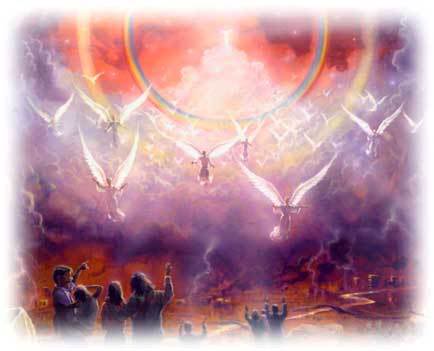
.. “Immediately after the tribulation of those days the sun will be darkened, and the moon will not give its light, and the stars will fall from heaven, and the powers of the heavens will be shaken. Then will appear in heaven the sign of the Son of Man, and then all the tribes of the earth will mourn, and they will see the Son of Man coming on the clouds of heaven with power and great glory. And He will send out his angels with a loud trumpet call, and they will gather his elect from the four winds, from one end of heaven to the other.” Matthew 24:3-14,29-31

REVELATION: SAINTS RAPTURED – STANDING IN TRANSFIGURED BODIES BEFORE GOD’S THRONE

After this, I looked, and behold, a great multitude that no one could number, from every nation, from all tribes and peoples and languages, standing before the throne and before the Lamb, clothed in white robes, with palm branches in their hands, and crying out with a loud voice, “Salvation belongs to our God who sits on the throne, and to the Lamb!” And all the angels were standing around the throne and around the elders and the four living creatures, and they fell on their faces before the throne and worshiped God, saying, “Amen! Blessing and glory and wisdom and thanksgiving and honor and power and might be to our God forever and ever! Amen.”
Then one of the elders addressed me, saying, “Who are these, clothed in white robes, and from where have they come?” I said to him, “Sir, you know.” And he said to me, “These are the ones coming out of the great tribulation. They have washed their robes and made them white in the blood of the Lamb.
Revelation 7:9-14

For this, we declare to you by a word from the Lord, that we who are alive, who are left until the coming of the Lord, will not precede those who have fallen asleep. For the Lord himself will descend from heaven with a cry of command, with the voice of an archangel, and with the sound of the trumpet of God. And the dead in Christ will rise first. Then we who are alive, who are left, will be caught up together with them in the clouds to meet the Lord in the air, and so we will always be with the Lord. Therefore encourage one another with these words.” 1 Thessalonians 4:15-18

HISTORICAL VALIDITY OF JESUS CHRIST

JESUS’ HISTORICAL VALIDITY

Does HISTORY really validate the New Testament Gospels to be true about Jesus: His first coming, His crucifixion, His resurrection, His coming again?

Non-Christian ancient sources confirm details of Christ’s death and some of His resurrection. Dr. Gary Habermas catalogued over 3,400 sources, many of whom are sceptical, or even critical of Christians, adding to their veracity. Here are seven of the three thousand four hundred: 1. Josephus 37-100 AD, 2. Suetonius 70-160 AD, 3. Pliny the Younger 61-113 AD, 4. Tacitus 56-120 AD, 5. Mara Bar-Serapion 72 AD, 6. Lucian 125-180 AD, 7. Babylonian Talmud. They all confirm key points of the gospel

1. Jesus died by crucifixion; 2. He was buried; 3. His death caused the disciples to despair and lose hope; 4. The tomb was empty three days later. 5. Hundreds of people saw the resurrected Jesus.

After Jesus’ resurrection, all of His disciples saw Him and had many experiences with Him, “for over 40 days” (Acts 1:3) – eating with Jesus in different places, and lastly watching Jesus ascend off the earth – “as they were looking on, He was lifted up, and a cloud took Him out of their sight” (Acts 1:9).

Rome’s most prominent Jewish historian, Flavius Josephus (37-100 AD) wrote about the resurrection of Jesus. He also recorded Jesus’ 12 apostles and many of Jesus’ disciples (1 Cor. 15:1-9) all went to their deaths, most as martyrs for continually claiming Jesus’ resurrection (1 John 1:1-4). Some people have died for what was a lie – but no one, much less hundreds, will die for what they ALL KNOW is a lie! The apostles and Jesus’ disciples all preached Jesus’ resurrection up to the time of their deaths.

Today – anyone can find out if Jesus is alive! Jesus made it possible for our Heavenly Father to send the Third Person of the Trinity, the Holy Spirit, to indwell the spirit of everyone who repents of their sins against God and accepts Jesus as their Lord and Saviour. The Holy Spirit is their counsellor, teacher, and comforter.

The spirit of man is the lamp of the Lord, searching all his innermost parts.” Proverbs 20:27

The spirit of a person was always meant to be filled with the Holy Spirit. The lamp of the Lord cannot function without the oil of the Holy Spirit. The Holy Spirit will convict us of sin. It is His job to make us like Jesus to enable us to be Jesus’ ambassadors on the earth.

“However, you are not in the flesh but in the Spirit, if indeed the Spirit of God dwells in you But if anyone does not have the Spirit of Christ, he does not belong to Him. If Christ is in you, though the body is dead because of sin, yet the spirit is alive because of righteousness. But if the Spirit of Him who raised Jesus from the dead dwells in you, He who raised Christ Jesus from the dead will also give life to your mortal bodies through His Spirit who dwells in you.” Romans 8:9-11 

Thousands of Christians have beemartyred for not denying their loyalty to Jesus Christ and many more will do so before His return. Jesus has warned us beforehand that prior to His return there will be a time of great tribulation for Christians.

There need be no question, historically or personally, about the resurrection of Jesus. If someone is willing to receive Him as their own personal Lord and Saviour they will receive the third person of the Trinity, the Holy Spirit who will testify to the reality of Jesus and God the Father.   

The detail on the historical sources of Jesus’ life, death and resurrection was sourced from material provided by Jim McCotter – jimsbookstore.com

BIBLICAL HISTORY – POST FLOOD

The Bible’s history provides the only true explanation for the world that exists today. We know from Egypt’s history that the eight people that survived God’s judgement of the worldwide flood of Noah’s day were deified as the OGDOAD. One of the reasons they were deified as gods was because they outlived at least 8 generations of post-flood people. God had reduced the post-flood people’s lifespan to a max of 120 years. The other reason being they were the only source of all of the knowledge of the pre-flood people which included building cities and forging with bronze and iron.

Cain knew his wife, and she conceived and bore Enoch. When he built a city, he called the name of the city after the name of his son, Enoch… To Enoch was born Irad, and Irad fathered Mehujael, and Mehujael fathered Methushael, and Methushael fathered Lamech. (Lamech’s wife Adah bore Jabal), His brother’s name was Jubal; he was the father of all those who play the lyre and pipe. Zillah also bore Tubal-cain; he was the forger of all instruments of bronze and iron.Genesis 4:17-22

The picture below depicts the eight people (Noah and his family) in a boat being held up by God (Atum) so that they survived the worldwide flood. To learn more, if you have not already done so, can I suggest you take a look at my post on March 14th, 2023 titled Biblical History: 1. Impact of the worldwide flood on Nations. 2. God established His nation Israel.

The meaning of Shem

Jesus descended from Noah’s son Shem. Shem means ‘name’ (reputation). It also denotes a person’s whole selfhood, their presence—which is why it was God’s “name” that dwelt in the temple (2 Chronicles 7:16). How fitting that Jesus descended from the one called “name”, as the perfect and whole representation of God, to dwell among us!

The eight people off the Ark lived long lives just as all pre-flood people did. Shem lived at least 600 years and was probably 450 years old when he met Abraham. Shem was still alive when Isaac was born—his great (8×) grandson. If they lived close enough for a family visit, Shem could have chatted with Isaac (and any of the generations in between still alive) and told them about the world before the Flood. For example, he might have shared how much more common dinosaurs were in the days prior to the Deluge, and that there weren’t any really high mountains to speak of, nor the Arctic and Antarctic of today covered in ice.

The unique biblical post-flood Ice Age model solves the stubborn mysteries of earth science that secular scientists have been wrestling with for some 200 years. The Genesis Flood explains why the Ice Age began, why it stopped, and how it took only hundreds of years, not hundreds of thousands. The Ice Age model solves other mysteries such as the life and death of the woolly mammoth in Siberia, Alaska, and Canada’s Yukon Territory; the end-Ice-Age mass extinction of animals; the mix of warm and cold-climate animals and plants; and why today’s dry areas (e.g. the Sahara, Central Australia) were once well-watered. See the article The Unique Post-Flood Ice Age by Michael Oard (www.creation.com)

In another post, we will look at the fact these eight people off the Ark would have lived through the Tower of Babel event when God created the nations by causing different family groups to speak different languages and so separated and dispersed over all of the earth.