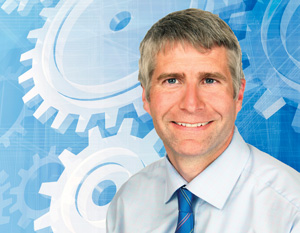

Prof Stuart Burgess & intricate design of the Envisat ESA satellite drive shaft – nothing compared to the design in nature.
A world expert on biomimetrics (imitating design in nature), Prof. Stuart Burgess, BSc, PhD(Brun), CEng, FIMechE, is Professor of Engineering Design, Department of Mechanical Engineering, University of Bristol (UK).
Dr Burgess is the author of over 40 papers published in secular science journals, and another 50 conference proceedings. He has also registered 7 patents.
Is it more difficult for engineers—who spend so much time considering designed objects – to embrace Darwinian evolution than it is for biologists?
Stuart explains: “Yes, for two reasons. Firstly, since the design by human beings is not limited by the step-by-step change that evolution is limited by, human engineers should produce designs which are far more sophisticated than those found in nature. Yet the opposite is true. Nature has by far the most sophisticated designs. A second reason is that engineers know that you cannot design by making random mistakes. If you randomly change a single parameter in a car engine it will always result in a retrograde step. Design improvements always require careful planning and careful changing of many parameters at the same time.”
Stuart has ample experience of this, including working on the design of a solar array for the hugely expensive Envisat ESA satellite, as he explains:
“The Envisat satellite cost £1.6 billion4 and has hundreds of thousands of components and several million separate pieces of design information, like dimensions and material properties. It would only have taken one or two errors in the design information and the whole mission would have failed. This kind of project illustrates how difficult design is and how design does not happen by chance.”
This brings us to the nub of the issue—whether or not we are the purposeful Creation of Almighty God?
Stuart explains how his Christian faith connects with the work he has been involved in all these years.
“Engineering is a great profession for a Christian because it involves creativity. Man’s ability to create is one aspect of our being made in the image of God. The difficulty of designing and building things that are relatively simple makes you realize how great is the wisdom and power of God who has made all things.”
What would he say to those who argue that one’s Christian faith and convictions about the Gospel of the Lord Jesus Christ are largely separate from the issue of origins, and separate from the meaning of the text in the early chapters of Genesis?
“The doctrine of Special Creation is important because it helps remind people there is a personal Creator who was involved in the detailed design of man. Believing in Special Creation also helps people to appreciate God’s skill in creating such a vast array of intricate plants and creatures. I think it is very important to believe in a historical Adam and historical Eve. If you start to compromise by, for example, accepting evolution and ape-men, then the theological problems are very serious. If Adam and Eve were descended from an ape-like creature, then you have to argue that their immediate ancestors, though looking completely like humans, were not actually made in the image of God. This goes completely against what Genesis teaches and it also goes against the fact that God has the supernatural power to create in an instant. When Jesus turned water into wine and gave sight to the blind, He used His supernatural power to do this in an instant. I think the key to accepting Genesis as a literal account is to remember that God is infinite in wisdom and power. When you really grasp this, then you realize that creating the world in six days was never a problem for God.”
Go to http://www.creation.com for the complete article on Professor Stuart Burgess by Phillip Bell.


 LIVING ETERNAL NOW