David Closson, director of the Centre for Biblical Worldview at Family Research Council, thinks that the measurable rise in popularity of religious and Bible apps is a sign that America may be on the cusp of a spiritual awakening.
At the same time, America is deeply divided, yet there is no single conflict at the core of the discord. Instead, an ideological divide is widening at an alarming pace. We have seen “cancel culture,” which initially aimed to suppress opposing voices, evolve into an “assassination culture,” where some openly call for the violent elimination of adversaries. Perhaps this is the reason why young people are looking for something better: hope in a world consumed with hate.
“I’m encouraged by the growing popularity of faith-based apps like YouVersion and Hallow,” Closson told TWS. “As someone who works closely on cultivating a biblical worldview in the next generation, I see this as more than a digital trend — it could be a sign that something deeper is stirring. The political and cultural ‘vibe shift’ we’ve all sensed might actually point to a spiritual awakening. People are looking for clarity, truth, and hope in a confusing world, and many are turning — or returning — to faith as the foundation for that. I believe this hunger for meaning could very well be connected to a deeper worldview shift that could signal the beginning of revival in our nation.”
The surge in religious app popularity is coinciding with a marked rise in the sales of print Bibles, with sales up 22% as of last fall (compared to the same period the previous year), which is being partially attributed to a jump in first-time buyers.
Observers say the resurgence in faith can be partially attributed to — of all things — the ubiquity of phones and the increasing popularity of religious apps like Hallow. In a profile on the explosive growth of the Catholic app published Saturday on The Free Press, 39-year-old “Sarah,” a fallen away Catholic, says she had hit rock bottom after she embarked on an affair and found herself estranged from her husband and three children. Alone in a Chicago hotel room after binging on drugs and alcohol, she offered a desperate prayer to God for help. Days later, she happened upon an Instagram ad for Hallow featuring Hollywood actor Mark Wahlberg, inviting people to pray the rosary. After downloading the app and listening to morning prayer routines, short sermons, a guided “examination of conscience,” and a multitude of other resources, she sensed a change beginning to happen in her.
Months later, Sarah had moved back in with her family and began therapy with her husband. Sarah is now a cantor at her church and regularly goes to confession. “She is convinced God used Hallow to save her soul, her marriage, her career — perhaps even her life.”
As of now, Hallow has been downloaded 23 million times since its creation in 2018. In February of last year on Ash Wednesday, Hallow became the first religious app to ever reach the number one spot in Apple’s App Store. The app once again reached number one on Ash Wednesday this year. Sarah told The Free Press that the reason for the app’s massive growth is because there are a multitude of people like her who are “starved for connection, for meaning” and “starved for God.”
Hallow is far from the only religious app to see unprecedented growth over the last year. Bible Chat, “an AI chatbot trained exclusively on the Bible,” has been downloaded seven million times since 2023 and was second only behind Google Translate in the Reference category. On January 5, the first Sunday of this year, almost 800,000 people installed the Bible app YouVersion, with 18.2 million people opening the app that same day.
It will be interesting to see how this plays out as persecution of Christians increases as we enter the tribulation and extreme tribulation of the last seven years before Jesus returns to restore righteousness.
In recent years what is inelegantly referred to as “cancel culture” has moved from focusing its attention on present-day matters to imposing its narrative on how we view the past. Indeed, in the Anglo-American world, the principal battlefield on which the culture wars are fought is that of the past. That is why so much effort has gone into corrupting the historical memory of America and Australia.
With the ascendancy of the decolonisation movement, a campaign that seeks to exact vengeance against the past has acquired an unprecedented intensity. It promotes the claim that the very foundation of the Anglo-American world must be condemned. From this perspective, its past has no redeeming features. It encourages the public, especially the young, to learn to hate their Christian heritage.
The beginnings of Australia, Britain, Canada, and the United States are represented as a form of original sin that still haunts society.
Australia is demonised as an evil settler-colonial society whose past is a history of shame. The Australian historian Geoffrey Blainey has characterised it as the “black armband” view of history. From this perspective, the past is inherently evil and corrupt; its influence is malevolent, and the sway it exercises over present-day society is implicated in oppressive and exploitative behaviour.
Arguably, one of the most significant achievements of the war against the past is to racialise the origins of Western civilisation and, by implication, subject contemporary society to a racialised imperative. Virtually every important historical personality is cast into the role of a racist villain. Aristotle has been denounced as the philosophical inspiration of white supremacy. Shakespeare’s plays are demonised as a purveyor of white privilege. Some academics and educators dismiss Winston Churchill’s status as a heroic foe of Nazi Germany and accuse him of being a war criminal.
In the case of America, the decolonisers assert the US was founded to entrench slavery and contend that, to this day, the nation is dominated by this legacy.
As a cultural practice, the racialisation of society has cast its net wide so that the most unlikely normal aspects of life can be deemed a manifestation of white privilege. Its most visible targets are the symbols of our past, such as statues or street names. However, the war against the past is so driven by hatred that it lashes out against the most trivial targets. Australian activists have denounced classical music and opera as racist. Even the names of plants and animals have been brought into the frame of decolonisation.
Dr. Brett Summerell, the Australian Institute of Botanical Science’s chief scientist, has decried that the “names of effectively all Australian plants were defined by white – primarily male – botanists”. He observed that many plants were “named using Latinised terms to describe features or locations, and a number are named after (usually white male) politicians or patrons”. As an illustration of the problem of allowing white male scientists to give plants a name, Summerell points to the plant genus Hibbertia, named after George Hibbert, a man “who made his fortune from slave trading”.
The logic of the crusade against the past is that there is literally nothing about Australia’s past worth celebrating. This message is continually communicated by institutions of culture. Schools have become an important site for indoctrinating young people with a negative rendition of their cultural inheritance.
This development is particularly striking in Britain, where the war against the past is relentlessly pursued in the classroom. British schools often rely on teaching material that instructs teachers to avoid presenting the British Empire as an equal balance of good and bad. They are told the British Empire should be taught as any other power that committed atrocities. The curriculum guidelines suggest that the deeds of the British Empire are comparable to those of Nazi Germany. In effect, these guidelines seek to make British children feel guilty about their nation’s past.
All aspects of the past come with a health warning and even school libraries are being cleansed of old books. School libraries in Australia have removed “outdated and offensive books on colonialism” from their collections.
The purge of a school library in Melbourne was guided by Dr Al Fricker, a Dja Wurrung man, and expert in Indigenous education with Deakin University. While auditing all 7000 titles on its library shelves, Fricker justified removing books because they were almost 50 years old and were “simply gathering dust anyway”.
There is something truly disturbing about the idea that a library ought to rid itself of old non-fiction books. Once upon a time, old books were treasured and treated with care by libraries, not treated with suspicion. It is not just old books targeted in schools; any appreciation of the legacy of the past is cleansed from the curriculum.
From a very young age, children are exposed to a form of education that aims to morally distance them from their cultural legacy and deprive them of a sense of pride in their past. In the UK, primary schoolchildren as young as five are offered US-style lessons about “white privilege”. Teachers are instructed to avoid teaching “white saviour narratives” during lessons on slavery by de-emphasising the role of white abolitionists such as William Wilberforce.
Significant sections of these societies have adopted the attitude of thinking the worst about their nation’s history. These sentiments are often transmitted to schoolchildren, and many youngsters grow up estranged from their communities’ past. According to a survey by the London-based Policy Exchange think-tank, almost half of the young people between the ages of 18 and 24 agreed that schools should “teach students that Britain was founded on racism and remains structurally racist today”.
Their reaction is not surprising since 42 percent of 16- to 18-year-olds have been taught that “Britain is currently a racist country”.
Often, during history lessons, more time was devoted to disabusing pupils’ beliefs in the celebrated accounts of their communities’ past than to acquaint children with the important deeds of their ancestors.
This curriculum is more likely to motivate children to feel emotionally alienated from their ancestors than to feel a sense of pride about their nation’s past.
Apologists for an anti-patriotic curriculum continually protest that the past needs to be painted in even darker colours than is the norm. One American website advising history teachers complained: “History is an essential theme of the education curriculum. This is because learning about a nation’s origin is very important. However, in children’s history classes, kids are deprived of the parts of history considered murky. The curriculum is more focused on portraying America as a rational and noble nation.”
Disabusing the young of the belief that their country is a noble nation is one of the drivers of a curriculum designed to deprive pupils of possessing a sense of national pride.
Why does all this matter? If schools and other institutions of culture transmit a narrative based on suspicion and hatred for the past, society is in serious trouble. It means young people are not only dispossessed of their historical inheritance but are also indoctrinated to feel estranged from it.
Until recently it was recognised that education and the socialisation of young people depended on acquainting the young with the experience of the past. Education is a realm where young people become acquainted with the experience of the past and learn about the values that have evolved over the centuries through a generational transaction. This occurs principally through the family and young people’s education at school.
Throughout the modern era, leading thinkers from across the ideological divide understood the significance of transmitting the knowledge of the past to young people. The conservative thinker Matthew Arnold’s formulation of passing on “the best that has been thought and said in the world” is virtually identical to the ultra-radical Lenin’s insistence that education needs to transmit the “store of human knowledge”. Writing from a conservative perspective, the English philosopher Michael Oakeshott concluded: “Education in its most general significance may be recognised as a specific transaction which may go on between the generations of human beings in which newcomers to the scene are initiated into the world they inhabit.” Oakeshott went on to call it a “moral transaction”, one “upon which a recognisably human life depends for its continuance”.
This socialisation of young people through the intergenerational transmission of the legacy of the past forges connections between members of society. It provides young people with the cultural and moral resources necessary to make their way in the world and gain strength from the experience of their elders. A 16-year-old boy who knows that his uncle and grandfather served in the Navy has a model of duty available to him even if he doesn’t join up when he comes of age. A girl whose mother commits herself to environmental activism grows up oriented towards valuing the planet. This is more than school-acquired knowledge; it is fundamental to the adulthood that children and teenagers envision as they get older. The stories that children hear from their parents, relatives, and neighbours help them to understand who they are, and where they come from.
Through this intergenerational dialogue, the experience of the past is both tested and revitalised.
Unfortunately, institutions of culture have become captured by a spirit that is entirely antithetical to the project of transmitting society’s historical legacy to young people. Instead of transmitting the values upheld by previous generations, educational institutions are often in the business of dispossessing young people from their cultural inheritance.
Consequently, they are complicit in promoting the condition of social amnesia. In effect, the younger generation is deprived of the knowledge that would help them to know where they come from. They are historically disconnected from the experience and influence of previous generations. Uprooted from the past they are often disoriented and confused about their place in the world. Nor is the problem confined to institutions of education. The project of estranging society from its historical inheritance has proved to be remarkably successful. The media and the entertainment industry – for example, Netflix and Hollywood – communicate the sentiment of intolerant anti-traditionalist scorn.
This deep-seated mistrust of tradition goes so far as to warn mothers and fathers to be wary of the child-rearing practices used by parents in previous times. The advice and views of grandparents is frequently attacked as irrelevant and possibly prejudicial to the development of the child by so-called parenting experts. As a result of the institutionalisation of these attitudes, children are no longer socialised into the values held by their grandparents and certainly not by their more distant ancestors.
It is through the alienation of society from its history that opponents of Western culture seek to gain moral and political hegemony. The stakes are high in this conflict since the project of contaminating the past diminishes the capacity of society to endow people’s lives with meaning. A society that becomes ashamed of its historical legacy invariably loses its way. It weakens society’s capacity to socialise children and dooms them to a state of a permanent crisis of identity.
This article is from The Australian and it does not make mention of the role Christianity had in our history and the fact that we are in a spiritual battle that is in its last stages. Satan and his demons know their time is short. Their strategy has changed. The theory of evolution which convinced most that God is not needed to explain the existence of the Cosmos is under threat from the discovery of DNA and the electron microscope. DNA is complex information that controls the highly complex machinery in each cell. The only source of highly complex information is an intelligent source outside of its creation. Satan knew the evolution strategy would eventually fail so he prepared the younger generation in particular for his next strategy – ALIENS. Even the most outspoken atheists such as Richard Dawkins when pressed on the evidence for intelligent design “It could come about in the following way. It could be that at some earlier time, somewhere in the universe, a civilization evolved, by probably some kind of Darwinian means, to a very, very high level of technology and designed a form of life that they seeded onto, perhaps, this planet.
If you have not heard Dawkins speak on intelligent design then you need to listen to this interview with Ben Stein. DAWKINS IS OPEN TO ALIENS BUT NOT GOD.
Just look at all the computer games for young children and films that are about ALIENS. What about the thousands of reported UFOs and Alien abductions. Satan has prepared people for his final strategy. Demons are already manifesting as Aliens and the saviour of mankind. It is only a matter of time before the Antichrist (possessed by Satan) comes on the scene.
Campus Cancel Culture: There is no such thing as academic freedom and free speech on campus if activists can weaponise a university’s complaints-handling process to harass scholars and students they disagree with. Joanna Howe experienced this first-hand as a law professor at the University of Adelaide She was subject to five investigations in two years. These investigations have been of varying degrees of severity, formality, and length. But they have all been motivated by complaints from individuals who disagree with the substance of her research and advocacy critiquing abortion up to birth.
Professor Joanna Howe reported in The Australian on August 24th, 2024 “I won my legal fight. But there is a wider battle being waged against academic freedom”
“One complaint was from a pro-abortion colleague complaining that my research critiquing abortion was religiously motivated thus bringing down the reputation of the Adelaide Law School. Never mind the fact that I’d never once used religion as the basis for my argument critiquing laws that facilitate abortion up to birth!
Another complaint was from an activist member of the public alleging that my video on the tragic death of Jessica Jane was misleading. Jessica was a baby girl who was unexpectedly born alive after an abortion and left to die on a metal kidney dish for 80 minutes in an empty room. Although my boss acknowledged my video was uncomfortable to watch, she confirmed the accuracy of its contents and its consistency with the coronial report. University of Adelaide Professor of Law Dr Joanna Howe says activists are “seeking to cause trouble” for her at work as a result of sharing her academic research on abortion.
Yet another complaint came in via an email from Western Australian Labor MP Peter Foster to the vice-chancellor. Foster’s problem? Apparently, I’d been traversing the halls of WA parliament spruiking a research report that purported to be the views of the university. It’s a pity Foster didn’t bother to read the report’s first footnote, which made it patently clear the views therein were the author’s alone.
Just before Christmas another investigation was initiated: this one prompted by an avalanche of complaints by TikTok activists claiming I had misrepresented facts on abortion and that I shamed women who got abortions. I had done no such thing but that investigation hung over my head, like a cloud, all through the summer holidays.
Finally on January 24, less than two hours after I’d received an email clearing me of the fourth investigation, I received another email, from a different department of the university, opening a new investigation into research misconduct. This one alleged plagiarism and misrepresentation of facts and was prompted by a complaint from a pro-abortion activist with a TikTok account dedicated to attacking me.
This investigation was by far the most serious of those I had endured. It was formal, dragged out over months, and an independent investigator was appointed. When the investigator’s report cleared me of any potential breach of the Australian Code for Responsible Research, I breathed a sigh of relief, assuming it was over.
But the university had other ideas, imposing “corrective actions”: a mandatory requirement that I complete an anti-bias course within 30 days and ordering me to have a formal discussion with my line manager about my research.
Predictably, the TikTok troll released the letter online and a torrent of online abuse ensued. I was accused by all and sundry of being guilty of plagiarism and misrepresentation of facts, and that the university had ordered me to unpublish my research. Of course, none of this was true but the university’s own letter had made it seem like it might be.
I appealed three times to senior management and pointed out that the university was in breach of its own policies by imposing these corrective actions on me. My appeals were rejected out of hand and no reasons were given.
The 30 days passed and I refused to submit to the corrective actions. Instead, I fought back, taking my case to the Fair Work Commission asking for an urgent resolution to the dispute.
The university caved during conciliation and I won my case. The corrective actions were removed and a process has now been agreed to that will protect my academic freedom.
This is a significant victory for my academic freedom but this saga has exposed how dangerous it is for academics who dare take on controversial research.
I have written to Universities Australia chair David Lloyd, demanding that a new process be adopted across the higher education sector to address the problem of vexatious and bad faith complaints.
Although Australian universities protect academic freedom and freedom of speech in enterprise bargaining agreements, and through specific policies and procedures, the interaction of these protections with other policies and procedures of universities can result in academic freedom being undermined or circumvented altogether.
I am requesting that Universities Australia introduce a new, sector-wide requirement to mandatorily dismiss complaints that are made vexatiously or in bad faith. I am also requesting that universities only investigate complaints about the conduct of research if they are made by a person who is a member of the academic staff of the university, a person of good standing in Australia’s academic research community, or a person directly affected by the alleged misconduct.
The rise of cancel culture, increasing political polarisation and the pressure to protect students from uncomfortable ideas they deem offensive have the potential to seriously erode academic freedom and freedom of speech in our universities.
I know this first-hand and I’ve won my legal fight. But this battle is bigger than me and we need institutional-wide reform to ensure the robust protection of academic freedom and free speech for scholars and students on campus.
This is just another end-times sign that Jesus warned Christians will endure in the time before He returns to restore righteousness and usher in His Millennial Kingdom. Go to http://www.millennialkingdom.net for information on the thousand-year reign that is next on God’s agenda for planet Earth.
Sorry, I missed putting up a post on each of the last two days. I was attending a Full Gospel Businessman’s (FGBFI) Convention where we had 20+ Indonesian Christian businessmen and wives in Australia to revive FGBFI in Australia. Christians from a Muslim country were here to revive Christians in a former Christian country. They were on fire for God. We obviously need more persecution to set us on fire.
Promise Keepers, an Evangelical organization in the USA founded in 1990 that holds men’s rallies in stadiums nationwide, has seen several scheduled events at churches and other venues canceled in recent months.
As recently as June,Belmont University, a private Christian university in Nashville, cancelled a Promise Keepers event after the national Christian men’s ministry posted a blog criticizing LGBT pride month. The university accused the organization of “unnecessarily fan[ning] the flames of culture wars.”
Promise Keepers’s “Daring Faith” tour, is one of several events that were later canceled by Christian venues, including Hope Church in Cordova, Tennessee, and The Fountain of Praise in Houston.
“Chairman and CEO of Promise Keepers, Ken Harrison said the cancellations were “disheartening” given that they came not from secular groups, but overtly Christian ones. One venue was worried that we would offend people by expressing our belief, rooted in Scripture, about gender and sexual identity,” he told The Christian Post via email. “Others said they didn’t want to draw protesters or simply didn’t give us a reason.
In 2021, a USA Todayeditorcalled on the Dallas Cowboys organization to bar Promise Keepers from holding a men’s conference at AT&T Stadium in Arlington, Texas, over Harrison’s views on men competing in women’s sports.
“The spirit of the age we live in is fear — of being criticized, disliked, canceled. As Promise Keepers, we refuse to give into that fear,” he said. “We choose to pursue and share God’s truth over being liked by all.
Jesus told us that in the time before Jesus returns to restore righteousness to Earth that Christians will endure increasing tribulation.
“For nation will rise against nation, and kingdom against kingdom, and there will be famines and earthquakes in various places. All these are but the beginning of the birth pains. “Then they will deliver you up to tribulation and put you to death, and you will be hated by all nations for my name’s sake. And then many will fall away and betray one another and hate one another. And many false prophets will arise and lead many astray. And because lawlessness will be increased, the love of many will grow cold.” Matthew 24:7-12
But the good news is that Jesus will take us to heaven with the Rapture event prior to pouring out His wrath upon an unrepentant world with the Trumpet and Bowl judgements.
“Because you have kept my word about patient endurance, I will keep you from the hour of trial that is coming on the whole world, to try those who dwell on the earth.“Revelation 3:10
We are told at the sixth seal that celestial signs appear in the sky that herald Jesus coming to gather the Saints and also God’s wrath has come.
“Then the kings of the earth and the great ones and the generals and the rich and the powerful, and everyone, slave and free, hid themselves in the caves and among the rocks of the mountains, calling to the mountains and rocks, “Fall on us and hide us from the face of him who is seated on the throne, and from the wrath of the Lamb, for the great day of their wrath has come, and who can stand?” Revelation 6:15-17
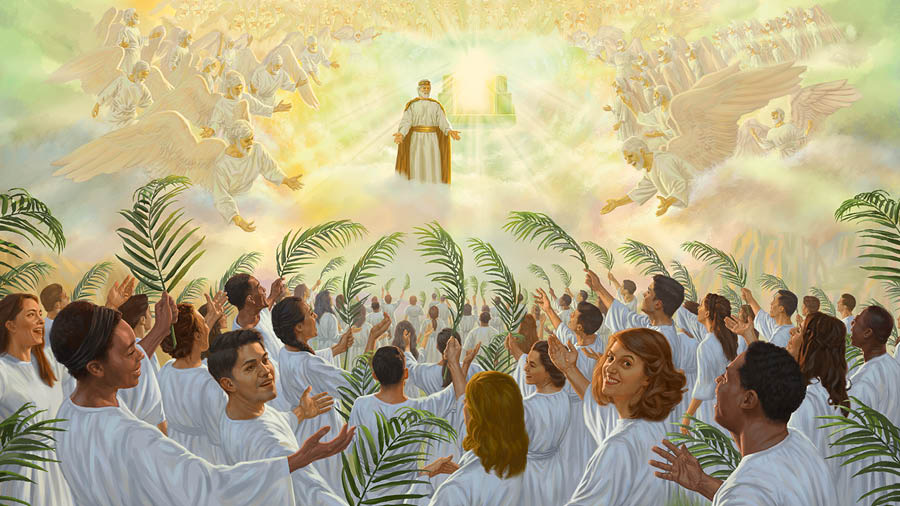
It is at the trumpet blast of the seventh seal that the Rapture takes place and shortly thereafter John sees the raptured Saints before the throne of God.
“After this I looked, and behold, a great multitude that no one could number, from every nation, from all tribes and peoples and languages, standing before the throne and before the Lamb, clothed in white robes, with palm branches in their hands, and crying out with a loud voice, “Salvation belongs to our God who sits on the throne, and to the Lamb!” And all the angels were standing around the throne and around the elders and the four living creatures, and they fell on their faces before the throne and worshiped God, saying, “Amen! Blessing and glory and wisdom and thanksgiving and honor and power and might be to our God forever and ever! Amen.” Revelation 7:9-12
How do we connect what we see happening in culture with what God has revealed in His Word, the Bible? Is this all about equal rights? No! That is already in the constitution. You need to understand the connection between the Globalists, e.g. World Economic Forum, and the groups (Cancel Culture, Black Lives Matter, Gay Groups, Transgender Groups, Climate Change Activists) they have supported/funded including in universities. It’s a conspiracy driven by principalities and powers in the heavenly places. All truth is under attack, particularly Jesus’ truth. “I am the way, and the truth, and the life” John 14:6. If you are not with these groups then you are against them and you need to be eliminated. Look at the following “last days” prophetic scripture. The people described here are the people we see trying to take control in our day. God has warned us in advance.
“But understand this, that in the last days, there will come times of difficulty. For people will be lovers of self, lovers of money, proud, arrogant, abusive, disobedient to their parents, ungrateful, unholy, heartless, unappeasable, slanderous, without self-control, brutal, not loving good, treacherous, reckless, swollen with conceit, lovers of pleasure rather than lovers of God, having the appearance of godliness, but denying its power.” 2 Timothy 3:1-4
If there is a Scripture verse that so accurately defines the ambiguity between good and evil driving cancel culture in the current times, it is Isaiah 5:20:
“Woe to those who call evil good, and good evil; who put darkness for light, and light for darkness; who put bitter for sweet, and sweet for bitter!”
The Air We Breathe: How we all came to believe in freedom, kindness, progress, and equality Glen Scrivener Good Book Company, 2022
I gave a brief review of this book by the Australian pastor Glen Scrivener (now living in the UK) in a recent post. However, I would like to share more and encourage you further to purchase his book. It will equip you to engage in good conversations with the lost and with the Holy Spirit’s guidance help you to bring them to a knowledge of the truth. As a reminder Scrivener’s main thesis for his book:
“Today in the west, many consider the church to be dead or dying. Christianity is seen as outdated, bigoted, and responsible for many of society’s problems. This leaves many believers embarrassed about their faith and many outsiders wary of religion. But what if the Christian message is not the enemy of our modern Western values, but the very thing that makes sense of them?”
SCRIVENER ON PROGRESS
Progress does have a dark side. Darwin proclaimed biological progress (evolution by random chance versus creation by an intelligent designer), Hegel, historical progress (Hegel’s providence is not the providence of the Judeo-Christian God. Rather, Hegel argues that universal history is itself the divine Spirit or Geist manifesting or working), Freud, psychological progress, and Marx, economic and political progress. The ugly fruit of such philosophies notwithstanding, Christian ideals run through them like veins in blue cheese. But without a vertical reference (God unacknowledged), the desire for progress all too easily spawns violence. The 20th century was the most blood-stained in history, the ‘murder century’. Think of Stalin’s Holodomor (Ukrainian: murder by famine) and purge of tens of millions in the 1930s, or of Chairman Mao’s ‘Great Leap Forwards’ (1958–1962), where over 45 million died of overwork, starvation, or murder—not to mention the horrors of death camps like Auschwitz. Post-WWII, a moral standard was needed to establish the ‘self-evident’ moral truths so bespattered by the Nazis. As with slavery, those atrocities were deemed “crimes against humanity” but few admitted they were crimes against God. If they were mere “crimes against humanity”, we have a dilemma, for humanity was on both sides (evil oppressors and their victims). Scrivener states pithily, “If we’re all squabbling apes, then there’s no transcendent justice in condemning Nazism” (p. 181). So what price progress?
Secularism today, having fled past evils, now pursues values like rights, freedom, and progress, but divorces them from their source. This concurs with Tom Holland’s thesis in Dominion—without Christianity’s humanity-enhancing teaching about the image of God, the ruthless suppression of weaker minorities fits evolutionary logic: “To believe that God had become man and suffered the death of a slave was to believe that there might be strength in weakness, and victory in defeat. Darwin’s theory, more radically than anything that previously had emerged from Christian civilization, challenged that assumption. Weakness was nothing to be valued. Jesus, by commending the meek and the poor over those better suited to the great struggle for existence, had set Homo sapiens on the downward path toward degeneration. For eighteen long centuries, the Christian conviction that all human life was sacred had been underpinned by one doctrine more than any other: that man and woman were created in God’s image.”
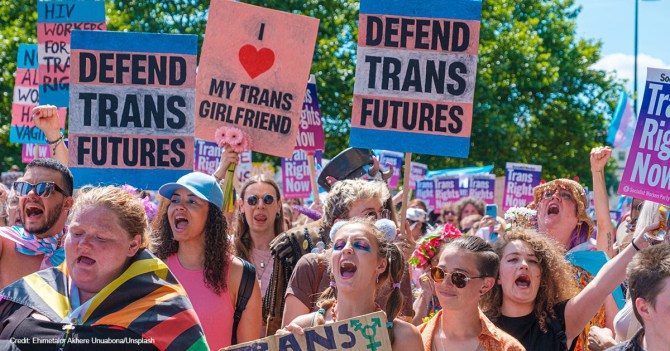
Transgender advocates want equality, compassion, and consent, but they divorce these from Christianity and recombine them differently. Equality becomes a radical individualism as people emphasize rights over institutions and community. Compassion risks becoming what sociologists have termed ‘competitive victimhood’, and perceived victim status is used to gain an advantage. This leads to clashes between different minority groups—e.g. feminists versus trans-rights activists—so whose suffering takes precedence? Divorcing sexual consent from Christian values is a wrecking ball as far as marriage, family, and the wider community are concerned. As Scrivener points out, “Consent is vital, but it is not a sufficient foundation for sexual ethics” (p. 194). Progressive secularization is not a sustainable strategy! The WEIRD (Western, Educated, Industrialized, Rich, and Democratic) values upon which Scrivener’s book focuses are strongly believed by all, but people in Western society are making a hash of applying them in everyday life. Compared to the ancient world, equality, compassion, consent, enlightenment, science, freedom, and progress were given a makeover by Christianity, and these are dear to the hearts of modern people. As Scrivener says, “These are our creedal convictions, and, by and large, we are a society of believers” (p. 197). But even as people are straining to discard Christianity, they continue with their moralizing: “If anyone blasphemes our WEIRD values … we ‘cancel’ them—that is, we ostracise them socially and professionally. This is really a modern form of ‘ex-communication’ for modern kinds of ‘heretics’” (p.198). And anyone can find themselves a target, especially, as the author wryly observes, with the turbo-charging of outrage made possible by social media. In today’s ‘cancel culture, there is plenty of guilt, but without grace, forgiveness is nowhere in sight! Scrivener is right on the money in noting that the denial of King Jesus while trying to retain Christian ideals, brings judgment, not liberation: “In order to pursue the kingdom without the King, we have had to dethrone the person of Christ and install abstract values instead. … [But] Values can only judge you” (p. 200). People need the Gospel of hope, so the author invites readers to consider how history will judge them— more especially how will God judge them? Wonderfully, Christ came not to police people’s morals so much as to heal them, cleanse them, and forgive needy, despondent human beings.
Scrivener skilfully defends the Gospels and their accounts of Christ, and he does so in a highly original and compelling manner, demonstrating their sheer genius. The strong evangelistic approach is fresh, not hackneyed. Jesus, the History Maker, is the One behind the values so cherished by the West—He embodies them. In fact, Christ loved this world to death, pioneering life for all violators of those values through His Resurrection. This is not a book that fizzles out toward the end. In its closing pages, Scrivener appeals in turn to the three categories of readers mentioned in the second paragraph of this review. It is refreshingly honest and very well executed. To Christians, he writes, “In all this, great wisdom is needed to discern the Christian-ish values of a WEIRD culture from true Christianity” (p. 230). Absolutely, and this book deserves to be very widely read to equip us to convey the truth to those the Holy Spirit brings across our path.
In April, Wahlberg spoke with CBN’s Faithwire about the movie and faith, particularly in response to Cancel Culture — an issue he said was addressed in “Father Stu.”
Mark financed the movie himself as all the people he spoke to would not support it including the Catholic church. It demonstrates his level of commitment to share the good news of the Gospel of Jesus Christ.
“This movie has a very clear message that we are not going to give up on people,” he explained of the film, which chronicles the life of the late Catholic priest, Stuart Long. “We are not going to turn our backs on people because of mistakes that they’ve made. We are going to tell people and encourage people that nobody is beyond redemption and that we support you, we love you, we accept you for who you are.”
Moving forward, the 51-year-old actor said his top priority is leaving a legacy of faith.
“I’m kind of doing all this not to continue to grow my career, but to utilize my career for good and to do God’s work,” Wahlberg said. “If this is a movie that really changes people’s lives and motivates them and inspires them to do great things — you know, all I really gotta do is convert one person, and I get to go through the pearly gates.” I do not know if Mark Wahlberg is born again as this last statement is of concern. Moreover, I have not seen the movie but I hope it will be used by God for His purposes.
You can read more about CBN’s conversation with Wahlberg by clicking here. and you can see the Trailer for the film.
Have you ever seen or heard Phil Roberston on faith. If you have not you are missing out on a treat.
On this episode of Faith vs. Culture: How should Christians respond to cancel culture?
Duck Commander Phil Robertson joins Dan and Billy to talk about his experience with and response to cancelling (cancel culture). It is brilliant.
Robertson, who infamously faced his own bout with cancel culture in 2013, when A&E suspended him over comments he made about homosexuality during a magazine interview, told CBN’s “Faith vs. Culture” he holds no ill will against anyone involved in his highly-publicized controversy.
Q & A – a popular ABC (Australian Broadcasting Corporation) show on prime time TV. Martin Isles is on the far right.
The Sydney Morning Herald thought this week’s Q and A was a significant cultural moment. They compared it with another one in 2008 where the shibboleth question for our culture , that of homosexuality, came up. It was indeed a revealing programme – telling us a great deal about where Australian culture, politics and religion are at – and where we are heading.
Hamish MacDonald, the host, was joined by Trent Zimmerman, Liberal Member (Homosexual) for North Sydney; Anika Wells, Labor Member for Lilley;; Antoinette Lattouf, Journalist, diversity advocate, and author; and Teela Reid, Wiradjuri/Wailwan, Lawyer; and Martyn Iles, Managing Director, Australian Christian Lobby.
It was the appearance of Martyn Iles that was too much for some people – even before he had been on the show. Those who believe in love and are opposed to hate speech were quick to share the love…
“Just saw the line up for #QandA and omg the creep from the Australian Christian Lobby is on? “
“Honestly, giving people like Martyn Iles a public platform is very unhealthy for society. The ACL is a hate group. I dearly wish we had laws against this”
“I’d rather hear from a Satanist or someone other than that man…”
The Church that believes in love, unity and diversity was also quick to show us just how loving, united and diverse they are:
“Just want to pre-emptively comment on tonight’s #qanda. This man is likely to slander and bear false witness against LGBTIQ+ people and communities. He does not represent the Church, nor the majority view of Christians in Australia.” Leichhardt Uniting Church.
And it’s not just liberals – mention Iles name in some evangelical circles and eyebrows are raised, knowing looks exchanged and a general impression is given that we don’t really want to be associated with that sort of thing.
What did we learn from the show? We learned a great deal about contemporary Australian society… Here are some of the lessons….
1. For some, ‘lived experience’ trumps everything.
Facts, truth, democracy, morality, religion – everything is subordinate to what is called ‘lived experience’. Martyn was asked “have you lived experiences, heard, shared and acted upon?” The implicit statement being that unless you have walked in their shoes then you cannot represent, speak about or disagree with. “I don’t think Martyn can walk in a gay man’s shoes”. All of this sounds so true. But in ABC culture that only applies to some groups. Nobody on the panel (which was largely hostile to Martyn) seemed to grasp that they did not have Martyn’s lived experience as a Christian – but that did not stop them commenting on it and condemning it.
One panellist spoke of Lil Naz X as being a hero because of his Satan’s shoes video. She declared that this shows that you cannot speak unless you feel the hate, it doesn’t matter what the intention of the speaker is. She has a point? I felt that her speech, and much of the rest was full of hate for people like Martyn and me – i.e., biblical Christians. By her own standard she was guilty of hate speech. Or does this not work both ways?
When Martyn mentioned the story of the Canadian man who went to jail because he misgendered his teenage daughter, he was told – “I think that’s a very specific example and we don’t know all the details…I’m not interested in speaking this specific example”. So, some stories are not worth telling and don’t count as evidence?
Within a few minutes of that we were listening to someone who identified as “an aboriginal queer non- binary person” who went on to tell the story of a relative who died in prison. That very specific example was of course not going to be questioned.
Just before the programme I saw an advert for another ABC show – You can’t say that – where we were told that everyone has a story and deserves to be heard! But is that true? Would the ABC allow my story to be told? Or that of a transgender detransitioner? Or someone who is ex-gay? Sadly, in our society today, your story only matters if it fits in with the pre-determined narrative?
1. Identity Politics is polarising and dividing Australia.
Martyn was told that ‘you don’t have skin in the game when it comes to women’s issues”. That assumes a narrow fundamentalist individualistic view of what a human being is. All of us were ‘born of a woman’ and most of us had a mum as did Martyn. Martyn is young and not married but he has colleagues and friends who are women. I would suggest as a Christian he has a lot of skin in the game. He cares about issues such as the sexual exploitation of women and the trans attack on the very notion of what a woman is.
2. Most Australians don’t have a clue about Christianity and are hostile to what they do not know.
This was exemplified by the tweets that ABC put up on the screen. In itself it was revealing that the only tweets that I saw them put up were hostile. I’m sure they received some supportive ones for Martyn but that did not fit their narrative. He was there to be mocked and abused.
3. Shallow superficial soundbites have largely replaced substantive discussion as the primary discourse in Australian politics and media.
There were so many examples of this in the show. The lack of depth and thought was quite frightening. Take this one example. Anika Wells stated: “In the Bible there are 3,000 references to poverty and very few to homosexuality, so why can’t the ACL spend their money on that? “ This was retweeted as Gospel truth – but it’s just factually wrong. Clearly they had not bothered to read Mark Powell’s response to this oft made fake claim a couple of years ago – https://www.spectator.com.au/2017/11/abc-anything-but-biblical-christianity/
The point is that it sounds right, and they want it to be right, so the claim is made and left completely unchallenged.
Or take Trent Zimmermann’s claim that “any person should be able to decide what future they want from their own life and their body is part of that”. So if someone feels they are too fat they should be allowed to starve themselves? Or if people decide they want to change sexuality they should be allowed to seek conversion therapy? After all its their body!
Trent Zimmermann then went on: “we have to be careful about questioning whether transgenderism is a legitimate course for an individual to take…’ after pointing out that transgender people are much more likely to attempt suicide. Again, the host and other panellists, seemed to miss the rather obvious point that if being transgender does lead to such a high risk of suicide, perhaps we should question it a lot more?
But transgender is a very protected category on the ABC – the host gave out the Lifeline number after the discussion on trans….“if this conversation raises any issues…” which of course led to the inevitable tweet “If you have a guest on #qanda that makes you need to announce the LifeLine phone number that should tell you what sort of guest you have”.
4. The Cultural Elites don’t do diversity or equality.
At times this whole show felt like a put-up job. I think four of the questions were hostile to Martyn. The host questioned whether Martyn was just raising the Israel Folau issue (Israel was sacked from playing rugby after a Biblical post on Facebook that stated homosexuals were destined for Hell) as an attempt to increase the ACL’s membership, he also challenged Martyn’s figures on transgender. These are legitimate questions – the problem is that he made no similar challenges on the rest of the panel. He stated that Rugby Australia officials were not there to defend themselves – but permitted a series of attacks on Folau, who also wasn’t there to defend himself. He told Martyn ‘you’ve had plenty time, make it quick’ which again would have been fair enough if it were not for the fact that it was four (five?) against one and most of the questions were directed against him.
The audience seemed far more diverse than the panel (something noted by the Twitterati – some of whom objected that such people were even there). One young man made the telling statement “if you express your faith, then you will be met with severe career ending consequences”. This show was ample evidence of that.
Adapted from a report in The Australian Presbyterian by David Robertson
Great to see this article on Faithwire by editor Tré Goins-Phillips: Pop star Justin Bieber, who has been outspoken about his Christian faith, is using a single on his new Gospel EP to share Scripture and condemn cancel culture.
In the song “Afraid to Say,” 27-year-old Bieber expresses sorrow over the accelerating cancel culture that has consumed much of our public discourse in recent months.
“What have we done with society when everybody’s getting canceled?” he asks. “And can’t there be room for maturity? ’Cause writing ’em off is not the answer.”
The “Peaches” singer then goes on to explain that redemption from God is the solution to what ails our broken culture:
We can’t write people off. God never writes us off, even in our darkest days. Even when we least deserve it. Even when we’re doing that stupid thing we wish we weren’t doing. God never writes us off — ever. He’s with us in our pain. He’s with us in a struggle. He’s with us in our bad decisions. He’s with us all the time. He never writes us off.
In the chorus, Bieber sings: “Does what I gotta say even matter? / Is life about climbing up the ladder? / And can we even see lives that are shattered?”
The songs ends with Lauren Walters reciting Psalm 139:13-16.
“You formed the whole of me, inward and out,” he said. “I am awesomely and wonderfully created. Your creations are spectacular. You skillfully designed me. You saw the Essenes of me, before I was formed. Before I existed, all of my days were written in your book.”




 LIVING ETERNAL NOW