
This week’s’ Israel Matters explores the current state of anti-Semitism, particularly in Hungary, and the role of the church in combating it. Stephen Briggs discusses recent events, including a controversial Super Bowl ad and the reception of the Israeli delegation at the Winter Olympics. He then speaks with Sara Kulifai, who shares insights on Hungary’s historical context regarding anti-Semitism and the church’s proactive stance in fostering Jewish-Christian relations. The discussion emphasizes the importance of education, activism, and biblical understanding in addressing anti-Semitism. Israel Matters to God so should Matter to Us. The interview with Sara Kulifai is enlightening as she shows how one church with the right leadership can make disciples like Sara that can influence nations for good. Make sure you share this video widely as hopefully it will challenge many churches to look at how they are influencing at least the communities they serve.
Category Archives: Church as God intended
DISCIPLESHIP IS PRIMARILY THE RESPONSIBILITY OF THE PARENTS
Unfortunately it is not according to a Barna Survey. 51% of American Christian parents surveyed “expected the church to take the lead.” Only 49% of parents considered teaching their children about reason, faith, and Biblical Christianity to be their responsibility. Correctly children’s ministry leaders state that discipleship should begin at home.
The findings reflect another concerning trend, which shows 86% of parents “feel under-equipped” to teach their kids the Bible and basic theology.
There’s a deep challenge here, Barna stated. “If children’s ministry is going to be healthy, pastors must help both parents and their ministry leaders find common ground.” Discipling children should be a joint effort. For example, the Gospel is lived out in the home, alongside the Church, not just taught on Sundays.
The church needs to encourage parents to embrace their primary role, by teaching them how to have everyday faith conversations. Properly discipled mums and dads will be better prepared to disciple their kids.
Families, Barna continued, should be encouraged “to practice their faith together in everyday life—serving others, praying as a household, and applying Scripture in real situations.” This is “so the next generation grows resilient and ready to follow Jesus in the world beyond church walls.”
Barna’s insights are nothing new. They point back to the Puritans, who understood that every home was to be a little church. “A family is a little Church, a little commonwealth,” said William Gouge in 1622. “It is a school where first principles and civics are learned; whereby men are prepared for greater matters of Church and State.”
Or as Charles Spurgeon preached in 1875, “Men are as much serving God in looking after their own children, and training them up in God’s fear, as they would be if they had been called to lead an army to battle for the Lord of hosts.” This includes “minding the house and making their household a church for God.” “It is a grand event when a family is saved!” Spurgeon cheered. “Oh, if households enter into Christ, the very bells of Heaven may ring again and again and again with a joy that has many joys within it!”
THE CHURCH HAS SO COMPROMISED WITH THE WORLD THAT IT NO LONGER PREACHES BIBLICAL TRUTH
George Barna, a leading expert in church and worldview trends, has weighed in on some of the biggest issues facing the Church, including the steady decrease in a biblical worldview and dwindling concern for spiritual formation, which results in “Christian invisibility” in our culture.
Bible Colleges and seminaries set young ministry leaders up for failure. “You get what you measure,” George Barna contended. “So, if you measure the wrong things, you’ll get the wrong outcomes … pastors measure how many people show up, how much money they raise, how many programs they offer, how many staff persons they hire, how much square footage they built out. Jesus didn’t die for any of that. “If we were to go back to the Bible, I think we’d recognise the local church, the institutional church, as we’ve created it, is man-made. It’s not in the Scriptures,” he said.
Barna says, “We need to go back and recognise that it starts with families; parents have the primary responsibility to raise their children to become spiritual champions. Local churches need to support parents in that endeavour. Our primary focus needs to be on children … and growing their biblical worldview. If we do that, we’ll be able to increase the 3 per cent of adults who are disciples in America today to a larger proportion.”
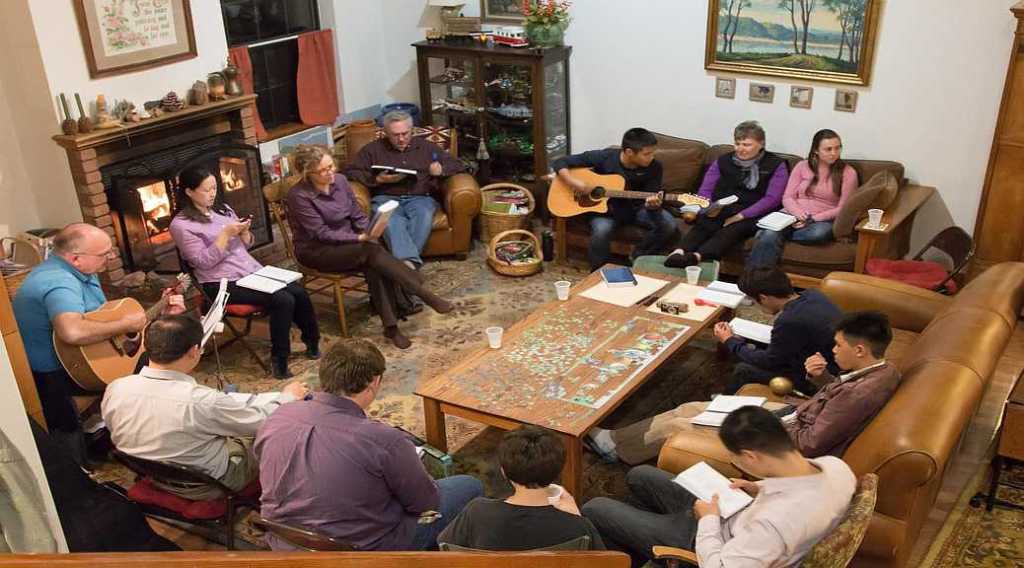
I would also suggest that the church return to the church as described in the Book of Acts. Francis Chan got it right when he walked away from his church of 5000 to establish house churches where everybody is trained to be disciples to preach the good news of the Gospel.
Barna warns the church is at a critical juncture, and the path to a thriving Christian community lies in returning to the core biblical principles, the empowerment of parents as spiritual leaders and the intentional discipling of the next generation. “All the other stuff is noise,” he said. “If we don’t do those things, we’re going to lose even more in this war … this is our moment, we’ve reached a time of Christian invisibility in our culture. What I’m seeing now is that we’re getting to this place where the typical American … will not have anyone in their circle of influence who has a biblical worldview. You’re not going to be influenced by God’s truth.
PRAYING FOR THE CHURCH IN THE END TIMES
The Church, as the body of Christ, is called to be a city on a hill, a light to the nations, and the pillar of truth in a world darkened by sin. However, many denominational/institutional churches have compromised with the world on sexuality, marriage, and gender. They are the apostate church Jesus described in the Olivet Discourse as the end-times church. They are not the church God intended, as described in the Book of Acts.
The Early Church Was Hospitable
People were not only giving their resources or money but were joyfully opening their homes to hold gatherings and share meals. Church didn’t have a specific time or place, it simply was whenever the believers were together; at home or at the temple, at the dining table, or resting in the living room. They shared their lives, their homes, their food, and their time—and they did it all with glad and generous hearts. “And day by day, attending the temple together and breaking bread in their homes, they received their food with glad and generous hearts.” Acts 2:46
The Early Church Was Sacrificial
From their closeness and love for one another, flowed unselfishness that blessed all the church members. People were valued over money or social standing and through the church, the Lord met all the needs of the poor and needy members. They were loved and cherished to the glory of God.
“And they were selling their possessions and belongings and distributing the proceeds to all, as any had need.” Acts 2:45
The Early Church Was Joyful
And do you know what the result of living like that was? Joy. A natural, God-given, outpouring of joy. Joy despite persecution, joy despite ridicule. God gave His early church joy. They never stopped praising Him.
“And day by day, attending the temple together and breaking bread in their homes, they received their food with glad and generous hearts, praising God and having favor with all the people. And the Lord added to their number day by day those who were being saved.” Acts 2:46-47
The Early Church Was Expanding
This radical, miraculous, and joyful lifestyle got the attention of many outsiders, and God, in His goodness, saved many during this time in church history.
The Early Church Was Gospel-Cantered
The church was made up of people who shared one very specific belief: Jesus is the way, the truth, and the life—no one comes to the Father except through Him (John 14:6). You were not part of the church unless you accepted that salvation is through Christ’s life, His death, and resurrection alone and declared this faith publicly by baptism (being fully submerged in water and then raised out again). Their unity in Christ united them as a group.
“And Peter said to them, “Repent and be baptized every one of you in the name of Jesus Christ for the forgiveness of your sins, and you will receive the gift of the Holy Spirit.” So those who received his word were baptized, and there were added that day about three thousand souls.” Acts 2:38.41
The Early Church Was Devoted to Learning God’s Word
The early church was excited about their salvation and ready to live lives that honored God, so they devoted themselves to the teaching of the apostles. They didn’t have the fully revealed Word of God the way we do today. They were taught from the Old Testament scrolls and from sermons and letters written and sent around by the apostles. This was a trait that continued until it led to the Reformation.
“And they devoted themselves to the apostles’ teaching and the fellowship, to the breaking of bread and the prayers“. Acts 2:42
The Early Church Was Diverse
This doesn’t seem very profound today, but we must remember that in Bible times, your culture and geographical position largely influenced who and how you worshipped. Until the beginning of the church, that is! Suddenly, at Pentecost, people from all regions with varied languages experienced the miracle of the Holy Spirit who enabled them to understand and speak in different languages that they might hear the gospel and believe. Many were then united in their faith in Jesus Christ. What a great reminder that the gospel is for all people; every tribe, tongue, and nation. The early church was certainly diverse (Acts 2:9-11)!
The Early Church Was United
Something that really stands out about the early church is their intentional devotion to one another. The gospel not only saved their eternal lives (souls) but also drastically changed their everyday, earthly lives, and relationships too! There were no isolated groups within the church, there was no room for pretenders and hypocrisy, they were physically and emotionally close and shared everything they had with each other.
“And all who believed were together and had all things in common.” Acts 2:44
The Early Church: a Reminder for Today’s Christians
As Christians, we are to love God, hold fast to His Word, and serve each other with the same zeal and love that the first Christians had for each other. We’re quick to get comfortable in our neat, quiet lives but the gospel calls us to step out, love hard, make sacrifices, and share ourselves with others. We are His church, He has called us. And He will meet our needs as we serve Him and seek to edify our own churches, particularly in our region, city and nation.
How will you respond?
“This is my commandment, that you love one another as I have loved you. Greater love has no one than this, that someone lay down his life for his friends.” John 5:12-13
CHURCH IN THE END TIMES
The following article is taken from http://www.housechurches.net and is largely by Jim McCotter. Did you know the largest and fastest-growing Christian movement in the United States today is the house church movement? More than one U.S. survey revealed that approximately 20,000,000 people meet in some form of a house church in the United States.
Jim McCotter has some excellent resources available on http://www.jimsbookstore.com.
All apostles, prophets, evangelists, pastors (shepherds), and teachers were first Elders (Titus 1:5) and also referred to as Overseers or Bishops (1 Tim. 3:1).
- “Pastor” and “Shepherd” are the same words in Greek and refer to the same person – a spiritual leader caring for God’s flock of Believers.
- “Bishop” and “Overseer” are the same words in Greek and refer to the same person.
- “Elder” and “Bishop/Overseer” refer to the same person (Titus 1:5 & 7; 1 Tim. 3:1-2), but do have different meanings: “Elder” relates to their spiritual maturity and qualifications. “Bishop/Overseer” relates to their authority and responsibility.

Three Categories of Churches
There are three categories of churches in the NT:
- Universal Church – Jesus said, “I will build My church” (Mat. 16:18). The universal church is made up of all Jesus’s true Believers in the world.
- City Church – The city church was made up of all Jesus’s Believers in a city. No place in the NT does it use the plural word “churches” in any city. There was only one church per city. Thus the city church. There was “the church in Jerusalem… the church in Ephesus… the church in Philippi” etc. The word “church” (singular) was used 169 times in the NT and never plural “churches” in a city. A plurality of Elders were appointed to work together to oversee all the Believers in “the church”, therefore, all the Believers in the city – thus the city church. The only time the plural word “churches” was ever used in the NT was when it referred to a region with many towns, such as the “churches in Galatia… the churches in the province of Asia” etc.
- House Church – In each city Christians would regularly meet in homes. For example, in the “church in Jerusalem”, many thousands were saved and all the Believers met in homes – functioning as house churches. In Jerusalem there would have been hundreds of house churches. The Believers gathered for church in homes – sharing together the “Word, fellowship, breaking bread and prayer… and eating their meals together in gladness” (Acts 2:42, 46; 5:42; 8:3; 12:12; 20:7-8). Paul and his fellow apostles spent over three years in the city of Ephesus, and it was one of their greatest works. Historians said there may have been over 1,000 house churches in Ephesus. There were many house churches in Rome, Priscilla and Aquila’s being one (Rom. 16:3-5). In Colossi, some Christians meet in Nympha’s home (Col. 4:15). Paul writes to Philemon and greets the church that met in his home (Phil. 1:1-2). There are a total 22 places mentioned in the NT where just Believers got together and they were only house churches. Apostles spoke daily in public places, such as the 12 apostles speaking daily in Solomon’s court and the Apostle Paul reasoning daily in the school of Tyrannus and in the marketplaces. But none of these places were considered as church gatherings. They were evangelizing and teaching to reach out to new people in the cities. But when they met with just Believers, in what we call church, they only met in homes – sharing the Word, having fellowship, breaking bread, and praying together (Acts 2:41-46; 20:7-11).
It was not until the 4th century that Christians stopped having church in homes. Constantine the Great had Christians start meeting in the large buildings previously designed for pagan worship. Then Constantine and his mother Helena started constructing more of the same.
This was NOT Christ and the Apostles NT church plan, design, or model. It was the pagan building model and their worship format. A big stage up front where only the pagan high priest would stand and speak. Big buildings with this model and format were what the Roman Emperor and his mother fostered in all Christians at that time.
And sadly, most spiritual leaders have continued to follow this same unbiblical model and format ever since. It would not be so bad if it was only considered an extracurricular Christian activity today. But the problem is –spiritual leaders today have substituted this pagan model for Christ’s NT church. Sad to say, man’s proud tradition has been to the great detriment of world Christendom.
Church buildings were not the New Testament way or example. That was only the Old Testament model having a large temple building. After church buildings came into effect, the church functions out of necessity became a spectator event instead of a participator event, as was the New Testament house church model, seen in many verses, such as – “When you assemble, each one has a psalm, has a teaching, has a revelation…” (1 Cor. 14:26). Participators grow strong. Spectators grow fat.
New Testament Christians were told “not to forsake our assembling together… to encourage one another” (Heb. 10:25) — “teaching and admonishing one another” (Col. 3:16) — “I myself am convinced, my brothers and sisters, that you yourselves are full of goodness, filled with knowledge and competent to instruct one another” (Rom. 15:14). Rabbis had a saying, “He who teaches learns twice.”
With the New Testament house church model, spiritual leaders multiply, and then house churches multiply. Small house churches are like small rabbits that multiply 100 times faster than any big elephant church.
As persecution of Christians escalates in the last seven years before Jesus returns, the church will be forced back to the house church model as in the Book of Acts, just as it was in China under Mao and in Muslim countries now.
GOD’S INTENT FOR THE CHURCH
God’s intent for the Church has always been that it be a place where lost people get found and the broken get put back together — a place filled with “weres” who are learning to build new lives through the power of the Holy Spirit.
It’s time for surveys to tell us that churches are breaking new ground and being filled with those from broken families, broken relationships, and broken lives. But they should also tell us churches are doing all they can to break the downward cycle of family dysfunction and restore health to marriage and fatherhood. Only then can people step into the life God has for them, and only then can they be part of God’s heart for breaking new ground through the power of the Gospel.
“For I am not ashamed of the Gospel, for it is the power of God for salvation to everyone who believes …” (Romans 1:16).
In Paul’s first letter to the church in Thessalonica, he reminded them they had “turned to God from idols to serve a living and true God …” (I Thessalonians 1:9). When he took the Gospel to the city of Ephesus, many who engaged in sorcery and pagan worship left their ways to follow Jesus (Acts 19: 19, 23-27). The survey question, “How many of you came from families that practiced sorcery and idolatry?” Would have had embarrassing results. Yet Heaven was smiling as new ground was being broken.
But the city of Corinth tops them all: “Or do you not know that the unrighteous will not inherit the Kingdom of God? Do not be deceived; neither the sexually immoral, nor idolaters, nor adulterers, nor homosexuals, nor thieves, nor the greedy, nor those habitually drunk, nor verbal abusers, nor swindlers, will inherit the Kingdom of God. Such were some of you; but you were washed, but you were sanctified, but you were justified in the name of the Lord Jesus Christ and in the Spirit of our God” (I Corinthians 6:9-11). That must have been quite a congregation! New ground was being broken.
“Churches must work to restore healthy marriages and fatherhood to combat a growing decline in Christianity, according to a survey released by a faith-based group.” The article went on to detail how the decline in resident fatherhood and the collapse of marriage are likely explanations for the increase in religious non-affiliation throughout the United States.
God’s roles for males and females need to be restored. Male leadership in the home and church is clearly laid out in God’s Word but it like most of God’s commandments has been jettisoned by an unbelieving world. Fortunately, God tells us in His Word that this would be the case and the only solution is for Jesus to return and restore righteousness by ruling and reigning the nations with a rod of iron, and this He will do for 1000 years with the resurrected Saints. Jesus’ Millennial Kingdom is a transition period prior to God establishing a new Heaven and new Earth where only the righteous dwell. Whilst Satan is bound for most of the thousand years. In the end, God allows him to be released and astoundingly he is still able to raise an army of rebellious people like the sand of the sea to come against Jesus and the Saints. The rebellion is promptly put down and this earth and heaven are destroyed. A second resurrection occurs of those unbelievers who were not raised at the first resurrection and all those who died during the Millennium. Jesus White Throne judgement follows. Only then does John see a new Heaven and a new Earth and a magnificent New Jerusalem descending from Heaven onto the new Earth.

CHURCH AS JESUS INTENDED
Returning to a no-frills practice of following Jesus will be good for all of us. We will remember what our faith is all about. This is why in the last days before Jesus returns He needs to purify His church. Apostasy in denominational churches is rife as demonstrated by the acceptance of gay marriage and homosexual pastors. They no longer believe in the inerrancy of God’s Word. Like the world, they have been caught up in the evolutionary myth of billions of years of Earth’s history. They no longer believe that God judged mankind with the worldwide flood of Noah’s day and yet it is the only explanation for the existence of billions of dead things buried quickly all over the world, including the fossil fuels: coal, oil, and natural gas (the result of buried forests). They have discounted both Noah’s flood and the short timescale of Scripture determined by Genesis 1-11. When you study geology from a biblical standpoint and use the geological model of the Flood to connect the real-world observations of geology you discover it is superior to the prevailing old-earth frameworks in explaining the data. (Biblical Geology 101 by Michael Oard and Robert Carter 2021).

An exciting training development, one which could help us prepare for church without buildings, has gained great popularity in the body of Christ over the past several years by readying people for possible service on the mission field, particularly among Muslims. TOAG, or “Training Ordinary Apprentices to Go,” (Global Mobilisation Network). It seeks to teach people to “do church” in small group settings, away from large worship gatherings that will not be available abroad. Participants spend ten months learning how to reach unreached people groups and develop an authentic community in a small group setting. Families with children are welcomed in, and future workers for Christ are much better prepared than earlier generations of believers. I’ve heard from a few that have participated in TOAG that it is difficult, yet rewarding. The method’s founders state the goal of the training: During TOAG, interns learn to be a Kingdom Community without including Western structures that often hinder movements. They experience life in community with other interns, something more akin to the Book of Acts. By taking them out of present ecclesiastical structures, which include powerful (& professional) music, well-crafted homilies (by highly trained professionals) in safe, comfortable surroundings (expensive buildings), interns experience first-hand what is and is not required for believers to be a ‘Kingdom-Community,’ experimenting with simple, organic structures capable of sharing the life-changing power of God’s Kingdom and reproducing into movements. … These are just some of the reasons why many Americans benefit from the hands-on learning experience of TOAG.
We need to prepare for the prophesied persecution that is coming and expect God to grow us through it as never before. Literally, millions of Christians around the world can testify to this truth, as Paul testified clearly in this Scripture.
“We also glory in our sufferings, because we know that suffering produces perseverance; perseverance, character; and character, hope. And hope does not put us to shame, because God’s love has been poured out into our hearts through the Holy Spirit, who has been given to us.” Romans 5:3-5:
Whether you use TOAG or some other training method you need to get with like-minded believers who understand the times and get into step with what God is calling us to do in these last days to make sure we complete the Great Commission in the community where God has placed us.
Check out http://www.lastdaysovercomer.org for the free ebook Prepare for the Last Days – Fulfilling God’s Purposes at the End of the Age.
QUESTIONS ABOUT HOUSE CHURCHES
We are told that prior to Jesus’ return that there will be a great falling away. Apostasy will be rampant. Already, we are seeing Institutional churches compromising with the world on Biblical inerrancy, gay marriage, and homosexual leadership. The church needs to get back to the House church model expounded in the Book of Acts. Church as God intended. We have seen the effectiveness of the House Church model in China when all Mission groups were expelled at the time Chairman Mao came to power. We are also seeing it in Iran and other Middle Eastern countries where Christians are being persecuted.

Practical House Church Functioning, Disciplining, & Multiplying:
Can I challenge you to search for Biblical answers to the following questions? You will be challenged about the way you think about church.
- Why the symbolic elements in the Lord’s Supper are important.
- Why wine vs grape juice.
- Why a full meal during the Lord’s Supper versus only taking a bit of bread and a cup.
- Why have the Lord’s Supper with a full meal every week?
- Why does trying to imitate an unbiblical traditional church model kill the Lord’s New Testament house church model?
- Why and how we need to have everyone contribute in the Word, the meal, and prayer – how this impacts spiritual growth and discipleship far more than any modern-day, man-made discipleship program.
- Why baptism* as described in Scripture is so important. Infant baptism and sprinkling with water do not achieve God’s purpose for baptism.
- Why modern traditional churches resist God’s ordinance of head coverings related to men and women praying and prophesying in church versus God’s headship – in church, family, and society.
- Why and what about music.
- Why teaching children Biblical history including Noah’s worldwide flood versus Evolution and billions of years is so important.
- Why about when, how long, and what order of activity during church, and scheduling vs Spirit leading.
- Why and what to do about problem people.
- Why traditional church leadership & leaders versus N.T. leadership & leaders.
- Why, when, where, and with whom should we break off to start another house church.
Can I encourage you to get Jim McCotter’s book Church Revolution Today – How N.T. Christians Reached The World. You will find all the answers you need on church as Jesus intended in Jim’s book.
*The scriptural examples of baptism, such as Jesus’ baptism in the Jordan River (Matthew 3:16) and the Ethiopian eunuch’s baptism in a body of water (Acts 8:36-39), indicate immersion demonstrates one dying to self and emerging a new creation in Christ. “Repent and be baptized, every one of you, in the name of Jesus Christ for the forgiveness of your sins.” Acts 2:38. This Scripture reveals baptism is a symbolic act representing the cleansing of one’s sins through faith in Jesus Christ.
GOD PRESERVES HIS SERVANTS
After 52 years of ministry, skydiving 98-year-old preacher, Roy Jernigan wants people to see Jesus in his life. I can relate to Roy’s testimony. I am 86 and I know God still has more for me to do specifically to alert the church to God’s soon-coming Millennial Kingdom on this earth. Checkout http://www.millennialkingdom.net
Asked to comment on the state of the American Church today:
Jernigan quickly explained that the main driver of his faith is the Bible without the trappings of denominational restrictions.

Jernigan has certainly got this right. The denominational church is not the church Jesus established as outlined in the Book of Acts. Jesus calls us all to be disciples who make more disciples. We all like the denominational church model as it removes this essential facet of the church. It is the pastor’s responsibility to grow the church so we can get on with our lives doing what we want to do.
“I’m not a denominational man. I don’t criticize the denominations but think about this: we have all kinds of denominations — Baptist, Methodist, Presbyterian, Episcopalian, you name it, and every one of them has a different doctrine,” he explained. “They can’t all be right. And so, consequently, I don’t claim a denomination. I claim to be a Christian. And as a Christian, I follow the New Testament teachings on the Apostle Paul.”
And Jernigan’s nondenominational approach to ministry aligns with the direction of the American Church today. Data from the 2020 U.S. Religion Census show that in the last 10 years, the number of American Christian adherents in nondenominational churches nearly doubled in number and surpassed America’s largest Protestant denomination, Southern Baptist, by several million adherents.
Other recent studies also show that while America remains a highly religious nation, with seven in 10 claiming affiliation with some kind of organized religion, for the first time in nearly 80 years, fewer than half now say they have formal membership in a specific house of worship. Church attendance has also continued to decline in the wake of the COVID-19 pandemic lockdowns.
While he admits that being a Christian today is much harder than it was 50 years ago when fewer distractions were competing for people’s attention, Jernigan believes that the model of many church ministries today is partly to blame for people deserting the pews.
“I’ll be honest with you, one of the biggest problems that pastors have today is trying to build a church on their own,” Jernigan told CP.
“Today, preachers have gotten themselves into such a rut by building big buildings with stained glass windows and everything. And the people have deserted them because they get tired of being bled to death [financially]. And hear the preacher say, ‘you got to give, you got to give, you got to give.’ My conviction is you don’t have to hound Christians to give. If they are saved, they love the Lord, they will give,” he said.
Jernigan also criticized preachers who treat their ministry as a business. “I think it’s the wrong approach. Commercial? You don’t commercialize God. I believe this is a gross mistake, that people, you see so much of this today, trying to commercialize and put things into a peaceful (more like bless me) type of thing rather than teaching the Bible,” he said. “I do believe if preachers would come down off the high horse, and quit preaching, what I call cotton candy messages, that’s all fluff and no substance, I believe there’d be a great difference in the world today.”
And as the church continues to compete for the attention of society today, Jernigan is worried that current social trends might lead to a point in society where Jesus is “completely rejected.”
“Today, there is much more to pull a person away than there was in my day,” he said. “It is much more difficult. And it does appear to me that as the time approaches (Jesus return to put things right), that things are going full circle to the extent that Christ … is going to be completely rejected.”
He urged Christians who left institutional churches but still want to maintain their Christian faith to keep reading the Bible and praying to God for direction.
“My heart goes out to so many people, it really does,” he said. “There are a lot of people out there that are hungry, and they’re thirsting for the Word of God, but they don’t have anyone to give it to them.” You be one of those Christians that does do what Jesus called us to do i.e. bring the good news of Jesus Christ to the lost.
DOING CHURCH RIGHT
If you do church right, some of the unchurched will love you and some will hate you
This article by Michael Brown addresses the traditional church model but it applies to some degree to the House Church model. However, it is unlikely that a hostile pagan will ever want to attend a house church meeting.

Jesus Himself exhorted us, “let your light shine before others, that they may see your good deeds and glorify your Father in Heaven” (Matthew 5:16). Or, in the words of Peter, “Live such good lives among the pagans that, though they accuse you of doing wrong, they may see your good deeds and glorify God on the day he visits us” (1 Peter 2:12).
Let us be known for our good works, for our kindness and compassion, for helping the poor and the needy, for standing for righteousness, and for opposing injustice. By all means, let us live this out for the glory and honor of God and for the good of a hurting world.
But let us not deceive ourselves. The same world that hated Jesus will hate us also. The same humanity that chose darkness over the light in Jesus’ day will gravitate to the darkness today. Do not be deceived.
As Jesus said to His disciples, “Students are not greater than their teacher, and slaves are not greater than their master. Students are to be like their teachers, and slaves are to be like their masters. And since I, the master of the household, have been called the prince of demons, the members of my household will be called even worse names!” (Matthew 10:24–25)
And this: “If the world hates you, keep in mind that it hated me first. If you belonged to the world, it would love you as its own. As it is, you do not belong to the world, but I have chosen you out of the world. That is why the world hates you. Remember what I told you: ‘A servant is not greater than his master.’ If they persecuted me, they will persecute you also. If they obeyed my teaching, they will obey yours also” (John 15:18–20).
That means that some people will love us because they see our lives, because they are drawn to Jesus, and because they too have opened their hearts to Him. Others will hate us, repelled by our godly lives, turned off by our moral standards, and dead set against receiving Jesus as Lord. No matter how gracious we are, they will brand us as bigots and haters and worse.
On a practical level, that means that the young, drug-addicted, non-believing couple living together out of wedlock should feel welcomed and loved when they walk into one of our services. They should encounter people who have joy, who are thrilled to see new faces, and who treat them as if they were family.
At the same time, if the Gospel is being preached and the Holy Spirit is moving, at some point they will become conscious of their sin and will be called to repent and receive mercy and grace through the cross.
If they can continue to come week in and week out, never feeling uncomfortable, never feeling conviction, never encountering both the holiness of God and the love of God, then something is wrong with those meetings.
As Jesus also said, the Holy Spirit has come to “convict the world concerning sin and righteousness and judgment” (John 16:8). The Holy Spirit will make us uneasy in our sin. The Holy Spirit will invade our hiding places. The Holy Spirit will reveal what is wrong so that we can be made right.
Again, on a practical level, that means that a gay couple attending our meetings should be greeted just like a couple living together out of wedlock — with love and grace and with hospitality. But if they continue to attend our gatherings, if we are preaching the Word, giving place to the Spirit in our worship, and living godly lives ourselves, they will recognize that God is not pleased with their union. They will be confronted with grace and truth and will have to decide how they will respond. Will it be with contrition and confession or with disobedience and defiance?
This reminds me of what an ex-gay Christian said when he was asked if you could be gay and Christian (meaning, practicing and/or affirming homosexuality and following Jesus at the same time). He responded, “Not for long!”
In light of this, I have to question what a pastor is teaching when a wealthy strip club owner could be a long time, tithing member of his church without either coming under church discipline or Holy Spirit conviction. Something very fundamental is wrong with this picture. (For the record, this is a real-life example. The church claimed to be a Bible-believing, evangelical congregation.)
So, let us do our best to have churches and communities that the unchurched will love, but not at the expense of speaking the truth, with both clarity and compassion. And let us remember that if we are true to Jesus, true to the Word, and true to the Spirit, some will love us and others will hate us. It is inevitable and unavoidable.
Article “If you do church right, some of the unchurched will love you and some will hate you” by Michael Bronw in Christian Post Wednesday, Feb. 8th, 2023.
 LIVING ETERNAL NOW