URGENT WARNING: CHURCH WAKE UP

The Son of Man is going to be delivered into the hands of men, and they will kill Him. And when He is killed, after three days He will rise.” But they did not understand the saying, and were afraid to ask him.Mark 8:31-32

Just before Jesus death and resurrection when the disciples were shattered at the events unfolding and Jesus telling them He was going to die (three times) they asked Him about His future coming in power to rule and reign on earth.

Tell us, when will these things be, and what will be the sign of your coming and of the end of the age?” Matthew 24:3b

Jesus account of the events preceding His second coming (Olivet Discourse) is given in the three Gospels, Matthew 24, Mark 13 and Luke 21 so it should be obvious that God wants us to heed this information.

One stark lesson Jesus gives us is in the parable of the ten virgins.

Then the kingdom of heaven will be like ten virgins who took their lamps and went to meet the bridegroom.Matthew 25:1

It is clear in this parable that Jesus is the bridegroom and the virgins are the church. The first thing we learn is that half of them were foolish and did not have oil for their lamps. Moreover, when they get oil and return Jesus says to them depart from me I do not know you.

“Afterward the other virgins came also, saying, Lord, lord, open to us.’ But he answered, ‘Truly, I say to you, I do not know you.’ Watch therefore, for you know neither the day nor the hour.” Matthew 24:11-13

This should cause all pastors to be concerned. Half of the people in the church in the “last days” are not born again. What is the state of the church you attend?

A sure sign we are in the last days is the state of the church today with gay and transgender pastors accepted in many institutional churches. Therefore most people including the pastor in these churches are not born again with the Holy Spirit.

God’s word is clear, leadership in the church must be male just as leadership in the home is male. God has assigned roles and responsibilities for male and female and he assigns our gender at conception.
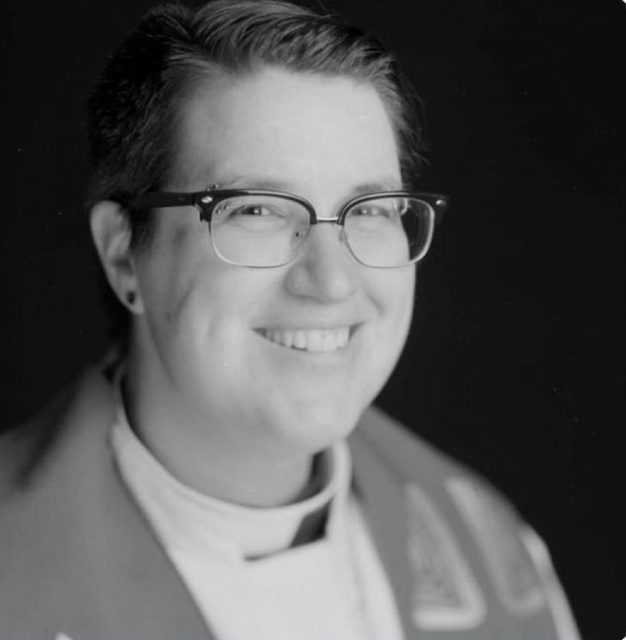
Bishop-elect Megan Rohrer of the Sierra Pacific synod of the Evangelical Lutheran Church of America. Via Facebook.

The Rev. Megan Rohrer was elected bishop of the Evangelical Lutheran Church in America’s Sierra Pacific synod on Saturday (May 8, 2021), becoming the first transgender San Francisco pastor, Megan Rohrer is the first transgender person to be elected bishop in the denomination or in any of the U.S.’s major Christian faiths.

The Sierra Pacific synod encompasses 180 congregations in northern California and northern Nevada, with more than 36,000 individual members and about 13,000 worshipers attending on Sundays. Bishops are elected to six year terms in the ELCA.

Rohrer was elected on the fifth ballot in Saturday’s episcopal election, edging out the Rev. Jeff R. Johnson, pastor of the University of California, Berkeley’s Lutheran chapel, who led the voting until the final ballot. 

While gay bishops have served in mainline Protestant denominations since Bishop Gene Robinson was named a bishop in the Episcopal diocese of New Hampshire in 2003, transgender priests and ministers are only slowly finding acceptance. In 2007, Drew Phoenix was permitted to remain as pastor of a Baltimore United Methodist parish after coming out as transgender; the UMC appointed its first transgender deacon in 2017. The Episcopal Church approved transgender priests in 2012.

The other major concern from this parable is that at Jesus return all ten were asleep not just the five without oil. This is a clarion call for all believers and a reason for my call to alert the church to the coming tribulation and the prophesied events Jesus gave us so we would not be taken by surprise particularly by the great falling away that we are observing in the church today. I am glad to say that God has called many others to do as I am doing and it is important we stay connected. I make sure I include videos and message from these brothers in Christ on this website.

ARE CHURCHES BEHAVING LIKE MALLS IN THE AGE OF AMAZON?

This quote from church thought leader Carey Nieuwhof sums up the institutional church well. It is obvious that only a major disruption , indeed a catastrophe was needed to bring the church to its knees and consider it may not be serving the purposes of God.

History tells us that God uses disruption even major catastrophes for His purposes. History also tells us that disruption leads to innovation which in turn changes the world.

God forcefully moved Adam and Eve out of the garden of Eden. This pattern of forced displacement of people by God is in the whole narrative of Scripture. It is an essential part of His global plan for the redemption of mankind which brings glory and honour to Him.

Does God bring destruction and calamity? Does our loving and gracious God cause disasters to occur in the world?     Read these words God spoke to Noah:

I have determined to make an end of all flesh for the earth is filled with violence through them. Behold I will destroy them with the earthGenesis 6:13,

God destroyed that He might save. God saved Noah and His family that He might preserve the line of His coming Redeemer.

What about the TOWER OF BABEL: Come, let us build ourselves a city, and a tower whose top is in the heavens; let us make a name for ourselves, lest we be scattered abroad over the face of the whole earth. Genesis 11:3-4

Once again we see a massive disaster brought about by God, which caused massive migration and displacement of people: the foundation of the nations that exist today. A refugee crisis on a much larger scale than today.

“You will be hated by all for my name’s sake. But not a hair of your head will perish. By your endurance you will gain your lives (eternal life).” Luke 21:17-19

Covid 19 is another of God’s major disrupters. The church needs to recognise that we are in a time when God is doing something new. Therefore, it is a time to get into prayer to seek His leading, just as the church at Antioch did in Paul’s day. Those that read my posts know I believe the church in the prophesied “last days” before Jesus returns to take His Saints to heaven and before He pours out His wrath upon a world which is fast becoming as it was in Noah’s day, will be much like the early church as described in the Book of Acts. It is one of the reasons I am supporting the Kenya House Church Movement (KHC) and I am hoping that some of my followers will join me in that endeavour. None have done so as yet, but that is OK, God’s timing is always perfect. My next post will be an update on KHC.

CHURCH AS DESCRIBED IN THE BIBLE

In just 11 minutes Francis Chan describes what the Bible says about church and then he describes the short comings of church today. And even more importantly what we can do to get back on track.

LISTEN TO HOW THIS CHURCH GOT RIGHT WITH GOD

Bob Gallaty finally realises He was the problem in His church. The reason why churches are not seeing God move is the Holy Spirit is not directing them, particularly their leaders, and true prayer is absent. Pastors in particular need to watch this video.

Robby Gallaty is senior pastor of Long Hollow Baptist Church in Hendersonville, Tennessee. He spoke with Faithwire about his church having seen 1,048 people baptized from Dec. 20 to April 11. He spoke about how to lead a church, how to make space for the Holy Spirit, and how to pursue God in prayer in effective and meaningful ways.

Those who follow livingeternal.net know that I believe the end times church will be like the church described in the Book of Acts. Church is relational, home groups, and is about making disciples who in turn make disciples of Jesus. Therefore, I am not saying that Bob Gallaty has discovered the right model but he is certainly moving in the right direction.

BIBLE BELIEVING COUNTER-CULTURAL CHURCHES THRIVING

The most common religious identity among young adults in the U.S. is “none,” and the majority of Americans don’t believe it’s necessary for a person to believe in God to be moral and have good values, a new survey has found. The survey on American Life investigating contemporary religion in the U.S. found that among young adults (age 18 to 29), the most common religious identity today is none. More than one in three (34%) young adults are religiously unaffiliated.  Nearly nine in 10 (87%) Americans report they believe in God, but just over half (53%) report they believe in God without any doubts at all. Overall, 42% of Americans have a close social connection with someone who is religiously unaffiliated — up from 18% in 2004.
Additionally, most Americans say it’s not necessary for a person to believe in God to be moral and have good values. Close to six in 10 (59%) Americans say a belief in God is not a precondition to being moral and having good values, while 41% of the public say a belief in God is essential. These statistics, the authors say, mark a “remarkable shift in recent years. The study also found that Americans are almost equally divided over whether it is better to discuss religious beliefs and ideas with those who do not share the same perspective, and most Americans have never been invited to church. A majority (54%) of Americans say they have not been asked to participate in a religious service in the past 12 months or have never been asked.

The survey corroborates a 2019 Pew Study survey that documented the decline of Christians and rise of religiously unaffiliated. Pew noted that the religiously unaffiliated group rose to 22.8% share of the population in 2014, eclipsing the number of Catholics in America, who fell to 20.8%. Christians as a whole fell from 78.4 to 70% of the population between 2007 to 2014, with every major group experiencing a decline. Similarly, the 2018 General Social Survey found that the number of religious “nones” in the U.S. are now statistically equal to the number of evangelicals. Ryan Burge, a political science researcher at Eastern Illinois University who analyzed data from the survey, told The Christian Post that the religious “‘none’s’ are not slowing down.”

THE GOOD NEWS

Russell Moore, president of the Ethics & Religious Liberty Commission of the Southern Baptist Convention, previously said the “increasing strangeness” of Christianity is actually “good news” for the church. “Christianity isn’t normal anymore. It never should have been. The increasing strangeness of Christianity might be bad news for America, but it’s good news for the church. The major newspapers are telling us today that Christianity is dying, according to this new study, but what is clear from this study is exactly the opposite: while mainline traditions plummet, evangelical churches are remaining remarkably steady,” Moore said.

He added that statistics indicate there are honest atheists in America today, and that they are rejecting what’s called “almost-Christianity,” or traditions that “jettison the historic teachings of the Church as soon as they become unfashionable.” “The churches that are thriving are the vibrant, counter-cultural congregations that aren’t afraid to not be seen as normal to the surrounding culture. This report actually leaves me hopeful. The Bible Belt may fall. So be it,” he continued. “Christianity emerged from a Roman Empire hostile to the core to the idea of a crucified and resurrected Messiah. We’ve been on the wrong side of history since Rome, and it was enough to turn the world upside down.”

GOD’S WORD IS INERRANT

WHY DO WE MAKE DISCIPLES?

Great to see God raising up young people who understand the purpose of the church is to make disciples who complete the Great Commission. Watch this young couple as they explain the 411 Discipleship Training Course. This is just one of the many initiatives God is raising up for His purposes in the “last days”. You will be encouraged as you learn what is being accomplished to build God’s Kingdom here on earth. I hope you embark on Troy’s 411 program with your partner. It asks the following four questions. WHY?, WHO?, WHAT? & WHEN? Go watch the video and find out why.

GOD USES CATASTROPHES FOR HIS PURPOSES

Nickey Gumbel, vicar (pastor) at Holy Trinity Brompton in London, developed the world-famous Alpha Courses and has decades of experience with in-person small groups. Like so many, he never considered online groups as a viable option and only transitioned his church’s small groups to online when forced by the coronavirus pandemic. A few short months later, he is a true believer in online groups and their advantages According to Gumbel, here are nine ways that online groups are actually better than in-person groups:

1. Everyone is more relaxed. Think about it: instead of walking into a strange environment, everyone is sitting in their favorite chair at home, they’ve got their coffee or tea (or whatever) fixed just the way they want, and they’re in their comfortable clothes. All of this puts a person at ease, leading to better discussion.

2. Everyone is in their own home. For most, home is a place of solace, and it’s much more inviting to join a group while at home. Some actually have a reluctance to walk into a church building or someone else’s home, so this can be an incredible advantage.

3. Travel time is cut down. This isn’t as big of an issue in smaller towns where distances are reduced, but in larger urban environments, travel time can be a groups killer. For instance, the average commute time where I live (Northern Virginia) is about an hour each way. Adding another meeting with travel time on top of that can be a huge hindrance. Online groups eliminates the travel time.

4. The total meeting time is shortened. Because travel time is eliminated, the total meeting time is shortened, making it easier for people to commit to a group.

5. Childcare becomes so much easier. Unless your small group meets on Sunday morning at church when children’s activities are going on, childcare for young families can be a deal breaker for in-person groups. Gumbel shared about a single mom that was able to join an online group precisely because it was online and she didn’t have to try and arrange childcare for her kids.

6. The conversation flows better because everyone knows each other’s names. Even in groups that have met for awhile, people aren’t confident that they know everyone’s names. This can lead to reduced interaction out of fear of getting someone’s name wrong. When you’re on an online group meeting like Zoom, everyone’s name appears by their screen. As simple as that sounds, this is actually a big deal. Everyone knows everyone’s name!

7. There’s an easier out if you don’t like the group. People like to have an exit strategy before they try something new (like a small group). Think about the hurdles facing someone debating whether or not to try out a small group for the first time: they’re walking into an unfamiliar place with unfamiliar people. If they don’t like the group, they’re stuck there at least for the rest of the meeting, longer if they feel a social obligation to continue. With online meetings, there’s an easier out: just get off the call. This easier out actually incentivizes people to try something new.

8. People tend to be more open online than in person. Call this the social media effect. Have you ever noticed how people tend to share more openly (even when they shouldn’t) online? It’s as if the screen gives them a sense of transparency where they can share how they really feel. This works for online small groups as well. Gumbel shared in his podcast interview that after leading in-person groups for decades, he was shocked at just how quickly his new online group shared and how quickly they went deep. Also, a good leader can make sure that all participate in the meeting, with the mute button. he can make sure no one person dominates the meeting.

9. Group dropout rates are reduced. A final positive aspect that Gumbel noted was that in his short time leading online groups, the dropout rates seem to have reduced. In any in-person group you start, the number you start with is hardly ever the number you finish with. It’s too easy for people to talk themselves out of getting dressed up, getting back in their car after a long day’s work to go to small group. If you’re not feeling well, if you’re got a lot to do, if childcare falls through (or any number of other things), you miss the group. With an online group, people tend to stick longer, leading to reduced dropout rates.

Likewise, I am a Board Member of International Christian Chamber of Commerce (ICCC) Australia and have been blessed greatly with the use of Zoom not only for meetings with Australian delegates but we now have Zoom meetings for Asia and the World for leaders and potential new members.

WHY ON LINE SMALL GROUPS CHURCH IS A GREAT OPTION

Nickey Gumbel, vicar (pastor) at Holy Trinity Brompton in London, recently recorded a podcast with Canadian Pastor and thought leader Carey Nieuwhof. Gumbel developed the world-famous Alpha Courses and has decades of experience with in-person small groups. Like so many, he never considered online groups as a viable option and only transitioned his church’s small groups to online when forced by the coronavirus pandemic. A few short months later, he is a true believer in online groups and their advantages. You can listen to the whole podcast here. (He starts talking about online groups around 29:55).

According to Gumbel, here are nine ways that online groups are actually better than in-person groups:

Zoom meeting with twelve people

1. Everyone is more relaxed. Think about it: instead of walking into a strange environment, everyone is sitting in their favorite chair at home, they’ve got their coffee or tea (or whatever) fixed just the way they want, and they’re in their comfortable clothes. All of this puts a person at ease, leading to better discussion.

2. Everyone is in their own home. For most, home is a place of solace, and it’s much more inviting to join a group while at home. Some actually have a reluctance to walk into a church building or someone else’s home, so this can be an incredible advantage.

3. Travel time is cut down. This isn’t as big of an issue in smaller towns where distances are reduced, but in larger urban environments, travel time can be a groups killer. For instance, the average commute time where I live (Northern Virginia) is about an hour each way. Adding another meeting with travel time on top of that can be a huge hindrance. Online groups eliminates the travel time.

4. The total meeting time is shortened and cost reduced. Because travel time is eliminated, the total meeting time is shortened, making it easier for people to commit to a group. Cost of Zoom for each group, max $20 a month.

5. Childcare becomes so much easier. Unless your small group meets on Sunday morning at church when children’s activities are going on, childcare for young families can be a deal breaker for in-person groups. Gumbel shared about a single mom that was able to join an online group precisely because it was online and she didn’t have to try and arrange childcare for her kids.

6. The conversation flows better because everyone knows each other’s names. Even in groups that have met for awhile, people aren’t confident that they know everyone’s names. This can lead to reduced interaction out of fear of getting someone’s name wrong. When you’re on an online group meeting like Zoom, everyone’s name appears by their screen. As simple as that sounds, this is actually a big deal. Everyone knows everyone’s name!

7. There’s an easier out if you don’t like the group. People like to have an exit strategy before they try something new (like a small group). Think about the hurdles facing someone debating whether or not to try out a small group for the first time: they’re walking into an unfamiliar place with unfamiliar people. If they don’t like the group, they’re stuck there at least for the rest of the meeting, longer if they feel a social obligation to continue. With online meetings, there’s an easier out: just get off the call. This easier out actually incentivizes people to try something new.

8. People tend to be more open online than in person. Call this the social media effect. Have you ever noticed how people tend to share more openly (even when they shouldn’t) online? It’s as if the screen gives them a sense of transparency where they can share how they really feel. This works for online small groups as well. Gumbel shared in his podcast interview that after leading in-person groups for decades, he was shocked at just how quickly his new online group shared and how quickly they went deep.

9. Group dropout rates are reduced. A final positive aspect that Gumbel noted was that in his short time leading online groups, the dropout rates seem to have reduced. In any in-person group you start, the number you start with is hardly ever the number you finish with. It’s too easy for people to talk themselves out of getting dressed up, getting back in their car after a long day’s work to go to small group. If you’re not feeling well, if you’re got a lot to do, if childcare falls through (or any number of other things), you miss the group. With an online group, people tend to stick longer, leading to reduced dropout rates.

Article by Josh Daffern in Patheos (www.patheos.com) 9 Reasons Why Online Groups May Actually Be Better than In-Person Small Groups.

God is in control of all events in His world. Covid 19 did not take Him by surprise so we need to ask what is God doing and how can we get in step with Him. We are meant to be overcomers and game changers. We know that in the last days, church will be as it was in the Book of Acts, all believers involved in the Great Commission. As Nickey Gumbel has found Zoom Home Group meetings work so let us learn from his experience.

HELPFUL ADVICE FOR A VIBRANT CHURCH

It is interesting to read the comments of a pastor from  the Grace Capital City, which meets at the Church of the Pilgrims in Washington, D.C. It is a growing congregation, with Lead Pastor Chris Moerman estimating that about 80 percent of its membership is millennial. Whilst I believe church growth can be a problem and the ideal church is the one described in the Book of Acts which is home groups, Chris Moerman makes some useful comments on how to reach millennial’s.

“I would attribute this growth to a combination of genuine and authentic relationships, a vibrant spirituality expressed through worship, teaching and community, and a passion to give people a vision for God’s work in their lives that impacts not just their Sunday’s at church, but their everyday existence,” Moerman added.

“At The Table Church, we’re passionate about Jesus, we create ministry around peoples’ gifts and empower them to put those gifts into action. We also have fun, do our best to love people well and we’re obsessed with helping people experience community. All of these things resonate with millennial’s, but I think everyone is hungry for the same thing.” We’ve discovered that millennial’s are looking for the many things other age demographics are. They’re looking for a church where the mission is clear and the path to getting engaged in community is simple and easy,”

Lum told CP that “keeping a clear mission” and helping people “use their gifts in the context of community” have enabled his church to stay vibrant.

“Congregations should look like the cities where God has planted them. If you’re in a city exploding with young people, then your church should definitely be reaching young people,” said Lum.

“Pastoring millennials requires a different approach to giving, but I think it’s a healthy and much needed transition. Millennials don’t give out of guilt or obligation, but instead they want to know that their generosity is making an impact.” Lum added that a key feature of giving in his church was “transparency,” adding that “everything is an open book.” “We provide quarterly financial updates that highlight the impact of our congregants’ investment in our church and our community,” he said.

While some majority-millennial churches are thriving, others have become a source of concern for what some believe is too great a focus on reaching out to one generation.

Jessica Lair with New Season church, a multi generational, multi ethnic congregation in Sacramento, California, told CP about a time when she worked with a millennial-centred church in Los Angeles.

Lair argues that millennial-centred churches deprive themselves of good spiritual wisdom from other age groups. “We as a generation need to quit with the attitude of ‘we can do it better,’ because sometimes, we can’t do it better,” wrote Lair, herself a millennial. “We as millennial’s NEED the generation before us. I have learned more life lessons at a multi-generational church in seven months than I did at a millennial church in two years.”

MEGA CHURCHES ARE NOT GOD’S IDEA

Darrin Patrick, a megachurch pastor, author and speaker, has died. He died of what appears to be a “self-inflicted gunshot wound,” according to a statement from the church. No official cause of death has been released.

Sadly this is not the first, I know of four in the past two years. Jarrid Wilson at 30 years of age was probably the most tragic. One has to ask what is the reason for this large number of suicides. Read what Darrin Patrick had to say about celebrity pastors -” It was recipe for disaster“.

Patrick had been a rising star among Reformed evangelical circles and was serving as vice president of the Acts 29 church planting network. He was fired from Journey for what church elders called misconduct including “inappropriate meetings, conversations, and phone calls with two women” and an abuse of power.

Darrin Patrick

Patrick talked about losing his church in a podcast interview that was published this week. He talked about being part of a group of young pastors who became celebrities with book deals, speaking gigs, fame and money but little spiritual maturity.

It was a recipe for disaster,” he said.

Patrick said his early success led to an obsession with keeping up his image rather than his soul. “I was spending a lot of energy creating and sustaining my image,” he told podcast host Charles Smith. “It’s so subtle; I am trying to influence people for the gospel—you have to have a social media presence, you have to speak at conferences.”

Patrick said he eventually became isolated from many of his friends when he was pastoring Journey Church. “I stopped pursuing friendships,” he said. “Another way to say that, I stopped being known. And that was the beginning of the end.”