Recent developments in creationist cosmology offer an elegant explanation of the distant starlight question which is consistent with the Genesis account of creation and is based on recent astronomical observations and Einstein’s General Relativity equations. Whilst a detailed explanation of this new cosmology is beyond the scope of this Feedback article, it is explained more fully in Harnett’s article “Has dark matter really been proven?” http://www.creation.com
This article provides a framework for understanding the answer to the distant starlight question. The key elements are time dilation, the recent observations showing that we live in a galactocentric universe, and the Scriptural references to God ‘stretching out the heavens’ on Day 4 of the Creation Week.
An experimentally verified prediction of Einstein’s General Relativity Theory is a phenomenon called gravitational time dilation. It has long been established that gravity affects the rate at which time flows in any particular location in the universe.
Another mechanism for time dilation is a rapid acceleration of the fabric of space in an expanding universe. This is explained more fully in Hartnett’s article referenced above.
We live in a galactocentric universe: Standard Big Bang theory has it that the universe has neither a centre nor an edge which is an assumption, called the Cosmological Principle, designed to avoid the earth being a special place. If the Earth was special in any way, it would imply design and thus a Designer which flies in the face of atheistic evolutionary belief. When Edwin Hubble discovered the redshift in the spectra of stars and galaxies and interpreted them as distance (known as the Hubble Law), he was horrified at the implication that the Earth could be in a special place. He wrote: ‘Such a condition [red shifts] would imply that we occupy a unique position in the universe … But the unwelcome supposition of a favoured location must be avoided at all costs … [and] is intolerable … moreover, it represents a discrepancy with the theory because the theory postulates homogeneity.’1
Recent surveys3,4 have measured the galactic redshift for around 250,000 galaxies and have revealed an over abundance of galaxies at certain redshifts in which the data departs from the expected theoretical distribution in a series of large spikes. A straightforward interpretation of this data is that the galaxies are distributed with a spherical shell-like symmetry with the Milky Way galaxy at or near the centre! Such a result is entirely consistent with the biblical picture but is at odds with standard big bang beliefs and is not consistent with the Cosmological Principle.
In at least 11 places, the Scriptures speak of God ‘stretching out the heavens’ (e.g. Job 9:8, Isaiah 40:22 and 42:5, Jeremiah 10:12, Zechariah 12:1) and in Genesis 1:15 the words ‘And it was so.’ are recorded in connection with the events of Day 4 of Creation Week, implying the completion of the events described on that Day. It is a reasonable conclusion to draw that God stretched out the heavens to the vast extent of the observable universe in just one 24 hour day and then ceased the action of ‘stretching out’. This is more rational than the inflation fudge of big bangers discussed above. That is, where the universe just happened to expand much faster than light, although there is no known physical cause for starting or stopping this superluminal expansion.
We should also note that God created the Earth first before the sun, moon and stars (and by inference the planets etc) so it would seem reasonable to assume the universe was stretched out with the Earth at or very near its centre. Furthermore, Psalm 147:4 and Isaiah 40:26 imply that there is a finite number of stars in the universe. So, the Bible seems to teach that we live in a finite universe that has, at the very least, our Milky Way galaxy at its centre.
We now have the keys to understanding how starlight can reach us from such vast distances in just a few thousand years of Earth time. The days of the Creation Week were recorded from the point of view of an observer on the earth so the time reference in Genesis is Earth time. On Day 4, as God commenced stretching out the heavens, the mass of the universe (presumably including the ‘waters above’ which were separated out on Day 2) would have been confined to a much smaller volume of space than is the case today. Assuming the Hartnett–Carmeli theory is correct, the Universe rapidly expanded with massive time dilation as a result of very rapid acceleration of the fabric of space on Day 4. By the end of Day 4, when God completed his work of creating the sun, moon and stars, and had stretched out the heavens to their vast extent, billions of years of cosmic time could have elapsed at the outer edges of the cosmos in just one 24 hour earth day. There would have been more than enough time for the light from distant stars to have reached the earth so that when Adam gazed at the night sky on that sixth night he would have seen much the same as what we see today.
6,000 years have passed since the Creation Week. If the models outlined above are correct, the light we see today from any star that is greater than 6,000 light years away from the earth will have originated on Day 4 itself. This would include most of the visible stars, all of which are part of the Milky Way galaxy. We are effectively looking at God’s creative activity on Day 4 as we gaze into the universe!
So what do we make of supernova 1987A? At 170,000 light years away we are looking at an event that occurred on Day 4 but whose light did not reach us until 1987.
Is an exploding star consistent with a perfect creation? God said that the stars were created to be for signs and seasons (Genesis 1:14) and God foreknew all that would happen right from the very beginning. What to us seems to be destruction is actually just a physical process which does not necessarily denote any lack of perfection in the original creation. Importantly, there is no loss of biblical life involved (the creatures affected by death brought about by the Fall were those the Bible calls נֶפֶשׁ חַיָּה (nephesh chayyāh)).6
Another excellent resource on the light travel dilemma is previewed in the video below.
University of Colorado at Boulder: James Webb telescope spots super old, massive galaxies that shouldn’t exist, sciencedaily.com, 22 Feb 2023.
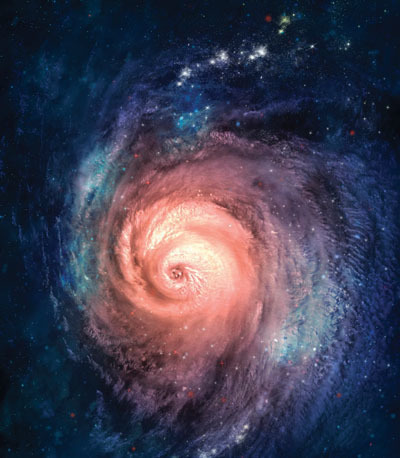
Spiral galaxy. Somewhere in deep space.
An international research team examining images from the James Webb telescope reported finding six galaxies as big as our Milky Way Galaxy. This was thought impossible because they are said to be ‘only’ 500 to 700 million years after the alleged Big Bang, which is ‘too early’ for the theory. Yet they appear remarkably ‘modern’.
It’s no surprise that as technology enables us to ‘see’ more from the universe’s past, attempts to explain how everything made itself by natural processes face more, not less, difficulties. The alternative still stands:
“In the beginning, God created the heavens and the earth.” (Genesis 1:1).
Erica Nelson, co-author of the Nature paper and assistant professor of astrophysics at the University of Colorado Boulder, said, “It’s bananas. You just don’t expect the early universe to be able to organize itself that quickly. These galaxies should not have had time to form.”
“For His (God’s) invisible attributes, namely, his eternal power and divine nature, have been clearly perceived, ever since the creation of the world, in the things that have been made. So they are without excuse. For although they knew God, they did not honor him as God or give thanks to him, but they became futile in their thinking, and their foolish hearts were darkened.” Romans 1:20-21
“And God said, “Let there be lights in the expanse of the heavens to separate the day from the night. And let them be for signs and for seasons, and for days and years, and let them be lights in the expanse of the heavens to give light upon the earth.” And it was so. And God made the two great lights—the greater light to rule the day and the lesser light to rule the night—and the stars. And God set them in the expanse of the heavens to give light on the earth, to rule over the day and over the night, and to separate the light from the darkness. And God saw that it was good. And there was evening and there was morning, the fourth day.” Genesis 1:14-19
Although evolutionary theory says all creatures descended from a common ancestor, when one looks at animals today (or in the fossil record), they appear to be unique creations with the ability to change to fit their environments.
A creature’s ability to live and change is programmed at the deepest levels of the genome in ways we do not fully understand.It is inconceivable that it could have evolved by random chance.
What we can now see with an electron microscope is that the human genome works as a four-dimensional ‘computer’: our three billion letter sequence of DNA is able to turn sections of itself on and off; it is coiled into 3D fractal spheres where sections folded near each other combine to create new levels of information; it changes shape over time to expose different areas of DNA needed to create tens of thousands of different proteins.
This level of complexity is not just limited to the genome, but can be seen in the interdependent relationships between living creatures throughout every ecosystem. Such highly-engineered structures and relationships can only exist if they are created simultaneously in a short space of time — which is exactly how Genesis says God created in six normal days.
In the last few years, apologist William Lane Craig has attacked biblical (‘young earth’) creation. However, he is not enamoured with many of the other compromise views. In 2021, he published a book, In Quest of the Historical Adam. He concluded that Adam and Eve were a real original couple who gave rise to all humans, and who committed the first acts of sin. But they were a pair of Homo heidelbergensis who lived perhaps 750,000 years ago. Dr. Jonathan Sarfati and Keaton Halley of Creation Ministries International offer their analysis of Craig’s book.
They do an excellent job of critiquing Craig’s book. God’s Bible is inerrant. It clearly provides evidence for a young earth and this video will help you support that view. Share your thoughts in the comments and share the video with your friends! If you would like to support Creation Ministries and their efforts: (https://creation.com/donate)
A rare look inside a fossilized dinosaur egg found in southern China has revealed an exquisitely preserved embryo—and evidence suggesting that some of these prehistoric creatures had even more in common with modern birds than previously thought.
Scientists said the embryo inside the egg, which was laid between 72 million to 66 million years ago during the Late Cretaceous period, was that of a two-legged, feathered carnivore known as an oviraptorid. They said, in a paper about the discovery published Tuesday in the journal iScience (interdisciplinary open-access journal), the embryo’s curled body position—with its back against the blunt end of the 7-inch-long egg and its head between its legs—resembles that of bird embryos.
For evolutionists, this find poses some difficult questions:
1. How could this fossilised embryo survive millions of years?
2. How come it resembles that of bird embryos today?
“God created the great sea creatures and every living creature that moves, with which the waters swarm, according to their kinds, and every winged bird according to its kind. And God saw that it was good. And God blessed them, saying, “Be fruitful and multiply and fill the waters in the seas, and let birds multiply on the earth.” And there was evening and there was morning, the fifth day. And God said, “Let the earth bring forth living creatures according to their kinds—livestock and creeping things and beasts of the earth according to their kinds.” And it was so. And God made the beasts of the earth according to their kinds and the livestock according to their kinds, and everything that creeps on the ground according to its kind. And God saw that it was good.Then God said, “Let us make man in our image, after our likeness. And let them have dominion over the fish of the sea and over the birds of the heavens and over the livestock and over all the earth and over every creeping thing that creeps on the earth… And there was evening and there was morning, the sixth day.” Genesis 1:21-31
Why did God create the universe in six days? He tells us in His commandments: six days you shall work and the seventh day you will rest. It was a pattern for how He made man. We are to work as He did for six days and the seventh will be a rest and holy day which is used to remember, thank and praise our Creator.
“For in six days, the Lord made heaven and earth, the sea, and all that is in them, and rested on the seventh day. Therefore the Lord blessed the Sabbath day and made it holy.” Exodus 20:121
In the soon-coming Millennial Kingdom Jesus will reinstate this pattern for man.


 LIVING ETERNAL NOW