Professor Stuart Burgess, the author of the article from which this abbreviated version was taken claims the debate over creation and evolution is far from settled, with design, complexity, the origin of life and the fossil record raising enduring questions about a Creator.
Professor Stuart Burgess, B.Sc. (Eng.), Ph.D., C.Eng., FIMechE, excels in mechanical engineering, both in man-made devices and God’s design in nature. He has held academic posts at Bristol University, Cambridge University and Liberty University in the USA. At Bristol University he was appointed Head of Department three times between 2004 and 2011. He has worked for the European Space Agency (ESA) and was the lead designer for the solar array on the world’s largest civilian earth-observation spacecraft (Envisat); these gear systems are used on all the ESA’s large earth-observation satellites. For years, he led the design and testing of the chain drive for the British Olympic Track Cycling Team who won a record six gold medals at the 2016 Rio Olympics and also ranked 1st in the 2021 (postponed due to Covid) and 2024 Olympic Games. He was invited to exhibit this work at the Royal Society (National Academy of Sciences) in the UK in 2017 where it received national publicity. He has published over 200 scientific papers on the science of design in engineering and nature.
A Royal Society lecture delivered by Steve Jones had an unusually blunt title – ‘Why creationism is wrong and evolution is right’. The purpose of the uncompromising title was, no doubt, to try to convince a sceptical public that evolution should be accepted as scientific truth.
A Mori poll for the BBC Horizon programme showed that only 48% of people in the UK believe the theory of evolution, and that 44% think that creationism should be taught in science classes.
But it is not just among the general public that you find a stubborn belief in a Creator. Many scientists and engineers who believe that there must be at least some involvement of a supernatural Creator to explain life on earth. Professor Stuart Burgess knows two biology professors who doubt many of the fundamental aspects of evolutionary theory, despite having to teach the theory to their students.
ORIGIN OF LIFE: Intelligent design arguably provides the only answer to one of the biggest questions of all – the origin of the very first living system. Despite intense efforts using sophisticated equipment, no one has been able to produce self-sustaining life from lifeless chemicals.
The result of the classic Miller experiment in 1953, which created some of the building blocks of life from ordinary chemicals, represents meagre progress. The fact that there has been no progress on this front during the last 50 years makes it very difficult to believe that life emerged by accident in the first place.
OVER DESIGN IN NATURE: Another compelling piece of evidence for intelligent design is the existence of over-design in nature. Evolutionary theory is based strictly on fitness for survival. However, many organisms have beauty and sophistication far beyond what is needed for them to survive.
Peacock display in sunlight, Sigiriya, Central province, Sri Lanka.
The brilliant peacock tail feathers, which produce their colours by optical interference, have a design of breath-taking precision. Yet their only function is to form an attractive display (and remember that most other birds get by without such optical displays!) The intricacy of peacock feathers, it is said, made Darwin feel sick when he looked at them.
FOSSIL EVIDENCE: Fossil evidence, like the recently publicised fish Tiktaalik roseae (supposedly a transition between fish and land animals), does little to convince for evolution. Such creatures were well designed for their particular environment – and the fact that they exhibit unusual combinations of features does not mean that they are necessarily ‘missing links’ between other kinds of creatures.
Only those already committed to a belief in evolution are forced to see them as evolutionary ‘links’ rather than well-designed creatures in their own right. Overall, the fossil record continues to provide more problems for evolution than support.
It is significant that many of the greatest scientists were enthusiastic believers in a Creator – including Isaac Newton, Lord Kelvin, James Clerk Maxwell and Michael Faraday. The last three of these scientists knew of the theory of evolution but believed in intelligent design and the biblical creation account. Anyone who believes in a Creator stands shoulder to shoulder with some of the greatest scientists in history.
The current fashion of ruling out any role for God in origins actually breaks a fundamental principle of science – namely, to be open-minded about ideas before there is concrete proof that they are wrong. No one has proved that God had no role in origins.
Because the origin of life is an unrepeatable event, it will never be possible to prove how life came into existence. Even if evolution were to be taught in schools for the next 100 years, the majority of people would probably still instinctively believe in a Creator.
Historians often claim humanity stretches back 100,000 years or more—but does the evidence support that? Written records only reach the late third millennium BC, and the earliest dates wobble by centuries depending on assumptions about carbon dating and Egyptian chronology.
What if secular history actually compresses into a biblical timeline after Noah’s flood? From population growth to the pyramids to China’s mythical rulers, Doctor Carter explains why history can’t go back as far as we’ve been told—and why the Bible’s ‘warts and all’ record stands uniquely trustworthy. He is one of Creation Ministries (www.creation.com) best presenters. You will learn a lot of useful information to use in supporting a young earth history.
Mary Clair Kelly of the Institute of Creation Research (ICR) interviews Dr. Jake Hebert to break down what modern astronomy actually observes versus what it assumes, and why the age of the universe is nowhere near as settled as you’ve been told.
Jake Hebert earned a B.S. from Lamar University, an M.S. from Texas A&M University, and a Ph.D. from the University of Texas at Dallas (all degrees in physics).
Jake Herbert believes the Biblical Timeline of a young Earth can be defended. This interview will be of interest to all who believe in Biblical inerrancy and therefore a young age of the Cosmos.
Why do so many scientists reject creation—and is that rejection rooted in science itself or in something deeper? This conversation explores how assumptions like naturalism shape what people believe about origins, about truth, and even about the nature of science itself. Dr Robert Carter unpacks why believing in a rational Creator actually makes science possible, and how shifting the conversation from ‘facts’ to ‘worldviews’ can open surprising doors for meaningful dialogue. If you have ever struggled to talk about these things with others, this episode is for you.
This is an important video and will help Christians have effective conversations with agnostics and atheists on creation and evolution.
The final nail in the coffin of human evolution by Dr Robert Carter published 03 Jul, 2025
Humans and chimpanzees are NOT 99% identical, like we have been told for the last 40 years. The real differences are 15 times greater than the now-outdated evolutionary guesses.
The first estimates of human-chimpanzee genetic similarity were made in the 1970s. DNA from the two species was mixed and repeatedly heated and cooled in a test tube. By passing light through the tube, the amount of DNA alignment was estimated by how cloudy the solution became at different temperatures. This gave us the first claims of “98 to 99%” identity.1 John Ahlquist, whom we interviewed in Creation magazine, was one of the main researchers on that project. The problem with this method, he realized, is that it only measured the DNA that would align. Huge areas of dissimilar DNA could exist, and they would not have been able to see it.2
Most evolutionists simply accepted the “98 to 99%” figure without question and it has been broadcast across essentially all media platforms ever since. The only serious challenge came from the creationist community,3 with only an occasional admission from the evolutionary side. In one of those, the author acknowledged the “myth of 1%” and said that the real number is much less.4
Everything seemed to go in circles for a long time. Then evolutionary biologist Dr Richard Buggs wrote a blog post in 2018 where he concluded that less than 85% of the human and chimpanzee genome matched letter-for-letter.5 This was based on a paper he was about to publish with one of his newly minted PhDs, Josiah Seaman.6 That paper seemed to indicated a 96.6% similarity, but that occurs only after cutting out the centromeres, telomeres, all copy number variations, about 300,000 small insertions and deletions (accounting for about two million letters in each genome), and an additional percentage of DNA that resisted alignment.24 Yes, humans and chimpanzees do share a lot of DNA, but when you include what they don’t share, the percent identity drops significantly, into the low 80% range.
New study with complete data
All this prior work (by Drs. Ahlquist, Tomkins, Buggs, etc.) was based on incomplete sequencing. We did not have a fully-sequenced human genome until the summer of 2023,7 let alone a high-quality chimpanzee genome. Indeed, the early versions of the chimpanzee genome were even assembled on a scaffold of the human genome, automatically making them look more human-like. However, a major new study has completed each great ape genome to a very high standard.8 Like the newest human genome, they are (nearly) complete, from one end to the other. Older versions had major gaps, had faked centromere data, and were highly problematic around the numerous repetitive regions. These ‘telomere-to-telomere’ versions solved these problems.
The assembly of these genomes was no trivial matter. Even after all that work, they had to develop a filtering protocol that rejected certain DNA variants, and they had to hand-curate multiple sections that did not ‘behave’.
The alignment was even more difficult. They identified 175 inversions larger than 10,000 nucleotides, one chromosome fusion, and one large translocation.9 They also saw 632 inversions that were unique to one species only.
Analyzing the data
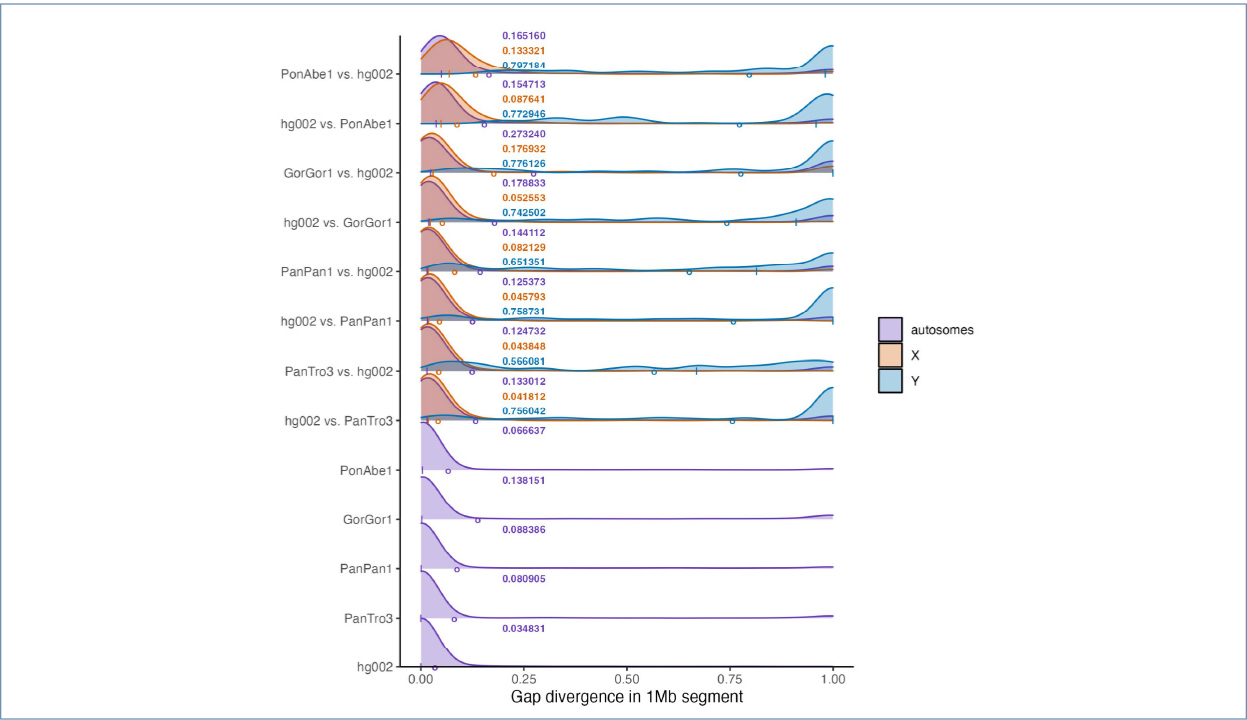
The ‘percent difference’ data are reported in Yoo et al.’s supplemental information (figure 1).
Figure 1. The percent difference caused by alignment gaps between human and great apes. Each alignment was divided into 1-million-bp segments and the percent difference caused by gaps in that segment was calculated. The curves represent histogram-like (e.g., count) data, and each curve has been normalized to its maximum value (so that the peaks all have the same height). The mean (average) for each curve is denoted by the short vertical lines, and the values are reported in the column of numbers. The curves are often quite skewed, making an ‘average’ more difficult to see, so the authors also reported the median (middle value, circles). hg002 = human, PanTro3 = chimpanzee, PanPan1= bonobo, GorGor1 = gorilla, PonAbe1 = orangutan.
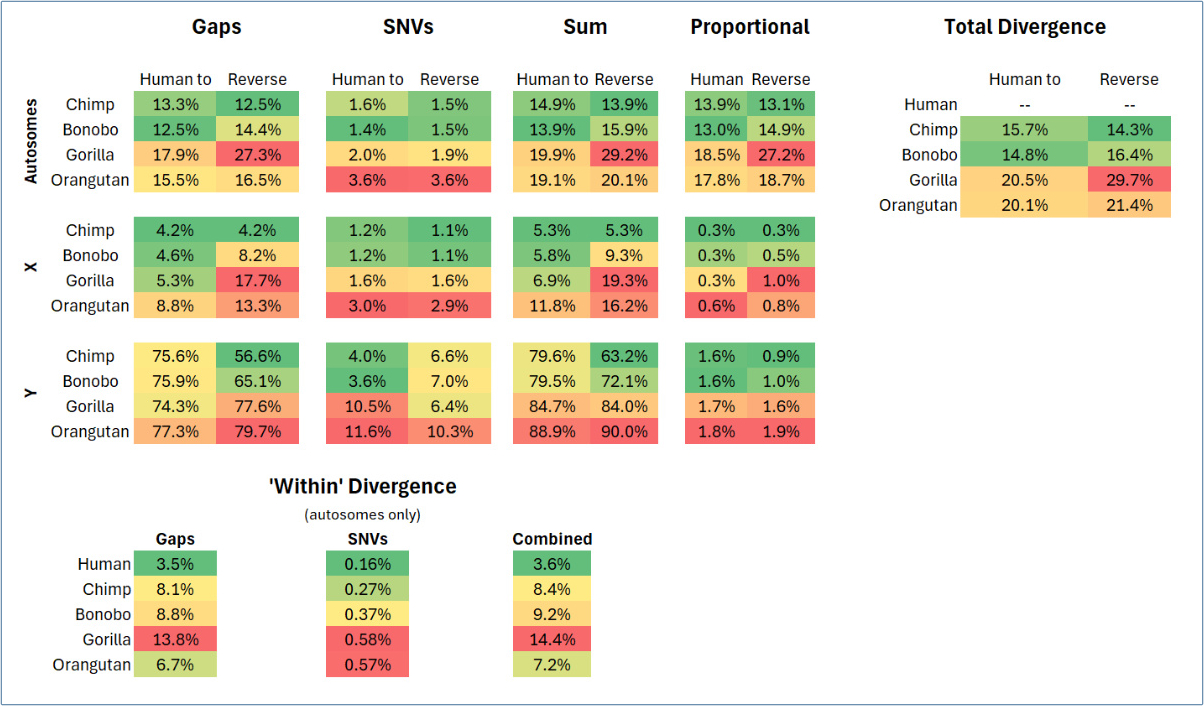
They did not provide any error bars, just the average for each genome pair. They also broke up the data among the autosomes and the X and Y chromosomes. The blue bulges on the right in figure 1 represent giant gaps in the Y chromosome alignment. The purple bulges on the bottom represent the differences found among the two genome copies within the same individual. I worked up their data to get a complete estimate of divergence between the species (figure 2).
Figure 2. Genome similarity calculations. The data for gap and SNV divergence for the autosomes and X and Y chromosomes were tabulated. The differences were summed and then combined using the proportional lengths of the three chromosome types in the different species. The human-to-ape and the reverse calculations are not identical due to the presence or absence (depending on which way you are looking) of many alignment gaps.
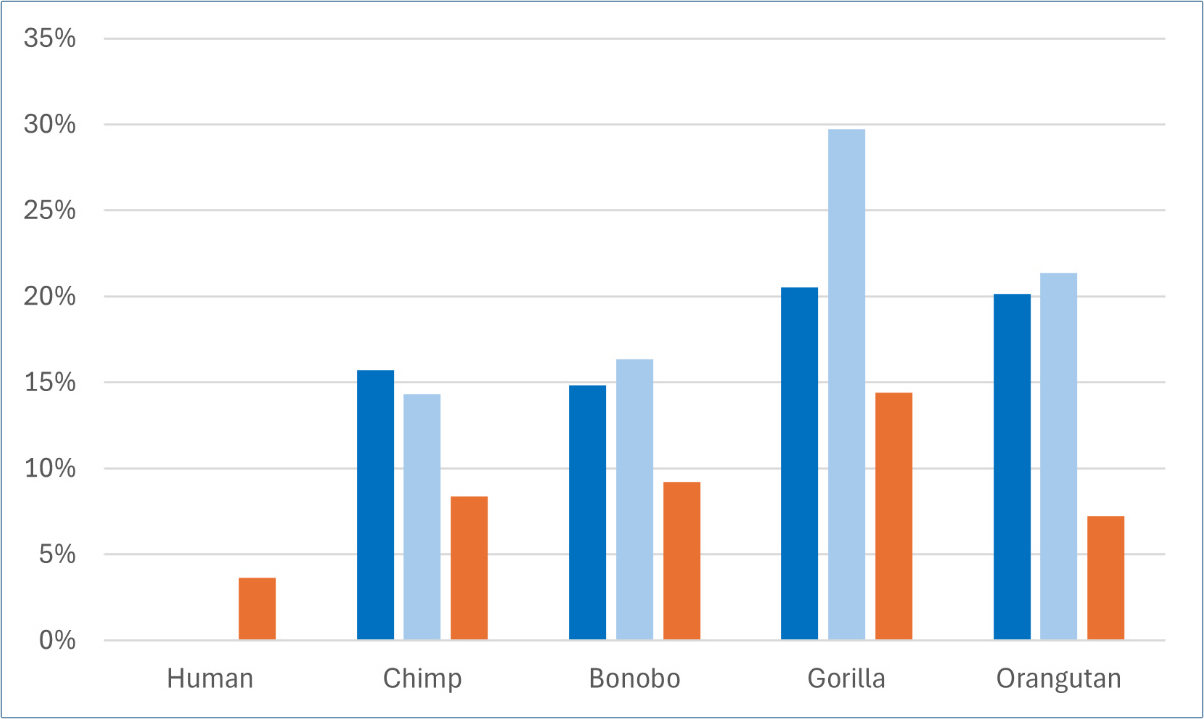
From that, it was possible to generate a bar chart that showed the within- and among-species differences (figure 3).
Figure 3. Final data summary. Orange: within-species difference. Dark blue: human to ape. Light blue: ape to human.
99%? Not even close!
This is a big deal. First, many commentators have claimed this proves that the human and chimpanzee genomes are only about 85% identical.10,11,12 They are spot on, but you would not know that from the major headlines. Nor can you easily find the information in the published paper. Instead, you must drill down into more than 100 pages of detailed supplementary information to find the relevant information.
Second, creationist researchers like Dr Jeffrey Tomkins have been vindicated. While the earlier studies were stymied by a lack of trustable sequence data, the newest genomes show how different we are from all apes.
However, third, there are vast stretches of sequence that are nearly identical between humans and chimpanzees. At random, I found one that stretched for several hundred thousand bases and was nearly 99% identical.13Our opponents will misdirect and obfuscate to their dying breath.
Fourth, our opponents will misdirect and obfuscate to their dying breath. Case in point, in a recent video a commentator named Gutsick Gibbon claimed that I agree with her about human-chimpanzee similarity.14 No, while I agree with her that Tomkins is human and made mistakes (I have also pointed out glaring mistakes in her work and several errors in my work as well15), I do not agree with her that humans and chimpanzees are highly similar.
Fifth, God could have created us 99.9999% identical to chimps, or he could have made us 50% identical, or even less. The biblical creation model makes no prior claim on this. We should expect a high similarity because of the obvious structural, behavioural, physiological, and nutritional similarities between us. But how much? Nobody can know! Note that the evolutionary community was also unable to come up with an estimate before the numbers were run. They have no prior commitment to which ape species would be more like us. The debate about which species was more genetically like us lasted until the 1980s. Many people wanted orangutans to win and resisted the notion that chimps were our evolutionary cousins. Some paleontologists were arguing for the primacy of orangutans as late as 2009, although by that point they were a very small minority.16
The four numbers
Finally, there are four things that we need to know:
What is the percent similarity among the parts that align?
What is the percent similarity when you include the parts that don’t?
How many mutations must have occurred over evolutionary time to account for these differences?
How long would it take to functionally integrate new mutations into the genome?
The answer to the first question is now known: about 98%. The answer to the second question is also now known: about 85%. That third question is now where the debate should be, and the fourth question might be the biggest Achilles’ heel of all for evolutionary theorists.
The evolutionary model here is unlike ours in that it is ‘one-tailed’. They will gladly accept high similarity levels, but there is a cliff on the other side of the argument. If we are too dissimilar, they cannot explain the differences in their 6.5 million years. They do have the ability to back up the time to the most recent common ancestor, but even that ability is limited. A few years ago, some scientists were arguing for 13 million years.17 Some wanted to push the time even further back, but the paleontologists would have none of that because that would necessitate putting early apes in with the dinosaurs. They are stuck. The difference must be low. Period.
How much ‘difference’ can they explain?
Given an evolutionary conveyor belt of new mutations entering in, old mutations being removed by selection and drift, and really old mutations going to ‘fixation’ (i.e., 100%), they expect the mutation rate to approximate the fixation rate.
Here’s how the calculations work out:
Given a haploid mutation rate μ, the number of new mutations per generation is simply 2Nμ, where N is the population size.18
For a new neutral mutation, the probability of fixation is proportional to its frequency in the population. Since there are 2N copies of the genome in the population, and since, by definition, a new mutation starts in one copy of one chromosome, the frequency of that mutation is 1/(2N).19 The rate of fixation (r) would be proportional to the number of mutations that appear (2Nμ).
Thus, r= 2Nμ / 2N = μ
If the mutation rate is 100 per individual per generation, that equates to 50 mutations per haploid genome per generation.20 They would thus expect the human genome to accumulate 50 fixed differences per generation.21 Over 6.5 million years (~300,000 generations), they would expect 15 million differences between each species and our common ancestor, or about 30 million differences between us and them today.
30 million differences / 3 billion letters = 1%
THIS is why they have been quoting that 1% figure all these years, and this is why they have been resisting anything else. If the number is much greater, things do not work out in their favor. When the difference grows past that level, their models break down. It is simply too hard to explain so many differences, even in their ‘millions of years’ mindset.
But even a 15% difference could still be explained if large insertions and deletions cause sudden changes. Consider that the chimp Y chromosome is only half as long as the human Y. Does that amount to 30 million differences, or one? For example, if a single deletion erased the heterochromatic arm of the chimp Y chromosome, a 0.5% difference between our two genomes would instantly appear. What other large changes could be effected by such things?
Yet, we are not talking about changes in ‘junk DNA’. Multiple functional genes are in the unaligned regions. Even though about 99% of human genes are found in the other species, Yoo et al. found 185 gene families unique to humans and from around 1,400 to 2,000 gene copy-number differences among the species.22 True, many of the duplicated areas deal with highly repetitive, non-coding DNA, but these areas have increasingly proved to be functional, as we and others have pointed out many times.23 There are also fully-functional genes in these areas, specifically ones that deal with brain function.24 About 55% of each genome, on average, is composed of repetitive elements (LINEs, SINEs, LTRs, etc.).25 These, too, are proving to have functions, so they cannot be ignored in any comparison.
Given many millions of point mutations and tens of thousands of insertions, deletions, inversions, and duplications, can they explain this in an evolutionary context? They can explain some in their models, but those models are often quite simplistic (like the equations above). Random mating is a critical assumption, but it is never true, and non-random mating only slows down how fast new variants spread. There are also questions about population growth and how it affects all calculations. Given that the human population has been expanding (since the Flood or since the invention of agriculture, take your pick), ZERO genetic variants have become fixed in the human genome for the last 10,000 years in the evolutionary timeline. How does ‘no evolution for 10,000 years’ affect the evolutionary forecast?The ‘fact’ that they have been trumpeting from the rooftops since the 1970s turns out to be no fact at all. The real difference is NOT 1%. No, it is 15x greater.
But the fourth question above is perhaps the most fundamentally important question in evolution. Why? Because evolution needs new genes to arise and activate. Humans and chimpanzees do not just differ at the nucleotide level. Our genes are not used in the same ways and our brains have very different wiring pathways. Those changes would not just have to arise. No, they would have to arise, spread out and replace whatever original gene was in that place, and then integrate themselves into the already complex regulatory processes that exist.
This is a massive problem, even for the “1%” crowd. Now that we know the human and chimpanzee genomes are more than 10 times more different than they thought, the problem of evolution only becomes that much more difficult. This is one of the greatest scientific discoveries that supports the biblical creation model. It does not mean, however, that evolutionists will never be able to explain what we see. It does mean, though, that they will be scrambling for cover. The ‘fact’ that they have been trumpeting from the rooftops since the 1970s turns out to be no fact at all. The real difference is NOT 1%. No, it is 15x greater.
Cohen, J., Relative differences: the myth of 1%, Science316(5833):1836, 2007. Return to text.
Buggs, R., How similar are human and chimpanzee genomes?, richardbuggs.com, 14 Jul 2018. Return to text.
Seaman, J. and Buggs, R., FluentDNA: nucleotide visualization of whole genomes, annotations, and alignments, Frontiers in Genetics 11:292, 2020. Return to text.
Rhie, A. et al., The complete sequence of a human Y chromosome, Nature621(7978):344–354, 2023. Return to text.
Yoo, D. et al., Complete sequencing of ape genomes, Nature641(8062):401–418, 2025. Return to text.
Yoo et al., ref. 7, supplementary information, p. 101. Return to text.
Luskin, C, Letter to the Smithsonian: Correct your signage on human-chimp genetic similarity!, evolutionnews.org, 27 May 2025. Return to text.
Buggs, R., How much of a human genome is identical to a chimpanzee genome?, richardbuggs.com, 6 May 2025. Return to text.
Tomkins, J.P., Chimp genome markedly different from human, icr.org, 29 May 2025. Return to text.
Gutsick Gibbon, I killed this creationist argument, youtube.com, 28 May 2025. Return to text.
Carter, R., James 3 vs. the anticreationists, biblicalgenetics.com, 16 Jan 2024; youtube.com/watch?v=FIY7FTTFZyg. Return to text.
Grehan, J.R. and Schwartz, J.H., Evolution of the second orangutan: phylogeny and biogeography of hominid origins, J. Biogeogr.36(10):1823–1844, 2009. Return to text.
Venn, O. et al., Strong male bias drives germline mutation in chimpanzees, Science344(6189):1272–1275, 2014. Return to text.
The formula includes a “2” because the genome is diploid. The mutation rate is usually given as the haploid mutation rate, for historical reasons. Return to text.
Again, a 2 is in the denominator because there are two copies of the genome per individual in diploid species. Return to text.
The classic neutral theory formula r = μ applies when μ is the per-site mutation rate. When Kimura derived this result, he was showing that at any given nucleotide position, the rate of neutral substitution equals the mutation rate at that site. However, when one multiplies both sides of r = μ by the genome size, the exact same number is reached, especially since we started with the per-haploid genome mutation rate (i.e., the sum of the per-site mutation rates * number of sites). Thus, the relationship r = μ scales directly. I applied the principle at the genome level rather than the per-site level because the question was about the rate of fixation across a species. Return to text.
Given random mating, which never happens, and a stationary population size, which is clearly not true for humans. Without these assumptions the evolutionary model cannot deliver even a 1% difference. Return to text.
Yoo et al., ref. 7, supplementary information pp. 66–67. Return to text.
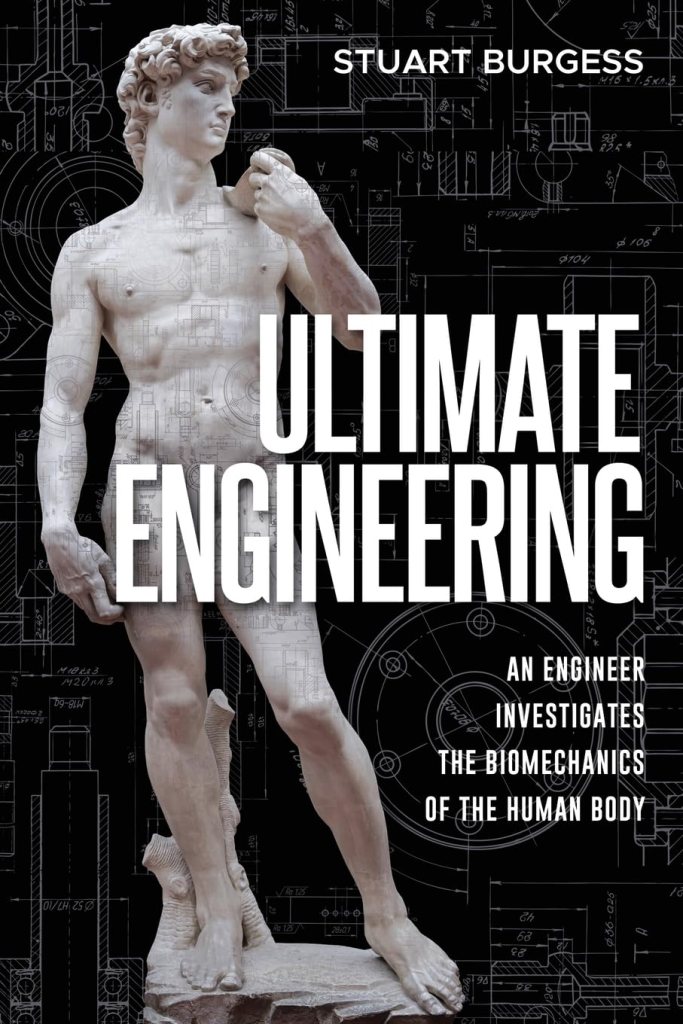
Who first invented fiber optic cables? Or camera shutters? Or truss structures? Or double wishbone suspensions? Or block-style Roman arches? What about laser beams? As award-winning British engineer and designer Stuart Burgess reveals, the original inventor of these and countless other ingenious devices was no human inventor. Instead, the “first to market” was the designing force behind the living world.
Evolutionary theory predicts a living world crowded with substandard designs. But as Burgess shows in Ultimate Engineering, the latest science has discovered just the opposite — designs so advanced they are at the limit of the possible, precisely as proponents of the theory of intelligent design anticipated. As Burgess also details, he and other researchers are taking the discovery of these advanced designs and using them to inspire fresh technological breakthroughs — a revolution known as biomimetics.
Burgess shows that Darwinian natural selection and mutations cannot produce the wonders seen in the human body. The arguments and confessions of evolutionists are also well documented. One senior professor, a non religious microbiologist suggested that evolutionary theory was “black magic”. Another such professor a leading biology researcher at a top university, said in an equally frank moment, “You wave a magic wand and say, Evolution did it”.
Time spent reading Ultimate Engineering could lead to a new appreciation of where you came from, why you are here and where you are going.
The Christian church has historically supported ‘young-earth creation’, however, around ad 1800, long age theories crept into secular geology. They denied the global Flood of Genesis a priori by restricting causes to processes happening now. That meant it would take millions of years to form the rocks and fossils. In response, many churches essentially replaced the authority of Scripture with the authority of secular geology.
As a result, God raised up ministries like Creation Ministries International (CMI), http://www.creation.com. The ‘young earth’ position is not their axiom, or starting assumption. Rather, it is a theorem, i.e., something logically deduced from their real axiom: the authority of Scripture. Throughout most of its history, the Church accepted that Scripture was the last word on origins. Thus no Church Father or Reformer taught that Earth was older than a few thousand years.
Sadly, the liberal wing of the church rejected the authority of Scripture outright. They agreed that Scripture really does teach a young earth, but it was wrong. Many conservatives wanted to keep biblical authority but were intimidated by the secular long-age claims. So they invented various schemes to pretzelize the Bible to accommodate long-age thinking. For example, concepts like the gap and day-age theories appeared in the 19th century. The ‘framework hypothesis’ was a 20th-century novelty. (See creation.com/history-interpretation.)
But it was clear that they had really made secular ‘science’ their final authority. If these views were really taught in the text, then why did the Church Fathers, Reformers, and other Christian scholars miss them before about 1800? And if we abandon biblical authority on history, then why not on morality and doctrine as well (creation.com/useful-dupes)?
Other pushbacks are claims that the Bible is not clear on the topic. But this goes to another important issue: whether the main teachings of the Bible are understandable or perspicuous. After all, Jesus often said, “it is written”. Paul said, “All Scripture is breathed out by God” and makes us “complete” and “equipped” (2 Timothy 3:15–17). This could not be, if the Bible were as difficult as some claim.
Some make hyper-pious claims that ‘God’s days are not man’s days’. But God wrote Scripture to teach us. Therefore, God’s meanings must be the same as ours; otherwise, communication is broken. And for us to apply His teachings, God’s logic must be the same as ours. The difference is that God knows all true premises and commits no logical fallacies (see creation.com/logic).
This is the 48th year of Creation magazine, affirming both the authority and understandability of Scripture, plus ample supporting evidence. The latest issue contains much more of the same. For instance, hard blue-gray rocks forming in decades show there is no need for millions of years.
Biblical authority and understandability have historically been a fruitful foundation for science. On p. 24, CMI interview a molecular biologist who firmly defends biblical creation, while challenges the supposed evolution of the whale. The biblical Creation/Fall/ Flood/dispersion framework explains the wide variety of animals around the world, including the bowerbird. Plus, the Bible’s design implication explains why some animals will sacrifice themselves for their groups. And their p. 40 article explains how and why Scripture clearly teaches the foundational doctrine of creation out of nothing.
This article is taken from the latest issue of Creation Magazine Vol 48, Issue 1 2026. I have been a subscriber for 48 years.
In this in-depth interview, Dr. Bill Barrick—Professor Emeritus of Old Testament and Hebrew at The Master’s Seminary — unpacks what the Hebrew text of Genesis 1 really says. Does the Bible itself teach a young earth? Is the day-age theory compatible with the Hebrew grammar? What about the Gap Theory, mytho-history, and functional creation views made popular by scholars like William Lane Craig, Michael Heiser, and John Walton? We dig deep into the Hebrew of בְּרֵאשִׁית בָּרָא אֱלֹהִים (“In the beginning God created”), explore whether Genesis 1:1 is a heading or a historical statement, and discuss how the text itself answers questions about the firmament, cosmology, and biblical authority.
00:00 Intro 02:08 Discussion on Young Earth Creationism 09:01 Old Earth Creationism and Personal Journey 12:09 Day-Age Theory and Hebrew Grammar 22:05 Gap Theory Examined 32:21 William Lane Craig and Mytho history? 37:05 Poetry vs. Historical Narrative 41:38 Analysing Genesis 1:1-3 57:11 Primitive Cosmology and Metaphors 01:04:42 The Light Before the Sun
Our worldview informs our personal, social, and political lives. It helps us understand our purpose. Further, our worldview determines our ethics, our values, and our capacity for happiness. It helps us answer the big questions of life: How did I get here? How am I to live? Where do I find meaning in life? What is my ultimate destiny? It is more telling than any other aspect of our lives.
In forming our worldviews, Harvard psychiatrist, Dr. Armand Nicholi says, that we make one of two assumptions about life. The first is that we live in a godless universe; we are a product of nature that has evolved over time. This is a secular worldview that emphasizes scientific knowledge and its motto is “What do science and nature have to say?” The second assumption is that there is a supernatural intelligence who gives the universe order and life meaning. This is a spiritual worldview that is rooted in Biblical revelations. It places emphasis on spiritual truth and wisdom and its motto is: “What does God have to say about this?”
It is reasonable to conclude that every person has an opinion on God and spiritual reality, even if it is a belief that He is non-existent. We all have a faith view of reality and it trickles down into our lives and influences the choices we make. One of the great flaws in our human character is we stubbornly hold on to our beliefs because they generally reflect how we want life to be rather than how life actually is. For this reason, evidence does not seem to matter.
A great example of this is Dr. Francis Collins. He is most noted for having been chosen to chair the Human Genome Project, ENCODE where, in 2003, he led an international collaboration of two thousand scientists in sequencing the human genome. More recently, he was appointed by President Obama to be the Director of the National Institutes of Health. Clearly, he is a prominent scientist, but what is perhaps even more interesting is his spiritual journey.
He began this journey as an atheist. In his third year of medical school, while he was working in the hospital, he was attending a woman who had exhausted her options for treatment. She suffered from a heart condition and was going to die soon. Collins was moved by this kind and faithful woman. She had a strong faith, and she shared it with him. She said, “You know, I’m ready to go. Don’t worry about me.” And then she said, “Dr. Collins, you’ve been so kind to listen to me and care for me and listen to me share with you about my faith. Tell me about your faith. Tell me what you believe.” Collins later wrote: “Nobody had ever asked me that question before, not like that, not in such a simple, sincere way. I realized I didn’t know the answer. I felt uneasy. I could feel my face flushing. I wanted to get out of there. The ice was cracking under my feet. All of a sudden, by this simple question, everything was a muddle. Collin’s began to wonder if he was an atheist because he had chosen the position of reason or because it was the answer he wanted. Finally, it came to him: “As a scientist, I had always insisted on collecting rigorous data before drawing a conclusion. And yet, in matters of faith, I had never collected any data at all. I didn’t know what I had rejected. So, I decided that I should be a little better grounded in my atheism. I better find out what this is all about. So, I challenged a patient of mine who was a Methodist minister. And, after listening to my questions and realizing that I was not dealing with a very full deck of information, he suggested that I read the Gospel of John, which I did…I found the scripture to be interesting, puzzling, and not at all what I had thought faith was about… then I began to read C.S. Lewis and realized there was a great depth of thinking and reasoning that could be applied to the question of God.” Lewis convinced him that reason and faith go hand in hand, though faith has the added component of revelation—the Bible. Collins had previously believed that Jesus and the stories of the Bible were nothing more than mere myths. Again, as he studied the historical evidence, he was stunned at how well documented and how historically accurate the Bible is. He also saw a surprising fidelity of the transmission of the manuscripts that were passed down over the centuries. And, over time, Francis Collins, based on the accumulation of the evidence that he observed, concluded that God exists, and that Jesus is the Son of God. He also concluded that most of the religious skeptics that he knew and that he meets today are just like he was. That is to say, they didn’t want to think about these things and never looked at any evidence, never drawing conclusions from the real evidence that was available. This is what Dr. Dallas Willard, former professor of philosophy at the University of Southern California, believed was a major problem with individuals who considered themselves to be agnostic or atheist. Willard found that so many of the students and scholars he encountered on campus and in the world were guilty of what he called “irresponsible disbelief.” These bright men and women would often choose to disbelieve in something without any significant commitment to an investigation of that disbelief by way of sound reasoning and careful examination of the evidence.
Do you believe the Bible is inerrant? The revealed word of God. If you do then you need to reject evolution and its billions of years and hold to to the Biblical history and the worldwide flood of Noah’s day. It produced the billions of fossils and fossil fuels, oil and gas that evolutionists tell us took billions of years to form. The Bible tells us that to initiate the flood God broke the mantle of the earth “all the fountains of the great deep burst forth, and the windows of the heavens were opened.” The whole topography of the Earth was changed when God poured out His wrath upon the Earth the first time when He judged the wicked Nephilim (hybrid angel/humans) and mankind. The subsequent Ice Age was a single, rapid event triggered by post-Flood conditions. These included massive volcanic activity releasing aerosols that cooled the continents, combined with warm oceans from Flood-related heating, leading to heavy snowfall and glacier formation. The duration is typically estimated as several hundred years, with glaciers building up over the first few centuries and melting during the latter half as volcanic activity waned. This fits within the post-Flood timeline, allowing for human and animal dispersal (e.g., via land bridges from lower sea levels) before the rise of early civilizations like those in Mesopotamia around 4,000 years ago. The Tower of Babel event that formed the nations with new God given languages occurred just 200 to 300 years after the Flood and was the reason people dispersed across the world.
God has been active in His world with these dramatic events. The apostle Peter told us 2000 years ago that in the last days before Jesus returns that the world would reject God and His account of creation and Noah’s Flood as myths and suffer God’s judgement just as the ungodly did before the worldwide flood. The many fulfilled Biblical prophecies are proof God exists and His Word is truth.
“Knowing this first of all, that scoffers will come in the last days with scoffing, following their own sinful desires. They will say, “Where is the promise of his coming? For ever since the fathers fell asleep, all things are continuing as they were from the beginning of creation.” For they deliberately overlook this fact, that the heavens existed long ago, and the earth was formed out of water and through water by the word of God, and that by means of these the world that then existed was deluged with water and perished. But by the same word the heavens and earth that now exist are stored up for fire, being kept until the day of judgment and destruction of the ungodly.” 2Peter 3: 3-7
“Science unequivocally requires that all things are composed of matter and energy. Therefore, immaterial substances—such as God or the human soul—cannot exist.”
However, science itself does not provide any substantiation for the premise. After all, if science can deal only with matter and energy, it can’t possibly show that other things can’t exist. Rather, this claimed requirement is a philosophical position called materialism, and there are substantial grounds for doubting it. ‘Materialism’ in philosophy doesn’t mean striving for material goods, but the belief that matter (or mass/energy) is all there is.
Immaterial Creator of the universe
Among the reasons for rejecting materialism are the compelling arguments that support the existence of an immaterial Creator of the universe. These include the design of living things, the fine-tuning of the universe for life, and the evidence that it has a finite age, among other arguments.
These features of reality are best explained by the biblical teaching that God is the Creator. If these arguments are successful, materialism fails.
Humans are more than mere machines
If materialism were true, humans would consist merely of organized matter, which we have reason to doubt. The renowned atheist Richard Dawkins eloquently articulates his perspective on human nature:
On one planet [Earth], and possibly only one planet in the entire universe, molecules that would normally make nothing more complicated than a chunk of rock, gather themselves together into chunks of rock-sized matter of such staggering complexity that they are capable of running, jumping, swimming, flying, seeing, hearing, capturing, and eating other such animated chunks of complexity; capable in some cases of thinking and feeling, and falling in love with yet other chunks of complex matter.
However, this materialistic perspective faces serious philosophical and scientific challenges. If humans are reduced to purely physical objects devoid of any immaterial aspect, it becomes exceedingly difficult to explain many basic truths about human beings.
Intrinsic value
The first of these is a person’s value. Physical objects have value only because we assign value to them. They are tools, not ends in themselves. Their value is extrinsic and dependent on changeable factors. Human beings, on the other hand, possess intrinsic value merely by virtue of being human, independent of external factors. We do not lose our value even if we lose significant capabilities—declining mentally or becoming comatose, to give a couple of examples.
Christians know that our intrinsic value comes from being made in God’s image We are not merely bodies but souls that can relate to God. Yet even non-Christians will often recognize the value of human beings, whether they recognize the source of that value or apply it consistently to all people.
Without intrinsic value, it would be hard to make sense of human rights, for example. We know it’s wrong to treat people as mere objects. But the evolutionary materialism of our age insists we have emerged unaided from animals, which originally arose randomly from simple chemicals. That means that people lack souls and do not bear the image of God. In other words, they can only be mere physical objects. In such a view, the intrinsic nature of our value cannot be accounted for.
First-person perspective
Second, physical objects lack a first-person perspective. They lack consciousness and self-awareness and are incapable of having a truly subjective point of view, using the self-reflexive pronoun ‘I’. Even complex computers and robots with artificial intelligence lack real awareness.
In contrast, human beings do possess a first-person perspective. We are conscious agents, capable of not only awareness but even self-awareness and the ability to articulate our point of view. It is difficult to explain this universal experience if humans are merely physical objects.
“DAILY, WE ENCOUNTER MENTAL STATES THAT CANNOT BE EXPLAINED BY BRAIN MATTER ALONE.”
Intentional mental states
Third, humans possess intentional mental states. ‘Intentionality’ is a technical term in philosophy that refers to the power of the mind to represent or refer to other things. That is, some mental states can be ‘of’ or ‘about’ something else. Whenever people think, believe, desire, fear, or wonder, they direct their thoughts toward a specific subject or concept. They may think about breakfast, or experience a fear of spiders, for example. Physical events by themselves are not ‘of’ or ‘about’ other things in that same sense, so what happens in our minds is not physical. Daily, we encounter mental states that cannot be explained by brain matter alone.
Human emotion and other ‘felt’ experiences
Fourth, when a person feels joyful, upset, or anxious, the brain is part of the neural circuitry that plays a role in giving that person such experiences. The brain itself, though, is not joyful, upset, or anxious; the person is. The brain is only a complex organ—a physical object with physical properties, similar in that sense to a computer. A computer might be programmed to say, “I’m sad”, but the computer would not really feel sadness. Emotions like happiness, sadness, and fear are not material entities. They can only be experienced by conscious, sentient creatures who have a non-material aspect to their being, like humans and many animals. This is evidence that we are not merely brains in bodies.
Brain research subjects
Empirical studies show results consistent with the above philosophical arguments. For example, pioneering neuroscientist Wilder Penfield conducted over 1,100 brain surgeries in which he stimulated areas of the brain while patients were awake, and noted their responses. He was able to induce bodily movements, sensations, emotions, and memories. But the patients invariably testified that the response was like a reflex, not an action they chose to do. Penfield found he could not stimulate their will. Also, he could not cause them to draw conclusions, make decisions, or even think abstract thoughts (about, say, mathematics). Such experiments suggest that it is the immaterial self which is ultimately responsible for these activities, rather than the physical brain.
IMAGE BEARERS
God developed and populated the earth, which was initially empty (“without form and void”), as described in Genesis 1:2. He executed this task with exceptional precision and skill, thereby establishing a magnificent stage upon which to showcase His most significant creative accomplishment, humankind. Not only did God reserve the best for last, but He also created humans in a manner that distinguished them from animals. According to Genesis 1:26, humans were created to have a unique relationship to God. This was accomplished through the divine plan (“let us make man”), the divine pattern (“in our image”), and the divine purpose (“let them have dominion”). The attribute of being in the image of God (imago Dei) is not merely bestowed by God and retained by humans. It is what gives people special value (Genesis 9:6; James 3:9), and it is part of God’s design for human beings, who were specifically created to represent God on Earth and reflect many of His attributes.