Newly released data from the Australian Council of Educational Research (ACER) Social-Emotional Wellbeing survey of around 500,000 primary and secondary students between 2018 and 2023 reveals a generation deep in emotional crisis and lacking the tools to manage their emotions. Girls at all ages are struggling to cope more than boys. “Many indicators of wellbeing examined in the survey have worsened and barely any have improved despite all the genuine attention and effort by schools and parents and the millions of dollars spent to fund youth wellbeing programs, ‘’ the survey’s author Michael Bernard, California State University Emeritus Professor, and former Melbourne University Professor, said.
The ACER data is collated from the well-being surveys completed by students undertaken by schools seeking to get a handle on the extent of the challenge. It captures kids from all states and territories and from both government and non-government schools.
Australia’s primary school-age children are angrier, lonelier, more anxious, and less able to control their emotions than they were 5 years ago, new research finds, despite the increased societal concern for childhood wellbeing and focus on resilience. The picture is no less bleak in secondary school, where more than one in two students say they feel “very stressed”, an upward trend since 2003, and 56% say they have a hard time controlling their sense of worry.
Professor Bernard said the new numbers were staggering, even before looking at recent trends. “The numbers are bad for young primary schoolkids and get worse as they get older.” The survey reports one in three (32 percent) of the more than 300,000 primary school-age students say they “feel bad for long periods”, and almost half (44 percent) say they can’t calm down quickly when they feel bad. In secondary school, 53 percent of the 180,000 surveyed say they feel “very stressed”. By year 12 it is 77 percent of girls and 55 percent of boys. Adolescent mental health expert and psychologist Michael Carr-Gregg said his practice had been deluged with “so many extremely anxious, extremely depressed kids.” “In my 30 years in the field I’ve never seen anything like the level of stress and anxiety that today’s children and adolescents are going through,” Dr Carr-Gregg said.
What these psychologists fail to mention is the key factor that is impacting the mental health of teens. It is the teaching of evolution as a fact in schools, even Christian schools. The Big Bang and Evolution remove God from His creation and make the Bible a book of fables and myths. It also removes any purpose or meaning to life. There is no hope or knowledge of the God who loves His creation and has provided a way back into a right relationship with Him and the promise of eternal life.
“For God so loved the world, that he gave his only Son, that whoever believes in him should not perish but have eternal life.” John 3:16
DNA must have been created. It is impossible it evolved. It is the instruction code for all living things.
Science continues to reveal more complexity at the smallest levels of life. As a result, the evolutionary account of life’s origins is rapidly trending toward mythology. May God receive the glory for His incredible creation!
Moreover, Jesus Christ changed history from BC to AD. No other person in history has impacted the world as this God/man did. Jesus confirmed the Torah as God’s Word revealed to man by His prophets.
“Jesus said to him, if they do not hear Moses and the Prophets, neither will they be convinced if someone should rise from the dead.’”Luke 16:31
The Bible gives us an accurate history of this world. Creation by God in six days was a real event. The Fall of man was a real event that brought death into this world. The worldwide flood of Noah’s day that killed all mankind except eight people (God’s judgement on a world in rebellion against Him) was a real event. It buried millions of dead things all over the world, fossils and produced all the fossil fuels not billions of years. The world is just 6000 years old. God created the nations when He confused the languages at the Tower of Babel. Jesus entered history to provide a way back into a right relationship with our Heavenly Father. He paid the price for our rebellion, He died that we might live. The Bible also tells us that Jesus is returning soon to rule and reign for the last 1000 years before God destroys this Earth and creates a new Earth where only the righteous dwell.
“I am the way, and the truth, and the life. No one comes to the Father except through me. John 14:6
What a loving God (but also Holy God) that we have that He would send His ony Son to redeem us. And how good is Jesus, God’s Son that He would come to die in our place. God requires us to repent of our rebellion against Him and His commandments and accept Jesus as our Lord and Saviour to come back into His family. It’s an offer of eternal life. It is beyond me why people do not want to get back into a right relationship with their Creator and experience this new eternal life in Christ. What about you?
In Christ’s story of the rich fool, a man decides to hoard his fortune and then “take life easy; eat, drink and be merry” (see Luke 12:13-21). The word translated “fool” literally means “unthinking one.” Mindless. Senseless. The rich fool was out of touch with eternal realities. Despite death’s inevitability, he failed to prepare for it—and failed to remember that he would give an account to God.
“For we will all stand before the judgment seat of God; for it is written, “As I live, says the Lord, every knee shall bow to me, and every tongue shall confess to God.” So then each of us will give an account of himself to God.” Romans 14:10-12
The rich fool stored up treasures for himself on Earth as if he were the center of the universe and as if this world was where he’d live forever. The man was a fool to imagine his silver, gold, crops, land, and barns were actually his. He was a fool to ignore God’s claims on him and his possessions:
A wise person will regularly ask, “Lord, what do you want me to do with all you have put in my hands?” God’s Word tells us exactly how to prepare now for the afterlife. Though our culture and even some of our Christian friends may encourage us to do so, we don’t have to live like fools!
In the world’s eyes, the rich fool was a great success. Today he would be admired, and he might even be placed on a church or ministry board. But in the end, all his success counted for nothing.
Had the rich fool acknowledged God as his Creator and Redeemer, and as the ultimate owner of everything he possessed, he would have been rich toward God and stored up treasures in Heaven. Instead, he stored up for himself treasures on Earth and was suddenly and eternally parted from them at death.
The most troubling aspect of this parable is that if we met this man, most of us would commend him for his foresight. Notice he isn’t called the rich sinner, but the rich fool.
If you have been raised to believe in the Big Bang and evolution then death is then end of life period. There is no life after death.
Materialists Are Self-Destructive Keepers
Christian Smith and Hilary Davidson observed this about those who fail to live generous lives:
By holding onto what we possess, we diminish its long-term value to us. In protecting only ourselves against future uncertainties and misfortunes, we become more anxious about uncertainties and vulnerable to future misfortunes. In short, by failing to care well for others, we actually do not properly take care of ourselves.
Christ-followers are self-enriching givers. Why? Because giving inevitably enlarges our hearts, lives, and capacity for joy.
Don’t misunderstand. The true good life doesn’t say no to wealth or pleasures. Rather, it says yes to greater and lasting wealth and pleasures that are found when we cheerfully part with God’s money and possessions for others’ good and God’s glory.
God graciously gives us money and possessions to meet real needs, both our own needs and the needs of others. He wants us to enjoy life, but He doesn’t entrust excess to us so we can indulge excessive wants. Money and possessions are not life-giving. They are utterly incapable of imparting to us the identity, purpose, significance, and security we crave.
I recently heard someone talk about the rampant unhappiness, disease, and disillusionment he and his friends experienced while, he said, they were “living the good life.” Though I put that phrase in quotation marks, this person didn’t use air quotes or note the irony that what he called the “good life” was in fact devastatingly bad. In his case, the “good life” included drugs and sexual immorality, which led to the loss of his wife and children, and ultimately left him utterly empty.
Even when this so-called good life brought times of enjoyment, it was only “the fleeting pleasures of sin” (Hebrews 11:25). Such pleasures don’t even last in this world, and they certainly won’t outlive this life. The rich man in Christ’s story learned the hard way that his prosperity was short-lived. It came to a dramatic and eternal end at his death, when God proclaimed, “You fool!”
Our Source of Life
To understand what constitutes the good life, we need to understand what life really is, where it comes from, and where it’s going.
God is the eternal source of life. He gave human beings “the breath of life” (Genesis 2:7), and He designed the first people to experience communion with Himself, the living God. In the presence of Eden’s tree of life (Genesis 2:9), He walked with Adam and Eve as they enjoyed a life-giving and delightful relationship (Genesis 3:8). God warned them, though, that if they ate of the fruit of one particular tree, this beautiful life would tragically end in death (Genesis 2:17).
They disobeyed, and as promised, sin brought death. While Adam and Eve’s physical death came gradually, the end of their life-giving spiritual relationship with God was immediate. The Holy Spirit departed their spirit.
Ever since, people have lived in a state of spiritual death, with dying bodies, decaying relationships, and failed dreams. Death is the new normal. But that’s not the end of the story. The good news of the gospel is that Jesus’ sacrifice conquers sin and death on our behalf.
John’s Gospel tells us that God created the world through Jesus, bringing life and light to His creation (John 1:1-5). He raised Lazarus from the dead to display His power to make dead people alive again (John11:42-44). Then He, too, rose from the grave, ensuring the ultimate death of sin and the defeat of death itself. His resurrection gives us life (Romans 4:25). His coming back to life is the basis of God’s moving us from death to life (1 Corinthians 15:17).
Jesus calls Himself life in these four passages: the bread of life (John 6:48), the light of life (John 8:12), the resurrection and the life (John 11:25), the way, and the truth, and the life (John 14:6)
There’s no way to overestimate the importance of life in John’s Gospel. John tells readers his Gospel was written: “that you may believe that Jesus is the Messiah, the Son of God and that by believing you may have life in his name” (John 20:31, NIV).
Jesus is not just a signpost or a compass to life; He is life. He’s not merely a map leading to water or an X that marks the spot where treasure is buried. Rather, He is the wellspring. He is the treasure.
The living God says, “I have set before you life and death, blessing and curse. Therefore choose life, that you and your offspring may live” (Deuteronomy 30:19). He offers us true life and, with it, blessing. But He warns us against sin and the curse that always comes with it. Just as He did in the Garden, God offers us the quality of life that comes from obeying Him. God says, “Let your heart hold fast my words; keep my commandments, and live” (Proverbs 4:4).
The Good Life Is Available to Everyone Who Knows Jesus
After establishing a restaurant chain, two banks, a ranch, a farm, and real estate ventures, Jerry Caven says the real fun started when his career was coming to an end:
At age 59 I was headed into retirement, looking for a nice lake home. Then God changed our plans and led Muriel and me to put our money and time overseas. It’s been exciting. Before, we gave token amounts, now we put substantial money into missions. Our hearts are in another country now. We visit and minister there often.
The Cavens say, “After seeing the way poor Christians in other countries trust him, we’ve asked God if he wants us to give away all of ‘our’ money. He hasn’t led us to do that yet. But we’ve meant it when we asked.”
When we live the good life, people quickly notice. The Cavens added this story: “A non-Christian couple saw us giving, and saw how much it excited and changed us. Then they started giving too, even before knowing Christ. They saw the joy and they wanted in on it!”
The simplest statement made in Scripture about the life that Jesus brings His people is perhaps also the most profound: “I came that they may have life and have it abundantly” (John 10:10).
The giving life is not about obligation or guilt or drudgery or merely surviving. It’s about life in abundance.
“And Jesus answered them, “Do you think that these Galileans were worse sinners than all the other Galileans because they suffered in this way? No, I tell you; but unless you repent, you will all likewise perish. Or those eighteen on whom the tower in Siloam fell and killed them: do you think that they were worse offenders than all the others who lived in Jerusalem? No, I tell you; but unless you repent, you will all likewise perish.” Luke 13:2-5
Twice in this verse, Jesus makes it clear that ALL who do not repent and realize that Jesus is the only way back into a relationship with our Heavenly Father will perish.
“I am the way, and the truth, and the life. No one comes to the Father except through me.” John 14:6
Paul’s conversion is a good example of true repentance, a complete change of heart from a man who was persecuting Christians to proclaiming and proving Jesus was the Jews prophesied Christ, the Son of God.
“For some days he (Paul) was with the disciples at Damascus. And immediately he proclaimed Jesus in the synagogues, saying, “He is the Son of God.” And all who heard him were amazed and said, “Is not this the man who made havoc in Jerusalem of those who called upon this name? And has he not come here for this purpose, to bring them bound before the chief priests?” But Saul increased all the more in strength and confounded the Jews who lived in Damascus by proving that Jesus was the Christ.” Acts 9:19-22
The next verse is amazing: when we repent and accept Jesus Christ as our Lord and Saviour, God the Father sends the third person of the Trinity to indwell our Spirit to be our Counsellor, Teacher, and Comforter. We are thereby a new creation in Christ Jesus enabled by the Holy Spirit.
“Therefore, if anyone is in Christ, he is a new creation. The old has passed away; behold, the new has come. All this is from God, who through Christ reconciled us to himself and gave us the ministry of reconciliation; that is, in Christ God was reconciling the world to himself, not counting their trespasses against them, and entrusting to us the message of reconciliation. Therefore, we are ambassadors for Christ, God making his appeal through us. We implore you on behalf of Christ, to be reconciled to God. For our sake he made him to be sin who knew no sin so that in him we might become the righteousness of God.” 2 Corinthians 5:17-21
David got it right when he repented after he had committed a grievous sin with Bathsheba and killed her husband Uriah.
“Create in me a clean heart, O God, and renew a right spirit within me. Cast me not away from your presence, and take not your Holy Spirit from me. Restore to me the joy of your salvation, and uphold me with a willing spirit.Then I will teach transgressors your ways, and sinners will return to you. Deliver me from bloodguiltiness, O God, O God of my salvation, and my tongue will sing aloud of your righteousness. O Lord, open my lips, and my mouth will declare your praise. For you will not delight in sacrifice, or I would give it; you will not be pleased with a burnt offering. The sacrifices of God are a broken spirit; a broken and contrite heart, O God, you will not despise. ” Psalms 51:10-17
David was punished by God for his sin and He did so threefold. David would never again have peace in his house, he would be publicly shamed for his private sin, and, at the apex, his son would die. Although God did not kill David for his evil deeds, the punishments he received caused him to live in shame. David did not get off easy. Remember that.
“‘Now, therefore, the sword will never depart from your house, because you despised me and took the wife of Uriah the Hittite to be your own.’ This is what the Lord says: ‘Out of your own household I am going to bring calamity on you. Before your very eyes, I will take your wives and give them to one who is close to you, and he will sleep with your wives in broad daylight. You did it in secret, but I will do this thing in broad daylight before all Israel. . . . The Lord has taken away your sin. You are not going to die. But because by doing this you have shown utter contempt for the Lord, the son born to you will die.’” 2 Samuel 12:10-14
Unless you truly get this basic truth you are missing out on all but what you can generate on your own for the short time God allows you to live on the planet He created. Above all, you are missing out on eternal life.
Happiness can’t be bigger than its source. God is primary; all other forms of happiness—relationships, created things, and material pleasures—are secondary. If we don’t consciously see God as our source, these secondary things intended for enjoyment can master us.
Only God can satisfy the longing soul, and the hungry soul he fills with good things” (Psalm 107:9). We are finite and fallen, and we lack what’s required for true happiness. All those who look within themselves for pleasures and delight are doomed to misery. We just aren’t big enough and good enough to supply the happiness we crave!
When the first man and woman, Adam and Eve, disobeyed God, being deceived by the already fallen angelic being Satan, God withdrew the Holy Spirit from Adam and Eve’s spirit. They died spiritually then and physically some 900 years later.
“The spirit of man is the lamp of the Lord, searching all his innermost parts.” Proverbs 20:27
Our spirit, as the lamp of the Lord, was always meant to house the Holy Spirit. What an amazing truth, the third person of the Trinity, the Holy Spirit, is the oil that allows us to function as God intended.
The wonderful news for all who accept God’s solution for our rebellion (JESUS paying the price, dying that we might live) is that Jesus made it possible for our Heavenly Father to send the Holy Spirit to once again indwell our spirit, enabling us to live as He intended.
Christ-followers enjoy what God provides first and foremost because they enjoy the God who made them and provides for them. Unlike us, God is infinite and without flaws. Secondary things bring some joy, but God alone is our “exceeding joy” (Psalm 43:4). Scottish theologian Samuel Rutherford (1600–1661) wrote, “It is the infinite Godhead that must allay the sharpness of your hunger after happiness, otherwise there shall still be a want of satisfaction to your desires.”
Secondary things are not incidental or unimportant— they’re God’s gifts to draw us to Him—so we should never disdain the created world. But by putting God first and His creation second, the world and its beauties become instruments of joy and worship. We love them better when we love God more than them.
In the mid-1600s, Puritan John Gibbon said, “God alone is enough, but without him, nothing [is enough] for thy happiness.” Whether or not we’re conscious of it, since God is the fountainhead of happiness, the search for happiness is always the search for God.
The only place you will find out the truth about this Cosmos and the meaning of life is in God’s Word, in which He gives us the entire story of the Cosmos we inhabit from its beginning to its fiery end. My recommendation would be either The Open Bible Expanded Edition (New King James Version), Thomas Nelson Publishers, or the ESV Study Bible (English Standard Version) published by Crossway.
Creation Ministries International seeks to give glory and honour to the triune God of the Bible as Creator, and to affirm the truth of the biblical record of the real origin and history of the world and mankind.
Part of this real history is the bad news that the rebellion of the first man, Adam, against God’s command, brought death, suffering, and separation from God into this world. We see the results all around us. All of Adam’s descendants are sinful from conception (Psalm 51:5) and have themselves entered into this rebellion (sin). They, therefore, cannot live with a holy God but are condemned to separation from God. The Bible says that “for all have sinned, and come short of the glory of God” (Romans 3:23) and that all are therefore subject to “everlasting destruction from the presence of the Lord and from the glory of His power” (2 Thessalonians 1:9).
“Behold, I was brought forth in iniquity, and in sin did my mother conceive me. Behold, you delight in truth in the inward being, and you teach me wisdom in the secret heart.” Psalms 51:5. Read the entire Psalm, David prayed this Psalm after his sin with Bathsheba was disclosed by Nathan.
But the good news is that God has done something about it. “For God so loved the world, that He gave His only begotten Son, that whoever believes in Him should not perish, but have everlasting life” John 3:16
Jesus Christ the Creator, God the Son, though totally sinless, took on human nature, so He could become our Redeemer. Then He suffered, on behalf of mankind, the penalty of mankind’s sin, which is death and separation from God. He did this to satisfy the righteous demands of the holiness and justice of God, His Father. Jesus was the perfect sacrifice; He died on the cross, but on the third day, He rose again, conquering death so that all who truly believe in Him, repent (repentance = a change of mind) of their sin and trust in Him (rather than their own merit), are able to come back to God and live for eternity with their Creator.
Therefore: “He who believes on Him is not condemned, but he who does not believe is condemned already, because he has not believed in the name of the only-begotten Son of God”John 3:18
What a wonderful Saviour—and what a wonderful salvation in Christ our Creator!
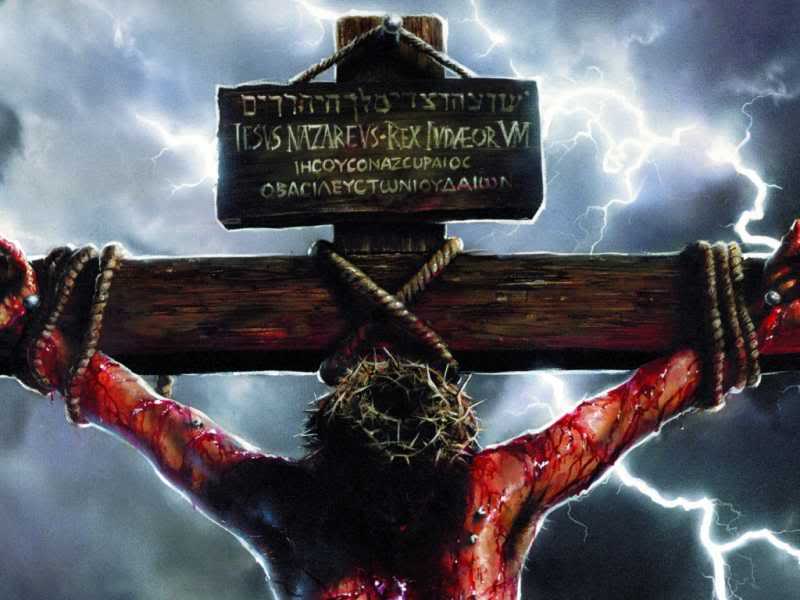
Why did Jesus of Nazareth endure a torturous death by crucifixion? After all, he could have just stayed in Heaven and left us all alone to pay the penalty for our sins. Instead, “he humbled himself and became obedient to death — even death on a cross”
“Who (Jesus), though he was in the form of God, did not count equality with God a thing to be grasped, but emptied himself, by taking the form of a servant, being born in the likeness of men. And being found in human form, he humbled himself by becoming obedient to the point of death, even death on a cross.” Philippians 2:6-8
But why? For one thing, God loves us dearly. All three persons of the Trinity were in agreement. God our heavenly Father was prepared to send His only Son to pay the penalty we deserve to pay. Jesus was prepared to make the tremendous sacrifice (incomprehensible) on our behalf and the Holy Spirit had to endure making it happen.
“God demonstrates his own love for us in this: While we were still sinners, Christ died for us” (Romans 5:8). Love is the biggest reason Jesus “endured the cross, scorning its shame” (Hebrews 12:2).
Jesus suffered and died on the cross so that you and I could be rescued from sin, death, resurrection to face judgment, punishment, and a second death in the Lake of Fire. If we could have saved ourselves by our own righteousness, it would have been utterly foolish for the Father to send his only Son to redeem us. The fact of the matter is that Christ’s crucifixion was the only way we could be rescued. “If righteousness could be gained through the law, Christ died for nothing” (Galatians 2:21).
I assure you that the Messiah didn’t endure crucifixion for nothing! It was the only way God’s worldwide rescue mission could be accomplished!
Do you realize what happens to a person after death if their sins are not forgiven? Jesus made it very clear that the wages of sin are death. And because God does not want you to go to Hell, but rather to Heaven, he did the one thing that would save us from punishment and a second death.
“The Father has rescued us from the dominion of darkness and brought us into the kingdom of the Son he loves, in whom we have redemption, the forgiveness of sins” Colossians 1:13-14
“Be faithful unto death, and I will give you the crown of life. He who has an ear, let him hear what the Spirit says to the churches. The one who conquers will not be hurt by the second death.” Revelation 2:10-11
“But as for the cowardly, the faithless, the detestable, as for murderers, the sexually immoral, sorcerers, idolaters, and all liars, their portion will be in the lake that burns with fire and sulfur,which is the second death.” Revelation 21:8
The Bible says “The message of the cross is foolishness to those who are perishing” (1 Corinthians 1:18). We simply don’t understand any of it. It must be illuminated by the Holy Spirit working through the Word of God. The Lord opens our minds to understand the Bible, just like he did with his first disciples. “Then he opened their minds so they could understand the Scriptures” (Luke 24:45).
The prophet Isaiah foretold the crucifixion of Christ some 700 years prior to Jesus’ birth,
“He was pierced for our transgressions, he was crushed for our iniquities; the punishment that brought us peace was upon him, and by his wounds, we are healed” Isaiah 53:5)
This prophecy clearly foretold the suffering the Messiah would endure. Nevertheless, many people refuse to believe Isaiah’s message. “The 17th-century Jewish historian, Raphael Levi, admitted that long ago the rabbis used to read Isaiah 53 in synagogues, but after the chapter caused ‘arguments and great confusion,’ the rabbis decided that the simplest thing would be to just take that prophecy out of the Haftarah readings in synagogues.” So much for Biblical inerrancy.
Meanwhile, don’t forget: If Jesus had sinned even one time, he would not qualify as anyone’s Savior. In that case, he would need someone to save him. Thankfully, “He committed no sin, and no deceit was found in his mouth” (1 Peter 2:22). A sinner cannot pay for anyone’s sins; a perfect sacrifice is required.
“For you know that it was not with perishable things such as silver or gold that you were redeemed from the empty way of life handed down to you from your forefathers, but with the precious blood of Christ, a lamb without blemish or defect” 1 Peter 1:18-19
God not only forgives our sins when we accept the Messiah by faith, but he also gives us a new heart with which to love and serve our Creator.
The death of Jesus on the cross pays for our sins and reconciles us to God. When we repent of our sins, trust Jesus to forgive our sins, and are baptized, we receive the third person of the Trinity into our souls to enable us to live the Christian life and be in a right relationship with God. Apart from the cross, we would remain rebels and would lack the Holy Spirit which enters our soul the moment we are spiritually reborn (John 3:1-18). Jesus endured the Cross so that all who receive him (John 1:12) will enjoy a relationship with the Lord forever.
Have you placed your faith in Christ’s sacrifice on the cross, or are you living under the delusion that your best efforts are enough to gain eternal life? If we could defeat sin and death with our own righteousness, then it would have made no sense for the Father to send his only Son to suffer such excruciating pain and unrelenting physical, spiritual, and emotional torment.
If you have not yet bowed your knee, repented, and surrendered your heart to Christ, this is a perfect time to do so. Turn away from your sins and believe that the Messiah’s death on the cross paid the full penalty for your sins.
Repenting your sins and accepting Christ as your Savior is the path to peace with God, whereas rejecting the Messiah leaves a person on death row facing punishment and second death.
Why should you be living eternally now? All believers will appear before the judgment seat of Christ and whilst our eternal destiny is safe what we have done will affect our rewards. For Christians that are raised in the first resurrection and are raptured with the living Saints, it is generally agreed that we will face the judgment seat of Christ during the time (Isaiah 34:8, Isaiah 61:2, Isaiah 63:4) we are in heaven before returning to earth with Jesus. If you disagree, keep in mind that these are not my words, but God’s. Jesus, speaking to both believers and unbelievers, said, “I tell you, on the day of judgment people will give account for every careless word they speak, for by your words you will be justified, and by your words, you will be condemned.” Matthew 12:36-37. Also, Paul said, “For we must all appear before the judgment seat of Christ, so that each one may receive what is due for what he has done in the body, whether good or evil”2 Corinthians 5:10
There are two different judgments in God’s Word: the judgment of faith, and the judgment of works. The judgment of faith relates to our eternal salvation, while the judgment of works relates to our eternal rewards.
For Christians, salvation took place in a moment in the past. It was free, it can’t be lost, it is the same for all Christians, and it is solely based on a faith that is ours by the grace of God alone. By contrast, future rewards are earned (by God’s grace), can be lost, differ among Christians, and are based on our efforts.
Salvation is about God’s work for us. Conversely, rewards are a matter of our work for God. When it comes to salvation, our work for God is no substitute for God’s work for us. God saves us because of Christ’s work, not ours. Likewise, when it comes to rewards, God rewards us for our work, not Christ’s. (Our good works are empowered by the Holy Spirit; nevertheless, we need to submit to Him so God refers to it as our work.)
Let me be sure this is perfectly clear. Christ paid the price for all of our sins, once and for all (Hebrews10:12-18). If we have trusted Him for that provision, we will not pay the eternal price, the second death. He has fully forgiven our sins, and we are completely secure in Christ’s love (Psalm 103:8-18; Romans 8:31-39). Our salvation is sure, and we will not undergo the judgment of condemnation (John 5:24; Romans 8:1).
But although the forgiveness of our sins has every bearing on our eternal destination, it has no automatic and effortless effect on our eternal rewards, apart from the fact that God’s sanctifying work comes out of our salvation, and therefore we should expect that the Holy Spirit’s presence in our lives should lead us to do good works that God will reward. But we must choose to do the works He prompts us to do. Neither does it mean our choices have no consequences in eternity. Forgiven people can still lose their rewards or forfeit eternal positions of responsibility they could have had if they’d served Christ consistently and faithfully before death.
Trust in Christ, lean on Him, and draw upon Him for power, for apart from Him we can do nothing. But if we hope to receive a reward, we must still do the necessary work. As our forefathers put it, to wear the crown we must first bear the cross.
Just as there are eternal consequences to our faith, so there are eternal consequences to our works.
What we do with our resources—including our time, money, and possessions—will matter not just twenty minutes, twenty days, or twenty years from now. It will matter twenty trillion years from now.
Though Paul insists we are saved by faith, not works (Titus 3:5), he also clearly states that the choices we make and the things we do have eternal implications, and that we will each answer to God for the works we have done in this life:
If anyone builds on this foundation [Christ] using gold, silver, costly stones, wood, hay or straw, their work will be shown for what it is, because the Day will bring it to light. It will be revealed with fire, and the fire will test the quality of each person’s work. If what has been built survives, the builder will receive a reward. If it is burned up, the builder will suffer loss but yet will be saved—even though only as one escaping through the flames. (1 Corinthians 3:12-15)
Those believers who have been less faithful and obedient in their walk with Christ will not suffer loss of salvation! But they will suffer loss of the reward that would have been theirs had they been more Christ-centered and faithful in their service to Jesus.
What 1 Corinthians 3 says is so sobering that a temporary loss doesn’t seem likely. This loss of rewards appears permanent, for while we will all serve God in our resurrected bodies on His New Earth, there appears to be a finality to the fact that after death comes judgment (Hebrews 9:27). If there are any future judgments for our service to God on the New Earth, we are not told about them in Scripture. Of course, we should anticipate for our future service He will say to all of his children, “Well done!” And yet, despite Scripture’s silence on this, I think it’s very possible that God, who is by nature a rewarder (), may continue to reward His people for faithful service on the New Earth. That resonates with me, and I don’t see anything unbiblical about it. It fully fits His nature as a Father who takes joy in saying “Well done” to His devoted children.
Earning Our Full Reward
First Corinthians isn’t the only passage that speaks of losing reward. The apostle John wrote, “Watch yourselves, so that you may not lose what we have worked for, but may win a full reward” (2 John 1:8, ESV).
To win a full reward would be glorious, wouldn’t it? But surely all of us will regret some of our decisions on that day when we “suffer loss” or “lose what we have worked for.” Anticipating standing before the judgment seat of Christ should motivate us to follow Him wholeheartedly and generate in us a proper fear of God.
All of us will be full of joy in Heaven, but those who served Him faithfully, particularly in the midst of adversity, will have been made, by God’s grace, into larger vessels. They won’t be fuller of joy, but they will have a greater capacity, and their fullness will accordingly contain even more joy. (Hence the special place in Revelation given to the martyrs.) There won’t be envy or regret, because of our new natures, and all will be full of joy, yet there will be true continuity and eternal consequence so that what we do—not just what we believe—in this life affects the next.
Maybe one way to say it is that the “loss” of rewards is in some sense permanent, but the “suffering” of that loss will be temporary. God will do away with the suffering (Revelation 21:4), but that is after the judgment, after we give an account to the Lord. The suffering of regret will be there at the judgment (how could it not be?) before entrance to the eternal state, but then comes the learning and purifying and eternal rejoicing. Perhaps we’ll offer a short, entirely sincere, “I regret my lack of faith and faithfulness,” expressing this to our God who graciously forgives. Then, with that forever behind us, we move on to eternal joy.
But there will be no ongoing suffering, for all our regrets about our past will be overshadowed by God’s grace. Yet if there were no reckoning, no “suffering loss” then the 1 Corinthians 3 passage would be meaningless (which is exactly what most teaching on the subject reduces it to). Some will object that this is a sort of Protestant purgatory, just shorter in duration than languishing in the flames of Catholic purgatory. But the suffering is not in the eternal state, only in a temporal judgment, and judgment must involve the negative as well as positive or it too is meaningless. The biblical statements of “giving an account” and that include “works done in the body, whether good or evil” are unmistakable in that regard. (Doing the evil will clearly have taken away from the rewards that would have come from doing good.)
Consequences without Condemnation
Since all who know Jesus go to the intermediate Heaven immediately when we die, it appears that whenever this judgment happens, it will be after we get there. So, while God will one day wipe away every tear from our eyes (Revelation 21:4), it seems likely that when we must give an account for our lives, there will be, for a time, some regrets and tears and a sense of that loss Scripture speaks of.
I realize this is hard to grasp. I am just trying to be true to all God’s Word says, instead of choosing only parts of it. This may sound like a sort of condemnation and punishment, but we are assured this isn’t the case, for “There is no condemnation for those who are in Christ Jesus” (Romans 8:1).
Ephesians 1:7 says, “In him [Jesus] we have redemption through his blood, the forgiveness of sins, in accordance with the riches of God’s grace”. The Bible teaches not only forgiveness of our sins but also consequences for our choices. These consequences apply despite our forgiveness. Forgiveness means that God eliminates our eternal condemnation; we will not be ultimately punished for our sins, but there may be immediate consequences in this world due to our sins. Forgiven people can still contract AIDS, go to jail for drunk driving, or suffer the death penalty, for example. A murderer or drug dealer can be fully redeemed and forgiven, and may still spend the rest of his life in prison. He may lose his family as well as his freedom. After all, the thief on the cross remained there despite his confession of faith.
In Heaven, God appears to say that while all our sins will be forgiven and there will be no ongoing shame or regrets, nevertheless at the judgment seat an initial and temporary sense of shame, regret and sorrow seems likely, though one that will soon be swallowed up by eternal grace and joy.
Prepared for Good Works
One of the most often quoted passages in Scripture states, “For it is by grace you have been saved, through faith—and this is not from yourselves, it is the gift of God— not by works, so that no one can boast” (Ephesians 2:8-9).
It’s a wonderful truth, but verse 10 immediately follows with more truth about works: “For we are God’s handiwork, created in Christ Jesus to do good works, which God prepared in advance for us to do.” God has prepared a lifetime of good works and we will give an account to Him for whether or not we have done them.
Surely each of these passages and others like them implies that while we will be fully forgiven in Christ and be forever totally cleansed and purified by His redemptive work, we will nonetheless be held accountable for what we have and haven’t done in this life.
It seems reasonable we won’t be joyful at the very moment we have to give an account for our sins, the careless words we have spoken, and all the wood, hay, and straw of our lives that will be consumed in the fire, that could have instead been gold and silver and precious stones. And at the same time, we will find great pleasure in the rewards God has given us, and we will celebrate the rewards He gives to others.
Embracing Paradox
But how does this all fit with the truth about the forgiveness of our sins? I think of the example of Charles Spurgeon, who didn’t try to reconcile every paradox or apparent contradiction in the Bible. Speaking of the truths of God’s sovereignty and human responsibility—which I also believe to be applicable to the truths of complete forgiveness and accountability at the judgment Spurgeon said this:
“These two truths, I do not believe, can ever be welded into one upon any human anvil, but one they shall bein eternity: they are two lines that are so nearly parallel, that the mind that shall pursue them farthest, will never discover that they converge; but they do converge, and they will meet somewhere in eternity, close to the throne of God, whence all truth doth spring.“
Spurgeon also wrote, “Those who will only believe what they can reconcile will necessarily disbelieve much of divine revelation.” Our desire for logical consistency, as we understand it, can become our God. Then we, not Scripture and not God, become our own ultimate authority. We end up ignoring, rejecting or twisting Scripture that doesn’t fit our chosen theology.
On the contrary, our theology should reflect Scripture itself, and wherever Scripture teaches apparently contradictory ideas, our theology should embrace those same ideas, rather than resort to a consistency that rejects part of God’s revealed Word.
Certainly, any and all of our regrets about our past will be overshadowed by God’s grace, which is the good news of the Gospel. There is comfort in 1 Corinthians 4:5, which says God “will bring to light the things now hidden in darkness and will disclose the purposes of the heart. Then each one will receive his commendation from God.” God will apparently find something to reward “each one” for. This makes sense, for no one can truly be born again without having demonstrated some fruit for which God can reward us.
Let’s Live in Light of Eternity Now
All of this argues for cultivating an eternal perspective in which we seek to live each day in light of eternity—not out of dread, yet with the right kind of fear of God and heartfelt love that desires to please our Lord and Savior.
In his book When Christ Comes, Max Lucado writes, “You can be certain you won’t regret any sacrifice you made for the kingdom. The hours of service for Christ? You won’t regret them. The money you gave? You’d give it a thousand times over. The times you helped the poor and loved the lost? You’d do it again. . . . You’d change the diapers, fix the cars, prepare the lessons, repair the roofs. One look into the faces of the ones you love, and you’d do it all again.”
An eternal perspective isn’t something we have to wait until Heaven to have. So I’ve often given readers and listeners this advice: live now the way that you will one day wish you would have. Don’t postpone obedience, holiness, purity, drawing close to God, and serving others.
Five minutes after we die, we’ll know exactly how we should have lived—it will be too late to go back and change anything. God has given us His Word so we don’t have to wait until we die to know how we should have lived. There’s no second chance for the unbeliever—but also no second chance for the believer! Just as missionary C. T. Studd said, “Only one life, ’twill soon be past; only what’s done for Christ will last.”
You and I have one life on this fallen earth in which to follow Jesus and invest in Heaven. Let’s not miss the opportunity. God will one day take away all our sorrows, but why go into eternity with regrets? Here’s a prayer for us: May what will be most important to us five minutes after we die become most important to us now.
Let me add KNOW YOUR WHY:
To bring glory to God
To know God’s will for your life
God wants to use me to bring people into His Kingdom
Adapted from the article: “Will We Have Regrets at the Judgment Seat of Christ?” December 5, 2022 by Randy Alcorn http://www.patheos.com
Living Eternally Now is available o Amazon or from me direct: ron@bakb.com.au
“Many will say to me in that day, Lord, Lord, have we not prophesied in thy name? and in thy name have cast out devils? and in thy name done many wonderful works? And then will I profess unto them, I never knew you: depart from me, ye that work iniquity.” Matthew 7:22-23
How come many will be ignorant of what is necessary to gain eternal life? Sadly, many people are selective about what they want from God and it invariably relates to improving their experience in this life, e.g. prosperity gospel.
David Clarkson, author of The Conviction of Hypocrites (1622–1686) lists spiritual things that many are ignorant of. He writes: “They consider not that there must be regeneration…that there must be a new creation…There must be a universal change in every part of the soul…There must be holiness in life… A renouncing of the world… Mortification… A taking up the cross.”
These can only be achieved by repentance, accepting Jesus as Lord and Saviour thereby receiving the Holy Spirit to enable the believer to live a Christian life.
Those who are born again of the Holy Spirit will know what is needed. However, countless people who consider themselves Christians are closed to these truths and are ignorant about what God requires for salvation. These kinds of people will think far too highly of themselves. “Self-love will not suffer them to deal impartially with their souls,” says Clarkson. This self-love deceives the hypocrite and causes him to flatter himself with only positive opinions. Truly, God must open their eyes and remove their blindness if they are to be saved.
If someone is able to rightly judge himself to be a sinner, there is still one final hurdle to be faced. Being able to see oneself as he is, he must now see God clearly. Clarkson says that many fall victim to “misapprehensions of God.” People will often mistakenly suppose that God is more merciful than He actually is. They think that God will neglect justice in order to issue forgiveness, which He will not.
Clarkson characterized such a thought process like this: “Though I allow myself in this or that sin, and fall into it now and then, why it is but a little one, and God is gracious, he is not so strict and rigid as some would make him.”
People will often assume what God is like based on what they want Him to be like, instead of how the Bible describes Him. Is the Bible false? Is God a liar? When Jesus said: “I am the way,” was He mistaken? We can confidently answer these questions with a “No.” Therefore, God will not make an exception for anyone (and make Himself a liar) in order to pardon an unbeliever. People must know Jesus as their Lord and Saviour and be born again by the Holy Spirit to receive eternal life.
How do we live in the light of eternity and see beyond the moment in a world of increasing darkness?
God has enabled us to look beyond today to see what lies ahead. Jesus made it possible for our Heavenly Father to send the Holy Spirit to indwell all believers. Our bodies are now the temple of the Holy Spirit. All believers have received the Holy Spirit to be their counselor, comforter, and teacher. We are Holy Spirit enabled.
We have a spiritual lens through which to view the world from God’s perspective.
“Now we have received, not the spirit of the world, butthe Spirit who is from God, that we might know the things that have been freely given to us by God.” 1 Corinthians 2:12
“Eye has not seen, nor ear heard, nor have entered into the heart of man the things which God has prepared for those who love Him. But God has revealed them to us through His Spirit.” 1 Corinthians 2:9-10
available as an ebook and trade paperback book from Amazon
Considering we are living in the “last days” when persecution of Christians will increase. It is essential we live Holy Spirit-enabled lives. He may not reveal what immediately lies ahead but we live our lives knowing He is in control of coming events. Moreover, we will not be taken by surprise, His Word tells us exactly how the “last days” play out before Jesus returns.
“Living eternal now” is a way of travelling in the here and now, with our spiritual vision fixed on God and eternity so we are submitted to His will.
Remember, our days are numbered. The psalmist says, “So teach us to number our days, so that we may gain a heart of wisdom” Psalm 90:12 Hopefully, this admonition, will affect how we use our time, and how we decide our priorities, so we don’t waste time.
Paul also tells us, that we are now alive to the spiritual realm, we see what is important from an eternal perspective, and we don’t dwell on earthly matters which are temporary: ” while we do not look at the things which are seen, but at the things which are not seen. For the things which are seen are temporary, but the things which are not seen are eternal.” 2 Corinthians 4:18
The preceding verses tell us how being Holt Spirit enabled, we know that whatever God allows into our lives, we will be able to see it as “light affliction” because we know it is for His glory.
“Even though our outward man is perishing, yet the inward man is being renewed day by day. For our light affliction, which is but for a moment, is working for us a far more exceeding and eternal weight of glory,” 2 Corinthians 4:16-17
If we are living Holy Spirit-enabled lives then the fruit of the Spirit (9) will be evident in our lives: love, joy, peace, patience, gentleness, goodness, kindness, and self-control. The fruit of the Spirit demonstrates how far along we are in the sanctification process, submitted to God’s will.
As well, we will be operating in the gifts of the Spirit (9). The gifts of the spirit are the ammunition that the Holy Spirit provides for our use as we walk Holy Spirit-enabled lives. The miraculous will truly be evident.
“But the manifestation of the Spirit is given to each one for the profit of all: for to one is given the word of wisdom through the Spirit, to another the word of knowledge through the same Spirit, to another faith by the same Spirit, to another gifts of healing by the same Spirit, to another the working of miracles, to another prophecy, to another discerning of spirits, to another different kinds of tongues, to another the interpretation of tongues. But one and the same Spirit works all these things, distributing to each one individually as He wills. 1 Corinthians 12:7-11
Note the counsel Paul gives concerning neglecting and quenching the Holy Spirits work in our lives.
“Do not quench the Spirit. Do not despise prophecies. Test all things; hold fast what is good.” 1 Thessalonians 5:19-21
Do not neglect the gift that is in you… Meditate on these things; give yourself entirely to them, that your progress may be evident to all.1 Timothy 4:14
Are you living eternal now? If not why not?
One aspect of living eternally now is based on our expectation of the hereafter. Where will you be, and what will you be doing? Sadly, most people’s view of eternal life is not that appealing. They view it as an eternity in heaven but have no idea of what they will be doing there e.g. plucking harps and praising God. As a result, not too many are anxious to leave this life and go there. If you would like to know more about what Christians who are raised from the dead will be doing next then I suggest you go to my website http://www.millennialkingdom.net




 LIVING ETERNAL NOW