
In this video clip “Mountains After the Flood”, geologists John Whitmore and Andrew Snelling talk with Del Tackett about the importance of their research project in the Grand Canyon. They discuss creation science and why it provides answers to evidence not found in the conventional scientific paradigm. This four-minute segment shows convincing evidence that the Coconino Sandstone was laid down by a catastrophic flood. This formation spreads across the Colorado Plateau province of the United States, including northern Arizona, northwest Colorado, Nevada, and Utah. Make sure you watch the entire film to see the fascinating results of their research.
Category Archives: EVIDENCE FOR A YOUNG EARTH
MORE EVIDENCE FOR A YOUNG EARTH
In 1980, Mount St. Helens (in Washington State, USA) erupted, blasting the top and side off the mountain. Then, as volcanoes do, it began to rebuild. In 1992, samples of new volcanic rock—KNOWN to be only about 10 years old—were dated using standard radiometric dating techniques (3 samples from the same rock, 350,000 years, 900,000 years, and 2,800,000 years). The results were eye-opening. Radiometric dating is not all it’s cracked up to be! In fact, it’s fair to ask: “Can radiometric dates be trusted at all?” Join geologist Dr Tas Walker for a discussion of the Mount St. Helens eruption and its aftermath, the fundamental flaws in radiometric dating methods, and the relevance of the age of the earth to people’s view of the world.
TIMESTAMPS ⌛ 00:00 Teaser 00:40 Introduction: What’s the deal with Mount St. Helens? 02:33 Dating rocks from Mount St. Helens 04:34 Assumptions underlie radiometric dating 05:57 Three samples, three dates: 350,000 – 2.8 million years 07:36 Story-telling accompanies radiometric dating 11:10 How can we get ACCURATE dates? 12:29 How were the Mount St. Helens dates received? Handling objections 17:05 Carbon dating gives good evidence for a YOUNG earth! 18:37 The only way to be sure of the age of something 19:58 Different kinds of radiometric dating 21:19 Radiometric dating seems so SCIENTIFIC – How can it not be right? 23:00 What to do when the dates don’t fit the expectations 27:56 Is it okay to publish dates/perspectives that don’t match existing expectations? 31:51 The age of the earth is a critical part of people’s worldview 33:38 So, what do long-age geologists think of Mount St. Helens? 35:55 Other lessons from Mount St. Helens: 36:09 → Geologic layers can be deposited rapidly 36:59 → Erosion can happen rapidly 38:02 Geologists are now more accepting of catastrophism, but won’t let go of long ages 39:17 In conclusion: The age of the earth matters to both the biblical and the naturalistic worldviews
A SURPRISING ECOSYSTEM IN NORTHEASTERN GREENLAND SUPPORTS THE BIBLICAL ICE AGE
Scientists have developed a new method for discovering which animals inhabited an area. This method analyzes the environmental DNA (eDNA) in the soil from plants and animals that once lived in the region. The method was applied to the Kap København Formation in northeast Greenland, where research has been conducted for nearly 40 years. The area today is a polar desert, home to just a few plants, hares, and musk oxen. Scientists had previously found macrofossils from coniferous boreal forest trees and rich insect fauna, but they were greatly surprised by what they discovered recently.

Scientists found what they believe to be 2-Ma-old DNA, which pushed back the occurrence of ancient DNA almost 1 Ma. They obviously do not accept discoveries of DNA in dinosaurs. Comparing the eDNA to a data bank of DNA from modern plants and animals, the researchers were amazed to find DNA from mastodons, reindeer, rodents, geese, and rabbits that inhabited a forest ecosystem of poplar, spruce, cedar, and yew trees combined with present-day polar vegetation. They identified 102 genera of plants, whereas earlier paleontologists had only identified eight. Some have disputed whether the mastodon DNA is truly from a mastodon or some other elephant.
Such an ecosystem requires much warmer temperatures than today. The present-day average temperature is –17°C. The researchers estimated it would have been 10°C warmer 2 Ma ago, but there are indications that it may have been even warmer since many of the plant fossils found do not grow on permafrost. No one predicted such an ecosystem, and there are no modern analogues. One researcher was quoted as saying: “Not in a million years would you expect a mastodon up there.”
Mastodon remains are found in forests in the United States but are never found in Greenland. And reindeer supposedly had not evolved by that time, as admitted by paleogeneticist Eske Willerslev: “Reindeers, according to paleontologists, should not have survived; they shouldn’t even exist at that time.”
Biblical interpretation
Creation scientists do not accept the date of 2 Ma but have no trouble accepting that this DNA would still exist since all of this eDNA is only thousands of years old. Two Ma lies at the outer edge of DNA’s theoretical shelf life. We have two choices in determining where the organisms fit into biblical Earth history. First, the organisms could be from the worldwide Flood of Noah’s day. A great number of warm-climate Cenozoic fossils exist in the polar areas of the Northern Hemisphere. For instance, trees typical of the southeast United States are found with alligators, crocodiles, large tortoises, and lemurs on Ellesmere and Axel Heiberg Islands, and are dated as early Cenozoic. However, these fossils indicate a climate that would be too warm for the early Ice Age. For instance, sea surface temperatures would have cooled too rapidly after the Flood to sustain the observed tropical and subtropical paleo flora. Moreover, winters would have been too cold to sustain them. Furthermore, the preserved leaf-litter sequences on Axel Heiberg Island are preserved as well at the bottom of each layer as they are at the top. This indicates rapid deposition during the Flood rather than prolonged exposure afterward. Therefore, these Cenozoic fossils are from the Flood.
The other option for the Greenland eDNA is that the organisms could be left over from the Ice Age. The oceans would have been warm early in the Ice Age due to the heat produced during the Flood. The Arctic Ocean could have been over 20°C, keeping coastal areas mild by onshore airflow early in the Ice Age. Plants and animals that preferred temperate climates could have lived comfortably for hundreds of years in the far north, especially along the coastal areas of the Arctic Ocean. Considering the eDNA evidence, the organisms from northeast Greenland are typical Ice Age animals, such as reindeer and mastodons. Thus, the evidence from eDNA for northeast Greenland, in contrast with that for Axel Heiberg Island, indicates a post-Flood environment. In other words, the fossils in the Kap København Formation were buried early during the temperate climatic conditions during the post-Flood rapid Ice Age, while the Arctic Ocean was relatively warm.
How did the mammals make it to northern Greenland?
There is the question of how the animals would have been able to migrate to northern Greenland across multiple straits, the last being the Nares Strait between Ellesmere Island and Greenland (figure 1). The large mammals could have swum, especially since the water would have been relatively warm. Mammoths made it to the Channel Islands off the southern California coast by swimming since there was no land bridge. Elephants are excellent swimmers: “My research shows that modern elephants are excellent distance swimmers, among the best of all land mammals, and skilled at crossing water gaps.” Or, the animals of northeast Greenland may have been aided by log and vegetation mats left over from the Flood that would have floated for many years on the post-Flood oceans. This transportation would be especially likely for small mammals.
To be aided by log mats, the animals had to first cross the Bering Land Bridge. This land bridge was more likely exposed early in the Flood when animals could more easily journey through Siberia into Alaska, when winters were mild, not at the end of the Ice Age, when winters were colder than today. Further evidence of this early Ice Age land bridge is the finding of Columbian mammoth fossils at the bottom of Ice Age debris in central British Columbia. These mammoths could only arrive at this location from the ice-free corridor and through the Peace River water gap before the mountain ice caps inundated the lowlands of British Columbia. eDNA evidence of animals in northeast Greenland also adds to the indirect evidence that the Bering Land Bridge existed early, but not late in the Ice Age. Moreover, some log mats would still have existed for transportation. Northern Canada also needed to be warm enough for forests to grow, which need not have been large for them to shed pollen and eDNA and for animals to survive in northern Greenland.
Conclusion
Researchers were amazed to find DNA evidence of a temperate ecosystem in the Kap København Formation in northeast Greenland. The most likely explanation is that these fossils were buried during the early part of the post-Flood rapid Ice Age but the world rejects God and His Word just as the Apostle Peter warns us they would in God’s Word.
“You should remember the predictions of the holy prophets and the commandment of the Lord and Savior through your apostles, knowing this first of all, that scoffers will come in the last days with scoffing, following their own sinful desires. They will say, “Where is the promise of his coming? For ever since the fathers fell asleep, all things are continuing as they were from the beginning of creation.” For they deliberately overlook this fact, that the heavens existed long ago, and the earth was formed out of water and through water by the word of God, and that by means of these, the world that then existed was deluged with water and perished. But by the same word the heavens and earth that now exist are stored up for fire, being kept until the day of judgment and destruction of the ungodly.” 2 Peter 3:2-7
Article adapted from the Creation Journal Volume 37, Issue 2, 2023 by Michael J Oard. It is the Technical Journal produced by Creation Ministries International (CMI). The must-have journal from CMI is Creation Magazine. Check it out at http://www.creation.com

GEOLOGICAL EVIDENCE FOR NOAH’S FLOOD
In Genesis 6:13, we read that before the Flood, regarding “all flesh”, God said to Noah, “I will destroy them with the earth” (’eretz). Then, in Genesis 9:11, after the Flood, God confirmed to Noah that by the Flood He had indeed destroyed the created Earth, when He said, “never again shall there be a flood to destroy the earth” (’eretz). Whatever constituted the ’eretz that was created on Day 1, God destroyed it by the Flood cataclysm.
Corroborating God’s revelation to Noah that the created Earth (’eretz) had been destroyed in the Flood (Genesis 9:11) is the record of widespread destructive volcanic and sedimentary processes evident in the Precambrian rock record. In the Precambrian we see evidence of huge volcanoes, depositing lava accumulations up to 22 km thick, including abundant products of explosive volcanic activity.

Rocks of the Precambrian cratons, including the exposed Precambrian shields, comprise some 71% of the Earth’s total land area. Extensive study of exposed Precambrian strata, motivated by its content of valuable minerals, has resulted in the accumulation of copious geological information on the Precambrian.
This information can be used by creationists to incorporate all of the Precambrian into a Genesis Flood geologic model.
There are abundant products of volcanism, including explosive volcanism, and volcanic lava sequences up to 22 km thick, throughout the Precambrian geologic record. Superpositional relationships of distinct lithological associations enable global correlation of early Precambrian strata. A Genesis Flood geologic model is proposed wherein the Flood cataclysm was initiated by a sudden reduction of gravitational force which decompressed the earth’s hot, water-saturated mantle. The Precambrian rock record was extruded from the mantle and deposited during Day 1 to Day 40 of the Flood cataclysm.
Widespread evidence of destructive volcanic geologic activity throughout the Precambrian corroborates the Scriptural record of the destruction of the created earth (’eretz) by the Flood cataclysm (Gen. 9:11).
This should lead us to preclude a Creation Week or Antediluvian origin for the Precambrian geologic record, and instead consider all of the Precambrian as Flood deposited. Walker noted that the Precambrian Strelley Pool Chert formation in the Pilbara region of Western Australia (figure 6) is underlain and overlain by rocks deposited from volcanic eruptions, and suggested:
“From a biblical perspective, it is inconceivable that volcanoes would be active during Creation Week, depositing volcaniclastics and tuff such as comprise parts of the stratigraphic sections [emphasis added].”
Widespread evidence throughout the globally correlated Precambrian rock record of huge explosive volcanic eruptions comprises tuffs, ignimbrites, pyroclastic flows, volcaniclastics, accretionary lapilli/lapillistone, and agglomerates. The processes necessary for the accumulation of accretionary lapilli/lapillistone include an atmospheric ash column, moisture, accretion, deposition, and lithification. We might reasonably question whether atmospheric ash columns would have been occurring during Creation Week.
Deposition of even the thinnest of these volcanic accumulations, the 10.5-km-thick Swaziland Supergroup (figure 3), over six days during Creation Week, would require lava to accumulate at 1.75 km stratigraphic thickness per day. The 22.0 km-thick-lower Pilbara Supergroup of Western Australia (figure 6) would need to accumulate at 3.67 km of lava per day if deposited during Creation Week.
On the basis of the volcanic content, and especially the explosive volcanic content, and the widespread destruction of organisms throughout the Precambrian, we should, I suggest, question a Creation Week or Antediluvian origin for the Precambrian rock record, reconsider the way we interpret the Precambrian fossil record, and conclude that the Precambrian is all Flood deposited.
Consistent with Genesis 7:11 and Proverbs 3:20a, Noah’s Flood may have been initiated by God causing the mantle to heat in a cataclysmic global thermal-tectonic episode, cracking open the earth’s crust and driving out water to the earth’s surface. Secular scientists have found evidence of episodic rifting events at the margins of North America between 0.8 and about 0.6 Ga. These are thought to record the fragmentation of a Neoproterozoic supercontinent.13,14 This is consistent with the breaking open of the crust by the fountains of the great deep, followed by further continental extension and then ocean formation.
Biblical Geology 101 is avalable from CMI http://www.creation.com
CRAB CAPTURED IN AMBER
“The specimen is spectacular, it is one of a kind. It’s absolutely complete and is not missing a single hair on the body, which is remarkable”. These are the words lead author Javier Luque used to describe Cretapsara athanata, the first crab from the ‘Cretaceous dinosaur era’ preserved in amber (fossil tree resin), and the most complete fossil crab ever found. Despite being ‘dated’ at around 100 million years, 3-D scans showed it to be modern-looking.
The amber preserved delicate features such as antennae, compound eyes, and mouthparts covered in minute hairs. It even preserved the well-developed gills which meant the small crab was most likely water-dwelling. Plant material and insect faeces were also found in the same amber lump (c. 20 mm × 7 mm). “How then did a 100 million-year-old aquatic animal become preserved in tree amber, which normally houses land-dwelling specimens?”

For evolutionists, such a question leads to many ‘it might have’ stories. Of course, they would be aware that to preserve the crab in such a complete state the resin would have to engulf it quickly. Today’s generally slow trickle of resin from trees would never suffice.
The conditions found in the Noahic Flood around 4,500 years ago readily account for all aspects of this find. The obvious one is finding an aquatic crab in resin from a tree, alongside terrestrial plant and insect material. As forests were ripped up and carried by the floodwaters, huge rafts of trees crashed into each other. The damaged trees were bleeding abnormally copious amounts of their sticky resin, which quickly enveloped the items it contacted. This also explains the existence of large amber deposits, such as the ones mined in Myanmar from which this specimen came.
Harvard University, International team of researchers discover first dinosaur era crab fully preserved in amber; oeb.harvard.edu, 20 Oct 2021.
This article appeared in Creation Magazine Vol 44 Issue 2, 2022 (http://www.creation.com)
MORE EVIDENCE FOR A YOUNG EARTH
The oceans show us a young earth
Another informative article by Paul Price from Creation Ministries (CMI) check out their website http://www.creation.com
Long ages of billions of years is a very widespread belief today.
The ‘millions and then billions of years’ idea first came from geology—from the rock layers. More precisely, from the interpretation that these layers supposedly formed by the same slow and gradual processes we see happening today, at more or less the same rates. This is the belief system called uniformitarianism. It was not the result of scientific evidence, but was imposed upon the evidence.
This belief system a priori rules out the biblical Flood as a possible explanation. Conversely, the Flood would have performed all that geological work shown in the rocks in a short time, rather than billions of years. Of course, the waters of that Flood ended up in today’s seas. Just by standing on the shoreline, we can get a sense of the vastness of God’s power in creating this planet and all the water on it, as well as the awesome scope of God’s judgment in the Flood. But we can learn a great deal more from those majestic waves; there are many lines of evidence from the oceans that refute the idea of billions of years and resoundingly affirm biblical history.
The oceans present us with another way of ‘dating’, because we can measure the rates of various processes with respect to the oceans. And using the long-ager’s own belief system of uniformitarianism, we get ‘maximum ages’ that do not square with the secular long-age paradigm. They do not, however, present any problem for the biblical timeline of history. Thus, uniformitarianism is self-refuting with respect to the scientific evidence we have available.

Ocean salt
The salinity of our oceans can give us a ‘clock’ of sorts, because we are able to estimate the amount of salt entering our oceans as well as the amount that leaves. It turns out that much more is entering than leaving, so the oceans are getting saltier over time. So let’s use this as a uniformitarian ‘clock’ by assuming the processes have stayed much the same. Starting with fresh water, how long would it take for the oceans to become as salty as they are?
A study by creation scientists Steve Austin and Russell Humphreys, using the most conservative numbers available, gave an absolute upper limit (not actual age!), of 62 million years.1 While this may seem like a long time, it is actually far too low a number to accommodate the secular age for the ocean of 3.8 billion years.2 And note that the oceans would have started out with some salt in them, plus a stupendous amount of salt and other minerals would have been added during the Flood from erosion and volcanism. The only ‘out’ for long-agers is to assume that the rates have dramatically changed—which undermines the whole idea of uniformitarianism!
Where is all the seafloor sediment?
On average, the depth of sediment on the ocean floor is less than 400 metres (about 1,300 feet), with some areas of the ocean floor having no mud at all. We would not expect to find this if the oceans were extremely old. We can also estimate the maximum rate at which subduction (one crustal plate gradually being thrust under another) could be pulling sediment back into the crust. Assuming that this rate has always been the same (again, uniformitarianism against itself), it is far too slow to account for this result; not enough seafloor mud is getting eliminated by this process. In fact, at the present rate, all the sediment would have been accumulated in under 12 million years.5 And once more, the dramatic erosive power of a year-long global Flood means that it would have actually happened much more quickly even than that.
Accumulating nickel
According to a UK environmental health guideline, concentrations higher than 30 parts per billion are toxic for marine life—yet that concentration would have already been reached in just 1,076,000 years at current rates of input! Just as for salt, nickel is also entering our oceans far too quickly for the old-earth timeline of history.4
Gigantic submarine canyons
All over the world, we find examples of huge canyons offshore, some greater even than Grand Canyon, which are located in deep water and run perpendicular to the coastline. Uniformitarian geologists are at a loss, admitting that there are currently no widely accepted theories capable of explaining them. However, looking at these features from the perspective of a young earth and Noah’s Flood makes perfect sense. They were carved by ‘channelized flow’ coming off the continents in the recessive stage of the Flood. That is why they are often found seawards of valleys on the land. The same rapid channelized flow that carved the valley on land also carved the submarine valley offshore.
Summary
The oceans do not show the appearance of age we would expect if they were really billions of years old. This is consistent with the Bible; the oceans of today began on Day 1 of Creation Week, some 6,000 years ago, covering the earth.
Today’s oceans contain more than enough water to flood the whole earth. If we were to flatten out all the current unevenness on the land and seafloor, the water present would cover the whole earth nearly 3 km (2 miles) deep! Tectonic movements of the earth’s crustal plates at the onset of the Flood would account for the water flooding the land.
After the Flood, as Psalm 104:8 seems to indicate, “the mountains rose, the valleys sank down”, giving us the very uneven surface of the planet we now inhabit. Even Mount Everest, one of the planet’s tallest peaks, would have been uplifted at the closing stages of the Flood, coming into being at that time as a brand-new feature. (It is measured to be still rising, though much more slowly, today.) So no wonder it has limestone with marine fossils on its summit. All this answers the age-old questions of ‘Where did all that water come from?’ ‘Was there enough to cover the earth?’, and, ‘Where did it all go?’
As we’ve seen, our oceans not only contain many evidences that confirm the Bible’s history, but they still contain the very same waters that inundated the planet long ago – the very same waters that carried Noah’s Ark – the very same waters God used to judge a rebellious mankind.
EVIDENCE FOR A YOUNG WORLD
As I mentioned in my post, “Age of the World is a Critical Issue for Understanding the Bible”, Dr. Humphreys reveals in his book Evidence for a Young World that there is a great deal of evidence for the short timescale given in the Bible: galaxies wind themselves up too fast, comets disintegrate too quickly, not enough mud on the seafloor, not enough sodium in the sea, the earth’s magnetic field is decaying too fast, biological materials (found in dinosaur bones) decay too fast, too much helium in minerals, and too much carbon -14 in deep geologic strata.
Last post we looked at the earths magnetic field and the fact it is decaying too fast for the world’s history to be more than thousands of years, certainly not billions.
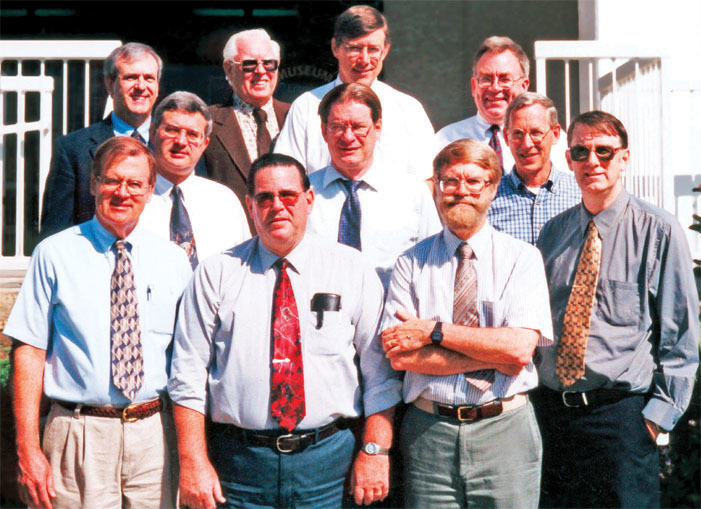
Dr. Humphreys was part of a very important RATE project (Radioisotopes and the age of the Earth). It involved eleven Ph.D. scientists pictured below. This helped answer a major old-earth argument about radiometric-dating.
Dr Humphreys work concerned small, hard mineral crystals called zircons, which often contain radioactive elements. As these decay, they produce helium. Helium leaks out quickly due to its very small hard atoms. The hotter the material the faster it leaks out. Dr Humphreys measured amounts of helium in zircons, and compared it to the amount expected from the decay and helium leakage measured in the laboratory.
Zircon crystals from a borehole in New Mexico have a helium leakage of about 6000 years. In contrast the uranium-lead age of the crystals is about 1.5 billion years. The uranium-lead age of course assumes that the decay rate is the same slow rate we measure today.
The Bible reveals that God created a mature world. Hence the Rate Team believes the decay rate initially was speeded up, also the catastrophic plate tectonic upheaval at Noah’s Flood would have had an effect on the decay rate. It cannot be assumed that no daughter elements existed at the beginning and the decay rate was uniform.
There is a great deal of evidence for a young world that supports the Bible’s history of around 6000 years, certainly not billions of years.
The book and video, Evidence for a Young World are available from http://www.creation.com.
FURTHER PROOF OF A YOUNG UNIVERSE
Age of Ceres
Check out CMI http://www.creation.com for the this story by Jonathan O’Brien.
The dwarf planet Ceres is the largest body in the solar system’s asteroid belt, between the orbits of Mars and Jupiter. Recently, NASA’s Dawn spacecraft made detailed fly-over inspections of Ceres and beamed back data that shocked many scientists.
Ceres shows clear signs of being very geologically active.1 For such a small body—only 1.28% the mass of our moon—Ceres has long-age-believing planetary scientists shaking their heads in wonder. One can almost hear them asking, “Are you Cerious!?”

The mystery for evolutionists is how Ceres, which they believe to be very old, can still be so hot inside.
Ceres is too far away from large planets to receive an influx of energy from gravitational effects/tidal heating, and radioactive decay can’t provide the heat over billions of years either.
Secularists believe that planetary bodies were originally molten and gradually cooled. They predicted that Ceres, a miniature world floating alone in the coldness of space, and believed to be the same age as the solar system, would have become frozen and inactive eons ago.
It appears that tiny Ceres, with its lively, hot interior, is no more than a few thousand years old. This is consistent with the Bible’s record that God formed the earth first, around 6,000 years ago.
EVIDENCE RADIO ACTIVE DECAY NOT PROOF OF BILLIONS OF YEARS
From the work done by the Rate team it is clear that the assumption of a constant slow decay process was wrong. There must have been speeded-up decay, perhaps in a huge burst associated with Creation Week and/or a separate burst at the time of the Flood.
The RATE project began as a cooperative venture between the Institute for Creation Research (ICR), the Creation Research Society (CRS) and Creation Ministries International (CMI).
As a result, there is now powerful independent confirmatory evidence that at least one episode of drastically accelerated decay has indeed been the case, building on the work of Dr Robert Gentry on helium retention in zircons. The landmark RATE paper – Humphreys, D. et al., Helium diffusion rates support accelerated nuclear decay, though technical can be summarised as follows: (www.icr.org/pdf/research/Helium_ICC_7-22-03.pdf)
- When uranium decays to lead, a by-product of this process is the formation of helium, a very light, inert gas which readily escapes from rock.
- Certain crystals called zircons, obtained from drilling into very deep granites, contain uranium which has partly decayed into lead.
- By measuring the amount of uranium and ‘radiogenic lead’ in these crystals, one can calculate that, if the decay rate has been constant, about 1.5 billion years must have passed. (This is consistent with the geologic ‘age’ assigned to the granites in which these zircons are found.)
- There is a significant amount of helium from that ‘1.5 billion years of decay’ still inside the zircons. This is at first glance surprising for long-agers, because of the ease with which one would expect helium (with its tiny, light, unreactive atoms) to escape from the spaces within the crystal structure. There should surely be hardly any left, because with such a slow buildup, it should be seeping out continually and not accumulating.
- Drawing any conclusions from the above depends, of course, on actually measuring the rate at which helium leaks out of zircons. This is what one of the RATE papers reports on. The samples were sent (without any hint that it was a creationist project) to a world-class expert to measure these rates. The consistent answer: the helium does indeed seep out quickly over a wide range of temperatures. In fact, the results show that because of all the helium still in the zircons, these crystals (and since this is Precambrian basement granite, by implication the whole earth) could not be older than between 4,000 and 14,000 years. In other words, in only a few thousand years, 1.5 billion years’ worth (at today’s rates) of radioactive decay has taken place. Interestingly, the data have since been refined and updated to give a date of 5680 (+/- 2000) years.
The paper looks at the various avenues a long-ager might take by which to wriggle out of these powerful implications, but there seems to be little hope for them unless they can show that the techniques used to obtain the results were seriously (and mysteriously, having been performed by a world-class non-creationist expert) flawed.
 LIVING ETERNAL NOW