A SURPRISING ECOSYSTEM IN NORTHEASTERN GREENLAND SUPPORTS THE BIBLICAL ICE AGE

Scientists have developed a new method for discovering which animals inhabited an area. This method analyzes the environmental DNA (eDNA) in the soil from plants and animals that once lived in the region. The method was applied to the Kap København Formation in northeast Greenland, where research has been conducted for nearly 40 years. The area today is a polar desert, home to just a few plants, hares, and musk oxen. Scientists had previously found macrofossils from coniferous boreal forest trees and rich insect fauna, but they were greatly surprised by what they discovered recently.

Scientists found what they believe to be 2-Ma-old DNA, which pushed back the occurrence of ancient DNA almost 1 Ma. They obviously do not accept discoveries of DNA in dinosaurs. Comparing the eDNA to a data bank of DNA from modern plants and animals, the researchers were amazed to find DNA from mastodons, reindeer, rodents, geese, and rabbits that inhabited a forest ecosystem of poplar, spruce, cedar, and yew trees combined with present-day polar vegetation. They identified 102 genera of plants, whereas earlier paleontologists had only identified eight. Some have disputed whether the mastodon DNA is truly from a mastodon or some other elephant.

Such an ecosystem requires much warmer temperatures than today. The present-day average temperature is –17°C. The researchers estimated it would have been 10°C warmer 2 Ma ago, but there are indications that it may have been even warmer since many of the plant fossils found do not grow on permafrost. No one predicted such an ecosystem, and there are no modern analogues. One researcher was quoted as saying: “Not in a million years would you expect a mastodon up there.”

Mastodon remains are found in forests in the United States but are never found in Greenland. And reindeer supposedly had not evolved by that time, as admitted by paleogeneticist Eske Willerslev: “Reindeers, according to paleontologists, should not have survived; they shouldn’t even exist at that time.”

Biblical interpretation

Creation scientists do not accept the date of 2 Ma but have no trouble accepting that this DNA would still exist since all of this eDNA is only thousands of years old. Two Ma lies at the outer edge of DNA’s theoretical shelf life. We have two choices in determining where the organisms fit into biblical Earth history. First, the organisms could be from the worldwide Flood of Noah’s day. A great number of warm-climate Cenozoic fossils exist in the polar areas of the Northern Hemisphere. For instance, trees typical of the southeast United States are found with alligators, crocodiles, large tortoises, and lemurs on Ellesmere and Axel Heiberg Islands, and are dated as early Cenozoic. However, these fossils indicate a climate that would be too warm for the early Ice Age. For instance, sea surface temperatures would have cooled too rapidly after the Flood to sustain the observed tropical and subtropical paleo flora. Moreover, winters would have been too cold to sustain them. Furthermore, the preserved leaf-litter sequences on Axel Heiberg Island are preserved as well at the bottom of each layer as they are at the top. This indicates rapid deposition during the Flood rather than prolonged exposure afterward. Therefore, these Cenozoic fossils are from the Flood.

The other option for the Greenland eDNA is that the organisms could be left over from the Ice Age. The oceans would have been warm early in the Ice Age due to the heat produced during the Flood. The Arctic Ocean could have been over 20°C, keeping coastal areas mild by onshore airflow early in the Ice Age. Plants and animals that preferred temperate climates could have lived comfortably for hundreds of years in the far north, especially along the coastal areas of the Arctic Ocean. Considering the eDNA evidence, the organisms from northeast Greenland are typical Ice Age animals, such as reindeer and mastodons. Thus, the evidence from eDNA for northeast Greenland, in contrast with that for Axel Heiberg Island, indicates a post-Flood environment. In other words, the fossils in the Kap København Formation were buried early during the temperate climatic conditions during the post-Flood rapid Ice Age, while the Arctic Ocean was relatively warm.

How did the mammals make it to northern Greenland?

There is the question of how the animals would have been able to migrate to northern Greenland across multiple straits, the last being the Nares Strait between Ellesmere Island and Greenland (figure 1). The large mammals could have swum, especially since the water would have been relatively warm. Mammoths made it to the Channel Islands off the southern California coast by swimming since there was no land bridge. Elephants are excellent swimmers: “My research shows that modern elephants are excellent distance swimmers, among the best of all land mammals, and skilled at crossing water gaps.” Or, the animals of northeast Greenland may have been aided by log and vegetation mats left over from the Flood that would have floated for many years on the post-Flood oceans. This transportation would be especially likely for small mammals.

To be aided by log mats, the animals had to first cross the Bering Land Bridge. This land bridge was more likely exposed early in the Flood when animals could more easily journey through Siberia into Alaska, when winters were mild, not at the end of the Ice Age, when winters were colder than today. Further evidence of this early Ice Age land bridge is the finding of Columbian mammoth fossils at the bottom of Ice Age debris in central British Columbia. These mammoths could only arrive at this location from the ice-free corridor and through the Peace River water gap before the mountain ice caps inundated the lowlands of British Columbia. eDNA evidence of animals in northeast Greenland also adds to the indirect evidence that the Bering Land Bridge existed early, but not late in the Ice Age. Moreover, some log mats would still have existed for transportation. Northern Canada also needed to be warm enough for forests to grow, which need not have been large for them to shed pollen and eDNA and for animals to survive in northern Greenland.

Conclusion

Researchers were amazed to find DNA evidence of a temperate ecosystem in the Kap København Formation in northeast Greenland. The most likely explanation is that these fossils were buried during the early part of the post-Flood rapid Ice Age but the world rejects God and His Word just as the Apostle Peter warns us they would in God’s Word.

You should remember the predictions of the holy prophets and the commandment of the Lord and Savior through your apostles, knowing this first of all, that scoffers will come in the last days with scoffing, following their own sinful desires. They will say, “Where is the promise of his coming? For ever since the fathers fell asleep, all things are continuing as they were from the beginning of creation.” For they deliberately overlook this fact, that the heavens existed long ago, and the earth was formed out of water and through water by the word of God, and that by means of these, the world that then existed was deluged with water and perished. But by the same word the heavens and earth that now exist are stored up for fire, being kept until the day of judgment and destruction of the ungodly.2 Peter 3:2-7

Article adapted from the Creation Journal Volume 37, Issue 2, 2023 by Michael J Oard. It is the Technical Journal produced by Creation Ministries International (CMI). The must-have journal from CMI is Creation Magazine. Check it out at http://www.creation.com

A POST-FLOOD ICE AGE PROVIDES A MECHANISM FOR WET SAHARA

The notion of a ‘wet Sahara’ in the recent past is controversial among secular researchers since they struggle to adduce a mechanism to explain it. However, much evidence exists for it and has recently been bolstered by the discovery of ancient shorelines. And unlike the conditions proposed by secular researchers, the conditions produced by a post-Flood Ice Age in the biblical perspective provide mechanisms for explaining the existence of a ‘wet Sahara’. Further, proof of the inerrancy of God’s Word.

Field and satellite pictures record evidence of large ancient lakes and rivers. Paleolake Chad lies at the boundary between the Sahara and the Sahel. Evidence indicates it was once much larger than today, covering an area of 340,000 km2 (130,000 mi2).7 Countless human artifacts, and fossils of large animals, such as elephants, giraffes, buffaloes, antelopes, rhinoceroses, and other animals have been found. In low-lying areas, there are fossils of aquatic animals like hippopotamuses, crocodiles, fish, and clams. These are post-Flood fossils, from the Ice Age period.

Both creation and secular geologists agree that the earth’s deserts and semi-arid areas were once well-watered. Creation scientists largely attribute this to the warmer ocean water just after the Flood, warmed by the enormous volcanic eruptions that took place during the Flood. Warmer oceans generated vast amounts of evaporation, which caused the great ice sheets to build up rapidly over many parts of the world, leading to the Ice Age.

At the same time, the extra water vapour in the atmosphere caused high rainfall at lower latitudes where it was not cold enough to form snow and ice. Thus, the post-Flood Ice Age explains why the earth’s deserts and semi-arid areas were once well-watered.

Judging by the thousands of rock petroglyphs, the population of the Sahara was quite large. James Wellard states: The Sahara is a veritable art gallery of prehistoric paintings. … The evidence is enough to show that the Sahara was one of the well-populated areas of the post-flood world. … in the most inaccessible corners of the desert, [there are] literally thousands of figures of tropical and aquatic animals, enormous herds of cattle, hunters armed with bows and boomerangs, and even ‘domestic’ scenes of women and children and the circular huts in which they lived.

Extract from the article “Ice Age Megalakes did exist in the Sahara” by Michael J. Oard in Journal of Creation Vol 37. Issue 1, 2023

MORE EVIDENCE FOR NOAH’S FLOOD

The notion of a ‘wet Sahara’ in the recent past is controversial among secular researchers since they struggle to adduce a mechanism to explain it. However, much evidence exists for it and has recently been bolstered through the discovery of ancient shorelines. And unlike the conditions proposed by secular researchers, the conditions produced by a post-Flood Ice Age in the biblical perspective provide mechanisms for explaining the existence of a ‘wet Sahara’.

Paleolake Chad covered an area of 340,000 km. much larger than the current Lake Chad

The Ice Age solution

The biblical rapid Ice Age model can explain the existence of the large and small lakes in the Sahara and the population of animals and people by a northward displacement of the Inter Tropical Convergence Zone (ITCZ). In the same way as were the lakes in the southwestern U.S., and other lakes generally around the 30th parallel of the Northern Hemisphere, the Saharan lakes were first filled during Flood runoff. Residual floodwater would have been left in enclosed basins. Evidence for this could be the marine foraminifera fossils found in the Sahara Desert. Then much more rain in the Sahara during the Ice Age would have either maintained the lakes or filled them up to overflowing, resulting in rivers and streams. Dried-up rivers and streams with amphibian fossils are found below the sand. Such a wet environment was caused by much greater evaporation from the Ice Age warm ocean and a different general circulation from that evident today. But the wet Sahara continued after the Ice Age into the mid-Holocene, likely because the ITCZ was displaced much farther north.

There was only ever one ice age, it followed the worldwide flood and lasted about 700 years.

The Ice Age lasted longer in the Southern Hemisphere (SH) than the Northern Hemisphere (NH). Glacial maximum was reached about 500 years after the Flood with deglaciation taking another 200 years, lasting a total of 700 years. However, the SH would not reach glacial maximum until perhaps 300 years later, because of the time needed for the build-up of the Antarctic Ice Sheet. The atmosphere and oceans of the two hemispheres have only a minimal exchange of water and air between them, so each generally acts independently. And because the SH has much more ocean than the NH, it would take longer for the Southern Hemisphere oceans to cool (cooling is 75% by evaporation and 25% by cool airflow off the continents).

How does this explain the green Sahara in the African Humid Period? It is known that today, the ITCZ migrates seasonally away from the winter hemisphere, within a range of about 10° latitude.8 Therefore, after the Ice Age ended in the Northern Hemisphere, the Ice Age in the Southern Hemisphere would have pushed the ITCZ even farther north than it shifts today as the seasons change. The SH Ice Age could easily push the ITCZ 600 km (375 mi) north into the Sahara Desert and cause the green Sahara to persist for centuries after the ice sheets had disappeared from northern regions.

Both creation and secular geologists agree that the earth’s deserts and semi-arid areas were once well-watered. Creation scientists largely attribute this to the warmer ocean water just after the Flood, warmed by the enormous volcanic eruptions that took place during the Flood. Warmer oceans generated huge amounts of evaporation, which caused the great ice sheets to build up rapidly over many parts of the world, leading to the Ice Age. At the same time, the extra water vapour in the atmosphere caused high rainfall at lower latitudes where it was not cold enough to form snow and ice. Thus, the post-Flood Ice Age explains why the earth’s deserts and semi-arid areas were once well-watered.

This high-rainfall condition would have lasted for several centuries until the sea had cooled off and reached equilibrium with the atmosphere, as it is today. In the runoff stage in the last part of the Flood, many lakes would have formed from the ponding of water in enclosed basins on an already waterlogged Earth. After the Flood during the Ice Age, high rainfall would have caused these lakes to grow and be sustained, along with a network of rivers and streams.

Taken from the article “Ice Age megalakes did exist in the Sahara” by Micheal Oard in the Journal of Creation/2023, volume 37, in the section Perspectives

GEOLOGICAL EVIDENCE FOR NOAH’S FLOOD

In Genesis 6:13, we read that before the Flood, regarding “all flesh”, God said to Noah, “I will destroy them with the earth” (’eretz). Then, in Genesis 9:11, after the Flood, God confirmed to Noah that by the Flood He had indeed destroyed the created Earth, when He said, “never again shall there be a flood to destroy the earth” (’eretz). Whatever constituted the ’eretz that was created on Day 1, God destroyed it by the Flood cataclysm.

Corroborating God’s revelation to Noah that the created Earth (’eretz) had been destroyed in the Flood (Genesis 9:11) is the record of widespread destructive volcanic and sedimentary processes evident in the Precambrian rock record. In the Precambrian we see evidence of huge volcanoes, depositing lava accumulations up to 22 km thick, including abundant products of explosive volcanic activity.

Rocks of the Precambrian cratons, including the exposed Precambrian shields, comprise some 71% of the Earth’s total land area. Extensive study of exposed Precambrian strata, motivated by its content of valuable minerals, has resulted in the accumulation of copious geological information on the Precambrian.

This information can be used by creationists to incorporate all of the Precambrian into a Genesis Flood geologic model.

There are abundant products of volcanism, including explosive volcanism, and volcanic lava sequences up to 22 km thick, throughout the Precambrian geologic record. Superpositional relationships of distinct lithological associations enable global correlation of early Precambrian strata. A Genesis Flood geologic model is proposed wherein the Flood cataclysm was initiated by a sudden reduction of gravitational force which decompressed the earth’s hot, water-saturated mantle. The Precambrian rock record was extruded from the mantle and deposited during Day 1 to Day 40 of the Flood cataclysm.

Widespread evidence of destructive volcanic geologic activity throughout the Precambrian corroborates the Scriptural record of the destruction of the created earth (’eretz) by the Flood cataclysm (Gen. 9:11).

This should lead us to preclude a Creation Week or Antediluvian origin for the Precambrian geologic record, and instead consider all of the Precambrian as Flood deposited. Walker noted that the Precambrian Strelley Pool Chert formation in the Pilbara region of Western Australia (figure 6) is underlain and overlain by rocks deposited from volcanic eruptions, and suggested:

From a biblical perspective, it is inconceivable that volcanoes would be active during Creation Week, depositing volcaniclastics and tuff such as comprise parts of the stratigraphic sections [emphasis added].”

Widespread evidence throughout the globally correlated Precambrian rock record of huge explosive volcanic eruptions comprises tuffs, ignimbrites, pyroclastic flows, volcaniclastics, accretionary lapilli/lapillistone, and agglomerates. The processes necessary for the accumulation of accretionary lapilli/lapillistone include an atmospheric ash column, moisture, accretion, deposition, and lithification. We might reasonably question whether atmospheric ash columns would have been occurring during Creation Week.

Deposition of even the thinnest of these volcanic accumulations, the 10.5-km-thick Swaziland Supergroup (figure 3), over six days during Creation Week, would require lava to accumulate at 1.75 km stratigraphic thickness per day. The 22.0 km-thick-lower Pilbara Supergroup of Western Australia (figure 6) would need to accumulate at 3.67 km of lava per day if deposited during Creation Week.

On the basis of the volcanic content, and especially the explosive volcanic content, and the widespread destruction of organisms throughout the Precambrian, we should, I suggest, question a Creation Week or Antediluvian origin for the Precambrian rock record, reconsider the way we interpret the Precambrian fossil record, and conclude that the Precambrian is all Flood deposited.

Consistent with Genesis 7:11 and Proverbs 3:20a, Noah’s Flood may have been initiated by God causing the mantle to heat in a cataclysmic global thermal-tectonic episode, cracking open the earth’s crust and driving out water to the earth’s surface. Secular scientists have found evidence of episodic rifting events at the margins of North America between 0.8 and about 0.6 Ga. These are thought to record the fragmentation of a Neoproterozoic supercontinent.13,14 This is consistent with the breaking open of the crust by the fountains of the great deep, followed by further continental extension and then ocean formation.

Biblical Geology 101 is avalable from CMI http://www.creation.com


FURTHER EVIDENCE FOR NOAH’S FLOOD

The recent observation of ‘floating islands’ large enough to support trees and monkeys provide interesting support for the biblical framework of animal dispersal after Noah’s Flood. Current long-age theories of biogeographical dispersal struggle to explain how rafting across oceans could be viable. However, the Flood would have provided much fodder for the formation of large floating vegetation mats akin to modern ‘floating islands’, but much larger, potentially enabling them to survive trips even across oceans.

There are numerous small floating islands on isolated water bodies adjacent to the Magdalena River of northwest Columbia. The rafts are composed of aquatic plants, bound together and floating. As the floating islands grow, they can support large woody vegetation such as vertical trees. These floating islands typically are 30 m long, but some are greater than 100 m long. One floating island was observed to have trees up to 10 m tall and monkeys on the limbs. Theoretically, as the river floods, it could pick up one of these floating islands and send it downriver to the ocean, where it could even float for a distance on the ocean. Apparently, ocean travel has not been observed. Still, the authors believe this observation provides the potential for explaining cross-ocean transport.

Photograph of one of the floating islands on the Magdalena River during the December 2016 field trip (credit UF). As a scale guide, the raft is about 80 m across. Also note that O’Dea et al. (2016) includes video footage from 2010 of similar scale rafts travelling down the Chagres River in Panama.

Despite the new observation, the evidence still suggests that the uniformitarian ideas of vegetation rafts and short-lived land bridges are very unlikely. For one, the rafts would be too small, assuming the vegetation was ripped up by a storm, deposited in a river, and carried to the ocean. Then there are the numerous other challenges presented by Mazza et al. listed in tables 1–3.

Creation scientists have a much better option for explaining biogeography. First, the rafts of logs and vegetation are a result of a violent global Flood, so they do not have to drift down a river to the sea, but would already be floating on the oceans. Based on the estimated amount of coal, it is likely that the pre-Flood biosphere had about 10 times the amount of carbon, which could translate into 10 times the number of plants and trees compared to the present earth. Although masses of this vegetation were deposited within the sedimentary rocks, much of it would have continued to float on the oceans after the Flood. These logs and vegetation mats could be extensive and thick and last many years. They should be able to transport small animals, and possibly relatively large animals, across water bodies. The ocean currents and winds during the Ice Age would have been different than they are today. Although we do not know these variables, we are not constrained to explain biogeography by the present-day water currents and wind patterns. Moreover, there was much more rain during the early- to mid–Ice Age, so the need for fresh water on the log mats would not necessarily have been a problem. It is likely that plants and even trees grew on these post-Flood floating islands, providing food for animals. I have observed plants growing on wood pilings (figure 1), so the same thing could occur on the floating islands.

Article: A floating island with growing trees and monkeys observed IN SECTION: PERSPECTIVES by Michael J. Oard in Journal of Creation 2022 Vol 36, Issue 3

CRAB CAPTURED IN AMBER

“The specimen is spectacular, it is one of a kind. It’s absolutely complete and is not missing a single hair on the body, which is remarkable”. These are the words lead author Javier Luque used to describe Cretapsara athanata, the first crab from the ‘Cretaceous dinosaur era’ preserved in amber (fossil tree resin), and the most complete fossil crab ever found. Despite being ‘dated’ at around 100 million years, 3-D scans showed it to be modern-looking.

The amber preserved delicate features such as antennae, compound eyes, and mouthparts covered in minute hairs. It even preserved the well-developed gills which meant the small crab was most likely water-dwelling. Plant material and insect faeces were also found in the same amber lump (c. 20 mm × 7 mm). “How then did a 100 million-year-old aquatic animal become preserved in tree amber, which normally houses land-dwelling specimens?”

For evolutionists, such a question leads to many ‘it might have’ stories. Of course, they would be aware that to preserve the crab in such a complete state the resin would have to engulf it quickly. Today’s generally slow trickle of resin from trees would never suffice.

The conditions found in the Noahic Flood around 4,500 years ago readily account for all aspects of this find. The obvious one is finding an aquatic crab in resin from a tree, alongside terrestrial plant and insect material. As forests were ripped up and carried by the floodwaters, huge rafts of trees crashed into each other. The damaged trees were bleeding abnormally copious amounts of their sticky resin, which quickly enveloped the items it contacted. This also explains the existence of large amber deposits, such as the ones mined in Myanmar from which this specimen came.

Harvard University, International team of researchers discover first dinosaur era crab fully preserved in amber; oeb.harvard.edu, 20 Oct 2021.

This article appeared in Creation Magazine Vol 44 Issue 2, 2022 (http://www.creation.com)

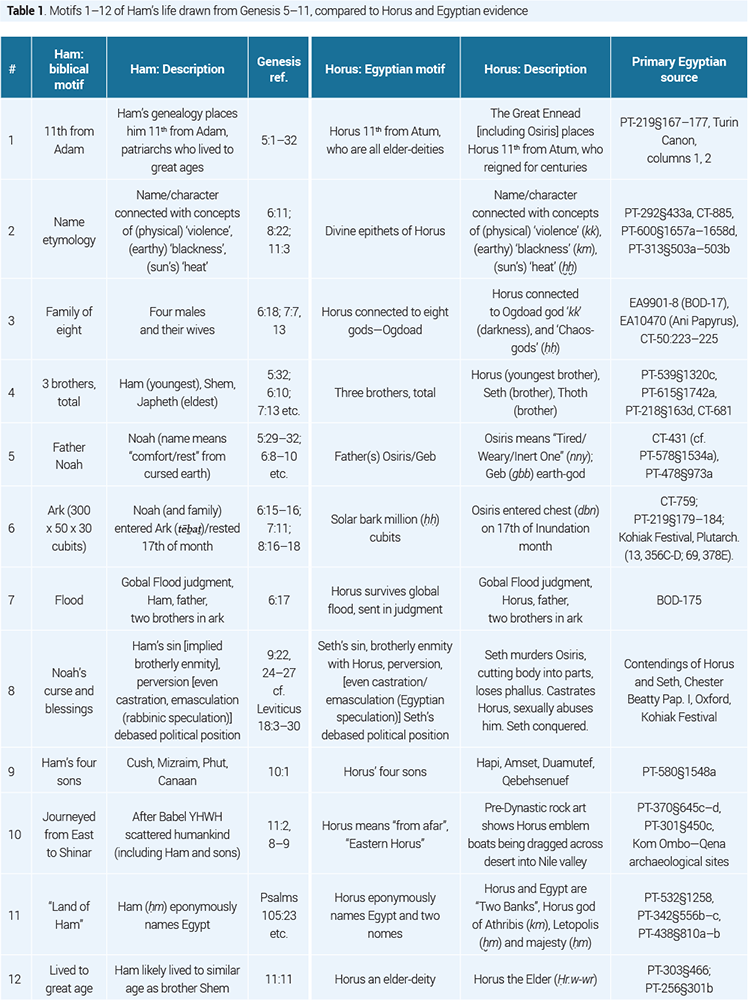
CONNECTION BETWEEN BIBLICAL HAM AND EGYPTIAN GOD HORUS

Please check out my previous post: Egyptian Stories Reveal Noah’s Flood posted October 20th, 2021.

There are three main flood stories that emerged in Egypt from Heliopolis, Memphis, and Hermopolis. The similarities between these stories are that they all feature a primordial ocean, a primeval hill, and a deification of nature. The story from Heliopolis features a group of nine gods. It speaks of Atum, the creator god, and the Ogdoad, the eight gods on the boat. The Hermopolis story features the Ogdoad, a group of eight gods. Could these represent the eight people who survived the flood?

The name “Ham” means hotblacknoise, or troubled. “Kek”, the final god in the Ogdoad, means darkness, floodwater, or twilight. These similarities suggest that Kek represents Ham. Additionally, Kek is also known as Horus, therefore Ham = Kek = Horus. 

Look at the remarkable similarities between Biblical Ham and the Egyptian God Horus.

a table motifs 1 12 of ham life drawn from genesis 5 11 compared to horus and egyptian evidence

This information was obtained from Creation Ministries http://www.creation.com.

EVIDENCE FOR NOAH’S FLOOD

The Bible describes a global flood about 1600 years after creation. The most devastating catastrophe ever recorded would surely leave evidence, wouldn’t it? So what are consequences of Noah’s Flood? This video from Creation Ministries International does a great job of revealing that evidence. For me the evidence given on ancient history and when nations such as Greece, Germany, Ethiopia were first established was new.