WHO AM I? Solving the identity puzzle (2)

This is part 2 of my review of Martyn Isles’s book WHO AM I? Solving the identity puzzle. If you have not read my first post I suggest you do. It refers to the serious error of all humans being immortal.

This post will deal with the serious omission from Martyn’s book and that is the role the Holy Spirit played in Adam’s life and now plays in believers’ lives.

When God breathed life into Adam he became a living creature.

then the Lord God formed the man of dust from the ground and breathed into his nostrils the breath of life, and the man became a living creature.Genesis 2:7

Proverbs 20:27 tells us that the “spirit of a man” is the lamp of the Lord. A lamp requires oil to function. The Holy Spirit is the oil required to make the lamp of the Lord function. Hence, Adam received from God the Holy Spirit so Adam’s spirit could function as the lamp of the Lord. Adam was then able to function in the spiritual dimension and communicate with God as he did in the Garden of Eden.

The spirit of man is the lamp of the Lord, searching all his innermost parts.Proverbs 20:27

What was immediately lost in The Fall is the Holy Spirit departed Adam and Eve’s spirits so they and we as their descendants are no longer able to communicate directly with God.

The good news is that when we accept Jesus as our Lord and Saviour our Heavenly Father will send the Holy Spirit to once again indwell our spirit to be our helper, our counselor, teacher, and comforter.

If you love me, you will keep my commandments. And I will ask the Father, and he will give you another Helper, to be with you forever, even the Spirit of truth, whom the world cannot receive because it neither sees him nor knows him. You know him, for he dwells with you and will be in you.John 14:15-17

But the Helper, the Holy Spirit, whom the Father will send in my name, He will teach you all things and bring to your remembrance all that I have said to you. John 14:26

Nevertheless, I tell you the truth: it is to your advantage that I go away, for if I do not go away, the Helper will not come to you. But if I go, I will send him to you. John 16:7

When the Spirit of truth comes, he will guide you into all the truth, for he will not speak on his own authority, but whatever he hears he will speak, and he will declare to you the things that are to come. He will glorify me, for he will take what is mine and declare it to you. All that the Father has is mine; therefore I said that he will take what is mine and declare it to you.” John 16:13-15

Therefore I want you to understand that no one speaking in the Spirit of God ever says “Jesus is accursed!” and no one can say “Jesus is Lord” except in the Holy Spirit.1 Corinthians 12:3

And do not grieve the Holy Spirit of God, by whom you were sealed for the day of redemption.” Ephesians 4:30

Do not quench the Spirit. Do not despise prophecies, but test everything; hold fast what is good.1 Thessalonians 5:19-20

The Holy Spirit produces the fruit of the spirit in our lives: love, joy, peace, patience, faithfulness, gentleness, goodness, kindness, and self-control. He is also the one who provides the gifts for ministry.

But the fruit of the Spirit is love, joy, peace, patience, kindness, goodness, faithfulness, gentleness, self-control; against such things there is no law. Galatians 5:22-23

Now there are varieties of gifts, but the same Spirit; and there are varieties of service, but the same Lord; and there are varieties of activities, but it is the same God who empowers them all in everyone.” 1 Corinthians 12:4-6

For to one is given through the Spirit the utterance of wisdom, and to another the utterance of knowledge according to the same Spirit, to another faith by the same Spirit, to another gifts of healing by the one Spirit, to another the working of miracles, to another prophecy, to another the ability to distinguish between spirits, to another various kinds of tongues, to another the interpretation of tongues. All these are empowered by one and the same Spirit, who apportions to each one individually as he wills.1 Corinthians 12:8-11

Jesus told His disciples not to do anything until the Holy Spirit came to indwell their spirits at Pentecost. It was only then that they were empowered to live the Christian life. Likewise for us, unless we have received the Holy Spirit we cannot live the Christian life, it is impossible.

ROCKS DON’T LIE – BATTLING WORLDVIEWS

Article in Journal of Creation Volume 37, Issue 2, 2023 by Carl R. Froede, Jr, and A. Jerry Akridge

Naturalists often confuse their worldview invoking eons of geologic time with empirical science. Many are so indoctrinated with the concept of deep time they overlook conflicting evidence. A recent article, published in the monthly open-access GSA Today, demonstrates this problem. The authors state: “Astronomy and geology require contemplation of time scales and length scales far outside those of human experience. Granitic plutons are intruded and crystallized at depths ranging from a few kilometers to tens of kilometers, over durations of 10–5 [100,000] to 10–7 [10,000,000] years, at temperatures comparable to the melting temperature of gold, from magmas at least 10,000,000 times more viscous than water. Human experience is not relevant to these conditions and can be highly misleading.

This statement assumes the Genesis Flood never occurred and humans did not exist on Earth when granite formed in the subsurface or possibly later became exposed through the erosion of the overburden. Is this statement a matter of empirical science or the projection of a naturalistic worldview?

Flood-formed granites

The formation of granite and granite landforms has been studied by many young-earth creationists (figure 1). Creationist research indicates that water-enriched granitic melts can form, move upward through the crust, and crystallize in days to weeks. This occurred during Creation Week (most likely Day 3) and also during the Flood—two periods of Earth’s past when geologic intense activity is expected based on the outline in Genesis.

The rapid creation, mobilization, and crystallization of granite would have been enhanced by aqueous conditions associated with the breaking up of the fountains of the deep with the onset of the Flood. Entrained water within the rapidly heating rocks and sediments would have decreased the melting temperature, increasing melt mobility, and enhancing its rapid crystallization.

In some instances, remaining latent heat within subsurface granitic melts/crystallized masses generated during the Flood would have allowed them to continue as heat sources up to the present age timeframe (figure 2). Today, hot springs and other geothermal areas may indicate these features.

The biblical outline of Earth’s history allows for this conceptualization and provides a framework to test our worldview relative to the development of granite.

The naturalistic perspective

While not within a period of time compatible with the Bible, some naturalists acknowledge the rapid formation, ascension, and crystallization of granitic melts is possible over short periods of time (<100,000 years). However, with little water in the slowly forming melt, naturalists envision the entire granitic formation-to-crystallization process would extend over millions of years due to the slow-moving tectonic processes essential in melt generation, movement, and eventual crystallization. During this lengthy time interval, most of the water / hydrothermal fluids within the subsurface rocks and sediments would be driven off, thereby reducing its effectiveness in generating a more mobile granite melt at lower temperatures. The naturalistic worldview imposes limits in both the conceptualization of granitic development and the empirical methods used to test its ideas.

Interestingly, pegmatites that cross-cut granites (figure 3) are postulated by naturalists as having formed and crystallized rapidly—”in days to months, not in thousands to millions of years as previously believed.” This view is not isolated, as many other petrologists invoke days to months for the formation and development of pegmatites. There is no current naturalistic model that emplaces pegmatites in a water-depleted environment. They are always associated with water-enriched feldspars, quartz, and minor trace elements within a slowly crystallizing granitic melt. Missing is the reasoning to minimize water and other hydrothermal fluids from the original granitic melt.

Battling worldviews

Understanding the conceptual geologic history of granites demonstrates the differences in worldviews between naturalists and Bible-supporting young-earth creationists. This is not a battle over empirical science, but rather over the framework of our ideas (i.e. philosophy/theology). These foundational assumptions drive the investigation of geologic features like granites. Oftentimes these foundational assumptions impede scientific progress because they limit possibilities in designing appropriate models for further testing.

Conclusions

Ultimately, through scientific testing, a dominant theory for the origin, movement, emplacement, and crystallization of granite will emerge. The naturalistic worldview rejects everything but the physical universe and its many geologic concepts operating over millions of years. Most young earth creationists accept both the physical and the supernatural—as conveyed through Scripture—in the scientific investigation of geologic features found across Earth.

Satan (the leader of a group of fallen angelic beings) wants to ensure humans leave God out of everything concerning the world he now controls due to Adam and Eve’s original sin. This is of cause absurd, Satan only rules because God has permitted him to do so within the parameters He allows. The Book of Job, given to us in God’s Word, is to show us that this is true. God has also given us the entire story of the world He created for His purposes, the Bible. Fulfilled Biblical prophecies, is all the proof we need, to know God has preserved its integrity.

We, therefore, know that God made us in His image, to be in a relationship with Him. We also know that God gave us free will and that Adam and Eve chose to disobey God giving us a fallen world with Satan and his minions controlling the lives of most of its inhabitants. God’s redemptive plan is amazing and it demonstrates how important we are to God. The second person of the Trinity, God’s son, Jesus, became a human to pay the price for our sin of rebellion, death on a wooden cross. We now have a way back into a renewed relationship with God the Father.

Jesus said to him, I am the way, and the truth, and the life. No one comes to the Father except through me.” John 14:6

Have you accepted the wonderful offer of eternal life made possible by Jesus’ sacrifice?

Jesus made it possible for our Heavenly Father to send the Holy Spirit to indwell the spirit of all those who do accept His wonderful offer. The Holy Spirit enables believers to live a life devoted to doing the will of God. He is your counsellor, teacher, and comforter. He produces the fruit of the Spirit (Galatians 5:22) in your life and provides the gifts of the Spirit for ministry (1 Corinthians 9).

Do you not know that your body is a temple of the Holy Spirit within you, whom you have from God? You are not your own, for you were bought with a price. So glorify God in your body.1 Corinthians 6:19-20

MORE EVIDENCE FOR NOAH’S FLOOD

The notion of a ‘wet Sahara’ in the recent past is controversial among secular researchers since they struggle to adduce a mechanism to explain it. However, much evidence exists for it and has recently been bolstered through the discovery of ancient shorelines. And unlike the conditions proposed by secular researchers, the conditions produced by a post-Flood Ice Age in the biblical perspective provide mechanisms for explaining the existence of a ‘wet Sahara’.

Paleolake Chad covered an area of 340,000 km. much larger than the current Lake Chad

The Ice Age solution

The biblical rapid Ice Age model can explain the existence of the large and small lakes in the Sahara and the population of animals and people by a northward displacement of the Inter Tropical Convergence Zone (ITCZ). In the same way as were the lakes in the southwestern U.S., and other lakes generally around the 30th parallel of the Northern Hemisphere, the Saharan lakes were first filled during Flood runoff. Residual floodwater would have been left in enclosed basins. Evidence for this could be the marine foraminifera fossils found in the Sahara Desert. Then much more rain in the Sahara during the Ice Age would have either maintained the lakes or filled them up to overflowing, resulting in rivers and streams. Dried-up rivers and streams with amphibian fossils are found below the sand. Such a wet environment was caused by much greater evaporation from the Ice Age warm ocean and a different general circulation from that evident today. But the wet Sahara continued after the Ice Age into the mid-Holocene, likely because the ITCZ was displaced much farther north.

There was only ever one ice age, it followed the worldwide flood and lasted about 700 years.

The Ice Age lasted longer in the Southern Hemisphere (SH) than the Northern Hemisphere (NH). Glacial maximum was reached about 500 years after the Flood with deglaciation taking another 200 years, lasting a total of 700 years. However, the SH would not reach glacial maximum until perhaps 300 years later, because of the time needed for the build-up of the Antarctic Ice Sheet. The atmosphere and oceans of the two hemispheres have only a minimal exchange of water and air between them, so each generally acts independently. And because the SH has much more ocean than the NH, it would take longer for the Southern Hemisphere oceans to cool (cooling is 75% by evaporation and 25% by cool airflow off the continents).

How does this explain the green Sahara in the African Humid Period? It is known that today, the ITCZ migrates seasonally away from the winter hemisphere, within a range of about 10° latitude.8 Therefore, after the Ice Age ended in the Northern Hemisphere, the Ice Age in the Southern Hemisphere would have pushed the ITCZ even farther north than it shifts today as the seasons change. The SH Ice Age could easily push the ITCZ 600 km (375 mi) north into the Sahara Desert and cause the green Sahara to persist for centuries after the ice sheets had disappeared from northern regions.

Both creation and secular geologists agree that the earth’s deserts and semi-arid areas were once well-watered. Creation scientists largely attribute this to the warmer ocean water just after the Flood, warmed by the enormous volcanic eruptions that took place during the Flood. Warmer oceans generated huge amounts of evaporation, which caused the great ice sheets to build up rapidly over many parts of the world, leading to the Ice Age. At the same time, the extra water vapour in the atmosphere caused high rainfall at lower latitudes where it was not cold enough to form snow and ice. Thus, the post-Flood Ice Age explains why the earth’s deserts and semi-arid areas were once well-watered.

This high-rainfall condition would have lasted for several centuries until the sea had cooled off and reached equilibrium with the atmosphere, as it is today. In the runoff stage in the last part of the Flood, many lakes would have formed from the ponding of water in enclosed basins on an already waterlogged Earth. After the Flood during the Ice Age, high rainfall would have caused these lakes to grow and be sustained, along with a network of rivers and streams.

Taken from the article “Ice Age megalakes did exist in the Sahara” by Micheal Oard in the Journal of Creation/2023, volume 37, in the section Perspectives

CRAB CAPTURED IN AMBER

“The specimen is spectacular, it is one of a kind. It’s absolutely complete and is not missing a single hair on the body, which is remarkable”. These are the words lead author Javier Luque used to describe Cretapsara athanata, the first crab from the ‘Cretaceous dinosaur era’ preserved in amber (fossil tree resin), and the most complete fossil crab ever found. Despite being ‘dated’ at around 100 million years, 3-D scans showed it to be modern-looking.

The amber preserved delicate features such as antennae, compound eyes, and mouthparts covered in minute hairs. It even preserved the well-developed gills which meant the small crab was most likely water-dwelling. Plant material and insect faeces were also found in the same amber lump (c. 20 mm × 7 mm). “How then did a 100 million-year-old aquatic animal become preserved in tree amber, which normally houses land-dwelling specimens?”

For evolutionists, such a question leads to many ‘it might have’ stories. Of course, they would be aware that to preserve the crab in such a complete state the resin would have to engulf it quickly. Today’s generally slow trickle of resin from trees would never suffice.

The conditions found in the Noahic Flood around 4,500 years ago readily account for all aspects of this find. The obvious one is finding an aquatic crab in resin from a tree, alongside terrestrial plant and insect material. As forests were ripped up and carried by the floodwaters, huge rafts of trees crashed into each other. The damaged trees were bleeding abnormally copious amounts of their sticky resin, which quickly enveloped the items it contacted. This also explains the existence of large amber deposits, such as the ones mined in Myanmar from which this specimen came.

Harvard University, International team of researchers discover first dinosaur era crab fully preserved in amber; oeb.harvard.edu, 20 Oct 2021.

This article appeared in Creation Magazine Vol 44 Issue 2, 2022 (http://www.creation.com)

MORE EVIDENCE FOR A YOUNG EARTH

The oceans show us a young earth

Another informative article by Paul Price from Creation Ministries (CMI) check out their website http://www.creation.com

Long ages of billions of years is a very widespread belief today. 

The ‘millions and then billions of years’ idea first came from geology—from the rock layers. More precisely, from the interpretation that these layers supposedly formed by the same slow and gradual processes we see happening today, at more or less the same rates. This is the belief system called uniformitarianism. It was not the result of scientific evidence, but was imposed upon the evidence.

This belief system a priori rules out the biblical Flood as a possible explanation. Conversely, the Flood would have performed all that geological work shown in the rocks in a short time, rather than billions of years. Of course, the waters of that Flood ended up in today’s seas. Just by standing on the shoreline, we can get a sense of the vastness of God’s power in creating this planet and all the water on it, as well as the awesome scope of God’s judgment in the Flood. But we can learn a great deal more from those majestic waves; there are many lines of evidence from the oceans that refute the idea of billions of years and resoundingly affirm biblical history.

The oceans present us with another way of ‘dating’, because we can measure the rates of various processes with respect to the oceans. And using the long-ager’s own belief system of uniformitarianism, we get ‘maximum ages’ that do not square with the secular long-age paradigm. They do not, however, present any problem for the biblical timeline of history. Thus, uniformitarianism is self-refuting with respect to the scientific evidence we have available.

beach
Just by standing on the shoreline, we can get a sense of the vastness of God’s power in creating this planet and all the water on it, as well as the awesome scope of God’s judgment in the Flood.

Ocean salt

The salinity of our oceans can give us a ‘clock’ of sorts, because we are able to estimate the amount of salt entering our oceans as well as the amount that leaves. It turns out that much more is entering than leaving, so the oceans are getting saltier over time. So let’s use this as a uniformitarian ‘clock’ by assuming the processes have stayed much the same. Starting with fresh water, how long would it take for the oceans to become as salty as they are?

A study by creation scientists Steve Austin and Russell Humphreys, using the most conservative numbers available, gave an absolute upper limit (not actual age!), of 62 million years.1 While this may seem like a long time, it is actually far too low a number to accommodate the secular age for the ocean of 3.8 billion years.2 And note that the oceans would have started out with some salt in them, plus a stupendous amount of salt and other minerals would have been added during the Flood from erosion and volcanism. The only ‘out’ for long-agers is to assume that the rates have dramatically changed—which undermines the whole idea of uniformitarianism!

Where is all the seafloor sediment?

On average, the depth of sediment on the ocean floor is less than 400 metres (about 1,300 feet), with some areas of the ocean floor having no mud at all. We would not expect to find this if the oceans were extremely old. We can also estimate the maximum rate at which subduction (one crustal plate gradually being thrust under another) could be pulling sediment back into the crust. Assuming that this rate has always been the same (again, uniformitarianism against itself), it is far too slow to account for this result; not enough seafloor mud is getting eliminated by this process. In fact, at the present rate, all the sediment would have been accumulated in under 12 million years.5 And once more, the dramatic erosive power of a year-long global Flood means that it would have actually happened much more quickly even than that.

Accumulating nickel

According to a UK environmental health guideline, concentrations higher than 30 parts per billion are toxic for marine life—yet that concentration would have already been reached in just 1,076,000 years at current rates of input! Just as for salt, nickel is also entering our oceans far too quickly for the old-earth timeline of history.4

Gigantic submarine canyons

All over the world, we find examples of huge canyons offshore, some greater even than Grand Canyon, which are located in deep water and run perpendicular to the coastline. Uniformitarian geologists are at a loss, admitting that there are currently no widely accepted theories capable of explaining them. However, looking at these features from the perspective of a young earth and Noah’s Flood makes perfect sense. They were carved by ‘channelized flow’ coming off the continents in the recessive stage of the Flood. That is why they are often found seawards of valleys on the land. The same rapid channelized flow that carved the valley on land also carved the submarine valley offshore.

Summary

The oceans do not show the appearance of age we would expect if they were really billions of years old. This is consistent with the Bible; the oceans of today began on Day 1 of Creation Week, some 6,000 years ago, covering the earth.

Today’s oceans contain more than enough water to flood the whole earth. If we were to flatten out all the current unevenness on the land and seafloor, the water present would cover the whole earth nearly 3 km (2 miles) deep! Tectonic movements of the earth’s crustal plates at the onset of the Flood would account for the water flooding the land.

After the Flood, as Psalm 104:8 seems to indicate, “the mountains rose, the valleys sank down”, giving us the very uneven surface of the planet we now inhabit. Even Mount Everest, one of the planet’s tallest peaks, would have been uplifted at the closing stages of the Flood, coming into being at that time as a brand-new feature. (It is measured to be still rising, though much more slowly, today.) So no wonder it has limestone with marine fossils on its summit. All this answers the age-old questions of ‘Where did all that water come from?’ ‘Was there enough to cover the earth?’, and, ‘Where did it all go?’

As we’ve seen, our oceans not only contain many evidences that confirm the Bible’s history, but they still contain the very same waters that inundated the planet long ago – the very same waters that carried Noah’s Ark – the very same waters God used to judge a rebellious mankind.

BIBLICAL HISTORY PROVED BY ARCHAEOLOGY

A 2,000-years-old mikvah (ritual bath) was recently uncovered in the Lower Galilee.

A 2,000-years-old mikvah (ritual bath) was recently uncovered in the Lower Galilee. Most people probably would never have heard about the discovery if not for the dramatic photos of the entire structure being carried by truck to a nearby kibbutz for preservation.

The remarkable sight of a truck-borne mikvah, however, also makes one pause and reflect on the remarkable implications of the archeological find.

Opinion: Palestinians’ most dangerous enemy is… archaeology
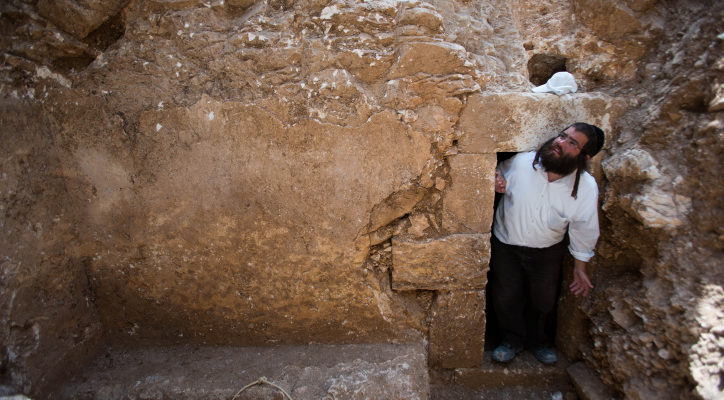
A Jewish man seen outside an ancient Mikveh, a Jewish ritual bath, discovered inside an underground cave in Jerusalem

It means that 2,000 years ago, the residents of the Lower Galilee were practicing the exact same religious rituals that Orthodox Jews throughout the world practice today. Those Galileans, in other words, were Jews.

They weren’t “Palestinians.” The word “Palestine” had not yet been invented. They weren’t Arabs or Muslims—the invasion of the Land of Israel by Muslim fundamentalists from the Arabian Peninsula was still 600 years in the future. The directors of the excavation were Walid Atrash and Abd Elghani Ibrahim. You can tell by their names that they are not exactly Orthodox Jews. The P.A. will have a hard time getting anybody to believe that Atrash and Ibrahim are agents of a Zionist conspiracy.

Archaeologists discovered Hebrew-language inscriptions dating back 2,600 years.

One was a stone seal with the words “belonging to Ikkar son of Matanyahu.” The other was a clay seal impression that read “belonging to Nathan-Melech, servant of the king.” They weren’t in Arabic. And the names weren’t Yasser or Mahmoud.

Archaeologists uncovered a 2,000-year-old paved road that was used by Jews who made the annual pilgrimage to the capital at the time of the festivals of Passover, Shavuot and Sukkot.

The pavement and the solid foundation that was left exposed (Image: A. Peretz, IAA)

A 2,000-year-old ‘lost’ street built in Jerusalem by Pontius Pilate has been uncovered for the first time since the city was sacked by the Romans in 70AD. It wasn’t used by Arabs, or Muslims or “Palestinians”—because there weren’t any of them around in those days.

The ancient walkway most likely used by pilgrims as they made their way to worship at the Temple Mount was first discovered in 1894 by British archaeologists in the “City of David” within the walls of Jerusalem.

Researchers have now found more than 100 coins beneath the paving stones that date the street to around the year 31AD.

The finding provides strong evidence that the street was commissioned by Pontius Pilate, the Roman governor of the province Judaea, best known for being the official who presided over the trial of Jesus and ordered his crucifixion.

Excavators from the University of North Carolina discovered two stunning mosaics at the site of a 1,600-year-old synagogue near Huqoq in northern Israel.

One depicts a scene from the exodus of the Jews from ancient Egypt. The other shows images based on verses in the Torah’s book of Daniel.

Portion of the mosaic depicting a fish swallowing a soldier during the parting of Red Sea. (Credit: Jim Haberman/Baylor University)

Note that the mosaics do not show scenes from the Koran. There is nothing Arabic of Islamic or “Palestinian” about them. They are Jewish, they are situated in Israel, and they are 1,600 years old.

Every new archaeological discovery about the ancient Jews constitutes another stick in the spokes of the wheels of the Palestinian Arab propaganda machine. Every physical fact in the soil of the country shatters the P.A.’s lies. Every stone or seal or shard of pottery reminds us who are the real indigenous people of the Land of Israel.

EVIDENCE RADIO ACTIVE DECAY NOT PROOF OF BILLIONS OF YEARS

From the work done by the Rate team it is clear that the assumption of a constant slow decay process was wrong. There must have been speeded-up decay, perhaps in a huge burst associated with Creation Week and/or a separate burst at the time of the Flood.

The RATE project began as a cooperative venture between the Institute for Creation Research (ICR), the Creation Research Society (CRS) and Creation Ministries International (CMI).

As a result, there is now powerful independent confirmatory evidence that at least one episode of drastically accelerated decay has indeed been the case, building on the work of Dr Robert Gentry on helium retention in zircons. The landmark RATE paper – Humphreys, D. et al., Helium diffusion rates support accelerated nuclear decay, though technical can be summarised as follows: (www.icr.org/pdf/research/Helium_ICC_7-22-03.pdf)

  • When uranium decays to lead, a by-product of this process is the formation of helium, a very light, inert gas which readily escapes from rock.
  • Certain crystals called zircons, obtained from drilling into very deep granites, contain uranium which has partly decayed into lead.
  • By measuring the amount of uranium and ‘radiogenic lead’ in these crystals, one can calculate that, if the decay rate has been constant, about 1.5 billion years must have passed. (This is consistent with the geologic ‘age’ assigned to the granites in which these zircons are found.)
  • There is a significant amount of helium from that ‘1.5 billion years of decay’ still inside the zircons. This is at first glance surprising for long-agers, because of the ease with which one would expect helium (with its tiny, light, unreactive atoms) to escape from the spaces within the crystal structure. There should surely be hardly any left, because with such a slow buildup, it should be seeping out continually and not accumulating.
  • Drawing any conclusions from the above depends, of course, on actually measuring the rate at which helium leaks out of zircons. This is what one of the RATE papers reports on. The samples were sent (without any hint that it was a creationist project) to a world-class expert to measure these rates. The consistent answer: the helium does indeed seep out quickly over a wide range of temperatures. In fact, the results show that because of all the helium still in the zircons, these crystals (and since this is Precambrian basement granite, by implication the whole earth) could not be older than between 4,000 and 14,000 years. In other words, in only a few thousand years, 1.5 billion years’ worth (at today’s rates) of radioactive decay has taken place. Interestingly, the data have since been refined and updated to give a date of 5680 (+/- 2000) years.

The paper looks at the various avenues a long-ager might take by which to wriggle out of these powerful implications, but there seems to be little hope for them unless they can show that the techniques used to obtain the results were seriously (and mysteriously, having been performed by a world-class non-creationist expert) flawed.

MORE EVIDENCE FOR THE ACCURACY OF BIBLICAL HISTORY

EVIDENCE FOR THE TOWER OF BABEL:

In the video from Genesis is History on The Evidence for the Tower of Babel, Archaeologist Dr. Douglas Petrovich, from the Oriental Institute of Chicago carefully explains how he surveyed all the relevant  archaeological data in order to come to the specific conclusion that Eridu is the site of the original Babel. There is an enormous amount of evidence he has amassed for his arguments, much of it never before having been discovered or put together by anyone.

Dr Del Tacker interviews Dr Douglas Petrovich  Perhaps the most interesting aspect of Doug’s approach is that, due to his training as an archaeologist, he does not start with the location of the actual building. Instead, he points out Genesis 11 describes a technologically-advanced people who suddenly dispersed throughout the ancient Near East, in distinct and new patterns that could easily be explained by their having been divided into linguistic groups according to their ethnicity.

He assumed this massive dispersion would be easier to identify archaeologically than a half-finished tower. He therefore worked his way back to the source of the dispersion, then looked for evidence of a large, unfinished building. In this extremely interesting way, he reverse engineered the account recorded in Genesis 11 to arrive at his conclusions.

One of those conclusions was that, prior to this dispersion, people moved toward urban living in only one place: southern Sumer. Interestingly, Eridu is universally recognised as the world’s first city. Doug also pointed out that there were many other sites where communities and villages had been established, often before Eridu was settled.

This is an interesting divergence from the view held by many creationists. It is believed that all the people in the world were living at Babel before their dispersion. As a teacher of ancient languages, however, Doug observes that the Hebrew text of Genesis 11:1-2 does not specifically state the entire population of the earth moved to a single site, just that the entire world spoke the same language.

It’s worth reviewing the context of the Genesis 11 account. After the Flood, Genesis 10 describes the dispersion of different people groups throughout the world as they descended from Noah’s three sons. At the end of each son’s lineage, Moses says the different peoples were divided into languages, clans, and nations. He finishes this Table of Nations by explaining that:

These are the clans of the sons of Noah, according to their genealogies, in their nations, and from these the nations spread abroad on the earth after the flood. Now the whole earth had one language and the same words. And as people migrated from the east, they found a plain in the land of Shinar and settled there. (Gen 10:32-11:2)

In his discussions, Doug noted that the word “Shinar” is the Hebrew cognate (i.e. equivalent) of the Akkadian word “Shumer,” which historians today call “Sumer.” Furthermore, as is common in many Hebrew texts, Moses is going back in history to explain how the many different languages originated.

Yet when did this actually happen?

Some scholars think Moses provides a chronological indicator when he says “to Eber were born two sons: the name of the one was Peleg, for in his days the earth was divided, and his brother’s name was Joktan.” (Gen 10:25)  From the context, it makes sense this division could be referring to the division of languages at Babel mentioned just a few sentences later. Depending on whether one follows the Masoretic or Septuagint chronological tradition (Doug holds to the Septuagint dates), Peleg lived 5 or 6 generations after Noah. If one follows the Masoretic dates, it’s over 100 years; if one follows the Septuagint dates, however, it’s over 500 years.

Again, the generally-held view of many creationists is that all the people of the world were living together at Babel. Yet the text merely says “as people migrated from the east.” If read in context of the preceding Table of Nations, it would seem to be referring to one of the many migrations of people spreading over the face of the earth.

Nevertheless, it has always been assumed that Genesis 11 implied everyone was still living together in one place on the plain of Shinar (or Sumer). Otherwise, how could all the languages of the earth have been changed?  The traditional view is a reasonable assumption, but perhaps there is another way of looking at the event that also maintains the integrity of the text.

Dispersion and Languages

Doug Petrovich’s perspective is that, after the Flood, groups of people began to spread out slowly over the face of the earth as documented in Genesis 10. They lived in smaller communities with less technological development, something he says fits with the archaeological record.

In Genesis 11, however, he sees a unique technological event: a group of people move to the plains of Shinar and begin to build the first major city. Moses describes them as a proud people who applied specific technological skills to create a new type of urban community where they could rebel together against God; their largest building would have “its top in the heavens.”

As a result of their pride, God judges them by confusing their language and dispersing them over the earth. Doug explains that he sees this dispersion in the archaeological record. In some places, the post-Babel groups built new communities in undeveloped regions, in others they slaughtered the local inhabitants of an existing community and overtook the site, and, in a few others, they moved into an existing town but lived in a separate area as possibly the world’s first segregated neighbourhoods.

Looked at from this perspective, God’s act of changing the languages at Babel, then dispersing the new linguistic groups throughout the earth, is what transformed a single language into many different languages. The new languages spread through the earth like ripples in a pond as the new peoples interacted with each other.

Granted, this is a fresh perspective on an old question. Yet it has much to commend itself. It is a good example of a scientist taking the Biblical text as real history, then looking at the world to see where the data fits with it.

Nevertheless, there is still much work to be done to synchronise the archaeological record with the Biblical account. The primary problem is that too few people are working in this area. The challenge of reconciling the various dating methods, the archaeological data, and the different chronological traditions still remains to be solved. Doug explores this further in his second video “Carbon Dating & the Septuagint,” also included in Beyond Is Genesis History? Vol 3 – Bible & Stars.

For those who want to hear the longer, technical explanation behind his arguments, watch his lectures from the 2017 IGH Conference on YouTube: Identifying the Post-Babel Dispersion and Identifying Babel and its Tower.