SIGNPOSTS TO GOD

Prominent atheist Richard Dawkins was once asked what he would say to God if he encountered Him after he died. Dawkins quoted what Bertrand Russell is reputed to have said when asked the same question: “Sir, why did you take such pains to hide yourself?

I think I can understand why some might echo that sentiment. After all, God is invisible; we can’t perceive Him directly with our physical senses. Yet the signs of His existence—indeed, of His goodness and greatness—are everywhere. The Apostle Paul was right when telling a first-century pagan audience that God has always given evidence of His existence through the good things He has done, such as “rains from heaven and fruitful seasons, satisfying your hearts with food and gladness.” (Acts 14:17). God has put up signposts everywhere to help us find our way to Him. Here are just a few of them.

The humblest believer in God as Creator must exercise far less credulity, and has far less explaining to do, than the most ardent evolutionist materialist.

Of course, fallen humanity has devised many increasingly sophisticated speculations of how nature could have made itself. Ministries like Creation Ministries International (http://www.creation.com) provide people with specific answers to such challenges. Even so, it pays to step back and contemplate the ‘big picture’ of what is claimed, and its affront to common sense.

Evidence of design

Flicking through a magazine one day as a child, I came across a photograph of Mount Rushmore, South Dakota, with the unmistakable likenesses of four American presidents carved into the rocks. Knowing nothing of how these came to be there, I remember thinking, “How strange! These can’t have happened by accident.”

Precisely! No one could seriously suggest that these shapes resulted from wind, or rain, or glacial erosion. These carved faces are clearly the result of creative design and effort.

Though not professing a commitment to anything like the God of the Bible, Paul Davies, former professor of theoretical physics at The University of Adelaide, writes in his book The Mind of God:

Through my scientific work, I have come to believe more and more strongly that the physical universe is put together with an ingenuity so astonishing that I cannot accept it merely as a brute fact … I cannot believe that our existence in this universe is a mere quirk of fate, an accident of history, an incidental blip in the great cosmic drama.2

The humblest believer in God as Creator must exercise far less credulity, and has far less explaining to do, than the most ardent evolutionist materialist.

Another signpost is human nature. We have been made in the image of God (Genesis 1:27). Thus, we have spiritual capacities that cannot be explained apart from God. Language, reason, ambition, creativity, humour, wonder, worship—all these have no counterpart in the natural world. These qualities mark us out as different from the rest of God’s handiwork. This is another way of saying that our Creator has endowed us with the capacity to relate to Him at a personal level.

Within human nature, conscience is another sign pointing to God. Proverbs 20:27 says of the human spirit that it is “the lamp of the Lord, searching all [man’s] innermost parts.”. Our conscience is responsible for our intuitive knowledge of right and wrong, good and evil. The Apostle Paul states that even those who don’t have God’s law in written form still have a conscience that commends them when they instinctively do what it commands and accuses them when they don’t (Romans 2:14–15).

Even without a ‘book of rules,’ we know it’s wrong to lie, steal, covet, and murder. Conscience ‘puts a pebble in our shoe’ whenever we violate it. The standard it sets and the guilt it inflicts point us to God—the Source of all good and the Judge of all evil.

Eternity in our hearts

Our longing for eternity is another pointer to God. Somehow, we know and feel that this life is not all that there is. Archaeologists have discovered how carefully and elaborately the ancient Egyptians prepared for the afterlife, and they had no Bible to tell them about a life to come. Where does this longing for eternity come from? Everything on Earth is subject to change and decay:

Of old you laid the foundation of the earth, and the heavens are the work of your hands. They will perish, but you will remain; they will all wear out like a garment. You will change them like a robe, and they will pass away, but you are the same, and your years have no end (Psalm 102:25–27).

These ‘immortality longings’ we all feel at various moments are pointers to the God who created us in His own image.

Hunger of the soul

Another signpost to God is our longing for meaning and purpose. We always knew when our cat Simba was hungry and wanted to be fed. (Any cat owner knows that dogs have masters, but cats have staff!) He would eat his prescription dry food and go away content; his next meal seemed to be the limit of his horizon. But we can’t live at that bare, subsistence level—at least, not for long. We crave meaning and purpose in our lives; we long to enjoy significant and satisfying relationships.

This sense of longing is often called ‘the homesickness of the soul’—and rightly so, for that’s precisely what it is. The true object of our longing is God. The words of the psalmist reflect this truth:

As a deer pants for flowing streams, so pants my soul for you, O God. My soul thirsts for God, for the living God. When shall I come and appear before God? (Psalm 42:1–2)

Illuminating the way

Of all the signposts pointing to God, the Bible is by far the clearest. When a British monarch is crowned, he or she is given a copy of the Bible, and told, “This Book is the most valuable thing that this world affords. This is the royal law; these are the lively oracles of God.” When we read the Bible with a humble and teachable attitude, we find it to be a source of supernatural wisdom and power. The psalmist prayed: “Open my eyes, that I may behold wondrous things out of your law” (Psalm 119:18). Paul reminded his young associate Timothy that Scripture provides the wisdom and instruction that leads to “salvation through faith in Christ Jesus” (2 Timothy 3:15).

Scripture’s major theme is Jesus Christ, God’s only Son. As the “image of the invisible God” (Colossians 1:15), Jesus is the clearest and most compelling witness to the existence and greatness of God the Father. Jesus Himself said: “Whoever has seen me has seen the Father” (John 14:9). He is the perfect transcript of what God is like.

But the supreme demonstration of God’s love and care is the sending of His Son into the world to suffer death on the cross, to save us from our sins, and to reclaim us for Himself. The Cross is more than enough to convince us that God loves and cares for lost people (Romans 5:8). Jesus Himself said that He came “to seek and to save the lost” (Luke 19:10).

There are signposts everywhere to help us find our way to God, but the most vital one is Jesus. He said: “I am the way, and the truth, and the life. No one comes to the Father except through me” (John 14:6).

The article Signposts to God is by Peter Howe on http://www.creation.com

EVOLUTION CAN’T EXPLAIN THE INCREDIBLE DNA-FOLDING MECHANISM DISCOVERED

The article is taken from CREATION MAGAZINE Vol 36, Issue 3, 2024

Biological cells are like tiny cities bustling with machines performing numerous tasks to keep cells alive. For decades, one class of these machines, SMCs (for Structural Maintenance of Chromosomes), have been known to fold DNA strands into intricate three-dimensional structures. This is crucial for the proper organization and function of the genome.

DNA

Insights gained from multiple studies have paved the way toward a step-by-step model of how these machines might extrude loops of DNA as part of this process. An SMC is like an arm with two hands at one end. Each hand holds either end of a stretch of DNA. One of these hands holds continuously while the other periodically ‘let go’ when the arm is bending, during which time the DNA loop becomes a little larger. The hand then re-grabs the DNA before the arm re-extends. In this way, SMCs can extrude longer and longer loops of DNA.

The conundrum for evolution: this machine, useless until fully functional, is needed for reproduction, so natural selection (differential reproduction) can’t explain it.

Dekker, C. et al., How do molecular motors fold the genome? Science 382(6671): 646–648, 2023.

MORE EVIDENCE FOR A CREATOR

Michael Behe, John Lennox, and Steven Meyer are three leading voices in science and academia on the case for an intelligent designer of the universe and everything in it (including us). In this wide-ranging conversation, they point out the flaws in Darwin’s theory and the increasing amount of evidence uncovered by a rigorous application of the scientific method that points to an intentional design and creation of the physical world.

You will need over an hour to watch this video but I suggest you will be glad you did. In particular, I like John Lennox for his pearls of wisdom, and rating the three men as to what gems I learned, it would be 1. John Lennox, 2. Stephen Meyer and 3. Michael Behe. I need to watch the video again at least once more, to make notes, of the information I will incorporate to improve my argument for the God of the Bible’s existence.

DRAMATIC FALL IN BIBLE-BELIEVING CHRISTIANS IN THE U.S.A

These findings come from The American Worldview Inventory 2023, conducted by the Cultural Research Centre at Arizona Christian University under the supervision of George Barna, director of research at the Cultural Research Centre. While born-again Christians make up about one-third of all U.S. adults and are considered “the backbone of local church activity because of their higher level of commitment to the Christian faith,” the study shows that between 2020 and 2023, the share of those who say they believe Jesus did not commit sins during his lifetime on Earth fell from 58% to 44%.

Jesus being sinless is central to the hope Christians have in Him as Saviour explains the apologetics website Got Questions because, “If Jesus were not sinless, there would be no sacrifice for sin.” The apostle Peter stated it clearly: ‘He committed no sin, and no deceit was found in His mouth.’ (1 Peter 2:22) Indeed, as Jesus Christ is God, He has no capacity to sin,” the Christian website explains.

This shift in belief among born-again Christians was among six that showed a significant decline in the past three years that Barna characterized as “indefensible.”

Fewer than half of born-again Christians also now believe they have a unique, God-given calling or purpose. The share of those who held that belief fell from 88% to a staggering 46% during the pandemic.

A downward trend was also observed among those who say the Bible is unambiguous in its teaching about abortion. That belief fell from 58% to 44%. Those who say human life is sacred fell from 60% to 48%.

The number of born-again Christians who say God is the basis of all truth fell from 69% to 63% over the period. The share of born-again believers who say they are deeply committed to practicing their religious faith fell from 85% to 50%, while the share of those who say they read or study the Bible at least once a week fell from 60% to 55%. When it comes to the general population of U.S. adults, Barna said the share of the population that claims to hold a biblical worldview fell from 6% to 4% in the last three years, while less than half now claim to be “deeply committed to practicing” their religious faith. That measure fell from 60% to 48%. Barna also found that only 33% of adults now say they attend church service during a typical week which shows “a decline representing the loss of about 15 million churchgoing adults each week.”

The veteran researcher said the findings on the drastic shift in Christian belief over such a short period of time are “highly unusual” because “religious beliefs and behaviors have typically been a hallmark of consistency.” “Most religious beliefs change over the course of generations, not a few years,” Barna said.

Barna noted that a significant driver behind the decline in Christians holding on to a biblical worldview is syncretism, an ideology described as “the worldview that merges otherwise incompatible philosophies of life, particularly evolution and a Cosmos that has existed for billions of years, into a made-to-order worldview that incorporates enough biblical elements to be minimally Christian in nature.”

These statistics highlight how successful Satan’s strategy to undermine the foundations of God’s Word has been. Thankfully God has raised up ministries such as Creation Ministries International (CMI) and Answers in Genesis to show that evolution and its history of billions of years for this Cosmos is not defensible. In fact, the audacious claim by secular scientists in the New Scientist book How Evolution Explains Everything About Life (2017) cannot be substantiated. On page 69 they claim ” The only thing we know for certain is that life must have popped into existence sometime between Earth’s formation 4.5 billion years ago and the appearance of the first undisputed fossils about 3.4 million years ago.” Living cells require information (DNA) and decoding machinery. Even the simplest living cell has an enormous quantity of information on its DNA (about 600,000 letters) and it has the decoding machinery to read these letters. Also, the instructions to build this decoding machinery are encoded on its DNA. DNA can’t be decoded without the machines, but the machines can’t be built without the DNA coding for them. An impossible vicious circle for chemical evolution. There is simply no way “life must have popped into existence“.

MADE IN THE IMAGE OF GOD COMPELLING EVIDENCE FOR CREATION

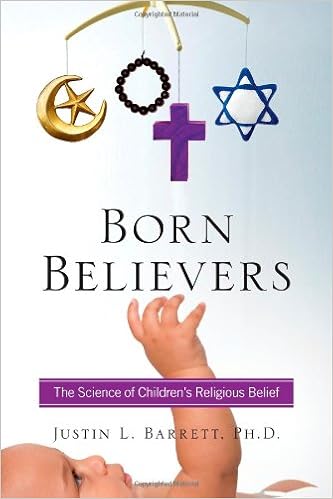
Justin L. Barret’s book Born Believers reveals some extraordinary facts about the ability and the capacity for very young children to believe and have faith. His work as a noted developmental psychologist and anthropologist at Oxford University, about the value of religious faith, has found that we are all predisposed to believe in God from birth. This is consistent with Scripture.

He has made everything beautiful in its time. Also, he has put eternity into man’s heart… “ Ecclesiastes 3:11

Belief begins in the brain. Under the sway of powerful internal and external influences, children understand their environments by imagining at least one creative and intelligent agent, a grand creator and controller that brings order and purpose to the world. Further, these beliefs in unseen super beings help organize children’s intuitions about morality and surprising life events, making life meaningful.

Summarizing scientific experiments conducted with children across the globe, Professor Barrett illustrates the ways human beings have come to develop complex belief systems about God’s omniscience, the afterlife, and the immortality of deities. He shows how the science of childhood religiosity reveals, across humanity, a “natural religion,” the organization of those beliefs that humans gravitate to organically, and how it underlies all of the world’s major religions, uniting them under one common source.

For believers and nonbelievers alike, Barrett offers a compelling argument for the human instinct for religion, as he guides all parents in how to effectively encourage children in developing a healthy constellation of beliefs about the world around them.

Surely, this is compelling evidence for creation and that evolution is a failed theory.

Then God said, “Let us make man in our image, after our likeness...” Genesis 1″26a

So God created man in his own image, in the image of God he created him; male and female he created them.” Genesis 1:27