AS THE BIBLE TELLS US WE ARE FEARFULLY AND WONDERFULLY MADE

Scientists at Harvard University, working with Google AI/machine learning experts, have published an amazing study of a one cubic millimetre piece of human brain. (The piece was excised during a medical procedure).

Sliver of brain tissue

The sliver of tissue, ~3 mm long, was sliced into over 5,000 thin sections and each one was scanned with an electron microscope. The images were then analyzed with Google’s machine learning programs (AI) to piece together a detailed 3-dimensional picture of the cells and their connections.

The tiny fragment contained 57,000 cells and 230 mm (9 in) of fine blood vessels. It had thousands of neurons and nearly 150 million synapses (the major connections between neurons).

The electron microscope images alone occupied 1,400 terabytes of computer memory. To put this in perspective, a typical large external hard drive today stores 20 terabytes. It would take 70 of these hard drives to store the data. But the whole brain is one million times this volume. Scaling up, we would need 70 million hard drives. At just $US300 each, this would cost 21 billion dollars, quite aside from the power to run them. And that’s just for one copy.

The researchers found things that have not been seen before. As one of the co-authors who helped lead the research, Jeff Lichtman, remarked to the Guardian,

We found many things in this dataset that are not in the textbooks. We don’t understand those things, but I can tell you they suggest there’s a chasm between what we already know and what we need to know.

We have a long way to go before we understand how the brain works. Indeed, we are “fearfully and wonderfully made” (Psalm 139:14).

It is getting harder and harder for biological scientists to cling to evolution and random chance and deny intelligent design for what they can now observe. Since the discovery of DNA and the electron microscope that revealed complex machinery even in the simplest cell, the demise of evolution as the cause of life on this planet was sealed.

For his invisible attributes, namely, his eternal power and divine nature, have been clearly perceived, ever since the creation of the world, in the things that have been made. So they are without excuse. For although they knew God, they did not honor him as God or give thanks to him, but they became futile in their thinking, and their foolish hearts were darkened. Claiming to be wise, they became fools, and exchanged the glory of the immortal God for images resembling mortal man and birds and animals and creeping things.” Romans 1:20-23

Sample, I., Scientists find 57,000 cells and 150m neural connections in tiny sample of human brain, theguardian.com, 10 May 2024.

Shapson-Coe, A. et al., A petavoxel fragment of human cerebral cortex reconstructed at nanoscale resolution, Science 384(6696):2024.

This article appeared in the latest issue of Creation Magazine

CAMBRIDGE PHD SCIENTIST: EVOLUTION IS A MYTH

In this video, Dr. Marco Fasoli who holds a doctorate in biochemistry from the University of Cambridge uses science to expose the many flaws in Darwin’s theory of evolution. He does it at a level that most people without a background in science will understand.

From my standpoint, I believe that evolution has been Satan’s most successful strategy. It has taken two generations away from God. At schools and universities, Gen Z and Gen Alpha, have been taught that evolution from “goo to you” not creation by an omnipotent designer is how the Cosmos came to exist.

DARWINIAN EVOLUTION FALSIFIED

Jerry Bergman is a famous creationist author who has extensively published over many decades and who has taught at several universities. He describes the research that went into this book:

“This project has been for me a lifelong study for which this book is a summary. It is the culmination of four decades of research on the issue of evolution, 41 years of teaching life science at the college level, and over 1,700 publications in 2,400 college libraries in 65 nations and 13 languages” (p. xvii).

In terms of specifics, this work focuses on taxonomy, so-called convergent evolution, irreducible complexity, pseudogenes, and antibiotic resistance. Bergman goes into considerable detail on all of these.

Bacterial resistance to antibiotics: not evolutionary novelties

Evolutionists often cite antibiotic resistance in bacteria as evidence for evolution. It is not. It is a product of the ‘tweaking’ of pre-existing features in the bacteria, which raises the question of how these features arose in the first place

Bergman has examined and deconstructed a variety of ‘pillars’ of evolution. Each one of them contains major flaws. Neither taxonomy nor genetics, for example, compel belief in evolution.

Irreducible Complexity

Evolutionists have caricatured, but not overcome, the fatal problem of irreducible complexity. The best explanation for living things, whether somebody likes it or not, remains an intelligent designer.

Evolutionists have argued that biological systems only appear to be irreducibly complex because these systems once possessed numerous redundancies that enabled the components to function independently from each other. These redundancies have since been removed by evolutionary processes, leaving the remaining components in a state of lockstep dependence upon each other—hence the apparent irreducible complexity.

To begin with, the explanation is ad hoc. There is no evidence for any such one-time grand redundancies, and, if they are going to pooh-pooh the Intelligent Design explanation, the burden of proof is on the evolutionists to show that they once existed. Note also that spot redundancies should not be confused with the hypothesized grand redundancies that presumably governed the whole. In the Krebs cycle, for example, a few of the compounds can be synthesized by alternative pathways. The fact that parts of the Krebs cycle are redundant is very different from saying that the Krebs cycle as a whole is, or once was, redundant. The fact that there are ‘shortcuts’ within the Krebs cycle is very different from suggesting that the entire Krebs cycle can be bypassed by a shortcut. Bergman quips: “Reducing the cycle by one step does not negate the fact that it still requires the remaining parts of the cycle. It would not be irreducibly complex only if a single quark were responsible for the biochemical results that the Krebs cycle achieves” (p. 123).

An analogy with the automobile may help. The car thief can do a ‘shortcut’ around the key-starting system by short-circuiting the wires that lead to the starter motor and driving away the car. This means that, from a mechanical point of view, the keystarting system is redundant. However, this individual redundancy certainly does not mean that the automobile as a whole is a redundant system, much less that the automobile could spontaneously arise, step-by-step, without intelligent design.

DRAMATIC FALL IN BIBLE-BELIEVING CHRISTIANS IN THE U.S.A

These findings come from The American Worldview Inventory 2023, conducted by the Cultural Research Centre at Arizona Christian University under the supervision of George Barna, director of research at the Cultural Research Centre. While born-again Christians make up about one-third of all U.S. adults and are considered “the backbone of local church activity because of their higher level of commitment to the Christian faith,” the study shows that between 2020 and 2023, the share of those who say they believe Jesus did not commit sins during his lifetime on Earth fell from 58% to 44%.

Jesus being sinless is central to the hope Christians have in Him as Saviour explains the apologetics website Got Questions because, “If Jesus were not sinless, there would be no sacrifice for sin.” The apostle Peter stated it clearly: ‘He committed no sin, and no deceit was found in His mouth.’ (1 Peter 2:22) Indeed, as Jesus Christ is God, He has no capacity to sin,” the Christian website explains.

This shift in belief among born-again Christians was among six that showed a significant decline in the past three years that Barna characterized as “indefensible.”

Fewer than half of born-again Christians also now believe they have a unique, God-given calling or purpose. The share of those who held that belief fell from 88% to a staggering 46% during the pandemic.

A downward trend was also observed among those who say the Bible is unambiguous in its teaching about abortion. That belief fell from 58% to 44%. Those who say human life is sacred fell from 60% to 48%.

The number of born-again Christians who say God is the basis of all truth fell from 69% to 63% over the period. The share of born-again believers who say they are deeply committed to practicing their religious faith fell from 85% to 50%, while the share of those who say they read or study the Bible at least once a week fell from 60% to 55%. When it comes to the general population of U.S. adults, Barna said the share of the population that claims to hold a biblical worldview fell from 6% to 4% in the last three years, while less than half now claim to be “deeply committed to practicing” their religious faith. That measure fell from 60% to 48%. Barna also found that only 33% of adults now say they attend church service during a typical week which shows “a decline representing the loss of about 15 million churchgoing adults each week.”

The veteran researcher said the findings on the drastic shift in Christian belief over such a short period of time are “highly unusual” because “religious beliefs and behaviors have typically been a hallmark of consistency.” “Most religious beliefs change over the course of generations, not a few years,” Barna said.

Barna noted that a significant driver behind the decline in Christians holding on to a biblical worldview is syncretism, an ideology described as “the worldview that merges otherwise incompatible philosophies of life, particularly evolution and a Cosmos that has existed for billions of years, into a made-to-order worldview that incorporates enough biblical elements to be minimally Christian in nature.”

These statistics highlight how successful Satan’s strategy to undermine the foundations of God’s Word has been. Thankfully God has raised up ministries such as Creation Ministries International (CMI) and Answers in Genesis to show that evolution and its history of billions of years for this Cosmos is not defensible. In fact, the audacious claim by secular scientists in the New Scientist book How Evolution Explains Everything About Life (2017) cannot be substantiated. On page 69 they claim ” The only thing we know for certain is that life must have popped into existence sometime between Earth’s formation 4.5 billion years ago and the appearance of the first undisputed fossils about 3.4 million years ago.” Living cells require information (DNA) and decoding machinery. Even the simplest living cell has an enormous quantity of information on its DNA (about 600,000 letters) and it has the decoding machinery to read these letters. Also, the instructions to build this decoding machinery are encoded on its DNA. DNA can’t be decoded without the machines, but the machines can’t be built without the DNA coding for them. An impossible vicious circle for chemical evolution. There is simply no way “life must have popped into existence“.

THESE GALAXIES HAD NO TIME TO FORM

University of Colorado at Boulder: James Webb telescope spots super old, massive galaxies that shouldn’t exist, sciencedaily.com, 22 Feb 2023.

Spiral galaxy. Somewhere in deep space.

An international research team examining images from the James Webb telescope reported finding six galaxies as big as our Milky Way Galaxy. This was thought impossible because they are said to be ‘only’ 500 to 700 million years after the alleged Big Bang, which is ‘too early’ for the theory. Yet they appear remarkably ‘modern’.

It’s no surprise that as technology enables us to ‘see’ more from the universe’s past, attempts to explain how everything made itself by natural processes face more, not less, difficulties. The alternative still stands:

In the beginning, God created the heavens and the earth.” (Genesis 1:1).

Erica Nelson, co-author of the Nature paper and assistant professor of astrophysics at the University of Colorado Boulder, said, “It’s bananas. You just don’t expect the early universe to be able to organize itself that quickly. These galaxies should not have had time to form.”

For His (God’s) invisible attributes, namely, his eternal power and divine nature, have been clearly perceived, ever since the creation of the world, in the things that have been made. So they are without excuse. For although they knew God, they did not honor him as God or give thanks to him, but they became futile in their thinking, and their foolish hearts were darkened.Romans 1:20-21

And God said, “Let there be lights in the expanse of the heavens to separate the day from the night. And let them be for signs and for seasons, and for days and years, and let them be lights in the expanse of the heavens to give light upon the earth.” And it was so. And God made the two great lights—the greater light to rule the day and the lesser light to rule the night—and the stars. And God set them in the expanse of the heavens to give light on the earth, to rule over the day and over the night, and to separate the light from the darkness. And God saw that it was good. And there was evening and there was morning, the fourth day.Genesis 1:14-19

MORE AND MORE EMINENT SCIENTISTS ABANDONING EVOLUTION IN SUPPORT OF INTELLIGENT DESIGN

Foresight, by Dr. Marcos Eberlin, is about the design of life, the fine-tuning of the universe, and the inadequacy of naturalistic storytelling. It discusses the origin of life, the limits of natural selection, and the naturalistic bias that permeates the scientific community. It includes many examples of fascinating designs in living things and explanations for why evolution cannot reasonably be invoked to explain these features.

Marcos Eberlin has a Ph.D. in chemistry from the University of Campinas. He boasts an impressive career with many accomplishments. He founded the Thomson Mass Spectrometry Lab, was the president of the International Mass Spectrometry Foundation, and won the Thomson medal in 2016. Eberlin stands as a great example of a highly qualified scientist who does not believe in evolution and believes that the universe was created by a supernatural designer. This allows the book to stand out among Intelligent Design (ID) books, as it argues for the existence of a supernatural creator, and against the General Theory of Evolution.

The book is rather short but packed full of information. It contains nine chapters with roughly half the book focusing on the intricacies of life at the cellular and molecular level. These chapters focus on biochemistry, organelles, proteins, and DNA. The second half of the book focuses on multicellular organisms such as insects, carnivorous plants, birds, humans, and special features found in specific multicellular organisms and features shared among many multicellular organisms. The first half of the book is fairly technical. Unless you are already familiar with organic chemistry and cell biology, there is a good chance that you will need to consult a textbook or utilize an internet search engine.

Evolution has no foresight

This communicates the core argument of the book. Foresight is something not present in differential reproduction. The only things selected are physiological changes that provide an immediate and substantial increase in reproductive success. A mutation that notably increases root length could help with gathering essential nutrients from poor soil; a mutation that causes defective leaf development can produce thorns.Display footnote number:3 Both relatively simple changes provide clear costs and benefits without the need for a developing structure to be almost useless over millions of years.

This shows an issue with the ‘why’ in evolutionary storytelling. It is often easy to see how a certain feature is advantageous, and thus why it would evolve. However, this exercise in imaginative storytelling breaks down when you ask, “why would natural selection favour defective structures that would be a detriment to the species for generations?”

A good ID book, but still an ID book

The book contains many solid arguments in favour of intelligent design and does a great job of exposing the unscientific nature of evolutionary biology. While it does rise above the standard ID offering by identifying the designer as a supernatural, transcendent creator, he provides a flawed distinction between historical and operational science. The book still contains the typical shortcoming of books on ID. By ignoring the identity of the Creator, this book will have a limited impact in spreading the Gospel.

DARWINIAN EVOLUTION FALSIFIED

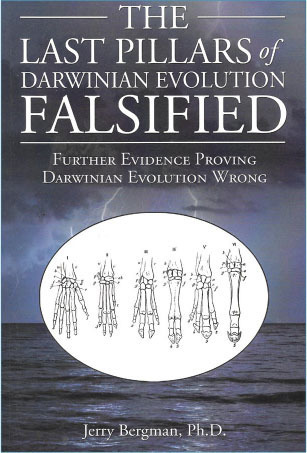
The Last Pillars of Darwinian Evolution Falsified: Further evidence proving Darwinian evolution wrong
by Jerry Bergman

Dr. Jerry Bergman is a famous creationist author who has extensively published over many decades and who has taught at several universities. He describes the research that went into this book:

“This project has been for me a lifelong study for which this book is a summary. It is the culmination of four decades of research on the issue of evolution, 41 years of teaching life science at the college level, and over 1,700 publications in 2,400 college libraries in 65 nations and 13 languages” (p. xvii).

In terms of specifics, this work focuses on taxonomy, so-called convergent evolution, irreducible complexity, pseudogenes, and antibiotic resistance. Bergman goes into considerable detail on all of these.

Irreducible complexity is the fatal problem for evolution

Bergman touches on some of the challenges facing commonly believed evolutionary explanations for the origins of complex structures, resulting from the co-option of components originally having different functions. He comments:

“… the availability of these parts would have to be synchronized … the parts must be correctly and properly positioned in 3-D space so they can be properly assembled … . Even if all of the parts are available at the proper time, the vast majority of assembly variations will be nonfunctional or dysfunctional” (pp. 145–146).

Some evolutionists have vulgarized the Intelligent Design explanation as a ‘jackpot or nothing’ one. But that is exactly what it is, and evolutionists have failed to show how the emergence of a complex biological structure can be anything other than ‘jackpot or nothing’.

Bergman has examined and deconstructed a variety of ‘pillars’ of evolution. Each one of them contains major flaws. Neither taxonomy nor genetics, for example, compel belief in evolution. Evolutionists have caricatured, but not overcome, the fatal problem of irreducible complexity. The best explanation for living things, whether somebody likes it or not, remains an intelligent designer.

A condensed version of a review of Dr. Bergmans book in the latest edition of The Creation Journal Volume 37, Issue 1, 2023