DNA DEBUNKS EVOLUTION

In this video, Dr Robert Carter explores how genetics supports a biblical timeline. The evidence is irrefutable and deserves to get wide distribution. Make sure you send it to family and friends.

DNA is supposedly millions of years old, but can it really survive that long? The evidence suggests otherwise. From genetic entropy showing species can’t survive endless mutations, to ancient DNA breaking down too quickly in the ground, to mitochondrial Eve and Y-chromosome Adam pointing to recent common ancestors — multiple lines of evidence challenge evolutionary timescales. DNA barcoding reveals another puzzle: species across the animal kingdom appear to be roughly the same age, as if some major event reset life on Earth.

ADAM, EVE AND NOAH VS MODERN GENETICS

This is an important, in fact, critical topic for the creation model. The world does not look at the Bible in a favorable light. In fact, it disparages it, sometimes with open hostility. Attacks are often centered on the claim that the Bible is not reliable on historical grounds, and if the history of the Bible is inaccurate, what about the theology? Think about what Jesus told Nicodemus in John 3:12, “If I have told you earthly things and you do not believe, how will you believe if I tell you heavenly things?” Many people today see no history in the Bible; therefore, the spiritual implications are meaningless to them. What would happen to evangelism if the history of the Bible turns out to be true after all?

It comes as a surprise to most people to hear that there is abundant evidence that the entire human race came from two people just a few thousand years ago (Adam and Eve), that there was a serious population crash (bottleneck) in the recent past (at the time of Noah’s Flood), and that there was a single dispersal of people across the world after that (the Tower of Babel). It surprises them, even more, to learn that much of this evidence comes from evolutionary scientists. In fact, an abundant testimony to biblical history has been uncovered by modern geneticists. It is there for anyone to see if they know where to look!

For our purposes, the most important places to look are in the Y chromosome (which is only found in males and which is passed on directly from father to son) and in the mitochondrial DNA (a small loop of DNA that we nearly always inherit from our mothers only; males do not pass it on to their children). These two pieces of DNA record some startling facts about our past.

The evolutionary map of world migrations is startlingly close to the biblical account of a single dispersal of people from Babel. The evolutionary “Out of Africa” theory tells us there was a single dispersal of people, centered near and travelling through the Middle East, with three main mitochondrial lineages, with people traveling in small groups into previously uninhabited territory, and that all of this occurred in the recent past. Every item in that list is something directly predicted by the Tower of Babel account in the Bible. (Image http://www.mitomap.org).

Over the last decade, a vast amount of information has been collected that allows us to answer questions that we could not even consider earlier. The tools of modern genetics allow us to specifically ask questions about history, for our genes carry a record that reflects where we came from and how we got to where we are. The tools at our disposal are powerful.

Creation and genetics

There are two brief passages in the Creation account we can use to draw some conclusions about human genetic history. Please note that we cannot use these verses for land animals (because we do not know how many of each kind were initially created) or any of the swimming critters (“with which the waters abounded”—Genesis 1:21). These statements apply to people only:

And the Lord God formed man out of the dust of the ground, and breathed into his nostrils the breath of life; and the man became a living being.” Genesis 2:7

And the Lord God caused a deep sleep to fall on Adam, and he slept; and he took one of his ribs, and closed up the flesh in its place. Then the rib which the Lord God had taken from the man he made into a woman, and He brought her to the man.” Genesis 2:21–22

These simple statements have profound implications. They put a limit on the amount of diversity we should find in people living today. The Bible clearly says the human race started out with two people only. But how different were these two people? There is an intriguing possibility that Eve was a clone of Adam. The science of cloning involves taking DNA from an organism and using it to manufacture an almost perfect copy of the original. Here, God is taking a piece of flesh, with cells, organelles, and, importantly, Adam’s DNA, and using it to manufacture a woman. Of course, she could not be a perfect clone, because she was a girl! But what if God had taken Adam’s genome and used it to manufacture Eve? All he would have had to do was to leave out Adam’s Y chromosome and double his X chromosome and, voilá, instant woman!

I do not know if Eve was genetically identical to Adam. The only reason I bring this up is because we have two possibilities in our biblical model of human genetic history: one original genome or two. Either result is still vastly different from the most popular evolutionary models,2 but we need to discuss the range of possibilities that the Bible allows.

Your genome is like an encyclopedia (almost literally). And, like an encyclopedia, the genome is broken down into volumes, called chromosomes, but you have two copies of each volume (with the exception of the X and Y chromosomes; women have two Xs but men have one X and one Y). Imagine comparing two duplicate volumes side by side and finding that one word in a particular sentence is spelled differently in each volume (perhaps “color” vs “colour”). Can you see that if Eve was a clone of Adam, there would have been, at most, two possible variants at any point in the genome? If Eve was not a clone, however, there would have been, at most, four possible variants at any point in the genome (because each of the original chromosomes came in four copies). This still allows for a lot of diversity overall, but it restricts the variation at any one spot to 2, 3, or 4 original readings.

Does this fit the evidence? Absolutely! Most variable places in the genome come in two versions and these versions are spread out across the world. There are some highly variable places that seem to contradict this, but most of these are due to mutations that occurred in the different subpopulations after Babel.

There are indications, however, that Eve may not have been a clone. The ABO blood group is a textbook example of a gene with more than two versions.3 There are three main versions of the blood type gene (A, B, and O). However, many, but not all, people with type O blood carry something that looks very much like a mutant A (the mutation prevents the manufacturing of the type A trait on the outside of cells). So here is a gene with more than two versions, but one of the main versions is clearly a mutation. This is true for many other genes, although, as usual, there are exceptions. The important take home point is that essentially all of the genetic variation among people today could have been carried within two people, if you discount mutations that occurred after our dispersion across the globe. This is a surprise to many.

The Flood and genetics

Like in the Creation story, there are only a few verses in the Flood account that help us with our model. But as seen before, these verses are profound. About 10 generations after Creation, a severe, short bottleneck occurred in the human population. From untold numbers of people, the entire world population was reduced to eight souls with only three reproducing couples.

So Noah, with his sons, his wife, and his sons’ wives, went into the ark because of the waters of the flood.” Genesis 7:7

Now the sons of Noah who went out of the ark were Shem, Ham, and Japheth… These three were the sons of Noah, and from these the whole earth was populated.” Genesis 9:18–19

We can draw many important deductions from these statements. For instance, based on Genesis 7 and 9, how many Y chromosomes were on the Ark? The answer: one. Yes, there were four men, but Noah gave his Y chromosome to each of his sons. Unless there was a mutation (entirely possible), each of the sons carried the exact same Y chromosome. We do not know how much mutation occurred prior to the flood. With the long life spans of the antediluvian patriarchs, it may be reasonable to assume little mutation had taken place, but all of Creation, including the human genome, had been cursed, so it may not be wise to conclude that there was no mutation prior to the Flood. The amount of mutation may be a moot point, however, for, if it occurred, the Flood should have wiped out most traces of it (all of it in the case of the Y chromosome).

How many mitochondrial DNA lineages were on the Ark? The answer: three. Yes, there were four women, but the Bible does not record Noah’s wife as having any children after the Flood (in this case, girl children). And notice the claim in Gen 9:19, “These three were the sons of Noah, and from these the whole earth was populated.” This is a strong indication that Noah’s wife did not contribute anything else to the world’s population. With no prohibition against sibling marriage, yet,4 one or more of the daughters-in-law may have been her daughter, but this does not change the fact that, at first glance, we expect a maximum of three mitochondrial lineages in the current world population. There is a chance that there will be less, if there was very little mutation before the Flood or if several of the daughters-in-law were closely related. At most, we do not expect more than four.

How many X chromosome lineages were on the Ark? That depends. If you count it all up, you get eight. If, by chance, Noah’s wife passed on the same X chromosome to each of her three sons (25% probability), then there were seven. If Noah had a daughter after the Flood (not expected, but possible), there could be as many as nine X chromosome lineages. Either way, this is a considerable amount of genetic material. And since X chromosomes recombine (in females), we are potentially looking at a huge amount of genetic diversity within the X chromosomes of the world.

Does this fit the evidence? Absolutely! It turns out that Y chromosomes are similar worldwide. According to the evolutionists, no “ancient” (i.e., highly mutated or highly divergent) Y chromosomes have been found.5 This serves as a bit of a puzzle to the evolutionist, and they have had to resort to calling for a higher “reproductive variance” among men than women, high rates of “gene conversion” in the Y chromosome, or perhaps a “selective sweep” that wiped out the other male lines.6 For the biblical model, it is a beautiful correlation and we can take it as is.

The evidence from mitochondrial DNA fits our model just as neatly as the Y chromosome data. As it turns out, there are three main mitochondrial DNA lineages found across the world. The evolutionists have labeled these lines “M”, “N”, and “R”, so we’ll refer to them by the same names. They would not say these came off the Ark. They claim they were derived from older lines found in Africa, but this is based on a suite of assumptions (I discussed these in detail in a recent article in the Journal of Creation7). It also turns out that M, N, and R differ by only a few mutations. This gives us some indication of the amount of mutation that occurred in the generations prior to the Flood.

Let’s assume ten female generations from Eve to the ladies on the Ark. M and N are separated by about 8 mutations (a small fraction of the 16,500 letters in the mitochondrial genome). R is only 1 mutation away from N. This is an indication of the mutational load that occurred before the Flood. Given the assumption that mutations occur at equal rates in all lines, about four mutations separate M and N each from Eve (maybe four mutations in each line in ten generations). But what about R? It is very similar to N. Were N and R sisters, or perhaps more closely related to each other than they were to M? We’ll never know, but it sure is fascinating to think about.

One more line of evidence crops up in the amount of genetic diversity that has been found within people worldwide. Essentially, much less has been found than most (i.e., evolutionists!) predicted. The general lack of diversity among people is the reason the Out of Africa model has humanity going through a disastrous, near-extinction bottleneck with only about 10,000 (and perhaps as few as 1,000)8 people surviving. However, the reason for this lack of diversity is twofold. First, the human race started out with only two people. Second, the human race is not that old and has not accumulated a lot of mutations, despite the high mutation rate. Third, there actually was a bottleneck event, Noah’s Flood!

The Tower of Babel and genetics

Could it be possible that there is evidence to back up this tale of rebellion and judgment? Like the Creation and Flood accounts, there are only a couple of verses that apply to our model of genetics. But, like the others, these verses are as profound as they are simple.

“Now the whole earth had one language and one speech.” Genesis 11:1

And they said, ‘Come, let us build ourselves a city, and a tower whose top is in the heavens; let us make a name for ourselves, lest we be scattered abroad over the face of the whole earth.’” Genesis 11:4

It sounds like they were in a homogenous culture, but what do people in that situation do? Would you expect them to mix freely? Were language or cultural barriers present that would have prevented the sons of Shem from marrying the daughters of Japheth? Would the daughters of Ham be expected to marry freely with the sons of any of the three men? Note in Gen 11:4 that they knew about the potential for spreading out and getting separated from one another and intentionally did the opposite! However, this was against the express command of God, who had ordered them to spread out (to populate the earth). So, He took matters into His own hands.

“’Come, let Us go down and confuse their language, that they may not understand one another’s speech.’ So the Lord scattered them abroad from there over the face of all the earth, and they ceased building the city.” Genesis 11:7–8

There are tremendous implications that come from the Babel account. First it explains the amazing cultural connectivity of ancient peoples—like pyramid building, common flood legends, and ancient, non-Christian genealogies that link people back to biblical figures (e.g., many of the royal houses of pagan northern Europe go back to Japheth, the son of Noah).

The dramatic rise in world population over the past several decades is a well known fact. From a biblical perspective, the current human population easily fits into the standard model of population growth using very conservative parameters.10 In fact, starting with 6 people and doubling the population every 150 years more than accounts for the current human population (a growth rate of less than 0.5% per year!). Population size would have increased quickly given the rate at which the post-Flood population reestablished agriculture, animal husbandry, industry and civilization. So we must ask the question, “Why are there so few people in the world today?” The answer is that the world is young and we have not been here many thousands of years.

When did the dispersion occur? Our best clue about the timing of the event comes from Genesis 10:25. In referencing the 5th generation descendent of Shem, a man named Peleg, it says, “in his days the earth was divided.” To what is this referring? Many people believe this is referring to a division of the landmasses (plate tectonics). This may be true, but it would require a huge amount of geologic activity after the Flood, and this would have occurred in historical times with no record of the events. The interpretation I favor is that this passage is referring to the division of people at Babel. Just a few verses after the Peleg reference, the section is summed up with another reference to the division at Babel. This fits both the context and the science. In context, Peleg was closely associated with Babel.

How large was the population at the time? We would expect rapid population growth, but we cannot know exactly. There are 16 named sons born to the three brothers, Shem, Ham and Japheth. If we assume about the same number of daughters, Noah had on the order of 30 grandchildren. At that rate of growth, there would have been about 150 children in Salah’s generation, about 750 in Eber’s generation, and about 3,750 in Peleg’s generation. Of course, these generations overlap, etc., so let’s say there were between 1,000 and 10,000 people alive at the time of Babel. This fits nicely with the available data. It is a high rate of growth, but wars and disease had yet to start taking their toll.

There is one more verse in this section that we need to discuss:

These were the families of the sons of Noah, according to their generations, in their nations; and from these the nations were divided on the earth after the flood.” Genesis 10:32

At Babel, God did not separate the nations according to language. He used language to separate them according to paternal (male) ancestry! This has monumental significance and is the key to understanding human genetic history.

Do you see the implication in this simple verse? At Babel, God did not separate the nations according to language. He used language to separate them according to paternal (male) ancestry! This has monumental significance and is the key to understanding human genetic history. Paternal sorting would lead to specific Y chromosome lineages in different geographical locations. Since males and females from the three main families should have been freely intermixing prior to this, it also leads to a mixing of the mitochondrial lines. It is as if God put all the people into a giant spreadsheet and hit a button called “Sort According to Father.” He then took that list and used it to divide up and separate the nations.

We already saw that Y chromosomes have little variation among them. We now add the fact that this little bit of variation is almost always geographically specific. That is, after the nations were separated according to Y chromosome, mutations occurred in the various lines. Since the lines were sent to specific geographical areas, the mutations are geographically specific. The current distribution of Y chromosome lines is a tremendous confirmation of the biblical model.

Mitochondrial DNA (mtDNA) adds another confirmation. We have already learned that there are three main lineages of mtDNA. We now add the fact that these three lineages are more or less randomly distributed across the world. Also, the various mutations within each of the three main families of mtDNA are geographically specific as well.11 In other words, as the three mixed mitochondrial lines were carried along with the Y chromosome dispersal, each line in each area began to pick up new mutations, just like we would predict.

After the Flood

The last remaining significant reference in the Bible that will help us build our model of human genetic history is called The Table of Nations. It is found in Genesis chapters 9 and 10. The Table of Nations is a record of the post-Babel tribes, who they descended from, and where they went. If the Bible is an accurate source of history, one might expect to be able to find a significant amount of evidence for the Table of Nations in genetic data. The truth is not that simple, however, and it is important to keep several things in mind. First, the account was written by a person in the Middle East and from a Middle Eastern perspective. It is incomplete in that there are huge sections of the world that are not discussed (sub-Saharan Africa, Northern Europe, Most of Asia, Australia, the Americas, and Oceania). It also reflects a snapshot in time. It was written after the dispersion began, but not necessarily before the dispersion was complete. Indeed, much has changed in the intervening years. People groups have migrated, cultures have gone extinct, languages have changed, separate cultures have merged, etc. The history of man has been full of ebb and flow as people mixed or fought, resisted invasion or were conquered. The history of man since Babel is very complicated. Modern genetics can answer some of the big questions, but answers to many of the smaller details may elude us forever.

From an article Adam, Eve and Noah vs Modern Genetics by Dr Robert W. Carter http://www.creation.com/noah-and-genetics

GENETIC ENTROPY LEADING TO EXTINCTION

A devastatingly powerful argument against evolution

Entropy is the universal tendency for things to run down and fall apart. Thanks, largely to the work of Dr John Sanford (renowned plant geneticist and genetic engineering pioneer from Cornell University), the same gradual process of ‘running down’ is also operating in the human gene pool.

Called genetic entropy, it is driving humanity—and all higher organisms—to the point of extinction.

The most definitive findings were published in 2010 in the Proceedings of the National Academy of Science by Lynch.4 That paper indicates human fitness is declining at 3–5% per generation

In fact, this process, which operates more rapidly in ‘higher’ organisms,3 means that the human species could only be several thousand years old; certainly not hundreds of thousands of years, or we would have already become extinct.

This topic is not widely known, but it’s very powerful support for biblical creation. Simply put, genetic entropy means that the information content in the genome (all of our genes) is progressively declining, due to the accumulation of mutations, generation after generation.

Mutations happen in all life forms (and in viruses). In our corrupted, fallen world, the mechanisms that replicate the genetic material from one generation (or one cell division) to the next now are imperfect. Each time we have children, we inevitably pass along some mistakes that were not there before. Another source of mutation is environmental radiation

Estimates vary, but a common figure is that each child is born with around 100 new mutations. These are added to the ones already accumulated in previous generations.

These mistakes are almost never helpful. Could you ever expect to improve an encyclopedia by adding more and more spelling mistakes every time one is printed? The evolutionary literature acknowledges this very clearly. Even the simplest of living organisms are highly complex. Mutations—indiscriminate alterations of such complexity—are much more likely to be harmful than beneficial.5 It seems unlikely that any mutation is truly neutral in the sense that it has no effect on fitness. All mutations must have some effect, even if that effect is vanishingly small.9

In summary, the vast majority of mutations are deleterious. This is one of the most well-established principles of evolutionary genetics, supported by both molecular and quantitative-genetic data. One estimate is that damaging mutations outnumber helpful ones by a million to one.7 Even most of the ‘beneficial’ mutations turn out to break things rather than make things, e.g. wingless beetles on windswept islands

Evolutionists will sometimes try to rebut these ideas by saying things like, “If a mutation is damaging, it will be weeded out by natural selection.’ This oversimplified view of selection is drilled into biology students relentlessly in classrooms all over the world—and it is greatly misleading, because for most mutations, it is totally wrong!

Natural selection (NS)—a straightforward, real process—essentially just means ‘differential reproduction’; some members of a population will reproduce more than others. Therefore, the traits that are possessed by the ones reproducing the most are going to become the most common in the population over time.

The power of NS has been carefully measured.14 For selection to be able to ‘see’ the mutation, it must be strong enough to affect reproduction (e.g. by killing the individual before it can reproduce, or by causing sterility or a significant decline in fertility). Thus, NS cannot ‘see’ a nearly-neutral mutation because, on its own, the negative effect of the individual mutation is very tiny—far too small to cause any appreciable difference in reproduction. As errors accumulate with each generation, eventually their collective effect is very damaging. Natural selection can only weed out individual mutations as they happen. Once mutations have accumulated enough to be a real, noticeable problem, they are then a problem in the entire population, not just in an individual here or there. The whole population cannot be ‘selected away’—except by going extinct!

It is easy to see that selection does not weed out most mutations. We all have hundreds of mutations our ancestors did not have—yet most people have no trouble becoming parents and passing on their genes (along with many mistakes, both old and new). In short, if the world were even several hundred thousand years old, genetic entropy means that we would have long since become extinct.15 This demonstrates that it is biblical creation, not evolutionary theory, that matches up to genetic reality—and it highlights the dismal future that awaits humanity apart from the intervening work of our Creator God.

For references and Notes go to CMI (www.creation.com) and the article “Genetic entropy: The silent killer A devastatingly powerful argument against evolution” by Paul Price

GENETICS AND SEXUAL ORIENTATION

An important video from Dr Christopher Yuan on sexual orientation.

You’re in a conversation and someone says, “People can’t help being gay. It’s part of their genetic makeup.” What would you say?

Today, the search has shifted to whether or not there is any genetic component to one’s sexual orientation, and if there is, what kind of role does it play in determining who we are sexually attracted to? Still, people will often assume that there must be a genetic source for sexual orientation and will talk about it as if it is settled science. But it’s not. So, the next time you’re in a conversation and someone says being gay is genetic, here are three things to remember:

First, genetics only play a small role in determining sexual orientation.

Second, genetics cannot predict whether a person is gay or straight.

Third, sexuality is not WHO you are, it’s HOW you are.

WHAT IS THE MOST COMPLEX COMPUTER OPERATING SYSTEM IN THE KNOWN UNIVERSE?

The human genome is the most complex computer operating system anywhere in the known universe.

It controls a super-complex biochemistry that acts with single-molecule precision. It controls the interaction network of hundreds of thousands of proteins. It is a wonderful testament to the creative brilliance of God and an excellent example of the scientific bankruptcy of neo-Darwinian theory. Why? Because the more complex life is, the less tenable evolutionary theory becomes. Super-complex machines cannot be tinkered with haphazardly or they will break. And super-complex machines do not arise from random changes.

The four dimensional human genome defies naturalistic explanations.

Our computer programs are essentially one-dimensional. The human genome operates in four dimensions. This is one of the greatest testimonies to the creative brilliance of God available.

ecoli-bacterium-lge

Figure 1: A comparison of the control of transcription in E. Coli (left) with the Linux call graph (right). The bacterial cell is able to control many protein-coding genes (green lines at bottom) with relatively few controls (yellow and purple lines). Linux, while obviously a result of intelligent design, falls far short in that it requires many more high-level instructions to control relatively few outputs. From Yan et al. 2010.1

I am serious when I compare the genome to a computer operating system. The only problem with this analogy is that we have no computers that can compare to the genome in terms of complexity or efficiency. It is only on the most base level that the analogy works, but that is what makes the comparison so powerful. After millions of hours of writing and debugging we have only managed to create operating systems that can run a laptop or a server, and they crash, a lot. The genome, though, runs a hyper-complex machine called the human body. The organisation of the two are radically different as well. A team made up of computer scientists, biophysicists, and experts in bioinformatics (in other words, really smart people) compared the genome of the lowly E. coli bacterium to the Linux operating system (figure 1) and have discovered that our man-made operating systems are much less efficient because they are much more “top heavy”.1 It turns out that the bacterial genome has a few high-level instructions that control a few middle-level processes, that in turn control a massive number of protein-coding genes. Linux is the opposite. It is much more top heavy and thus much less efficient at getting things done. The bacterium can do a lot more with fewer controls. I predict that the study of genomics will influence the future development of computers.

This is very brief summary of the information contained in the DVD by Dr Robert Carter  The High Tech Cell. You need to get this valuable resource and I suggest you purchase a copy from the Creation Ministries webstore.

DEFEND THE BIBLE – GO ON THE OFFENSIVE

Looking for Answers pic

There is now so much evidence which proves the Bible is trustworthy that Christians properly equipped can go on the offensive rather than go on the defensive as so many do when challenged as to the veracity of Scripture’s claims.

The many fulfilled Bible prophesies, such as Isaiah’s prophesy that a Persian king would arise with the name Cyrus – around 150 years before the event occurred. Three hundred prophesies in the Old Testament (OT) of the birth, life, death and resurrection of Jesus that all occurred exactly as prophesied.

In the field of archaeology, the Bible has been confirmed accurate by numerous archaeological discoveries. The Hittites were presumed to be a mythical tribe because no physical evidence had been found. That was until a huge ‘City of the Hittites was uncovered.  The discovery of the Dead Sea Scrolls as late as 1947 with an almost complete copy of Isaiah in which there are so many of the prophesies of Jesus life, death by crucifixion and resurrection. As a result, the Bible is regarded as “the most accurate history book in the world”(The Archaeology of the New Testament by E.M.Blaiklock). Considering this fact alone, one can logically assume that its other historical claims in Genesis such as a real Adam and Eve and a global Flood are also true.

In the New Testament (NT), scholars used to be skeptical about John’s description of the Pool of Siloam in Jerusalem, but archaeology showed that John’s description was accurate (which also proved that the gospel of John was authored by someone who had been in Jerusalem before the AD 70 destruction, which fits very well with the Apostle John being the author). John and all the NT authors – and even Jesus himself – believed and quoted from Genesis more than any other book in the Bible.

It is in the area of Genesis Creation where the rubber really hits the road, and where Creation Ministries has truly shone with evidence that recent discoveries particularly on DNA (Information Theory) and the function of cells have demonstrated the futility of evolution with its proposed mechanisms of natural selection and mutation. On their website http://www.creation.com there are almost 8,500 fully searchable articles you can access to equip you with answers to provide real seekers of the truth about God and Creation.

The Bible is trustworthy, including its claims about sin and salvation. Jesus is who he said He is. He is the way, the truth and the life. Jesus believed Genesis was true history then I suggest so should we.

A GOOD GOD & A WORLD OF DEATH & SUFFERING?

lambs

One of the most common questions asked of Christians is some version of: “If God is so loving, why are there bad things in the world?” The implication being that if God created this world in the state it is in, He can’t be ‘very good’ Himself. This is sometimes used as a reason to reject belief in God.

If God created everything in 6 days when exactly were ‘bad things’ created?

The first thing we need to understand is that God wasn’t surprised by the Fall of Adam. God is all knowing and so knew that a punishment would have to be meted out following Adam’s (and his offspring’s) rebellion.

According to Scripture, at the time of the Fall the environment changed and there were changes in the physical construction of some things as well. For example thorns appeared where there were none before. Some might ask ‘Doesn’t that mean God must have created new genetic information for these things at that time where there was none before?’ Not necessarily, because ‘hidden’ genetic information can lie dormant within living things and be activated under certain environmental conditions.

For example up to the 1920’s, scientists used to classify grasshoppers as a separate species to locusts. However, researchers have since determined that they are actually the same creature. Under certain (laboratory reproducible) circumstances they exhibit a sort of Jekyll/Hyde transformation that is truly startling!

Behavioural differences happen immediately at the transformation, with physical changes appearing in subsequent generations. The difference in behaviour (grasshoppers are solitary, locusts swarm), and morphology (locusts have smaller legs, wings and bodies but have a 30% larger brain than grasshoppers) is significant and changes neural, muscular and exo-skeletal expression. And the transformation from grasshopper to locust can also be reversed back again. Yet the DNA of the two creatures is identical.7

This ability for DNA to express different programming from the same source code under different environmental conditions is actually fairly common. The epigenetic code, a set of switches that turn genes on and off (e.g. in response to environmental stimuli) is a main contributor to this ability of the ‘finished product’ to vary despite the same DNA ‘instructions. This is known as ‘phenotypic plasticity’.

Not only is the discovery of latent genetic information an incredible challenge for evolution to account for, and a tremendous evidence of design (because it exhibits all of the characteristics of foresight and pre-planning in the genomes of creatures around the world), but it also helps answer the supposedly unanswerable question of how ‘bad things’ appeared after the Fall if God’s creation was completely finished by the end of the sixth day of creation.

God’s word is true

Foreknowing the Fall of man,9 God created the features of a post-Fall world in latent form within His very good world. They only became activated when God cursed the creation as punishment for Adam’s transgression. And the entire creation groans because of that Curse and is evidence that something is desperately wrong with this world. If God had not caused our physical environment to change at the time of the Fall, we would be lost without Him, bound for Hell but still in a virtual paradise. How would we know there was anything wrong and that we were in need of our Saviour

extract from article “The good, the bad and the ugly ….” by Calvin Smith on http://www.creation.com


Awesome Creator says Dr Yusdi Santoso

10396472-computer-artwork-showing-a-hand-and-double-stranded-dna-deoxyribonucleic-acid-molecules-dna-is-compo[1]

Dr Yusdi Santoso an Oxford PhD scientist whose research on DNA polymerase led to the discovery that, prior to proof reading, there is an additional process that screens the DNA letters before they are incorporated into the copy. Since defective screening leads to copying errors Dr Yusdi’s work may contribute to curing genetic diseases arising from inefficiencies in this process.

Only those people who have already decided to reject God, reject it is a miracle of design by an awesome designer outside the Matter/Space/Time Universe He created says, Dr Yusdi Santoso.

It is interesting that Francis Crick evolutionist, one of the discoverers of the structure of DNA and author of Life Itself: Its Origin & Nature admitted, “an honest man, armed with all the knowledge available to us now, could only state in some sense, the origin of life appears at the moment to be almost a miracle, so many conditions which would have to be satisfied to get it going”.

Can I recommend you take a look at the complete article “Oxford trained scientist acknowledges the Creator” in Creation magazine Vol. 36, No. 3 2014. Dominic Statham interviews biophysicist Dr Yusdi Santoso. It concludes with – Dr Santoso is adamant that the reality of God can be seen in creation: “The Bible tells us we are fearfully and wonderfully made (Psalm 134:19) and I saw this clearly in much of my scientific work. My research into DNA polymerase, particularly, showed me just how complex life is. All this speaks of an awesome Creator.

THE BIBLE PROVIDES THE TRUE HISTORY OF THIS WORLD

Biblical timelinesJesus_genealogies_newer_small


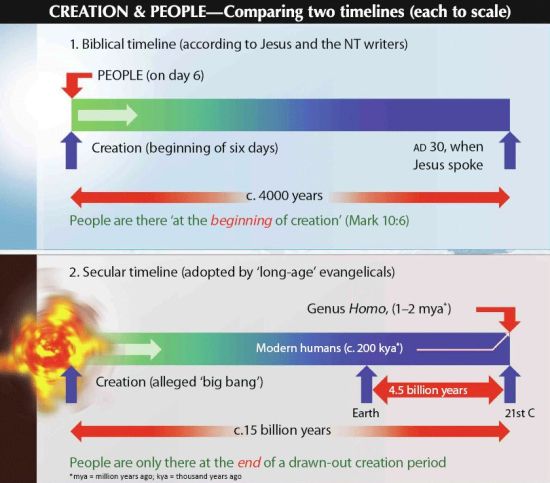
The Bible is God’s WORD and  it clearly reveals the correct Timeline for this universe which differs so radically from the Secular Timeline of billions of years.

We know Jesus implicitly believed the Old Testament as true history as revealed in the chronogenealogies and He specifically says in Mark 10:6 that Adam and Eve were there at the beginning of Creation (Day 6). “But from the beginning of creation, God made them male and female”.

Recent reports on the human genome provide powerful support for the biblical history of Creation and Fall. We are unable to reproduce ourselves without making multiple copying errors every generation. As a result our genomes are decaying towards extinction from copy errors alone. There are many other causes for mutations.

In his landmark book Genetic Entropy and the Mystery of the Genome, Geneticist Dr John Sanford clearly demonstrates that human genomes are decaying at an unstoppable rate. More recently Dr Sanford and colleagues have confirmed his predictions with a powerful computer simulation programme Mendel’s Accountant. The Model predicts our species will become extinct in about 300 generations (6,000 years, with a generation time of 20 years).

The only kind of genome copying system that can sustain life over thousands of years is one that has two primary characteristics. First it must be precisely engineered so that it began without making  copying mistakes. Second it must be protected and maintained in such away that it is at least partly insulated from the general genome decay that is rapidly going on around it. These characteristics fit very well into the Biblical account of Creation and Fall just a few thousand years ago, but are impossible from a Darwinian starting point. It is amazing that the Mendel Accountant Model simply projected backwards comes up with perfect copy fidelity at around 4,000 years BC.

The Darwinian claim  –  that life could have started with low fidelity self-replicating molecules – is exposed as culpable foolishness. The ‘RNA world’ scenario collapses into ‘error catastrophe’ so quickly it is scandalous that such nonsense is taught as a realistic model of origin in our schools and universities.

This information was extracted from an article by Alex Williams, Human Genome Decay and the Origin of Life. Journal of Creation 28 (1) 2014.

IS CONSENSUS SCIENCE, ANTI-SCIENCE?

Ben Stein Expelledignaz_semmelweis
Pictured is Dr Ignaz Semmelweis. He struggled against the scientific consensus of his day. The cost of ignoring his research findings was the loss of countless lives and much suffering.

Sadly consensus science has a poor record. In fact the task of science has nothing to do with consensus. Consensus is the business of politics. Science on the contrary requires only one investigator who happens to be right.

Dr Ignaz Semmelweiss, a Hungarian surgeon, was one of those investigators who was right. He discovered that ‘childbed fever’ which typically caused a ten to thirty percent mortality level, could largely be abolished if doctors simply washed their hands in a chlorine solution before examining pregnant mothers.
The compelling evidence however failed to impress his superiors and he was eventually dismissed from the clinic even though the mortality rate for his patients was essentially zero. Semmelweis’s procedure went contrary to the whole theory of medical consensus existing in his day. He spent the last years of his life unsuccessfully trying to convince European doctors of his systems effectiveness. He ended his life in a mental hospital and his ideas forgotten until Dr Joseph Lister took up the battle this time successfully.
The story of Dr Alexander Gordon of Aberdeen is much the same. In 1795 he suggested that the fevers which were the number one killer of women following childbirth were an infectious process and he was able to prevent/cure them. The consensus said NO…. Thus the consensus took one hundred and twenty five years to arrive at the right/same conclusion. These are but two of many examples of scientists resistance to accepting the truth when it conflicts with accepted dogma.

Evolution is also an entrenched dogma despite the overwhelming evidence for amazing design of life and the universe. Since the discovery of the complexity of  DNA (ENCODE PROJECT) and sub-microscopic cell machinery of irreducible complexity there is a growing number of eminent scientists embracing intelligent design.  Why the establishment is so wedded to materialism and evolutionary naturalism is perhaps best explained by Professor Richard Lewontin, a geneticist and probably one of the world’s leaders in promoting evolutionary biology.

“We take the side of science in spite of the patent absurdity of its constructs, in spite of its failure to fulfill many of its extravagant promises of health and life, in spite of the tolerance of the scientific community for unsubstantiated just-so stories, because we have a prior commitment , a commitment to materialism. It’s not that the methods and institutions of science somehow compel us to accept a material explanation of the phenomenal world, but on the contrary, that we are forced by our a priori  adherence to material causes to create an apparatus of investigation and a set of concepts that produce material explanations no matter how counter- intuitive, no matter how mystifying to the uninitiated. Moreover, that materialism is an absolute for we cannot allow a Divine foot in the door.”

Dr Scott Todd, an immunologist from Kansas State University said it more succinctly: “Even if all the data point to an intelligent designer, such an hypothesis is excluded from science because it is not naturalistic.”

Evolution sheds no light on the beginning of the Universe and life. It postulates matter, energy and time brought this beautiful orderly Cosmos into being, with its intricate life forms, its complex natural laws, its intangible moral qualities and the creative and reasoning powers of man. Even Aristotle and Plato knew this speaks of infinite intelligence and yet evolution insists blind chance can account for it all. At a foundational level we are involved in a battle of world views.

Christians know God, so the idea that matter and energy and blind chance can produce the Cosmos we inhabit is absurd.

Recommended reading: By Design, Dr Jonathan Sarfati, The Design Inference, Dr William Dembski, The Edge of Evolution, Dr Michael Behe and of course  www.creation.com