THE CHURCH HAS LOST ITS FEAR OF GOD

The real issue before us today is not differences in style or methods, but whether the Church still fears God enough to proclaim his truth without compromise.
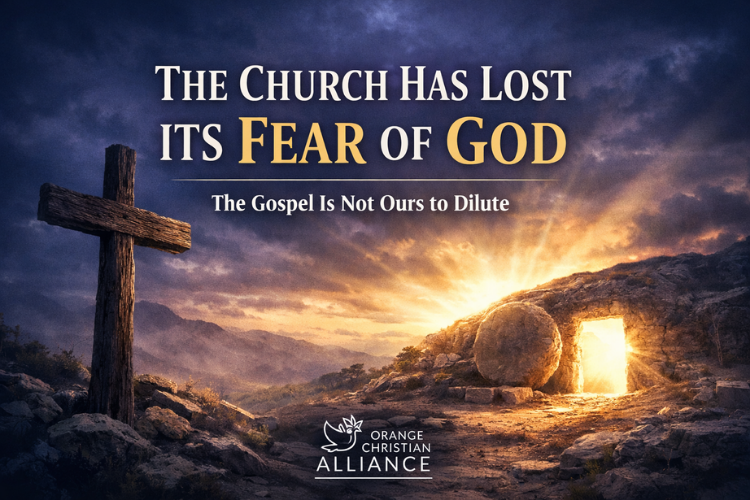
Church Has Lost Fear of God

In Orange, NSW, Australia, the Easter “Family” Festival organisers used banners promoting the event with the word “Easter” barely visible. On Palm Sunday, the beginning of Holy Week, the festival that should have been a clear, unapologetic proclamation of the crucified and risen Christ, the redeemer of sinful humanity, was diluted, softened, reshaped – and made “safe.”

On Resurrection Sunday, the very foundation of our faith, the event without which there is no Christianity, the highlight at one local church was a helicopter dropping 7,000 Easter eggs on the church lawn for the excited crowd.

The concern isn’t about the eggs – it’s about what is central. What will the children remember? Christ crucified and risen? Or the excitement of getting lots of chocolate Easter eggs? 

Charles Spurgeon was right: “The Church exists for the glory of God, not for the entertainment of men.”

When did the Church forget that? Surely, we knew it once. Easter is not ambiguous. It is not cultural. It is not a generic “family-friendly” moment designed to entertain. It is the central declaration of the Christian faith: Christ died for sin and every person is commanded to repent.  

He was pierced for our transgressions…” — Isaiah 53:5
“God commands all people everywhere to repent.
” — Acts 17:30 

Losing the Fear of God to the Fear of Man

Somewhere along the way, the Church has lost the weight of what it has been entrusted with. The day that proclaims Christ crucified and risen – the day that declares victory over sin and death – has been reshaped to make it acceptable to a world that does not know him.

The gospel is offensive. Yes. But it is the gospel that Jesus himself preached.

It confronts sin. It calls for repentance. It declares that man is not good, and that salvation is found in Christ alone. Yet, instead of standing on that truth with holy conviction, many have chosen to present it in a way that avoids offence and maximises appeal.

But the call of God has never been to make the message acceptable – or to entertain the crowds. The Apostle Paul said“I did not shrink from declaring to you the whole counsel of God” (Acts 20:27). And again, “Preach the word; be ready in season and out of season; reprove, rebuke, and exhort” (2 Timothy 4:2). 

Consider Daniel. In captivity, and under pressure to conform, he “resolved that he would not defile himself” (Daniel 1:8).

He would not bow to the culture. He would not dilute his obedience. He would not trade faithfulness for acceptance.

Not even in something as seemingly small as food.

When commanded not to pray, he opened his windows and prayed to God as he always had – even at risk of his life (Daniel 6:10). Yet he rose to positions of authority in two empires: without once compromising his faith.

God honours those who honour him (1 Samuel 2:30).

But today, many in the Church bend where Daniel stood firm. 

They soften, they accommodate, they adjust. Not under threat of death. Not under persecution, but under the pressure of culture, attendance, and public acceptance.

“For the time is coming when people will not endure sound teaching…” (2 Timothy 4:3).

That time is here.

Church Compromise over Biblical Conviction

The decline of the Western world is not accidental; it is the fruit of a Church that has too often chosen silence and compromise where God’s word demands truth and boldness.

The Great Commission was not about drawing crowds and entertaining them. It was a command: “Therefore go and make disciples of all nations… teaching them to obey everything I have commanded you” (Matthew 28:19–20). That command has not changed. The Church must come back to holiness. Come back to the Word of God. Come back to the fear of the Lord. Come back to the bold, unashamed proclamation of Jesus Christ – crucified for our sin, and raised to life by the power of God. The tragedy is not that the world rejects the truth; it always has. The tragedy is that the Church, more often than not, no longer has the courage to proclaim it as written. It is a fearful thing to handle the Word of God lightly: he will not overlook the dilution of his truth.

Those entrusted to preach his word will give an account. Not for how well they were received, but for how faithfully they proclaimed. It is the truth – not the compromise – not the spectacle – that sets men free.

Lord, search us, correct us, and bring us back to holiness.

Taken from an article by Kris Dhillon in the Canberra Declaration, 9 April 2026

REPENTANCE AND HOLINESS

Scripture is clear: “As He who called you is holy, you also must be holy in all your conduct” 1 Peter 1:15

From that time Jesus began to preach, saying, “Repent, for the kingdom of heaven is at hand.” Matthew 4:17

Look what A.W.Tozer said:

I look back and remember a day when it was common for men and women to come to an altar of prayer and kneel there, shake, tremble, and weep in agony of conviction over their iniquity. We do not see it now because the God we preach is not the everlasting, awful Holy One who cannot look upon iniquity. When we get a vision of the Holy One as he desires to reveal himself, this will come back as a mighty power to change us into his likeness.

Tozer then quotes this hymn by Charles Wesley:

Lord, incline me to repent; Let me now my fall lament, Deeply my revolt deplore, Weep, believe, and sin no more. 

Repentance is the lost word in the Christian dictionary. You may want to consider adding the sentiment of Charles Wesley’s words to your next prayer. I am sure you won’t use Wesley’s words exactly.

It is not as if we have to repent and be holy in our own strength. Jesus made it possible for our Heavenly Father to send the Holy Spirit to enable us to be holy. He will produce the fruit of the Spirit in your life and enable you to do the ministry that God has called you to do. We just need to submit to His leading day by day and not grieve Him or quench His work in our lives.


HAPPINESS AND HOLINESS

“Holiness is the royal road to happiness. The death of sin is the life of joy.” Charles Spurgeon. Indeed, holiness is exactly what secures our happiness.

To be holy is to see God as He is and to become like Him, covered in Christ’s righteousness. And since God’s nature is to be happy, the more like Him we become in our sanctification, the happier we will be. Forcing a choice between happiness and holiness is utterly foreign to Scripture. If it were true that God wants us to be only holy, wouldn’t we expect Philippians 4:4 to say, “Be holy in the Lord always” instead of “Rejoice in the Lord always”?

The Puritans, Jonathan Edwards, Charles Spurgeon, and many others used the words happy and happiness frequently in biblical, theological, and Christ-centered contexts. When they called on believers to be happy, they weren’t speaking of happenstance or chance, but of enduring delight and pleasure and good cheer in Jesus.

Sadly, Bible teachers such as Oswald Chambers saw people trying to find happiness in sin so they came to think that pursuing happiness is sinful. Chambers said, “Joy is not happiness,” and continued, “There is no mention in the Bible of happiness for a Christian, but there is plenty said about joy” (God’s Workmanship, and He Shall Glorify Me, 346). I respect and have been blessed by Oswald Chambers publications such as My Utmost for His Highest, but statements like this are misleading. It simply is not true. In the King James Version, which Chambers used, Jesus tells his disciples, “If ye know these things, happy are ye if ye do them” (John 13:17 KJV). Speaking of faithful Christians, James said, “We count them happy which endure” (James 5:11 KJV). Peter said to fellow believers, “If ye suffer for righteousness’ sake, happy are ye” (1 Peter 3:14 KJV) and “If ye be reproached for the name of Christ, happy are ye” (1 Peter 4:14 KJV). I am not sure what Oswald Chambers thought of these verses but it seems clear God wants us to be happy but we can only be happy when we are in close relationship with Him and obedient to His Word and call.

DIED TO SELF, ALIVE IN CHRIST

Paul tells us our body is the temple of the Holy Spirit and to offer our bodies as a living sacrifice, holy, acceptable to God. He also tells us not to be conformed to this world but be transformed by the renewing of our mind. Why? So that we will know the perfect will of God for this day and the days ahead.

“I beseech you therefore, brethren, by the mercies of God, that you present your bodies a living sacrifice, holy, acceptable to God, which is your reasonable service. And do not be conformed to this world, but be transformed by the renewing of your mind, that you may prove what is that good and acceptable and perfect will of God.Romans 12:1

To be transformed, not only do I need Jesus, His blood sacrifice and the Holy Spirit, I also need the Word of God.

Jesus, in His prayer to His heavenly Father said:

Sanctify them by Your truth. Your word is truth. As You sent Me into the world, I also have sent them into the world. ” John 17:17

This is how we transform our mind, with the Word of truth. It is only then, we will hear from God, perceive correctly the here and now, and know what God has for us to do today.

Our love for Jesus must be such that our hearts desire is to pray this prayer for all of those that God leads us to, or brings across our path. We must never forget God is the one who chooses – “But we should always give thanks to God for you, brethren beloved by the Lord, because God has chosen you from the beginning for salvation through sanctification by the Spirit and faith in the truth.” 2 Thessalonians 2:13

Jesus, you have brought this person to me, please help me to show them who You are. Also, I know, that by the power of the Holy Spirit, You are able to transform whatever their deficits are into victories, Holy Spirit show me the part I am to play in their journey with you.

This image has an empty alt attribute; its file name is how-do-we-glorify-god.jpg

Is it true that God chooses people to have eternal life and yet we must believe to have eternal life? Why are we urged to believe when it is God who gives us the faith?

Therefore He has mercy on whom He wills, and whom He wills He hardens.
You will say to me then, “Why does He still find fault? For who has resisted His will?” But indeed, O man, who are you to reply against God? Will the thing formed say to him who formed it, “Why have you made me like this?” Does not the potter have power over the clay, from the same lump to make one vessel for honour and another for dishonour? Romans 9:18-20

The answer to this paradox is unknown: it is a mystery but Scriptures tell us both are true. Hence, it is imperative we are led by the Holy Spirit moment by moment. The old hymn says it all: “Trust and obey, for there is no other way, to be happy in Jesus, but to trust and obey.”