RESISTING ISLAM’S THREAT TO THE WEST

There is no political Islam; no moderate Islam; no Islamism; no extremist militant Islamism; no Jihadism; no Wahhabism; no self-radicalised Islamism; no radical Islam; no radical Islamism. There is only Islam. Countless Islamic leaders and scholars have said so. Only Westerners come up with euphemisms to protect Islam as though the latter fictitious terms are something distinct from Islam.”
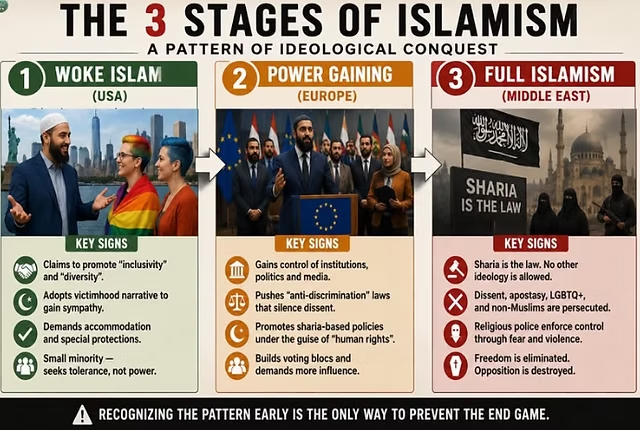
In order for the West to win this civilizational battle, it must:
1) Proudly and unequivocally defend Western values;
2) Reject cultural relativism and the unicornia vision of multiculturalism;
3) Recommit to individual dignity over the celebration of collective identity politics;
4) Recognise that all cultures are not equal;
5) Recognise that all religious beliefs are not equally consistent with Western values;
6) Recognise that all immigrants are not equally likely to assimilate and adopt Western values;
7) Recognise that immigrants who espouse intolerable values that seek to destroy our civilisation will be deported (en masse);
8) Implement a rational immigration policy that recognises the importance of cultural homophily (choosing immigrants who hail from cultures that possess similar values to those of the host nations);
9) Exhibit zero tolerance for seditious belief systems; such systems can be criminalised if they constitute an existential threat to our freedoms and liberties.”

“For the first time in recorded history, a civilisation has decided that the most enlightened virtue is to surrender its culture, heritage, women, and children without putting up any defence. Suicidal empathy shall prove to be the demise of the West.

Danny Burmawi is a Jordanian-born author, analyst, and public intellectual specializing in comparative religions, Theology, and Middle East Affairs. He is the founder and executive director of the Ideological Defense Institute (IDI), a U.S.-based research and public-education institute.

Born and raised in a Muslim family in Jordan, Burmawi converted to Christianity in 2007. As a result, he was forced to leave his home country and relocate to Lebanon, where he lived and worked for approximately fifteen years. During this period, he founded and led multiple Christian organizations across the Middle East, traveled to more than forty countries and delivered lectures, seminars, and training programs across the Middle East, Europe, and North America. Due to the sensitivity of his work, much of it was conducted under a low public profile. Danny says, “fear of Islam is the symptom of a healthy society that wants to survive. The less a society fears Islam, the faster it will vanish.” “I have lived in five different countries and visited over forty. I lived as a Muslim and I lived as a Christian. And after twenty years, one conclusion has become impossible to escape: Christian culture is superior to all others.”

THE QUESTION THE WEST IS TOO AFRAID TO ASK ABOUT ISLAM

Thomas Aquinas questioned Muhammad’s credentials to speak for God. His question remains uncomfortably relevant. Viewed as a philosopher, Thomas Aquinas is a foundational figure of modern thought. Aquinas asked, what evidence entitles a man to claim that God speaks through him? That’s not an unreasonable question. I would argue it’s an indispensable one — especially in 2026.

As Islam seeks to spread its tentacles across Europe and beyond, Westerners are reluctant to critique it. Instead, the modern instinct is to treat every religious tradition as equally mysterious, equally profound, and equally beyond criticism. But Italian philosopher and theologian Thomas Aquinas had no such inhibitions. Writing 600 years after Muhammad claimed to have received God’s final and ultimate revelation for mankind, Thomas Aquinas dared to ask what credentials the Arab had to speak for God.

Conquest Is Not a Credential

Aquinas’s first question concerned divine authentication. Christianity, as Aquinas understood it, was not simply a collection of moral teachings attributed to a charismatic founder. The claims of Jesus were accompanied by miracles and supernatural signs, understood as evidence that His message originated with God.

Aquinas, therefore, asked a rather awkward question: where were the comparable signs establishing Muhammad’s prophetic authority? His answer was devastatingly blunt. Muhammad advanced his cause through force. Aquinas’s observation that military strength is hardly a divine credential is difficult to dismiss. Robbers have weapons. Tyrants have armies. Conquerors have empires.

That hardly makes them messengers of God!

Desire, Discipline, and the Two Faiths

Aquinas was equally pointed about morality. Aquinas argued that Muhammad’s teaching accommodated bodily desire and offered promises of sensual pleasure. Christianity, by contrast, demands the disciplining of appetite and the elevation of the spiritual life above the gratification of the flesh.

Aquinas, therefore, saw a revealing difference in the two systems: Christianity asks man to master his desires; Islam gives those desires considerably more room to manoeuvre — a point well made by French author Michel Houellebecq in his excellent novel Submission. Houellebecq, who had to go into hiding after his book was published, imagined that French men might easily convert to Islam after discovering how generously it catered to their desires.

Truth, Fable, and the Courage to Question

Aquinas third insight concerned truth. He did not claim that Muhammad taught nothing true. His criticism was subtler: he argued that truths were mixed with fables and serious falsehoods in order to create what we now call Islam. That mixture matters because divine revelation ought to possess an authority and coherence that does not depend upon convenient additions from human imagination. Finally, Aquinas questioned the circumstances surrounding Muhammad’s earliest followers and the subsequent expansion of Islam. He contrasted Christianity’s dependence upon preaching, miracles and spiritual conviction with a movement that, as history records, employed military force to secure submission.

In my opinion, Aquinas was very much on point in his critique of Islam. He refused to confuse popularity with truth, conquest with revelation, or desire with virtue. And perhaps that is the lesson we most need to recover in 2026. A society that is frightened to question religious claims is not tolerant; it is intellectually timid.

Respect for individuals does not require surrendering our capacity to examine ideas, doctrines and claims to divine authority. Aquinas understood something that we seem increasingly determined to forget: truth does not become true because millions believe it, because a movement expands, or because criticism makes us uncomfortable.

Religious claims, precisely because they purport to speak with the authority of God, deserve scrutiny rather than exemption from it. We should be capable of critiquing Islam without hatred toward Muslims or contempt for their dignity. But intellectual charity does not mean intellectual surrender. A free society must be able to distinguish between respecting a person and accepting his theology. And Muslims should be able to handle criticism of Islam without resorting to threats or violence.

The veracity — or otherwise — of Islam is not a medieval question. It’s an urgent question for those of us living in 2026. But I fear, a question the West is much too afraid to ask.

Taken from an article by the same name by James McPherson, journalist and a host on Sky News.

CHALLENGED BY ISIS BRUTALITY: SYRIAN MUSLIMS FIND JESUS

Syrian Christians have shared how they converted from Islam to Christianity after witnessing the brutality of Islamic extremist groups like ISIS, who carried out barbaric acts in the name of Allah.

Members of the recently-established Church of the Brethren in Kobani  — the first local Christian place of worship for decades — shared with NBC News how Christianity appealed to them after living under Sharia law.

‘Christianity was the religion I was searching for’ said Farhad Jasim. Farhad, 23, who works as a mechanic, converted to Christianity late last year. He told NBC he was jailed by ISIS for six months in early 2016 after the militants discovered he didn’t know the basics of Islam. During his time in captivity, he was tortured and forced to read the Quran.

“After I witnessed their brutality with my own eyes, I started to be sceptical about my belief,” Jasim said.

After hearing about the Church of the Brethren, which opened in September and is part of a denomination that dates back to 18th-century Germany, Jasim decided to visit: “It didn’t take me long to discover that Christianity was the religion I was searching for,” he said.

Jasim told the outlet his family has rejected him because of his newfound faith and expressed hope that one day, his loved ones will not only forgive him but embrace Christianity, too.

“If ISIS represents Islam, I don’t want to be a Muslim anymore,” he said. “Their God is not my God.”

Firas, a 47-year-old farmer, told NBC he converted to Christianity after living under ISIS for two years. He recalled how militants would terrorise anyone who didn’t adhere to their particular brand of Islam.

“I saw men and young teenagers being whipped on the streets because they were caught smoking. I saw dead bodies of young men being thrown from high buildings for being gay,” Firas said. “This was their Islam.”

“If heaven is made for ISIS and their belief, I would choose hell for myself instead of being again with them in the same place, even if it’s paradise,” he added.

While ISIS was driven out of the city, located along the Syrian-Turkish border, over four years ago, converting to Christianity remains taboo  — and even dangerous — in the Muslim-majority region. Persecution watchdog Open Doors notes that even in more secure parts of Syria, Christians who have converted from Islam face pressure and discrimination from their communities. Kobani is home to about 300 Christians, according to estimates.

Omar, 38, who serves as church administrator, said that even before ISIS overtook the region, it was strictly forbidden to change religion from Islam to Christianity. But under ISIS, converting to Christianity “wasn’t even imaginable,” he said, adding: “ISIS would kill you immediately.”

“Most of the brothers here converted or come to church as a result of what ISIS did to them and to their families,” he said. “No one is forced to convert. Our weapon is prayer, the spreading of the spirit of love, brotherhood and tolerance.”

The story of Farhad reminds me of the Muslim taxi driver I met recently when I took a taxi from my home to Sydney, (Australia) airport.

When I got into the taxi, I noticed that the mandatory photo, driver’s name and taxi registration number was not on the front windscreen. A proverbial “red flag” went up and I felt led by the Lord to ask the driver his name. The way I said it was “my name is Ron, what is yours?” It was obvious from his response, he did not want to tell me. I persisted and he eventually blurted out. “it’s Mohammed and I am ashamed to be a Muslim.”

Woops! “Why is that Mohammed?” I said. He asked me if I had seen this picture. He could not get the image out of his mind and the thought that Allah would want these 21 Egyptian Coptic Christians beheaded because they would not renounce Jesus. I felt led to respond with, “You know what Mohammed, God calls us to love Him with all our heart, soul and mind and to love our neighbour as our self.” I then put my hand on his shoulder and said, “God calls me to love you Mohammed”. Well, I almost didn’t get to the airport. Mohamed cried out “That’s it! That’s it! and we almost mounted the footpath. It was like the light went on for Mohammed, this is the God I want to serve. When we got to the airport, Mohammed did not want me to go so I gave him my business card and told him to contact me when he was next in the area where I live.

How many other Muslims must be wrestling with the same issues about a god of death, definitely not a god of love.

TRUE FACE OF ISLAM

Rita Chaima radiates with joy. When you see her face, you can tell she’s filled with deep happiness and contentment.  But that’s the opposite of the way she used to feel. Chaima was raised a Muslim, and from an early age she struggled with suicidal depression.  She tells her powerful story in a new documentary called “In His Footsteps” by a ministry called The Last Reformation.

Rita Chaima 2

“I just saw a cruel world and I didn’t want to be a part of it,” she recalls.  Chaima says she tried to kill herself three times. “I was doing drugs, I was smoking, I was smoking anything… I just wanted to destroy myself.”  At one point she became so angry that she made up her mind to join ISIS in Syria. “I hated people who weren’t Muslim. I wanted to kill them,” she says. The videos by ISIS-inspired her. “I loved to see them bleeding. I was seeing videos of decapitation and loved it.

But then something else happened. Her mom got a bunch of free books for her, and there was a Bible among them. That’s when Chaima met Jesus.

“I started to read the Bible to prove to Christians that they were wrong,” she says. “But I was wrong! And the grace of Jesus Christ started to touch me.”

“I was reading things like ‘pray for your enemies,’ ‘love them,’ and I was someone who wanted to kill them. Intellectually, I didn’t want to accept Jesus, but Jesus started to do a work in my heart,” she says. She couldn’t resist the love of Jesus anymore, so she decided to follow Him.

When she told her family what she had done, they rejected her. She says they stopped talking to her, and for months she was alone in her room. “It was like a prison.”

She says in the past, depression would have overtaken her. But not this time. She started to read the Bible a lot. “Jesus was there with me. He was encouraging me. The Holy Spirit was really there. I felt it, I knew it.”

Her Muslim family has now totally abandoned her, but her story doesn’t end there.

When it was time for Chaima to be baptized, something supernatural happened.

“I don’t even remember what I did. I had to see the video of my baptism. I was completely crazy, the demon was crazy, it wasn’t me. I kicked Jon. He baptised me. I kicked him.” But as she flailed and screamed, Jon continued to minister over her, telling the demon to go until peace finally came over her body. She was finally set free and baptised in the Holy Spirit.

“After the baptism I felt like the heavy weight completely disappeared. And I was so excited to go and make disciples,” she said.

“I started to want to talk about Jesus to everyone, even to the people who led me to terrorism. I wanted to go and see them, tell them that they are wrong, and that love is waiting for them.”

And that’s just what she now does, traveling with gospel minister Peter Ahlman and other Christians, she shares her testimony wherever she goes.

You can watch her testimony below through an excerpt from the “In His Footsteps” documentary by The Last Reformation.