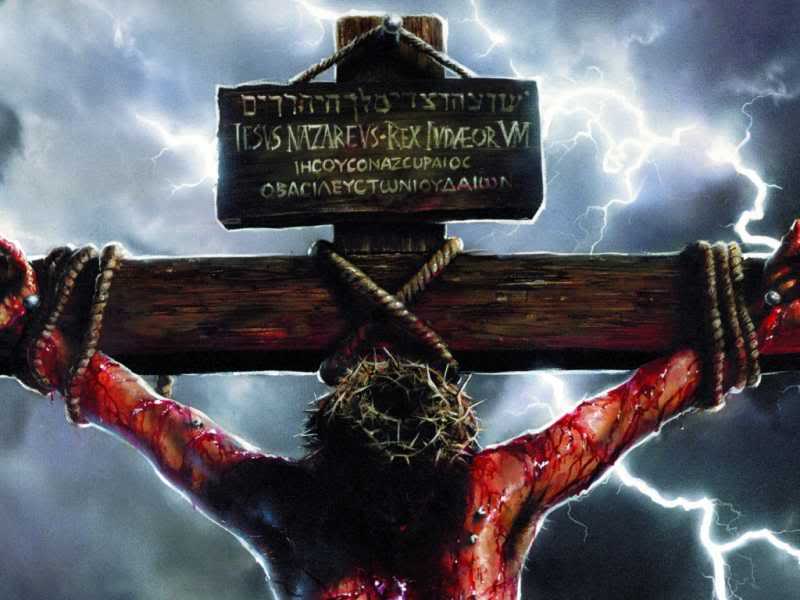
If you could control the moment you died, what would your last words be? As Jesus hung on the cross, He spoke seven times. The first of His final words was a prayer. But not for Himself.
“Father, forgive them, because they do not know what they are doing.” (Luke 23:34)
Really? They didn’t know what they were doing? 1. The Jewish leaders plotted Jesus’ death for months. They paid Judas to betray Him. They held a mock trial in the middle of the night. 2. The crowd cried out for His crucifixion. They even chose a murderer to be set free rather than Jesus, the One who had healed the sick, raised the dead, and fed thousands. 3. Governor Pilate knew Jesus was only guilty of making the Jewish leaders mad. He tried to set Jesus free, but in the end, he knowingly gave the order for Jesus’ death. 4. The Roman soldiers spit on Jesus, beat Him, jammed a crown of thorns onto His head, and mocked Him. As they led Him to Calvary, they watched Him stumble, battered and bleeding. When they drove the nails through His hands and feet, the soldiers knew exactly what they were doing. Christ’s agony was real. 5. Jesus’ executioners didn’t know what they were doing because sin and “the god of this age has blinded the minds of unbelievers to keep them from seeing the light of the gospel of the glory of Christ, who is the image of God” (2 Corinthians 4:4). Yet, Jesus said, “Father, forgive them, because they do not know what they are doing”Luke 23-34
If they had truly understood who Jesus was and what they were doing to Him—God’s Son, their promised Messiah—do you think they would have never done such evil? The horror of such actions would have overwhelmed them. Instead, they would have fallen down before Jesus and worshiped Him.
Apart from Christ, we are all spiritually blind—and spiritually deaf. In the rebellion of our sin, we are no different than the people in the days of Ezekiel, Jesus, and Paul, who have ears but do not hear (Ezek. 12:2; Matt. 13:13; Acts 28:27). In our sinful state, we don’t hear, see, or respond to the truth.
Unless God opens our eyes to see Jesus and our sin, we will stay as blind and deaf as the dead, because that’s exactly what we are—dead in our trespasses and sins.
“And you were dead in the trespasses and sins in which you once walked, following the course of this world, following the prince of the power of the air, the spirit that is now at work in the sons of disobedience— among whom we all once lived in the passions of our flesh, carrying out the desires of the body and the mind, and were by nature children of wrath, like the rest of mankind.” Ephesians 2:1-3
In modern Australia, you will be feted for mocking Christ but cast out into the social wilderness for saying men are not women. That’s what the stories of Reuben Kaye and Moira Deeming suggest.
Kaye is a self-styled queer comic who was fawned over on ABC’s (Government funded TV channel) Q+A this week for his swipe at the son of God. It was on the Ten Network’s The Project back in February that he told a cheeky crucifixion gag. He said he didn’t understand why Christians had such a problem with him. “I love Jesus,” he said. “I love any man who can get nailed for three days straight and come back for more.”
The Project hosts giggled awkwardly. Christians were not so amused. Some threatened to protest at his gigs.
The audience on this week’s Q+A was a different affair entirely. They came not to douse this “blasphemer” in holy water but to gush over his supposedly daring Jesus-bashing.
An audience member asked if he thought a straight comic would have caught so much flak for a joke about the crucifixion. Q+A host Patricia Karvelas then read the joke out, for context, eliciting chuckles from the audience. Kaye said, yes, it was because he was a “queer person” that the religious reacted with such spluttering fury to his Jesus joke. They want us to “become invisible”, he said.
The applause was rapturous. He was treated as a valiant warrior for free speech. Chill out, you sad, tragic Christians, and let us say what we want to say – that was the undertone of Kaye’s own puffed-up self-defense and the cheering he received on the ABC.
This is how far we have fallen from a country that still opens parliament with prayer. That practice is not likely to survive much longer. Several of the Labour members and the Greens Party do not enter Parliament until the prayers are finished.
Jesus told us that in the last days, unbelievers will hate us and even worse kill us because we uphold Jesus as Lord of not only this world but the Cosmos.
“Then they will deliver you up to tribulation and put you to death, and you will be hated by all nations for my name’s sake. And then many will fall away and betray one another and hate one another. And many false prophets will arise and lead many astray. And because lawlessness will be increased, the love of many will grow cold.” Matthew 24:9-12
Does HISTORY really validate the New Testament Gospels to be true about Jesus: His first coming, His crucifixion, His resurrection, His coming again?
Non-Christian ancient sources confirm details of Christ’s death and some of His resurrection. Dr. Gary Habermas catalogued over 3,400 sources, many of whom are sceptical, or even critical of Christians, adding to their veracity. Here are seven of the three thousand four hundred:1. Josephus 37-100 AD, 2. Suetonius 70-160 AD, 3. Pliny the Younger 61-113 AD, 4. Tacitus 56-120 AD, 5. Mara Bar-Serapion 72 AD, 6. Lucian 125-180 AD, 7. Babylonian Talmud. They all confirm key points of the gospel:
1. Jesus died by crucifixion; 2. He was buried; 3. His death caused the disciples to despair and lose hope; 4. The tomb was empty three days later. 5. Hundreds of people saw the resurrected Jesus.
After Jesus’ resurrection, all of His disciples saw Him and had many experiences with Him,“for over 40 days” (Acts 1:3) – eating with Jesus in different places, and lastly watching Jesus ascend off the earth – “as they were looking on, He was lifted up, and a cloud took Him out of their sight”(Acts 1:9).
Rome’s most prominent Jewish historian, Flavius Josephus (37-100 AD) wrote about the resurrection of Jesus. He also recorded Jesus’12 apostles and many of Jesus’ disciples (1 Cor. 15:1-9) all went to their deaths, most as martyrs for continually claiming Jesus’ resurrection (1 John 1:1-4). Some people have died for what was a lie – but no one, much less hundreds, will die for what they ALL KNOW is a lie! The apostles and Jesus’ disciples all preached Jesus’ resurrection up to the time of their deaths.
Today –anyone can find out if Jesus is alive! Jesus made it possible for our Heavenly Father to send the Third Person of the Trinity, the Holy Spirit, to indwell the spirit of everyone who repents of their sins against God and accepts Jesus as their Lord and Saviour. The Holy Spirit is their counsellor, teacher, and comforter.
“The spirit of man is the lamp of the Lord, searching all his innermost parts.” Proverbs 20:27
The spirit of a person was always meant to be filled with the Holy Spirit. The lamp of the Lord cannot function without the oil of the Holy Spirit. The Holy Spirit will convict us of sin. It is His job to make us like Jesus to enable us to be Jesus’ ambassadors on the earth.
“However, you are not in the flesh but in the Spirit, if indeed the Spirit of God dwells in you But if anyone does not have the Spirit of Christ, he does not belong to Him. If Christ is in you, though the body is dead because of sin, yet the spirit is alive because of righteousness. But if the Spirit of Him who raised Jesus from the dead dwells in you, He who raised Christ Jesus from the dead will also give life to your mortal bodies through His Spirit who dwells in you.” Romans 8:9-11
Thousands of Christians have been martyred for not denying their loyalty to Jesus Christ and many more will do so before His return. Jesus has warned us beforehand that prior to His return there will be a time of great tribulation for Christians.
There need be no question, historically or personally, about the resurrection of Jesus. If someone is willingto receive Him as their own personal Lord and Saviour they will receive the third person of the Trinity, the Holy Spirit who will testify to the reality of Jesus and God the Father.
The detail on the historical sources of Jesus’ life, death and resurrection was sourced from material provided by Jim McCotter – jimsbookstore.com
Why did Jesus of Nazareth endure a torturous death by crucifixion? After all, he could have just stayed in Heaven and left us all alone to pay the penalty for our sins. Instead, “he humbled himself and became obedient to death — even death on a cross”
“Who (Jesus), though he was in the form of God, did not count equality with God a thing to be grasped, but emptied himself, by taking the form of a servant, being born in the likeness of men. And being found in human form, he humbled himself by becoming obedient to the point of death, even death on a cross.” Philippians 2:6-8
But why? For one thing, God loves us dearly. All three persons of the Trinity were in agreement. God our heavenly Father was prepared to send His only Son to pay the penalty we deserve to pay. Jesus was prepared to make the tremendous sacrifice (incomprehensible) on our behalf and the Holy Spirit had to endure making it happen.
“God demonstrates his own love for us in this: While we were still sinners, Christ died for us” (Romans 5:8). Love is the biggest reason Jesus “endured the cross, scorning its shame” (Hebrews 12:2).
Jesus suffered and died on the cross so that you and I could be rescued from sin, death, resurrection to face judgment, punishment, and a second death in the Lake of Fire. If we could have saved ourselves by our own righteousness, it would have been utterly foolish for the Father to send his only Son to redeem us. The fact of the matter is that Christ’s crucifixion was the only way we could be rescued. “If righteousness could be gained through the law, Christ died for nothing” (Galatians 2:21).
I assure you that the Messiah didn’t endure crucifixion for nothing! It was the only way God’s worldwide rescue mission could be accomplished!
Do you realize what happens to a person after death if their sins are not forgiven? Jesus made it very clear that the wages of sin are death. And because God does not want you to go to Hell, but rather to Heaven, he did the one thing that would save us from punishment and a second death.
“The Father has rescued us from the dominion of darkness and brought us into the kingdom of the Son he loves, in whom we have redemption, the forgiveness of sins” Colossians 1:13-14
“Be faithful unto death, and I will give you the crown of life. He who has an ear, let him hear what the Spirit says to the churches. The one who conquers will not be hurt by the second death.” Revelation 2:10-11
“But as for the cowardly, the faithless, the detestable, as for murderers, the sexually immoral, sorcerers, idolaters, and all liars, their portion will be in the lake that burns with fire and sulfur,which is the second death.” Revelation 21:8
The Bible says “The message of the cross is foolishness to those who are perishing” (1 Corinthians 1:18). We simply don’t understand any of it. It must be illuminated by the Holy Spirit working through the Word of God. The Lord opens our minds to understand the Bible, just like he did with his first disciples. “Then he opened their minds so they could understand the Scriptures” (Luke 24:45).
The prophet Isaiah foretold the crucifixion of Christ some 700 years prior to Jesus’ birth,
“He was pierced for our transgressions, he was crushed for our iniquities; the punishment that brought us peace was upon him, and by his wounds, we are healed” Isaiah 53:5)
This prophecy clearly foretold the suffering the Messiah would endure. Nevertheless, many people refuse to believe Isaiah’s message. “The 17th-century Jewish historian, Raphael Levi, admitted that long ago the rabbis used to read Isaiah 53 in synagogues, but after the chapter caused ‘arguments and great confusion,’ the rabbis decided that the simplest thing would be to just take that prophecy out of the Haftarah readings in synagogues.” So much for Biblical inerrancy.
Meanwhile, don’t forget: If Jesus had sinned even one time, he would not qualify as anyone’s Savior. In that case, he would need someone to save him. Thankfully, “He committed no sin, and no deceit was found in his mouth” (1 Peter 2:22). A sinner cannot pay for anyone’s sins; a perfect sacrifice is required.
“For you know that it was not with perishable things such as silver or gold that you were redeemed from the empty way of life handed down to you from your forefathers, but with the precious blood of Christ, a lamb without blemish or defect” 1 Peter 1:18-19
God not only forgives our sins when we accept the Messiah by faith, but he also gives us a new heart with which to love and serve our Creator.
The death of Jesus on the cross pays for our sins and reconciles us to God. When we repent of our sins, trust Jesus to forgive our sins, and are baptized, we receive the third person of the Trinity into our souls to enable us to live the Christian life and be in a right relationship with God. Apart from the cross, we would remain rebels and would lack the Holy Spirit which enters our soul the moment we are spiritually reborn (John 3:1-18). Jesus endured the Cross so that all who receive him (John 1:12) will enjoy a relationship with the Lord forever.
Have you placed your faith in Christ’s sacrifice on the cross, or are you living under the delusion that your best efforts are enough to gain eternal life? If we could defeat sin and death with our own righteousness, then it would have made no sense for the Father to send his only Son to suffer such excruciating pain and unrelenting physical, spiritual, and emotional torment.
If you have not yet bowed your knee, repented, and surrendered your heart to Christ, this is a perfect time to do so. Turn away from your sins and believe that the Messiah’s death on the cross paid the full penalty for your sins.
Repenting your sins and accepting Christ as your Savior is the path to peace with God, whereas rejecting the Messiah leaves a person on death row facing punishment and second death.
Jesus speaks at various points while on the cross. There are actually seven statements that Jesus made on the cross. Why does Mark focus on only one of those statements?
My God, my God, why have you forsaken me? Psalms 22:1
“And at the ninth hour, Jesus cried with a loud voice, “Eloi, Eloi, lema sabachthani?” which means, “My God, my God, why have you forsaken me?” Mark 15:34
This is the first line of Psalm 22: “My God, my God, why have you forsaken me?” The rest of the psalm describes prophetically exactly what is happening to Jesus as He spoke these words. In effect, Jesus gives us His personal testimony of His work on the cross, while He is on the cross. If this is the case it was not only a cry because God was far from Him in Jesus’ most desperate hour but it was the first point of a final Gospel presentation.
Anyone who knew the first line of this psalm would know that it pointed to Jesus, in fact, the psalm vividly describes His life on earth. Let’s look at the main points of the psalm and the gospel accounts of His crucifixion.
The rejection of Jesus Christ as God’s Messiah
“But I am a worm and not a man, scorned by mankind and despised by people. Everyone who sees me mocks me; they sneer and shake their heads:” (Psalm 22:6–7)
“Those who passed by were yelling insults at him, shaking their heads, and saying, “Ha! The one who would destroy the temple and rebuild it in three days,” (Mark 15:29)
““He relies on the Lord; let him save him; let the Lordrescue Him since he takes pleasure in Him.”” (Psalm 22:8)
“He trusts in God; let God rescue Him now—if He takes pleasure in Him! For He said, ‘I am the Son of God.’”” (Matthew 27:43)
The virgin birth of Jesus Christ
“It was you who brought me out of the womb, making me secure at my mother’s breast. I was given over to you at birth; you have been my God from my mother’s womb.” (Psalm 22:9–10)
The persecution of Jesus on the cross
“Don’t be far from me, because distress is near and there’s no one to help. Many bulls surround me; strong ones of Bashan encircle me. They open their mouths against me—lions, mauling and roaring.” (Psalm 22:11–13)
“Let the Messiah, the King of Israel, come down now from the cross, so that we may see and believe.” Even those who were crucified with him taunted him.” (Mark 15:32)
Jesus is pointing to this psalm which predicts the very events that are happening to Him while they watch. In a very surreal sense, the people below are watching prophecy unfold. The fact that prophecy is unfolding that shows the Messiah must suffer to save people for eternity should make them come to Him.
Jesus must suffer
“I am poured out like water, and all my bones are disjointed; my heart is like wax, melting within me. My strength is dried up like baked clay; my tongue sticks to the roof of my mouth. You put me into the dust of death. For dogs have surrounded me; a gang of evildoers has closed in on me; they pierced my hands and my feet.” (Psalm 22:14–16)
“They divided my garments among themselves, and they cast lots for my clothing.” (Psalm 22:18)
“So they said to one another, “Let’s not tear it, but cast lots for it, to see who gets it.” This happened that the Scripture might be fulfilled that says: They divided my clothes among themselves, and they cast lots for my clothing. This is what the soldiers did.” (John 19:24)
Jesus was mocked and insulted while on the cross
“I can count all my bones; people look and stare at me.” (Psalm 22:17)
“Those who passed by were yelling insults at him, shaking their heads, and saying, “Ha! The one who would destroy the temple and rebuild it in three days, save yourself by coming down from the cross!”” (Mark 15:29–30)
Jesus proclaims the Gospel to people around Him. He is sharing about their need for God.
People need God
“I will proclaim your name to my brothers and sisters; I will praise you in the assembly. You who fear the Lord, praise him! All you descendants of Jacob, honor him! All you descendants of Israel, revere him! For he has not despised or abhorred the torment of theoppressed. He did not hide his face from him but listened when he cried to him for help.” (Psalm 22:22–24)
Jesus even predicts from the cross by referencing this psalm that the Jews will reject Jesus and the world will accept Him:
Some will reject the Messiah
“I will give praise in the great assembly because of you; I will fulfill my vows before those who fear you. The humble will eat and be satisfied; those who seek the Lordwill praise him. May your hearts live forever! All the ends of the earth will remember and turn to the Lord. All the families of the nations will bow down before you,” (Psalm 22:25–27)
Other people than the Jews will share Jesus
Jesus predicts the beginning of the church from this psalm:
“Their descendants will serve him; the next generation will be told about the Lord. They will come and declare his righteousness; to a people yet to be born they will declare what he has done.” (Psalms 22:30-32)
The death of Jesus is only the beginning. Thankfully, the story doesn’t end with Jesus dying on the cross.
The final Gospel presentation of Jesus Christ reminds us that God’s story is not over. Just like every great story has a great ending. Every great story has “a first” line. They also have a great last line.
“The End” does not end at the cross. Instead, the cross means that there is a “To be continued. Jesus will return.”The many prophecies of His Second Coming testify to the fact that we are in the time Jesus prophesied would precede His return to rule and reign on this earth for one thousand years.
Adapted from the article “The Final Gospel Presentation of Jesus Christ” April 29, 2019, by Jim Erwin http://www.patheos.com
The EYE WITNESS Bible Series produced by Hatikvah Films is excellent and I would suggest you consider using the one titled EASTER at your Home Group. Ideally, it would have been a study prior to Easter but any time of year it is a powerful message.
The following 14-minute segment shows enough to determine if it is for you. It tells the story of Jesus’ Triumphal Entry into Jerusalem riding on a donkey. It is described in all four gospel accounts. Only Matthew and John were present at the event, and all four gospel writers had different purposes in choosing the details of their storyline. Although the Triumphal Entry is traditionally taken to have happened on the Sunday before the crucifixion of Jesus, experts vary on the exact day it happened. John wrote that Jesus arrived in Bethany six days before the Passover, and indicates the entry happened the next day. John says that people were going to see Lazarus, whom Jesus had raised from the dead.
What about the pharisees and the sadducees, the religious leaders of the day, what was their reaction to Jesus raising Lazarus from the dead? There were many eye witnesses to that miraculous event.
“So the chief priests made plans to put Lazarus to death as well, because on account of him many of the Jews were going away and believing in Jesus.” John 10:11-12
Matthew indicates a donkey and its colt were to be brought to Jesus, while the other three gospels mention only a colt. Luke indicates the colt had more than one owner. Mark and Luke have Jesus saying the colt will be unridden. All of the writers have a common goal of relating the event and the crowd’s reactions to at least two scriptures:
“Rejoice greatly, O daughter of Zion! Shout aloud, O daughter of Jerusalem! Behold, your king is coming to you; righteous and having salvation is He, humble and mounted on a donkey, on a colt, the foal of a donkey.” Zechariah 9:9 https://youtu.be/8ijCwrJVR4A



 LIVING ETERNAL NOW