In Queensland’s Gold Coast (equiv. Miami, Florida) known for its entertainment and nightlife, an Evangelical event drew large crowds. Thousands attended the July 7th “Look Up Celebration,” led by Will Graham at the Gold Coast Convention and Exhibition Centre, committed to following Jesus.
“God moved mightily,” Graham wrote on Facebook. “As I shared about God’s love with a crowd of more than 4,600 people gathered at the Gold Coast Convention and Exhibition Centre, hundreds decided to put their hope and trust in Jesus Christ. Would you join me in praying for these new believers and for God to continue to work in the Gold Coast?”
“People have money, titles, degrees, possessions, but spiritually they’re wandering,” Graham said. “You may be searching and wandering. Tonight, God wants you to come home to Him.”
“Many people believe there are multiple ways to God, but that’s not what the Bible says,” Will Graham told the crowd. “Jesus said, ‘I am the way, the truth, and the life. No one comes to the Father except through Me” John 14:6 There’s only one way to God, and that’s through His Son, Jesus Christ, and what He did on the cross. Jesus bled and died to pay the debt so that you and I can have a relationship with God.”
The event culminated with hundreds responding to Graham’s call to begin a new faith journey, visibly moving toward the stage to publicly commit to following Jesus Christ, said the Billy Graham Evangelistic Association (BGEA).
Over 380 churches and more than 1,000 volunteers contributed to the preparation of the “Look Up Celebration,” BGEA added. The preparation included a Christian Life and Witness Course, aimed at educating participants on living and sharing their faith.
A prayer counselor identified only as Trinity, said it was like a revival. “I haven’t seen anything like this since I’ve been here,” he said. “It’s life-changing. There’s no greater miracle than the saving of souls. Tonight, I know there’s not just a celebration here with us, but there’s a celebration in Heaven.”
Will has shared the Gospel with more than 1 million people across six continents since beginning his evangelistic ministry in 2006, according to BGEA.
The Apostle Paul brought his intellect to bear against the best-of-the-best philosophers and religious practitioners of his day on Mars Hill in Act 17. At that time, Athens was the religious center of Greece and was marinating in every faith and philosophy that existed.
When he was delivering his address to that diverse audience on Mars Hill, Paul highlighted a few things all those in attendance had in common — their shared humanity and inherent religious nature — but then he took a hard right turn into the particulars of the Christian faith that makes it distinct from all others.
One important thing that the assertion “all religions are the same” ignores is the key distinction between universals and particulars. Universals are typically said to be abstract whereas particulars are concrete; i.e., a universal is something particulars have in common, but that commonality in no way means all particulars are the same thing.
No one does a better job of humorously pointing this out where religion is concerned than the English writer and poet Steve Turner in his short work called “Creed”:
We believe that all religions are basically the same. At least the one that we read was. They all believe in love and goodness. They only differ on matters of Creation, Sin, Heaven, Hell, God, and Salvation.
And, of course, the central difference in all religions that Paul highlighted to the Athenians was Christ Himself, which is exactly how you and I should deal with the “all religions are the same” argument as well.
If there was ever a time for a Christian leader to declare in a speech that we all believe the same thing and that every road leads to God, it was then. But that’s not what Paul did.
Why and how Christianity is distinct
Think about every religion you know without Christianity. The vast majority, if not all, take an approach to our human predicament that is either epistemic, pragmatic, or existential, with some blending two or all three.
The epistemic path is one that says, “If I just learn something, then I’ll be better.” For example, Buddhism has its four noble truths, its 8-fold path to enlightenment, etc. To the epistemic, knowledge leads to salvation.
The pragmatic approach says, “If I just do something, then I’ll be OK.” Nearly every religion other than Christianity follows this works-based plan, with a good example being Islam and its concept of the deeds scale. The pragmatist earns their salvation by the sweat of their brow.
The existentialist thinks, “If I just experience something, then I’ll be fine.” Those involved in spiritist and/or new-age faiths always look for a vision, a breakthrough, or some spiritual event that moves them from their current life to one that’s better.
But Christianity is different. It is not epistemic, pragmatic, or existential, but instead is something else.
The Christian faith is ontological.
Christianity rests completely on a Person — Jesus Christ. The prophets of other religions admit their faith does not depend on them to be true, i.e., you can take them out of the equation and the religion remains intact.
But if you take Christ out of Christianity, it completely collapses. Moreover, Christianity subsumes the approaches found in other religions and pours them all into the person of Christ.
As an example, the epistemic gains knowledge through words. And what do we read at the beginning of John’s Gospel?
“In the beginning was the Word, and the Word was with God, and the Word was God. And the Word became flesh, and dwelt among us, and we saw His glory, glory as of the only begotten from the Father, full of grace and truth” (John 1:1, 14). Jesus is the knowledge of God personified.
With respect to pragmatism and a works-based approach, Jesus was once asked: “What shall we do, so that we may work the works [plural] of God?” Jesus’ answer to them was, “This is the work [singular] of God, that you believe in Him whom He has sent” (John 6:28-29).
Lastly, existentialism concerns itself with experience and life. To that end, Jesus said, “I have come that they might have life and have it abundantly … I am the way, and the truth, and the life; no one comes to the Father but through Me” (John 10:10; 14:6).
Christianity diverges from all other religions because it is built upon the person of Christ, who, in His Person, embodies all approaches to spiritual truth.
Paul acknowledged this unique and ontological nature of Christianity when he spoke on Mars Hill and also when he wrote, “for I know whom [not what] I have believed … For God, who said, “Light shall shine out of darkness,” is the One who has shone in our hearts to give the Light of the knowledge of the glory of God in the face of Christ” (2 Tim. 1:12; 2 Cor. 4:6).
In other words, Christianity is Jesus. Period.
This post was taken from a great article by Robin Schumacher CP VOICES | MONDAY, APRIL 03, 2023 “All religions are the same and other lies”
It is important to read the following two Scriptures regularly to remind ourselves of what Jesus has accomplished for us. Progressive Christianity has rejected penal substitution, seeing it as cruel and unjust, inducing self-loathing. The problem here is that they have not truly understood what God the Father has accomplished with His Son Jesus. There is no doubt that “the beginning of wisdom is to fear God” but that is not the end of the story.
“For you have not come to what may be touched, a blazing fire and darkness and gloom and a tempest and the sound of a trumpet and a voice whose words made the hearers beg that no further messages be spoken to them. For they could not endure the order that was given, “If even a beast touches the mountain, it shall be stoned.” Indeed, so terrifying was the sight that Moses said, “I tremble with fear.But you have come to Mount Zion and to the city of the living God, the heavenly Jerusalem, to an innumerable company of angels, to the general assembly and church of the firstborn who are registered in heaven, to God the Judge of all, to the spirits of just men made perfect, to Jesus the Mediator of the new covenant, and to the blood of sprinkling that speaks better things than that of Abel.” Hebrews 12:18-24
“Pilate also wrote an inscription and put it on the cross. It read, “Jesus of Nazareth, the King of the Jews… and it was written in Aramaic, in Latin, and in Greek.” John 19:19-20
What actually happened on the cross? If we put aside unhelpful traditions and consider what the Bible teaches us, there is much to celebrate.
“God made him who had no sin to be sin for us so that in him we might become the righteousness of God.” 2 Corinthians 5:21
Jesus didn’t just carry sin, or pay for sin; he became sin. The perfect Lord of all, who humbled himself to serve his own creation, became all human brokenness. Paying for sin is one thing; becoming sin is far deeper. Jesus became every expression of human brokenness, and more than that became the cause of all human brokenness, which is judgement. His spiritual agony was so much worse than the physical pain of the cross. It is no wonder the sky darkened, as all that is good became all that is harmful.
It doesn’t stop there. Jesus became sin, that we might become the righteousness of God. In turn, this means that we become righteousness, as completely as he became sin.
The cross, then, is an exchange – of our lack for his supply, our brokenness for his wholeness, our fear for his love, which can all be summed up as our righteousness (“filthy rags”) for his righteousness (right-standing with God, forever).
“And you, who were dead in your trespasses and the uncircumcision of your flesh, God made alive together with him, having forgiven us all our trespasses, by canceling the record of debt that stood against us with its legal demands. This he set aside, nailing it to the cross. He disarmed the rulers and authorities and put them to open shame, by triumphing over them in Him.” Colossians 2:13-15
The cross provides the forgiveness of sin, by cancelling our legal indebtedness. Sin and death were destroyed. The enemies of humankind were disarmed, triumphed over, and made a spectacle of. What a wonderful God we have.
More than three years after Pope Francis sparked a firestorm of religious debate by telling a young boy that his deceased atheist father might still end up in Heaven, a new study from the Pew Research Center shows a majority of Catholic and mainline Christians also believe people who don’t believe in God will go to Heaven.
Did not Jesus say, “I am the way, and the truth, and the life. No one comes to the Father except through me.” John 14:6.
“Whoever believes in the Son has eternal life; whoever does not obey the Son shall not see life, but the wrath of God remains on him.” John 3:36
Religious rituals versus relationship with the living God
What are the Christian leaders in these denominations teaching their congregations? What did Jesus accomplish on The Cross on our behalf? Does it account for nothing? And yet we know that without Jesus’ sacrifice our Heavenly Father could not have sent the Holy Spirit to indwell believers to sanctify us and enable us to live the Christian life.
Data for the Pew Research Centre study, conducted Sept. 20-26, was collected from a nationally representative sample of 6,485 U.S. adults.
Pew researchers decided for the first time to tackle deep philosophical questions like the meaning of life, the purpose of suffering, and why bad things happen to people. The national study was released amid a backdrop of major life-changing events for many, most notably the coronavirus pandemic which has claimed millions of lives globally.
In discussing American views on the afterlife, the study showed that majorities of U.S. adults believe in both Heaven and Hell, but significantly more believe in Heaven. Some 73% of respondents reported belief in Heaven, while 62% of respondents reported belief in Hell.
When it comes to Christians as a group, the study showed that the overwhelming majority of all Christian groups supported belief in Heaven. Protestants from historically black and evangelical churches were more likely than mainline Protestant Christians or Catholics to express belief in Hell.
And while 39% of all American adults, in general, believe people who don’t believe in God can still go to Heaven, 68% of Catholics and 56% of mainline Protestant Christians were found to hold this belief compared to 21% of evangelicals and 31% of Christians from historically black churches.
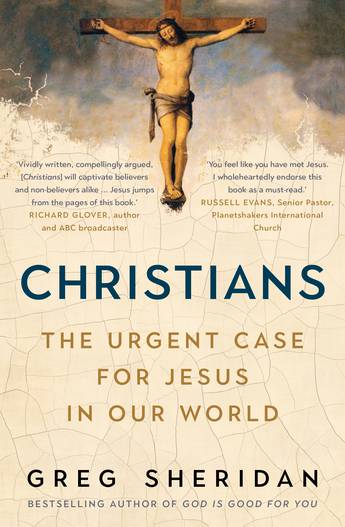
Greg Sheridan widely-respected foreign editor for The Australian. has written an impassioned, informed and utterly compelling case for the truth and importance of Christianity in our lives. He presents a strong argument for the historical reliability of the New Testament, meets the living Jesus there, explores the extraordinary personality of Paul, celebrates Mary’s activism and examines the magnificent richness of John.
Filled with insights, intelligence, warmth and humour, Greg also introduces us to a range of fascinating Christians today, among them political leaders, and young activists offering the radical Christian interpretation of love to their generation. His book explores the journey of those who have been guided by faith, such as Gemma Sisia, whose school in Tanzania has transformed the lives of thousands of children, and the dynamic Chinese Christians pursuing their beliefs under harsh restrictions. He examines where Jesus can be found in popular culture and talks to Christian leaders – Pentecostal, Catholic, Evangelical and others – in Australia, the US and Britain.
At a time when the chasm of understanding between secularism and faith has never seemed wider, Christians is timely, relevant and convincing.
‘At the heart of the Christian story is the truth about the life of Jesus … Greg Sheridan’s book is a good read about Good News.’ Peter Comensoli, Catholic Archbishop of Melbourne
‘If there is ever going to be a Renaissance of Christian belief to save us from the dreariness of much secular humanism, it will come from a book like Christians. I will be buying it and giving it away to believers and sceptics alike.’
Watch this video: an unbeliever who knows and is impressed by Greg’s work as a journalist interviews the author. He now believes there is a valid case for God that needs to be explored.
Amanda (not real name) and her husband come from a small Muslim village in Northern China. Amanda had a secret. She was a fortune-teller. Word began to spread that Amanda was exceptionally good at her ‘craft’ of fortune-telling, and people travelled from other villages to ask guidance about their future and seek solutions for their problems. But then Amanda was struck by a mysterious illness. One day she awoke and was unable to move any of her limbs. Her husband rushed her to hospital, but the doctors were unable to diagnose the problem. “I was so afraid,” Amanda recounted. “Somehow I just knew God was punishing me. I knew I must have done something to displease him.” Amanda’s sister was a Christian and visited her in hospital.
She told Amanda, “Jesus is the only Saviour for all mankind.” That night Jesus revealed himself to Amanda in a dream. “In the dream, I was in a taxi and it was very dark outside,” Amanda recalled. “We were driving into complete darkness. Suddenly, three men wearing white robes with radiant light all around them appeared on the right-hand side of the car. I couldn’t see their faces, but they told me it was time for me to make a choice. As quickly as they had appeared, they were gone. “Then two men wearing black robes appeared to the left of the taxi. They approached me and tried to entice me to join them on their side of the car. Something drew me inexplicably to the pure white robes, so I got out on the right-hand side of the taxi.
“I woke from the dream and knew immediately that one of the men in white robes was Jesus, and that I was to follow Him. I prayed right there in my bed and immediately the paralysis left my body. It has never returned.” Miraculously, her husband experienced the same dream months later, and also came to faith. Amanda’s ‘craft’ has been changed by her encounter with Christ. Now, when people come to ask for wisdom and solutions to their problems, Amanda points them towards Jesus. She prays that he will illuminate their lives with his truth and love. But Amanda’s conversion hasn’t been free of persecution. When her father-in-law found out that she had become a Christian, he lost his temper and began to treat Amanda and her children with contempt.
“On one occasion, I had to go out, so I left my children in the care of their grandparents,” Amanda shared. “When I came back, I found bruises on their faces. My heart just broke.” To this day, Amanda’s children are afraid of staying with their grandparents. In spite of the persecution from her relatives, Amanda continues to share the gospel with others. Many have found the Lord, and up until the coronavirus crisis began, they were meeting once a week to read the Bible and pray together. Even in the hardest places to follow Jesus, his light is continuing to shine through believers just like Amanda.


 LIVING ETERNAL NOW