Did you know that the same land can be used to grow crops and produce solar energy at the same time? That’s the promise of agrivoltaics, a fast-emerging practice that combines agriculture with solar power. By installing solar panels for agriculture over farmland, agrivoltaics not only helps generate clean energy but also supports sustainable farming. As climate change pressures mount and the demand for renewable energy rises, this smart use of space through agrivoltaics farming is gaining attention across the globe. It offers a unique way to meet both food and energy needs without competing for land.
Maximizes land productivity Farmers can increase land-use efficiency by up to 186% by using agrivoltaics to generate renewable energy while carrying on with their agricultural operations. By reducing conflicts between farming and energy development, this dual use helps achieve solar capacity targets without compromising priceless farmland.
Improves crop resilience and yields Partial shade from solar panels keeps soil moisture levels stable, lowers water evaporation, and moderates temperature extremes. According to research from Arizona and Kenya, this microclimate promotes the growth of some crops, particularly in hot or arid areas, resulting in increase in yields and less need for irrigation.
Diversifies income for farmers. Farmers generate extra income by combining crop or livestock production with solar for agriculture. They can lower electricity costs, supply clean energy to farm operations, and occasionally resell excess power to the grid, boosting the stability of farm income. Solar for agriculture thus works on multiple levels of sustainability.
Enhances ecosystem services and biodiversity By preserving native vegetation and establishing habitats for pollinators like bees, agrivoltaics sites can enhance the health of ecosystems. By controlling stormwater runoff and reducing the need for herbicides, these green areas lessen their negative effects on the environment and maintenance expenses.
Provides grazing opportunities Sheep and chickens are examples of livestock that can graze beneath solar agriculture panels, naturally controlling vegetation while enjoying the shade and protection they provide. This promotes animal welfare and lowers maintenance.
Improves working conditions for farm laborers By providing shade, solar agriculture installations improve comfort and safety for farm workers spending extended periods of time outside by shielding them from intense heat and damaging UV rays.
Helps combat climate change Agrivoltaics in India helps achieve regional and national objectives to reduce greenhouse gas emissions and increase climate resilience in agriculture by producing clean, renewable energy and lowering dependency on fossil fuels.
Reduces water consumption In regions that are prone to drought, the shade from agrivoltaics farming reduces the amount of water lost by transpiration and evaporation from plants and soil, thereby promoting more sustainable farming practices. .
I am confident that agrivoltaics will be the way solar is used in the coming Jesus Millennial Kingdom. Is this something of interest to you and you want to be used by Jesus in His coming Millennial Kingdom then get involved now so you will be prepared. God will use the talents He has given you so make sure you develop them for use in His coming Millennial Kingdom. Checkout http://www.millennialkingdom.net as well as become a follower of http://www.livingeternal.net
“Do you not know that friendship with the world is enmity with God? Therefore whoever wishes to be a friend of the world makes himself an enemy of God.” Romans 12:2 instructs: “Do not be conformed to this world, but be transformed by the renewal of your mind, that by testing you may discern what is the will of God, what is good and acceptable and perfect.“, and 1 John 2:15 states, “Do not love the world or the things in the world. If anyone loves the world, the love of the Father is not in him.”
Jesus said during the Sermon on the Mount, “You cannot serve two masters” Matthew 6:24. Repeatedly, Scripture talks of the perishable and the imperishable, the temporal and the eternal. As Christians, we simply cannot give our attention to both. We either live in this world with eternity in mind or we don’t. As Blakey put it, we must ask ourselves: “Do I want the new Heaven and new Earth later or this world now?”
Asking the question, however, is just the beginning. We should have an answer to it as well. Especially because our answer to that question says a lot about what we love, where our hope is placed, and, perhaps most strikingly, where we may be headed when we’re no longer walking the earth. Our answer is a matter of life or death; obedience or rebellion; truth or deceit. Our answer may well determine whether we truly understand the difference between being in the world and being of the world.
To desire this world implies a desire for the temporary. Fading pleasures and perishable goods often lure people astray. Instant gratification and selfish ambition cause many to feel as though this world offers more than it really does. After all, life is a highway, right? “We only live once,” as they say, so why not make the most of it by doing whatever we want whenever we want?
To choose this world now inevitably means whatever lies beyond the grave is a mere afterthought — if even a thought at all. The author of Ecclesiastes makes this point throughout the whole book: “All is vanity.” Ecclesiastes 8:15a states, “And I commend joy, for man has nothing better under the sun but to eat and drink and be joyful.” Within its proper context, this verse is not advocating for a hedonistic lifestyle — one that places pleasure as the highest good and aims for pleasure. Rather, the point it’s making reflects the primary theme of Ecclesiastes, namely, that nothing really matters apart from God.
All is vanity when we try to live separately from our Creator and rely on our own devices. Our purpose is uprooted and lost in a flood of uncertainty. Hopes and dreams may live on, but to what end? Without objective truth in mind, love, joy, peace, and all biblical fruit carry completely different meanings. In fact, at the heart of some of the most secular ideas is this sense of “I can be my own god,” “no truth is final,” and “this life is ultimately about me.” Almost anyone can walk around believing they’re not voluntarily choosing hell. Who in their right mind would boast about such a choice? However, by choosing this world, one is, in effect, choosing that which we dare not consider.
It’s easy to laugh off the decisions we make in our day-to-day. “Oh, I didn’t know any better.” “I was just having a bad day.” “We all make mistakes, right?” Sure, we are allowed to make mistakes and have bad days. The natural conclusion of living as sinners in a fallen world is that we will make mistakes and have bad days. But for those who are called to righteousness, we cannot allow that to become our excuse for letting poor decisions and misguided priorities be the norm.
As Christians, we should not crave the world we currently reside in but look to God for what He has for us when Jesus Christ returns first to rapture the Saints and then to pour out His wrath upon an unrepentant world. Biblical end-times prophecies reveal that Satan’s rule over planet Earth is coming to an end. What is next on God’s agenda for planet Earth is Jesus’ Millennial Kingdom. Jesus and the glorified Saints will rule and reign on this Earth for 1000 years to complete the Abrahamic, Davidic, and New Covenants. This Earth still has 1,000 years with Jesus and the Saints ruling with a rod of iron. “
“She gave birth to a male child (Jesus), one who is to rule all the nations with a rod of iron, but her child was caught up to God and to his throne, and the woman fled into the wilderness, where she has a place prepared by God, in which she is to be nourished for 1,260 days.” Revelation 12:5-6
“The one who conquers and who keeps my works until the end, to him I will give authority over the nations, and he will rule them with a rod of iron, as when earthen pots are broken in pieces, even as I myself have received authority from my Father.” Revelation 2:26-27
“From his mouth comes a sharp sword with which to strike down the nations, and He will rule them with a rod of iron.“Revelation 19:15a
It is obvious that on the new Heaven and new Earth where only righteousness dwells Jesus and the Saints will not need to rule with a rod of iron. Jesus Millennial Kingdom is a transition period. Jesus must reign over his kingdom until he has defeated all his enemies. Once this is accomplished, Jesus will hand over the kingdom to the Father. When the Kingdom of God is handed over to the Father, it will be free of sin and death, identifying it as the Eternal State (Revelation 21:4, 8).
” Peter described us as “sojourners and exiles” (1 Peter 2:11). The truth is, we don’t actually belong here. When we were born again we were made to be with Christ, worshipping and having fellowship with Him and His people. As Christians, we understand we have a role in this world and should strive to walk in a manner worthy of our calling. We should be salt and light, using our gifts and abilities to serve, bless, and care for others. Christians should be trying to have influence, and we do so by tying everything back to the gospel.
As forgiven sinners, Christians should be defined by our gratitude for what Christ did on the cross for our sake. Believers should be bursting at the seams to share this gloriously Good News with those who are of the world! We do this because we are not of the world. We’re merely in it for a time. We’re just passing through. The church cannot choose this world now because our entire existence is rooted in what comes next – Jesus’ Millennial Kingdom.
God sets a limit on evil and suffering in your life. In Job’s life, Satan could do only so much for so long. God determined the limits. And since life continues after death, your suffering can last only the tiniest fraction of your true eternal lifetime. Rest in the knowledge that everything that comes into your life—yes, even evil and suffering—is Father-filtered.
Here and now, God offers you the comfort of His presence. He promises in Hebrews 13:5, “Never will I leave you; never will I forsake you.”
Suffering is temporary. It could last far longer.
If you are God’s child, then your suffering cannot outlast your lifetime. Knowing that suffering will one day end gives us strength to endure this day. Though we don’t know exactly when, we do know for sure that either by our deaths or by Christ’s return, our suffering will end. From before the beginning, God drew the line in eternity’s sand to say to His children, “This much and no more, then endless joy.”
“For this light momentary affliction is preparing for us an eternal weight of glory beyond all comparison, as we look not to the things that are seen but to the things that are unseen. For the things that are seen are transient, but the things that are unseen are eternal.” 2 Corinthians 4:17-18
In 2 Corinthians 4:17–18 Paul speaks of relative weights. He calls our present evils and sufferings “light and momentary.” When we face a lengthy period of great adversity, though it hardly seems momentary, in fact, it is. In eternity, people in God’s presence will fully agree with Paul that their earthly sufferings were unworthy to be compared with eternal glory.
Suffering can produce some desirable good. It can make us better people, and it can reveal God’s character in ways that bring Him glory and bring us good.
As a young Christian, I believed that going to Heaven instead of Hell was all that mattered. But as I read the Bible, I saw that to be called according to God’s purpose is to be conformed to the character of Christ. God’s purpose for our suffering is Christlikeness. That is our highest calling. If God answered all our prayers to be delivered from evil and suffering, then He would be delivering us from Christlikeness. But Christlikeness is something to long for, not to be delivered from.
Whether suffering brings us to Christlikeness depends, to some degree, upon our willingness to submit to God, to trust Him, and to draw our strength from Him. Suffering will come whether we allow it to make us Christlike or not—but if we don’t our suffering is wasted.
God can see all the ultimate results of suffering; we can see only some. When we see more, in His presence, we will forever praise Him for it. He calls upon us to trust Him and begin that praise now.
Suffering and weeping are real and profound, but for God’s children, they are temporary. Eternal joy is on its way.
God promises that the eternal ending will break forth in such glorious happiness that all present suffering will pale in comparison. All who know Jesus will have a happy ending. We just haven’t seen it yet.
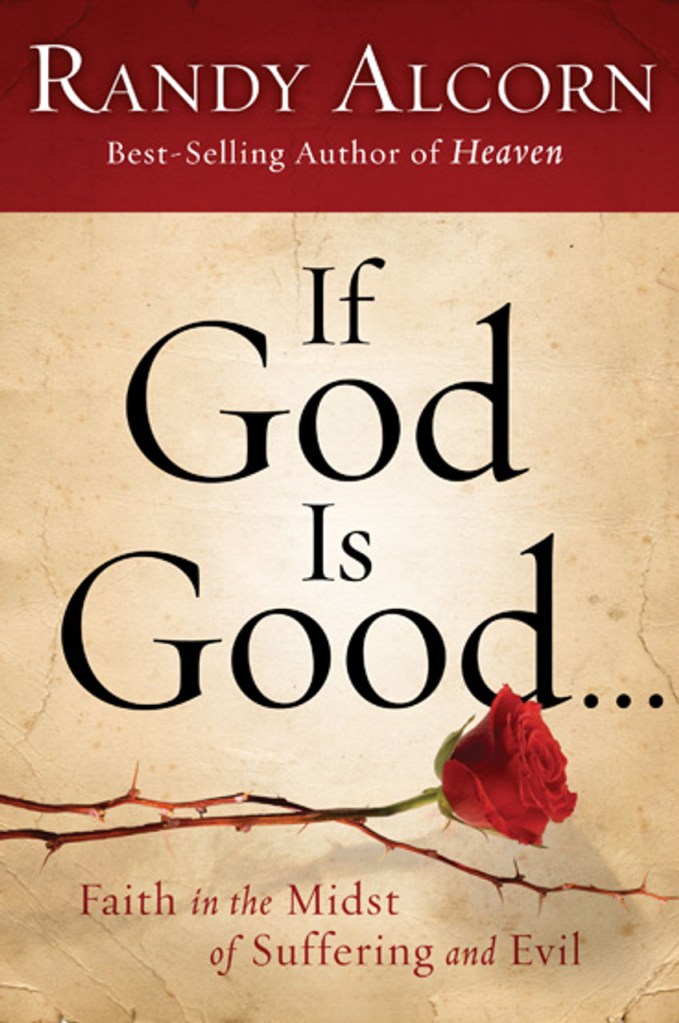
This article was adapted from Randy Alcorn’s book If God Is Good.
Just as Moses told the people of Israel to choose life by loving the Lord your God, obeying His voice, and holding fast to Him.
“Therefore choose life, that you and your offspring may live, loving the Lord your God, obeying His voice and holding fast to him, for He is your life and length of days, that you may dwell in the land that the Lord swore to your fathers, to Abraham, to Isaac, and to Jacob, to give them.” Deuteronomy 30:19-20
Jesus has told us that only He is the way the truth and the life.
“Jesus said to him (Thomas), I am the way, and the truth, and the life. No one comes to the Father except through me. If you had known me, you would have known my Father also.” John 14:6-7
What do you choose, life eternal, by accepting what Jesus has accomplished on your behalf or death? Jesus paid the price for our rebellion against God, how good is our God? Do not be like the Israelites who turned away from God and suffered the consequences of being cast out of the land God gave them.
“But if your heart turns away, and you will not hear, but are drawn away to worship other gods and serve them, I declare to you today, that you shall surely perish.” Deuteronomy 30:17-18 2
If you choose Jesus you will not perish, nor will you be left like orphans. Jesus made it possible for our Heavenly Father to send the third person of the Trinity to indwell our Spirit to be our helper, our counsellor, our teacher, and our comforter.
“I will not leave you as orphans; I will come to you… But the Helper, the Holy Spirit, whom the Father will send in my name, He will teach you all things and bring to your remembrance all that I have said to you.” John 14:18, 26
You can have all you need to live righteously in this life and begin to live in the knowledge that you have eternal life in Jesus through the indwelling power of the Holy Spirit. Start living eternal now ready for Jesus soon coming return. My book is available on Amazon as an ebook or trade paperback edition. I hope you will get a copy and put it into circulation.
Courage is the mental or moral strength to venture forward, persevere, and withstand danger or difficulty. Courageous faith rarely feels safe. It’s what Ed McCully, a classmate of Jim Elliot, described as living “a life of reckless abandon for the Lord, putting all my energy and strength into it.” Truly, it’s a risk. I want to encourage you to have the courage that’s born out of a Spirit-filled life. Jesus made it possible for our Heavenly Father to send the Holy Spirit to indwell all believers so it is imperative we allow Him to be our counsellor, our teacher, and our comforter and to use all of the nine ministry gifts He provides.
Listen to what Rachelle Starr, author of the new book, Outrageous Obedience says, What does courage that’s guided by faith involve? I’ll tell you that when you head into the clubs, you must be sensitive to the Holy Spirit. Yes, I need the Spirit every second of every day. But in the clubs, I am constantly praying, Jesus, give me words to speak to this dancer. Give me the wisdom to interact with this club manager. Help the awkwardness our team feels to not show on our faces. Help us to show your love instead.
1. The Spirit is consistent with his messaging. The Holy Spirit’s voice never says anything contrary to God’s revealed Word. In fact, the Bible teaches us that one of the Spirit’s jobs is to remind us of the things we’ve learned from God’s Word (John 16:13). The Holy Spirit is never going to tell you to hurt or gossip about someone. No, he’s going to prompt you to confess your sins, obey him, show love to someone who is difficult, or stop talking and listen to a friend who’s in pain. What he tells you will always agree with what God has already told you in the Bible.
2. The Spirit often speaks most clearly in the dark. We want to experience intimacy with God and clearly hear his voice, and I’ve found that we typically feel closest to him and hear him the loudest when we are in the darkest of places, in times of desperation. In those moments when I’m ministering in a dingy dressing room, I am intensely aware of how desperate I am for God’s help. The Spirit gives us words when we need them to bear witness (Mark 13:11). He is the Helper and Comforter who goes with us when it seems like everything is against us.
3. We must walk with the Spirit to know his voice. To hear the voice and promptings of the Spirit, you’ve got to know Him. You won’t hear His voice if you don’t recognize it from spending time with His Word. For me, this involves learning to quiet my soul; I can’t hear the Spirit if my life is too loud. The amazing thing is God wants to have a vibrant relationship with you, and the more you read God’s Word, the more he’ll speak to you. Yes, he speaks through the Bible, but having heard his voice in the Word will help you identify the Holy Spirit’s quiet promptings in your heart as well.
4. The Spirit moves us to action. The Holy Spirit brings you to a place where you need to express your faith. The Spirit leads you to active obedience to God’s commission, which requires making real adjustments in your life (Matthew 28:18–20; Acts 13:2, 15:28; 2 Corinthians 3:17–18). The adjustment may be small—like choosing to call a hurting friend—or it may be big—like moving your family across an ocean. But Spirit-empowered obedience almost always involves a courageous adjustment.
Jesus makes it plain that forgiveness is an essential requirement of all prayers. He also makes it abundantly clear that He will respond to all prayers of believers that are operating in obedience to God’s will, which will be the Holy Spirit’s leading.
Therefore I tell you, whatever you ask in prayer, believe that you have received it, and it will be yours. And whenever you stand praying, forgive, if you have anything against anyone, so that your Father also who is in heaven may forgive you your trespasses.”Mark 11:24-25
First, go and be reconciled to them” (Matthew 5:23-24). They may not forgive you, of course; they may reject your attempt or react with renewed anger over what you did, but then it becomes their problem, not yours. You will have done everything you could to let them know you regret what happened, and that you want their forgiveness.
Paul makes it clear that God answers humble prayers given with thanksgiving. We can also then be confident that the peace of God will “guard our hearts and minds“.
“Do not be anxious about anything, but in everything by prayer and supplication with thanksgiving let your requests be made known to God. And the peace of God, which surpasses all understanding, will guard your hearts and your minds in Christ Jesus.” Philippians 4:6-7
See what David has to say about prayer. He loves God because He knows God responds to his prayers. Note what David says about calling on God as long as he lives. Also, note David differentiates between his body and soul.
“I love the LORD because he has heard my voice and my pleas for mercy. Because he inclined his ear to me, therefore I will call on him as long as I live.” Psalms 116:1-2
“The LORD preserves the simple; when I was brought low, He saved me. Return, O my soul, to your rest; for the LORD has dealt bountifully with you.” Psalms 116:6-7
“For you have delivered my soul from death, yes, my feet from falling, that I may walk before God in the light of life.” Psalms 56:13
“For you have delivered my soul from death, my eyes from tears, my feet from stumbling; I will walk before the LORD in the land of the living.” Psalms 116:8-9
I love the following Scripture on prayer, it tells us so much 1. Rejoice always, 2. Pray without ceasing in allcircumstances, 3. When we do, rejoice, be thankful, and pray we are in the will of God, 4. Do not quench the Holt Spirit within you, 5. Do not despise prophecies (there are about 2000 prophecies of Jesus’ second coming), 6. Test everything, be Bereans, 7. Hold fast to what is good and reject the rest.
“Rejoice always, pray without ceasing, give thanks in all circumstances; for this is the will of God in Christ Jesus for you. Do not quench the Spirit. Do not despise prophecies, but test everything; hold fast what is good.”1 Thessalonians 5:16-21
Note what David said in these two Psalms, that he would do. We can at least do the same.
Thank Jesus for what He has accomplished for us – our salvation, recognising how costly it was for Jesus and our Heavenly Father.
Devote ourselves and all we have to His service.
Doing good is sacrifice, with which God is well pleased; and this must accompany giving thanks in His name.
We are not ashamed to be in God’s service and to invite others to join us. Such are true saints of God, in whose lives and deaths He will be glorified.
“What shall I render to the LORD for all his benefits to me? I will lift up the cup of salvation and call on the name of the LORD, I will pay my vows to the LORD in the presence of all his people.” Psalms 116:12-14
“I will offer to you the sacrifice of thanksgiving and call on the name of the LORD. I will pay my vows to the LORD in the presence of all his people, in the courts of the house of the LORD, in your midst, O Jerusalem. Praise the LORD!” Psalms 116:17-18
“I know that the LORD will maintain the cause of the afflicted, and will execute justice for the needy. Surely the righteous shall give thanks to your name; the upright shall dwell in your presence.” Psalms 140:12-13
What about the ten lepers who were healed by Jesus. Only one returned to give thanks to Jesus, and He was a Samaritan. Not one of the Jews, members of Jesus’ chosen nation, returned to give thanks.
“And as he entered a village, he was met by ten lepers, who stood at a distance and lifted up their voices, saying, “Jesus, Master, have mercy on us.” When he saw them He said to them, “Go and show yourselves to the priests.” And as they went they were cleansed.Then one of them, when he saw that he was healed, turned back, praising God with a loud voice; and he fell on his face at Jesus’ feet, giving him thanks.Now he was a Samaritan.Then Jesus answered, “Were not ten cleansed? Where are the nine? Was no one found to return and give praise to God except this foreigner?” And he said to him, “Rise and go your way; your faith has made you well.”
Do we thank God constantly for His Word as Paul and His fellow believers did? Sadly, His church is not even upholding the inerrancy of God’s Word let alone thanking Him for it.
“And we also thank God constantly for this, that when you received the word of God, which you heard from us, you accepted it not as the word of men but as what it really is, the word of God, which is at work in you believers.“1 Thessalonians 2:13
“Take hold of the eternal life to which you were called and about which you made the good confession in the presence of many witnesses.“1 Timothy 6:12
“Pursue righteousness, godliness, faith, love, steadfastness, and gentleness. Fight the good fight of the faith.” 1 Timothy 6:11
Have you taken hold of eternal life which was won for you by the sacrifice of Jesus on The Cross? By His sacrifice, Jesus made it possible for our Heavenly Father to send the Holy Spirit to indwell your Spirit to be your counsellor, teacher, and comforter. The Holy Spirit enables you to take hold of eternal life and prepare yourself for what is coming next: Jesus’ Millennial Kingdom on this earth. God has given us incredible detail on what plays out on this earth prior to Jesus’ return, first to raise the dead in Christ, and then to rapture all believers who are alive on earth. God then pours out His wrath upon an unrepentant world for one year and ten days.
The Day of the Lord extends from Yom Teruah of the Sixth Year of the 70th Week until Yom Kippur at the end of Year Seven which will be followed by a Jubilee year to start Jesus’ Millennial Kingdom.
A Jubilee year starts on Yom Kippur (Lev. 25:9) rather than on Yom Teruah (also called Rosh Hashanah) as most Jewish years do. This makes the year before a Jubilee year exactly one year and ten days long. This is the length of time we propose for the Day of the Lord (God’s Wrath).
God calls his Wrath both a day of vengeance and a year of recompense (Heb: SHILLUM, meaning “retribution”).
“For the Lord has a day of vengeance, a year of recompense for the cause of Zion.” Isaiah 34:8
On Tishri 10, the Jews celebrate the Day of Atonement (Yom Kippur) which is often referred to simply as “The Day.” Prophetically on this day, Jesus returns to earth, triumphs over evil, destroys the Antichrist, and redeems the Jewish remnant who will repent. He will “atone” for their sins.
A Jubilee year beginning precisely at the Second Coming (on Yom Kippur) would indeed fulfill the promise inherent in a Jubilee of “setting the captives free.”
“To proclaim the favourable year (Jubilee year) of the Lord, and the day of vengeance of our God.” Isaiah 61:2
The length of time God poured out His wrath upon the earth, the first time, was one year and ten days – Noah’s Flood. (calculated from Gen 7:11, Gen. 8:14). It is the same interval of time God will pour out His wrath prior to Jesus’ second coming to earth. Jesus said it will be like the days of Noah and so it will be in more ways than one.
“They came to life and reigned with Christ for a thousand years. The rest of the dead did not come to life until the thousand years were ended. This is the first resurrection. Blessed and holy is the one who shares in the first resurrection! Over such the second death has no power, but they will be priests of God and of Christ, and they will reign with him for a thousand years.” Revelation 20:4-6
Giving is more than a noble and compassionate act. It’s a giant lever positioned on the fulcrum of this world, allowing us to move mountains in the next world. When we die, we will see at last the incredible, eternal results of our giving.
Because we give, eternity will be different—for others and for us and our families. Giving away our money, possessions, time, and talents is a sacred opportunity to make a great and eternal difference. And it’s also our opportunity to enter into living the good life now.
The following story is extracted from Randy Alcorn’s book “Giving is the Good Life”
When he was young, Matt McPherson sought the Lord’s direction for his life. Matt built archery bows and asked God for the wisdom to build the best bows in the world. He developed the single-cam bow and now owns one of the world’s largest archery bow companies.
Matt started other business ventures, including McPherson Guitars, which he began with his father. Their goal is to make money to impact the world. They now fully support more than seven hundred missionaries worldwide.
Matt’s story is another one that makes me thank God for furthering His Kingdom by not calling some people to spend their lives as pastors or missionaries. There are millions of faithful business and professional people, including musicians, artists, and athletes, spread across the world. If Matt has fully funded seven hundred missionaries, how many tens of thousands of other missionaries have been able to go do their work because believers in secular vocations have faithfully used their gifts and passions to build businesses that generously send and support them? And while supporting missionaries, they themselves serve Christ in the unique mission fields of their businesses and neighborhoods.
Matt McPherson says, “When I’m dying, I’m not going to be wishing I’d bought myself something else. I’m going to be thinking, ‘I wish I would have done more for Christ.’”
I think Matt is exactly right. When we enter Christ’s presence, we’ll see with eternity’s clarity.
We’re called God’s servants, and we’re told it’s required of us that we “prove faithful” (1 Corinthians 4:2). So while we still have our earthly lives to live, why not sharpen our long-distance vision and grab hold of the good life now?
Why not make what will be most important to us when we die most important to us now?
Why not spend the rest of our lives closing the gap between what we are giving and what we will one day wish we’d given?
If you want help to start/build a kingdom business then can I suggest you consider purchasing my book on Amazon. It is available as an ebook or trade paperback edition.
Why should you be living eternally now? All believers will appear before the judgment seat of Christ and whilst our eternal destiny is safe what we have done will affect our rewards. For Christians that are raised in the first resurrection and are raptured with the living Saints, it is generally agreed that we will face the judgment seat of Christ during the time (Isaiah 34:8, Isaiah 61:2, Isaiah 63:4) we are in heaven before returning to earth with Jesus. If you disagree, keep in mind that these are not my words, but God’s. Jesus, speaking to both believers and unbelievers, said, “I tell you, on the day of judgment people will give account for every careless word they speak, for by your words you will be justified, and by your words, you will be condemned.” Matthew 12:36-37. Also, Paul said, “For we must all appear before the judgment seat of Christ, so that each one may receive what is due for what he has done in the body, whether good or evil”2 Corinthians 5:10
There are two different judgments in God’s Word: the judgment of faith, and the judgment of works. The judgment of faith relates to our eternal salvation, while the judgment of works relates to our eternal rewards.
For Christians, salvation took place in a moment in the past. It was free, it can’t be lost, it is the same for all Christians, and it is solely based on a faith that is ours by the grace of God alone. By contrast, future rewards are earned (by God’s grace), can be lost, differ among Christians, and are based on our efforts.
Salvation is about God’s work for us. Conversely, rewards are a matter of our work for God. When it comes to salvation, our work for God is no substitute for God’s work for us. God saves us because of Christ’s work, not ours. Likewise, when it comes to rewards, God rewards us for our work, not Christ’s. (Our good works are empowered by the Holy Spirit; nevertheless, we need to submit to Him so God refers to it as our work.)
Let me be sure this is perfectly clear. Christ paid the price for all of our sins, once and for all (Hebrews10:12-18). If we have trusted Him for that provision, we will not pay the eternal price, the second death. He has fully forgiven our sins, and we are completely secure in Christ’s love (Psalm 103:8-18; Romans 8:31-39). Our salvation is sure, and we will not undergo the judgment of condemnation (John 5:24; Romans 8:1).
But although the forgiveness of our sins has every bearing on our eternal destination, it has no automatic and effortless effect on our eternal rewards, apart from the fact that God’s sanctifying work comes out of our salvation, and therefore we should expect that the Holy Spirit’s presence in our lives should lead us to do good works that God will reward. But we must choose to do the works He prompts us to do. Neither does it mean our choices have no consequences in eternity. Forgiven people can still lose their rewards or forfeit eternal positions of responsibility they could have had if they’d served Christ consistently and faithfully before death.
Trust in Christ, lean on Him, and draw upon Him for power, for apart from Him we can do nothing. But if we hope to receive a reward, we must still do the necessary work. As our forefathers put it, to wear the crown we must first bear the cross.
Just as there are eternal consequences to our faith, so there are eternal consequences to our works.
What we do with our resources—including our time, money, and possessions—will matter not just twenty minutes, twenty days, or twenty years from now. It will matter twenty trillion years from now.
Though Paul insists we are saved by faith, not works (Titus 3:5), he also clearly states that the choices we make and the things we do have eternal implications, and that we will each answer to God for the works we have done in this life:
If anyone builds on this foundation [Christ] using gold, silver, costly stones, wood, hay or straw, their work will be shown for what it is, because the Day will bring it to light. It will be revealed with fire, and the fire will test the quality of each person’s work. If what has been built survives, the builder will receive a reward. If it is burned up, the builder will suffer loss but yet will be saved—even though only as one escaping through the flames. (1 Corinthians 3:12-15)
Those believers who have been less faithful and obedient in their walk with Christ will not suffer loss of salvation! But they will suffer loss of the reward that would have been theirs had they been more Christ-centered and faithful in their service to Jesus.
What 1 Corinthians 3 says is so sobering that a temporary loss doesn’t seem likely. This loss of rewards appears permanent, for while we will all serve God in our resurrected bodies on His New Earth, there appears to be a finality to the fact that after death comes judgment (Hebrews 9:27). If there are any future judgments for our service to God on the New Earth, we are not told about them in Scripture. Of course, we should anticipate for our future service He will say to all of his children, “Well done!” And yet, despite Scripture’s silence on this, I think it’s very possible that God, who is by nature a rewarder (), may continue to reward His people for faithful service on the New Earth. That resonates with me, and I don’t see anything unbiblical about it. It fully fits His nature as a Father who takes joy in saying “Well done” to His devoted children.
Earning Our Full Reward
First Corinthians isn’t the only passage that speaks of losing reward. The apostle John wrote, “Watch yourselves, so that you may not lose what we have worked for, but may win a full reward” (2 John 1:8, ESV).
To win a full reward would be glorious, wouldn’t it? But surely all of us will regret some of our decisions on that day when we “suffer loss” or “lose what we have worked for.” Anticipating standing before the judgment seat of Christ should motivate us to follow Him wholeheartedly and generate in us a proper fear of God.
All of us will be full of joy in Heaven, but those who served Him faithfully, particularly in the midst of adversity, will have been made, by God’s grace, into larger vessels. They won’t be fuller of joy, but they will have a greater capacity, and their fullness will accordingly contain even more joy. (Hence the special place in Revelation given to the martyrs.) There won’t be envy or regret, because of our new natures, and all will be full of joy, yet there will be true continuity and eternal consequence so that what we do—not just what we believe—in this life affects the next.
Maybe one way to say it is that the “loss” of rewards is in some sense permanent, but the “suffering” of that loss will be temporary. God will do away with the suffering (Revelation 21:4), but that is after the judgment, after we give an account to the Lord. The suffering of regret will be there at the judgment (how could it not be?) before entrance to the eternal state, but then comes the learning and purifying and eternal rejoicing. Perhaps we’ll offer a short, entirely sincere, “I regret my lack of faith and faithfulness,” expressing this to our God who graciously forgives. Then, with that forever behind us, we move on to eternal joy.
But there will be no ongoing suffering, for all our regrets about our past will be overshadowed by God’s grace. Yet if there were no reckoning, no “suffering loss” then the 1 Corinthians 3 passage would be meaningless (which is exactly what most teaching on the subject reduces it to). Some will object that this is a sort of Protestant purgatory, just shorter in duration than languishing in the flames of Catholic purgatory. But the suffering is not in the eternal state, only in a temporal judgment, and judgment must involve the negative as well as positive or it too is meaningless. The biblical statements of “giving an account” and that include “works done in the body, whether good or evil” are unmistakable in that regard. (Doing the evil will clearly have taken away from the rewards that would have come from doing good.)
Consequences without Condemnation
Since all who know Jesus go to the intermediate Heaven immediately when we die, it appears that whenever this judgment happens, it will be after we get there. So, while God will one day wipe away every tear from our eyes (Revelation 21:4), it seems likely that when we must give an account for our lives, there will be, for a time, some regrets and tears and a sense of that loss Scripture speaks of.
I realize this is hard to grasp. I am just trying to be true to all God’s Word says, instead of choosing only parts of it. This may sound like a sort of condemnation and punishment, but we are assured this isn’t the case, for “There is no condemnation for those who are in Christ Jesus” (Romans 8:1).
Ephesians 1:7 says, “In him [Jesus] we have redemption through his blood, the forgiveness of sins, in accordance with the riches of God’s grace”. The Bible teaches not only forgiveness of our sins but also consequences for our choices. These consequences apply despite our forgiveness. Forgiveness means that God eliminates our eternal condemnation; we will not be ultimately punished for our sins, but there may be immediate consequences in this world due to our sins. Forgiven people can still contract AIDS, go to jail for drunk driving, or suffer the death penalty, for example. A murderer or drug dealer can be fully redeemed and forgiven, and may still spend the rest of his life in prison. He may lose his family as well as his freedom. After all, the thief on the cross remained there despite his confession of faith.
In Heaven, God appears to say that while all our sins will be forgiven and there will be no ongoing shame or regrets, nevertheless at the judgment seat an initial and temporary sense of shame, regret and sorrow seems likely, though one that will soon be swallowed up by eternal grace and joy.
Prepared for Good Works
One of the most often quoted passages in Scripture states, “For it is by grace you have been saved, through faith—and this is not from yourselves, it is the gift of God— not by works, so that no one can boast” (Ephesians 2:8-9).
It’s a wonderful truth, but verse 10 immediately follows with more truth about works: “For we are God’s handiwork, created in Christ Jesus to do good works, which God prepared in advance for us to do.” God has prepared a lifetime of good works and we will give an account to Him for whether or not we have done them.
Surely each of these passages and others like them implies that while we will be fully forgiven in Christ and be forever totally cleansed and purified by His redemptive work, we will nonetheless be held accountable for what we have and haven’t done in this life.
It seems reasonable we won’t be joyful at the very moment we have to give an account for our sins, the careless words we have spoken, and all the wood, hay, and straw of our lives that will be consumed in the fire, that could have instead been gold and silver and precious stones. And at the same time, we will find great pleasure in the rewards God has given us, and we will celebrate the rewards He gives to others.
Embracing Paradox
But how does this all fit with the truth about the forgiveness of our sins? I think of the example of Charles Spurgeon, who didn’t try to reconcile every paradox or apparent contradiction in the Bible. Speaking of the truths of God’s sovereignty and human responsibility—which I also believe to be applicable to the truths of complete forgiveness and accountability at the judgment Spurgeon said this:
“These two truths, I do not believe, can ever be welded into one upon any human anvil, but one they shall bein eternity: they are two lines that are so nearly parallel, that the mind that shall pursue them farthest, will never discover that they converge; but they do converge, and they will meet somewhere in eternity, close to the throne of God, whence all truth doth spring.“
Spurgeon also wrote, “Those who will only believe what they can reconcile will necessarily disbelieve much of divine revelation.” Our desire for logical consistency, as we understand it, can become our God. Then we, not Scripture and not God, become our own ultimate authority. We end up ignoring, rejecting or twisting Scripture that doesn’t fit our chosen theology.
On the contrary, our theology should reflect Scripture itself, and wherever Scripture teaches apparently contradictory ideas, our theology should embrace those same ideas, rather than resort to a consistency that rejects part of God’s revealed Word.
Certainly, any and all of our regrets about our past will be overshadowed by God’s grace, which is the good news of the Gospel. There is comfort in 1 Corinthians 4:5, which says God “will bring to light the things now hidden in darkness and will disclose the purposes of the heart. Then each one will receive his commendation from God.” God will apparently find something to reward “each one” for. This makes sense, for no one can truly be born again without having demonstrated some fruit for which God can reward us.
Let’s Live in Light of Eternity Now
All of this argues for cultivating an eternal perspective in which we seek to live each day in light of eternity—not out of dread, yet with the right kind of fear of God and heartfelt love that desires to please our Lord and Savior.
In his book When Christ Comes, Max Lucado writes, “You can be certain you won’t regret any sacrifice you made for the kingdom. The hours of service for Christ? You won’t regret them. The money you gave? You’d give it a thousand times over. The times you helped the poor and loved the lost? You’d do it again. . . . You’d change the diapers, fix the cars, prepare the lessons, repair the roofs. One look into the faces of the ones you love, and you’d do it all again.”
An eternal perspective isn’t something we have to wait until Heaven to have. So I’ve often given readers and listeners this advice: live now the way that you will one day wish you would have. Don’t postpone obedience, holiness, purity, drawing close to God, and serving others.
Five minutes after we die, we’ll know exactly how we should have lived—it will be too late to go back and change anything. God has given us His Word so we don’t have to wait until we die to know how we should have lived. There’s no second chance for the unbeliever—but also no second chance for the believer! Just as missionary C. T. Studd said, “Only one life, ’twill soon be past; only what’s done for Christ will last.”
You and I have one life on this fallen earth in which to follow Jesus and invest in Heaven. Let’s not miss the opportunity. God will one day take away all our sorrows, but why go into eternity with regrets? Here’s a prayer for us: May what will be most important to us five minutes after we die become most important to us now.
Let me add KNOW YOUR WHY:
To bring glory to God
To know God’s will for your life
God wants to use me to bring people into His Kingdom
Adapted from the article: “Will We Have Regrets at the Judgment Seat of Christ?” December 5, 2022 by Randy Alcorn http://www.patheos.com
Living Eternally Now is available o Amazon or from me direct: ron@bakb.com.au




 LIVING ETERNAL NOW