Somalia Suffers Worst Terrorist Attack in its History: 276 Have been Killed.
At least 276 people have died in a deadly bomb attack on Saturday in what is being called Somalia’s worst terrorist attack in the country’s history.

BBC News reports that the massive bombing occurred in a busy part of Mogadishu, the country’s capital. No group has yet taken responsibility for the attack, although the al-Shabaab terrorist group is known for targeting the region.
Only 111 of the dead have been identified by family members. One hundred sixty-five others will be given a national mass funeral and buried by the government.
Heartbreaking stories have been emerging from Somalia in the wake of the bombing. One victim, Maryam Abdullahi, had been in medical school and was due to graduate the day after the bombing took place.
Maryam’s father had flown to Mogadishu to celebrate her graduation, but instead ended up mourning her death.
“The family is so shocked, especially our father who travelled all the way from London to attend her graduation, but instead he attended her burial,” said Maryam’s sister, Anfa’a.
Witnesses and survivors of the attack say it was unlike anything they’ve ever seen. Local resident Muhidin Ali said it was “the biggest blast I have ever witnessed, it destroyed the whole area.”
“What happened yesterday was incredible, I have never seen such a thing before, and countless people lost their lives. Corpses were burned beyond recognition,” added Mohamed Yusuf Hassan, the director of the Madina Hospital in Mogadishu.
Are Coptic Christians Celebrating the Martyrdom of Their People Too Much?

The 2,000-year-old Coptic Church of Egypt has a long tradition of hallowing those who died affirming their faith in the face of violence.
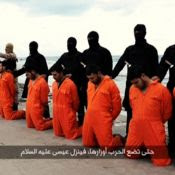
But the group that calls itself the Islamic State has launched waves of attacks on the Coptic community in recent years – claiming at least 70 lives and wounding scores of others – an unrelenting assault that has opened a debate in the community about martyrdom.
The issue has been most recently punctuated by the deadly knifing of a Coptic priest in a poor Cairo neighbourhood Thursday (Oct. 12). A suspect was arrested but his motive is still unknown.
Recently, another Coptic priest — the well-known Rev. Boules George from the well-heeled Cairo suburb of Heliopolis — took to the television airwaves to “thank” the Islamic State terrorists who launched the Palm Sunday church bombings that claimed 45 lives, saying they provided “a rocket” that delivered victims straight to heaven.
“Thank you very, very, very much,” George told the viewers of his program on Egypt’s Coptic TV channel just hours after the terror attacks. “You have given us the death of Christ himself, and this is the greatest honor that of any of us can attain.”
The Islamic State intensified its insurgency in the Sinai Peninsula and targeted Copts, Coptic churches, police and military facilities in Egypt after the 2013 ousting of ex-President Mohammed Morsi, a member of the Muslim Brotherhood.
Glorifying a particularly bloody December attack on a Cairo church, the militants in February released a video declaring that Christians in Egypt were their new “favorite prey” and pledging to wage a “jihad” similar to that in Iraq and Syria, where tens of thousands of Christians have become refugees after fleeing the militants.
Comprising an estimated 10 percent of Egypt’s 90 million people, the Coptic Church is the largest Christian denomination in the Middle East and North Africa.
“We are Egyptian citizens as well as Christians,” said Al-Janoubie. “We need to stop viewing this harassment toward us with pride and saying terrorism gives us a chance to play the same role our ancestors did like in those Sunday school stories about the torture of martyrs.”
Coptic leader Pope Tawadros II, however, has publicly supported the idea that the church derives strength from these deaths of the faithful.
“The blood of our martyrs, the tearful prayers of our monks, and the sweat of all those who serve the church is the source of our spiritual power,” said Tawadros in a Sept. 13 message to the faithful.
Some in the hierarchy of the Coptic Church say martyrdom is widely misunderstood.
“It is true that we love martyrdom, but we also love life,” said Bishop Raphael, the No. 2 man in the Coptic curia. “We do not hate life on earth, because our Lord created us to live in it, not to die.”
This summer, Raphael implemented an Egyptian Interior Ministry directive to suspend church events in difficult-to-secure locations in order to minimize exposure to new attacks. “The fact that we receive death with a spiritual philosophy does not mean that our blood is cheap,” said the bishop.
Still, Raphael is calling for erecting a new church dedicated to the 28 martyrs of a jihadist attack in May that occurred on a desert road between the Egyptian city of Minya and the monastery of Samuel the Confessor — a sixth-century saint tortured at the hands of a rival Byzantine Christian sect.
It’s hard to argue against martyrdom for the 28 people who died in the attack, some community members say. Survivors said their assailants ordered them to fast because it was the Islamic holy month of Ramadan, killed their husbands and brothers, and ordered them to convert to Islam.
“After spraying us with gunfire and taking our jewelry, they ordered the women and children who were still alive to recite a testimony to convert to Islam,” said Hanan Adel, a 28-year-old survivor.
As can be expected, these horror stories don’t inspire all Copts to embrace martyrdom.


 LIVING ETERNAL NOW