
In his 1841 poem “The Player” (also translated as “The Fiddler”), Karl Marx writes, “Look now, my blood-dark sword shall stab/Unerringly within thy soul./God neither knows nor honors art./The hellish vapors rise and fill the brain/Till I go mad and my heart is utterly changed.” He continues, “See this sword—the Prince of Darkness sold it to me,” and, “Ever more boldly I play the dance of death.”
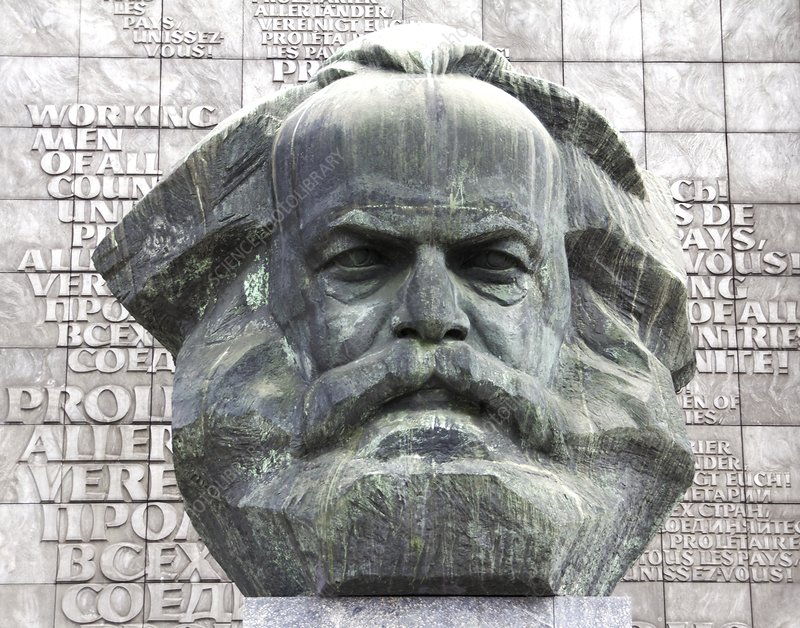
Karl Marx monument by Soviet sculptor Lev Kerbel in Chemnitz, Saxony, Germany. The head is 7m high, made of bronze and erected in 1971. Behind Marx there’s a huge frieze exhorting ‘Workers of the world, unite!’ in several languages.
An analysis of the above poem from biographer Robert Payne, in his 1968 book “Marx,” states, “Marx is here celebrating a satanic mystery, for the player is clearly Lucifer or Mephistopheles [a Faustian devil], and what he is playing with such frenzy is the music which accompanies the end of the world.”
He continues, “Marx clearly enjoyed the horrors he depicted, and we shall find him enjoying in very much the same way the destruction of whole classes in the ‘Communist Manifesto.’ He was a man with a peculiar faculty for relishing disaster.”
“There can be very little doubt that those interminable stories were autobiographical,” wrote Payne. “[Marx] had the Devil’s view of the world, and the Devil’s malignity. Sometimes he seemed to know that he was accomplishing works of evil.”
However bizarre Marx’s early writings were, his stated claims and goals were not far from the reality of what he created: a system that in a single century took an unprecedented number of lives. Estimates vary, but according to combined research from historians, including Aleksandr Solzhenitsyn, Jung Chang, and Jon Halliday, and numbers collected by “The Black Book of Communism,” published by Harvard University Press in 1999, the number is close to 150 million deaths.

