Noah’s Ark & Flood Movie in Select Theaters in the U.S.A. March 20–21, 2024. The movie site states:
There is a tale over 4,000 years old, preserved in ancient writings from every major culture around the world. Many thought it was only a myth, but recent discoveries confirm what the Bible has said all along. From the Director of Genesis: Paradise Lost, Sevenfold Films and Genesis Apologetics present The Ark and the Darkness. Geology, paleontology, the fossil record, ancient history, volcanism, earth science—all of these scientific fields converge on one simple truth: Noah’s Flood actually happened. Join the team of scientists from Answers in Genesis and Liberty University as they reveal the truth about Noah’s Flood.
A Christian creationist group in California (Genesis Apologetics) released the new movie on the flood called The Ark and the Darkness that will have limited showings in a number of movie theaters across the nation on March 20–21.
This is a documentary-style movie with some impressive animation, and it features various interview segments with a number of creation scientists, including some from Answers in Genesis (such as AiG’s geologist Dr. Andrew Snelling, paleontologist Dr. Gabriela Haynes, and researcher and speaker Dr. Terry Mortenson).
If there really was a global flood—as the Bible states—then there should be abundant evidence of that fact.? But what would that evidence look like? And who could be better placed to ‘see’ such evidence than a scientist who studies the way that floods and flowing water shape landscapes? Join fluvial geomorphologist, Dr Ron Neller, for a fascinating discussion of the evidence that, over 30 years, eventually led him to conclude that there has, indeed, been a global flood on Earth—as the Bible describes. His faith journey took over 30 years in an antagonistic university environment.
I believe the end times church will be as described in the Book of Acts: it will be a House Church Movement largely due to the persecution of Christians that will be prevalent at that time. Very similar to the underground churches in China during the time of Chairman Mao and the house churches in most Muslim countries today.
Our beliefs are the framework in which faith and values exist. God is holy and He created humanity for relationship with Him. His ways are higher and His principles are flawless.
Because of Adam’s and Eve’s disobedience, the Holy Spirit departed their spirits so all of their descendants lack the Holy Spirit to enable them to live a holy life pleasing to God. The penalty for Adam and Eve’s disobedience was death, first spiritual death when they lost the Holy Spirit and then physical death. The good news is that God through His son Jesus was prepared to become a man, live a sinless life, and by His death pay the price for mankind’s rebellion/sin. When we repent of our sin and are prepared to accept Jesus as our Lord and Saviour then God the Father sends the Holy Spirit to indwell our spirit enabling us once again to be in fellowship with Him and live a holy life. We are a new creation.
“Therefore, if anyone is in Christ, he is a new creation. The old has passed away; behold, the new has come. All this is from God, who through Christ reconciled us to himself and gave us the ministry of reconciliation; that is, in Christ God was reconciling the world to himself, not counting their trespasses against them, and entrusting to us the message of reconciliation.” 2 Corinthians 5:17-19
Notice that all of us have been given the ministry of reconciliation to bring others to Jesus Christ.
Our beliefs must be based on the following scriptures.
“We believe in one holy, perfect, and eternal God, self-existing in three persons: Father, Son, and Holy Spirit; distinguishable but indivisible.” Deuteronomy 6:4; Matthew 28:19; 2 Corinthians 13:14
“We believe the Bible is the divinely inspired Word of God – accurate and applicable to our lives.” 2 Timothy 3:16; 2 Peter 1:19-21; 1 Corinthians 2:13
“We believe that God created the world and everything in it just 6000 years ago. He created it in six days and rested on the seventh solely as a pattern for how we are to live: we will work six days and the seventh day will be a sabbath rest. We believe that humanity was created in the image of God to know him and to enjoy him, that God gave every human being free will, and humanity’s choice to sin has separated each of us from God and His purpose for our lives whereby we are completely unable to attain right-standing with God on our own merit.” Romans 5:12, 18-19
We believe God judged the earth with the worldwide flood of Noah’s day just ten generations after Adam. Only eight people survived, Noah’s family, to repopulate the earth. The flood resulted in billions of dead things being buried quickly all over the earth and created the fossil fuels that we use today. Evolutionists deny there was a worldwide flood and try to justify evolution by adding billions of years to Earth’s history.
“Now the earth was corrupt in God’s sight, and the earth was filled with violence. And God saw the earth, and behold, it was corrupt, for all flesh had corrupted their way on the earth. And God said to Noah, “I have determined to make an end of all flesh, for the earth is filled with violence through them. Behold, I will destroy them with the earth. Make yourself an ark of gopher wood. Make rooms in the ark, and cover it inside and out with pitch...” Genesis 6:11-14
Less than two hundred years following the worldwide flood God had to step in and confuse the languages and create the nations so that once again a disobedient people would do as He instructed them, “Be fruitful and multiply and fill the earth.“
“Come, let us build ourselves a city and a tower (Tower of Babel) with its top in the heavens, and let us make a name for ourselves, lest we be dispersed over the face of the whole earth.” Genesis 11:4
“Come, let us go down and there confuse their language, so that they may not understand one another’s speech.” So the Lord dispersed them from there over the face of all the earth, and they left off building the city.” Genesis 11:7-8
God established His nation, Israel from one man Abraham to represent Him on Earth. One of the greatest miracles that proves God’s existence is the Exodus and God establishing Israel in the land God gave them. It is amazing that even before they entered the promised land God told them through Moses that they would be driven out by God into other nations but He would regather them at His prearranged time. In 1948 the miracle of Israel’s restoration began which is the most significant prophesied end times event signaling Jesus’s soon coming return.
“And when all these things come upon you, the blessing and the curse, which I have set before you, and you call them to mind among all the nations where the Lord your God has driven you, and return to the Lord your God, you and your children, and obey his voice in all that I command you today, with all your heart and with all your soul, then the Lord your God will restore your fortunes and have mercy on you, and He will gather you again from all the peoples where the Lord your God has scattered you.“Deuteronomy 30:1-3
“We believe that our Lord and Saviour Jesus Christ changed history BC and AD. He is the only one who can reconcile us to God; who, though fully God, became both God and man through conception by the Holy Spirit and was born of the virgin Mary. His sinless life made possible His death as perfect atonement for all humanity. This is entirely by means of God’s grace offered to us.” Romans 5:12, 18-19
“We believe that Jesus Christ gave up His life on the cross, was buried, and rose again on the third day. He defeated death by resurrection power, appeared to many including His disciples, ascended to heaven, and will come again to establish His Millennial Kingdom with the resurrected Saints, prior to the White Throne judgement and creating a new Heaven and new Earth where only the righteous will dwell. We believe this is the Biblical way of seeing the whole world which empowers us to live every day as Jesus did in subjection to the Holy Spirit.” 1 Corinthians 15:1-4; 2 Corinthians 6:14, 7:1; Romans 4:25; John 14:2-3; 1 Thessalonians 4:13-18; Ephesians 5:18
“We believe that water baptism by immersion is an outward act of obedience, and a public demonstration of faith and discipleship, by everyone who chooses to acknowledge Jesus Christ as their Lord and Saviour.” Matthew 28:19; Acts 2:34-36, 19:1-6
“We believe the baptism in the Holy Spirit is a distinct experience given by God. Speaking in unknown languages is significant evidence of this experience and is available to every believer. The key to this event is not simply the gift of tongues, but rather empowerment to operate in every gift the Spirit gives us including miracles, deliverance, healing, freedom, and all manner of excessive generosity as a part of bringing the reality of God to our world.” Acts 2:1-4, 4:30, 8:14-17, 10:44-45; Galatians 3:14; Jude 1:20; Romans 8:11; 1 Corinthians 12:9; James 5:14; Mark 16:17; Ephesians 4
“We believe in the reality of the spiritual realm – angels and demons, heaven and hell, the existence of the devil, and God’s ultimate judgment upon him and his fallen angels. We believe in the eternal life of believers and eternal separation from God for unbelievers with a second death.” Matthew 25:41; John 3:16, 3:36, 5:24; 2 Thessalonians 1:8-9; Revelation 2:11, Rev. 29:6, Rev. 20:14, Rev. 21:8, Rev. 20:10–15
“We believe all human life is a gift from God and that life is sacred from the moment of conception. Each person has a divinely ordained purpose, irrespective of the circumstances and we uphold the sanctity of human life from conception. We believe God’s intention for marriage is one man and one woman and that all sex is reserved for marriage, as God intended it.” Genesis 1:27-28, 2:24; Psalms 139:13-16; Proverbs 5:15-19; Jeremiah 1:5; Matthew 19:4-6; Mark 10:1-9; Luke 1:15; Ephesians 5:22-23; 1 Corinthians 6:9, 7:1-4; Galatians 5:16
“We believe that because of our sinful nature and the brokenness in our world, we all struggle with varying issues, but the heart of God is to bring forgiveness and restoration to those who seek it. Through grace and truth, personal healing and reconciliation to God are available to all.” Psalm 23:3; Jeremiah 29:11-14; Luke 4:18; John 1:14,17, 8:31-32; Acts 3:19-21; Romans 6–8; Galatians 6:1; Hebrews 4:16; 2 Corinthians 12:8-9
The authors survey the ancient chroniclers for durations to the Flood and to Creation. We find that the ancient chroniclers unanimously placed the Flood in the twenty-fourth century BC. Several durations to Creation also agree with Ussher’s date within ten years (The Ussher chronology is a 17th-century chronology of the history of the world by James Ussher, the Archbishop of Armagh and Primate of All Ireland)
We were surprised to find how closely chroniclers from ancient nations agree with each other and the Ussher chronology. Not only are there precise durations to the Flood and Creation from several civilizations, but a considerable amount of history from the antediluvian era has been preserved, albeit now covered under layers of superstition and idolatry.
The Hindu texts preserve a great deal of chronological and historical data, which has been overlaid and interpreted through the lens of much later Gnosticism. The Hindu word buddha originally meant a sage or prophet, millennia before it came to mean a particular god (Hamilton 1820, 289).
The oldest Hindu texts describe Adam, Enoch, and Noah as buddhas, which originally meant prophets (Hamilton 1820, 114–120). However, they also refer to the first ten generations of prediluvian patriarchs as “avatars” or incarnations of God, (Hamilton 1820, 10) which we obviously reject.
The Chinese remember the first ten patriarchs as legendary emperors, and also preserve surprisingly detailed chronological details about some of them, as well as the history of Noah’s post-flood career.
Stellar Observations: Chinese and Babylonian sources seem to indicate that the earliest astronomical observations after the Flood date back to 2295 B.C. (Spineto 1845, 404). The Shû King records that Emperor Yâo ordered the construction of four observatories as the first priority after the Flood. In Griffith and White (2023), we calculated the date of Yâo’s reign as having begun in 2347 B.C. Some Chinese scholars calculate it as 2357 B.C.
Chinese: Alexander Hamilton states: “the Chinese annalists . . . place the deluge of Yau in the same year that the Hebrews place the flood of Noah, . . .” (Hamilton 1820, 345). This calculation was based on the reigns of the first three post-Flood dynasties, as opposed to astronomical calculations.
Hindu Astrological: “the year 2352 was obtained by the Hindus from a purely astronomical calculation . . . for this implies their opinion that the history of the world went back no further” (Browne 1844, 567). The Flood generally marks the beginning of known world history, as the Hindus considered the era before the Flood as the reign of the gods. Browne suggests this calculation was made in 204 B.C., which happens to be when the vernal equinox was leaving Aries. If so, this suggests the Hindus believed the vernal equinox was in the cusp of Taurus at the time of the Flood. We will repeat what we believe this calculation to have been in the astronomical section of this paper.
Diodorus states that the Egyptian priests maintained that “when mankind first appeared on the earth [after the Flood]; . . . but from the Trojan War, less than twelve hundred [years]” (Diodorus 1935, Book 1, §24.2). Since the Trojan war ended 1184/1183 B.C., less than 1,200 years yields a date below 2383 B.C. for the date of the Flood. Assuming Diodorus rounded to the nearest hundred, the Flood probably occurred between 2383 and 2333 B.C.
Eusebius cites Varro as computing that the Flood was 1,600 years before the Olympic aera, (Eusebius 2002, PrEv. 10.10) which yields 2376 B.C., plus or minus 50 years.
Censorinus dates the flood of Ogyges as less than 1,600 years before the first olympiad (Williams 1789, 250). He seems to have confused the much later flood of Ogyges with the Deluge, as several other Greek sources did with both the floods of Ogyges and Deucalion. This section is confusing; however, he gives values that sum up to between 1,400 to 1,514 years prior to the first Olympiad (Censorinus 2000, 30–31).
Bunsen quotes Censorinus as being more precise: “same year is referred to by Censorinus, about 238 A.D., who states, on the authority of Varro, ‘the most learned of the Romans,’ born 116 B.C., that the Flood took place about the year 2360” (Bunsen 2017, 11).
“This Nembrot [Nimrod], says Berosus, built Babylon 130 years after the flood” (Raleigh 1829, chapter 8). One hundred and thirty years before 2233 B.C. yields 2363 B.C. However, he may be referring to the Dispersion, in which case, 2191 + 130 yields 2321 B.C.
We find that the sources who used Berossus to determine the date of the Flood measured 1,000 years before the Fall of Troy, and then added 163 years to the date of the Flood. 1184 + 1,000 + 163 = 2347 B.C.
Nevertheless, 2363 B.C. is consistent with the testimonies of Diodorus, Varro, and Censorinus.
Polyhistor used this value also: “a kingdom at Babylon, 163 years after the flood, according to Polyhistor” (Williams 1789, 250).
Assuming that Polyhistor used 1,000 years before the Fall of Troy in 1183 B.C. as the date for the first kingdom in Babylon, then 163 years before 2184 B.C. yields 2347 B.C., matching Ussher’s date for the end of the Flood.
However, according to our triangulations from Griffith and White (2023), the first kingdom in Babylon after the Dispersion started in 2192/2191 B.C., yielding 2354 B.C. for the Flood using this 163-year duration.
756 Years after the Kali Yuga: Confucius dated the Flood as occurring in the 757th year of the Kali Yuga (Hamilton 1820, 316). This value is given as 3,267,000 ages from the Kali Yuga, which, divided by the 4,320-cipher of the Hindus and Chinese, yields 756.25 years (Hamilton 1820, 332). The Hindus calculated time before the Flood in double hours, reported as “years.” We demonstrated that the astronomical date for the Kali Yuga was 3104 B.C. in Griffith and White (2023), by counting from three different events: the Hijrah, the birth of Moses, and the Usurpation of Pradyato, all of which occurred after the Flood. Counting 756 whole years from 3104 B.C. gives 2348 B.C. for the Flood, agreeing exactly with Ussher.
The Deluge occurred in the 47th year of a Grand Cycle: “the world by the Hindus and Chinese, and the commencement of their cycles agree, each placing the deluge in the 47th year of a cycle” (Hamilton 1820, vol. 1, 332). The year 2349/8 was the forty-seventh year of the fourteenth sixty-year cycle from the start of the Grand Cycle in 3176 B.C. (Griffith and White 2023, 151.
Cush’s Reigns: 62/55/42 years: Belus, whom we believe to have been Cush, ruled Babel until 2192/2191 B.C., and is said to have reigned 62 years (Russell 1865, 379) by Scaliger and 55 years by Syncellus quoting Africanus (Clinton 1824, vol. 1, 267), all three of whom were redactors of Ctesias. We believe both values refer to events in the reign of Cush, called Belus, or Bel Marduk.
Cush could only have ruled in the city of Babel from the time it was founded in 2234/2233 B.C. until the Dispersion in 2192/2191 B.C. or 42/43 years, since, “At the end of forty two years after the building of the Tower, Ninus son of Belus took the kingship of the world” (Macalister 1941, §13).
However, the Babel project must have been the result of many years of planning and organization. This is evidenced by its founding on the conjunction of the New Moon with the Vernal Equinox in 2233 B.C. (Cullimore 1833, 167, 180). This suggests they anticipated this conjunction and deliberately waited for this date to establish the city or its temple. Therefore, it is not unreasonable to postulate that Belus/Cush began to rule in some fashion a decade or more before the city was founded.
Cullimore (1833, 165) states “The building of this tower is by profane writers uniformly ascribed to Belus.” Cush’s rule over his tribe would have started earlier when the land was divided around the time of Peleg’s birth. The two longer durations for his length of reign, which predate the founding of Babel, may be explained by two divisions of territory as reported in the Book of Jubilees (Charles 1913, Jubilees 8.8-10).
Berossus gives 34,080 days, which is 93.3 Julian years, or 94.6 years of 360 days then used by ancient Babylon, from the Flood until the first dynasty of Babylon, when by inference, Belus/Cush began to rule. 94.6 plus 62 is 156.6 years; 156 years before the Dispersion in 2192/2191 B.C. yields 2348/2347 B.C. for the Flood, and 2254/2253 B.C. for the First Territorial Division.
The Hindu records give 150 years from the Division of the Earth until the Usurpation of Pradyato (Hamilton 1820, 124). Pradyato was a Cushite who conquered the nascent Indus civilization and took over the government. This Usurpation was also given as 1,000 years after the Kali Yuga. Subtracting 756 years to the Flood from the Kali Yuga, as well as the 150 years of self-rule by the Hindus, we find that the division of the world was 94 years after the Flood began, which is 93 years after the end of the Flood. This triangulates, confirming that our interpretation of the 34,080 days is correct.
Syncellus cites Africanus in his epitome of Ctesias who gives the reign of Belus, whom we consider to have been Cush, as 55 years (Clinton 1824, 267), which by our reckoning would be from the birth of Peleg in 2247 BC (Ussher 2005, 21, §47) to the Dispersion in 2192/2191 B.C. Thus, it appears territorial division may have been a seven-year process that began in 2254 B.C. and was finalized in 2247 B.C., both confirming the Flood was in 2348/2347 B.C. Adding 101 years from the Flood to Peleg in the MT to the 55 years of Belus gives 156 years from the end of the Flood to the Dispersion, again triangulating 2348/2347 B.C. for the Flood.
Semiramis I: 312/313 years: The Annals of Clonmacnoise state that Semiramis’ rule started 313 years after the Great Flood. “Ireland long time after the flood lay waste until . . . after the flood 313 years . . . in the 1st year of the Raigne of Semiramis then monarchs of the world in Assiria” (McGeoghagan 1896, 12–13). The Irish Annals of Clonmacnoise state that Semiramis began to rule 312 years after the Flood (Percy 1823, 270).
2036/2035 BC, AP-21 Reign of Semiramis I; plus, 313 years; gives: 2349/2348 BC for the Flood
Emperor Yâo’s Reign 2347 BC: We found in a previous paper (Griffith and White 2022b, 422) that Yu of the Xia Dynasty of China began to reign in 2197 B.C. His predecessors Yâo and Shun reigned for a total of 150 years. Emperor Yâo’s reign was said to have begun when the Flood had ended.
2197 B.C., AP-4 Reign of Yu/Xia; plus, 150 years of Yâo and Shun; gives: 2347 B.C. end of Flood
George Barna, director of research at the Cultural Research Center on the findings from his research said,
“The ideological and philosophical confusion that characterizes America today is perhaps the biggest reflection of the nation’s rejection of biblical principles and its decision to replace God’s truth with ‘personal truth.‘”
Using recent data from the American Worldview Inventory, which is the first-ever national survey conducted in the United States measuring the incidence of both biblical and competing worldviews, Barna shows how the four adult generations in the U.S. — millennials, Gen X (baby busters), baby boomers and elders — had very different spiritual responses to the pandemic.
The research, which involved the tracking of a nationally representative sample of 2,000 adults undertaken in January, showed the lowest incidence of adults with a biblical worldview among the youngest cohorts, millennials, adults born between 1984 and 2002, and Gen X, adults born from 1965 through 1983.
The data show that of the four generations, millennials had the lowest incidence of biblical worldview at 2%. Their connection to Christianity was also shown as quite weak before the pandemic and “was even weaker by the end of the COVID-19” pandemic.
“Millennials were hit hard by the pandemic in dimensions such as their emotions, finances, vocation, relationships, and ideology,” Barna wrote.
Only 5% of Gen X adults held a biblical worldview, according to the data. The study shows that Gen X endured the greatest degree of “spiritual turbulence,” with 10 statistically significant changes and two notable directional changes.
“In all but one instance, those changes showed Gen Xers moving away from biblical perspectives or behaviors. In general, the nature of the spiritual transitions among Gen Xers during the pandemic era was a shift away from trust in God.
Among the biggest changes in their religious perspective was the decline in believing God created humans, that He is the basis of truth, and that He is the omniscient and omnipotent ruler of the universe,” Barna noted.Proof that the teaching of evolution in schools and universities has been one of Satan’s greatest strategies to undermine belief in God’s Word.
“Those doubts have precipitated important transitions in religious behavior, including less frequent Bible reading, church attendance, confession of personal sin, seeking to do God’s will, and worshiping God. Another noteworthy shift is the decline in how many Gen Xers believe that human life is sacred.”
Baby boomers, adults born between 1946 and 1964, and elders, adults 77 and older, were shown to be the most likely among adults to hold a biblical worldview. However, they were still in the minority among their respective cohorts and showed declines over the course of the pandemic.
The biblical worldview incidence among boomers dropped from 9% to 7% over the past three years, while it dropped among elders from 9% to 8%.
“The last three years have been a time of high anxiety for tens of millions of adults. It was an ideal time for the Christian Church to provide wise guidance and emotional calm. Unfortunately, most churches agreed to the government’s dictate that they close their doors and remain mostly silent. That left an unprepared populace to follow the primary form of leadership available to them: government perspectives and policies,” Barna argued.
“Obviously, that has not worked well, given how dissatisfied a large majority of the country is with the direction of the nation and the quality of post-COVID life. With only one out of every 50 millennials embracing a biblical worldview, America’s children are especially vulnerable to the inward-looking approach to life that their parents and most other adults practice,” he added.
“As a nation, we may be past the danger of COVID-19, but we are in the thick of the danger brought about by people relying upon syncretism as their dominant worldview.”
Biblical churches must see this as a time for an urgent response to the direction society is taking. While the Left pursues the Great Reset, it is time for the Church to pursue the Great Renewal — to get in step with what God wants to do to turn people’s hearts, minds, and souls back to God and His life principles.We are currently celebrating Pentecost when the Holy Spirit came and transformed the believers into disciples of Christ operating in the power of the Holy Spirit. It is time to operate in that same Holy Spirit power today, only then will the world know the truth about God and His Word.
Ministries such as Creation Ministries International (www.creation.com) and Answers in Genesis (www.answersingenesis.org) are essential in restoring faith in the foundational book of the Bible Genesis and its young earth history. Essential is belief in the worldwide flood of Noah’s day when God poured out His wrath upon the earth destroying all but the eight people on Noah’s Ark. Look what Jesus said about the last days before His return.
“For as were the days of Noah, so will be the coming of the Son of Man. For as in those days before the flood they were eating and drinking, marrying and giving in marriage, until the day when Noah entered the ark, and they were unaware until the flood came and swept them all away, so will be the coming of the Son of Man.” Matthew 24:37-39
Life sized replica of Noah’s Ark, spanning 510 feet long, 85 feet wide, and 51 feet high, produced by Answers in Genesis. It is now completed and being viewed by thousands of vistors to the site in Grant County Williamsburg, Kentucky.
Judging from the amount of coal found in the world, the earth before the Flood supported about eight to ten times more plants and trees than today. The Flood uprooted the vegetation and formed vast floating log mats similar to those found on Spirit Lake, north of Mount St. Helens, Washington state, USA, after the 1980 volcanic eruption. But the Flood log mats would have been much thicker and much more extensive.
Dinosaur tracks have been found on top of coal seams. This schematic and explanation show the how and why.
The log mats and associated plant debris would settle on the tops of BEDS (Briefly Exposed Diluvial Sediments), during a local to regional fall in the floodwaters (fig. 5a). Dinosaurs that had not yet drowned would swim to this island of brief safety, leaving tracks on the dense plant material (fig. 5b). A subsequent rise of sediment laden floodwaters would then bury the footprints with the plant material before it could float away. Cyclical rising and falling of water levels during the Flood would have quickly deposited huge amounts of sediment that contained multiple layers of plant debris. The increased temperature and pressure due to the weight of the overlying sediment would have turned the plant debris into coal in months, as has been experimentally demonstrated, resulting in multiple coal seams.
The BEDS geological model, based on the global Flood recorded in the Bible, solves many long-standing geological puzzles and helps us justify our confidence that the Bible is reliable.
An abbreviated version of the article A BEDS Origin for Coal by Michael Oard in Creation Magazine 2023, volume 45, Issue 2
The notion of a ‘wet Sahara’ in the recent past is controversial among secular researchers since they struggle to adduce a mechanism to explain it. However, much evidence exists for it and has recently been bolstered through the discovery of ancient shorelines. And unlike the conditions proposed by secular researchers, the conditions produced by a post-Flood Ice Age in the biblical perspective provide mechanisms for explaining the existence of a ‘wet Sahara’.
Paleolake Chad covered an area of 340,000 km. much larger than the current Lake Chad
The Ice Age solution
The biblical rapid Ice Age model can explain the existence of the large and small lakes in the Sahara and the population of animals and people by a northward displacement of the Inter Tropical Convergence Zone (ITCZ). In the same way as were the lakes in the southwestern U.S., and other lakes generally around the 30th parallel of the Northern Hemisphere, the Saharan lakes were first filled during Flood runoff. Residual floodwater would have been left in enclosed basins. Evidence for this could be the marine foraminifera fossils found in the Sahara Desert. Then much more rain in the Sahara during the Ice Age would have either maintained the lakes or filled them up to overflowing, resulting in rivers and streams. Dried-up rivers and streams with amphibian fossils are found below the sand. Such a wet environment was caused by much greater evaporation from the Ice Age warm ocean and a different general circulation from that evident today. But the wet Sahara continued after the Ice Age into the mid-Holocene, likely because the ITCZ was displaced much farther north.
There was only ever one ice age, it followed the worldwide flood and lasted about 700 years.
The Ice Age lasted longer in the Southern Hemisphere (SH) than the Northern Hemisphere (NH). Glacial maximum was reached about 500 years after the Flood with deglaciation taking another 200 years, lasting a total of 700 years. However, the SH would not reach glacial maximum until perhaps 300 years later, because of the time needed for the build-up of the Antarctic Ice Sheet. The atmosphere and oceans of the two hemispheres have only a minimal exchange of water and air between them, so each generally acts independently. And because the SH has much more ocean than the NH, it would take longer for the Southern Hemisphere oceans to cool (cooling is 75% by evaporation and 25% by cool airflow off the continents).
How does this explain the green Sahara in the African Humid Period? It is known that today, the ITCZ migrates seasonally away from the winter hemisphere, within a range of about 10° latitude.8 Therefore, after the Ice Age ended in the Northern Hemisphere, the Ice Age in the Southern Hemisphere would have pushed the ITCZ even farther north than it shifts today as the seasons change. The SH Ice Age could easily push the ITCZ 600 km (375 mi) north into the Sahara Desert and cause the green Sahara to persist for centuries after the ice sheets had disappeared from northern regions.
Both creation and secular geologists agree that the earth’s deserts and semi-arid areas were once well-watered. Creation scientists largely attribute this to the warmer ocean water just after the Flood, warmed by the enormous volcanic eruptions that took place during the Flood. Warmer oceans generated huge amounts of evaporation, which caused the great ice sheets to build up rapidly over many parts of the world, leading to the Ice Age. At the same time, the extra water vapour in the atmosphere caused high rainfall at lower latitudes where it was not cold enough to form snow and ice. Thus, the post-Flood Ice Age explains why the earth’s deserts and semi-arid areas were once well-watered.
This high-rainfall condition would have lasted for several centuries until the sea had cooled off and reached equilibrium with the atmosphere, as it is today. In the runoff stage in the last part of the Flood, many lakes would have formed from the ponding of water in enclosed basins on an already waterlogged Earth. After the Flood during the Ice Age, high rainfall would have caused these lakes to grow and be sustained, along with a network of rivers and streams.
Taken from the article “Ice Age megalakes did exist in the Sahara” by Micheal Oard in the Journal of Creation/2023, volume 37, in the section Perspectives
Further to my post on March 14th: BIBLICAL HISTORY: 1. IMPACT OF WORLDWIDE FLOOD ON NATIONS AND 2. GOD ESTABLISHES HIS NATION – ISRAEL, which included an article by Gavin Cox that revealed the Egyptians revered the eight people (Noah’s family) that survived the flood as God’s. They were referred to as the OGDOAD. Bearing in mind Noah’s sons lived for another 500 years post-flood, is it any wonder they were considered God’s by the post-flood people who had life spans up to 120 years. “My Spirit shall not abide in man forever, for he is flesh: his days shall be 120 years.“ Genesis 6:3.
Moreover, the Ogdoad, these eight people that came off the Ark were the source of all information that came from the pre-flood people who built cities, worked with iron and bronze, and played musical instruments.
“Adah bore Jabal; he was the father of all those who dwell in tents and have livestock. His brother’s name was Jubal; he was the father of all those who play the lyre and pipe. Zillah also bore Tubal-Cain; he was the forger of all instruments of bronze and iron.” Genesis 4:21-22
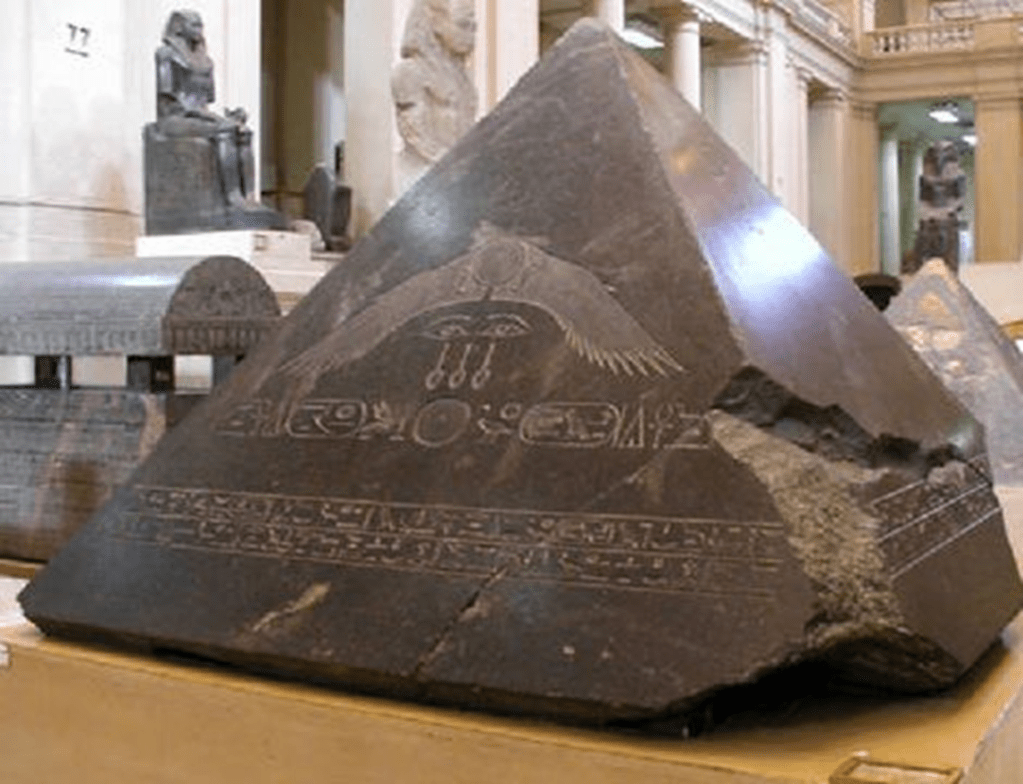
Additional proof is provided by the Ben Ben stones taken from the top of pyramids seen here in the Cairo Museum. The Benben sacred stone represents the primeval mound, the first land that appeared from the primeval ocean, called the Nun. It was upon this land that the eight ‘gods’ (OGDOAD) sprang into being; four males and their wives, headed by the chief god ‘Nu’ which is phonetically similar to Noah.
The pyramids were themselves extensions of the Benben. We know this to be a fact linguistically because the Egyptian word for pyramid is bnbn.t which is the female version of the bnbn sacred stone.
This explains the size and shape of the pyramids. They were a constant reminder to the Egyptians of the worldwide flood and the rebirth of the world from the deified eight occupants of Noah’s Ark.
This post will show that Ham, Noah’s third son was the Egyptian God Horus. It is part 1 of a two-part series by Gavin Cox.
One of the most famous and ancient of Egypt’s many deities was Horus, the falcon sun god. In two articles Gavin explore 12 key motifs of the life of Ham (Noah’s third son) drawn from the Genesis text. He then compares them to Horus drawn from Egyptian evidence, concentrating on the oldest evidence first.
Part 1 looks at the following motifs: 1) Ham is 11th from Adam; 2) the etymology of Ham’s name; 3) Ham came from a family of eight, and 4) Ham is the youngest of three brothers. These comparisons support the thesis that Ham was deified by the pagan Egyptians as Horus.
Egypt is eponymously called “the land of Ham” (Noah’s third son) in the Psalms (105:23, 27; 106:22) and “tents of Ham” (Psalm 78:51). Ham and Mizraim (Ham’s third son) appear together in Psalm 105:23 as designations for Egypt: “… Israel came to Egypt (miṣrāyim); Jacob sojourned in the land of Ham (ḥām).”
‘Mizraim’ is the common name for Egypt throughout Scripture. Ham was a first-hand witness of the Flood, and likely lived to a similar age as his brother Shem (500 years post-Flood, Genesis 11:11). Via Noah’s teaching, Ham knew about creation and the pre-Flood world, a knowledge that he would naturally pass to his descendants. All this became paganized by the Egyptians. Ham’s great post-Flood lifespan, involvement in re-establishing of post-Flood civilization, and knowledge of the pre-Flood world, likely meant he had divine status conferred upon him by the Egyptians.
Twelve key motifs of Ham’s life
Twelve key motifs of Ham’s life extracted from Genesis 5–11 (listed in table 1) will be compared to Horus. If Ham was deified as Horus, then the latter will likely reflect these motifs in some discernible, though paganized way. Article 1 will explore motifs 1–4, Article 2 motifs 5–12.
Both articles will set out to explore these connections, concentrating on the oldest Egyptian textual evidence in each case. Before this, a brief discussion of who Horus was is in order.
Introducing Horus—the falcon-solar deity
Horus is one of Egypt’s oldest and most important deities, attested to from at least the beginning of the Dynastic Period, where the familiar form of the Horus falcon appears on the Narmer Palette (figure 1).
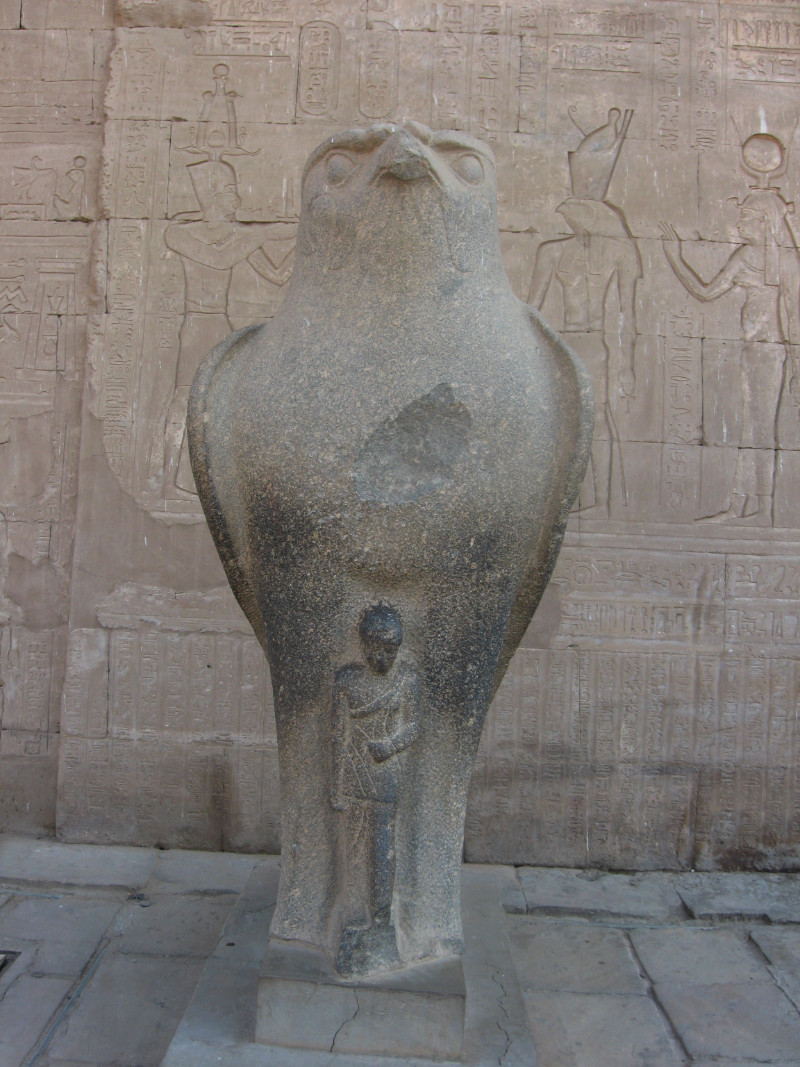
Figure 2. Horus statue in black granite, Temple of Horus, Edfu.
Horus appears in Old Kingdom Pyramid Texts (OK PTs), along with his sons, father, and mother (see part 2). Horus is depicted as a falcon (figure 2) or falcon-headed man, who was considered a creator god, as well as a form of the sun. His father was Osiris/Geb, with a notable brother, Seth. Much could be written regarding Horus; however, my two articles will be limited to a discussion of Horus’s possible connection to Ham, Noah’s third son.
Eleventh from Adam: Ham cf. Horus
The Genesis 5:1-32 chronogenealogies place Ham (with his brothers) 11th from Adam. Can a similar chronological relationship be discerned in Egyptian mythology, regarding Horus?
Gavin’s previous article made the case that Atum is the Egyptians’ paganized memory of Adam. Although the Ennead was considered a unified group (typically of nine), evidence suggests (e.g. PT-600§1655), that they were simultaneously considered consecutive offspring of Atum.4 All had long life spans like Noah’s sons.
Like biblical Ham, Horus is synonymous with concepts of; a) (physical) “violence” (tkk); b) (earthy) “blackness” (km)/“darkness” (kk)/“twilight” jḫḫ.w; and c) (sun’s) “heat” (bḫḫ.w).
Family of eight—Horus cf. Ham
Genesis (6:18, etc.) informs us that Ham belonged to a family of eight—comprising four males and their wives. Ancient Egypt had a group of eight gods—comprising of four males and their wives (the Ogdoad) whose names (see later) appear in OK PTs. In previous articles,25 I concluded this group represented the paganized memory of Noah’s family. The question to be asked is, if Horus is the deified Ham, is he also connected to a family of eight? The evidence presented below suggests he was. Specifically, the Ogdoad, whose names include the couple Kek and Keket (kk and kk.t).11
Like the semantic meaning of Ham, as discussed above, Horus is also connected by similar concepts: “attacker” (tkk), “darkness/twilight” (kk, jḫḫ.w) and phonetically similar bḫḫ.w “heat”. Ogdoad kk can be understood semantically from words containing the phonetic root kk, (compare ḫḫ). Thus, a shared semantic range exists between biblical Ham, Horus, and Ogdoad couple kk(.t).
Additional textual and pictorial evidence connecting Horus to the Ogdoad comes from the Hunefer BOD vignette. As Ham came from Noah’s family of eight, Horus also comes from a group of eight gods.
Scripture states Noah had three sons: Ham “his youngest” (Genesis 9:24) and “Shem … brother of Japheth the elder” (Genesis 10:21 YLT). Here Scripture employs the adjective: קָטָן (qāṭān) HALLOT-8338 ‘small, youngest’ to describe Ham. Can similar relationships be discerned in Horus’s family? The following evidence suggests this is so.
Horus had a brother, Seth, (both sons of Osiris) with whom he struggled violently for political dominion (see part 2, motif 8). A closely aligned god called Thoth is described as a brother of either Seth, or Horus in the PTs, and one example in the Coffin Texts of Horus, Seth, and Thoth being described as brothers. In BOD, Thoth shares the same father (Osiris) as Horus and Seth. When these examples are considered, then Horus is comparable to Ham in having two other brothers, and himself being described as the ‘youngest’.
Conclusion
This article has looked at four motifs from Ham’s life and compared them to Horus, the Egyptian falcon sun-deity. We have found positive connections in the following areas: motif 1. Ham was 11th from Adam. The case can be made that Horus is 11th from Atum when Osiris as the fatherly bystander is included from evidence in PTs regarding the Great Ennead. Motif 2. The etymology of Ham’s name includes concepts of (physical) “violence”, (earthy) “blackness/darkness”, and (sun’s) “heat”. These concepts compare favourably with divine epithets of Horus. Motif 3. Ham came from a family of 8—four males and their wives. The case is made here that Horus ascended from the Ogdoad, who are four males and their wives. Specifically, Horus is connected to Ogdoad member kk (darkness) in which case kk follows the natural ascension of darkness to light, to transform into Horus as the sun. Motif 4. Ham was the youngest of three brothers, Shem, and Japheth. The case can be made that Horus is the “child” who has a notable brother, Seth, and closely aligned to Thoth, another brother-(like) god. The connections are intriguing and so merit further study. Part 2 will analyze motifs 5–12.
The history of the world that is taught to our children in schools and universities is made up, based on the presupposition that the world evolved from pond scum. God told us in advance that the world would deny the truth about His world so that we can know He is in total control of all history from its watery beginning to its fiery end.
“I am stirring up your sincere mind by way of reminder, that you should remember the predictions of the holy prophets and the commandment of the Lord and Savior through your apostles, knowing this first of all, that scoffers will come in the last days with scoffing, following their own sinful desires. They will say, “Where is the promise of his coming? For ever since the fathers fell asleep, all things are continuing as they were from the beginning of creation.” For they deliberately overlook this fact, that the heavens existed long ago, and the earth was formed out of water and through water by the word of God, and that by means of these the world that then existed was deluged with water and perished. But by the same word the heavens and earth that now exist are stored up for fire, being kept until the day of judgment and destruction of the ungodly.”2 Peter 3:1-7
Jesus said the days of His second coming would be like the days of Noah. How will the time before Jesus’ return be like the days of Noah? For one, Jesus tells us that the unsaved will be totally unaware of God’s coming wrath as they were in Noah’s day. The people will also be lawless, a total rejection of God and His values.
“For as were the days of Noah, so will be the coming of the Son of Man. For as in those days before the flood they were eating and drinking, marrying and giving in marriage, until the day when Noah entered the ark, and they were unaware until the flood came and swept them all away, so will be the coming of the Son of Man.”Matthew 24:37-39
“Then they will deliver you up to tribulation and put you to death, and you will be hated by all nations for my name’s sake. And then many will fall away and betray one another and hate one another. And many false prophets will arise and lead many astray. And because lawlessness will be increased, the love of many will grow cold.” Matthew 24:9-12
Does the comparison with Noah’s Day even include parallels between the number of days of the Flood when God poured out His wrath for the first time on this earth and the coming Wrath of God that will be poured out with the Trumpet and Bowl judgements?
Does God’s Word tell us plainly how long the Wrath of God lasts, and will it be a surprise to almost everyone? Yes, God does with a number of Scriptures so that we can know for sure.
In Genesis 6:13, we read that before the Flood, regarding “all flesh”, God said to Noah, “I will destroy them with the earth” (’eretz). Then, in Genesis 9:11, after the Flood, God confirmed to Noah that by the Flood He had indeed destroyed the created Earth, when He said, “never again shall there be a flood to destroy the earth” (’eretz). Whatever constituted the ’eretz that was created on Day 1, God destroyed it by the Flood cataclysm.
Corroborating God’s revelation to Noah that the created Earth (’eretz) had been destroyed in the Flood (Genesis 9:11) is the record of widespread destructive volcanic and sedimentary processes evident in the Precambrian rock record. In the Precambrian we see evidence of huge volcanoes, depositing lava accumulations up to 22 km thick, including abundant products of explosive volcanic activity.
Rocks of the Precambrian cratons, including the exposed Precambrian shields, comprise some 71% of the Earth’s total land area. Extensive study of exposed Precambrian strata, motivated by its content of valuable minerals, has resulted in the accumulation of copious geological information on the Precambrian.
This information can be used by creationists to incorporate all of the Precambrian into a Genesis Flood geologic model.
There are abundant products of volcanism, including explosive volcanism, and volcanic lava sequences up to 22 km thick, throughout the Precambrian geologic record. Superpositional relationships of distinct lithological associations enable global correlation of early Precambrian strata. A Genesis Flood geologic model is proposed wherein the Flood cataclysm was initiated by a sudden reduction of gravitational force which decompressed the earth’s hot, water-saturated mantle. The Precambrian rock record was extruded from the mantle and deposited during Day 1 to Day 40 of the Flood cataclysm.
Widespread evidence of destructive volcanic geologic activity throughout the Precambrian corroborates the Scriptural record of the destruction of the created earth (’eretz) by the Flood cataclysm (Gen. 9:11).
This should lead us to preclude a Creation Week or Antediluvian origin for the Precambrian geologic record, and instead consider all of the Precambrian as Flood deposited. Walker noted that the Precambrian Strelley Pool Chert formation in the Pilbara region of Western Australia (figure 6) is underlain and overlain by rocks deposited from volcanic eruptions, and suggested:
“From a biblical perspective, it is inconceivable that volcanoes would be active during Creation Week, depositing volcaniclastics and tuff such as comprise parts of the stratigraphic sections [emphasis added].”
Widespread evidence throughout the globally correlated Precambrian rock record of huge explosive volcanic eruptions comprises tuffs, ignimbrites, pyroclastic flows, volcaniclastics, accretionary lapilli/lapillistone, and agglomerates. The processes necessary for the accumulation of accretionary lapilli/lapillistone include an atmospheric ash column, moisture, accretion, deposition, and lithification. We might reasonably question whether atmospheric ash columns would have been occurring during Creation Week.
Deposition of even the thinnest of these volcanic accumulations, the 10.5-km-thick Swaziland Supergroup (figure 3), over six days during Creation Week, would require lava to accumulate at 1.75 km stratigraphic thickness per day. The 22.0 km-thick-lower Pilbara Supergroup of Western Australia (figure 6) would need to accumulate at 3.67 km of lava per day if deposited during Creation Week.
On the basis of the volcanic content, and especially the explosive volcanic content, and the widespread destruction of organisms throughout the Precambrian, we should, I suggest, question a Creation Week or Antediluvian origin for the Precambrian rock record, reconsider the way we interpret the Precambrian fossil record, and conclude that the Precambrian is all Flood deposited.
Consistent with Genesis 7:11 and Proverbs 3:20a, Noah’s Flood may have been initiated by God causing the mantle to heat in a cataclysmic global thermal-tectonic episode, cracking open the earth’s crust and driving out water to the earth’s surface. Secular scientists have found evidence of episodic rifting events at the margins of North America between 0.8 and about 0.6 Ga. These are thought to record the fragmentation of a Neoproterozoic supercontinent.13,14 This is consistent with the breaking open of the crust by the fountains of the great deep, followed by further continental extension and then ocean formation.