The living God says, “I have set before you life and death, blessing and curse. Therefore choose life, that you and your offspring may live” (Deuteronomy 30:19). He offers us true life and, with it, blessing. But He warns us against sin and the curse that always comes with it. Just as He did in the Garden, God offers us the quality of life that comes from obeying Him. God says, “Let your heart hold fast my words; keep my commandments, and live” (Proverbs 4:4).
There are many reasons to obey what God commands us in Scripture. Here are five of them:
1) God, your Creator, said it.
2) God knows better than we do.
3) God is in charge, and we are not.
4) Whenever I have obeyed God, I and my family have ultimately benefited.
5) Whenever I have done it my way instead of God’s, with all my rationalizations and excuses, it hasn’t been for His glory, for my good, or the good of others. To obey God is always in our ultimate self-interest. In a universe where God sets up the rules, what is right is also smart.
Finally, we should remember that God gives us the power and strength to obey Him. Jesus made it possible for our Heavenly Father to send the third person of the Trinity to be our helper, our counsellor, our teacher, and our comforter. The Holy Spirit makes it possible for our spirit to function as the lamp of the Lord as God always intended.
“The spirit of man is the lamp of the Lord, searching all his innermost parts.” Proverbs 20:27
Scripture says we are empowered by the Holy Spirit to live in holiness.
“For the grace of God has appeared, bringing salvation for all people, training us to renounce ungodliness and worldly passions, and to live self-controlled, upright, and godly lives in the present age”Titus 2:12
We are fast approaching the time of Jesus second coming to Earth to fulfill the promises God made to the nation He established for His purposes, Israel.
“Thus says the Lord God: On the day that I cleanse you from all your iniquities, I will cause the cities to be inhabited, and the waste places shall be rebuilt. And the land that was desolate shall be tilled, instead of being the desolation that it was in the sight of all who passed by. And they will say, ‘This land that was desolate has become like the garden of Eden, and the waste and desolate and ruined cities are now fortified and inhabited.’ Then the nations that are left all around you shall know that I am the Lord; I have rebuilt the ruined places and replanted that which was desolate. I am the Lord; I have spoken, and I will do it.” Ezekiel 36:33-36
To finish strong for God’s glory you require patient endurance. You have received the Holy Spirit to enable you if you will only say “Not my will but your will be done today“. Moreover, there is no higher calling, no bigger privilege, no greater joy, and you will be kept from the coming wrath of God.
“Because you have kept my word about patient endurance, I will keep you from the hour of trial that is coming on the whole world, to try those who dwell on the earth.“Revelation 3:10
The following Scripture delivers a tough message but Jesus must be at the top of our pecking order.
“If anyone comes to me and does not hate his own father and mother and wife and children and brothers and sisters, yes, and even his own life, he cannot be my disciple. Whoever does not bear his own cross and come after me cannot be my disciple.” Luke 14:26-27
“Share in suffering as a good soldier of Christ Jesus. No soldier gets entangled in civilian pursuits since his aim is to please the one who enlisted him.” 2 Timothy 2:3
We have not ceased to pray for you, asking that you may be filled with the knowledge of his will in all spiritual wisdom and understanding, so as to walk in a manner worthy of the Lord, fully pleasing to him: bearing fruit in every good work and increasing in the knowledge of God; being strengthened with all power, according to his glorious might, for all endurance and patience with joy; giving thanks to the Father, who has qualified you to share in the inheritance of the saints in light. He has delivered us from the domain of darkness and transferred us to the kingdom of his beloved Son, in whom we have redemption, the forgiveness of sins.” Colossians 1:9-14
Each of the seven churches of Revelation 2 & 3 represents the church in each of the last seven years (Daniel’s 70 weeks prophecy) before Jesus returns first to rapture His church and then to return with the glorified Saints to conquer the Antichrist army at the battle of Armageddon.
The Scripture Revelation 3:7-13 is to the church of Philadelphia, the sixth church in the sixth year.
“Jesus says, I have set before you an open door, no one can shut it; for you have a little strength, have kept My word, and have not denied My name. Because you have kept My command to persevere, I will also keep you from the hour of trial (Rapture) which shall come upon the whole earth (wrath of God).” (Revelation 3:7-13)
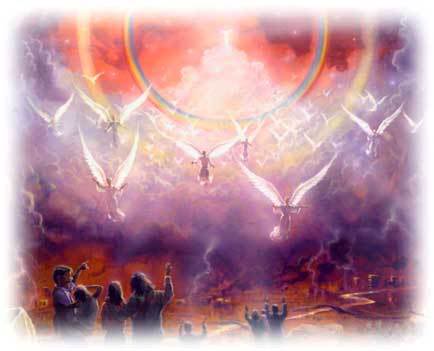
Just as the six churches represent the church in each of the last seven years, likewise the seven seals also represent what is happening on Earth in each of the last seven years. It is at the sixth seal, the sixth year, that we see the celestial signs that precede Jesus’ return to Earth to rapture the Saints and to begin to pour out His wrath upon the unrepentant.
“When he opened the sixth seal, I looked, and behold, there was a great earthquake, and the sun became black as sackcloth, the full moon became like blood, and the stars of the sky fell to the earth as the fig tree sheds its winter fruit when shaken by a gale. The sky vanished like a scroll that is being rolled up, and every mountain and island was removed from its place.Then the kings of the earth and the great ones and the generals and the rich and the powerful, and everyone, slave and free, hid themselves in the caves and among the rocks of the mountains, calling to the mountains and rocks, “Fall on us and hide us from the face of him who is seated on the throne, and from the wrath of the Lamb, for the great day of their wrath has come, and who can stand?” ” Revelation 6:12-14.
It is at the trumpet blast at the opening of the seventh seal that the rapture takes place and the trumpet and bowl judgments are poured out on an unrepentant world for one year and ten days. Why one year and ten days. The year before a Jubilee year is always one year and ten days and the year following Jesus’ return will be a Jubilee year. It so happens that when God poured out His wrath the first time with Noah’s flood it also was for one year and ten days. Check it out.
If the rapture happens at the start of the seventh year it means that the seventh church. the church of Laodicea (Laodicea is a combination of two Greek words (LAO, meaning “God’s people”; and DIKE, meaning “justice or judgment”) Judgement of God’s people)
“I know your works: you are neither cold nor hot. Would that you were either cold or hot! So, because you are lukewarm, and neither hot nor cold, I will spit you out of my mouth. For you say, I am rich, I have prospered, and I need nothing, not realizing that you are wretched, pitiable, poor, blind, and naked. I counsel you to buy from me gold refined by fire, so that you may be rich, and white garments so that you may clothe yourself and the shame of your nakedness may not be seen, and salve to anoint your eyes, so that you may see. Those whom I love, I reprove and discipline, so be zealous and repent.” Revelation 3:15-19
Do you belong to a church that says we are rich, have prospered, and are in need of nothing? Or are you in a church like the church of Philadelphia?
“‘I know your works. Behold, I have set before you an open door, which no one is able to shut. I know that you have but little power, and yet you have kept my word and have not denied my name… Because you have kept My command to persevere, I will also keep you from the hour of trial (Rapture) which shall come upon the whole earth (wrath of God).” Revelation 3:8,10
I have already put up two posts relating to walking with God. Can I suggest that if you cannot remember them that you go take another look? As we approach Jesus’ second coming, we need to be walking with God or we will not be an overcomer and part of His Millennial Kingdom.
1. Cultivating God’s Presence: It focuses on what Jesus has done to enable us to walk with God. It also looks at Enoch’s walk with God and what that teaches us. Finally, Matthew’s Gospel links our eternal destiny with the way we live now. It is why this website is called Living Eternal Now.
2. Getting in Step with God: It teaches that in just about all situations God takes the initiative. Hence, it is important for us to learn how to identify what that is in every situation, and to get in step with Him.
This post will look at the challenge that God’s will is not always easy to embrace. Fortunately, the O.T. prophets and Jesus’ disciples were good examples for us. They show us that walking with God requires us to have the single-mindedness of an athlete, one determined to train hard and to perform well on the day. The temptation to relax or give up is a constant.
For example, Abraham’s family set out from Ur, under the leadership of Terah, Abraham’s father. The biblical record shows us that they quickly got waylaid. Once they arrived in Haran they became settlers. It was only when Teruah died and Abraham got a fresh call from God that he resumed their journey (Genesis 11:31-12:3). It is not always easy to continue our journey and we tend to seek the familiar rather than embrace the vulnerability that walking with God entails. Jeremiah 12 recounts a story where the prophet is fed up with finding himself in yet another vulnerable situation. He had already been through the mill and he had had enough. His complaints to God are seen as evidence of his being a glass half-empty-person. But, who would not complain when he found himself imprisoned and not feel peeved in such circumstances? God’s initial call to Jeremiah seemed to imply that he would experience continual deliverance coupled with being given great authority in speaking to those in power (Jeremiah 1:8-10). Moreover, God’s response to Jeremiah’s prayer of complaint might seem lacking in sympathy to us. Jeremiah is told to toughen up because he would find himself in even more vulnerable situations in the future: ‘If you have raced men on foot, and they have wearied you, how will you compete with horses?’ (Jeremiah 12:5). Jeremiah was called to walk with God and embrace the journey, whatever the circumstances, and wherever his pilgrimage might lead, as indeed are we.
The prophets of Israel needed to exhibit greater than average stability or they would not have survived their calling for any longer than a month or so if that. They demonstrated exceptional perseverance in circumstances that must have created a huge sense of personal threat. Most of us would have looked for a way out of the call, as in the case of Jonah. However, God gave all of them the end of the story. They all saw their Messiah ruling and reigning the nations from a magnificent Jerusalem. I am sure this was in large part why they persevered.
For most of us on our faith journey, we really do feel vulnerable and our faith is usually a mixture of active trust and insecurity. Our memory of the past, the story of how God turned up the last time we trusted him, can sometimes help, but a previous positive experience doesn’t always make things easier the next time around. We need the stories of men and women of faith in the Bible to inspire us; we need to look to the example of Jesus, who looked to the joy set before him at the end of the journey.
“Therefore, since we are surrounded by so great a cloud of witnesses, let us also lay aside every weight, and sin which clings so closely, and let us run with endurance the race that is set before us, looking to Jesus, the founder, and perfecter of our faith, who for the joy that was set before him endured the cross, despising the shame, and is seated at the right hand of the throne of God.” Hebrews 12:1-2
Attachment to material possessions can often be a stumbling block, acting as a distraction to the main thing, which is knowing and following God. We are given the example of the early church where believers shared their possessions.
“And all who believed were together and had all things in common. And they were selling their possessions and belongings and distributing the proceeds to all, as any had need.”Acts 2:45
Their heightened awareness of the presence of God following Pentecost appears to have freed these early disciples from having to find security in their possessions. An unprecedented outpouring of generosity is a sign of – and the result of – the presence of the Holy Spirit. Generosity is also the natural response to the realization that God’s gifts to us are wholly unmerited. The fact that we are recipients of God’s generosity can also enable us to love ourselves more. After all, if God is so outrageously kind to us, if he welcomes us with open arms, perhaps it is true that we are loved extravagantly.
One way to express generosity is to practice regular financial giving. A rule can include the decision to give away a certain proportion of income to specific causes, individuals, or organizations. Having a rule actually simplifies our lives, saving us from constantly having to make decisions about where and how much to give. Of course, regular giving as part of a rule does not preclude additional giving to other causes.
“Each one must give as he has decided in his heart, not reluctantly or under compulsion, for God loves a cheerful giver. And God is able to make all grace abound to you so that having all sufficiency in all things at all times, you may abound in every good work.” 2 Corinthians 9:7-8
Also utilizing the gifts of the Holy Spirit will draw us closer to God in our walk with Him:
“Having gifts that differ according to the grace given to us, let us use them: if prophecy, in proportion to our faith; if service, in our serving; the one who teaches, in his teaching; the one who exhorts, in his exhortation; the one who contributes, in generosity; the one who leads, with zeal; the one who does acts of mercy, with cheerfulness.” Romans 12:6-8
“I appeal to you therefore, brothers, by the mercies of God, to present your bodies as a living sacrifice, holy and acceptable to God, which is your spiritual worship. Do not be conformed to this world, but be transformed by the renewal of your mind, that by testing you may discern what is the will of God, what is good and acceptable and perfect.” Romans 12:1-2
It will be extremely important as we come closer to the prophesied last seven years prior to Jesus’ second coming when persecution of Christians will escalate that we draw closer to God and our every step is guided by the Holy Spirit.
“Then they will deliver you up to tribulation and put you to death, and you will be hated by all nations for my name’s sake. And then many will fall away and betray one another and hate one another. And many false prophets will arise and lead many astray. And because lawlessness will be increased, the love of many will grow cold. But the one who endures to the end will be saved.” Matthew 24:9-13
Keep in mind that what you will be doing, and the role Jesus assigns to you in His coming Millennial Kingdom will depend upon how you live your life now. You need to be living eternal now.
We observe in Acts 10 and 11, God, rather than the apostles, took the initiative in most situations. The apostle’s involvement invariably requires their availability in prayer. God had heard Cornelius’s prayer and He also, with some considerable difficulty, sought to guide Peter as he prayed. Both Cornelius and Peter experienced the presence of God in a vision (Acts 10:2-3 and 9). Peter was rather slow to understand what was going on, trying hard to keep up with the God who had already gone before him. He eventually realised that he should visit Cornelius, but was astonished to find that God had already been working well beyond the bounds of the Church. To Peter’s amazement, he got halfway through his talk when the Spirit took over. The account reads as if the Spirit is rather impatient, perhaps even bored by Peter’s sermon, and doesn’t wait for him to finish (Acts 10:44)!
Even on the day of Pentecost, Peter was simply keeping up with God’s action and he did not initiate anything himself. He just happened to be present and took the opportunity to explain the events unfolding before his eyes, starting with a disclaimer to drunkenness (Acts 2:15).
God often makes his presence known to people, despite our slowness to ‘cotton on’ to whatever He is doing. We play our part, but very much as junior partners who are trying to keep up.
Our partnering with God is good for our mental health. It saves us from feeling we have the overwhelming responsibility of carrying the weight of the world on our shoulders. It releases us to walk with the Lord, in the confidence that He has both gone before us and that we carry His presence with us. Our part is to be attentive and to look for signs of the Holy Spirit’s activity as we fulfil our call to have an impact on people and communities. Doing this by seeking to discern the presence and activity of the Spirit is a different approach to what most of us have been taught which seemed to put the onus on us.
On occasions, walking with God means we have to ‘walk on the water’. Like the disciples, as we set out from the security of the shore, we do not realise all that the journey will entail. The story of Peter walking on water revealed how rash he was, but it also shows us the level of his faith in Jesus compared to his companions who stayed in the boat ‘Peters’ are people who are more desperate to join Jesus than those of us who always weigh up the risk. We need to avoid recklessness, but when it’s in response to having heard the prompting of the Holy Spirit, faithfully stepping into a vulnerable situation will get us closer to Him.
Much of this post is extracted from Richard Brown’s book Cultivating God’s Presence




 LIVING ETERNAL NOW