
The Philistines are first mentioned in the Table of Nations in Genesis 10. They descended from Noah’s son Ham, through his son Mizraim. The Hamitic people spread widely, settling across the Mediterranean region, Arabia, Mesopotamia, Anatolia (modern-day Turkey), Egypt, Libya, and Sudan. Yet, many of these people groups are enigmatic. For example, these are the people groups (note the plural -im ending in this list of names) who came from Mizraim (translated Egypt in the ESV):
Egypt (Mizraim) fathered Ludim, Anamim, Lehabim, Naphtuhim, Pathrusim, Casluhim (from whom the Philistines came), and Caphtorim. (Genesis 10:13–14)
The next mention of the Philistines is in the time of Abraham. He was living in southern Canaan, in the environs of Beersheba. Water was (and is) scarce in that region, so control over the water sources was important. Unsurprisingly, there were struggles between Abraham’s house (which probably numbered about 1,000 people at the time; and the Philistines who lived to the west: So they made a covenant at Beersheba. Then Abimelech and Phicol the commander of his army rose up and returned to the land of the Philistines. (Genesis 21:32) And Abraham sojourned many days in the land of the Philistines. (Genesis 21:34)
Abimelech is a name, but it is also a title. The Hebrew word ab (אב) means father and melech (מלך) means ‘king’, so the name Abimelech translates to ‘my father is king’. We are not yet told where this leader of the Philistines lives, but Abraham lived in Beersheba and at least visited a town to the west called Gerar. Abraham’s son Isaac also had dealings with the Philistines. In this case, however, we are given additional geographical details:
“Now there was a famine in the land, besides the former famine that was in the days of Abraham. And Isaac went to Gerar to Abimelech king of the Philistines.” (Genesis 26:1)
Since the name Abimelech can also be used as a title, this is not necessarily the same person that Abraham knew. But note that Abimelech is living in Gerar. This was a city situated northwest of Beersheba, on a different tributary within the same river system.
This explains much of the struggles the people were having about the control of water and why a treaty was needed. Abraham’s large contingent of people was in direct competition with the Philistines in the neighboring Gerar Valley.
In Genesis 26, we have the famous account of Rebecca being stolen by Abimelech (just like Sarah had been [Genesis 20]), the account of the Philistines stopping up Isaac’s wells due to jealousy of his large household and large flocks, and the account of how Isaac re-dug the wells.
We do not hear of the Philistines again until the Exodus, where the Israelites are told to not take the short route out of Egypt “by way of the Philistines” (Exodus 13:17). Later, the “sea of the Philistines” (i.e., the Mediterranean) was used as a boundary for the Promised Land (Exodus 23:31). Strangely, in Exodus 23, 24, and 33, when listing the nations that are to be displaced, no mention of Philistines is made.
A confusing array of tribes and nations
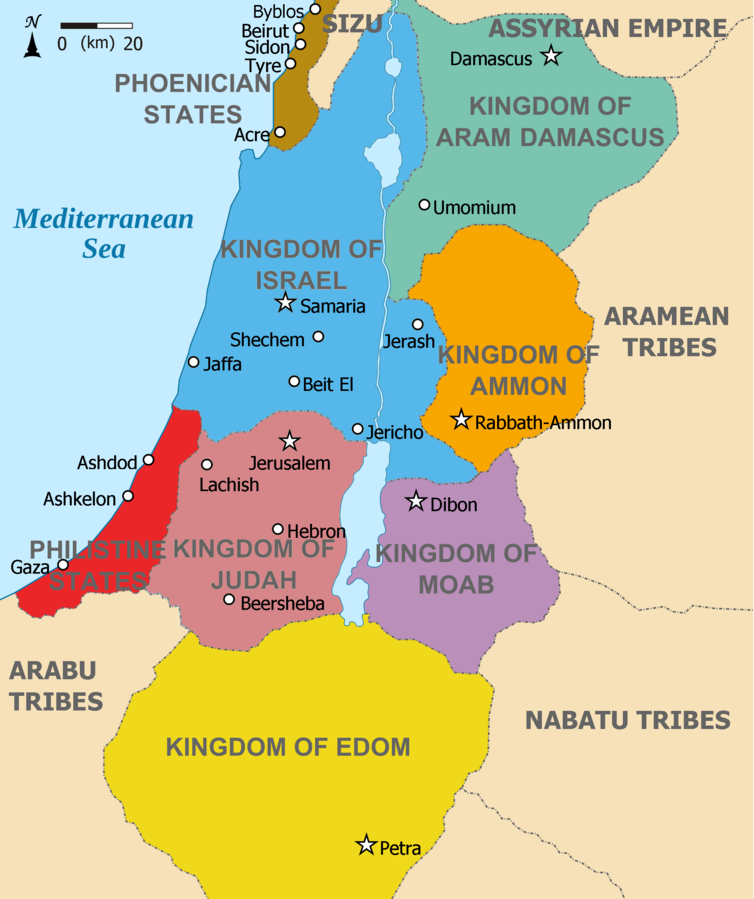
The term ‘Canaanites’ is used inclusively to describe the many tribes and groups that were living in the land of Canaan. The term ‘Philistines’ also describes a panoply of people groups living in Canaan. It is not always easy to separate the two terms and it is not always clear to which of the main groups one of the subgroups (e.g., the Pelethites discussed below) belong.
First, there were many non-Canaanite nations in the area, many of whom were Semitic:
- To the northeast lived the Aramaeans, named for Aram, a son of Shem. Their home base was the city of Damascus.
- When Abraham first moved into Israel, he was accompanied by his nephew, Lot. Lot’s sons were Moab and Ammon. The Moabites and Ammonites lived to the east of the Jordan River.
- Abraham himself had several sons. His first, Ishmael, gave rise to the Ishmaelites, a collection of 12 main tribes (Genesis 17:20) that also lived on the east side of the Jordan River.
- Abraham’s second son, Isaac, had two sons of his own, Jacob and Esau. Edom was another name for Esau. Like the others, the Edomites lived east of the Jordan.
- Abraham had more sons later in life. One of those was Midian. When Joseph’s brothers sold him into slavery, in one verse the Bible says they sold him to both Midianite and Ishmaelite traders (Genesis 37:28). Ishmael was the older brother of Midian. The two were living in the same region and their names were beginning to be comingled even at this early date.
- There were additional tribes that claimed Ham as their main patriarch (e.g., Sabtah and Sabteca), but these Arabian tribes do not factor into the story much.
- Next were the many Canaanite nations and tribes. Only two of Canaan’s sons are named (Sidon and Heth). The other tribes are ‘Canaanite’, but we cannot know how they connect.
- Hamath was a city to the northeast of Israel on the bank of the Euphrates River. The Hamathite territory was included in the ‘land’ promised to Abraham and which was later controlled by the Israelites under David and Solomon.
- To the northwest were the Phoenician cities of Tyre and Sidon. These are not named among the nations that were to be displaced, but Sidon was a son of Canaan.
- The Hittites were another Canaanite tribe. Their center of operations was in northern Israel. Bathsheba’s husband Uriah was a Hittite. It is unclear if the ancient Hittite empire that was centered in Anatolia was named after these people.
- The term ‘Amorite’ occurs frequently in ancient histories. They ranged widely. The Bible says they came from Canaan. In Scripture, we see them living on both sides of the Jordan. Og, king of Bashan, and Sihon, king of Heshbon, were Amorite leaders who lived on the east side of the Jordan and were defeated in battle (Numbers 21:21–35). The Amorites also figure heavily in the initial invasion of Canaan because the Israelite route went from Jericho up into the Amorite territory on the west side of the Jordan (e.g., Joshua 10:5).
- The Jebusites lived in and around the future city of Jerusalem. They are also associated with Amorites.
There were other people in the area for whom we have little information. Some were of great stature, specifically the Rephaim (Deuteronomy 3:11) and the Anakim. The Rephaim were driven out of the area on the east side of the Jordan by the Ammonites before the Israelites entered Canaan (Deuteronomy 2:20–21). The Valley of Rephaim that led down from Jerusalem to the coastal plain (Joshua 18:16) may have been named for them. The Avvim and the Geshurites were additional enigmatic tribes, but they lived between Mt Hermon and the Sea of Galilee. The mother of two of David’s children (Absalom and Tamar) was Maacah, the daughter of Talmai the king of Geshur. (2 Samuel 3:3, 13:1)
Finally, we have the Philistines. In the book of Joshua, we learn that the Israelites were unable to conquer Gaza, Ashdod, Ashkelon, Gath, and Ekron, the five-city “pentapolis” of the Philistines (Joshua 13:2–3). That region was controlled by the Philistines throughout the time of the Judges (e.g., the first period of Israelite rule after the Exodus; see Judges 3:3). For example, Shamgar famously killed 300 Philistines with an ox goad (Judges 3:31), and Samson had many dealings with them (Judges 14–16). There are many mentions of them throughout the books of 1 and 2 Samuel (e.g., Goliath was called a Gittite, that is, he was a Philistine from the city of Gath). They are also mentioned frequently in the prophets (e.g., Isaiah, Jeremiah, Ezekiel, Amos, Obadiah, and Zephaniah). For example:
“Are you not like the Cushites to me, O people of Israel?” declares the Lord. “Did I not bring up Israel from the land of Egypt, and the Philistines from Caphtor and the Syrians from Kir?”. Amos 9:7
Note here that Amos, who lived in the 8th century BC says the Philistines came from Capthor (Crete). Jeremiah, who was writing about 100 years after Amos, confirms where they came from:
“… because of the day that is coming to destroy all the Philistines, to cut off from Tyre and Sidon every helper that remains. For the Lord is destroying the Philistines, the remnant of the coastland of Caphtor.”. Jeremiah 47:4
Answering the riddle of the Philistines
The solution to these many puzzles is that there seems to be two different people groups called ‘Philistines’ in the Bible. The latter Philistines were indeed from Crete, but these may not have been the same Philistines that Abraham knew. In fact, the Bible records a population displacement in this very area:
As for the Avvim, who lived in villages as far as Gaza, the Caphtorim, who came from Caphtor, destroyed them and settled in their place. (Deuteronomy 2:23)
The book of Deuteronomy was written right before the Israelites invaded Canaan (~1406 BC). Thus, these new people (1) came to the area from Crete sometime between the time of Isaac and the time of Moses, a span of about 300 years. But the Bible refers to a group called the Avvim who lived in the area where the Philistines are also said to have lived.
Yet, the earlier record from Genesis does not claim they were from Capthor (although their relatives, the Capthorim, were). About 1,500 years later, the Bible claims they were. Thus, we have some confusion as to who these earlier Philistines were. If they came from Capthor, when? And, if they had come prior to the time of Abraham, why would that still be important more than a millennium and a half later?
It is strange that the Philistines are not mentioned in the ‘land’ promised to Abraham. Neither are they mentioned by the spies who searched out the land 40 years prior to the invasion of Canaan: But who were these later Philistines of David’s time? In the historical record, the enigmatic Sea Peoples attempted to invade Egypt during the reign of Ramses 111 ( 19th Dynasty, approximately 1186-1155 BC). This would have been during the period of the Judges, almost 300 years after the Exodus, and Israel had long been established as a nation. Their failed invasion was famously depicted on the walls of Ramses 111’s mortuary temple (Medinet Habu), but the diagram includes animals and women in the scene. Thus, the Sea People were not attacking; they were migrating. About the same time, we witness the end of the HIttite, Mycenaean, and Mitanni empires in the Mediterranean region. The reasons for all the upheaval are unknown, and we cannot seperate cause and effect (e.g., were the Sea People marauders, or were they seeking to escape some other group of attackers?). The Egyptian records claim that Rameses forcibly settled the survivors in southwest Cannaan, right where the ‘Philistine‘ cities were in Abraham’s day.
After Canaan had been successfully invaded by the Israelites, the Bible describes many of the people who had yet to be conquered. These include Philistines, Geshurites, the Avvim, and others:
“Now Joshua was old and advanced in years, and the Lord said to him, “You are old and advanced in years, and there remains yet very much land to possess. This is the land that yet remains: all the regions of the Philistines, and all those of the Geshurites (from the Shihor, which is east of Egypt, northward to the boundary of Ekron, it is counted as Canaanite; there are five rulers of the Philistines, those of Gaza, Ashdod, Ashkelon, Gath, and Ekron), and those of the Avvim, in the south, all the land of the Canaanites, and Mearah that belongs to the Sidonians, to Aphek, to the boundary of the Amorites, and the land of the Gebalites, and all Lebanon, toward the sunrise, from Baal-gad below Mount Hermon to Lebo-hamath, all the inhabitants of the hill country from Lebanon to Misrephoth-maim, even all the Sidonians. I myself will drive them out from before the people of Israel.” (Joshua 13:1–6)
By the time of David, there were multiple foreign people groups in the land, and it is a bit confusing who was there first and who may have come later. Some of these groups are closely associated with the Philistines, e.g., the Geshurites:
This is the land that yet remains: all the regions of the Philistines, and all those of the Geshurites. (Joshua 13:3)
The Bible claims the Philistines were in Canaan from the time of Abraham to the time of the final Old Testament prophets. This places them in the land before the significant influx of pottery and DNA that is associated with the island of Crete. This does not mean the Bible is wrong about the early Philistines, however. There are several possible solutions, each of which is faithful to biblical history:
- The earlier people were called Philistines by their contemporaries; the later people could have been given that name because they lived in Philistine territory.
- The earlier people could have been given the name ‘Philistines’ retroactively because they lived in the area later dominated by the real Philistines.
- The earlier and later Philistines were cousins or otherwise related by language or blood, so the new arrivals simply moved into a similar culture. In other words, they were both original ‘Philistines’, but can be distinguished by episodes of migration.
 LIVING ETERNAL NOW