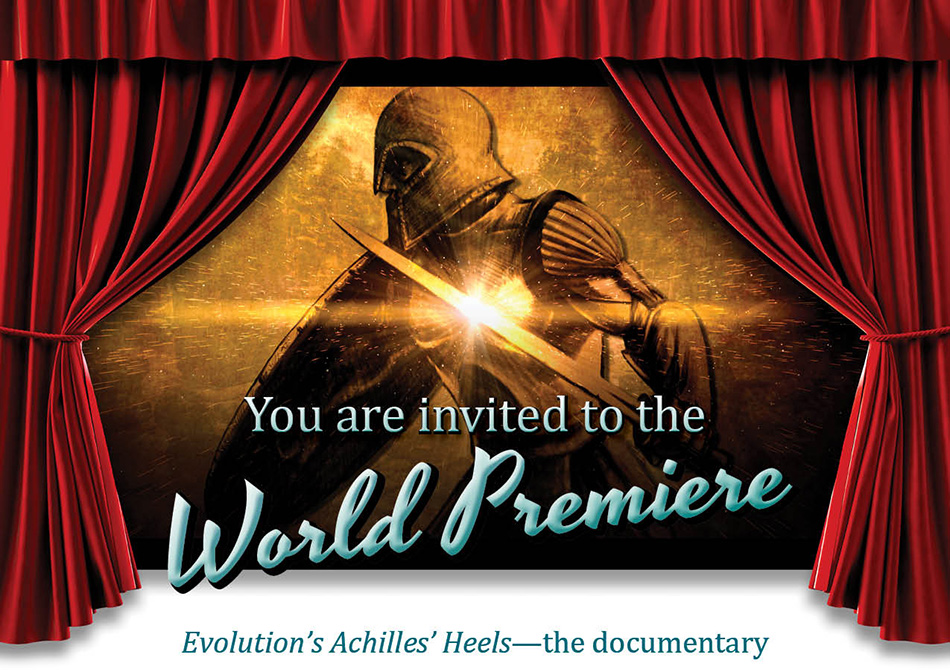
EXCITING DOCUMENTARY – EVOLUTION’S ACHILLES HEEL

EAH-premiere-banner

This 96-minute documentary interviews 15 Ph.D. scientists about the greatest weaknesses of modern evolutionary theory. The public generally only hears one side of the origins debate, but with stunning animations and dramatic footage, Evolution’s Achilles’ Heels presents a powerful ‘warts and all’ critique of textbook evolutionary orthodoxy. You’ll also discover just how much this debate impacts your view of yourself and the world around you.

“Never before have this many scientists been brought together for a project of this type. … Visually stunning 3D animations and dramatic footage help to show how the theory’s supposed strengths are, in fact, its fatal flaws—Evolution’s Achilles’ Heels.
CFDb (Christian Film Database)

“If we could award Evolution’s Achilles’ Heels more than five Doves, our best rating, we would! … the fifteen experts in this film blow open the door for God’s foot, the Grand Designer, to walk in boldly.”
The Dove Foundation

https://www.youtube.com/watch?v=TEkJezGRJPc

You need to get the video when it becomes available in November from http://www.creation.com

Professor’s atheistic pulpit—his classroom

David-Barash

Professor David Barash

Biology Professor David P. Barash from the University of Washington now thinks that his biology class is the proper forum for explicitly attacking his students’ religious convictions, as he shamelessly announced in his recent New York Times op-ed.1

Barash says, in a class on animal behaviour, Evolution proves that (a) living things were not designed, (b) humans are not exceptional, and (c) God cannot be both all-powerful and all-good.

This religion-bashing seminar is a severe abuse of power. As a public university professor, Barash’s role should not be to proselytize, but to educate—fairly informing students about all sides of legitimate academic disputes. Sadly, however, Barash’s approach to education is nothing more than a prejudicial, intellectually dishonest attempt to indoctrinate students into his own anti-Christian worldview.

If Barash’s New York Times summary is truly representative of his teaching, he hardly even acknowledges, much less addresses, arguments that challenge evolution or support biblical creation. Instead of dealing with the best creationist arguments, he presents caricatures that informed creationists are careful to avoid (e.g., denigrating evolution because it is called a ‘theory’).

Instead of allowing students to hear from all sides of the controversy, Barash tells them evolution is beyond question. He insists, “Teaching biology without evolution would be like teaching chemistry without molecules.”1 His statement would clearly have been news to leading chemist and member of the National Academy of Sciences, Philip Skell (1918–2010), the ‘father of carbene [CH2] chemistry’, who pointed out: ‘Certainly, my own research with antibiotics during World War II received no guidance from insights provided by Darwinian evolution. Nor for that matter did Alexander Fleming’s discovery of bacterial inhibition by penicillin’.

Furthermore, are Barash’s students prompted to consider how men like Linnaeus, Pasteur, and Mendel founded sub-disciplines of biology without any help from Darwin? Are they told that Dr Marc Kirschner, founding chair of the Department of Systems Biology at Harvard Medical School, has admitted, “Molecular biology, biochemistry, physiology, have not taken evolution into account at all”? Have they heard how evolutionary assumptions have often hindered scientific investigations, encouraging scientists to write off so-called ‘vestigial organs’, and ‘junk DNA’, for example, as non-functional by-products of the evolutionary process? Perhaps Barash himself would do well to learn about how creationists accept rapid adaptation and even speciation, and yet recognize why these types of changes are precisely the wrong sort of change needed to turn microbes into men.

In the centres of intellectual power today, creationists and other Darwin dissenters have a hard time maintaining their positions even when keeping their heads down, and they often get expelled anyway. But an evolutionary professor can openly proclaim that his lectures will argue against basic truths of Christianity, and there is hardly a public outcry.

If creation is disqualified from public education because it is too ‘religious’, then why isn’t Barash called on the carpet, for getting too ‘religious’ as well?

  1. Barash, D.P., God, Darwin, and My Biology Class,New York Times, 27 September 2014; nytimes.com.

Abbreviated article, “Darwinist Professor David Barash gets ‘theological’ in the classroom” by Keaton Halley and Jonathan Sarfati on http://www.creation.com

Dr Michael Guillen – do you believe every word in the Bible?

michael-guillen

Yes I do, he says.  So who is Dr Michael Guillen?

He was born in East Los Angeles, earned his BS from UCLA and his MS and PhD from Cornell University in physics, mathematics and astronomy.

For eight years he was an award-winning physics instructor at Harvard University. For fourteen years he was the Emmy-award-winning science correspondent for ABC News, appearing regularly on Good Morning America, 20/20, Nightline, and World News Tonight.

Dr. Guillen is the host of The History Channel series, “Where Did It Come From?” and producer of the award-winning family movie, LITTLE RED WAGON. Among his popular speaking topics is the series “CRAZY! Because Life Is Not Logical.”

Have I read the Bible cover to cover? Yes, I have (as well as the sacred literature of other religions), more than once and in different translations. Do I understand every word of the Bible? No, I don’t but believe every word, yes I do.

As 1 Corinthians 13:12 points out, no one should expect to comprehend everything right here, right now:

“Now we see things imperfectly, like puzzling reflections in a mirror, but then we will see everything with perfect clarity. All that I know now is partial and incomplete, but then I will know everything completely, just as God now knows me completely.”

Having faith in something I don’t completely understand is not limited to my spiritual life; it’s also true of my relationship to science and rational thought. Science and logic cannot explain everything about the universe – especially since more than 90% of the cosmos is invisible to us – nevertheless, I believe in them so much I dedicated my career to their practice.

For me, science and rational thought are precisely why I abandoned the atheism I practiced during many years of my schooling. As part of my rigorous scientific training, my mind was broadened with respect to things I cannot see. I was urged to believe in black holes, parallel universes, dark energy, and a plethora of other modern scientific exotica based solely on clever theoretical imaginings and indirect, circumstantial evidence. So now, when I read the Bible, which invites me to believe in all kinds of seemingly unbelievable things, my reaction is informed by what I’ve learned as a theoretical physicist. I believe Shakespeare said it best when he penned that immortal line: “There are more things in heaven and earth, Horatio, than are dreamt of in your philosophy.”

It takes humility to admit that to seemingly intractable problems there are many possible solutions we haven’t thought of yet, and might never think of in this life. It takes humility to have faith in something of everlasting importance that you don’t completely understand yet and can’t possibly, given its infinite nature and our finite capacities. It takes humility, above all, not to jump to any conclusions about what isn’t possible in this glorious, mysterious universe of ours … and what is.

For more information, go to www.michaelguillen.com or get his book Can a Smart Person Believe in God?