In this lecture, Danny Faulkner examines the evidences for both a young and old earth. Dr. Faulkner received his PhD in astronomy from Indiana University. He is distinguished Professor Emeritus at the University of South Carolina-Lancaster, where he taught astronomy and physics for over 26 years.
The account of Earth history that is currently popular in secular academia says that Earth’s surface has been shaped over billions of years by slow geological processes. But there is another, ancient, account of Earth history which says that its surface was shaped by a catastrophic, planet-wide flood—just a few thousand years ago. You might be surprised to hear that there are, in fact, many scientists who believe this latter account, maintaining that it is the best fit for a plethora of evidence from across the globe. In this interview, you’ll hear from one such scientist—geomorphologist, Dr Ron Neller—as he discusses five very famous landforms from around the globe, and how they bear witness to a recent global Flood.
The surface features of limestone deposits have several puzzling aspects that have stymied uniformitarian (‘slow and gradual’) geologists for well over a century. Especially puzzling are tower karst and tall sharp pinnacles. Eminent uniformitarian geomorphologists Baker and Twidale stated:
Domical forms in limestone, sandstone, and granite are converted to steep-sided towers. Such steepening through time is contrary to the expectable consequences of any of the conventional models of landscape evolution.
Template v36
Tower karst consists of isolated, steep-sided limestone hills surrounded by a generally flat surface.There are a number of types of tower karst ranging from tall vertical-sided towers to cones and hemispheres. Tower karst commonly protrudes above a flat or nearly flat planation surface produced by erosion, and capped by gravel. Some towers are isolated while others are in groups rising from a common base.
Tower karst is said to be many millions of years old. Based on fossils, the top of the tower karst in southwest China has been assigned an age of 75 million years. But such old dates defy present erosion rates that show the towers could not last more than tens of thousands of years. They also demonstrate that the dating methods that give such old ages are unreliable. Distinguished Chinese hydrogeologist Yuan Daoxian stated it is inconceivable how they could have survived.
According to Michael Oard, karst pinnacles provide strong evidence that they formed underwater from tower karst while the waters of Noah’s Flood were still covering the area. However, it would have occurred in locations where the velocity of the floodwater was relatively low.
Article TOWER KARST AND SHARP PINNACLES – Fascinating Flood-formed Limestone Structures by Michael Oard in Creation magazine Vol 46 issue 3
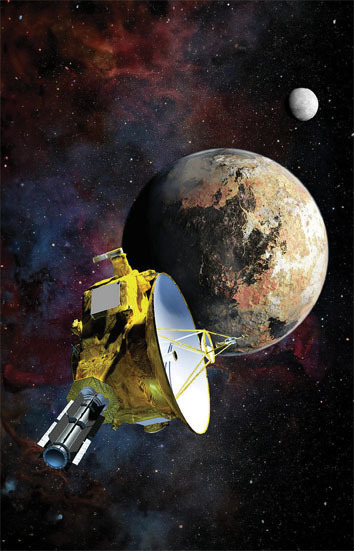
DEAD. COLD. DARK. SMALL. OLD, VERY OLD. Many such words have been used to describe the dwarf planet Pluto, which orbits the sun very far away. About 40 times as far from the sun as Earth. Pluto is much smaller than other planets and was ‘demoted’ from planet status in 2006. Secular scientists believe Pluto is 4.5 billion years (Ga) old. They also believed Pluto was dead, meaning geologically inactive. This is because, by being so small and far from the sun, if it were anywhere near that old, it would have lost all its internal heat long, long ago.
New Orions spacecraft and Pluto
In 2015, the New Horizons spacecraft finally reached its destination to study what NASA called “a relic from the formation of the solar system”. This was the first mission designed to study Pluto, its moons, and other objects in the Kuiper Belt. This belt is a vast region of space beyond Neptune’s orbit, containing icy bodies including Pluto.
The spacecraft took the first detailed, close-up images of the surface of Pluto and its moon, Charon, while studying the composition of the dwarf planet. What it has found and continues to find has been surprising, inspiring, intriguing, and mind-blowing. Pluto is shocking the science world by not being cold, dark, dead, and all the similar adjectives used to describe it. The greatest surprise is that Pluto does not appear to be old.
Several areas of Pluto studied are believed to be recently active cryovolcanoes. Among these areas are Virgil Fossae and Viking Terra. Similar icy volcanoes have also been discovered on the planetary moons Enceladus (orbiting Saturn) and Triton (orbiting Neptune). The question is then, how? How can a cold, dead planet still have volcanoes? How can a very old, small planet be active? Where would the energy come from, if not from internal heat? But how can Pluto be so small and still have internal heat? The Bible. God’s inerrant word gives us the answer it is about 6,000 years old not billions.
Great message from Ken Ham of Answers in Genesis. Make sure you visit their website http://www.answersingenesis.org. He omits what is next for this planet hence my addendum.
In an attempt to accept evolutionary ideas about the age of the earth (millions of years), many Christians try to add long ages somewhere into Genesis. Sometimes Christians will argue that the days of creation were not literal 24-hour days, that there was a time gap between Genesis 1:1 and 1:2, or that Genesis is just poetry. But any attempt to put millions of years into Genesis puts millions of years of death, suffering, and disease before sin—and that’s a big problem!
The Bible teaches that God’s original creation was “very good” (Genesis 1:31) and that death is the consequence of Adam’s sin (Genesis 2:17). Death did not exist in creation until after Adam’s sin.
“Therefore, just as sin came into the world through one man, and death through sin, and so death spread to all men because all sinned.” Romans 5:12
“For as by a man came death, by a man has come also the resurrection of the dead. For as in Adam all die, so also in Christ shall all be made alive.” 1 Corinthians 15:21–22
Although those passages refer specifically to human death, they are also discussing death in general. Other passages like Romans 8:22 make it clear that the whole world is groaning because of sin, and this includes the animal world. Taking Scripture with Scripture, it’s obvious there was no death, disease, or suffering of human or animal (nephesh) life before sin.
This is a big problem for those who believe in millions of years because those long ages supposedly come from the rock layers and fossils. Now, fossils are, of course, dead things, so if those rock layers are millions of years old, there’s been millions of years of death beforeAdam and Eve. And not just death, but also, millions of years of diseases and suffering, animal carnivory (but in God’s original creation everything was vegetarian, see Genesis 1:29–30), and thorns and thistles (a consequence of sin, Genesis 3:18).
Millions of years is incompatible with the Bible’s teaching about death!
Death is not a natural part of creation; it’s not something that has existed for millions of years—it’s an enemy (1 Corinthians 15:26), an intruder into God’s once “very good” creation.
As Christians, we cannot accept millions of years and remain faithful to the plain meaning of Scripture. So how old is the earth? Well, God created everything in six days, and then Genesis 5 and 11 give us detailed genealogies that allow us to determine how many years passed between Adam and Abraham (about 2,000 years). We know about 2,000 years passed between Abraham and Jesus, and then 2,000 more years gets us from Christ to us today. So, starting with the Bible’s history, the universe, earth, and life is only about 6,000 years old.
Yes, we live on a young earth impacted by death because of sin. But someday Jesus will return and create a new heavens and a new earth where death and suffering will be done away with and everyone who has placed their faith and trust in Jesus will live with him forever.
Thanks for stopping by and thanks for praying, Ken
A great message from Ken Ham except he left out the 1000 years Jesus will rule over the nations on this Earth with some, if not all of the glorified Saints. We have had 6000 years of Satan’s dominion over the Earth, next is Jesus’ Millennial Kingdom, and only then will this Earth be destroyed. The second resurrection of all of the dead will take place followed by Jesus’ White Throne judgement. It is only after the White Throne judgement that John sees the new Heaven and new Earth.
“Then I saw a great white throne and him who was seated on it. From his presence earth and sky fled away, and no place was found for them. And I saw the dead, great and small, standing before the throne, and books were opened…Death and Hades gave up the dead who were in them, and they were judged, each one of them, according to what they had done. Then Death and Hades were thrown into the lake of fire. This is the second death, the lake of fire.” Revelation 20:11-12
“Then I saw a new heaven and a new earth, for the first heaven and the first earth had passed away, and the sea was no more. And I saw the holy city, new Jerusalem, coming down out of heaven from God, prepared as a bride adorned for her husband. And I heard a loud voice from the throne saying, “Behold, the dwelling place of God is with man.He will dwell with them, and they will be his people, and God himself will be with them as their God.”Revelation 21:1-3
Bending rock sounds like the feat of a superhero. But this incredible achievement really occurred in the earth’s past. There are many places around the world where thick layers of rock are folded, sometimes at angles of 90°! One prominent example is the Carbon Canyon Fold.
The Carbon Canyon Fold is located in a side canyon adjacent to Grand Canyon itself. The layers making up the fold are a sequence of sandstone, siltstone/claystone, and limestone. Together, they make up the Tonto Group. In most places, the Tonto Group layers are just as horizontal as when they were deposited. But this is not the case with the Carbon Canyon Fold. How were these layers warped at such an unusual angle?
Conventional wisdom tells us that the oldest layers of the Tonto Group layers are approximately 525 million years old. Geologists think the uplift that folded the Tonto Group layers started between 70 and 50 million years ago. It was not complete until a mere five million years ago.
This model is problematic, however. There is no known mechanism by which the Tonto Group could have remained wet and pliable for 465 million years! The folded nature of this rock unit is incredible evidence of their relative youth. Those who believe these layers were formed over vast eons of time proposed other ideas to explain how the layers were folded long after hardening into rock.
Metamorphism is a process capable of making solid rock pliable again for folding. This can occur when the rock experiences extreme heat and pressure far beneath the earth’s surface. However, this cannot explain the folded layers seen in the Tonto Group. Metamorphism completely alters a rock’s mineral makeup. For example, such heat and pressure turn sandstone into quartzite. Claystone turns into a schist. Meanwhile, limestone turns into marble. If metamorphism were responsible for folding the Carbon Canyon Fold, evidence for this process should be obvious.
The best explanation for the warped nature of the Carbon Canyon Fold does appear to be that the process of folding occurred in the not-too-distant past. Most young-earth geologists think the uplift that caused the folding occurred over a period of time lasting just hundreds, and not millions, of years. If hundreds of millions of years passed between the formation of the Tonto Group layers and their uplift, the Carbon Canyon Fold should be a jumble of shattered rock fragments. The fact that they are not stands as testimony to their relative youth.
This article comes from a new blog post put together by a group of young scientists that are working under well-established Ph.D. Creation scientists https://newcreation.blog
Creationist scientist Dr Russell Humphreys shows a young-age creation perspective has real explanatory power for understanding magnetic fields of planets, moons, and other objects in space. The Ganymede moon of Jupiter has been shown to have its own magnetic field which should not be the case if the Cosmos is billions of years old. Humphreys became famous because he successfully predicted the magnetic field of Uranus before Voyager 2 flew by the Uranus system in 1986. The strength of the magnetic field was a complete surprise to evolutionists, though not to creationists, as creationist physicist Dr. Russell Humphreys, using Biblical assumptions, had accurately predicted the strength two years previously!
This is a complex article but at least make sure you read the Conclusion.
Ganymede is the largest moon (Jupiter) in the solar system (figure 1). With a radius of 2,634 km, Ganymede is slightly larger than the planet Mercury. A unique feature of Ganymede is that it possesses its own intrinsic magnetic field. To planetary scientists, it has been a challenge to explain how an object of Ganymede’s size could still possess its own magnetic field after over 4 Ga. After billions of years, an object of Ganymede’s size would be expected to have cooled down so that there would not be adequate heat to drive a magnetic dynamo. A dynamo requires a molten iron core that can have a convection motion of the fluid, which carries an electric current. But for Ganymede, the iron core is only approximately 700–800 km in radius. Ganymede may not have a solid iron core but has a liquid iron core surrounded by a silicate mantle, and then layers of water ice over the mantle.
Ganymede is influenced by the strong magnetic field of Jupiter, but there is a good consensus among scientists that it possesses its own intrinsic field. The Galileo spacecraft conducted magnetometer measurements which have been analyzed in relation to Jupiter’s field. Ganymede’s main dipole field was measured as 719 nanotesla (nT) and is tilted 176° in relation to its own spin axis. This makes it roughly antiparallel to Jupiter’s magnetic field.
The magnetic field model of Dr. D. Russel Humphreys has been more successful than old-age magnetic dynamo theories. Humphreys applied his model to the magnetic fields of Earth, Uranus, Neptune, Mercury, our Sun, and bodies in our solar system. Mercury is slightly smaller than Ganymede but possesses a larger iron core with both solid and liquid layers. Humphreys’ model proposed that when God created the planets he initially made them out of water in the manner described for Earth in Genesis 1 and 2 Peter 3, “out of water”.
This model has significant advantages over the old-age dynamo model. The dynamo model requires a molten conducting core such as liquid iron. It also requires convection motion of the fluid and is very dependent on the size of the core and the rate of rotation of the planet. But in Humphreys’ model, the core need not actually be melted, it just needs to be a conductor. The initial magnetic field from creation decays to the present. This has been described as ‘free decay’ because the field decreases in intensity over thousands of years. Humphreys’ model assumes a young age for the Earth and solar system and leads to realistic values for the magnetic dipole moment for Earth, Mercury, and the other planets. This makes Humphreys’ model more broadly applicable than dynamo theories. Thus, it can be applied to Ganymede as well, as Humphreys has done.
In Humphreys’ model for the creation of magnetic fields, the exact composition of the iron core after creation is not known, but this does not create a problem in applying the model. The core’s composition is estimated by interior structure models that attempt to match the overall density of the moon to gravity measurements taken by spacecraft (the Galileo mission). Today, Ganymede is believed to have an ice shell of roughly 200 km, then a silicate mantle of about 1,700 km, and this leaves the core as roughly 700–800 km in radius. However, these are only rough approximations. If the core is smaller, it needs to have a composition closer to pure iron in order to generate the measured magnetic field. But if the core is larger, then it could have a composition more in a light element such as sulfur (in FeS). In Sohl 2002, an analysis was done of the Galileo gravity data for the Galilean moons of Jupiter. They describe Ganymede’s magnetic field thus:
“Magnetometer measurements of the Galileo spacecraft have shown that Ganymede possesses an intrinsic magnetic field with equatorial and polar field strengths at the surface of 750 and 1,200 nT, respectively.”
They go on to give a range of values on the size of the Ganymede core: “The ice shell was suggested to be about 800 km thick. The core may have a radius between 400 and 1,300 km.” All these values are consistent with Humphreys’ model.
Conclusions
At creation, should we assume that the composition of the core was uniform throughout? This is a simplifying assumption but not really a requirement. If there was a composition gradient in the core initially where it was closer to pure iron at the core-mantle boundary but possessed more FeS at the bottom of the core, this would be unstable and so sinking iron ‘snow’ and rising FeS would be possible. Such a composition gradient could alter how rapidly the magnetic field decays for some period of time until the core reached a more stable uniform composition. So, to this author, it seems the ‘iron snow’ concept is possible, but it would not drive a dynamo in Ganymede, and it would not invalidate Humphreys’ magnetic model. Thus, a young-age creation perspective has real explanatory power for understanding magnetic fields of planets, moons, and other objects in space.
This article by Wayne Spencer The iron snow dynamo theory for Ganymede is taken from The Journal of Creation 2022 Volume 36, Issue 3 in the section Perspectives.
The Journal of Creation is the Technical Journal produced by Creation Ministries International (CMI). They also produce the excellent Creation Journal for nontechnical people. Go to http://www.creation.com to subscribe.
When physicist Dr Russell Humphreys was still at Sandia National Laboratories (he now works full-time for the Institute for Creation Research), he and Dr John Baumgardner (still with Los Alamos National Laboratory) were both convinced that they knew the direction in which to look for a definitive answer to the puzzle of why radiometric dating consistently gives ages of millions and billions of years.
picture – Linear accelerator used in radiometric dating.
Others had tried to find an answer in geological processes—e.g. the pattern was caused by the way the magma was emplaced or how it crystallized. This is indeed the answer in some cases.2,3 But Drs Humphreys and Baumgardner realized that in other cases there were many independent lines of evidence that suggested that huge amounts of radioactive decay had indeed taken place. (These include the variety of elements used in ‘standard’ radioisotope dating, mature uranium radiohalos and fission track dating.) It would be hard to imagine that geologic processes alone could explain all these. Rather, there was likely to be an answer that concerned the nuclear decay processes themselves.
From the eyewitness testimony of God’s Word, the billions of years that such vast amounts of radioactive processes would normally suggest had not taken place. So it was clear that the assumption of a constant, slow decay process was wrong. There must have been speeded-up decay, perhaps in a huge burst associated with Creation Week and/or a separate burst at the time of the Flood.
There is now powerful confirmatory evidence that at least one episode of drastically accelerated decay has indeed been the case, building on the work of Dr Robert Gentry on helium retention in zircons. The landmark RATE paper,4 though technical, can be summarized as follows:
When uranium decays to lead, a by-product of this process is the formation of helium, a very light, inert gas, which readily escapes from rock.
Certain crystals called zircons, obtained from drilling into very deep granites, contain uranium which has partly decayed into lead.
By measuring the amount of uranium and ‘radiogenic lead’ in these crystals, one can calculate that, if the decay rate has been constant, about 1.5 billion years must have passed. (This is consistent with the geologic ‘age’ assigned to the granites in which these zircons are found.)
However, there is a significant proportion of helium from that ‘1.5 billion years of decay’ still inside the zircons. This is, at first glance, surprising for long-agers, because of the ease with which one would expect helium (with its tiny, light, unreactive atoms) to escape from the spaces within the crystal structure. There should surely be hardly any left, because with such a slow buildup, it should be seeping out continually and not accumulating.
Drawing any conclusions from the above depends, of course, on actually measuring the rate at which helium leaks out of zircons. This is what one of the RATE papers reports on. The samples were sent (without any hint that it was a creationist project) to a world-class expert on helium diffusion from minerals to measure these rates. The consistent answer: the helium does indeed seep out quickly over a wide range of temperatures. In fact, the results show that because of all the helium still in the zircons, these crystals (and since this is Precambrian basement granite, by implication the whole earth) could not be older than 14,000 years. In other words, in only a few thousand years, 1.5 billion years’ worth (at today’s rates) of radioactive decay has taken place. Interestingly, the data have since been refined and updated to give a date of 5,680 (± 2,000) years.
The paper looks at the various avenues a long-ager might take by which to wriggle out of these powerful implications, but there seems to be little hope for them unless they can show that the techniques used to obtain the results were seriously flawed.
The Bible clearly tells us that God created a mature universe: Adam was a man, not a baby, the trees and plants mature and on day six Adam could see all of the stars in heaven. God tells us that He stretched out the heavens at creation on day four. The Cosmos could only have been created by a being outside of His creation with miraculous powers.
Big Bang from nothing does not explain the complex ordered universe that is so evident, it is certainly not good science.
Taken from an article by Dr. Carl Weiland “Radiometric dating breakthroughs” http://www.creation.com
4. Humphreys, D.et al., Helium diffusion rates support accelerated nuclear decay, icr.org, 16 October 2003. Return to text.
I recently posted on July 15th Noah’s Flood Fact or Fiction? If you have not viewed it, can I suggest you do, as it complements and reinforces this post. It is wonderful to see the amount of evidence being produced by Ph.D. scientists to support the young earth’s history presented in the Bible. In this video, we follow geologist Dr. Steve Austin and Del Tackett to Arizona where we can see the Grand Staircase, a thick stack of rock layers that are visible as sets of parallel cliffs above the Grand Canyon.
Steve then explains how the history of the world is best viewed through a Flood geology model as a five-step process: Sedimentation, Tectonics, Erosion, Volcanoes, and Exponential decline.
He then talks briefly about his experience as a creationist geologist. Dr. Austin is a field research geologist who has done research on six of the seven continents of the world. His research has taken him by helicopter into the crater on Mount St. Helens, by bush plane onto glaciers in Alaska, by raft through the Grand Canyon, on horseback into the high Sierra, by elevator into the world’s deepest coal mines, by SCUBA onto the Great Barrier Reef, by rail into Korean backcountry, by foot onto barren plateaus of southern Argentina, and by a four-wheel drive into remote desert areas of Israel, Jordan, and Saudi Arabia. Dr. Austin received his PhD from Pennsylvania State University in sedimentary geology.
Those who demand a naturalistic explanation (no miracles allowed!) for distant starlight from Christians don’t seem to realize that the standard ‘big bang’ secular view of origins entails miracles—but without a miracle worker! The problem is that the distribution of the background radiation in the universe is fairly uniform, but there has not been enough time for radiation (at the speed of light) to disperse over such a large universe. This is called the ‘horizon problem’. It is really the big bang’s very own ‘light time-travel’ problem. To ‘explain’ this, cosmologists invoked a period of super-fast expansion of the universe—much faster than the speed of light—for a brief time just after the ‘bang’. This was dubbed ‘inflation’. What started it, how it could proceed, and what stopped it are all mysteries. These are in effect naturalistic miracles, with no sufficient cause or explanation.2 They are used to prop up a theory that would not work without them.
So, it is not that miracles are not allowed in explaining origins. Ironically, they are only disallowed when it comes to biblical creation, which the Bible says is miraculous!
Bible-believing Christians are ‘streets ahead’ of secularists here because we have an all-powerful God who is able to do things beyond our ken.
Great is our Lord, and abundant in power; his understanding is beyond measure. The Lord lifts up the humble; he casts the wicked to the ground. (Psalm 147:5–6)
God calls us to humbly submit to Him and His Word.




 LIVING ETERNAL NOW