A recent study of over 100,000 gender-confused Americans found that those who underwent a “sex-change” surgery have “substantially increased rates not only of depression, but of anxiety, suicidal ideation, and substance use disorders.”
The study highlighted that men who underwent these surgeries had a depression rate of over 25%, compared to 11.5% of men who hadn’t gone as far as surgery. And for women, it was similar: nearly 23% vs. 14.6%. In other words, surgery doesn’t fix the identity crisis! It only makes things worse!
Now, this study was comparing those who had socially and maybe even chemically “transitioned,” versus those who “transitioned” and then later underwent surgery. Those who had surgery had a substantially higher risk of depression (the opposite of what you would expect if so-called gender-affirming “care” worked), but even the group with the lower depression rates—those who only socially and/or chemically transitioned—still have a much higher rate of depression than the general population (which is 5% according to the CDC). Again, our culture’s answer to gender confusion is not working! When we stray from God’s design and try to be our own gods, pain and suffering follow.
If a parent has a child struggling with gender identity, one of the first things they’re often told by counsellors, doctors, and therapists is, “You must immediately affirm your child’s new identity, or your child will likely commit suicide.” This and other studies prove that this is false and that surgery doesn’t fix the identity crisis! It only makes things worse!.
The good news is that on Monday, SCOTUS took up a case involving a challenge from a counsellor against a Colorado law banning so-called “conversion therapy” for minors identifying as LGBT. However, as Family Research Council President Tony Perkins clarified on Tuesday’s “Washington Watch,” while “the legacy media likes to call it conversion therapy … it’s really a ban on any conversation that doesn’t align with the Left’s radical gender ideology.” Colorado’s ban states that counsellors may not attempt to “change an individual’s sexual orientation or gender identity.”
What will your final words be to your family and friends? In the case of the Apostle Paul, his final message came from a Roman cell, written to his protégé Timothy as he faced execution under Emperor Nero. The letter of 2 Timothy, often acknowledged as his last known correspondence, brims with urgency — calling for faithfulness to the gospel, resilience in suffering, and vigilance against false teaching. Yet above all, Paul pointed to the ‘God-breathed’ word as the ultimate authority for “teaching, rebuking, correcting, and training in righteousness” (2 Timothy 3:16). In just a few words, his parting counsel to a world he’d soon depart from was simple yet profound: Anchor yourself in Scripture.
God’s entire word echoes this urgency as it calls us to hold fast to its richness as if our very lives hinge on it. But this only makes perfect sense when we recognize that Scripture, as God’s inspired revelation, guides us from this life to the next, where, for those in Christ, our present is tethered to eternity’s promise.
And this idea goes back to long before Paul, in which Ecclesiastes explained how Scripture speaks to every moment of life: “For everything there is a season… a time to be born, and a time to die; a time to weep, and a time to laugh; a time for war, and a time for peace” (Ecclesiastes 3:1-8). It’s a reminder that God’s word anticipates all we face.
Elsewhere, in Psalm 119:105, we read how the Bible is the “lamp” and “light” that guides us. Both Jeremiah and Psalm 1 characterize the person who treasures Scripture as someone who “is like a tree planted by water,” not fearing heat nor anxious of drought, but firmly planted and bearing fruit. “[H]is delight is in the law of the Lord, and on His law he meditates day and night. … In all that he does, he prospers” (Psalm 1:2-3). Even Jesus Himself prayed for us to be in the word. To the God of the universe, His Father above, He prayed on our behalf: “Sanctify them in the truth; Your word is truth” (John 17:17).
If Scripture reigns clear, and even Jesus prayed for the word to sanctify us, how could we do any less than dedicate our lives to the study and application of it? And yet, it’s one thing to read Scripture and to study it because we believe we should. It’s an entirely different matter to do so because we know and believe that we must.
God gave us His word for our benefit. When we read it, the words of life, from the Source of life, abundantly give us life. As the theologian Charles Spurgeon once said, “Nobody ever outgrows Scripture; the book widens and deepens with our years.” He also rightly stated that “within the Scripture there is a balm for every wound, a salve for every sore,” and that “no Scripture is exhausted by a single explanation. The flowers of God’s garden bloom not only double, but sevenfold; they are continually pouring forth fresh fragrance.” A quotation especially relevant here is when he said, “Every promise of Scripture is a writing of God, which may be pleaded before Him with this reasonable request, ‘Do as Thou hast said.’ The Heavenly Father will not break His word to His own child.” And what did He say? He said, “I will never leave you nor forsake you” (Hebrews 13:5; Deuteronomy 31:6). “And behold,” said Jesus, “I am with you always, to the end of the age”(Matthew 28:20). His word states that when we are weary and heavy-laden, He will give us rest (Matthew 11:28). The Bible says that “they who wait for the Lord shall renew their strength; they shall mount up with wings like eagles; they shall run and not be weary; they shall walk and not faint” (Isaiah 40:31).
Scripture says “we are more than conquerors through Him who loved us” (Romans 8:37), and that those in Christ will never taste death (John 8:51) nor feel its sting. The Bible says we have strength in Christ and that we can find true contentment in Him. In God’s word, we read that no flame will consume us, nor will any flood overwhelm us. Indeed, we learn in the pages of sacred Scripture that no matter the trial, no matter the valley, our Great Shepherd will get us through.
Scripture tells us that we are made with inherent dignity and value. It lays out the purpose of our existence. It explains the path we walk to glory. We may not understand everything in God’s word, but when it comes to the truths that fuel us to live, we have more than enough to chew on for eons upon eons. As Spurgeon stated, when we open the Bible and read it, we have every right to cry out: “God, do as You have said.” Most importantly, we have every reason to believe that He, indeed, will do the things He has promised in His word.
Paul’s final advice was to read our Bibles — to be planted in the word. And perhaps now it’s not hard to see why. These truths that get us through are found in no other source. Only Scripture contains God’s message to us in that He has loved us with an “everlasting love” (Jeremiah 31:3). Only the Bible reminds us that, despite inevitable trouble in this world, we can “take heart,” because Jesus has “overcome the world” (John 16:33). In God’s word, dear reader, we find love, joy, peace, goodness, faithfulness, and all the riches of Christ. It’s all there — everything we could ever need.
And it’s in reading of these truths, day and night, that we’re not only equipped for this earthly life, but where we grow in our affection for Christ. It’s where our desire for our true home deepens and matures. It’s where everything around us gets put into its proper perspective. The radiance of God’s glory shines from the pages of His word and illuminates our hearts, minds, and souls to live — to truly live — in the beauty of Him who laid His life down for His sheep.
It’s no wonder Paul’s final counsel before martyrdom was to plant ourselves in Scripture. When all around us fails, when life is simply too much, open the word and allow your Savior to capture your heart all over again. He never changes, and His word never fails. Turn to it and be filled by the well that never runs dry. As Isaiah 40:8 proclaims, “The grass withers, the flower fades, but the word of our God will stand forever.”
One of Jesus’s prophesied end-time signs is a great falling away from the truth of God’s word, and we are seeing that happen, particularly with the denominational/institutional churches, including the Catholic Church. I owned and managed Christian Press for thirty-plus years, distributing Christian books to Bible Colleges and Christian Bookshops. Even back then, I was disturbed that most of the Bible Colleges had compromised by accepting evolution and, as a result, no longer accepted the foundational book of the Bible, Genesis, as literal truth, teaching real history about God’s perfect creation, man’s fall into sin, and the promise of a divine saviour.
We are living in the end times, and over two thousand scriptures prophesy Jesus’ second coming. This makes it even more important that you are anchored in Scripture. and are watching for the prophesied signs.
Adapted from an article in the Washington Stand by Sarah Holliday, March 7th 2025, Paul’s Counsel before Martyrdom: Read the Bible
Brazil is witnessing a seismic shift in its religious landscape that’s rapidly reshaping the country’s spiritual and social fabric. Evangelicals are poised to outnumber Catholics as the largest faith group there. In the heart of Brazil, amidst the rhythmic beats of samba and the vibrant colours of carnival, something spiritually profound is unfolding. “We are on the verge of a religious change in Brazil’, said Brazilian sociologist Dr. José Alves. If there’s one image that symbolizes Catholicism’s influence here, it’s Rio de Janeiro’s98-foot-tall Christ the Redeemer. Inaugurated in 1931, the iconic statute celebrated the country’s rich Catholic heritage. There’s also the beautiful blue Cathedral of Brasilia – one of the largest Catholic churches in Brazil’s capital city. But despite these historical landmarks, Alves says the faith’s dominance is rapidly declining. “In 1950, 93 percent of Brazilians identified as Catholics. The Church was losing about 1 percent of followers every decade,” said Alves. “However, from 1991 onwards, the Catholic Church started to lose 1 percent of followers every year, resulting in a dramatic drop.”
Evangelical Christianity, once a minority faith here, is now growing at unprecedented levels. The surveys show that what was once the world’s largest Catholic nation, will be overwhelming evangelical by 2030. Signs of this growth are everywhere—mega-churches dotting the landscape, filled with thousands of worshippers each week. That includes Andre Fernandes’ church in São Paulo. “We are living in the fulfillment of a promise,” said Fernandes, who pastors Lagoinha Church. “For many decades, we have heard that Brazil would experience a wave of revival that would be exported around the world, and I believe that this is what we are experiencing at this moment.” It also includes Lourival Pereira’s congregation in the Amazon region—boasting more than 10,000 members across roughly 600 cell groups. “The foundation of our growth is these cells,” said Pereira, pastor of a Foursquare Church in Belem. “The real revival is taking place outside the church walls. Every day, people are meeting in small groups in homes; it’s the biblical model.”
Then there’s J.B. Carvalho’s church in the capital city of Brasília. “We started the church in 2003 with only 25 people. Today, we have about 12,000 people in Brasília alone,” said Carvalho of Community of the Nations Church. “We also have another 15,000 people in Fortaleza. Our churches are spread throughout Brazil.” And Silas Malafaia’s church in Rio de Janeiro is one of the largest and most influential Pentecostal churches in Brazil with more than 100,000 members. “In the next seven years or so, we will be the majority in the country,” declared Malafaia of the Assembly of God Victory in Christ church. “Today, we make up about 35% of the population, and God’s Kingdom has influence in every corner of Brazilian society.” Marcelo Crivella, a well-known evangelical pastor turned politician, once served as mayor of Rio de Janeiro. He says that, years ago, evangelical Christians hesitated to get involved in politics—but that’s no longer the case. More than 30% of the country’s legislators are now evangelical. “We are more than 140 deputies and more than 20 senators,” said Crivella, a Brazilian Congressman.
Many of them gather each Wednesday in the halls of Brazil’s Congress for worship and prayer. Celina Leão, the vice governor of Brasília, said that God is also at work in other branches of the government. “I used to participate in those prayer meetings when I was in Congress,” Leao said. “Now, every month in the governor’s office, we meet for prayer, and people come to my office. It’s a wonderful time to see friends and be in communion.” The country’s first evangelical church opened in 1922. By 1990, the number had grown to more than 7,000 congregations. Nearly 30 years later, it grew to almost 110,000. The growth is so staggering that one study found 17 new evangelical churches opening every day across Brazil. “Now in Brazil we have 550,000 churches,” declared Crivella. Ezenete Rodrigues says this dramatic transformation began, as in many great movements, with the most profound of practices: prayer. “I’ve always believed that prayer is like planting: You plant, plant, plant, and at some point, it will sprout, and then the explosion will come,” Rodrigues told CBN News.
Rodrigues is one of the country’s most well-known intercessors. She has organized countless prayer rallies nationwide, urging her fellow countrymen to turn to God. “Brazil has been hungry and thirsty for God, and the key has been intercession—bending our knees, seeking God, and letting the Spirit of the Lord guide us in everything we do,” said Rodrigues. “Today, we can look back and see so many beautiful fruits of this commitment.” Those who have been tracking the explosive growth of the evangelical movement here in Brazil say worship has also played a monumental role in the church’s growth. And one Christian artist, above all, has been at the centre of it all. Her name is Ana Paula Valadao. “Even growing up, I had glimpses of crowds, of multitudes worshipping the Lord,” Valadao said. From the late 1990s to the early 2000s, her group’s music became synonymous with a powerful worship movement that emphasized intimacy with God, passionate worship, and personal revival. “As I was songwriting, the whole idea was about transformation, was about changing the nation.” Valadao said.
Paula’s songs played across Brazil, helping many experience a deeper connection to their faith. “It was about healing the land, and we started seeing amazing salvation numbers,” said Valadao. She held concerts in strategic locations, drawing millions of people, many of whom were Catholics. “Like the carnival sight in Rio de Janeiro and in the soccer stadiums, Jesus broke every record, gathering more people than any soccer tournament,” Valadao recalled. Because of her songs, many Catholic services in Brazil today have embraced a more evangelistic style of worship, shifting away from traditional liturgies to incorporate contemporary music. Father Antonio Luiz Catelan Ferreira, who leads the Cathedral of São Sebastião in Rio de Janeiro, says the change is part of an effort to encourage former Catholics to ‘come home.’ “People are attracted to environments where worship celebrations and moments of prayer are done in a more charismatic way,” Ferreira said. “Today, a growing number of Catholics are returning precisely because prayer meetings are conducted in a more Pentecostal style.”
The Bible refers to Jesus’ judging the nations, and mention is made of sheep and goat nations. Hopefully, Brazil will be a sheep nation going into Jesus’s Millennial reign on this Earth.
The biblical and scientific evidence show that human-generated CO2 will produce some warming, but there is no climate emergency.
SUMMARY
The politicization of climate science has led to corruption of the science.
Over the last 100 years or so, the CO2 level has been increasing. However, the temperatures over that time have not been consistent with the hypothesis that human-generated CO2 is the prime cause of temperature increases.
The science is not ‘settled’, or there would be one model, not over a hundred, that attempts to predict the global temperature. Furthermore, the official climate models that have predicted up to 4.5°C of global warming with a doubling of the CO2 have failed all five tests applied to them. They should be rejected.
Because positive feedback does not operate, the warming from a doubling of the CO2 is likely to be less than 1°C, which would be beneficial to life on earth. Indeed, this is less than the 1.5°C of warming that the draconian policies formulated to limit CO2 production were set to achieve, based on the failed models.
The impact of global warming on various natural disasters has been hyped and is not supported by the evidence.
There is no climate emergency.
The economic impact of radical policies to limit CO2 will most seriously hurt the poorest people.
Because humans are intelligent and industrious, we can apply our God-given abilities to solve many (real) environmental issues, especially if we are guided by a Christian worldview.
The idea of dangerous climate change due to burning fossil fuels is unfounded in sound science, and divorced from biblical history.
As part of good stewardship, Christians should be at the forefront of a decision-making process that balances the needs of all the stakeholders, both in terms of economic development and in minimising negative impacts on the environment. A Bible-based approach to government, the environment, and justice will result in human flourishing, as it has in every country that has been strongly influenced by the Bible’s teaching.
Clearly, there can hardly be a Christian approach without Christ. Christians need to be pro-active in working to see others come to faith in Christ. In doing that we will also be once again laying the foundations for human flourishing, but also the flourishing of the planet because man is needed to look after it; that’s the way God designed it to be. Indeed, Hosea 2:18–23 connects the health of the land to the spiritual health of the people.
There is a sickness in many once-Christian countries, and it began with the undermining of the Bible as the Word of God from the beginning. When we see the Lord Jesus Christ once again honoured as Creator and Saviour of the world, we will see health return to our nations. As Biblical end times prophecies are already playing out in our day, Jesus’s return to set up His Millennial Kingdom is not too far off.
Be sober-minded; be watchful. Your adversary the devil prowls around like a roaring lion, seeking someone to devour. (1 Peter 5:8)
This report summarises an in-depth report by Creation Ministries International (CMI) by the same name on http://www.creation.com
Jonathan Cahn exposes the dark secret behind the movement to destroy Israel that goes back to Hasan al-Banna, the leader of the Muslim Brotherhood. He was enamoured with Hitler and his intent to destroy the Jewish people and went to Germany to work for Hitler.
For both Hitler and al-Banna, the first principle is not that all Jews are evil but that all evil is Jewish. Therefore, the Jews must be hated and ultimately exterminated. For the Jihadists of the Brotherhood, it is, indeed, a holy act pleasing to God and, therefore, a religious duty.
Before proceeding to Hamas, a few words must be said about the Muslim Brotherhood from which Hamas stems and Haj Amin al-Husseini, the tie that binds Hitler to Hamas.
When King Farouk granted asylum to Nazi war criminal Haj Amin al-Husseini on 20 June 1946, al-Banna hailed the former Mufti of Jerusalem as a hero and a great Jihadist. Al-Husseini also had meetings with Sayyid Qutb, the man who would become the Brotherhood’s most influential Jihadist ideologue. In al-Husseini, then, we have an important link between the Nazis and Hamas.
Following their own ideologue, Sayyid Qutb, Hamas understands itself to be waging the same war. To Hamas, it is, indeed, a holy war waged against the satanic God of the Jews.
Mati Shoshani meets with Ramin Parsa who grew up in Iran as a devout Shiite Muslim, taught to hate Israel and America—but his life took a miraculous turn. After finding faith in Jesus (Yeshua), everything changed. Now living in Israel, he shares his love for the Jewish people and his hope for a free Iran. What’s happening inside Iran today? Millions are leaving Islam, churches are growing underground, and a revolution is brewing. Can Iran and Israel become allies again? A powerful conversation about faith, history, and the future of the Middle East.
Stay up-to-date with the latest developments on Trinity Broadcast Network (TBN) Israel. Israel is rebuilding, and you can be part of it! After devastating wildfires destroyed over 57,000 acres of forests, it is time to restore the land. Join us as we share how you can help plant new life and bring hope back to Israel. Be part of this powerful renewal!
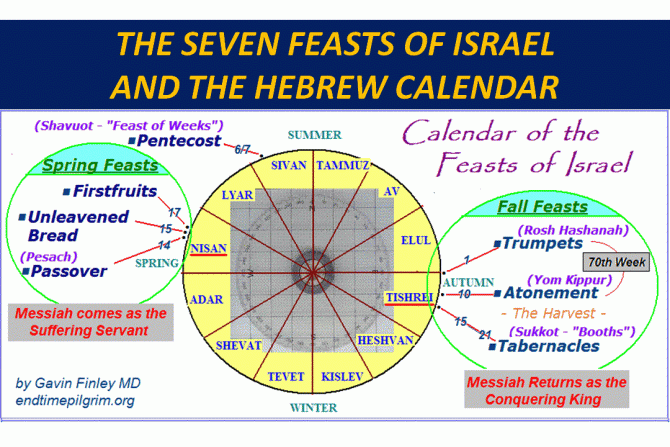
The Feasts of the Lord are God’s prophetic calendar for Jesus’ first and second coming to Earth. The Spring Feasts predicted His first coming so it is reasonable to assume the Fall Feasts will predict His second coming.
The Rapture will likely occur on Yom Teruah of the Sixth Year of Daniel’s 70th Week and the physical Second Coming will likely occur on Yom Kippur of the Seventh Year at the end of Daniel’s 70th Week. The Resurrection and Rapture (which occur at the trumpet blast of the Seventh Seal) will occur on Yom Teruah (The Feast of Trumpets).
Is there any Biblical support for other Feast Day fulfillments? Interestingly, there is! The Sixth Seal is the Celestial Earthly Disturbance Event. Based on our Feasts model, we predict it will be fulfilled on Shavuot (Pentecost). The initial primary fulfilment of Shavuot occurred when the Holy Spirit came upon the disciples in Jerusalem, and they spoke in other languages to the listeners in Jerusalem. Peter delivered the famous sermon found in Acts 2 to those listeners, and 3000 people were saved and baptized. In that sermon, Peter quoted Joel 2:30-31 which directly references the Celestial Earthly Disturbance Event! Peter openly linked the Celestial Earthly Disturbance Event with Shavuot (Pentecost) and with the later Rapture/start of the Day of the Lord (on Yom Teruah). linking the ultimate fulfilment of Shavuot (Pentecost, the day on which Peter was speaking) with the ultimate darkening of the sun and moon as part of the future Celestial Earthly Disturbance Event at the Sixth Seal (Joel 2:31 and Rev. 6:12)—-and also linking the Rapture/start of the Day of the Lord on Yom Teruah (the Feast of Trumpets), to follow shortly after that time (Yom Teruah occurs about four months after Pentecost). This is extremely strong evidence that this Sixth Seal will open on Shavuot (Pentecost), and by extension, from other correlations we have already noted, that all the seals will be fulfilled on the sequential Feasts’ dates. This is speculation, but a logical case is being built for this to happen as such. As you can see, knowing the Hebrew roots of our Christian faith is important in correctly interpreting much of scripture.
Back in 2020, thanks to President Trump’s vision and support, Taiwan Semiconductor Manufacturing Company (TSMC) began establishing advanced chip manufacturing in the United States. This vision is now a reality,” said TSMC Chairman and CEO Dr. C.C. Wei. “AI is reshaping our daily lives, and semiconductor technology is the foundation for new capabilities and applications. With the success of our first fab in Arizona, along with needed government support and strong customer partnerships, we intend to expand our U.S. semiconductor manufacturing investment by an additional $100 billion, bringing our total planned investment to $165 billion.”
Through this expansion, TSMC expects to create hundreds of billions of dollars in semiconductor value for AI and other cutting-edge applications,” said the company. “TSMC’s expanded investment is expected to support 40,000 construction jobs over the next four years and create tens of thousands of high-paying, high-tech jobs in advanced chip manufacturing and R&D,” it said.
Pictured is TSMC’s Arizona fab, which currently employs more than 3,000 people on 1,100 acres of land in Arizona. The site has been in volume production since late 2024. This expansion will play a crucial role in strengthening the U.S. semiconductor ecosystem by increasing American production of advanced semiconductor technology. It will also complete the domestic AI supply chain with TSMC’s first U.S. advanced packaging investments.
In the United States, in addition to its latest manufacturing site in Phoenix, TSMC operates a fab in Camas, Washington, and design service centers in Austin, Texas, and San Jose, California.
The difficult passage is Matthew 24:34: “Truly I say to you, this generation will not pass away until all these things take place,” the key question is, what does the term “generation” represent? The Greek word genea can mean a race of people, the total of those born during a certain timeframe, or a specific time (i.e., an age).
This passage is part of the Olivet Discourse, which is Jesus’ response to the disciple’s questions on the end times that precede His second coming to Earth. While Bible commentators assume different positions on what genea represents, none that I know of believe it refers to those alive at that time because “all these things” described earlier by Jesus in the chapter did not take place back then and still have not taken place today. Further, Jesus could not be referring to the generation listening to Him then because He had previously said the kingdom had already been taken away from that very same generation and they would not see it (Matthew 21:43).
That being the case, some, like theologian Charles Ryrie think genea means the Jewish race, while a slight majority (including myself) believe Jesus was referring to those alive who would see “all these things” that make up the end times, the Great Tribulation period in human history. Either interpretation could be valid, but the main point is that the text, given His previous statements in Matthew, isn’t saying Christ meant those alive in the first century.
In other words, Jesus wasn’t wrong in what He said. Next, when it comes to, “But of that day and hour no one knows, not even the angels of heaven, nor the Son, but the Father alone” (Matthew 24:36), and Jesus’ knowledge on earth, we take a deep breath and realize we are staring into the face of the Incarnation’s mystery. The best we can do is piece together what the Bible tells us.
We’re told that Jesus aged like all of us, “increased in wisdom” (Luke 2:52), and that He voluntarily set aside some of His divine attributes like omniscience, during His kenosis, when He “emptied Himself, taking the form of a bond-servant, and being made in the likeness of men” (Philippians 2:7).
Scripture also says that Jesus, during His time in this world, knew just what the Father showed Him. The Old Testament predicted this, saying: “I will raise up a prophet from among their countrymen like you, and I will put My words in his mouth, and he shall speak to them all that I command him” (Deuteronomy 18:18).
On this, Jesus Himself said: “I do nothing on my own authority but speak just as the Father taught me” (John 8:28), “For I have not spoken on my own authority, but the Father who sent me has himself given me a commandment — what to say and what to speak” (John 12:49).
That being true, Jesus evidently was shielded from the exact time of His return while alive then but has no doubt resumed His omniscience now that He has returned to His glorified state.
So, even though I’m a C. S. Lewis fan, I think he got this one wrong. The bottom line is there is nothing embarrassing about Jesus’s words regarding His return and the “generation” who would be alive to see it.
We are seeing the end times’ Scripture prophecies playing out in our day. Jesus’ second coming to Earth, first to raise to life the dead Saints and then to rapture those Saints alive before pouring out His wrath upon the unrepentant, is not too far off. One of the major prophecies signifying the end times is an apostate church that has compromised with the world on homosexuality, gay marriage and even transgenderism as demonstrated by Episcopal Bishop Budde in the sermon in Washington Cathedral with Trump present and she prayed on behalf of transgender children. What did she mean? God created male and female and that cannot be changed no matter what drugs and surgery is used.
This is my fourth post on a supernatural Christian awakening that is stirring up once again on American college campuses through Unite US – an evangelistic movement marked by salvations, water baptisms, and worship. Recently at the University of Kentucky, more than 2,000 students responded to the gospel message of Jesus Christ and many took part in spontaneous baptisms. “It’s hard to believe. This keeps happening. It is insane,” said Unite US speaker and founder of IF: Gathering Jennie Allen. Unite US was birthed out of a desire to “lift the name of Jesus.” It all began at Auburn University’s Neville Arena in September 2023 where 5,000 students showed up to worship Jesus and 200 were spontaneously baptized in a nearby lake. And now, the organization hosts massive worship events making waves on college campuses across the country. Collectively, those events have brought in more than 70,000 college students. Their first stop in 2025 was the University of Kentucky, just 30 minutes from Asbury University where the first sparks of a new spiritual awakening were seen among American students in February of 2023.
This time, more than 8,000 students packed Rupp Arena to worship Jesus and to hear a powerful presentation of the Gospel. “Every time they are confessing their sin; they are yelling it out. They are responding to the gospel in herds. Like droves of kids are coming forward to receive Jesus,” said Allen. “We are baptizing kids for an hour and a half. They are giving their lives to Jesus.” “It is only God,” she added. “There is a movement amongst students that you can’t believe. And even when you see it, you can’t believe it!” CBN’s Abigail Robertson was there, and she attests to the almost indescribable move of God that took place on the campus. “I’ve never seen anything like what happened last night. Kids lining up to get baptized in 30-degree weather – it’s truly amazing what’s happening,” she shared. According to the event’s organizers, it is an event that they have been praying about for months. “Our local student team organized weekly prayer gatherings and walked up to 42 miles one Saturday as they prayed over their campus,” the founder and visionary behind Unite US, Tonya Prewett, told CBN News.
“‘Jericho Marches,’ they called these Saturday prayer walks, and we saw walls come down last night,” she added. “We’ve been praying for this night for months, and God met us here again,” reads a post on social media. “We know it’s just the beginning of all He has in store.” Prewett shared a powerful message with the crowd about giving it all to Jesus. “You get so tired of the enemy and his attacks, that you will do anything. Even if it costs everything. Many times, God will use our deepest pain to propel us into our deepest purpose,” she shared. The night ended with hundreds of students making a public declaration for Jesus Christ, followed by water baptisms. And as each person rose out of the cool waters, cheers erupted from the crowd because another life was counted for the Kingdom of God. “He did it again. Except for He did it bigger than He’s ever done it,” said Unite US speaker and Pastor Jonathan Pokluda of Harris Creek Baptist Church in Waco, Texas.
“It was just crazy,” he said. “All the aisles and the altars were just full of people. Literally thousands of college students came forward to give their lives to Jesus. My legs are sore, my arm is sore from baptizing people. And we say thanks to God. Praise be His Name.” Unite US is bucking the claims that GenZ is spiritually apathetic. “I think we’re a generation of critical thinkers, and I think we’re a generation of authenticity, and we’re a generation of vulnerability,” Trosper Buchanan, a junior at UK, said. “I’ve seen and, and experienced firsthand, the death and the depravity that is disguised as the college experience. We’re just taught like this is what fulfills you and then this is life and then we, we take it and it kills us, and we’re like, ‘Well I guess, I guess something’s wrong with me,’” he continued. Dr. Sarah Baldwin, Vice President of Student Life at Asbury University, was at Asbury two years ago when a revival hit the campus that lasted several weeks. She told the outlet that GenZ is waking up to their true identity in Christ. “The students are recognizing that like, ‘no, this is what I was designed for; this is the purpose that was set aside for me, this is the life… this is the love that Jesus has for me.’”






 LIVING ETERNAL NOW