
Jonathan Cahn speaks on current events as they relate to end times Scriptures. Antisemitism is rampant worldwide. Nations are coming against Israel exactly as prophesied. How important it is to know how to stand in these end times when persecution is rife. Jonathan gives us 18 Keys on how to stand in the days of lawlessness and chaos.
FIJI OLYMPIC ATHLETES PRAISING GOD IN THE OLYMPIC VILLAGE
The harmonic singing of hymns praising God by the Fiji Olympic athletes, coaches, and staff during their worship gatherings in Paris’ Olympic Village has gone viral on social media.

Australian water polo player Matilda Kearns, housed near a building hosting teams from the Oceania countries, shared videos on Instagram of the Fijian athletes gathered in worship on a Sunday afternoon.
Five days earlier, Kearns shared another video from inside her room listening to the Fiji worship hymns that received over 600,000 likes. “So beautiful,” she said. “Everyone has come out onto their balconies to listen to it.”
In the videos, the Fijians are heard singing “Mo Ravi Vei Jisu.” According to Classical FM, the Fijian hymn translates to: “Put your trust into the Lord and he will guide your way.” Team Fiji shared a video of the members singing the full song in a July 21 Facebook video.
In interviews with the media, athletes have reported that they have been pleasantly surprised to hear singing from seven Fijian rugby players early in the morning. “They tend to start around 6:30 a.m.,” an Australia team staffer told Reuters. “No one is bothered by it. … It just sounds beautiful.”
The Fijian men’s rugby team made headlines in past years, taking home the gold medals in the 2016 and 2020 Olympic games before taking home the silver medal this year. After winning the gold in 2020, the the men’s rugby sevens team united to sing the hymn “E Da Sa Qaqa.” “We have overcome, we have overcome, by the blood of the Lamb, in the Word of the Lord, we have overcome,” they sang in their native language.
Captain Jerry Tuwai told The Guardian at the time that the team starts with prayers and songs and ends with prayers and songs. “That song says that our God is a loving God, and that while we always tend to go stray from what He expects from us, He still loves us, and gives us good things,” he said.
HYDROGEN AS A FUEL SOURCE
The thought of powering our cars, trucks, trains, and even planes with the most abundant element in the universe, whose byproduct is just water, sounds like the solution to greatly reducing global carbon emissions. Hydrogen seems perfect on the surface. It stores three times as much energy per unit of mass as gasoline. When it is combined with air, the energy released can power a vehicle, and it combines with oxygen to produce water.
Hydrogen is produced from water. About 70 million tons of hydrogen are produced each year, primarily used for ammonia fertilizer. And 96% of hydrogen production is made by a process known as steam-methane reformation. This process uses energy created by natural gas, coal, and oil to produce hydrogen. The industry produces 830 million metric tons of carbon dioxide yearly to produce this “clean” hydrogen fuel.
If we have to burn massive amounts of carbon-based fuel to put hydrogen in our cars, we aren’t helping the environment. We are only displacing where the carbon emissions take place, not whether or not they happen in the first place.
It is no different than fueling our electric vehicles with electricity produced from coal, natural gas, or oil. It is nonsensical to think that we are helping the environment.
Currently, 4% of hydrogen production is produced using electrolysis which uses electricity to split the hydrogen out of the water. However, the costs are four times higher than steam-methane reformation. To put things in perspective, it takes about 50–55 kilowatt hours of electricity to produce a single kilogram of hydrogen fuel. That’s the equivalent of about two days of electricity consumption for an average home in America. Two days of an entire household’s energy consumption just to produce one kilogram that provides enough fuel to travel 70 miles. Also, its volume is a problem It takes up a lot of space, so we can only carry about 5–6 kilograms of hydrogen in our tank. The other tricky nuance is that hydrogen molecules are so tiny, that they easily leak out of most containers.
Without billions of dollars in subsidies, hydrogen just doesn’t make economic sense; and because of where the energy comes from in the production of hydrogen – mainly fossil fuels – it doesn’t even make environmental sense.

For hydrogen fuel cells to be both environmentally sustainable and economical, the world must address how it produces baseload power. This is the kind of power required to manufacture the 70 million tons of hydrogen produced every year.
The most desirable technology to achieve this is nuclear fusion technology but it is still a long way off. Nuclear fusion is the same process that powers the sun and other stars and is widely seen as the holy grail of clean energy. Experts have worked for decades to master the highly complex process on Earth, and if they do, fusion could generate enormous amounts of energy with tiny inputs of fuel and emit zero planet-warming carbon in the process. In the meantime, nuclear fission providing carbon-free emissions with limited radioactive waste is a sustainable energy production strategy and one we should all be using. Both Small Modular Nuclear Reactors and Large-Scale Reactors are the way forward and progressive countries are already pursuing that strategy.
JESUS RETURN TO EARTH AS GIVEN IN THE OLIVET DISCOURSE
Baruch is the senior lecturer at the Zera Avraham Institute based in Israel. He holds a PhD in Jewish Studies. His dissertation was on the translation techniques of the Septuagint. Baruch has been married for 30 years to his wife, Rivka, and they have three adult children. The Kormans live in Israel.
Baruch teaches on Jesus’ return based on the Olivet Discourse in Matthew 24. He correctly warns Christians that during the end times, they will face tribulation. Jesus tells us that just as Daniel prophesied (Daniel 11:31) Christians will see the abomination of desolation (Antichrist) in the temple. They will experience persecution metered out by the Antichrist but they will be kept from the wrath of God that is poured out with the Trumpet (Revelation 8 & 9) and Bowl (Revelation 16) judgements.
GIVING THE GLORY TO GOD
Christian track star Sydney McLaughlin-Levrone gave credit to God as she became the first woman ever to become a two-time Olympic champion in the women’s 400-meter hurdles on Thursday. We have seen many American athletes acknowledge their Creator at the Paris Olympic Games.

The 25-year-old American won the gold medal in Paris, France, by recording a time of 50.37 seconds, beating out fellow American Anna Cockrell, who won the silver medal with a time of 51.87, and bronze medalist Femke Bol of the Netherlands, who finished in 52.15 seconds. Not having lost a 400-meter hurdles race since 2019, McLaughlin-Levrone’s victory never appeared to be in question as she pulled away from her competitors down the stretch.
“I credit all that I do to God. He’s given me a gift. He’s given me a drive to just want to continue to improve upon myself,” she said during a Thursday press conference. “I have a platform and I want to use it to glorify Him, and so whenever I step on the track, it’s always the prayer of ‘God let me be the vessel in which you’re glorified’ whatever the result is, how I conduct myself, how I carry myself, not just how I perform.“
What a wonderful testimony. God loves us to be thankful. Sydney will certainly get a “well done good and faithful servant” when she gets to meet up with her Lord and Saviour.
THE CHURCH THAT WILL BE LEFT BEHIND TO FACE THE WRATH OF GOD
“Thank you, Jesus”: Kenneth Copeland praises God for a new Bentley car. Prosperity gospel preacher Kenneth Copeland thanked Jesus for a dying man’s seed offering of a Bentley with a Breitling clock, which he had given in the hope that it would bring healing. It did not.

At Kenneth Copeland Ministries’ annual Southwest Believers’ Convention in Fort Worth, Texas, held from July 29 to Aug. 3, the 87-year-old televangelist regaled attendees with stories about his passion for Breitling watches, of which he owns around 36 coveted timepieces.
Speaking on “How to Walk by Faith and Not By Sight” two Mondays ago, Copeland delighted in showing off the diamond-encrusted Breitling adorning his left wrist to a man seated in the front row. “Do you think that one’s pretty?” Copeland asked the man. “It’s a Breitling. It has diamonds around the edge. Someone gave me that one.”
Copeland said he began gifting Breitling watches as seed gifts, adding that he and Pat Robertson, the late founder of the Christian Broadcasting Network and host of “The 700 Club,” had a “tradition” of gifting Breitlings to each other.
Bible scholar Justin Peters, a harsh critic of World of Faith prosperity preachers and the New Apostolic Reformation movement rebuked Copeland’s “wicked” teaching that sowing “a seed” will heal the sick.
“Kenneth Copeland knows full well that the people listening to him don’t follow him for exposition of Scripture; they are there for promises of health and wealth,” Peters said. “And there are a lot of sick people listening to him. Not just at this convention but all over the world. And they are sick; they are dying, some of them. And some have sick children, children who are dying.
As a warning to the televangelist who has boasted of being a billionaire, Peters quoted from Matthew:
“Not everyone who says to me, ‘Lord, Lord,’ will enter the kingdom of Heaven, but the one who does the will of my Father who is in Heaven. On that day many will say to me, ‘Lord, Lord, did we not prophesy in your name, and cast out demons in your name, and do many mighty works in your name?’ And then will I declare to them, ‘I never knew you; depart from me, you workers of lawlessness.'” Matthew 7:21-23,
Peters said he does not hate Copeland but was filled with “righteous indignation” because of the “audacity” the televangelist had to tell the story of a man who sowed a seed for healing from cancer yet died. “He’s dead,” Peters lamented.
Kenneth Copeland and all those he has deceived represent the seventh church of Revelation 3, the Church of Laodicea. It is the church that is left behind to face the wrath of God with the Trumpet and Bowl judgements. It describes the church in the seventh year of the 70th week of Daniel 9:24-27.
“For you say, I am rich, I have prospered, and I need nothing, not realizing that you are wretched, pitiable, poor, blind, and naked. I counsel you to buy from me gold refined by fire, so that you may be rich, and white garments so that you may clothe yourself and the shame of your nakedness may not be seen, and salve to anoint your eyes, so that you may see. Those whom I love, I reprove and discipline, so be zealous and repent.” Revelation 3:17-19
The sixth church, the Church of Philadelphia, is raptured. It represents the church in the sixth year of the 70th week of Daniel 9:24-27.
“‘I know your works. Behold, I have set before you an open door, which no one is able to shut. I know that you have but little power, and yet you have kept my word and have not denied my name… Because you have kept my word about patient endurance, I will keep you from the hour of trial that is coming on the whole world, to try those who dwell on the earth.” Revelation 3:8,10
LATEST ON SMALL MODULAR NUCLEAR REACTORS
There are already SMRs deployed and operating in China and Russia, as well as one test reactor in Japan.
Other first-of-a-kind SMRs are expected to be built this decade, followed by accelerated deployment worldwide during the 2030s, particularly as a source of reliable, low-carbon power generation and heat for hard-to-abate sectors. This includes notably the use of SMRs for on-grid baseload power to replace coal-fired generation, though market demand for SMRs continues to grow for other applications as well. The most promising include off-grid heat and power to replace diesel generators in remote regions for mining operations, fossil-fuel replacement for district heating, and high-temperature heat to replace fossil-fuel cogeneration in heavy industries. Other applications include replacing fossil fuels in cogeneration for ammonia and potash production for the fertiliser industry; hydrogen production for synthetic fuels and clean steel production; as well as marine propulsion to replace heavy-fuel oil for merchant shipping.
SMRs are driving innovation in the nuclear sector
The sector is witnessing significant innovation internationally. This includes SMRs at various stages of
development, from fundamental research on new concepts to commercial deployment and operation.
The innovation pipeline includes a range of reactor concepts – from incremental innovation in existing light water reactor technologies to breakthroughs in advanced Generation IV reactor concepts. It also includes SMRs in a variety of configurations – with land-based, multi-module, marine-based and transportable designs. These innovations incorporate new materials, a range of coolants, and, in some cases, innovative fuels. This is in turn expected to lead to the deployment of a range of SMRs of different sizes, with a range of outlet temperatures, and new attributes.
Nuclear energy supplies approximately 10% of the world’s electricity from 412 nuclear power
reactors in operation, providing 370 gigawatts of capacity. It is the largest source of non-emitting
electricity generation in OECD countries and the second largest source worldwide after hydropower.
The role of nuclear energy in meeting these pathways was emphasized at the 28th Conference of the
Parties (COP28) in Dubai on 2 December 2013 when the leaders of over 20 countries committed to
tripling global installed nuclear capacity by 2050, recognizing the critical role of nuclear energy in
achieving global net zero greenhouse gas emissions and keeping within reach the goal of limiting
the temperature rise to 1.5°C.
This commitment builds on NEA analysis that concluded in 2022 that to meet climate goals consistent with a 1.5°C scenario, global installed nuclear capacity needs to triple to 1 160 gigawatts by 2050 (NEA, 2022).
UNDERSTANDING THE DAY OF THE LORD
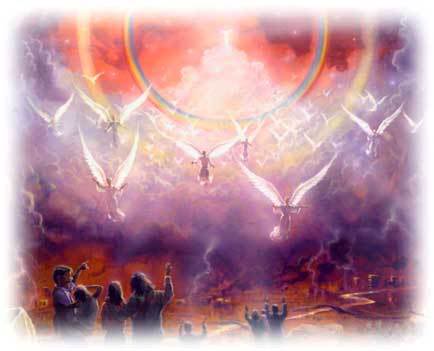
The phrase “Day of the Lord” usually identifies events that take place at the end of history (Isaiah 7:18-25) and is often closely associated with the phrase “that day.” One key to understanding these phrases is to note that they always identify a period during which God personally intervenes in history, directly or indirectly, to accomplish some specific aspect of His plan particularly Jesus second coming and a time when God will pour out His wrath upon the unrepentant as He did with Noah’s flood.
“But watch yourselves lest your hearts be weighed down with dissipation and drunkenness and cares of this life, and that day come upon you suddenly like a trap. For it will come upon all who dwell on the face of the whole earth.“ Luke 21:34-35
“For as in those days before the flood they were eating and drinking, marrying and giving in marriage, until the day when Noah entered the ark, and they were unaware until the flood came and swept them all away, so will be the coming of the Son of Man.“ Matthew 24:38-39
“But know this, that if the master of the house had known in what part of the night the thief was coming, he would have stayed awake and would not have let his house be broken into. Therefore you also must be ready, for the Son of Man is coming at an hour you do not expect.” Matthew 24:43-44
“But the day of the Lord will come like a thief, and then the heavens will pass away with a roar, and the heavenly bodies will be burned up and dissolved, and the earth and the works that are done on it will be exposed. Since all these things are thus to be dissolved, what sort of people ought you to be in lives of holiness and godliness, waiting for and hastening the coming of the day of God, because of which the heavens will be set on fire and dissolved, and the heavenly bodies will melt as they burn!” 2 Peter 3:10-12
“For they are demonic spirits, performing signs, who go abroad to the kings of the whole world, to assemble them for battle on the great day of God the Almighty. (“Behold, I am coming like a thief!” Revelation 16:14-15
The Old Testament passages dealing with the day of the Lord often convey a sense of imminence, nearness, and expectation: “Wail, for the day of the Lord is near!” (Isaiah 13:6); “For the day is near, even the day of the Lord is near” (Ezekiel 30:3); “Let all who live in the land tremble, for the day of the Lord is coming. It is close at hand” (Joel 2:1); “Multitudes, multitudes in the valley of decision! For the day of the Lord is near in the valley of decision” (Joel 3:14); “Be silent before the Lord God! For the day of the Lord is near” (Zephaniah 1:7). This is because the Old Testament passages referring to the day of the Lord often speak of both a near and a far fulfillment, as does much of Old Testament prophecy. Some Old Testament passages that refer to the day of the Lord describe historical judgments that have already been fulfilled in some sense (Isaiah 13:6-22; Ezekiel 30:2-19; Joel 1:15, 3:14; Amos 5:18-20; Zephaniah 1:14-18), while others refer to divine judgments that will take place toward the end of the age (Joel 2:30-32; Zechariah 14:1; Malachi 4:1, 5).
The New Testament passages call it a day of “wrath,” a day of “visitation,” and the “great day of God Almighty” (Revelation 16:14) and refers to a still future fulfillment when God’s wrath is poured out on unbelieving Israel (Isaiah 22; Jeremiah 30:1-17; Joel 1-2; Amos 5; Zephaniah 1) and on the unbelieving world (Ezekiel 38–39; Zechariah 14). The Scriptures indicate that “the Day of the Lord” will come quickly, like a thief in the night (Zephaniah 1:14-15; 1 Thessalonians 5:2), and therefore Christians must be watchful and ready for the coming of Christ at any moment.
Besides being a time of judgment, it will also be a time of salvation as God will deliver the remnant of Israel, fulfilling His promise that “all of Israel will be saved” (Romans 11:26), forgiving their sins and restoring His chosen people to the land He promised to Abraham (Isaiah 10:27; Jeremiah 30:19-31, 40; Micah 4; Zechariah 13). The final outcome of the day of the Lord will be that “the arrogance of man will be brought low and the pride of men humbled; the Lord alone will be exalted in that day” (Isaiah 2:17). The ultimate or final fulfillment of the prophecies concerning the day of the Lord will come at the end of history when God, with wondrous power, will punish evil and fulfill all His promises.
Much of the above comes from the website: http://www.gotquestions.org. It is a great place to go for answers to Biblical questions.
SIGNIFICANCE OF THE 9TH OF ARV
The ninth of Av is the Jewish Day of Mourning. Calamitous events occurred on Tisha B’Av. Tisha B’Av, the 9th day of the month of Av, is the saddest day on the Jewish calendar, on which Jews fast, deprive themselves, and pray. It is the culmination of the Three Weeks, a period during which they mark the destruction of the Holy Temple in Jerusalem.
Calamitous events that occurred on the 9th of Av: 1. Poised to enter the Promised Land, spies are sent in to check it out, and they return with a bad report resulting in 40 years of wandering in the wilderness. 2. Both temples were destroyed on the 9th of Av. 3. In 133 BC, the Jewish rebels were brutally butchered in the final battle at Betar on the 9th of Av. 4. One year after their conquest of Betar, the Romans plowed over the Temple Mount, the nation’s holiest site on the 9th of Av. 5. The Jews were expelled from England and their possession confiscated on the 9th of Av. 6. The Jews were banished from Spain on the 9th of Av. 7. Hitler approved the “final solution” order, which was the Nazi’s death warrant for the Jews of Europe, on the 9th of Av.
The Jews know that these events were judgements from God and that is why they are still Jews, and why we should believe the Bible is God’s Word.
Considering we are in the end times Nelson Walters suggests we watch for what might happen this 9th of Av, on August 13th, 2024.
ADOPTION OF SMALL MODULAR REACTORS
Britain’s new Labour government has said small nuclear plants will play an important role in helping the country meet its net-zero targets.
Britain’s Office of Nuclear Regulation (ONR) said the Rolls-Royce SMR 470 megawatt (MW) Small Modular Reactor (SMR) design had completed stage two of its three-step generic design assessment (GDA) – the formal process for approving a new reactor.
“The team will move directly into Step 3 of this rigorous independent assessment of our technology – ideally positioning us to deliver low-carbon nuclear power and support the UK transition to net zero,” said Helena Perry, Rolls-Royce SMR’s Safety and Regulatory Affairs Director.
The overall duration for the Rolls-Royce SMR GDA is expected to be 53 months, reaching completion in August 2026.
A unique approach
According to Paul Stein, Chairman of Rolls-Royce SMR, “The UK SMR heralds a new approach to the cost of nuclear power by broadly rethinking the manufacturing and construction methods and by the extensive use of digital twinning, keeping the physics package exactly the same. The SMR uses a pressurised water reactor, a type we know and love.”
The production will utilize commercially available, off-the-shelf components from within the UK supply chain, injecting revenue into the British economy and avoiding high-risk, complex construction principles.
Organization for Economic Cooperation and Development (OECD)
The second volume of The NEA Small Modular Reactor Dashboard is another milestone in the ongoing efforts of the OECD Nuclear Energy Agency (NEA) to comprehensively assess the progress toward commercializing and deploying SMR technologies. It is important to note that the present publication is not an update to the complement of reactors assessed in Volume I. Instead, the work extends the same methodology to a further 21 SMR designs worldwide to evaluate their progress toward commercialization and deployment as of 21 April 2023.
Australia is a member of the OECD and has access to the publications of its Nuclear Energy Agency on SMR’s and would be aware that the widespread use of SMRs is underway.
Notable public announcements, even in the intervening months since NEA published Volume I in March 2023, now reflect technology choices and plans by chemical manufacturers, oil companies, and copper mine owners. Market signals suggest that this trend will only continue to accelerate as awareness grows about the potential for SMRs to provide alternatives to fossil fuels for both power and non-power industrial applications.
Nuclear Energy allows us to use the existing transmission lines and infrastructure, which is extremely important in Australia with a widely distributed, small population in a large country. The proposal submitted by the Liberal Party for replacing cold fire power stations with SMRs and larger-scale nuclear reactors utilizes the existing transmission lines so is a cost-efficient option.
Wind and Solar in remote locations means a whole new transmission infrastructure to get the power to where it is needed. Moreover, they only work when the wind blows and the sun shines, so the power output is unreliable.
Blocking nuclear is a major setback for Australia’s industrial sector. In the past with our own coal and natural gas Australia provided industry with comparatively cheap energy that will change dramatically without nuclear. Also, Australia has the world’s largest economic demonstrated resources of uranium. In 2021, it was the world’s 4th largest uranium producer. However, Australia has only one commercial nuclear power plant therefore, it has limited domestic uranium requirements. It has and will continue to provide excellent export income.
 LIVING ETERNAL NOW