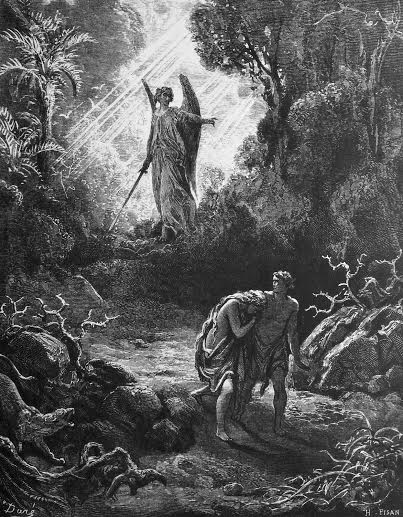
ANCIENT SUMERIANS RECORDED THE DIVIDE OF HEAVEN AND EARTH IN ACCORD WITH THE BIBLE

Before Adam ate the forbidden fruit, the heavenly (spiritual) dimension, and the earthly dimension were one realm— one domain, one plane of existence in which God, angels, and man had open communication and relationship; There was no separation between the spiritual realm, and the physical realm. There was perfect compatibility and agreement between them, an idea also found in Mesopotamian literature: “Heaven talked with Earth. Earth talked with Heaven.” (The Xianhua Wang Metamorphosis of Enlil (Satan) in Early Mesopotamia Pg. 152)

Anu (the creator god) carried off heaven while Enlil carried off the earth and assumed most of An’s powers.” (Kramer, Samuel Noah The Sumerians The University of Chicago Press, Chicago, 1963. Pg. 37-41)

Enlil … was at about the same time cosmologically considered the deity who separated Heaven from Earth and Earth from Heaven.” (Xianhua Wang The Metamorphosis of Enlil in Early Mesopotamia. Pg. 100.)
God walked in the Garden, and man could look at his face and endure God’s fire and lightning. Man’s transgression brought decay, degeneration, and death. God’s perfection and the fallen physical, earthly realm became incompatible. Now God’s fiery presence would scorch the ground like when He descended on Mt. Sinai (The mountains melt like wax before the LORD, before the Lord of all the earth. Psalms 97: 5). Now man could no longer see God’s face and live. The Garden of Eden, where God, angels, and man could commune together was gone. Open, unveiled fellowship became impossible. This divide of heaven and Earth caused by Satan (Enlil) was recorded by the ancient Sumerians ( Kramer, Samuel Noah The Sumerians The University of Chicago Press, Chicago, 1963. Pg. 37-41).

After The Fall, when God came into the Garden in the cool of the evening, Adam and Eve were compelled to hide themselves. Why? The first sign of disconnect was when they realised they were naked. They had been clothed with light like God covers himself “with light as with a garment” (Psalms 104: 2). They observed the glow in which they had previously been clothed was fading. This reality was displayed after Moses spent forty days with God and upon coming down the mountain, he “did not know that the skin of his face shone while he talked with Him” (Exodus 34: 29). When the congregation saw him, “The skin of his face shone, and they were afraid to come near him” (Exodus 34: 30).

After God announced the consequences of man’s actions, God had to remove Himself from his own creation, lest His fire destroy it. This removal is what the Scriptures call the veil. It is what marks the boundary between our earthly, physical domain and the spiritual domain. Isaiah first spoke of its removal: “And He will destroy on this mountain the surface of the covering cast over all people and the veil that is spread over all nations. He will swallow up death forever, and the Lord GOD will wipe away tears from all faces” (Isaiah 25: 7– 8). The prophet Isaiah also pined: “Oh that you would rend the heavens and come down” (Isaiah 64: 1). Whatever the veil is, it can be torn and removed.

There are four other distinct places where the veil (heavens) was opened: “I saw the heavens were opened and I saw visions of God” (Ezekiel 1: 1). “Jesus came up … and the heavens were opened to Him” (Matthew 3: 16). Stephen: “I see the heavens opened and the Son of Man standing at the right hand of God!” (Acts 7: 55– 56). John: “I saw heaven opened … Jesus was on a white horse” (Revelation 19: 11).

Since The Fall the cosmos exists as two realms— the one in which we live, and the other where spirit-based beings live and where God’s presence is manifest. The one realm was split into two: the earthly dimension is what Satan rules, he is the god of this world; the heavenly or spiritual dimension is where God rules. (God rules all, of course, but Satan has authority in the earthly realm.)

God did not curse the ground because of Adam; rather, like a reporter, He simply presented the consequence of the degenerative decay-death reaction that Adam triggered (Genesis 2: 17). God said, “Cursed is the ground for your sake” (Genesis 3: 17).

God created Adam from the adamáh (earth); Adam was the earth-man, the federal head of creation. Adam and the adamáh were linked physically and hence their fates were linked. When Adam ate from the fruit, death, degeneration, and decay happened upon Adam and upon the Earth and material cosmos as well. Decay permeated the entire creation from the invisible world of cells and DNA to all the animals, birds, and fish that God had formed out of the adamáh. Degeneration began within all living and non-living matter; the atoms of every tree, flower, blade of grass, rock, mountain, planet, and star. The complete composition of all physical creation became incompatible with God’s fiery presence.

I have found it liberating to understand the true history of God and His Cosmos and that the ancient world like the Sumerians recorded it in accord with God’s Word. I hope you find it liberating as well.

The information in this post has been extracted from Douglas Hamp’s book, Corrupting the Image 2: Hybrids, Hades, and the Mt Hermon Connection. Eskaton Media Group. There is a third book in the series: Corrupting the Image 3: Singularity, Superhumans, and The Second Coming of Jesus. I have not read it as yet but I am sure I will find some gems in it.

ADAM, EVE AND NOAH VS MODERN GENETICS

This is an important, in fact, critical topic for the creation model. The world does not look at the Bible in a favorable light. In fact, it disparages it, sometimes with open hostility. Attacks are often centered on the claim that the Bible is not reliable on historical grounds, and if the history of the Bible is inaccurate, what about the theology? Think about what Jesus told Nicodemus in John 3:12, “If I have told you earthly things and you do not believe, how will you believe if I tell you heavenly things?” Many people today see no history in the Bible; therefore, the spiritual implications are meaningless to them. What would happen to evangelism if the history of the Bible turns out to be true after all?

It comes as a surprise to most people to hear that there is abundant evidence that the entire human race came from two people just a few thousand years ago (Adam and Eve), that there was a serious population crash (bottleneck) in the recent past (at the time of Noah’s Flood), and that there was a single dispersal of people across the world after that (the Tower of Babel). It surprises them, even more, to learn that much of this evidence comes from evolutionary scientists. In fact, an abundant testimony to biblical history has been uncovered by modern geneticists. It is there for anyone to see if they know where to look!

For our purposes, the most important places to look are in the Y chromosome (which is only found in males and which is passed on directly from father to son) and in the mitochondrial DNA (a small loop of DNA that we nearly always inherit from our mothers only; males do not pass it on to their children). These two pieces of DNA record some startling facts about our past.

The evolutionary map of world migrations is startlingly close to the biblical account of a single dispersal of people from Babel. The evolutionary “Out of Africa” theory tells us there was a single dispersal of people, centered near and travelling through the Middle East, with three main mitochondrial lineages, with people traveling in small groups into previously uninhabited territory, and that all of this occurred in the recent past. Every item in that list is something directly predicted by the Tower of Babel account in the Bible. (Image http://www.mitomap.org).

Over the last decade, a vast amount of information has been collected that allows us to answer questions that we could not even consider earlier. The tools of modern genetics allow us to specifically ask questions about history, for our genes carry a record that reflects where we came from and how we got to where we are. The tools at our disposal are powerful.

Creation and genetics

There are two brief passages in the Creation account we can use to draw some conclusions about human genetic history. Please note that we cannot use these verses for land animals (because we do not know how many of each kind were initially created) or any of the swimming critters (“with which the waters abounded”—Genesis 1:21). These statements apply to people only:

And the Lord God formed man out of the dust of the ground, and breathed into his nostrils the breath of life; and the man became a living being.” Genesis 2:7

And the Lord God caused a deep sleep to fall on Adam, and he slept; and he took one of his ribs, and closed up the flesh in its place. Then the rib which the Lord God had taken from the man he made into a woman, and He brought her to the man.” Genesis 2:21–22

These simple statements have profound implications. They put a limit on the amount of diversity we should find in people living today. The Bible clearly says the human race started out with two people only. But how different were these two people? There is an intriguing possibility that Eve was a clone of Adam. The science of cloning involves taking DNA from an organism and using it to manufacture an almost perfect copy of the original. Here, God is taking a piece of flesh, with cells, organelles, and, importantly, Adam’s DNA, and using it to manufacture a woman. Of course, she could not be a perfect clone, because she was a girl! But what if God had taken Adam’s genome and used it to manufacture Eve? All he would have had to do was to leave out Adam’s Y chromosome and double his X chromosome and, voilá, instant woman!

I do not know if Eve was genetically identical to Adam. The only reason I bring this up is because we have two possibilities in our biblical model of human genetic history: one original genome or two. Either result is still vastly different from the most popular evolutionary models,2 but we need to discuss the range of possibilities that the Bible allows.

Your genome is like an encyclopedia (almost literally). And, like an encyclopedia, the genome is broken down into volumes, called chromosomes, but you have two copies of each volume (with the exception of the X and Y chromosomes; women have two Xs but men have one X and one Y). Imagine comparing two duplicate volumes side by side and finding that one word in a particular sentence is spelled differently in each volume (perhaps “color” vs “colour”). Can you see that if Eve was a clone of Adam, there would have been, at most, two possible variants at any point in the genome? If Eve was not a clone, however, there would have been, at most, four possible variants at any point in the genome (because each of the original chromosomes came in four copies). This still allows for a lot of diversity overall, but it restricts the variation at any one spot to 2, 3, or 4 original readings.

Does this fit the evidence? Absolutely! Most variable places in the genome come in two versions and these versions are spread out across the world. There are some highly variable places that seem to contradict this, but most of these are due to mutations that occurred in the different subpopulations after Babel.

There are indications, however, that Eve may not have been a clone. The ABO blood group is a textbook example of a gene with more than two versions.3 There are three main versions of the blood type gene (A, B, and O). However, many, but not all, people with type O blood carry something that looks very much like a mutant A (the mutation prevents the manufacturing of the type A trait on the outside of cells). So here is a gene with more than two versions, but one of the main versions is clearly a mutation. This is true for many other genes, although, as usual, there are exceptions. The important take home point is that essentially all of the genetic variation among people today could have been carried within two people, if you discount mutations that occurred after our dispersion across the globe. This is a surprise to many.

The Flood and genetics

Like in the Creation story, there are only a few verses in the Flood account that help us with our model. But as seen before, these verses are profound. About 10 generations after Creation, a severe, short bottleneck occurred in the human population. From untold numbers of people, the entire world population was reduced to eight souls with only three reproducing couples.

So Noah, with his sons, his wife, and his sons’ wives, went into the ark because of the waters of the flood.” Genesis 7:7

Now the sons of Noah who went out of the ark were Shem, Ham, and Japheth… These three were the sons of Noah, and from these the whole earth was populated.” Genesis 9:18–19

We can draw many important deductions from these statements. For instance, based on Genesis 7 and 9, how many Y chromosomes were on the Ark? The answer: one. Yes, there were four men, but Noah gave his Y chromosome to each of his sons. Unless there was a mutation (entirely possible), each of the sons carried the exact same Y chromosome. We do not know how much mutation occurred prior to the flood. With the long life spans of the antediluvian patriarchs, it may be reasonable to assume little mutation had taken place, but all of Creation, including the human genome, had been cursed, so it may not be wise to conclude that there was no mutation prior to the Flood. The amount of mutation may be a moot point, however, for, if it occurred, the Flood should have wiped out most traces of it (all of it in the case of the Y chromosome).

How many mitochondrial DNA lineages were on the Ark? The answer: three. Yes, there were four women, but the Bible does not record Noah’s wife as having any children after the Flood (in this case, girl children). And notice the claim in Gen 9:19, “These three were the sons of Noah, and from these the whole earth was populated.” This is a strong indication that Noah’s wife did not contribute anything else to the world’s population. With no prohibition against sibling marriage, yet,4 one or more of the daughters-in-law may have been her daughter, but this does not change the fact that, at first glance, we expect a maximum of three mitochondrial lineages in the current world population. There is a chance that there will be less, if there was very little mutation before the Flood or if several of the daughters-in-law were closely related. At most, we do not expect more than four.

How many X chromosome lineages were on the Ark? That depends. If you count it all up, you get eight. If, by chance, Noah’s wife passed on the same X chromosome to each of her three sons (25% probability), then there were seven. If Noah had a daughter after the Flood (not expected, but possible), there could be as many as nine X chromosome lineages. Either way, this is a considerable amount of genetic material. And since X chromosomes recombine (in females), we are potentially looking at a huge amount of genetic diversity within the X chromosomes of the world.

Does this fit the evidence? Absolutely! It turns out that Y chromosomes are similar worldwide. According to the evolutionists, no “ancient” (i.e., highly mutated or highly divergent) Y chromosomes have been found.5 This serves as a bit of a puzzle to the evolutionist, and they have had to resort to calling for a higher “reproductive variance” among men than women, high rates of “gene conversion” in the Y chromosome, or perhaps a “selective sweep” that wiped out the other male lines.6 For the biblical model, it is a beautiful correlation and we can take it as is.

The evidence from mitochondrial DNA fits our model just as neatly as the Y chromosome data. As it turns out, there are three main mitochondrial DNA lineages found across the world. The evolutionists have labeled these lines “M”, “N”, and “R”, so we’ll refer to them by the same names. They would not say these came off the Ark. They claim they were derived from older lines found in Africa, but this is based on a suite of assumptions (I discussed these in detail in a recent article in the Journal of Creation7). It also turns out that M, N, and R differ by only a few mutations. This gives us some indication of the amount of mutation that occurred in the generations prior to the Flood.

Let’s assume ten female generations from Eve to the ladies on the Ark. M and N are separated by about 8 mutations (a small fraction of the 16,500 letters in the mitochondrial genome). R is only 1 mutation away from N. This is an indication of the mutational load that occurred before the Flood. Given the assumption that mutations occur at equal rates in all lines, about four mutations separate M and N each from Eve (maybe four mutations in each line in ten generations). But what about R? It is very similar to N. Were N and R sisters, or perhaps more closely related to each other than they were to M? We’ll never know, but it sure is fascinating to think about.

One more line of evidence crops up in the amount of genetic diversity that has been found within people worldwide. Essentially, much less has been found than most (i.e., evolutionists!) predicted. The general lack of diversity among people is the reason the Out of Africa model has humanity going through a disastrous, near-extinction bottleneck with only about 10,000 (and perhaps as few as 1,000)8 people surviving. However, the reason for this lack of diversity is twofold. First, the human race started out with only two people. Second, the human race is not that old and has not accumulated a lot of mutations, despite the high mutation rate. Third, there actually was a bottleneck event, Noah’s Flood!

The Tower of Babel and genetics

Could it be possible that there is evidence to back up this tale of rebellion and judgment? Like the Creation and Flood accounts, there are only a couple of verses that apply to our model of genetics. But, like the others, these verses are as profound as they are simple.

“Now the whole earth had one language and one speech.” Genesis 11:1

And they said, ‘Come, let us build ourselves a city, and a tower whose top is in the heavens; let us make a name for ourselves, lest we be scattered abroad over the face of the whole earth.’” Genesis 11:4

It sounds like they were in a homogenous culture, but what do people in that situation do? Would you expect them to mix freely? Were language or cultural barriers present that would have prevented the sons of Shem from marrying the daughters of Japheth? Would the daughters of Ham be expected to marry freely with the sons of any of the three men? Note in Gen 11:4 that they knew about the potential for spreading out and getting separated from one another and intentionally did the opposite! However, this was against the express command of God, who had ordered them to spread out (to populate the earth). So, He took matters into His own hands.

“’Come, let Us go down and confuse their language, that they may not understand one another’s speech.’ So the Lord scattered them abroad from there over the face of all the earth, and they ceased building the city.” Genesis 11:7–8

There are tremendous implications that come from the Babel account. First it explains the amazing cultural connectivity of ancient peoples—like pyramid building, common flood legends, and ancient, non-Christian genealogies that link people back to biblical figures (e.g., many of the royal houses of pagan northern Europe go back to Japheth, the son of Noah).

The dramatic rise in world population over the past several decades is a well known fact. From a biblical perspective, the current human population easily fits into the standard model of population growth using very conservative parameters.10 In fact, starting with 6 people and doubling the population every 150 years more than accounts for the current human population (a growth rate of less than 0.5% per year!). Population size would have increased quickly given the rate at which the post-Flood population reestablished agriculture, animal husbandry, industry and civilization. So we must ask the question, “Why are there so few people in the world today?” The answer is that the world is young and we have not been here many thousands of years.

When did the dispersion occur? Our best clue about the timing of the event comes from Genesis 10:25. In referencing the 5th generation descendent of Shem, a man named Peleg, it says, “in his days the earth was divided.” To what is this referring? Many people believe this is referring to a division of the landmasses (plate tectonics). This may be true, but it would require a huge amount of geologic activity after the Flood, and this would have occurred in historical times with no record of the events. The interpretation I favor is that this passage is referring to the division of people at Babel. Just a few verses after the Peleg reference, the section is summed up with another reference to the division at Babel. This fits both the context and the science. In context, Peleg was closely associated with Babel.

How large was the population at the time? We would expect rapid population growth, but we cannot know exactly. There are 16 named sons born to the three brothers, Shem, Ham and Japheth. If we assume about the same number of daughters, Noah had on the order of 30 grandchildren. At that rate of growth, there would have been about 150 children in Salah’s generation, about 750 in Eber’s generation, and about 3,750 in Peleg’s generation. Of course, these generations overlap, etc., so let’s say there were between 1,000 and 10,000 people alive at the time of Babel. This fits nicely with the available data. It is a high rate of growth, but wars and disease had yet to start taking their toll.

There is one more verse in this section that we need to discuss:

These were the families of the sons of Noah, according to their generations, in their nations; and from these the nations were divided on the earth after the flood.” Genesis 10:32

At Babel, God did not separate the nations according to language. He used language to separate them according to paternal (male) ancestry! This has monumental significance and is the key to understanding human genetic history.

Do you see the implication in this simple verse? At Babel, God did not separate the nations according to language. He used language to separate them according to paternal (male) ancestry! This has monumental significance and is the key to understanding human genetic history. Paternal sorting would lead to specific Y chromosome lineages in different geographical locations. Since males and females from the three main families should have been freely intermixing prior to this, it also leads to a mixing of the mitochondrial lines. It is as if God put all the people into a giant spreadsheet and hit a button called “Sort According to Father.” He then took that list and used it to divide up and separate the nations.

We already saw that Y chromosomes have little variation among them. We now add the fact that this little bit of variation is almost always geographically specific. That is, after the nations were separated according to Y chromosome, mutations occurred in the various lines. Since the lines were sent to specific geographical areas, the mutations are geographically specific. The current distribution of Y chromosome lines is a tremendous confirmation of the biblical model.

Mitochondrial DNA (mtDNA) adds another confirmation. We have already learned that there are three main lineages of mtDNA. We now add the fact that these three lineages are more or less randomly distributed across the world. Also, the various mutations within each of the three main families of mtDNA are geographically specific as well.11 In other words, as the three mixed mitochondrial lines were carried along with the Y chromosome dispersal, each line in each area began to pick up new mutations, just like we would predict.

After the Flood

The last remaining significant reference in the Bible that will help us build our model of human genetic history is called The Table of Nations. It is found in Genesis chapters 9 and 10. The Table of Nations is a record of the post-Babel tribes, who they descended from, and where they went. If the Bible is an accurate source of history, one might expect to be able to find a significant amount of evidence for the Table of Nations in genetic data. The truth is not that simple, however, and it is important to keep several things in mind. First, the account was written by a person in the Middle East and from a Middle Eastern perspective. It is incomplete in that there are huge sections of the world that are not discussed (sub-Saharan Africa, Northern Europe, Most of Asia, Australia, the Americas, and Oceania). It also reflects a snapshot in time. It was written after the dispersion began, but not necessarily before the dispersion was complete. Indeed, much has changed in the intervening years. People groups have migrated, cultures have gone extinct, languages have changed, separate cultures have merged, etc. The history of man has been full of ebb and flow as people mixed or fought, resisted invasion or were conquered. The history of man since Babel is very complicated. Modern genetics can answer some of the big questions, but answers to many of the smaller details may elude us forever.

From an article Adam, Eve and Noah vs Modern Genetics by Dr Robert W. Carter http://www.creation.com/noah-and-genetics

IN QUEST OF THE HISTORICAL ADAM

In the last few years, apologist William Lane Craig has attacked biblical (‘young earth’) creation. However, he is not enamoured with many of the other compromise views. In 2021, he published a book, In Quest of the Historical Adam. He concluded that Adam and Eve were a real original couple who gave rise to all humans, and who committed the first acts of sin. But they were a pair of Homo heidelbergensis who lived perhaps 750,000 years ago. Dr. Jonathan Sarfati and Keaton Halley of Creation Ministries International offer their analysis of Craig’s book.

They do an excellent job of critiquing Craig’s book. God’s Bible is inerrant. It clearly provides evidence for a young earth and this video will help you support that view. Share your thoughts in the comments and share the video with your friends! If you would like to support Creation Ministries and their efforts: (https://creation.com/donate)

DID HUMANS EVOLVE FROM APES?

Humans did not evolve from chimps, gorillas, or orangutans. However, according to Darwinian evolution, humans are related to modern apes in that we shared a common ancestor.

This informative article by Dr Don Batten and Warren Nunn of Creation Ministries will equip you to explode this commonly held notion.

ape-man

Artists’ impressions of Homo erectus have most often depicted some really primitive, subhuman ‘ape-man’. However, the evidence that these were people (that should even share our species name) is mounting. So artists’ renditions are gradually shifting toward a much more obviously human appearance, as here.

Since Charles Darwin first proposed the basis for such ideas in the 19th century when he wrote On the Origin of Species by Means of Natural Selection, or the Preservation of Favoured Races in the Struggle for Life, molecules-to-man evolution has increasingly been taught as fact. Later, he fleshed out the idea of human evolution from a common ancestor with apes in The Descent of Man, and Selection in Relation to Sex.

The concept that humans and apes share a common ancestor contrasts with what we read in the Bible, because on the sixth day God said, “Let us make man in our image, after our likeness.” (Genesis 1:26) Further, in verse 27: “So God created man in his own image, in the image of God he created him; male and female he created them.” In Genesis chapter 2 it gives us more details, including that God made Adam from ‘dust’ and fashioned Eve, the first woman, from part of his side.

The two contrasting explanations for our existence—and for apes—have obvious philosophical/faith starting points because neither side can go back in time and observe how everything came into being. Both sides can only examine what we have in the present and draw conclusions from that.

Biblical creationists accept the Bible as an eyewitness account of that—for us—unobservable beginning. Thus, we can expect that by examining anything from germs to giraffes, that the data will best fit the presupposition of a perfectly created life-form that now exists in a world that is imperfect because of the Fall (Genesis 3). Therefore, we can expect (predict) that all life-forms now are not as genetically ‘perfect’ as their first parents.

So, ‘Did humans evolve from apes’ is really part of the bigger question, ‘Did humans and apes, and everything else, evolve?’

The answer is no, nothing ‘evolved’ in the sense that Darwin proposed through naturalistic, unguided processes. Instead, God created everything (including Adam and Eve) in six, 24-hour days and it was very good, as we are told in Genesis 1:31.

Because we can trust the Bible as real history, we know that

(a) all life was created about 6,000 years ago,
(b) there was a global Flood of judgment on the world, which only eight humans and a limited number of creatures survived, and that
(c) all air-breathing land animals are descendants of those that walked off Noah’s Ark about 4,500 years ago.

The DNA evidence

Chimpanzees are said to be the closest relatives of humans. There is an oft-repeated claim that human-chimp DNA is 98% (or more) similar. This figure was based on rather primitive comparisons published in 1975. These early reports were popularized by evolutionists, but this was long before even the initial drafts of the human and chimp genome that were announced in 2001 and 2005, respectively. As explained in Evolution’s Achilles’ Heels, and other places, with our modern understanding of genetics, we now know that “98%” is simply not the case.1 Even with genes that are similar between chimps and humans, the similarity is closer to 80%. If we consider the genes that chimps have that humans don’t and vice versa, the similarity drops to 70% or even less. However, the 98% myth persists.

An objective analysis of the claimed ape-men fossils shows that there is loads of wishful thinking involved.

Not enough time!

For the sake of the argument, let’s assume that the human and chimp genomes derived from a common genome in the six or seven million years since evolutionists say that humans and chimps split from the common ancestor. Then there is a need to account for 35,000,000 single-letter (base-pair) differences that had to arise and become fixed in the two genomes (i.e. the original letter in that location was replaced completely from the line to humans or the line to chimps); tens of millions of chromosomal rearrangements also had to occur, spread, and fix; as well as tens of millions of base-pair (‘letter’) insertions and deletions. (See Evolution’s Achilles’ Heels chapter 2 for more details). In short, there is simply insufficient time for evolutionists to account for the differences between chimp and human DNA, even with highly unrealistic assumptions in favour of it happening.2

Evolutionary time is measured in generations, not years. In six million years, there would only have been a few hundred thousand generations since chimps and humans were supposedly the same species. How then can there be enough time for so many brand-new genes to arise and be integrated? Each generation would have to select and retain an unbelievably huge number of mutations. This problem has come to be known as Haldane’s Dilemma. Despite claims to the contrary, Haldane’s Dilemma has never been solved. Modern knowledge of the genetic differences between chimps and humans shows that the problem is far greater for evolutionists than even Haldane imagined.3

Adam and Eve?

Studies of mitochondrial DNA, which is inherited from your mother, show that all humans had a single female ancestor.4 Likewise, studies of the Y-chromosome, which is only inherited from your father (to son!), show that all humans had a single male ancestor.5 Of course the evolutionary time scales attached to these individuals don’t match the Bible, but recalculations based on measurements of mutation rates in today’s world show that the biblical time frame is consistent with the data.

The world-wide genetic evidence in humans is consistent with the Bible’s history, that we are all descendants of Noah’s family, beginning some 4,500 years ago.6

Genetic decay

The number of mutations added to the human genome each generation is now known to be so high that it is inevitable that the human genome is deteriorating. This points back to a created perfection in the recent past.7 The same problem applies to all other complex creatures. This is another serious problem for the evolutionary idea that mutations and natural selection created humans and chimps from a common ancestor 6–7 million years ago. As the Russian geneticist, Alexey Kondrashov, remarked, “Why aren’t we dead 100 times over?” (he was assuming the evolutionary time frame).8

Fossils?

Are there really ‘ape-men’? An objective analysis of the claimed ape-men fossils shows that there is much wishful thinking involved, which is driven by the desire to ‘prove evolution’, or to justify the funding from National Geographic (e.g.), given to find ‘ape-men’.

There are a range of Homo species, including Neandertals. These are all descendants of Noah’s family. One exception is Homo habilis (‘handy man’), which prominent evolutionary anthropologists acknowledge is a ‘mixed taxon’, meaning that the fossil bones came from both apes and humans (hence it not surprisingly looks like an ‘ape-man’).

Other than that, objective numerical analysis shows that Australopithecus (‘southern ape’), supposedly the ancestors of humans (Homo spp.), are just types of apes that are not intermediate between chimps and humans.

That is, based on the fossils, there is no coherent story of human evolution from a common ancestor with apes, which is not surprising, considering the genetic evidence that shows they never existed.9

Conclusion

By reading the associated links to this article and books such as Evolution’s Achilles’ Heels, or by searching creation.com, you can learn more about this subject and when next someone asks you about any human-ape connection, you too will be able to gently suggest that they perhaps should take a closer look at the evidence.

You have a FATHER who loves you perfectly. Do you know HIM?

Expelled from the Garden of Eden

Adam and Eve expelled

Adam walked and talked face to face with his FATHER in the garden of Eden. Adam knew GOD as HE knew Adam – there was no separation. Adam knew his value and the proof of that value was his assignment to be like HIM, to partner with HIM having dominion over all of HIS creation.

GOD’S enemy, Satan (the father of lies) knew the FATHER’S one desire is for HIS children to know HIM. The battle has always been over intimacy in its purest form, between the ONE who is love and the ones who were created to receive HIS love. This battle had its front lines in the garden of Eden. One bite of the supernatural fruit from the tree of the knowledge of good and evil set into motion questions that would emanate from every human from Adam and Eve forward: “Is HE good or is HE evil?” and “Can HE be trusted?” Doubt was inspired by the mind of reason that had limited perspective based on a lie.

Generations later the battle continues to rage as GOD’S children wonder if they are loved and valued. We, the sons and daughters of GOD who couldn’t be more loved or valued, live as orphans with rejection complexes that cause us to look at every circumstance as proof of whether our FATHER loves us rather than going straight to HIM to experience HIS love for ourselves.

“In this the love of GOD was manifested toward us, that GOD has sent HIS only begotten SON into the world that we might live through HIM.” 1 John 4:9

The world lives as if GOD does not exist and if HE does, HE really watches from a distance to see how we’ll do without HIM.

Nothing could be further from the truth but you won’t know that GOD can be known and experienced until you dare to believe that HE wants to be known. You can gain access to all of HIS supernatural solutions to your problems.

Intimacy is a choice. It requires time and desire. Intimacy with the FATHER produces the knowledge of GOD, in which you know that HE is good and can be trusted. The choice is yours, start living eternal now.