
Let’s look at how Christians are reacting in real-time to Great Tribulation-like persecution. The primary responses we see in Arab Spring countries, some of which Jesus endorsed, include:
1. Running from the persecutors.
2. Remaining on-site and taking up arms.
3. Remaining on-site and insisting on legal protection.
4. Yielding to persecutors while actively ministering to them
Option 1: This has occurred in several Middle Eastern countries over the past decade and threatens the extinction of Christianity in that region of the world. Even prominent government leaders are beginning to acknowledge this fact.
Option 2: Sadly, this option has gained a little headway, due to calls like Greek Orthodox Bishop Lukas al-Khoury in Syria to have Christians take up arms “to protect Syria, churches, and convents.” Some believers undoubtedly have, but the loudest voices have decried this exhortation, saying that it violates the spirit of Christianity. Syrian Catholic Archbishop Jacques Behnan Hindo responded to the call to arms in this way: “As men of the Church, we cannot incite Christians to take up arms and to take part in the conflict. We cannot say these things; it is insane. It goes against the gospel and Christian doctrine.” I have not come across any reports that indicate Syrian Christians are standing and being resistant militarily to Islamist attacks.
Jesus certainly didn’t condone option 2 as He spoke in Matthew 24. He recommended option 1, in this specific circumstance: “Then let those who are in Judea flee to the mountains. Let no one on the housetop go down to take anything out of the house. Let no one in the field go back to get their cloak. How dreadful it will be in those days for pregnant women and nursing mothers! Pray that your flight will not take place in winter or on the Sabbath.” Matthew 24:16-20
But in other passages involving persecution, He argued for option 4. Christ never encourages a running towards martyrdom. Paul, too, never seemed to advocate seeking to be killed for Christ’s sake. Rather, he fled several times when he knew that his life was threatened, twice within the space of a few verses in Acts 9 (Acts 9:25, 30; 14:6, 17:10)! We know of Paul purposefully leaving at least four towns because of threats to his life. If you count other places where he left soon after starting an uproar, that number could climb to nearly ten. Don’t let anyone tell you that Paul never ran. He did! Self-preservation, the most basic human instinct, seems to be compatible with sold-out Christian living. I think we can make a very strong biblical case for running in the midst of persecution. In a similar way, I do not see convincing biblical evidence for having a death wish and actively seeking martyrdom, something Muslims do to “guarantee” a place in paradise. God does not call us to be cowardly, but Christ Himself advocated flight, and Paul lived out that commandment many times in his ministry. Remember these truths when the heat turns up and someone near you is insisting that God wants everyone to stand and fight, be outgunned, and go down in a blaze of glory. Once you are gone from this earth, you are gone, and you won’t be able to win anyone else to Christ. You also might leave your family heartbroken and in great need. We need to be careful that we don’t adopt a martyr complex, as Muslims have heartily done around the world.
Reverend Khalil Fawzi, the pastor of the largest evangelical congregation in the Middle East, Kasr El Dobara Evangelical Church, said recently that Muslim Brotherhood supporters in Egypt want to begin a civil war and would be helped in their quest by Christians turning violent. “They hoped the Christians will retaliate by killing and a civil war would start. I praise Christians for their patriotic attitude.”
Turkey’s defense of its mass killing of Armenians in the early twentieth century is a prime example. So if we do stand and fight, Muslims will have an easy out for killing men, women, and children who would otherwise be innocent bystanders.
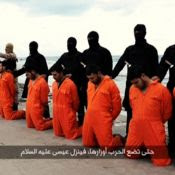
Options 3 & 4: We can learn much from our brothers and sisters in the Middle East who have selected options 3 and 4. Here are the primary lessons I see from where Christians are being persecuted by Muslims: 1. They understand once and for all that the church is not a building. Two days after the famed Archangel Michael Church was destroyed in Cairo, Coptic Orthodox Pope Tawadros II reminded his flock of what Jesus preached: “If the hands of evil kill, destroy and torch, then God’s hands are greater and they build. Christ’s commandments to us are to love your enemy, bless those who curse you, and do good to those who abuse you.”
The reaction to this charge, and other similar exhortations, has been Christians calmly meeting for worship in the areas of their churches that have not been completely burned to the ground, as seen in the 60 Minutes segment on Coptic Christians. The moving sight of Christians sitting in a room with one wall missing and the smell of burned wood still lingering, worshipping Jesus in a simple service, speaks volumes about understanding that the church is not a building. I think many Americans have come to realize this truth, as small groups have gained popularity over the past twenty years or so. That is a good realization to hold onto because we could very well come to a time when we are not allowed to meet in buildings.
Ralph Stice, author of Arab Spring, Christian Winter recounts this story: “I was struck by this possibility as I toured a literal underground church in Turkey’s Cappadocia region, mentioned in Acts 2:9 and 1 Peter 1:1. Our Muslim tour guide took us down a hole through which the four members of my family could barely squeeze. We walked among intricate hallways carved from stone and were told where meals were prepared and where people slept. It was an incredible experience to imagine living under the earth with brothers“.
In these last days as persecution intensifies we need to heed the warnings of Jesus in Matthew 24 and 25. Be watchful. Be ready. Be found faithful. Be on His mission, to spread the Good News.
Remember, Biblical prophecy tells us that Jesus is coming back and we are already seeing many of the prophecies playing out in our time. You can use these prophecies in your evangelism efforts to show unbelievers that God’s Word is true. We know the end of the story and for believers it is wonderful but for unbelievers, they will undergo the terrible wrath of God; the Trumpet Judgements outlined in Revelation 8 and the Bowl Judgements outlined in Revelation 16.
 LIVING ETERNAL NOW