If you haven’t watched President Trump’s recent speech in the UN then I would urge you to do so. It is impressive (without notes) and is based on his Republican teams accomplishments over less than two years. I am convinced he is God’s leader for the USA in these “last days” before Jesus return to rule and reign from Jerusalem.
NOTE how he ended his speech acknowledging and thanking GOD and we know it is the God of the Bible.
Taken from the new bible study for “Is Genesis History?” The full bible study is available here: http://bit.ly/ighbiblestudy
Dr. Stuart Burgess completed an engineering apprenticeship with Stothert and Pitt Cranes in Bath while completing a degree in mechanical engineering. After completing his PhD in the area of machine design he worked for the European Space Agency for five years mainly working on the ENVISAT earth observation satellite which is the largest earth observation civilian satellite in the world. He designed the solar array deployment mechanism including inventing a new type of gearbox – the double action worm gear set. He spent three years at Cambridge University as an Assistant Director of Research and Bye-Fellow of Selywn College. He led the design of the chain drive on the bicycles used by Team GB in the Rio Olympics where the cycling team won 6 gold medals and broke two world records. He has been at Bristol University since 1997 mainly working in the area of design optimisation of mechanical systems and bio-mechanical systems. I hope this in depth background on Stuart convinces you he has something worthwhile to say on a topic which determines where you will spend eternity.
There are at least 500 legends of a worldwide deluge. Many of these show remarkable similarities, with many aspects similar to the details about Noah’s Flood in the Bible
Perhaps all the peoples of these remote civilisations, including Australian Aborigines, had different flood experiences that, by chance, had all these features in common, on which they based their stories. However, the more reasonable alternative is that these legends all find their root in the same one global Flood experience that Genesis records.
Now Noah’s Ark on a Roman coin!
Imperial Rome produced a series of now-rare bronze coins depicting Noah’s Ark—the first known coins depicting a biblical scene. These coins, averaging about 3 cm in diameter, were produced during the reigns of five Roman Emperors: Septimius Severus, Macrinus, Gordian III, Philip, and Trebonianus Gallus, covering a period of 61 years (AD 192–253).
Real history
Noah’s Flood was an important historical event, not only for the Jews and Christians who lived in the city, but for the Romans as well, whether they understood this or not. It shows their common heritage and history, for they are all descended from Noah and his family, just as is everyone else today.
The history depicted on the coin speaks of a fallen humanity descended from Adam, God judging the world for its sin by flooding it, and God remembering Noah and keeping him safe throughout the Flood, for which He received His due praise. The New Testament indicates that the Ark is a ‘type’ of Jesus (1 Peter 3:20–21); coming to Him in faith and repentance ensures salvation from God’s judgement on sin. So the story on the coin can be used by Christians to point people to Jesus, the Saviour of the world.
What’s on the coin?
One side of the coin carries the image and name of the Emperor, which obviously changes depending on the time of minting, but the core features remain essentially the same. On the reverse side it depicts Noah and his wife inside the box-shaped Ark with waves lapping at the bottom of it. Noah’s name in Greek, ΝΩΕ (Nōe), can be clearly read in the middle of the Ark. On top of the Ark on the right is the raven, and on the top left is the dove with an olive branch in its mouth. On the left side of the coin Noah and his wife are again shown, standing outside the Ark on solid ground with their hands raised upwards to God in praise. This important feature shows that they recognised that God remembered them (Genesis 8:1), bringing them safely through the global Flood.
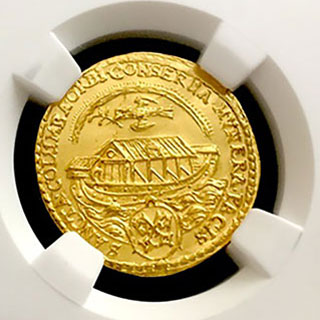
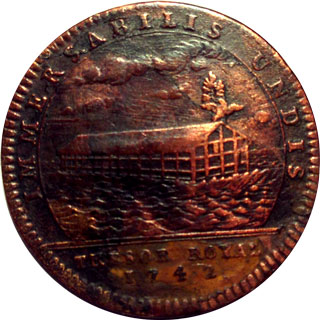
The Ark has appeared on many later coins. Here are some examples. Constant reminders of a real event when God judged mankind.
God’s history book, The Bible, gives us an account of a future event when God will pour out His wrath upon the earth and sadly, the majority of people will be unprepared for that event as they were in the days of Noah.
1649 golden ducat, commemorating the end of the Thirty Years’ War, by the city of Regensburg (Germany)
1742 French Royal Token
Silver bullion 500-dram Armenian coin
1998 Israel commemorative two-shekel coin
information on Noah’s Ark on a Coin taken from article with same name by Phil Robinson http://www.creation.com
Does what we find on the ground support the biblical narrative of the Jewish exodus from Egypt? There were no historians at the time to record the historical events.
“The only thing we can use to basically verify the biblical narrative is the archaeological record.”
Until now, the Number One attack on the bible, based on archaeology, has been lack of evidence, explains Rabbi Ken Spiro, a licensed Israeli tour guide with a Master’s degree in history.
But the more archaeologists dig, the more they seem to find.
It’s right there. It’s always been there. But until recently, no one has ever seen it.
Watch and be encouraged by historian/author Ken Spiro’s short video Archaeology Proves Exodus from Egypt
I do hope this account of the first five books of the Bible by RABBI ERIC TOKAJER will bring them alive for you as it did me.
The Bible is a history of the world from beginning to end, and that history is told over and over, one page at a time. Every word written adds more colour to the picture, and every phrase written provides more depth and contrast to help us see the fullness of the story as it is retold. To lay the foundation for what I am saying, let’s simply look at the first words of each of the five books of the Torah.
The book of Genesis begins with the words, “In the beginning God created the heavens and the earth” (Gen. 1:1, TLV). So, Genesis begins by introducing us to GOD.
The book of Exodus begins with the words, “Now these are the names of the sons of Israel who came into Egypt with Jacob, every man with his family” (Ex. 1:1). ” Exodus begins with the word “and,” connecting us to the book of Genesis, which introduced us to GOD. Exodus introduces us to the children of Israel, who are in bondage because they went to Egypt.
The book of Leviticus begins again with the word “and.” “And the LORD called Moses and spoke to him from the tent of meeting, saying ..” (Lev. 1:1, MEV). The “and” connects Leviticus to Exodus and Genesis as the picture continues to be painted.In Leviticus, GOD calls Moses from inside of the Tent of Meeting while Moses is outside of the Tent of Meeting. We are introduced to a GOD who is inviting His people into His home.
At this point, we have been introduced to GOD. We have been introduced to His people in bondage in Egypt. We have been introduced to GOD calling to man.
The book of Numbers also begins with “and.” “And the LORD spoke to Moses in the wilderness of Sinai in the Tent of Meeting on the first day of the second month in the second year after they went out from the land of Egypt, saying” (Num. 1:1). The “and” in Numbers connects the book of Numbers to the book of Leviticus. In Leviticus, we are introduced to Moses as one who has entered GOD’s home.
So, in Genesis, we are introduced to GOD. In Exodus, we are introduce to GOD’s people in trouble/bondage. In Leviticus, we are introduced to a GOD who invites His people into His home. In Numbers, we are introduced to a GOD who has welcomed His people into His home.
The Book of Deuteronomy begins with the words, “These are the words which Moses spoke to all Israel on this side of the Jordan in the wilderness, in the plain opposite Suph, between Paran and Tophel and laban and Hazeroth and Dizahab” (Deut. 1:1). Deuteronomy, like Genesis, does not begin with the word “and” because it is the conclusion of the story being told in the Torah. What story, you may ask? The same story told with every word and every stroke of paint: the Gospel.
Genesis tells us about GOD. Exodus tells us we are in bondage. Leviticus tells us GOD wants us to dwell with Him. Numbers tell us how we dwell with Him. Deuteronomy tells us to tell others about Genesis through Numbers so they can participate in Deuteronomy themselves. You see, the Bible/Torah isn’t a bunch of commandments and a burden too heavy to carry.
The Bible/Torah is our history, yours and mine. Each word is a stroke of colour that introduces us over and over to GOD. And when we view it from the right perspective, we are impacted by the beauty and intricacy of the Good News in every word and phrase that GOD loves us so much that He wants to spend eternity with us.
Dr. Del Tackett is part of an upcoming film titled “Is Genesis History?” and he’s hoping the documentary will give Christians the confidence they need to stand strong on the Word of God, particularly the creation account, without compromise.
“I’m hoping that people will look at the film and they would realise that they don’t have to accede to the accusation that if you hold to a position of [young earth], of a literal historical position in Genesis, then [you are] unscientific or stupid,” Tackett told The Christian Post during the premiere screening at The Creation Museum earlier this month.
“My hope is that those people that want to hold to biblical truth would walk away with the confidence that there is credible evidence and there are credible scientists, that they could be sure that what God has given us is true and can hold onto that.”
The documentary follows Tackett as he embarks on an eye-opening educational journey through evidence that supports historic claims from the book of Genesis, featuring commentary from renowned scientists and Bible scholars.
The film explores the questions and findings of the universe being created in six literal days, as well as whether or not humans evolved, the validity of a global flood, what happened to the dinosaurs and more.
“Here’s my position, and I think it’s one of the things that I’ve learned throughout the film: We are in an amazing time when the research is allowing us to see so much data that reinforces a Creator, that reinforces what He told us in the beginning,” Tackett said to Christian Post. “And I think it’s going to be increasingly difficult for the current paradigm to last much longer.”
“I would tell Christians, ‘If you are going to put your trust in Evolution and you’re going to say that God’s Word is now just an analogy, or it’s just some kind of simile, you’re twisting the Word of God because of a paradigm that is already really shaky.’ I would say, ‘You have that backwards. We start with the Word of God. We start with the record that God has given to us and stand on that, then begin to view the world around us. That’s when things will make sense.'”
The same is true when people try to make sense of evil, he noted. “If you come from a natural position, you won’t understand it. But if you come from it as it is described in the word of God, then it does make sense.”
“We live in a time where the current scientific paradigm is infiltrating a lot of the seminaries and a lot of the hierarchy in evangelical Christianity because people have been led to believe that science has settled this issue of deep time,” Tackett lamented.
If Christians are now feeling that they have to somehow rectify their faith for a scientific perspective, Tackett said then they are ripping out the foundation of everything that God has given to His creation.
“You lose the concept of a God that speaks life into existence, you lose the concept of male and female, you lose the concept of marriage, and the origin of sin and why there is evil. You lose the concept of a God that is holy, who judges sin and who will judge sin again,” he explained.
What the Bible scholar sees today is a generation caught in the current belief of creation without God.
“The world is still captive in the current paradigm. That paradigm, just as every paradigm in the past, really doesn’t allow any other questions,” Tackett pointed out.
What Tackett failed to say is that the theory of evolution has been the most successful ploy that Satan has concocted. It provides the excuse for fallen man to reject God, and despite the fact their is no mechanism (or evidence) to take you from “goo to you”, they won’t except the obvious – intelligent design because it requires a designer – GOD.
Moreover, to completely censor one side of the debate—when there are thousands of qualified ‘real’ scientists who believe in creation, highlights that it is a philosophy—masquerading as science—that is at work. To indoctrinate children to believe only one side is the antithesis of the intellectual high ground being claimed because it is actually anti-intellectual.
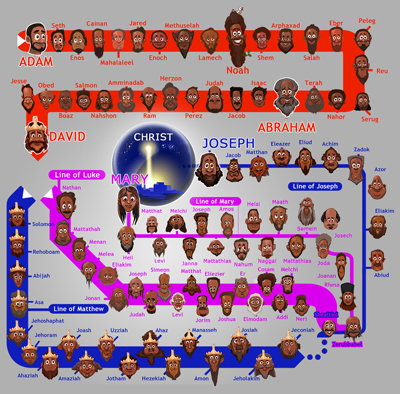
1 Chronicles 1 and Luke 3 take these genealogies to be completely historical. So theistic evolutionists who would relegate these genealogies to mythical status have to reckon not only with the plain teaching of the chronogenealogies, but how the rest of Scripture treats them as well.
Adam to Noah
The first genealogies we find in Genesis (in chapters 5 and 11) are called ‘chronogenealogies’ because the age of the father at the birth of the son are given. This allows us to know with a very high degree of accuracy (within a year) how much time passed during each generation. It also lets us know there is no gap between the names.
Shem to Abram
The most noticeable element of the genealogy is the steady decrease in lifespans. The antediluvians all seemed to live very long lives. But after the Flood, each generation lives shorter and shorter lives, until many children die before their longer-lived parents, and even before grandparents and beyond. By the time of Abraham, lifespans were only about twice what we experience in the modern-day world.
These genealogies are actually indications that Genesis intends to be taken as history, and not myth, because the chronology claims to set each person in a specific place in history. Many of the people in the genealogies are not mentioned elsewhere in Scripture, so their only purpose seems to be to link one important character with another (linking Noah back to Adam, for example). By the time Moses wrote Genesis, most of these names would not be otherwise significant to the Hebrews.
Matthew’s genealogy
The purpose of Matthew’s genealogy was to trace the legal line of rightful heirs to the throne of David. This of course included biological descent, but also some ‘adoptive’ relationships where a man had no descendant, or whose descendants were disqualified. Matthew’s genealogy used obvious ‘telescoping’ where less important people were omitted.
Matthew claims that his choice of names is significant because of the number of generations listed “So all the generations from Abraham to David were fourteen generations, and from David to the deportation to Babylon fourteen generations, and from the deportation to Babylon to Christ fourteen generations” (Matthew 1:17). The most plausible significance for this is because the numerical value of the letters in David’s name added up to 14. God is in total control of history. After all it is HIS story.
Luke’s genealogy
When we interpret the genealogies correctly, we see that they are trustworthy historical records.
Luke’s genealogy looks a lot more complete, and was probably the biological genealogy of Mary, so we see Jesus’ biological ancestry from David, and from Adam. We would expect that Luke would want to give us a complete chain to link Jesus biologically with David. But from Adam to David, he uses the Old Testament sources which indicates his confidence in them as Jesus had total confidence in them – Mt 5:18.
Luke’s genealogy is unusual in that it starts with Jesus and goes back to Adam—all the other genealogies go from father to son. This allows it to end with, “the son of Adam, the son of God.” This means that the genealogy starts and ends with a “son of God”, and nicely makes the theological point that Jesus is linked to all of humanity via common descent from Adam.
Trustworthy historical records
When we look at the biblical genealogies, we have to appreciate the purpose behind each of them, and that helps us to interpret them correctly. And when we interpret them correctly, we see that they are trustworthy historical records.
Extracted from article by Lita Costner “Are There Gaps in the Biblical Genealogies” http://www.creation.com





 LIVING ETERNAL NOW