OBJECTIVE MORALITY PROVES GOD EXISTS

This video covers the following content:

00:37 Introduction: Do we need God to explain morality? Or can evolution explain it?

01:49 What is morality? Defining terms

02:12 Objective morality

03:34 Subjective (or ‘relative’) morality

04:32 Is there evidence that objective morality even exists?

05:46 Do differences in conscience prove that morality is relative?

06:16 The fact that people disagree doesn’t mean there is no truth!

07:04 The Nazis were _objectively_ wrong!

08:06 Can evolution explain objective morality?

08:32 Aside: More evidence that objective morality exists

09:34 Continuing: Can evolution explain objective morality?

10:36 No, evolutionary explanations only produce _subjective_ morality!

12:25 Is morality just a social contract?

14:01 Is God really the best explanation for objective morality?

15:50 Atheist’s challenge: Where did God get _His_ moral standard from?

16:13 This is just a rehash of Euthyphro’s Dilemma (from Plato)

17:11 It’s a false dilemma

18:29 Answer: Moral goodness is rooted in the very character/nature of God

19:07 What about the presence of evil?

19:51 Moral evil depends on objective moral _goodness_ for it’s existence!

21:57 Even ‘natural evil’ points to the existence of a perfect standard of goodness!

24:16 Can atheists be good without God?

25:58 Conclusion: Why objective morality is best explained by God

27:12 The human problem with morality—and the solution

28:08 Example: Using the moral argument in real life

ONLY GOD DEFINES WHAT IS GOOD AND EVIL

God gave us His commandments to define what is lawful. God’s law is Holy. His commandments are Holy, righteous, and good. God defines what is sinful. Moreover, God gave each of us a conscience, an inner sense of right and wrong. One reason is because He loves us, and He doesn’t want us to destroy our lives and the lives of others through our evil deeds. But He also gave it to us to show us our need for Christ. He alone can forgive our sins, change our hearts, and then help us live the way we should.

The conscience is defined as that part of the human psyche that induces mental anguish and feelings of guilt when we violate it and feelings of pleasure and well-being when our actions, thoughts, and words are in conformity with our value systems. The Greek word translated “conscience” in all New Testament references is suneidēsis, meaning “moral awareness” or “moral consciousness.” The conscience reacts when one’s actions, thoughts, and words conform to or are contrary to God’s standard of right and wrong.

When King Solomon rebuked someone who had wronged his father, he said, “You know in your heart all the wrong you did” 1 Kings 2:44

Tragically, our conscience—this inner moral compass that ought to point us to right and wrong—can become dulled and suppressed, and we may not even be able to hear its warnings. Instead, we deliberately choose to do wrong—and the more we do this, the more calloused or hardened our conscience becomes. Some people, the Bible says, “suppress the truth by their wickedness” Romans 1:18

The world is increasingly suppressing God’s truth and is now openly opposed to it. It has embraced evolution and naturalism so that Man can make up His own rules. Christians who hold to God’s values are being treated as bigots and haters. Jesus said that in the last days before He returns this would be the case and we need to prepare for it.

“”Then they will deliver you up to tribulation and put you to death, and you will be hated by all nations for my name’s sake. And then many will fall away and betray one another and hate one another. And many false prophets will arise and lead many astray. And because lawlessness will be increased, the love of many will grow cold.Matthew 24:9-12

As Christians, we are to keep our consciences clear by obeying God and keeping our relationship with Him in good standing. We do this by the application of His Word and submitting to the indwelling Holy Spirit’s leading. We need to help those whose consciences are weak, treating them with Christian love and compassion. Don’t give in to cynicism or despair but ask God to help you point others to Christ’s transforming power.

SIGNPOSTS TO GOD

Another great article in Creation Magazine 2023, Vol 45, Issue 2, this time by Peter Howe Dip. Th., B.Th., M.A. A trained primary school teacher, Peter pastored several churches as an ordained minister in the Wesleyan Methodist Church of Australia.

Evidence of design

Flicking through a magazine one day as a child, I came across a photograph of Mount Rushmore, South Dakota, with the unmistakable likenesses of four American presidents carved into the rocks. Knowing nothing of how these came to be there, I remember thinking, “How strange! These can’t have happened by accident.”

Precisely! No one could seriously suggest that these shapes resulted from wind or rain or glacial erosion. These carved faces are clearly the result of creative design and effort.

Though not professing a commitment to anything like the God of the Bible, Paul Davies, former professor of theoretical physics at The University of Adelaide, writes in his book The Mind of God:

Through my scientific work, I have come to believe more and more strongly that the physical universe is put together with an ingenuity so astonishing that I cannot accept it merely as a brute fact … I cannot believe that our existence in this universe is a mere quirk of fate, an accident of history, an incidental blip in the great cosmic drama.

The humblest believer in God as Creator must exercise far less credulity, and has far less explaining to do, than the most ardent evolutionist materialist.

Of course, fallen humanity has devised many increasingly sophisticated speculations of how nature could nonetheless have made itself. Ministries like CMI provide people with specific answers to such challenges. Even so, it pays to step back and contemplate the ‘big picture’ of what is claimed, and its affront to common sense itself.

The evidence within

Another signpost is human nature. We have been made in the image of God (Genesis 1:27). Thus, we have spiritual capacities that cannot be explained apart from God. Language, reason, ambition, creativity, humour, wonder, worship—all these have no counterpart in the natural world. These qualities mark us out as different from the rest of God’s handiwork. This is another way of saying that our Creator has endowed us with the capacity to relate to Him at a personal level.

Within human nature, conscience is another sign pointing to God. Proverbs 20:27 says of the human spirit that it is “the lamp of the Lord, searching all [man’s] innermost parts.”. Our conscience is responsible for our intuitive knowledge of right and wrong, good and evil. The Apostle Paul states that even those who don’t have God’s law in written form still have a conscience that commends them when they instinctively do what it commands and accuses them when they don’t (Romans 2:14–15).

An image of hand

Even without a ‘book of rules,’ we know it’s wrong to lie, steal, covet, and murder. Conscience ‘puts a pebble in our shoe’ whenever we violate it. The standard it sets and the guilt it inflicts point us to God—the Source of all good and the Judge of all evil.

Eternity in our hearts

Our longing for eternity is another pointer to God. Somehow, we know and feel that this life is not all that there is. Archaeologists have discovered how carefully and elaborately the ancient Egyptians prepared for the afterlife, and they had no Bible to tell them about a life to come. Where does this longing for eternity come from? Everything on Earth is subject to change and decay:

Of old you laid the foundation of the earth, and the heavens are the work of your hands. They will perish, but you will remain; they will all wear out like a garment. You will change them like a robe, and they will pass away, but you are the same, and your years have no end.” Psalm 102:25–27

These ‘immortality longings’ we all feel at various moments are pointers to the God who created us in His own image.

Hunger of the soul

Another signpost to God is our longing for meaning and purpose. We always knew when our cat Simba was hungry and wanted to be fed. (Any cat owner knows that dogs have masters, but cats have staff!) He would eat his prescription dry food and go away content; his next meal seemed to be the limit of his horizon. But we can’t live at that bare, subsistence level—at least, not for long. We crave meaning and purpose in our lives; we long to enjoy significant and satisfying relationships.

This sense of longing is often called ‘the homesickness of the soul’—and rightly so, for that’s precisely what it is. The true object of our longing is God. The words of the psalmist reflect this truth:

As a deer pants for flowing streams, so pants my soul for you, O God. My soul thirsts for God, for the living God. When shall I come and appear before God?Psalm 42:1–2

Of all the signposts pointing to God, the Bible is by far the clearest. When a British monarch is crowned, he or she is given a copy of the Bible, and told, “This Book is the most valuable thing that this world affords. This is the royal law; these are the lively oracles of God.” When we read the Bible with a humble and teachable attitude, we find it to be a source of supernatural wisdom and power. The psalmist prayed: “Open my eyes, that I may behold wondrous things out of your law” (Psalm 119:18). Paul reminded his young associate Timothy that Scripture provides the wisdom and instruction that leads to “salvation through faith in Christ Jesus” (2 Timothy 3:15).Scripture’s major theme is Jesus Christ, God’s only Son. As “image of the invisible God” (Colossians 1:15), Jesus is the clearest and most compelling witness to the existence and greatness of God the Father. Jesus Himself said: “Whoever has seen me has seen the Father” (John 14:9). He is the perfect transcript of what God is like.

But the supreme demonstration of God’s love and care is the sending of His Son into the world to suffer death on the cross, to save us from our sins, and to reclaim us for Himself. The Cross is more than enough to convince us that God loves and cares for lost people (Romans 5:8). Jesus Himself said that He came “to seek and to save the lost” (Luke 19:10).

To help us find our way to God, there are signposts everywhere, but the most vital one is Jesus. He said: “I am the way, and the truth, and the life. No one comes to the Father except through me” (John 14:6).

REALITY OF MORAL LAW

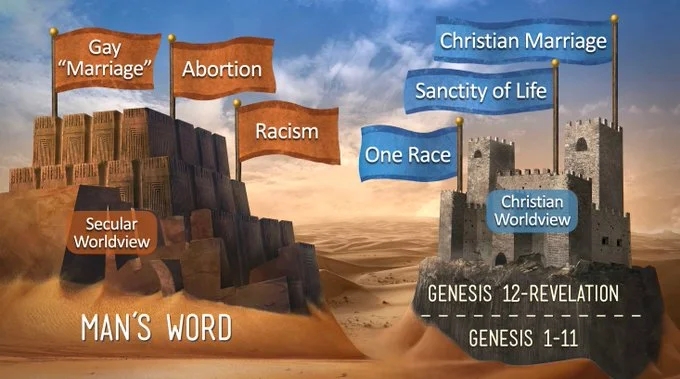
God is the moral lawgiver and has declared there is a moral order that governs life. It is revealed in His Word to us – the Bible. He created us, so He has the authority to tell us how life should be lived. Moreover, He created us in His image to be in a love relationship with us. Consequently, He gave us free will to choose, to trust Him or reject Him. Sadly, our progenitors disobeyed Him resulting in a world separated from its Creator. Demonstrating the extent of His love for us, our Heavenly Father sent His Son, Jesus, to become one of us so that He could provide a way for us to get back into a right relationship with Him. Jesus made it possible for our Heavenly Father to send the Holy Spirit to indwell all believers so they can follow the road map (Bible) God provided so we don’t get lost.

Adam and Eve expelled from the Garden of Eden

However, it must be remembered, all have a conscience, a moral compass which ultimately keeps us from destroying ourselves.

“No society has ever survived or will ever survive without morality, and no morality has ever survived without a transcendent source.” C.S. Lewis, Six Essays on the Abolition of Man

Dr. George Mavrodes taught philosophy at the University of Michigan for thirty-three years. He said that though the reality of moral obligations might not be proof for the existence of God, it is very strong evidence for it. He said that if anyone believes in absolute moral obligations, this only makes sense in a world where God exists. He makes it clear that this is the only way to account for one of the most significant aspects of human life. He encourages people who might not believe in God to be open to the possibility that the theistic view of life is truer to reality.

“Most of the skeptics I have seen move toward faith later told me that it was around this issue of moral obligation that they first began to wonder whether their views really fit the actual world they lived in.” Dr Tim Keller, Making Sense of God

Friedrich Nietzsche, the philosopher who coined the phrase “God is dead,” clearly recognized the hypocrisy that existed among those who claimed to be atheists. He had great contempt for those who didn’t believe in God and yet still clung to a belief in truth, morality, love, and human dignity. Nietzsche attempted to practice atheism until the day he died. As Jean-Paul Sartre said, such a life is “a cruel and long-range affair,” a life where love, beauty, and meaning could not exist. Nietzsche eventually went insane, suffering from the horrors of syphilis and spending the balance of his rapidly declining life in an asylum.

If you have an atheistic worldview and you logically think through its implications, you cannot help but experience despair when you consider that life is purposeless. We are here by chance, and when we die we go into everlasting nothingness. This generally culminates in a life of emptiness.

Diverting the mind is much easier for us today, because of the breakneck, vastly accelerated speed of daily life. The frenzy of digital life allows so little time for introspection and reflection. We find we are subtly, insidiously encouraged to ignore the significant issues of life, particularly the issue of “meaning.” Without realizing it, we seek to divert our minds with work and pleasure, to keep us from having to think about the emptiness of life, knowing that one day this is all going to end.

Without God, life ultimately is absurd.

THE ATHEIST DELUSION

What a great video by Ray Comfort. A must for your unbelieving family and friends.

Having to prove the existence of God to an atheist is like having to prove the existence of the sun, at noon on a clear day. Yet millions are embracing the foolishness of atheism. “The Atheist Delusion” pulls back the curtain and reveals what is going on in the mind of those who deny the obvious. It introduces you to a number of atheists who you will follow as they go where the evidence leads, find a roadblock, and enter into a place of honesty that is rarely seen on film. From Living Waters, creators of the award-winning TV program “The Way of the Master” and the hit movies “180” and “Evolution vs. God,” comes the powerful film “The Atheist Delusion.” Executive produced by TV co-host and best-selling author Ray Comfort (Hell’s Best Kept Secret, Scientific Facts in the Bible). Learn more at http://www.AtheistMovie.com

LIVING ETERNAL NOW – LED BY THE HOLY SPIRIT

The Bible clearly says we are to be “led by the Spirit”. It means being led by our recreated (born again) human spirit. Our spirit is in essence: conscience, intuition and in communion with the Holy Spirit that indwells our spirit.

This is what the Bible means when it says “you are the temple of the Holy Spirit” and “Christ in you, the hope of glory.”

LivingEternallyNow_CoverA_Page_1

We are made in God’s image and likeness so it is no coincidence we have a triune nature: Spirit, Soul and Body.

With our spirit we are in contact with the realm of God.

With our soul (will, mind, and emotions) we contact the realm of men.

With our five physical senses we contact the realm of earth.

We need to be like Jesus when He was on earth and say all of the time, “Holy Spirit, not my will but your will be done”. Sadly, so often after we err, we say, “something was telling me not to do that”. That something was the Holy Spirit speaking to our spirit.

We all have a conscience but in born again believers the conscience is in communion with the Holy Spirit, therefore it should be guided by the Holy Spirit. This is why the Bible warns; those who violate conscience end up shipwrecking their faith.

If, we allow the Holy Spirit to guide and direct our Spirit and therefore our soul (will, mind and emotions) then the fruit of the spirit will be evident in our lives: love, joy, peace, faithfulness, gentleness, goodness, kindness, patience and self-control.  Also, some of the nine gifts of the spirit will flow and we will truly start to bring His Kingdom to earth as it is in heaven.

Living Eternally Now available as an eBook on Amazon.