EVOLUTION UNDERMINES THE AUTHORITY OF THE BIBLE SAYS DR SARAH BUCKLAND

The information in this post was largely extracted from an interview with Dr. Sarah Fay Buckland titled GEOGRAPHY EXPERT FOR CREATION (Jonathan Sarfati chats with Dr. Sarah Buckland) in Creation Magazine 2023 Vol 45, Issue 2.

Dr. Sarah Fay Buckland earned her doctorate in geography from The University of the West Indies (Kingston, Jamaica) with high commendation. Dr. Buckland, who is a lecturer and published researcher, also holds a certificate in Bible evidence from the Creation Apologetics Teachers’ College (USA) by the Creation Training Initiative. She is the founder and principal director of Chosen to GLOW Ministries, which seeks to amplify the Christian voice in the public sphere and equip more youths to defend their faith.

Dr. Sarah Fay Buckland explains why it is imperative we believe the Genesis account of origins.

Evolution undermines the reliability of biblical history:

Evolutionary theory posits that human ancestry cannot be traced directly to only one man, contrasting with the biblical account of a literal Adam and Eve. This compromised belief undermines Jesus’ entire genealogy, as recorded in Luke’s Gospel. Jesus’ human ancestry traces back to Adam and the patriarchs. So how much of the Bible, therefore, would be deemed trustworthy? As Jesus asked:

If I have told you earthly things and you do not believe, how can you believe if I tell you heavenly things?John 2:12

Evolution undermines Jesus’ authority, omniscience, and thus His deity:

In several Bible passages in Luke, Jesus refers to real events that occurred in Genesis. He specifically referenced patriarchs and events, including the murder of Adam’s son Abel.

Therefore also the Wisdom of God said, I will send them prophets and apostles, some of whom they will kill and persecute,’ so that the blood of all the prophets, shed from the foundation of the world, may be charged against this generation, from the blood of Abel to the blood of Zechariah, who perished between the altar and the sanctuary.Luke 11:51

Also in Luke, Jesus uses the time of Noah and the Flood to reference the time of His soon-coming return.

Just as it was in the days of Noah, so will it be in the days of the Son of Man. They were eating and drinking and marrying and being given in marriage, until the day when Noah entered the ark, and the flood came and destroyed them all.Luke 17:26-27

Once again in Luke, Jesus makes it clear that God made Adam and Eve at the beginning of creation they were not the product of evolution over millions of years.

But from the beginning of creation, ‘God made them male and female.’ Therefore a man shall leave his father and mother and hold fast to his wife, and the two shall become one flesh.’ So they are no longer two but one flesh. What therefore God has joined together, let not man separate.” Mark 10:5-9

Genesis clearly states that all human beings were created in God’s image. All persons being created equal and endowed by their Creator with certain unalienable rights has formed the foundation for most positive anti-racial campaigns, including those by William Wilberforce and Dr Martin Luther King Jr. The Bible clearly teaches that God created humanity from ‘one man’ (Acts 17:26). While many secular movements depict Christianity as racist, the evolutionary worldview inherently has the most racist roots, both philosophically and in practice.

For instance, biological evolution requires an evolutionary ‘progression’ from the first ‘primitive’ humans to modern man. Unfortunately, Darwin and the early Darwinians point to an African origin of the most ‘primitive’ humans. Conversely, Europeans were considered the highest-evolved race. This philosophy influenced some of the most racist movements, including Hitler’s Nazism. It even filtered into early practices under the guise of ‘science’. African Pygmies were even caged in zoos.

Once again, the Bible’s unchanging doctrines always provide the most ethical basis for all aspects of life, in contrast to the ever-changing story of evolution.

GENOME MAKES EVOLUTION IMPOSSIBLE

The human genome is much more complex than anyone imagined. In fact, the level of complexity argues directly against any sort of evolutionary origin for the code that makes us. This episode features Dr Rob Carter and Gary Bates. This a must-watch video, just 19 minutes, particularly for young people to show that there is a master designer that has produced this incomprehensible complex universe. To my mind, no rational person could look at this video and think we were created by mutation and natural selection. And no one who is intellectually honest could do anything but be in awe of the genius of God.

ANSWERING THE SKEPTICS: NO EVIDENCE FOR GOD

The ‘no evidence for God‘ claim is an interesting one. It often works to frame the discussion in such a way that only creationists have a burden of proof. It allows the unbeliever the comfortable position of the skeptic: they get to poke holes in our case without ever having to make a case for anything themselves. Plus, skeptics regularly demand airtight arguments practically anyone would have to accept before they would believe in God (Agnosticism). As such, we almost certainly won’t convince them. But then that supposedly means that our faith in God isn’t reasonable. The game is rigged from the start. Heads, the skeptic wins; tails, we lose.

How should we respond?

CMI suggests you flip the script. Instead of you presenting a case for God, make them present what they think a case for God should look like. The simplest way to do this is to ask them: ‘What sort of evidence would you expect God to give?’

Many skeptics will say things like, ‘Well, none of the arguments I’ve seen convince me.’ Or they may just continue to demand that you convince them. Don’t let them off the hook. Hold their feet to the fire. Say something like: ‘Well, if I don’t know what would convince you, why should I bother trying? How do I know that anything I might say wouldn’t just fall on deaf ears?

You want them to give you something concrete. But, failing that, your goal is to make them feel the irresponsible dogmatism of their skepticism. If skeptics hate anything, it’s looking like a gullible dogmatist. If they continue to avoid the question then walk away. The Holy Spirit may prompt you to pray for them but otherwise do not waste more time.

But if they do give you something concrete, then play the skeptic. What you want to do is to show them that even the case they expect would convince them has the same sort of holes they think exist in the case we make for God exists.

EXAMPLES:

Many skeptics will say things like: ‘Well! if I saw an amputee healed in response to prayer, that would convince me.Response: ‘Really? How do you know God would’ve done it?’ ‘The prayer’, they’ll respond. Your response: ‘That could just be a coincidence. Besides, it’s just a one-off event. What if it never gets repeated? That doesn’t sound scientific. Plus, how do you know something other than God didn’t step in to heal the amputee? Maybe aliens did it! At least we know aliens can exist, since we exist. But God? You’re just linking events that have no demonstrable link and labelling it with ‘God did it’ to cover for your lack of a scientific explanation.’ This sort of response is a real stinger because it’s exactly how most skeptics respond to cosmological and design arguments for God.

Some of them might say, ‘Well, if God appeared to me right here and said, “Here I am, believe in me!” then I would.’ Response: ‘So, you’d bow the knee at a vision that may very well just be a dream? How would you know for sure you didn’t hallucinate?’

Some might say, ‘If the stars read “God exists. Worship him”, I would believe.Response: ‘That would only be useful to people who knew the language the message was written in. Nevertheless, how do you know the stars don’t say that in a language you’ve never encountered? At any rate, why not other beings that want to deceive us? It’s not something we could say that only God could do, so why should we trust a message in the sky with practically no context? Besides, why should you expect God to arrange the stars just to sate your curiosity about his existence? Is that really reasonable to expect of God? Are we the centre of his universe?

With such responses, you’re not trying to show that God doesn’t exist. Rather, you’re trying to show that we can always come up with reasons to doubt that will sound plausible to someone, no matter what evidence is put forward. And if they say, ‘Well, that’s what would convince me.Respond with: ‘So what? You can’t guarantee that it would convince every rational person. You didn’t say, “There’s no evidence for God that convinces me”; you said, “There’s no evidence for God”, period. If all you’re aiming to do is convince yourself, how can anyone else be sure that you’re really looking for the truth? And this isn’t just about trusting you. This is also about whether you’re even competent to look for the truth about God.

At this point, they might start saying things like, ‘Well, all I can do is look at the evidence and do my best to figure out the truth. You have to do that for yourself, too.’ At which point you can respond with: ‘Exactly! That’s all I’m trying to do, too. But I genuinely think that things like the following are best explained by the existence of God (click on the links for a detailed explanation of each).

I see those things and more as evidence for God. I’m not saying that other explanations can’t be offered, or even that smart and sane people can’t disagree with me. Maybe you don’t find these to be conclusive proofs, but it’s a gross overstatement to say that they don’t qualify as evidence. Furthermore, when I look at them as honestly and critically as I can, I still think God is the best explanation for them. But when you say, ‘there’s no evidence for God’, you seem to imply I’m less than rational and/or honest when I say that. Is that fair?

After all, that’s the real effect of this ‘no evidence for God’ claim. If they hold it consistently, they have to admit that you’re essentially irrational just for being a theist. But hopefully, by this point, they feel the unjustified dogmatism of their view, and walked it back a bit to admit that theists aren’t necessarily failing to reason properly when they believe in God. If you manage to do that, then you’ve won a huge victory. And that might be a good place to end the discussion for the time being. People often need time to process these sorts of things, so bombarding them with everything in our arsenal all at once is just unhelpful. For a start, they are probably not ready to hear most of it with an open mind. Rather, we try to deal with the person where they are at and try to nudge them a little bit in the right direction.

This information was assembled by Shaun Doyle of Creation Ministries International (CMI) in answer to the many queries CMI receives on how to answer skeptics’ arguments. http://www.creation.com

ONLY CREATION CAN EXPLAIN THE GOLDEN PLOVER

THE ANIMAL KINGDOM contains many marvels that modern science has yet to fully explain. One example concerns the migration flight of the golden plover.

The Pacific Golden Plover (Pluvialis fulva) is a small shorebird, about the size of a dove. It lives from northern Siberia to western Alaska. Every year, these birds leave their young and fly south to spend the winter in South Asia, Southeast Asia, Australasia, or on various Pacific islands.

Of the Alaska-dwelling members of this species, almost all (including those stopping en route to more distant destinations) make a migratory flight to Hawaii, where the bird is known as the kolea. Alaska to Hawaii means an 88-hour, non-stop flight across more than 4,500 km (2,800 miles) of open ocean. The birds are unable to swim, and there is no land between these locations for them to stop and rest. Amazingly, for an individual plover to fly this distance would require more energy than is stored in its body.

Before departure, they put on additional weight, mostly in the form of fat reserves to sustain their long flight. On average, they gain enough to give each bird about 70 grams (2.4 oz) of consumable energy. Here is the dilemma, though; these birds in flight burn approximately 1 gram of energy per hour, so they should consume all their stored energy in about 70 hours, which is 18 hours short of Hawaii. However, each year the golden plovers make it to Hawaii. How is this possible?

As do some other kinds of birds, the plovers fly in a V-formation. This is so they can ‘draft’ off each other, which reduces the energy required to fly. This saves each bird, on average, 23% of the energy that would be used if flying unaccompanied. This is, however, not the case for the bird at the lead position, but the plovers take turns in that position and thus ‘share the load’.3 These golden plovers arrive in Hawaii every year with 6.8 g (0.24 oz), on average, left over from what they had ready for the flight. This provides insurance in case of non-advantageous winds encountered on the flight route.4

It is not uncommon for the plovers to lose 50% of their total body weight during this epic flight spanning less than four days. This is amazing. Imagine a 60 kg human losing 30 kg (65 lb) while jogging non-stop for this entire period, neither eating nor drinking—without any ill effects!

Sophisticated programming

The plovers’ innate abilities enabling them to perform this amazing migratory feat have all the hallmarks of design, engineered into their systems for migration purposes. Consider the following instinctive abilities, all of which are pre-programmed within the bird’s DNA, thus already in the fertilized egg:

  • Timing their substantial fat gain. Each bird needs to have this extra fuel already on board when the time comes for them to depart, together, on their astonishing odyssey.
  • Ensuring in advance the correct amount of fat for the distance needed. Too little, and the bird would plunge into the ocean and perish, its fuel all spent, before reaching its destination. Extra weight adds to the effort of flying this incredible distance, so with no possibility to rest, too much fat risks the bird again falling short of Hawaii, in this case from exhaustion.
  • Drafting off each other in flight. Without such a clever aeronautic strategy, even the extra fat they carry would not last the distance. Consider, too, the built-in ingenuity that causes them to alternate the ‘lead pilot’ position so that all of them share this energy-saving benefit equally.

All of this reflects a Designer with intelligence and ability beyond all human understanding. In His omniscience, He can say, “I know all the birds of the hills” (Psalm 50:11). This Designer, the Lord Jesus Christ, created all the original populations (kinds) of living things ex nihilo. He deserves our awe and praise:

O Lord, how manifold are your works! In wisdom have you made them all; the earth is full of your creatures.” Psalm 104:24

The article is taken from Creation Magazine Volume 45, Issue 2, 2023. Make sure you subscribe http://www.creation.com

DARWINIAN EVOLUTION FALSIFIED

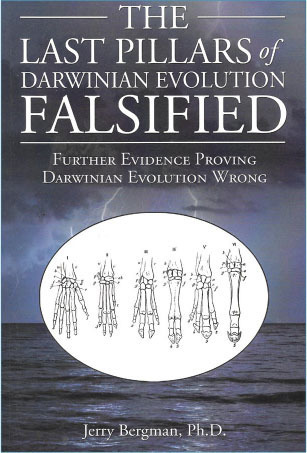
The Last Pillars of Darwinian Evolution Falsified: Further evidence proving Darwinian evolution wrong
by Jerry Bergman

Dr. Jerry Bergman is a famous creationist author who has extensively published over many decades and who has taught at several universities. He describes the research that went into this book:

“This project has been for me a lifelong study for which this book is a summary. It is the culmination of four decades of research on the issue of evolution, 41 years of teaching life science at the college level, and over 1,700 publications in 2,400 college libraries in 65 nations and 13 languages” (p. xvii).

In terms of specifics, this work focuses on taxonomy, so-called convergent evolution, irreducible complexity, pseudogenes, and antibiotic resistance. Bergman goes into considerable detail on all of these.

Irreducible complexity is the fatal problem for evolution

Bergman touches on some of the challenges facing commonly believed evolutionary explanations for the origins of complex structures, resulting from the co-option of components originally having different functions. He comments:

“… the availability of these parts would have to be synchronized … the parts must be correctly and properly positioned in 3-D space so they can be properly assembled … . Even if all of the parts are available at the proper time, the vast majority of assembly variations will be nonfunctional or dysfunctional” (pp. 145–146).

Some evolutionists have vulgarized the Intelligent Design explanation as a ‘jackpot or nothing’ one. But that is exactly what it is, and evolutionists have failed to show how the emergence of a complex biological structure can be anything other than ‘jackpot or nothing’.

Bergman has examined and deconstructed a variety of ‘pillars’ of evolution. Each one of them contains major flaws. Neither taxonomy nor genetics, for example, compel belief in evolution. Evolutionists have caricatured, but not overcome, the fatal problem of irreducible complexity. The best explanation for living things, whether somebody likes it or not, remains an intelligent designer.

A condensed version of a review of Dr. Bergmans book in the latest edition of The Creation Journal Volume 37, Issue 1, 2023

EVANGELISE MORE EFFECTIVELY WITH CMI RESOURCES

Creation Ministries International (CMI), including their flagship Creation magazine, exists to help readers worldwide love God with their minds and imitate Christ in logical thinking. In every issue, they interview good examples of that; in their latest issue Vol 45, Issue 2 it is geographer Dr. Sarah Buckland from Jamaica (pp. 18–21) and biologist Dr. KeeFui Kon from Singapore (pp. 36–39). They also show how biblical creation is logically illustrated by super designs, such as the golden plover (pp. 24–25) and even the air we breathe (pp. 50–52).

And he [Jesus] said to him, “You shall love the Lord your God with all your heart and with all your soul and with all your mind. Matthew 22:37

In your hearts honor Christ the Lord as holy, always being prepared to make a defense to anyone who asks you for a reason for the hope that is in you; yet do it with gentleness and respect, having a good conscience1 Peter 3:15

“​ Be imitators of me, as I am of Christ.1 Corinthians 11:1

What else is in the latest edition? Proof of the flood of Noah’s day, which must logically be global (Genesis 6–8). With an intense process like the Flood, we don’t need millions of years. And millions of years are necessary (but not sufficient) for evolution from goo to you via the zoo. The Flood explains the spectacular ammolite (pp. 12–13) and the wide Nile valley (p. 56). But God rescued a remnant of people (such as Shem, pp. 46–48) and animals on a massive Ark (pp. 32–35). After the Flood, people and animals migrated around the world, such as rafting monkeys (pp. 14–17).

A team of scientists at Australia’s Monash University has “discovered a new universal rule of biological growth that explains surprising similarities in the shapes of sharp structures” across a vast array of living things.

Our universe is governed by many precise and universal physical-mathematical laws, reflecting its lawgiving Creator. Many medieval founders of science, such as Roger Bacon, Robert Grosseteste, and Thomas Bradwardine taught that the Creator upheld the creation in the language of mathematics. Centuries later, Galileo wrote that the universe is “written in mathematical language”. So the discovery that structures in living creatures follow a mathematical power law is fascinating, but not surprising.

This is just a small example of the valuable content of the Creation magazine. You need to subscribe. Go to http://www.creation.com to do so. I have at least 100 copies of back issues of Creation magazine if anyone wants some email me at ron@bakb.com.au.

PLANETARY SCIENCE SUPPORTS A YOUNG COSMOS

Creationist scientist Dr Russell Humphreys shows a young-age creation perspective has real explanatory power for understanding magnetic fields of planets, moons, and other objects in space. The Ganymede moon of Jupiter has been shown to have its own magnetic field which should not be the case if the Cosmos is billions of years old. Humphreys became famous because he successfully predicted the magnetic field of Uranus before Voyager 2 flew by the Uranus system in 1986. The strength of the magnetic field was a complete surprise to evolutionists, though not to creationists, as creationist physicist Dr. Russell Humphreys, using Biblical assumptions, had accurately predicted the strength two years previously!

This is a complex article but at least make sure you read the Conclusion.

Ganymede is the largest moon (Jupiter) in the solar system (figure 1). With a radius of 2,634 km, Ganymede is slightly larger than the planet Mercury. A unique feature of Ganymede is that it possesses its own intrinsic magnetic field. To planetary scientists, it has been a challenge to explain how an object of Ganymede’s size could still possess its own magnetic field after over 4 Ga. After billions of years, an object of Ganymede’s size would be expected to have cooled down so that there would not be adequate heat to drive a magnetic dynamo. A dynamo requires a molten iron core that can have a convection motion of the fluid, which carries an electric current. But for Ganymede, the iron core is only approximately 700–800 km in radius. Ganymede may not have a solid iron core but has a liquid iron core surrounded by a silicate mantle, and then layers of water ice over the mantle.

Ganymede is influenced by the strong magnetic field of Jupiter, but there is a good consensus among scientists that it possesses its own intrinsic field. The Galileo spacecraft conducted magnetometer measurements which have been analyzed in relation to Jupiter’s field. Ganymede’s main dipole field was measured as 719 nanotesla (nT) and is tilted 176° in relation to its own spin axis. This makes it roughly antiparallel to Jupiter’s magnetic field.

The magnetic field model of Dr. D. Russel Humphreys has been more successful than old-age magnetic dynamo theories. Humphreys applied his model to the magnetic fields of Earth, Uranus, Neptune, Mercury, our Sun, and bodies in our solar system. Mercury is slightly smaller than Ganymede but possesses a larger iron core with both solid and liquid layers. Humphreys’ model proposed that when God created the planets he initially made them out of water in the manner described for Earth in Genesis 1 and 2 Peter 3, “out of water”.

This model has significant advantages over the old-age dynamo model. The dynamo model requires a molten conducting core such as liquid iron. It also requires convection motion of the fluid and is very dependent on the size of the core and the rate of rotation of the planet. But in Humphreys’ model, the core need not actually be melted, it just needs to be a conductor. The initial magnetic field from creation decays to the present. This has been described as ‘free decay’ because the field decreases in intensity over thousands of years. Humphreys’ model assumes a young age for the Earth and solar system and leads to realistic values for the magnetic dipole moment for Earth, Mercury, and the other planets. This makes Humphreys’ model more broadly applicable than dynamo theories. Thus, it can be applied to Ganymede as well, as Humphreys has done.

In Humphreys’ model for the creation of magnetic fields, the exact composition of the iron core after creation is not known, but this does not create a problem in applying the model. The core’s composition is estimated by interior structure models that attempt to match the overall density of the moon to gravity measurements taken by spacecraft (the Galileo mission). Today, Ganymede is believed to have an ice shell of roughly 200 km, then a silicate mantle of about 1,700 km, and this leaves the core as roughly 700–800 km in radius. However, these are only rough approximations. If the core is smaller, it needs to have a composition closer to pure iron in order to generate the measured magnetic field. But if the core is larger, then it could have a composition more in a light element such as sulfur (in FeS). In Sohl 2002, an analysis was done of the Galileo gravity data for the Galilean moons of Jupiter. They describe Ganymede’s magnetic field thus:

“Magnetometer measurements of the Galileo spacecraft have shown that Ganymede possesses an intrinsic magnetic field with equatorial and polar field strengths at the surface of 750 and 1,200 nT, respectively.”

They go on to give a range of values on the size of the Ganymede core: “The ice shell was suggested to be about 800 km thick. The core may have a radius between 400 and 1,300 km.” All these values are consistent with Humphreys’ model.

Conclusions

At creation, should we assume that the composition of the core was uniform throughout? This is a simplifying assumption but not really a requirement. If there was a composition gradient in the core initially where it was closer to pure iron at the core-mantle boundary but possessed more FeS at the bottom of the core, this would be unstable and so sinking iron ‘snow’ and rising FeS would be possible. Such a composition gradient could alter how rapidly the magnetic field decays for some period of time until the core reached a more stable uniform composition. So, to this author, it seems the ‘iron snow’ concept is possible, but it would not drive a dynamo in Ganymede, and it would not invalidate Humphreys’ magnetic model. Thus, a young-age creation perspective has real explanatory power for understanding magnetic fields of planets, moons, and other objects in space.

This article by Wayne Spencer The iron snow dynamo theory for Ganymede is taken from The Journal of Creation 2022 Volume 36, Issue 3 in the section Perspectives.

The Journal of Creation is the Technical Journal produced by Creation Ministries International (CMI). They also produce the excellent Creation Journal for nontechnical people. Go to http://www.creation.com to subscribe.

DARWIN’S ABOMINABLE MYSTERY

In 1879, some twenty years after the publication of his famous Origin of Species, Charles Darwin wrote a letter to botanist Dr Joseph Hooker. One sentence, in particular, underscored a vexing problem for evolutionary theory:

“The rapid development as far as we can judge of all the higher plants within recent geological times is an abominable mystery.” By ‘higher plants’ Darwin had in mind the plants he viewed as being the most ‘highly evolved’, i.e. the Angiosperms—plants with flowers (with seeds produced inside the female reproductive organ). As BBC Science put it, “The famous naturalist was haunted by the question of how the first flowering plants evolved. Why are they so beautiful, many have gorgeous scents for us to appreciate

Evolutionarily ‘out-of-place’

Little wonder evolutionary theorists are ‘allergic’ to Precambrian pollen

Buggs refers to “our knowledge of the fossil record” but this has to be selective knowledge. Evolutionists have to ignore or try to explain away various ‘out-of-place’ angiosperm fossils from beneath their supposed first appearance in Cretaceous rocks. For example, fossil “pollen of the Compositae” (the daisy family), which is found all the way down in the Precambrian, is presumed by evolutionists to encompass the time that life first evolved., This would mean flowering plants preceded the allegedly ‘more primitive’ plants, such as algae, mosses, ferns, and pine trees. Little wonder evolutionary theorists are ‘allergic’ to Precambrian pollen!

Flowers from the beginning

The Bible actually places the origin of all plants—algae, mosses, ferns, pine trees, and flowering plants—on Day 3 of Creation Week; not billions of years ago, but only about 6,000. And from the Bible we can conclude the ‘fossil record’ does not display the order of evolution over long time periods, but rather the order of burial during and since the global Flood of Noah’s day, about 4,500 years ago.

How come our schools and universities that teach evolution as fact do not present the many impossible facts such as flowers and DNA (complex information that controls all the machinery in cells) that evolution cannot explain.

So, for those who despite the evidence and the Bible’s eyewitness account want to cling doggedly to evolutionary ideas, Darwin’s “abominable mystery” remains. For Bible-believing Christians, however, there is no mystery.

BEAUTY AS FOOD FOR THE SOUL

“Beauty as food for the soul” comes from C.S. Lewis. The theme of beauty remained a central thread throughout Lewis’s life.

In fact, Jack (C.S. Lewis’s self-chosen childhood nickname) described himself as a beauty hunter. He spent his life seeking to find that place where all the beauty came from and of course he found it, our magnificent creator God. And that pursuit nurtured his work. Beauty, for Lewis, began in the simple beauty of the landscape and transposed itself into the literature Lewis came to love and master.

The more you study Lewis and his writing, the more you find a man of simple yet robust tastes. A man who took the time to imbibe the simplicity of the beauty around him. It was no frivolous pursuit. Beauty, as it turned out, was food for the soul.


Lewis enjoyed the habit of walking the garden before breakfast in order to drink in “the beauty of the morning, thanking God for the weather, the roses, the song of the birds, and anything else he could find to enjoy.”

His brother, Warren Lewis noted:

“Jack’s mind was developing and flowering on lines as unpolitical as can be imagined. His letters of the time are full of landscape and romance: they record his discovery of George MacDonald—a turning point in his life—and his first and characteristic delight in Chaucer, Scott, Malory, the Brontës, William Morris, Coleridge, de Quincey, Spenser, Swinburne, Keats.”

When was the last time you took a walk only to pick out the beauties surrounding you, thanking God for them? If you’re anything like me, it’s been too long.

You don’t have to be a literary giant, a great philosopher, or a mystic to understand and appreciate beauty. You just have to be willing to take a walk and, as Tolstoy says, look around you.

In the name of God, stop a moment, cease your work, look around you.” Leo Tolstoy

THREE PILLARS OF EVOLUTION DEMOLISHED

Jerry Bergman is a well-known creationist author who has extensively published over many decades and who has taught at several universities. He has taught biology, biochemistry, anatomy and physiology, genetics, and other courses for over 40 years. He has over 1,700 publications in both scholarly and popular science journals and monographs.

The three pillars of evolution identified by Bergman are abiogenesis (aka chemical evolution), natural and sexual selection, and mutations. The author of this book finds all three of these pillars defective as evidence for evolution.

Bergman has examined claims of abiogenesis, the nature of mutations, and the explanatory power of natural selection. As in the title of this book, he has thoroughly demolished them. The monopoly of the theory of evolution, in academia, is all the more irresponsible. In fact, it is puzzling.

Naturalistic origin of life assumed, not demonstrated

Bergman is especially critical of Miller–Urey ‘chemical soup’ explanations for the putative abiogenesis of life, not so much because they are grossly inadequate, but because they are not even seriously examined.

“Producing even simple amino acids and functional proteins requires highly laboratory-controlled experiments. Even under these ideal conditions, the very conditions hypothesized to create amino acids also rapidly destroy proteins” (p. 60).

Finally, ‘chemical soup’ experiments very much confuse the issue. Forming the building blocks of life, by abiogenesis, is the trivial part. The hard part is accounting for the information content necessary for even the most rudimentary form of life. Evolutionistic origin-of-life hypotheses do not even begin to do this!

Most ‘neutral mutations’ are not neutral after all

The next pillar of evolution, examined by Bergman, is that of mutations. The term ‘neutral mutation’ refers to a mutation that neither enhances nor reduces the fitness of the organism bearing it. Evolutionary orthodoxy long held that most mutations are neutral. Bergman challenges this and shows that most ‘neutral’ mutations are mildly deleterious. This creates a new problem for evolution. ‘Neutral’ mutations are not innocent, as previously believed. They do not kill the bearer outright, but, because their harm is subtle, they accumulate with other ‘neutral’ mutations in the genome. Bergman warns, “Even mutations that have ‘little effect’ on health can accumulate both in somatic and germ cells, eventually causing major damage” (p. 120)

Natural selection—an amorphous and misleading term

The third pillar of evolution is identified as natural selection. Bergman has a way with analogies. He compares the claims of natural selection with the statement, “The man is rich because he has money.” Others have characterized the natural selection explanation as a ‘survival of the survivors’ statement.

One must make a clear distinction between the arrival of the fittest and the survival of the fittest. The two, though often conflated, are most certainly not the same. The confusion goes back to the very beginning, as pointed out by Bergman:

“Darwin … portrayed natural selection as equivalent to artificial breeding, thereby making it more difficult to refute natural selection by arguing that it was a real physical force. Claiming that nature does the selecting avoids the requirement of discussing the actual factors involved in the causation events attributed to natural selection. Such obfuscation may have been excusable in Charles Darwin’s day, but is inexcusable in ours” (p. 165).

Natural selection does not even have theoretical explanatory power in many cases. Bergman comments: “Human life consists of many activities that are mentally pleasurable, none of which natural selection convincingly explains. Walking in forests, listening to music, creating poems, doing scientific research, aesthetic enjoyment of nature, and myriads of other activities are often not related to survival, or adaptation in a Darwinian sense. Some writers have struggled in vain to explain the existence by natural selection of our human ability to create music and art, all of which involve extremely complex body and brain systems” (p. 213).

Get the book from Creation Ministries: http://www.creation.com