
In recent years what is inelegantly referred to as “cancel culture” has moved from focusing its attention on present-day matters to imposing its narrative on how we view the past. Indeed, in the Anglo-American world, the principal battlefield on which the culture wars are fought is that of the past. That is why so much effort has gone into corrupting the historical memory of America and Australia.
With the ascendancy of the decolonisation movement, a campaign that seeks to exact vengeance against the past has acquired an unprecedented intensity. It promotes the claim that the very foundation of the Anglo-American world must be condemned. From this perspective, its past has no redeeming features. It encourages the public, especially the young, to learn to hate their Christian heritage.
The beginnings of Australia, Britain, Canada, and the United States are represented as a form of original sin that still haunts society.
Australia is demonised as an evil settler-colonial society whose past is a history of shame. The Australian historian Geoffrey Blainey has characterised it as the “black armband” view of history. From this perspective, the past is inherently evil and corrupt; its influence is malevolent, and the sway it exercises over present-day society is implicated in oppressive and exploitative behaviour.

Arguably, one of the most significant achievements of the war against the past is to racialise the origins of Western civilisation and, by implication, subject contemporary society to a racialised imperative. Virtually every important historical personality is cast into the role of a racist villain. Aristotle has been denounced as the philosophical inspiration of white supremacy. Shakespeare’s plays are demonised as a purveyor of white privilege. Some academics and educators dismiss Winston Churchill’s status as a heroic foe of Nazi Germany and accuse him of being a war criminal.
In the case of America, the decolonisers assert the US was founded to entrench slavery and contend that, to this day, the nation is dominated by this legacy.
As a cultural practice, the racialisation of society has cast its net wide so that the most unlikely normal aspects of life can be deemed a manifestation of white privilege. Its most visible targets are the symbols of our past, such as statues or street names. However, the war against the past is so driven by hatred that it lashes out against the most trivial targets. Australian activists have denounced classical music and opera as racist. Even the names of plants and animals have been brought into the frame of decolonisation.
Dr. Brett Summerell, the Australian Institute of Botanical Science’s chief scientist, has decried that the “names of effectively all Australian plants were defined by white – primarily male – botanists”. He observed that many plants were “named using Latinised terms to describe features or locations, and a number are named after (usually white male) politicians or patrons”. As an illustration of the problem of allowing white male scientists to give plants a name, Summerell points to the plant genus Hibbertia, named after George Hibbert, a man “who made his fortune from slave trading”.
The logic of the crusade against the past is that there is literally nothing about Australia’s past worth celebrating. This message is continually communicated by institutions of culture. Schools have become an important site for indoctrinating young people with a negative rendition of their cultural inheritance.
This development is particularly striking in Britain, where the war against the past is relentlessly pursued in the classroom. British schools often rely on teaching material that instructs teachers to avoid presenting the British Empire as an equal balance of good and bad. They are told the British Empire should be taught as any other power that committed atrocities. The curriculum guidelines suggest that the deeds of the British Empire are comparable to those of Nazi Germany. In effect, these guidelines seek to make British children feel guilty about their nation’s past.
All aspects of the past come with a health warning and even school libraries are being cleansed of old books. School libraries in Australia have removed “outdated and offensive books on colonialism” from their collections.
The purge of a school library in Melbourne was guided by Dr Al Fricker, a Dja Wurrung man, and expert in Indigenous education with Deakin University. While auditing all 7000 titles on its library shelves, Fricker justified removing books because they were almost 50 years old and were “simply gathering dust anyway”.
There is something truly disturbing about the idea that a library ought to rid itself of old non-fiction books. Once upon a time, old books were treasured and treated with care by libraries, not treated with suspicion. It is not just old books targeted in schools; any appreciation of the legacy of the past is cleansed from the curriculum.
From a very young age, children are exposed to a form of education that aims to morally distance them from their cultural legacy and deprive them of a sense of pride in their past. In the UK, primary schoolchildren as young as five are offered US-style lessons about “white privilege”. Teachers are instructed to avoid teaching “white saviour narratives” during lessons on slavery by de-emphasising the role of white abolitionists such as William Wilberforce.
Significant sections of these societies have adopted the attitude of thinking the worst about their nation’s history. These sentiments are often transmitted to schoolchildren, and many youngsters grow up estranged from their communities’ past. According to a survey by the London-based Policy Exchange think-tank, almost half of the young people between the ages of 18 and 24 agreed that schools should “teach students that Britain was founded on racism and remains structurally racist today”.
Their reaction is not surprising since 42 percent of 16- to 18-year-olds have been taught that “Britain is currently a racist country”.
Often, during history lessons, more time was devoted to disabusing pupils’ beliefs in the celebrated accounts of their communities’ past than to acquaint children with the important deeds of their ancestors.
This curriculum is more likely to motivate children to feel emotionally alienated from their ancestors than to feel a sense of pride about their nation’s past.
Apologists for an anti-patriotic curriculum continually protest that the past needs to be painted in even darker colours than is the norm. One American website advising history teachers complained: “History is an essential theme of the education curriculum. This is because learning about a nation’s origin is very important. However, in children’s history classes, kids are deprived of the parts of history considered murky. The curriculum is more focused on portraying America as a rational and noble nation.”
Disabusing the young of the belief that their country is a noble nation is one of the drivers of a curriculum designed to deprive pupils of possessing a sense of national pride.
Why does all this matter? If schools and other institutions of culture transmit a narrative based on suspicion and hatred for the past, society is in serious trouble. It means young people are not only dispossessed of their historical inheritance but are also indoctrinated to feel estranged from it.
Until recently it was recognised that education and the socialisation of young people depended on acquainting the young with the experience of the past. Education is a realm where young people become acquainted with the experience of the past and learn about the values that have evolved over the centuries through a generational transaction. This occurs principally through the family and young people’s education at school.
Throughout the modern era, leading thinkers from across the ideological divide understood the significance of transmitting the knowledge of the past to young people. The conservative thinker Matthew Arnold’s formulation of passing on “the best that has been thought and said in the world” is virtually identical to the ultra-radical Lenin’s insistence that education needs to transmit the “store of human knowledge”. Writing from a conservative perspective, the English philosopher Michael Oakeshott concluded: “Education in its most general significance may be recognised as a specific transaction which may go on between the generations of human beings in which newcomers to the scene are initiated into the world they inhabit.” Oakeshott went on to call it a “moral transaction”, one “upon which a recognisably human life depends for its continuance”.
This socialisation of young people through the intergenerational transmission of the legacy of the past forges connections between members of society. It provides young people with the cultural and moral resources necessary to make their way in the world and gain strength from the experience of their elders. A 16-year-old boy who knows that his uncle and grandfather served in the Navy has a model of duty available to him even if he doesn’t join up when he comes of age. A girl whose mother commits herself to environmental activism grows up oriented towards valuing the planet. This is more than school-acquired knowledge; it is fundamental to the adulthood that children and teenagers envision as they get older. The stories that children hear from their parents, relatives, and neighbours help them to understand who they are, and where they come from.
Through this intergenerational dialogue, the experience of the past is both tested and revitalised.
Unfortunately, institutions of culture have become captured by a spirit that is entirely antithetical to the project of transmitting society’s historical legacy to young people. Instead of transmitting the values upheld by previous generations, educational institutions are often in the business of dispossessing young people from their cultural inheritance.
Consequently, they are complicit in promoting the condition of social amnesia. In effect, the younger generation is deprived of the knowledge that would help them to know where they come from. They are historically disconnected from the experience and influence of previous generations. Uprooted from the past they are often disoriented and confused about their place in the world. Nor is the problem confined to institutions of education. The project of estranging society from its historical inheritance has proved to be remarkably successful. The media and the entertainment industry – for example, Netflix and Hollywood – communicate the sentiment of intolerant anti-traditionalist scorn.
This deep-seated mistrust of tradition goes so far as to warn mothers and fathers to be wary of the child-rearing practices used by parents in previous times. The advice and views of grandparents is frequently attacked as irrelevant and possibly prejudicial to the development of the child by so-called parenting experts. As a result of the institutionalisation of these attitudes, children are no longer socialised into the values held by their grandparents and certainly not by their more distant ancestors.
It is through the alienation of society from its history that opponents of Western culture seek to gain moral and political hegemony. The stakes are high in this conflict since the project of contaminating the past diminishes the capacity of society to endow people’s lives with meaning. A society that becomes ashamed of its historical legacy invariably loses its way. It weakens society’s capacity to socialise children and dooms them to a state of a permanent crisis of identity.
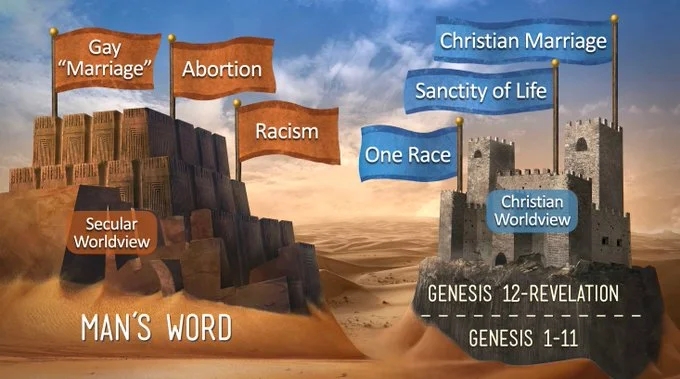
This article is from The Australian and it does not make mention of the role Christianity had in our history and the fact that we are in a spiritual battle that is in its last stages. Satan and his demons know their time is short. Their strategy has changed. The theory of evolution which convinced most that God is not needed to explain the existence of the Cosmos is under threat from the discovery of DNA and the electron microscope. DNA is complex information that controls the highly complex machinery in each cell. The only source of highly complex information is an intelligent source outside of its creation. Satan knew the evolution strategy would eventually fail so he prepared the younger generation in particular for his next strategy – ALIENS. Even the most outspoken atheists such as Richard Dawkins when pressed on the evidence for intelligent design “It could come about in the following way. It could be that at some earlier time, somewhere in the universe, a civilization evolved, by probably some kind of Darwinian means, to a very, very high level of technology and designed a form of life that they seeded onto, perhaps, this planet.
If you have not heard Dawkins speak on intelligent design then you need to listen to this interview with Ben Stein. DAWKINS IS OPEN TO ALIENS BUT NOT GOD.
Just look at all the computer games for young children and films that are about ALIENS. What about the thousands of reported UFOs and Alien abductions. Satan has prepared people for his final strategy. Demons are already manifesting as Aliens and the saviour of mankind. It is only a matter of time before the Antichrist (possessed by Satan) comes on the scene.
 LIVING ETERNAL NOW