GOD, THE SCIENCE, THE EVIDENCE

As debates over science, meaning, and morality grow ever more polarized, a ground-breaking, accurate, and easy-to-read new book in English invites readers to reconsider one of humanity’s most profound questions: could science itself now point us back to God?

The international bestseller God, the Science, the Evidence, an accessible yet rigorous investigation, has sold more than 400,000 copies across Europe. Now, this landmark work comes to the English-speaking world in an updated and expanded version.

The publication of God, the Science, the Evidence marks a major milestone in the renewed global interest in the scientific evidence for the existence of God. Representing years of research and reflection, it presents complex ideas in a clear and engaging style, one that has already made it a cultural phenomenon throughout Europe.

At its core, the book tackles one fundamental question: Is there a Creator God? And it approaches that question through a single lens—rationality—by examining twelve independent fields of knowledge.

Get the book and use it to brings others to the truth of our Creator God who loves us. When people come to realise that evolution is a failed theory and they were created in the image of their Creator God, a God who loves them it will change their lives forever.

WHY THERE REALLY IS A GOD

The book, Why There Really Is A God – And What You Need To Know About Him, is a well-written and thoughtfully organized exploration of the arguments for and against the existence of God. It has a balanced approach, with common counterarguments, scientific challenges, and philosophical objections also fairly represented and discussed. Its accessible style makes it a valuable resource for anyone interested in this fundamental question. For those already familiar with apologetics, the book may serve as a useful synthesis of various arguments presented in a coherent and accessible manner.

For skeptics, the book offers a direct engagement with the questions and objections they might raise, providing the author’s reasoned responses. It is a book that encourages critical thinking, inviting readers to engage with the evidence and draw their own conclusions. Whether you are a creationist, an atheist, or somewhere in between, this book can offer you a thorough review of one of the most important debates in human history without appearing one-sided.

Why There Really is a God is a valuable resource for a variety of readers. It serves as a useful reference for creationists seeking to strengthen their own position, providing a well-organized and comprehensive overview of foundational evidence. It is also an excellent introduction for those who are undecided or unsure about their beliefs, offering balanced and fair-minded reasoning. Even confirmed atheists will find the book thought-provoking, as it presents the arguments for God’s existence in a clear and compelling manner.

The text aligns with its stated aim of engaging “someone who is openminded enough to engage with the best arguments for (and against) God, and fair-minded enough to change their view if the evidence points in that direction” (p. 6). Wilson successfully creates a space for genuine inquiry, encouraging readers to think critically about the evidence and come to their own conclusions.

SIGNPOSTS TO GOD

Prominent atheist Richard Dawkins was once asked what he would say to God if he encountered Him after he died. Dawkins quoted what Bertrand Russell is reputed to have said when asked the same question: “Sir, why did you take such pains to hide yourself?

I think I can understand why some might echo that sentiment. After all, God is invisible; we can’t perceive Him directly with our physical senses. Yet the signs of His existence—indeed, of His goodness and greatness—are everywhere. The Apostle Paul was right when telling a first-century pagan audience that God has always given evidence of His existence through the good things He has done, such as “rains from heaven and fruitful seasons, satisfying your hearts with food and gladness.” (Acts 14:17). God has put up signposts everywhere to help us find our way to Him. Here are just a few of them.

The humblest believer in God as Creator must exercise far less credulity, and has far less explaining to do, than the most ardent evolutionist materialist.

Of course, fallen humanity has devised many increasingly sophisticated speculations of how nature could have made itself. Ministries like Creation Ministries International (http://www.creation.com) provide people with specific answers to such challenges. Even so, it pays to step back and contemplate the ‘big picture’ of what is claimed, and its affront to common sense.

Evidence of design

Flicking through a magazine one day as a child, I came across a photograph of Mount Rushmore, South Dakota, with the unmistakable likenesses of four American presidents carved into the rocks. Knowing nothing of how these came to be there, I remember thinking, “How strange! These can’t have happened by accident.”

Precisely! No one could seriously suggest that these shapes resulted from wind, or rain, or glacial erosion. These carved faces are clearly the result of creative design and effort.

Though not professing a commitment to anything like the God of the Bible, Paul Davies, former professor of theoretical physics at The University of Adelaide, writes in his book The Mind of God:

Through my scientific work, I have come to believe more and more strongly that the physical universe is put together with an ingenuity so astonishing that I cannot accept it merely as a brute fact … I cannot believe that our existence in this universe is a mere quirk of fate, an accident of history, an incidental blip in the great cosmic drama.2

The humblest believer in God as Creator must exercise far less credulity, and has far less explaining to do, than the most ardent evolutionist materialist.

Another signpost is human nature. We have been made in the image of God (Genesis 1:27). Thus, we have spiritual capacities that cannot be explained apart from God. Language, reason, ambition, creativity, humour, wonder, worship—all these have no counterpart in the natural world. These qualities mark us out as different from the rest of God’s handiwork. This is another way of saying that our Creator has endowed us with the capacity to relate to Him at a personal level.

Within human nature, conscience is another sign pointing to God. Proverbs 20:27 says of the human spirit that it is “the lamp of the Lord, searching all [man’s] innermost parts.”. Our conscience is responsible for our intuitive knowledge of right and wrong, good and evil. The Apostle Paul states that even those who don’t have God’s law in written form still have a conscience that commends them when they instinctively do what it commands and accuses them when they don’t (Romans 2:14–15).

Even without a ‘book of rules,’ we know it’s wrong to lie, steal, covet, and murder. Conscience ‘puts a pebble in our shoe’ whenever we violate it. The standard it sets and the guilt it inflicts point us to God—the Source of all good and the Judge of all evil.

Eternity in our hearts

Our longing for eternity is another pointer to God. Somehow, we know and feel that this life is not all that there is. Archaeologists have discovered how carefully and elaborately the ancient Egyptians prepared for the afterlife, and they had no Bible to tell them about a life to come. Where does this longing for eternity come from? Everything on Earth is subject to change and decay:

Of old you laid the foundation of the earth, and the heavens are the work of your hands. They will perish, but you will remain; they will all wear out like a garment. You will change them like a robe, and they will pass away, but you are the same, and your years have no end (Psalm 102:25–27).

These ‘immortality longings’ we all feel at various moments are pointers to the God who created us in His own image.

Hunger of the soul

Another signpost to God is our longing for meaning and purpose. We always knew when our cat Simba was hungry and wanted to be fed. (Any cat owner knows that dogs have masters, but cats have staff!) He would eat his prescription dry food and go away content; his next meal seemed to be the limit of his horizon. But we can’t live at that bare, subsistence level—at least, not for long. We crave meaning and purpose in our lives; we long to enjoy significant and satisfying relationships.

This sense of longing is often called ‘the homesickness of the soul’—and rightly so, for that’s precisely what it is. The true object of our longing is God. The words of the psalmist reflect this truth:

As a deer pants for flowing streams, so pants my soul for you, O God. My soul thirsts for God, for the living God. When shall I come and appear before God? (Psalm 42:1–2)

Illuminating the way

Of all the signposts pointing to God, the Bible is by far the clearest. When a British monarch is crowned, he or she is given a copy of the Bible, and told, “This Book is the most valuable thing that this world affords. This is the royal law; these are the lively oracles of God.” When we read the Bible with a humble and teachable attitude, we find it to be a source of supernatural wisdom and power. The psalmist prayed: “Open my eyes, that I may behold wondrous things out of your law” (Psalm 119:18). Paul reminded his young associate Timothy that Scripture provides the wisdom and instruction that leads to “salvation through faith in Christ Jesus” (2 Timothy 3:15).

Scripture’s major theme is Jesus Christ, God’s only Son. As the “image of the invisible God” (Colossians 1:15), Jesus is the clearest and most compelling witness to the existence and greatness of God the Father. Jesus Himself said: “Whoever has seen me has seen the Father” (John 14:9). He is the perfect transcript of what God is like.

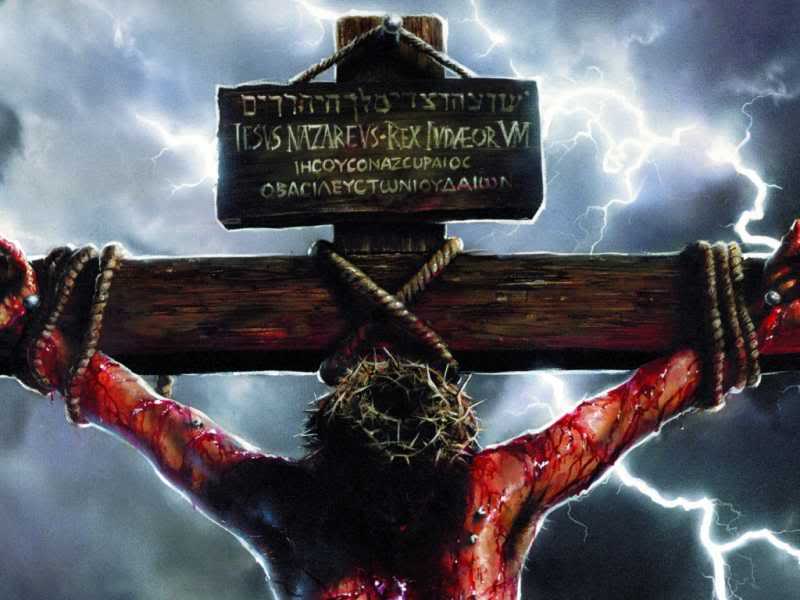
But the supreme demonstration of God’s love and care is the sending of His Son into the world to suffer death on the cross, to save us from our sins, and to reclaim us for Himself. The Cross is more than enough to convince us that God loves and cares for lost people (Romans 5:8). Jesus Himself said that He came “to seek and to save the lost” (Luke 19:10).

There are signposts everywhere to help us find our way to God, but the most vital one is Jesus. He said: “I am the way, and the truth, and the life. No one comes to the Father except through me” (John 14:6).

The article Signposts to God is by Peter Howe on http://www.creation.com

MORE EVIDENCE FOR A CREATOR

Michael Behe, John Lennox, and Steven Meyer are three leading voices in science and academia on the case for an intelligent designer of the universe and everything in it (including us). In this wide-ranging conversation, they point out the flaws in Darwin’s theory and the increasing amount of evidence uncovered by a rigorous application of the scientific method that points to an intentional design and creation of the physical world.

You will need over an hour to watch this video but I suggest you will be glad you did. In particular, I like John Lennox for his pearls of wisdom, and rating the three men as to what gems I learned, it would be 1. John Lennox, 2. Stephen Meyer and 3. Michael Behe. I need to watch the video again at least once more, to make notes, of the information I will incorporate to improve my argument for the God of the Bible’s existence.

SHARING THE TRUTH WITH A SKEPTIC

It can be discouraging to share the truth with a skeptic only to have them ignore it. It doesn’t seem to matter how much—or how good—our evidence is. Some people just do not want to believe as they do not want to give up control of their lives. They want to be the God of their world just as Satan did. So, do they need more evidence?

No, decidedly not. You see, it’s not a matter of the evidence. It’s a spirit/heart problem. The people of Jesus’ day saw him heal people—and even raise the dead! And yet many refused to believe. When Jesus’ body disappeared from the tomb, instead of believing, the religious leaders made up a story to explain away the evidence.

Yes, it’s a spirit/heart problem!

Did you know that our spirit was originally designed to be the lamp of the Lord? It was always meant to contain the Holy Spirit so that man could commune with God as Adam and Eve did in the Garden of Eden.

The spirit of man is the lamp of the Lord, searching all his innermost parts.” Proverbs 20:27

When Adam and Eve rebelled against God the Holy Spirit departed their spirit. It was no longer the lamp of the Lord. A lamp requires oil to function and the oil (Holy Spirit) was no longer available to them.

When we repent and accept Jesus as our Lord and Saviour then our Heavenly Father sends the Holy Spirit to indwell our spirit so that it can function again as the lamp of the Lord. He produces the fruit of the Spirit in our lives: love, joy, peace, patience, faithfulness, gentleness, goodness, kindness, and self-control. He is also the one who provides the gifts of the Spirit for ministry (1 Corinthians 12).

So what’s the answer for sharing with the skeptic? Pray, keep sharing truth, and trust God to send the Holy Spirit to convict them of their sin of rebellion against God.

From a biblical perspective, all true wisdom and understanding is found in Jesus Christ (1 Corinthians 1:30) as God, Creator, and Savior (John 1:1–4).

The true light (Jesus), which gives light to everyone, was coming into the world. He was in the world, and the world was made through him, yet the world did not know him. He came to his own, and his own people did not receive him. But to all who did receive him, who believed in his name, he gave the right to become children of God, who were born, not of blood nor of the will of the flesh nor of the will of man, but of God (by the Holy Spirit).John 1:9-13

You can choose to place your trust in the changing opinions of man or believe the unchanging, infallible words of God. God’s understanding is eternal (Isaiah 40:28) and fixed (Hebrews 13:8), which is why we must let Scripture be our final authority in all matters of life. Only then does life and science make sense!

It amazes me how the atheist does not consider the invalidity of his own position. The atheist calls for real science and knowledge, but he denies the God who makes it possible to even do scientific research because He promised to maintain the universe in a uniform way (Genesis 8:22). In a world with no God where everything came about from nothing by chance, how could we observe and repeat experiments consistently from day to day?

How does knowledge, which is immaterial, exist in an atheistic, strictly material world? Love, knowledge, self-awareness, and other abstract or immaterial concepts do not make sense in an atheistic worldview where only the material exists. Besides, if God does not exist and there are no absolutes and no ultimate answers for the meaning of life, then why do science at all?

Scripture addresses man’s biggest problem, which is that he is a sinner who has rebelled against God and needs a Saviour. Check out the Bible to see that it is indeed an operation manual for our lives, starting with the need for every person to repent of their sins and believe in the Lord Jesus Christ, His death on the Cross for our sins, and His Resurrection from the dead. This is the first step to real understanding and true knowledge (Proverbs 1:79:10).

From the first two chapters in Genesis and throughout the rest of Scripture, only the Bible lays down an accurate framework for correctly understanding the origin, structure, and laws that govern the universe. The Answers in Genesis (http://www.answersingenesis.org) and Creation Ministries (http://www.creation.com) websites contain literally hundreds of articles demonstrating operational science is consistent with the Bible.

SIGNPOSTS TO GOD

Another great article in Creation Magazine 2023, Vol 45, Issue 2, this time by Peter Howe Dip. Th., B.Th., M.A. A trained primary school teacher, Peter pastored several churches as an ordained minister in the Wesleyan Methodist Church of Australia.

Evidence of design

Flicking through a magazine one day as a child, I came across a photograph of Mount Rushmore, South Dakota, with the unmistakable likenesses of four American presidents carved into the rocks. Knowing nothing of how these came to be there, I remember thinking, “How strange! These can’t have happened by accident.”

Precisely! No one could seriously suggest that these shapes resulted from wind or rain or glacial erosion. These carved faces are clearly the result of creative design and effort.

Though not professing a commitment to anything like the God of the Bible, Paul Davies, former professor of theoretical physics at The University of Adelaide, writes in his book The Mind of God:

Through my scientific work, I have come to believe more and more strongly that the physical universe is put together with an ingenuity so astonishing that I cannot accept it merely as a brute fact … I cannot believe that our existence in this universe is a mere quirk of fate, an accident of history, an incidental blip in the great cosmic drama.

The humblest believer in God as Creator must exercise far less credulity, and has far less explaining to do, than the most ardent evolutionist materialist.

Of course, fallen humanity has devised many increasingly sophisticated speculations of how nature could nonetheless have made itself. Ministries like CMI provide people with specific answers to such challenges. Even so, it pays to step back and contemplate the ‘big picture’ of what is claimed, and its affront to common sense itself.

The evidence within

Another signpost is human nature. We have been made in the image of God (Genesis 1:27). Thus, we have spiritual capacities that cannot be explained apart from God. Language, reason, ambition, creativity, humour, wonder, worship—all these have no counterpart in the natural world. These qualities mark us out as different from the rest of God’s handiwork. This is another way of saying that our Creator has endowed us with the capacity to relate to Him at a personal level.

Within human nature, conscience is another sign pointing to God. Proverbs 20:27 says of the human spirit that it is “the lamp of the Lord, searching all [man’s] innermost parts.”. Our conscience is responsible for our intuitive knowledge of right and wrong, good and evil. The Apostle Paul states that even those who don’t have God’s law in written form still have a conscience that commends them when they instinctively do what it commands and accuses them when they don’t (Romans 2:14–15).

An image of hand

Even without a ‘book of rules,’ we know it’s wrong to lie, steal, covet, and murder. Conscience ‘puts a pebble in our shoe’ whenever we violate it. The standard it sets and the guilt it inflicts point us to God—the Source of all good and the Judge of all evil.

Eternity in our hearts

Our longing for eternity is another pointer to God. Somehow, we know and feel that this life is not all that there is. Archaeologists have discovered how carefully and elaborately the ancient Egyptians prepared for the afterlife, and they had no Bible to tell them about a life to come. Where does this longing for eternity come from? Everything on Earth is subject to change and decay:

Of old you laid the foundation of the earth, and the heavens are the work of your hands. They will perish, but you will remain; they will all wear out like a garment. You will change them like a robe, and they will pass away, but you are the same, and your years have no end.” Psalm 102:25–27

These ‘immortality longings’ we all feel at various moments are pointers to the God who created us in His own image.

Hunger of the soul

Another signpost to God is our longing for meaning and purpose. We always knew when our cat Simba was hungry and wanted to be fed. (Any cat owner knows that dogs have masters, but cats have staff!) He would eat his prescription dry food and go away content; his next meal seemed to be the limit of his horizon. But we can’t live at that bare, subsistence level—at least, not for long. We crave meaning and purpose in our lives; we long to enjoy significant and satisfying relationships.

This sense of longing is often called ‘the homesickness of the soul’—and rightly so, for that’s precisely what it is. The true object of our longing is God. The words of the psalmist reflect this truth:

As a deer pants for flowing streams, so pants my soul for you, O God. My soul thirsts for God, for the living God. When shall I come and appear before God?Psalm 42:1–2

Of all the signposts pointing to God, the Bible is by far the clearest. When a British monarch is crowned, he or she is given a copy of the Bible, and told, “This Book is the most valuable thing that this world affords. This is the royal law; these are the lively oracles of God.” When we read the Bible with a humble and teachable attitude, we find it to be a source of supernatural wisdom and power. The psalmist prayed: “Open my eyes, that I may behold wondrous things out of your law” (Psalm 119:18). Paul reminded his young associate Timothy that Scripture provides the wisdom and instruction that leads to “salvation through faith in Christ Jesus” (2 Timothy 3:15).Scripture’s major theme is Jesus Christ, God’s only Son. As “image of the invisible God” (Colossians 1:15), Jesus is the clearest and most compelling witness to the existence and greatness of God the Father. Jesus Himself said: “Whoever has seen me has seen the Father” (John 14:9). He is the perfect transcript of what God is like.

But the supreme demonstration of God’s love and care is the sending of His Son into the world to suffer death on the cross, to save us from our sins, and to reclaim us for Himself. The Cross is more than enough to convince us that God loves and cares for lost people (Romans 5:8). Jesus Himself said that He came “to seek and to save the lost” (Luke 19:10).

To help us find our way to God, there are signposts everywhere, but the most vital one is Jesus. He said: “I am the way, and the truth, and the life. No one comes to the Father except through me” (John 14:6).

ETERNAL LIFE OR ETERNAL DEATH YOU CHOOSE

If God exists and He created all things, it brings incredible responsibility upon the life of every man, woman, and child. Every individual under the sun has the responsibility to not only acknowledge their Creator but to give Him thanks for this magnificent universe. Moreover, they have an obligation to order their life around their Creator’s desires rather than their own—and this is the point where the bristling starts to happen. If God exists and He is the Creator of all things, this needs to inform the whole of one’s life. One must not only acknowledge Him as Creator and give Him thanks but we must live according to His rules. Every aspect of our lives must come under total surrender to the One who is the Author of life—and the one who rejects God surely does so on the basis of their desire to reject His authority.

It is all good and fine if there is a Creator who doesn’t impose His will upon the masses of His creation. However, the Creator has already judged the whole world on one previous occasion with a worldwide flood with only eight survivors. Moreover, His Word warns us that He intends to eventually destroy this fallen world with fire but beforehand there is Jesus’ Millennial Kingdom. He will rule and reign on this earth with resurrected and transformed believers for one thousand years. Check out, http://www.millennialkingdom.net

Atheists and agnostics for that matter stand on borrowed ground. They eat and drink borrowed food. They breathe in borrowed air and ultimately—live on borrowed time. They can no more diminish God’s glory and authority than if they were to try and blot out the light of the sun by standing before it. This is why many tend to go the route of dismissal of God’s existence to conceal their hatred of God, yet in the end, it will prove just as fruitless as an open hatred of God.

Let not your hearts be troubled. Believe in God; believe also in me… I am the way, and the truth, and the life. No one comes to the Father except through me.” John 14:1,6

Remember our Creator has gone to exceptional lengths to make Himself and the condition of the Cosmos (spiritual and physical) known to mankind and to enable us to get back into a right relationship with Him. Can we ask any more of God than He sends His Son to pay the price for our rebellion against Him and then to send the Holy Spirit to indwell the believer’s spirit to enable us to live the Christian life?

For the wages of sin is death, but the free gift of God is eternal life in Christ Jesus our Lord.Romans 6:23

If God were your Father, you would love me, for I came from God and I am here. I came not of my own accord, but He sent me. Why do you not understand what I say? It is because you cannot bear to hear my word. You are of your father the devil, and your will is to do your father’s desires. He was a murderer from the beginning and does not stand in the truth, because there is no truth in him. When he lies, he speaks out of his own character, for he is a liar and the father of lies. But because I tell the truth, you do not believe me.John 8:42-45

At the end of all days, every knee shall bow, and every tongue shall confess, that Jesus Christ is Lord. There is no hope for the one who dies under the consuming wrath of God, but just as there remains no hope for those who do not believe in Christ prior to their death, there will be no lingering skepticism. There will be no doubt. There will be no unbelief. All will believe and will either go away to eternal death or eternal life. Which do you choose?

MADE IN THE IMAGE OF GOD COMPELLING EVIDENCE FOR CREATION

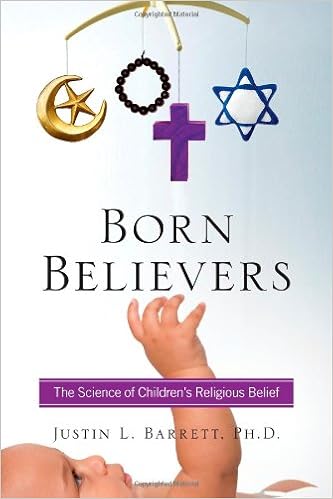
Justin L. Barret’s book Born Believers reveals some extraordinary facts about the ability and the capacity for very young children to believe and have faith. His work as a noted developmental psychologist and anthropologist at Oxford University, about the value of religious faith, has found that we are all predisposed to believe in God from birth. This is consistent with Scripture.

He has made everything beautiful in its time. Also, he has put eternity into man’s heart… “ Ecclesiastes 3:11

Belief begins in the brain. Under the sway of powerful internal and external influences, children understand their environments by imagining at least one creative and intelligent agent, a grand creator and controller that brings order and purpose to the world. Further, these beliefs in unseen super beings help organize children’s intuitions about morality and surprising life events, making life meaningful.

Summarizing scientific experiments conducted with children across the globe, Professor Barrett illustrates the ways human beings have come to develop complex belief systems about God’s omniscience, the afterlife, and the immortality of deities. He shows how the science of childhood religiosity reveals, across humanity, a “natural religion,” the organization of those beliefs that humans gravitate to organically, and how it underlies all of the world’s major religions, uniting them under one common source.

For believers and nonbelievers alike, Barrett offers a compelling argument for the human instinct for religion, as he guides all parents in how to effectively encourage children in developing a healthy constellation of beliefs about the world around them.

Surely, this is compelling evidence for creation and that evolution is a failed theory.

Then God said, “Let us make man in our image, after our likeness...” Genesis 1″26a

So God created man in his own image, in the image of God he created him; male and female he created them.” Genesis 1:27

FAITH JOURNEY BY LEADING SCIENTIST

Dr. Francis Collins is considered to be one of the most effective and ground-breaking scientists in the world. Collins graduated with a degree in chemistry from the University of Virginia. He earned his PhD in chemistry at Yale and then decided, for good measure, he would go to medical school at the University of North Carolina. From there, he returned to Yale and later, the University of Michigan. He is most noted for having been chosen to chair the Human Genome Project where, in 2003, he led an international collaboration of two thousand scientists in sequencing the human genome. More recently, he was appointed by President Obama to be the Director of the National Institutes of Health. Clearly, he is a prominent scientist, but what is perhaps even more interesting is his spiritual journey.

DIRECTOR OF THE NATIONAL INSTITUTE OF HEALTH

“As a scientist, I had always insisted on collecting rigorous data before drawing a conclusion. And yet, in matters of faith, I had never collected any data at all. I didn’t know what I had rejected. So, I decided that I should be a little better grounded in my atheism. I better find out what this is all about. So, I challenged a patient of mine who was a Methodist minister. And, after listening to my questions and realizing that I was not dealing with a very full deck of information, he suggested that I read the Gospel of John, which I did…I found the scripture to be interesting, puzzling, and not at all what I had thought faith was about… then I began to read C.S. Lewis and realized there was a great depth of thinking and reasoning that could be applied to the question of God.”

Lewis convinced Francis Collins that reason and faith go hand in hand, though faith has the added component of revelation—the Bible. Collins had previously believed that Jesus and the stories of the Bible were nothing more than mere myths. Again, as he studied the historical evidence, he was stunned at how well documented and how historically accurate the Bible is. He also saw a surprising fidelity of the transmission of the manuscripts that were passed down over the centuries. And, over time, Francis Collins, based on the accumulation of the evidence that he observed, concluded that God exists, and that Jesus is the Son of God.

He also concluded that most of the religious skeptics that he knew and that he meets today are just like he was. That is to say, they didn’t want to think about these things and never looked at any evidence, never drawing conclusions from the real evidence that was available.

This is what Dr. Dallas Willard, former professor of philosophy at the University of Southern California, believed was a major problem with individuals who considered themselves to be agnostic or atheist. Willard found that so many of the students and scholars he encountered on campus and in the world were guilty of what he called “irresponsible disbelief.” These bright men and women would often choose to disbelieve in something without any significant commitment to an investigation of that disbelief by way of sound reasoning and careful examination of the evidence.

GOD’S WRATH

God is in control of His universe, anyone who does not believe this will face God’s wrath. His Kingdom will come. Jesus will rule and reign on this earth.

Why do the nations rage and the people’s plot in vain?
The kings of the earth set themselves, and the rulers take counsel together, against the Lord and against his Anointed, saying, “Let us burst their bonds apart and cast away their cords from us.”
He who sits in the heavens laughs; the Lord holds them in derision. Then He will speak to them in his wrath, and terrify them in His fury, saying, “As for me, I have set my King on Zion, my holy hill.
Psalm 2:1-6

Jesus will rule and reign in a new Jerusalem that will be on the highest mountain on earth

ETERNAL LIFE OR THE WRATH OF GOD ARE THE ONLY TWO OPTIONS:The Father loves the Son and has given all things into his hand. Whoever believes in the Son has eternal life; whoever does not obey the Son shall not see life, but the wrath of God remains on him.John 3:35-36

WE ARE WITHOUT EXCUSE – HIS CREATION REVEALS THE TRUTH: “For the wrath of God is revealed from heaven against all ungodliness and unrighteousness of men, who by their unrighteousness suppress the truth. For what can be known about God is plain to them because God has shown it to them. For his invisible attributes, namely, his eternal power and divine nature, have been clearly perceived, ever since the creation of the world, in the things that have been made. So they are without excuse.Romans 1:18-29

GOD POURED OUT HIS WRATH ONCE PREVIOUSLY WITH NOAH’S FLOOD:The Lord saw that the wickedness of man was great in the earth and that every intention of the thoughts of his heart was only evil continually. And the Lord regretted that he had made man on the earth, and it grieved him to his heart. So the Lord said, “I will blot out man whom I have created from the face of the land, man and animals and creeping things and birds of the heavens, for I am sorry that I have made them.” But Noah found favour in the eyes of the Lord.Genesis 6:5-8

Replica of the Ark built by Johannes Huiber located in Holland. Answers in Genesis have also built a life sized Noah’s Ark in Cincinnati USA

GOD KNEW THAT THE WORLD WOULD IGNORE HIS SECOND WARNING OF COMING WRATH. WILL YOU?:Knowing this first of all, that scoffers will come in the last days with scoffing, following their own sinful desires. They will say, “Where is the promise of His (Jesus) coming? For, ever since the fathers fell asleep, all things are continuing as they were from the beginning of creation.” For they deliberately overlook this fact, that the heavens existed long ago, and the earth was formed out of water and through water by the word of God, and that by means of these the world that then existed was deluged with water and perished.2 Peter 3:3-6

JESUS GAVE US THIS WARNING ABOUT HIS SECOND COMING AND WRATH: “For as the lightning flashes and lights up the sky from one side to the other, so will the Son of Man be in His day. But first, He must suffer many things and be rejected by this generation (Jesus was speaking to His disciples just prior to His crucifixion. They were asking Him about the “end times”) . Just as it was in the days of Noah, so will it be in the days of the Son of Man. They were eating and drinking and marrying and being given in marriage, until the day when Noah entered the ark, and the flood came and destroyed them all.” Luke 17:24-27