DEFENDING THE BIBLICAL WORLDWIDE FLOOD

How Large Was Noah’s Ark? The length of the ark 300 cubits, its breadth 50 cubits, and its height 30 cubits. (Genesis 6:15) Unlike many whimsical drawings that depict the ark as some kind of overgrown houseboat (with giraffes sticking out the top), the ark described in the Bible was a huge vessel. Not until the late 1800s was a ship built that exceeded the capacity of Noah’s ark.

The dimensions of the ark are convincing for two reasons: the proportions are like that of a modern cargo ship, and it is about as large as a wooden ship can be built. The cubit gives us a good indication of size.1 Using the most likely cubit length, an ancient royal cubit of at least 20.4 inches (0.518 m), we know that the ark must have been no less than 510 feet (155 m) long, 85 feet (26 m) wide, and 51 feet (16 m) high. In the Western world, wooden sailing ships never got much longer than about 330 feet (100 m), yet the ancient Greeks built vessels at least this size 2,000 years earlier. China built huge wooden ships in the 1400s that may have been as large as the ark. The biblical ark is one of the largest wooden ships of all time—a mid-size cargo ship by today’s standards.

A Korean study was performed at the world-class ship research center (KRISO) in 1992. The team of nine KRISO researchers was led by Dr. Hong, now the research center’s director-general. The study confirmed that the ark could handle waves as high as 98 feet (30 m) and that the proportions of the biblical ark are near-optimal—an interesting admission from Dr. Hong, who believed in evolutionary ideas. The study combined analysis, model wave testing, and ship standards, yet the concept was simple: compare the biblical ark with 12 other vessels of the same volume but modified in length, width, or depth. Three qualities were measured—stability, hull strength, and comfort.

The Biblical verse below tells us Noah didn’t have to search or travel to faraway places to bring the animals on board. The world map was completely different before the flood, and based on Genesis 1, there may have been only one continent. The animals arrived at the ark as if called by a “homing instinct” (a behavior implanted in the animals by their Creator) and marched up the ramp themselves.

But I will establish my covenant with you, and you shall come into the ark, you, your sons, your wife, and your sons’ wives with you. And of every living thing of all flesh, you shall bring two of every sort into the ark to keep them alive with you. They shall be male and female. Of the birds according to their kinds, and of the animals according to their kinds, of every creeping thing of the ground, according to its kind, two of every sort shall come in to you to keep them alive.Genesis 6:18-20

Juveniles of even the largest land animals do not present a size problem, and, being young, they have their full breeding life ahead of them. Even most dinosaurs were not very large — some were the size of a chicken (although absolutely no relation to birds, as many evolutionists are now saying). Most scientists agree that the average size of a dinosaur is actually the size of a bison. As far as the number of different types of dinosaurs, it should be recognized that, although there are hundreds of names for different varieties (species) of dinosaurs that have been discovered, there are probably only 60–80 different kinds.

Was Noah’s Flood Global?And the waters prevailed so mightily on the earth that all the high mountains under the whole heaven were covered. The waters prevailed above the mountains, covering them fifteen cubits deep.Genesis 7:19–20

Noah’s flood was much more destructive than any 40-day rainstorm ever could be. Scripture says that the “fountains of the great deep” broke open. In other words, earthquakes, volcanoes, and geysers of molten lava and scalding water were squeezed out of the earth’s crust in a violent, explosive upheaval. These fountains were not stopped until 150 days into the flood—so the earth was literally churning underneath the waters for about five months! The duration of the flood was extensive, and Noah and his family were
aboard the ark for around a year.

Scientists once understood the fossils buried in water-carried sediments of mud and sand—to be mostly the result of the great flood. Wanting to debunk the Bible and the worldwide flood of Noah’s day, Charles Lyell of Darwin’s era introduced the ideal of slow gradual change over millions, now billions of years. Geologists now realise the evidence for catastrophism is everywhere. It can be seen all over the earth, from seabeds to mountaintops. Whether you travel by car, train, or plane, the physical features of the earth’s terrain clearly indicate a catastrophic past, from canyons and craters to coal beds and caverns. Some layers of strata extend across continents, revealing the effects of a huge catastrophe. The earth’s crust has massive amounts of layered sedimentary rock, sometimes miles (kilometers) deep! These layers of sand, soil, and material—mostly laid down by water—were once soft like mud, but they are now hard stone. Encased in these sedimentary layers are billions of dead things (fossils of plants and animals) buried very quickly. The evidence all over the earth is staring everyone in the face.

There are hundreds of stories and legends about a worldwide flood. Why do diverse cultures share a strikingly similar story?
Did you know that stories about a worldwide flood are found in historic records all over the world? According to Dr. Duane Gish in his popular book Dinosaurs by Design, there are more than 270 such stories, most of which share a common theme and similar characters. So many flood stories with such similarities surely come from the flood of Noah’s day.

Stories of the flood—distorted though they may be—exist in practically
all nations, from ancient Babylon onward. This evidence must not be lightly dismissed. If there never was a worldwide flood, why are there so many stories about it?

The reason for these flood stories is not difficult to understand. When we turn to the history book of the universe, the Bible, we learn that Noah’s descendants stayed together for approximately 100 years until God confused their languages at Babel (Genesis 11:1–9). As these people moved away from Babel, their descendants formed nations based on the languages they were given by God. Through those languages, the story of the flood was shared until it became embedded in their cultural history.

The Bible declares that the earth-covering cataclysm of Noah’s day is an obvious fact of history. People “deliberately overlook this fact, that . . . the world that then existed was deluged with water and perished” (2 Peter 3:5–6). The flood left much evidence—from the fact that over 70% of the rocks on continents were laid down by water and contain fossils to the widespread flood legends. Both of these evidences provide compelling support for this historical event.

God clearly sent a worldwide flood to punish humankind for their evil and corrupt ways (Genesis 6:5, 11). Even though flood-affirming evidence from geology and other areas of study is abundant, we don’t need this evidence to know what happened. Starting with the Bible and the history that God faithfully recorded there, Christians have a tool to interpret the evidence that evolutionists and non-Christians do not. We have the record of what happened from the one who was there.

Get all this information and more in a free booklet, Noah’s ArkA Biblical and Scientific look at the Genesis account produced by Answers in Genesis (www.answersingenesis.org)


MORE EVIDENCE FOR NOAH’S FLOOD

The notion of a ‘wet Sahara’ in the recent past is controversial among secular researchers since they struggle to adduce a mechanism to explain it. However, much evidence exists for it and has recently been bolstered through the discovery of ancient shorelines. And unlike the conditions proposed by secular researchers, the conditions produced by a post-Flood Ice Age in the biblical perspective provide mechanisms for explaining the existence of a ‘wet Sahara’.

Paleolake Chad covered an area of 340,000 km. much larger than the current Lake Chad

The Ice Age solution

The biblical rapid Ice Age model can explain the existence of the large and small lakes in the Sahara and the population of animals and people by a northward displacement of the Inter Tropical Convergence Zone (ITCZ). In the same way as were the lakes in the southwestern U.S., and other lakes generally around the 30th parallel of the Northern Hemisphere, the Saharan lakes were first filled during Flood runoff. Residual floodwater would have been left in enclosed basins. Evidence for this could be the marine foraminifera fossils found in the Sahara Desert. Then much more rain in the Sahara during the Ice Age would have either maintained the lakes or filled them up to overflowing, resulting in rivers and streams. Dried-up rivers and streams with amphibian fossils are found below the sand. Such a wet environment was caused by much greater evaporation from the Ice Age warm ocean and a different general circulation from that evident today. But the wet Sahara continued after the Ice Age into the mid-Holocene, likely because the ITCZ was displaced much farther north.

There was only ever one ice age, it followed the worldwide flood and lasted about 700 years.

The Ice Age lasted longer in the Southern Hemisphere (SH) than the Northern Hemisphere (NH). Glacial maximum was reached about 500 years after the Flood with deglaciation taking another 200 years, lasting a total of 700 years. However, the SH would not reach glacial maximum until perhaps 300 years later, because of the time needed for the build-up of the Antarctic Ice Sheet. The atmosphere and oceans of the two hemispheres have only a minimal exchange of water and air between them, so each generally acts independently. And because the SH has much more ocean than the NH, it would take longer for the Southern Hemisphere oceans to cool (cooling is 75% by evaporation and 25% by cool airflow off the continents).

How does this explain the green Sahara in the African Humid Period? It is known that today, the ITCZ migrates seasonally away from the winter hemisphere, within a range of about 10° latitude.8 Therefore, after the Ice Age ended in the Northern Hemisphere, the Ice Age in the Southern Hemisphere would have pushed the ITCZ even farther north than it shifts today as the seasons change. The SH Ice Age could easily push the ITCZ 600 km (375 mi) north into the Sahara Desert and cause the green Sahara to persist for centuries after the ice sheets had disappeared from northern regions.

Both creation and secular geologists agree that the earth’s deserts and semi-arid areas were once well-watered. Creation scientists largely attribute this to the warmer ocean water just after the Flood, warmed by the enormous volcanic eruptions that took place during the Flood. Warmer oceans generated huge amounts of evaporation, which caused the great ice sheets to build up rapidly over many parts of the world, leading to the Ice Age. At the same time, the extra water vapour in the atmosphere caused high rainfall at lower latitudes where it was not cold enough to form snow and ice. Thus, the post-Flood Ice Age explains why the earth’s deserts and semi-arid areas were once well-watered.

This high-rainfall condition would have lasted for several centuries until the sea had cooled off and reached equilibrium with the atmosphere, as it is today. In the runoff stage in the last part of the Flood, many lakes would have formed from the ponding of water in enclosed basins on an already waterlogged Earth. After the Flood during the Ice Age, high rainfall would have caused these lakes to grow and be sustained, along with a network of rivers and streams.

Taken from the article “Ice Age megalakes did exist in the Sahara” by Micheal Oard in the Journal of Creation/2023, volume 37, in the section Perspectives

HISTORIC EVIDENCE FOR NOAH’S FLOOD

Further to my post on March 14th: BIBLICAL HISTORY: 1. IMPACT OF WORLDWIDE FLOOD ON NATIONS AND 2. GOD ESTABLISHES HIS NATION – ISRAEL, which included an article by Gavin Cox that revealed the Egyptians revered the eight people (Noah’s family) that survived the flood as God’s. They were referred to as the OGDOAD. Bearing in mind Noah’s sons lived for another 500 years post-flood, is it any wonder they were considered God’s by the post-flood people who had life spans up to 120 years. “My Spirit shall not abide in man forever, for he is flesh: his days shall be 120 years. Genesis 6:3.

Moreover, the Ogdoad, these eight people that came off the Ark were the source of all information that came from the pre-flood people who built cities, worked with iron and bronze, and played musical instruments.

Adah bore Jabal; he was the father of all those who dwell in tents and have livestock. His brother’s name was Jubal; he was the father of all those who play the lyre and pipe. Zillah also bore Tubal-Cain; he was the forger of all instruments of bronze and iron.Genesis 4:21-22

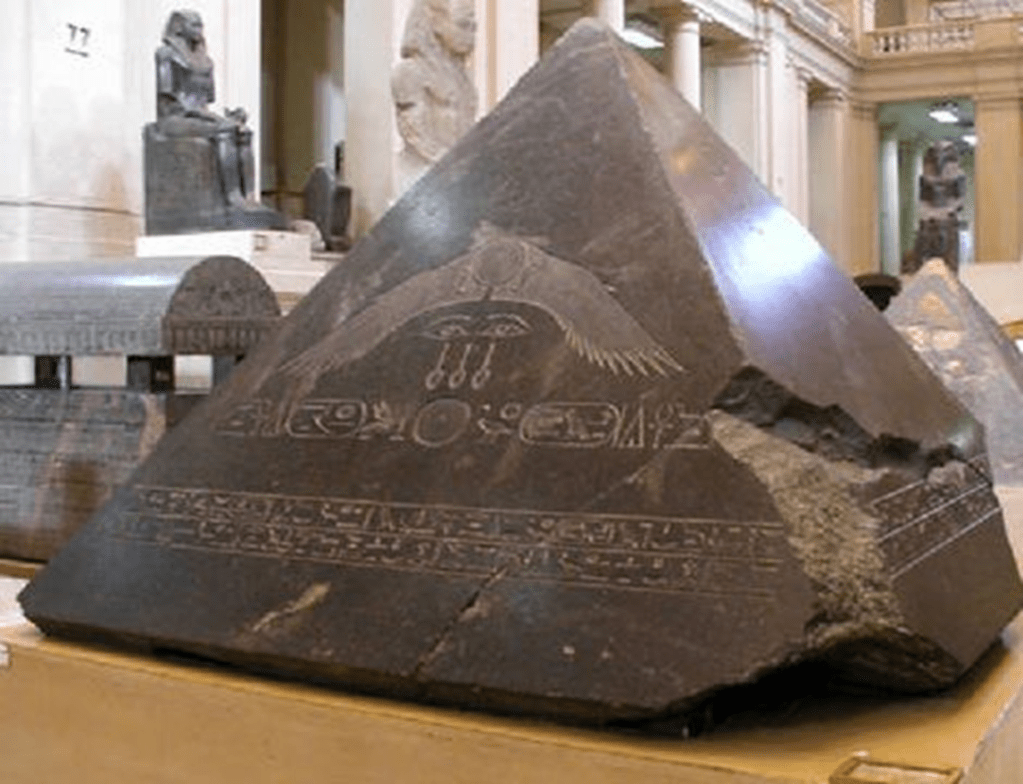
Additional proof is provided by the Ben Ben stones taken from the top of pyramids seen here in the Cairo Museum. The Benben sacred stone represents the primeval mound, the first land that appeared from the primeval ocean, called the Nun. It was upon this land that the eight ‘gods’ (OGDOAD) sprang into being; four males and their wives, headed by the chief god ‘Nu’ which is phonetically similar to Noah.

The pyramids were themselves extensions of the Benben. We know this to be a fact linguistically because the Egyptian word for pyramid is bnbn.t which is the female version of the bnbn sacred stone. 

This explains the size and shape of the pyramids. They were a constant reminder to the Egyptians of the worldwide flood and the rebirth of the world from the deified eight occupants of Noah’s Ark.

This post will show that Ham, Noah’s third son was the Egyptian God Horus. It is part 1 of a two-part series by Gavin Cox.

One of the most famous and ancient of Egypt’s many deities was Horus, the falcon sun god. In two articles Gavin explore 12 key motifs of the life of Ham (Noah’s third son) drawn from the Genesis text. He then compares them to Horus drawn from Egyptian evidence, concentrating on the oldest evidence first.

Part 1 looks at the following motifs: 1) Ham is 11th from Adam; 2) the etymology of Ham’s name; 3) Ham came from a family of eight, and 4) Ham is the youngest of three brothers. These comparisons support the thesis that Ham was deified by the pagan Egyptians as Horus.

Egypt is eponymously called “the land of Ham” (Noah’s third son) in the Psalms (105:2327106:22) and “tents of Ham” (Psalm 78:51). Ham and Mizraim (Ham’s third son) appear together in Psalm 105:23 as designations for Egypt: “… Israel came to Egypt (miṣrāyim); Jacob sojourned in the land of Ham (ḥām).”

‘Mizraim’ is the common name for Egypt throughout Scripture. Ham was a first-hand witness of the Flood, and likely lived to a similar age as his brother Shem (500 years post-Flood, Genesis 11:11). Via Noah’s teaching, Ham knew about creation and the pre-Flood world, a knowledge that he would naturally pass to his descendants. All this became paganized by the Egyptians. Ham’s great post-Flood lifespan, involvement in re-establishing of post-Flood civilization, and knowledge of the pre-Flood world, likely meant he had divine status conferred upon him by the Egyptians.

Twelve key motifs of Ham’s life

Twelve key motifs of Ham’s life extracted from Genesis 5–11 (listed in table 1) will be compared to Horus. If Ham was deified as Horus, then the latter will likely reflect these motifs in some discernible, though paganized way. Article 1 will explore motifs 1–4, Article 2 motifs 5–12.

table1

Both articles will set out to explore these connections, concentrating on the oldest Egyptian textual evidence in each case. Before this, a brief discussion of who Horus was is in order.

Introducing Horus—the falcon-solar deity

Horus is one of Egypt’s oldest and most important deities, attested to from at least the beginning of the Dynastic Period, where the familiar form of the Horus falcon appears on the Narmer Palette (figure 1).

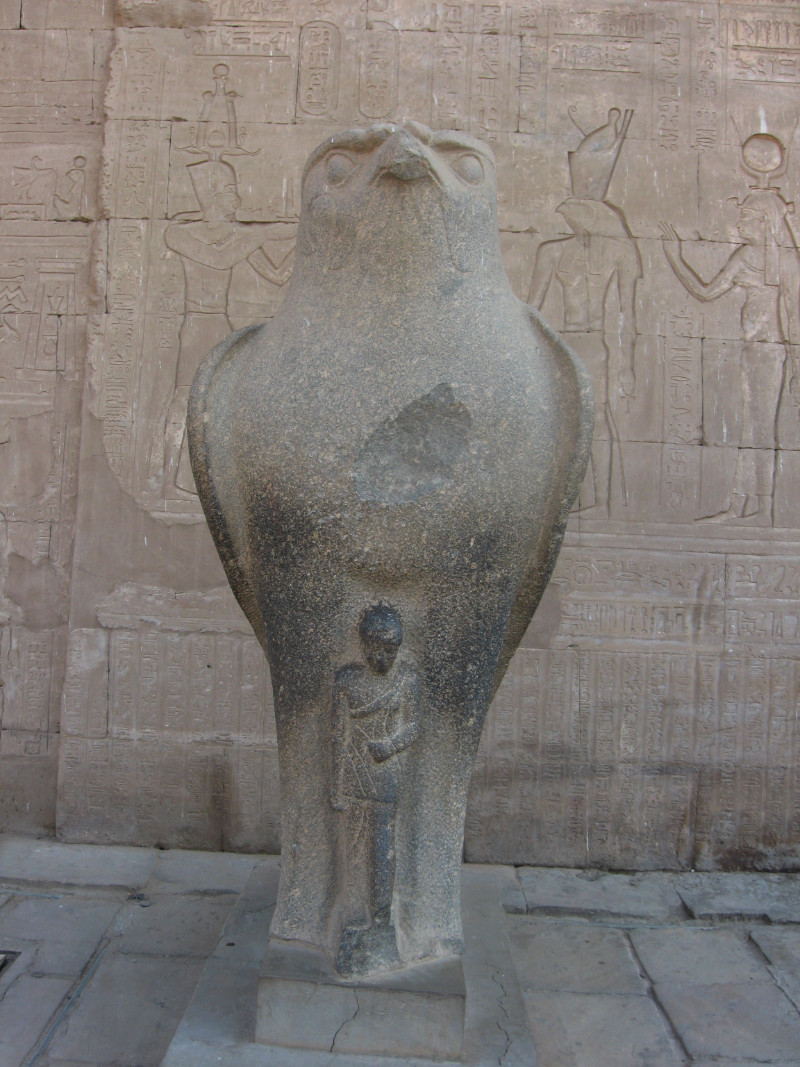
Horus statue in black granite
Figure 2. Horus statue in black granite, Temple of Horus, Edfu.

Horus appears in Old Kingdom Pyramid Texts (OK PTs), along with his sons, father, and mother (see part 2). Horus is depicted as a falcon (figure 2) or falcon-headed man, who was considered a creator god, as well as a form of the sun. His father was Osiris/Geb, with a notable brother, Seth.  Much could be written regarding Horus; however, my two articles will be limited to a discussion of Horus’s possible connection to Ham, Noah’s third son.

Eleventh from Adam: Ham cf. Horus

The Genesis 5:1-32 chronogenealogies place Ham (with his brothers) 11th from Adam. Can a similar chronological relationship be discerned in Egyptian mythology, regarding Horus?

“Atum … Shu … Tefnut … Geb … Nut … [Osiris] … Isis … Seth … Nephthys … Thoth … Horus.” yes they can.

Gavin’s previous article made the case that Atum is the Egyptians’ paganized memory of Adam. Although the Ennead was considered a unified group (typically of nine), evidence suggests (e.g. PT-600§1655), that they were simultaneously considered consecutive offspring of Atum.4 All had long life spans like Noah’s sons.

Like biblical Ham, Horus is synonymous with concepts of; a) (physical) “violence” (tkk); b) (earthy) “blackness” (km)/“darkness” (kk)/“twilight” jḫḫ.w; and c) (sun’s) “heat” (bḫḫ.w).

Family of eight—Horus cf. Ham

Genesis (6:18, etc.) informs us that Ham belonged to a family of eight—comprising four males and their wives. Ancient Egypt had a group of eight gods—comprising of four males and their wives (the Ogdoad) whose names (see later) appear in OK PTs. In previous articles,25 I concluded this group represented the paganized memory of Noah’s family. The question to be asked is, if Horus is the deified Ham, is he also connected to a family of eight? The evidence presented below suggests he was. Specifically, the Ogdoad, whose names include the couple Kek and Keket (kk and kk.t).11

Like the semantic meaning of Ham, as discussed above, Horus is also connected by similar concepts: “attacker” (tkk), “darkness/twilight” (kk, jḫḫ.w) and phonetically similar bḫḫ.w “heat”. Ogdoad kk can be understood semantically from words containing the phonetic root kk, (compare ḫḫ). Thus, a shared semantic range exists between biblical Ham, Horus, and Ogdoad couple kk(.t).

Additional textual and pictorial evidence connecting Horus to the Ogdoad comes from the Hunefer BOD vignette. As Ham came from Noah’s family of eight, Horus also comes from a group of eight gods.

Scripture states Noah had three sons: Ham “his youngest” (Genesis 9:24) and “Shem … brother of Japheth the elder” (Genesis 10:21 YLT). Here Scripture employs the adjective: קָטָן (qāṭān) HALLOT-8338 ‘small, youngest’ to describe Ham. Can similar relationships be discerned in Horus’s family? The following evidence suggests this is so.

Horus had a brother, Seth, (both sons of Osiris) with whom he struggled violently for political dominion (see part 2, motif 8). A closely aligned god called Thoth is described as a brother of either Seth, or Horus in the PTs, and one example in the Coffin Texts of Horus, Seth, and Thoth being described as brothers. In BOD, Thoth shares the same father (Osiris) as Horus and Seth. When these examples are considered, then Horus is comparable to Ham in having two other brothers, and himself being described as the ‘youngest’.

Conclusion

This article has looked at four motifs from Ham’s life and compared them to Horus, the Egyptian falcon sun-deity. We have found positive connections in the following areas: motif 1. Ham was 11th from Adam. The case can be made that Horus is 11th from Atum when Osiris as the fatherly bystander is included from evidence in PTs regarding the Great Ennead. Motif 2. The etymology of Ham’s name includes concepts of (physical) “violence”, (earthy) “blackness/darkness”, and (sun’s) “heat”. These concepts compare favourably with divine epithets of Horus. Motif 3. Ham came from a family of 8—four males and their wives. The case is made here that Horus ascended from the Ogdoad, who are four males and their wives. Specifically, Horus is connected to Ogdoad member kk (darkness) in which case kk follows the natural ascension of darkness to light, to transform into Horus as the sun. Motif 4. Ham was the youngest of three brothers, Shem, and Japheth. The case can be made that Horus is the “child” who has a notable brother, Seth, and closely aligned to Thoth, another brother-(like) god. The connections are intriguing and so merit further study. Part 2 will analyze motifs 5–12.

The history of the world that is taught to our children in schools and universities is made up, based on the presupposition that the world evolved from pond scum. God told us in advance that the world would deny the truth about His world so that we can know He is in total control of all history from its watery beginning to its fiery end.

I am stirring up your sincere mind by way of reminder, that you should remember the predictions of the holy prophets and the commandment of the Lord and Savior through your apostles, knowing this first of all, that scoffers will come in the last days with scoffing, following their own sinful desires. They will say, “Where is the promise of his coming? For ever since the fathers fell asleep, all things are continuing as they were from the beginning of creation.” For they deliberately overlook this fact, that the heavens existed long ago, and the earth was formed out of water and through water by the word of God, and that by means of these the world that then existed was deluged with water and perished. But by the same word the heavens and earth that now exist are stored up for fire, being kept until the day of judgment and destruction of the ungodly.” 2 Peter 3:1-7

GEOLOGICAL EVIDENCE FOR NOAH’S FLOOD

In Genesis 6:13, we read that before the Flood, regarding “all flesh”, God said to Noah, “I will destroy them with the earth” (’eretz). Then, in Genesis 9:11, after the Flood, God confirmed to Noah that by the Flood He had indeed destroyed the created Earth, when He said, “never again shall there be a flood to destroy the earth” (’eretz). Whatever constituted the ’eretz that was created on Day 1, God destroyed it by the Flood cataclysm.

Corroborating God’s revelation to Noah that the created Earth (’eretz) had been destroyed in the Flood (Genesis 9:11) is the record of widespread destructive volcanic and sedimentary processes evident in the Precambrian rock record. In the Precambrian we see evidence of huge volcanoes, depositing lava accumulations up to 22 km thick, including abundant products of explosive volcanic activity.

Rocks of the Precambrian cratons, including the exposed Precambrian shields, comprise some 71% of the Earth’s total land area. Extensive study of exposed Precambrian strata, motivated by its content of valuable minerals, has resulted in the accumulation of copious geological information on the Precambrian.

This information can be used by creationists to incorporate all of the Precambrian into a Genesis Flood geologic model.

There are abundant products of volcanism, including explosive volcanism, and volcanic lava sequences up to 22 km thick, throughout the Precambrian geologic record. Superpositional relationships of distinct lithological associations enable global correlation of early Precambrian strata. A Genesis Flood geologic model is proposed wherein the Flood cataclysm was initiated by a sudden reduction of gravitational force which decompressed the earth’s hot, water-saturated mantle. The Precambrian rock record was extruded from the mantle and deposited during Day 1 to Day 40 of the Flood cataclysm.

Widespread evidence of destructive volcanic geologic activity throughout the Precambrian corroborates the Scriptural record of the destruction of the created earth (’eretz) by the Flood cataclysm (Gen. 9:11).

This should lead us to preclude a Creation Week or Antediluvian origin for the Precambrian geologic record, and instead consider all of the Precambrian as Flood deposited. Walker noted that the Precambrian Strelley Pool Chert formation in the Pilbara region of Western Australia (figure 6) is underlain and overlain by rocks deposited from volcanic eruptions, and suggested:

From a biblical perspective, it is inconceivable that volcanoes would be active during Creation Week, depositing volcaniclastics and tuff such as comprise parts of the stratigraphic sections [emphasis added].”

Widespread evidence throughout the globally correlated Precambrian rock record of huge explosive volcanic eruptions comprises tuffs, ignimbrites, pyroclastic flows, volcaniclastics, accretionary lapilli/lapillistone, and agglomerates. The processes necessary for the accumulation of accretionary lapilli/lapillistone include an atmospheric ash column, moisture, accretion, deposition, and lithification. We might reasonably question whether atmospheric ash columns would have been occurring during Creation Week.

Deposition of even the thinnest of these volcanic accumulations, the 10.5-km-thick Swaziland Supergroup (figure 3), over six days during Creation Week, would require lava to accumulate at 1.75 km stratigraphic thickness per day. The 22.0 km-thick-lower Pilbara Supergroup of Western Australia (figure 6) would need to accumulate at 3.67 km of lava per day if deposited during Creation Week.

On the basis of the volcanic content, and especially the explosive volcanic content, and the widespread destruction of organisms throughout the Precambrian, we should, I suggest, question a Creation Week or Antediluvian origin for the Precambrian rock record, reconsider the way we interpret the Precambrian fossil record, and conclude that the Precambrian is all Flood deposited.

Consistent with Genesis 7:11 and Proverbs 3:20a, Noah’s Flood may have been initiated by God causing the mantle to heat in a cataclysmic global thermal-tectonic episode, cracking open the earth’s crust and driving out water to the earth’s surface. Secular scientists have found evidence of episodic rifting events at the margins of North America between 0.8 and about 0.6 Ga. These are thought to record the fragmentation of a Neoproterozoic supercontinent.13,14 This is consistent with the breaking open of the crust by the fountains of the great deep, followed by further continental extension and then ocean formation.

Biblical Geology 101 is avalable from CMI http://www.creation.com