Prosperity in the USA is, remarkably, broadening. American Enterprise Institute (AEI) finds 31% of Americans are now upper middle class, up from 10% in 1979, and its share of income doubled. Also tech job openings have doubled since mid-2023 to a three-year high, quietly refuting the obituaries for software engineering. AEI finds that the “core” middle class has shrunk, but only because more families have become upper-middle class over time. AEI finds that the “core” middle class has shrunk—but so too has the share of Americans with income too low to reach the middle class. The shrinking core middle class is due to a booming upper-middle class. Only the relatively worse-off parts of the middle class have shrunk—and by less than the upper-middle class has grown.
The US jobs report on Friday was surprisingly strong. That’s not the only part of the job market that’s doing better than expected.
My recent post Generative AI is About to Cause Humanity to Fork is one of my most looked at posts. It is about an article by Peter Diamandis of YouTube Metatrends and Moonshots fame. Let me quote the opening paras of his article “Humanity is About to Fork”.
The choices you make in the next five years will determine which branch of the human story you inhabit. Here’s what’s coming, and how to position yourself on the right side of every fork. Peter addresses five major splits that will cleave humanity into groups with dramatically different futures, capabilities, and lifespans: Fork 1. Creators versus Consumers, 2. Fork 2. Longevity Escape Velocity, Fork 3. Brain Computer Interface, Fork 4. Earth versus The Stars, Fork 5. Digital Consciousness (i.e. uploads). Peter then explores the bigger picture and how he intends to face each of these forks. It is a fascinating article. If you have not seen it I suggest you take a look.
Satan has done a devastating job of changing the world’s understanding of the true history of the Cosmos. He has used people like Charles Darwin to convince the world that it did not need a Creator. A Big Bang and Natural Selection is all you need.
When you look at the complex laws that govern the universe and just the complexity of the human body it is difficult to comprehend how scientists cling to the theory of evolution. Fortunately, many scientists like Dr Dean Kenyon, former Professor of Biochemistry at Stanford University and in 1969 was co-author of the book Biochemical Predestination which was adopted in the USA as a graduate textbook and was regarded as the seminal work on the naturalistic formation of living cells from chemicals of the earth. By the 1980’s Kenyon came to the conclusion that intelligent design was needed for life’s beginning. He said the discovery of DNA and the electron microscope rang the death knell of evolution. Why? Because DNA is complex information which cannot be made from matter or energy. Its only source in intelligence of the highest order. Also, the electron microscope revealed that inside every cell there are complex machines to make the chemicals the body needs and transport devices to move them around and they are all controlled by the information on the DNA . There is no way this can evolve by random chance. It is nonsense. Go to http://www.creation.com and http://www.answersingenesis.org for more information on creation versus evolution.
Check out this short video by Dr Dean Kenyon on intelligentdesign.
Why do so many scientists reject creation—and is that rejection rooted in science itself or in something deeper? This conversation explores how assumptions like naturalism shape what people believe about origins, about truth, and even about the nature of science itself. Dr Robert Carter unpacks why believing in a rational Creator actually makes science possible, and how shifting the conversation from ‘facts’ to ‘worldviews’ can open surprising doors for meaningful dialogue. If you have ever struggled to talk about these things with others, this episode is for you.
This is an important video and will help Christians have effective conversations with agnostics and atheists on creation and evolution.
The final nail in the coffin of human evolution by Dr Robert Carter published 03 Jul, 2025
Humans and chimpanzees are NOT 99% identical, like we have been told for the last 40 years. The real differences are 15 times greater than the now-outdated evolutionary guesses.
The first estimates of human-chimpanzee genetic similarity were made in the 1970s. DNA from the two species was mixed and repeatedly heated and cooled in a test tube. By passing light through the tube, the amount of DNA alignment was estimated by how cloudy the solution became at different temperatures. This gave us the first claims of “98 to 99%” identity.1 John Ahlquist, whom we interviewed in Creation magazine, was one of the main researchers on that project. The problem with this method, he realized, is that it only measured the DNA that would align. Huge areas of dissimilar DNA could exist, and they would not have been able to see it.2
Most evolutionists simply accepted the “98 to 99%” figure without question and it has been broadcast across essentially all media platforms ever since. The only serious challenge came from the creationist community,3 with only an occasional admission from the evolutionary side. In one of those, the author acknowledged the “myth of 1%” and said that the real number is much less.4
Everything seemed to go in circles for a long time. Then evolutionary biologist Dr Richard Buggs wrote a blog post in 2018 where he concluded that less than 85% of the human and chimpanzee genome matched letter-for-letter.5 This was based on a paper he was about to publish with one of his newly minted PhDs, Josiah Seaman.6 That paper seemed to indicated a 96.6% similarity, but that occurs only after cutting out the centromeres, telomeres, all copy number variations, about 300,000 small insertions and deletions (accounting for about two million letters in each genome), and an additional percentage of DNA that resisted alignment.24 Yes, humans and chimpanzees do share a lot of DNA, but when you include what they don’t share, the percent identity drops significantly, into the low 80% range.
New study with complete data
All this prior work (by Drs. Ahlquist, Tomkins, Buggs, etc.) was based on incomplete sequencing. We did not have a fully-sequenced human genome until the summer of 2023,7 let alone a high-quality chimpanzee genome. Indeed, the early versions of the chimpanzee genome were even assembled on a scaffold of the human genome, automatically making them look more human-like. However, a major new study has completed each great ape genome to a very high standard.8 Like the newest human genome, they are (nearly) complete, from one end to the other. Older versions had major gaps, had faked centromere data, and were highly problematic around the numerous repetitive regions. These ‘telomere-to-telomere’ versions solved these problems.
The assembly of these genomes was no trivial matter. Even after all that work, they had to develop a filtering protocol that rejected certain DNA variants, and they had to hand-curate multiple sections that did not ‘behave’.
The alignment was even more difficult. They identified 175 inversions larger than 10,000 nucleotides, one chromosome fusion, and one large translocation.9 They also saw 632 inversions that were unique to one species only.
Analyzing the data
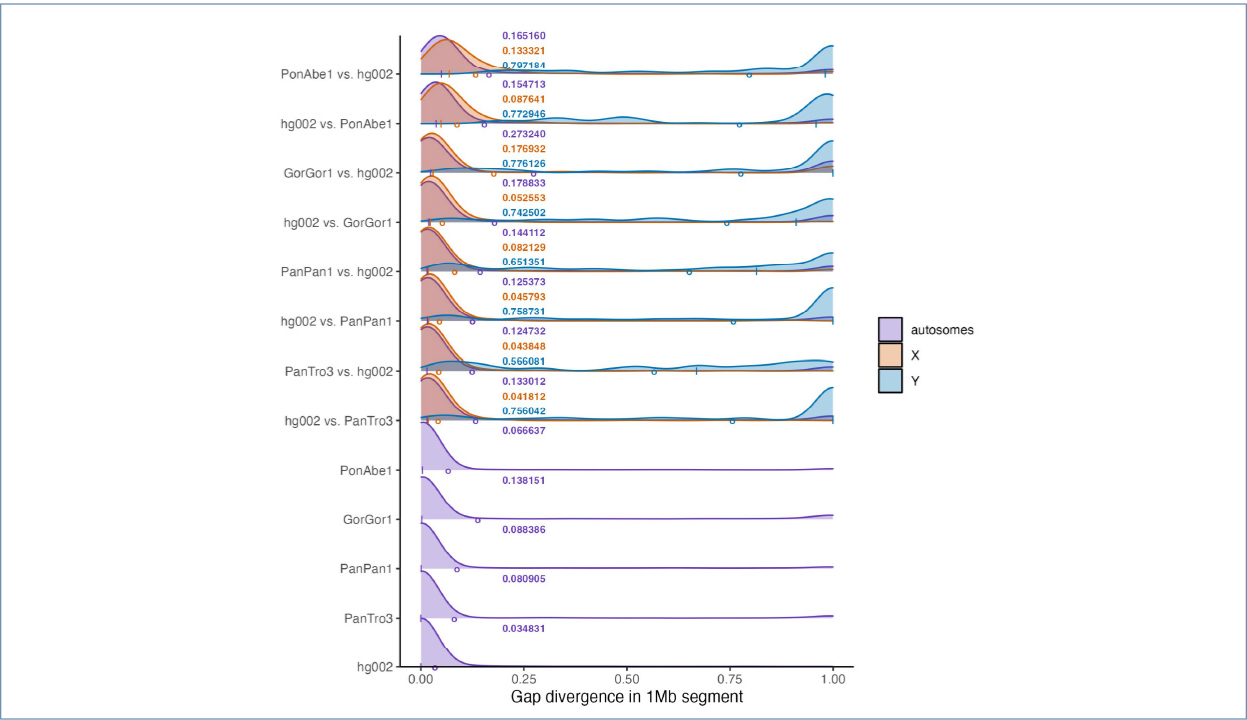
The ‘percent difference’ data are reported in Yoo et al.’s supplemental information (figure 1).
Figure 1. The percent difference caused by alignment gaps between human and great apes. Each alignment was divided into 1-million-bp segments and the percent difference caused by gaps in that segment was calculated. The curves represent histogram-like (e.g., count) data, and each curve has been normalized to its maximum value (so that the peaks all have the same height). The mean (average) for each curve is denoted by the short vertical lines, and the values are reported in the column of numbers. The curves are often quite skewed, making an ‘average’ more difficult to see, so the authors also reported the median (middle value, circles). hg002 = human, PanTro3 = chimpanzee, PanPan1= bonobo, GorGor1 = gorilla, PonAbe1 = orangutan.
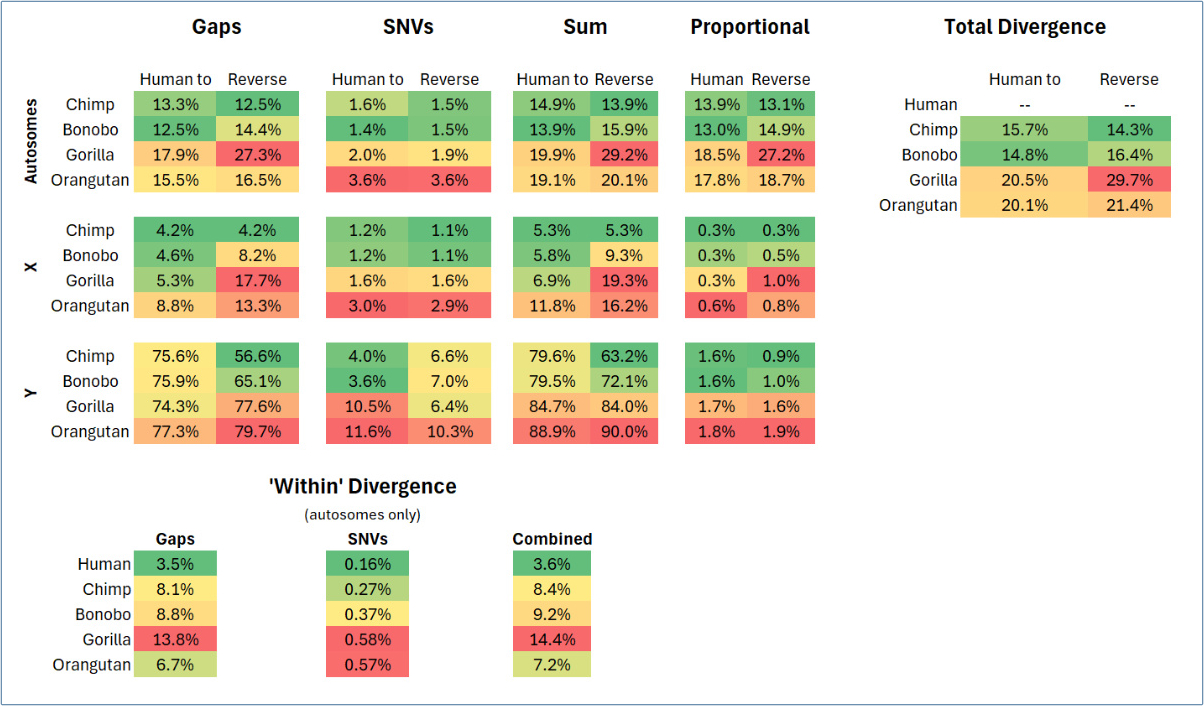
They did not provide any error bars, just the average for each genome pair. They also broke up the data among the autosomes and the X and Y chromosomes. The blue bulges on the right in figure 1 represent giant gaps in the Y chromosome alignment. The purple bulges on the bottom represent the differences found among the two genome copies within the same individual. I worked up their data to get a complete estimate of divergence between the species (figure 2).
Figure 2. Genome similarity calculations. The data for gap and SNV divergence for the autosomes and X and Y chromosomes were tabulated. The differences were summed and then combined using the proportional lengths of the three chromosome types in the different species. The human-to-ape and the reverse calculations are not identical due to the presence or absence (depending on which way you are looking) of many alignment gaps.
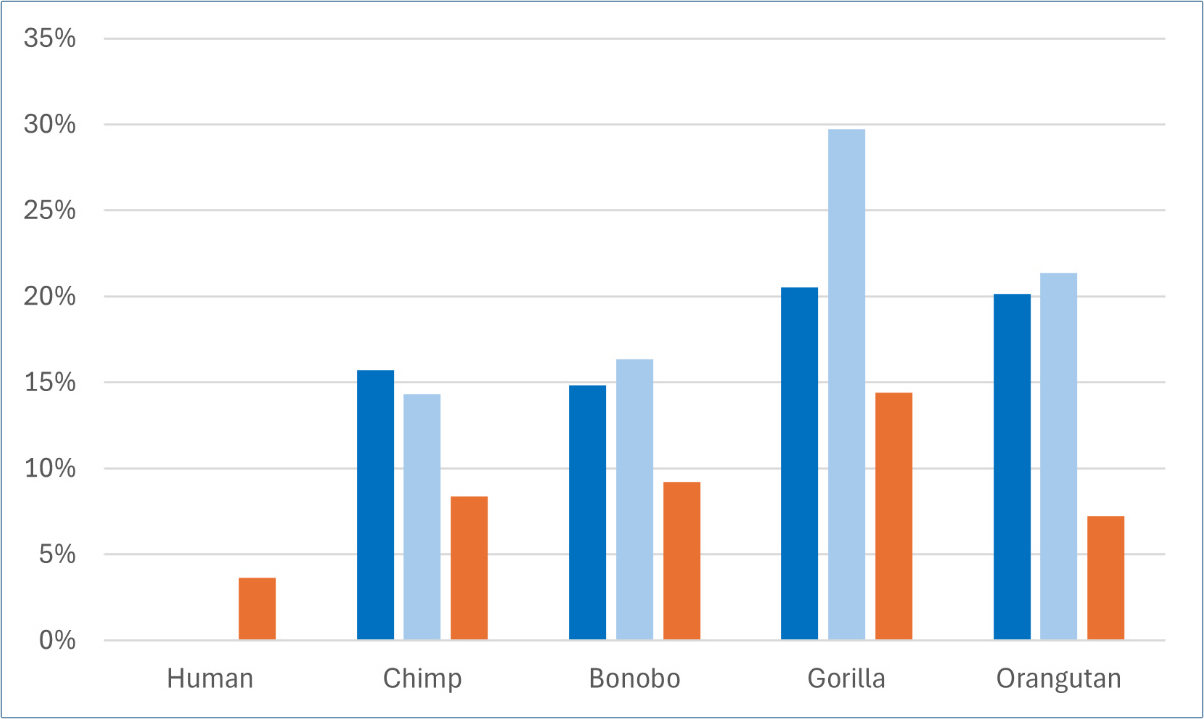
From that, it was possible to generate a bar chart that showed the within- and among-species differences (figure 3).
Figure 3. Final data summary. Orange: within-species difference. Dark blue: human to ape. Light blue: ape to human.
99%? Not even close!
This is a big deal. First, many commentators have claimed this proves that the human and chimpanzee genomes are only about 85% identical.10,11,12 They are spot on, but you would not know that from the major headlines. Nor can you easily find the information in the published paper. Instead, you must drill down into more than 100 pages of detailed supplementary information to find the relevant information.
Second, creationist researchers like Dr Jeffrey Tomkins have been vindicated. While the earlier studies were stymied by a lack of trustable sequence data, the newest genomes show how different we are from all apes.
However, third, there are vast stretches of sequence that are nearly identical between humans and chimpanzees. At random, I found one that stretched for several hundred thousand bases and was nearly 99% identical.13Our opponents will misdirect and obfuscate to their dying breath.
Fourth, our opponents will misdirect and obfuscate to their dying breath. Case in point, in a recent video a commentator named Gutsick Gibbon claimed that I agree with her about human-chimpanzee similarity.14 No, while I agree with her that Tomkins is human and made mistakes (I have also pointed out glaring mistakes in her work and several errors in my work as well15), I do not agree with her that humans and chimpanzees are highly similar.
Fifth, God could have created us 99.9999% identical to chimps, or he could have made us 50% identical, or even less. The biblical creation model makes no prior claim on this. We should expect a high similarity because of the obvious structural, behavioural, physiological, and nutritional similarities between us. But how much? Nobody can know! Note that the evolutionary community was also unable to come up with an estimate before the numbers were run. They have no prior commitment to which ape species would be more like us. The debate about which species was more genetically like us lasted until the 1980s. Many people wanted orangutans to win and resisted the notion that chimps were our evolutionary cousins. Some paleontologists were arguing for the primacy of orangutans as late as 2009, although by that point they were a very small minority.16
The four numbers
Finally, there are four things that we need to know:
What is the percent similarity among the parts that align?
What is the percent similarity when you include the parts that don’t?
How many mutations must have occurred over evolutionary time to account for these differences?
How long would it take to functionally integrate new mutations into the genome?
The answer to the first question is now known: about 98%. The answer to the second question is also now known: about 85%. That third question is now where the debate should be, and the fourth question might be the biggest Achilles’ heel of all for evolutionary theorists.
The evolutionary model here is unlike ours in that it is ‘one-tailed’. They will gladly accept high similarity levels, but there is a cliff on the other side of the argument. If we are too dissimilar, they cannot explain the differences in their 6.5 million years. They do have the ability to back up the time to the most recent common ancestor, but even that ability is limited. A few years ago, some scientists were arguing for 13 million years.17 Some wanted to push the time even further back, but the paleontologists would have none of that because that would necessitate putting early apes in with the dinosaurs. They are stuck. The difference must be low. Period.
How much ‘difference’ can they explain?
Given an evolutionary conveyor belt of new mutations entering in, old mutations being removed by selection and drift, and really old mutations going to ‘fixation’ (i.e., 100%), they expect the mutation rate to approximate the fixation rate.
Here’s how the calculations work out:
Given a haploid mutation rate μ, the number of new mutations per generation is simply 2Nμ, where N is the population size.18
For a new neutral mutation, the probability of fixation is proportional to its frequency in the population. Since there are 2N copies of the genome in the population, and since, by definition, a new mutation starts in one copy of one chromosome, the frequency of that mutation is 1/(2N).19 The rate of fixation (r) would be proportional to the number of mutations that appear (2Nμ).
Thus, r= 2Nμ / 2N = μ
If the mutation rate is 100 per individual per generation, that equates to 50 mutations per haploid genome per generation.20 They would thus expect the human genome to accumulate 50 fixed differences per generation.21 Over 6.5 million years (~300,000 generations), they would expect 15 million differences between each species and our common ancestor, or about 30 million differences between us and them today.
30 million differences / 3 billion letters = 1%
THIS is why they have been quoting that 1% figure all these years, and this is why they have been resisting anything else. If the number is much greater, things do not work out in their favor. When the difference grows past that level, their models break down. It is simply too hard to explain so many differences, even in their ‘millions of years’ mindset.
But even a 15% difference could still be explained if large insertions and deletions cause sudden changes. Consider that the chimp Y chromosome is only half as long as the human Y. Does that amount to 30 million differences, or one? For example, if a single deletion erased the heterochromatic arm of the chimp Y chromosome, a 0.5% difference between our two genomes would instantly appear. What other large changes could be effected by such things?
Yet, we are not talking about changes in ‘junk DNA’. Multiple functional genes are in the unaligned regions. Even though about 99% of human genes are found in the other species, Yoo et al. found 185 gene families unique to humans and from around 1,400 to 2,000 gene copy-number differences among the species.22 True, many of the duplicated areas deal with highly repetitive, non-coding DNA, but these areas have increasingly proved to be functional, as we and others have pointed out many times.23 There are also fully-functional genes in these areas, specifically ones that deal with brain function.24 About 55% of each genome, on average, is composed of repetitive elements (LINEs, SINEs, LTRs, etc.).25 These, too, are proving to have functions, so they cannot be ignored in any comparison.
Given many millions of point mutations and tens of thousands of insertions, deletions, inversions, and duplications, can they explain this in an evolutionary context? They can explain some in their models, but those models are often quite simplistic (like the equations above). Random mating is a critical assumption, but it is never true, and non-random mating only slows down how fast new variants spread. There are also questions about population growth and how it affects all calculations. Given that the human population has been expanding (since the Flood or since the invention of agriculture, take your pick), ZERO genetic variants have become fixed in the human genome for the last 10,000 years in the evolutionary timeline. How does ‘no evolution for 10,000 years’ affect the evolutionary forecast?The ‘fact’ that they have been trumpeting from the rooftops since the 1970s turns out to be no fact at all. The real difference is NOT 1%. No, it is 15x greater.
But the fourth question above is perhaps the most fundamentally important question in evolution. Why? Because evolution needs new genes to arise and activate. Humans and chimpanzees do not just differ at the nucleotide level. Our genes are not used in the same ways and our brains have very different wiring pathways. Those changes would not just have to arise. No, they would have to arise, spread out and replace whatever original gene was in that place, and then integrate themselves into the already complex regulatory processes that exist.
This is a massive problem, even for the “1%” crowd. Now that we know the human and chimpanzee genomes are more than 10 times more different than they thought, the problem of evolution only becomes that much more difficult. This is one of the greatest scientific discoveries that supports the biblical creation model. It does not mean, however, that evolutionists will never be able to explain what we see. It does mean, though, that they will be scrambling for cover. The ‘fact’ that they have been trumpeting from the rooftops since the 1970s turns out to be no fact at all. The real difference is NOT 1%. No, it is 15x greater.
Cohen, J., Relative differences: the myth of 1%, Science316(5833):1836, 2007. Return to text.
Buggs, R., How similar are human and chimpanzee genomes?, richardbuggs.com, 14 Jul 2018. Return to text.
Seaman, J. and Buggs, R., FluentDNA: nucleotide visualization of whole genomes, annotations, and alignments, Frontiers in Genetics 11:292, 2020. Return to text.
Rhie, A. et al., The complete sequence of a human Y chromosome, Nature621(7978):344–354, 2023. Return to text.
Yoo, D. et al., Complete sequencing of ape genomes, Nature641(8062):401–418, 2025. Return to text.
Yoo et al., ref. 7, supplementary information, p. 101. Return to text.
Luskin, C, Letter to the Smithsonian: Correct your signage on human-chimp genetic similarity!, evolutionnews.org, 27 May 2025. Return to text.
Buggs, R., How much of a human genome is identical to a chimpanzee genome?, richardbuggs.com, 6 May 2025. Return to text.
Tomkins, J.P., Chimp genome markedly different from human, icr.org, 29 May 2025. Return to text.
Gutsick Gibbon, I killed this creationist argument, youtube.com, 28 May 2025. Return to text.
Carter, R., James 3 vs. the anticreationists, biblicalgenetics.com, 16 Jan 2024; youtube.com/watch?v=FIY7FTTFZyg. Return to text.
Grehan, J.R. and Schwartz, J.H., Evolution of the second orangutan: phylogeny and biogeography of hominid origins, J. Biogeogr.36(10):1823–1844, 2009. Return to text.
Venn, O. et al., Strong male bias drives germline mutation in chimpanzees, Science344(6189):1272–1275, 2014. Return to text.
The formula includes a “2” because the genome is diploid. The mutation rate is usually given as the haploid mutation rate, for historical reasons. Return to text.
Again, a 2 is in the denominator because there are two copies of the genome per individual in diploid species. Return to text.
The classic neutral theory formula r = μ applies when μ is the per-site mutation rate. When Kimura derived this result, he was showing that at any given nucleotide position, the rate of neutral substitution equals the mutation rate at that site. However, when one multiplies both sides of r = μ by the genome size, the exact same number is reached, especially since we started with the per-haploid genome mutation rate (i.e., the sum of the per-site mutation rates * number of sites). Thus, the relationship r = μ scales directly. I applied the principle at the genome level rather than the per-site level because the question was about the rate of fixation across a species. Return to text.
Given random mating, which never happens, and a stationary population size, which is clearly not true for humans. Without these assumptions the evolutionary model cannot deliver even a 1% difference. Return to text.
Yoo et al., ref. 7, supplementary information pp. 66–67. Return to text.
We are living in a world that no longer believes God exists and in fact some believe that we can become Gods. Peter Diamandis is intelligent and it is difficult for me to understand how he still believes in evolution. By most measures it is a failed theory. Sadly, it seems the following Scripture defines Peter Diamandis: “And since they did not see fit to acknowledge God, God gave them up to a debased mind to do what ought not to be done.” Romans 1:28
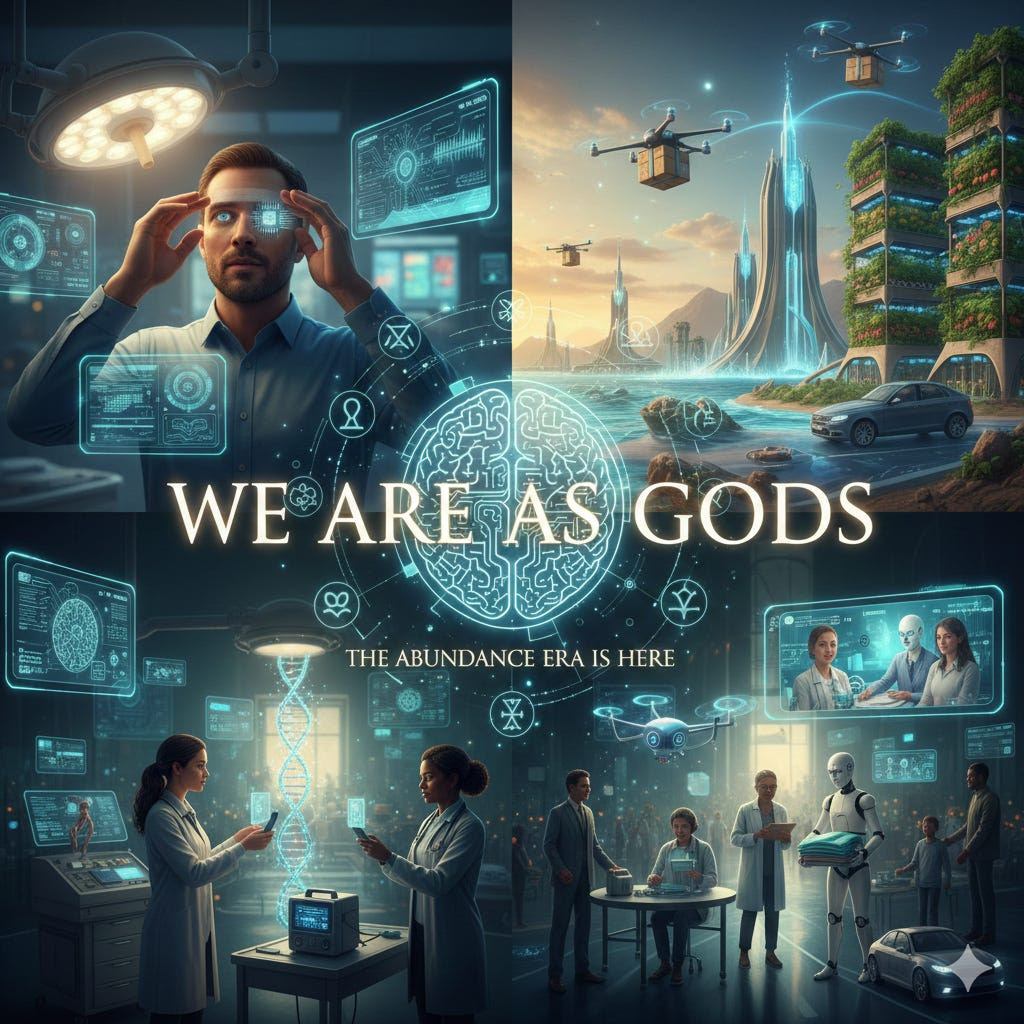
Excerpts from: We Are As Gods – A Survival Guide for the Age of Abundance, By Peter H. Diamandis & Steven Kotler
A man walks into a hospital, legally blind. Eighty minutes later, he walks out able to see faces. That’s not science fiction. That’s not a hundred years from now. That’s Monday morning in 2026. His name doesn’t matter. What matters is what happened inside that operating room. A surgeon implanted a two-millimeter photovoltaic microchip containing 400 light-powered pixels into his retina. The chip—called PRIMA—works like a solar panel, converting infrared light into electrical signals that stimulate surviving neurons. Those neurons transmit signals along the optic nerve to the visual cortex, where the brain constructs them into images. The surgery took 80 minutes. What were the results? Biblical.
Before the procedure, this man’s vision measured 20/450: legally blind by U.S. standards. And after? 20/160. The difference between seeing darkness and seeing faces. Between isolation and connection. Between blindness and sight.The blind can now see. And if that phrase sounds familiar, it should. Because according to the New Testament, the restoration of sight to the blind is one of the defining miracles – proof in the mathematical sense, of divine power.Which raises an interesting question: If we can perform miracles of biblical proportions, what exactly does that make us?
“We Are As Gods and Might as Well Get Good at It”
In 1968, Stewart Brand wrote those words in the first edition of the Whole Earth Catalog. He was talking about technology, and it was a tall order. Consider what it would actually take to match the gods. Creation ex nihilo: the creation of something from nothing. That feat is reserved. Only supreme deities need apply. Yahweh pulled it off. So did Brahma, Atum, Pangu. The ability to drag light, land, and life out of the void. Or omniscience – the ability to know all things. Omnipresence – the ability to exist everywhere at once. “Praecognitio” – Latin for the power to foretell the future. Shape-shifting. Resurrection. The power to heal the sick, control the weather, and part seas. If you count the miracles in the Old Testament alone, you get 83 supernatural acts divided into ten categories: Creation, Provision, Nature, Healing, Resurrection, Judgment, Protection, Prophecy, Communication, and Victory in Battle. That’s a lot of miracles. And in 1968, when Brand made his proclamation, we weren’t quite there. We were gods in training. Mainframe computers the size of oil tankers were the rule. The microchip had just been invented. Color television was a neat trick. NASA managed to orbit the moon with men in a can, but Neil Armstrong’s small step was still a year away. We were not gods. Not yet. But what nobody expected… we were very fast learners. The Miracle Inventory Let me show you something. If you measure modern technology against the Old Testament’s miracle categories, here’s what you might find:
CREATION MIRACLES Synthetic biology creates new forms of life or modifies existing ones. CRISPR edits genes with precision. 3D printing brings matter into being layer by layer: literally building something from almost nothing. Generative AI creates virtual worlds populated by self-directed agents capable of forming economies, religions, and societies. We create life. We create worlds. We create intelligence.
PROVISION MIRACLES Vertical farming produces food with 95% less water and 99% less land than traditional agriculture. Desalination turns seawater into drinking water at scale. Lab-grown meat provides protein without slaughter. Solar-powered systems provide clean water, cooking, and sustainable protein even in deserts. Drones deliver meals and medicine where supply chains fail. The miracle of provision—feeding multitudes, turning scarcity into Abundance—is no longer metaphor. It’s operational.
HEALING MIRACLES Gene therapy cures disease at the genetic level. Stem cells repair what injury destroys. Telemedicine enables remote diagnosis and treatment. Advanced diagnostics detect disease before symptoms appear – often catching seven out of the top ten causes of death early enough to intervene. AI-powered drug discovery accelerates cures for cancer and rare genetic disorders. The blind see. The paralyzed walk. The dying are healed.
RESURRECTION MIRACLES Cryonics preserves the dead in hope of future revival. Stem cells create new organs. Organ perfusion technology keeps donated organs viable for days instead of hours. CPR and drone-delivered defibrillators revive people in cardiac arrest. We raise the dead. Maybe not permanently. Not yet. But we’re getting there. The list goes on. And on. And on.
In 1968, when Stewart Brand made his proclamation, these capabilities were fantasy. Today, they’re infrastructure. Miracles have become utilities. We are, by any reasonable definition, gods. Why We Don’t Feel Divine So, if we’re literally walking the Earth in an age of miracles, why don’t we feel like gods? The answer lies in how our brains process novelty – or more accurately, fail to process it. In the 1980s, Northwestern University cognitive scientist Dedre Gentner ran experiments asking people questions like: “How is a solar system like an atom?” Most people answered: “Electrons orbit the nucleus like planets orbit the sun.” Gentner discovered something profound about how the mind works: a process she called structure-mapping. To understand the unfamiliar, humans don’t just make surface comparisons. We map deep relational similarities between domains. We use analogies as cognitive infrastructure. The brain to a computer. The internet to a web. Genes to code. The universe to a network. Analogy is how we compress novelty into familiarity. It’s how we make sense of the world when it starts changing faster than we can keep up. But here’s the problem: Our comparison machinery has run out of comparisons. Godlike powers in our pockets? What’s the analogy? Curing blindness with microchips? Resurrecting the dead with defibrillators? Creating life from stem cells? There are no easy grounds for comparison. Without analogies, we can’t parse the world. The result is cognitive vertigo: the sense that the world is moving faster than we can make sense of it. And when analogies fail, humans start hunting for deeper patterns—what Carl Jung called archetypes. The Rise of Archetypal Media. Jung argued that archetypes are universal patterns embedded in humanity’s collective unconscious, primal symbols that evoke powerful reactions across cultures. The Hero. The Shadow. The Great Mother. The Wise Old Man. In the early twenty-first century, we find ourselves awash in Jungian archetypes. And if you want to track the psychological impact of technological acceleration—the failure of analogy—just count the gods, goddesses, superheroes, and supervillains populating our screens. Start in 1968. The next decade produced one notable cinematic release: Superman. Television gave us Wonder Woman. The 1980s saw a step-function increase: ten superhero films and six TV shows. The 1990s doubled: twenty major releases and nearly as many shows. Between 2000 and 2010? The numbers tripled: sixty films and thirty television series. Jung would argue this surge is an unconscious response to the psychic destabilization brought on by radical acceleration in human potential. With each technological leap, we need new symbols and myths to anchor our understanding of our growing power. Archetypes provide narrative coherence and moral clarity. As Spider-Man says: “With great power comes great responsibility.” We live in a world of abundant archetypes because we live in a world of abundant miracles. The Information Apocalypse There’s another reason we don’t feel divine: information overload. In 3000 BCE, if you measured all the data in the world—papyrus scrolls, clay tablets, the works—you’d total about one gigabyte. The equivalent of 4,000 books. In 2012, when we published Abundance, the world produced 2.8 zettabytes of data. A zettabyte is a trillion gigabytes. That’s 4,000 trillion books. By 2025? 181 zettabytes. We don’t have an analogy for that number. And that’s the point. Information impacts the nervous system, and we’re living through the biggest information surge in history. The result is a mismatch between the data storm outside and the prediction engine inside. Our ancient brains don’t have the bandwidth, and our imagination has been hijacked by the apocalypse. No wonder we don’t feel divine. The Miracles in Your Pocket. Let’s bring this home. You carry miracle technology in your jeans and handbag. You can summon a chariot of the gods disguised as an Uber with a finger tap. You can conjure a feast via Uber Eats with another. You have answers to nearly every question in seconds—omniscience on demand. You can see anyone, anywhere, anytime through video calls—omnipresence as a feature, not a bug. Translation. Navigation. Simulation. Creation. Communication. It’s all at your fingertips. The grandiosity of “omnipresence” and “omniscience” has been replaced by the prosaic “Zoom” and “Google,” but the underlying superpowers are the same. These divine powers are everywhere and everywhen. In 2012, we predicted a future that included autonomous cars, flying cars, delivery drones, and humanoid robots. It sounded like science fiction. Today? Over 30 autonomous car companies are operational. Waymo operates robotaxis with zero safety drivers in San Francisco, Phoenix, and Los Angeles. Tesla Full Self-Driving has over one million users. Flying car companies—eVTOL vehicles—are conducting commercial test flights in Dubai, Los Angeles, and Singapore. Joby Aviation expects to launch commercial operations offering 15-minute flights from LAX to downtown LA (versus 60-90 minutes by car). Nearly every major retailer has robots running their warehouses. Zipline makes thousands of drone deliveries every day, transporting lifesaving medicines and saving tens of thousands of lives in the process. Humanoid robots? Google “Tesla Optimus.” You’ll find videos of robots folding clothing, serving drinks, and holding yoga poses. We’ve gone from hard-to-believe stories to commercial operations in just over a decade. The Survival Guide for the Age of Abundance Here’s the thing: Stewart Brand was right. We are as gods. But he left out the hard part. We have to get good at it. Because the same exponential forces that gave us godlike powers are also overwhelming our nervous systems, hijacking our attention, and triggering bias cascades that blind us to miracles. Our capabilities have far outstripped our wisdom. As Ray Kurzweil writes in his endorsement of We Are as Gods: “Peter Diamandis and Steven Kotler show that while exponential technologies deliver the capability for radical abundance, the real challenge lies in upgrading our consciousness to match our accelerating power. This is more than a survival guide—it’s a manual for optimizing our destiny.” That’s the paradox. We have the power to cure blindness, create life, and command machines with our thoughts. But we’re still running Stone Age prediction software in our heads. Our ancient brains don’t have the bandwidth to process miracles at scale. So we feel anxious instead of abundant. Overwhelmed instead of empowered. Burned out instead of divine. The solution isn’t less power. It’s a consciousness upgrade. The Abundance era has arrived. The miracles are here. The blind can see. The paralyzed can walk. We create life from stem cells and resurrect the dead with technology. But without upgrading our consciousness to match our godlike capabilities, we’ll miss it entirely. We’ll keep doom scrolling through the apocalypse, blind to the fact that we’re living through the most extraordinary transformation in human history. The Choice You have a choice. You can keep seeing the world through the lens of negativity bias, confirmation bias, and cognitive overload – where every headline is a disaster and every change feels like a threat. Or you can update your operating system. You can learn to see the miracles you’re living through. You can train your brain to recognize Abundance even when it’s wrapped in disruption. You can, in Stewart Brand’s words, get good at being gods. The tools are here. The data is clear. The miracles are multiplying. The only question is: Will you see them? Eric Schmidt, former CEO of Google, put it this way: “Diamandis and Kotler’s bestseller Abundance helped shift the global conversation from fear to possibility. Now, We Are as Gods reveals that the forces they predicted—AI, clean energy, digital biology—are scaling at a pace few could imagine. This book argues persuasively that the Abundance era has arrived and challenges leaders to use these capabilities responsibly and ambitiously.” The Abundance era has arrived. The blind can see. The paralyzed can walk. We create worlds with code and life with CRISPR. We are as gods. The question is: Are you ready to get good at it?
It is Babel all over again. Is it any wonder why Jesus has to return to restore righteousness. Be prepared for what is next on God’s agenda for planet earth go to http://www.millennialkingdom.net
Using the Bible, well-documented historical events, and some math, we find that the Flood began approximately 4,359 years ago in the year 2348 BC. Genesis teaches it; Jesus and the apostles confirmed it. It also explains most of the rocks and fossils and obliterates billions of years. Without millions of years , evolution is impossible – not that it is possible if millions of years were granted. We should therefore be prepared to defend a global flood along with the rest of the faith, as well as refute arguments against it.
“But even if you should suffer for righteousness’ sake, you will be blessed. Have no fear of them, nor be troubled, but in your hearts honour Christ the Lord as holy, always being prepared to make a defense to anyone who asks you for a reason for the hope that is in you; yet do it with gentleness and respect, having a good conscience, so that, when you are slandered, those who revile your good behavior in Christ may be put to shame.” 1 Peter 3:14-16
“We destroy arguments and every lofty opinion raised against the knowledge of God, and take every thought captive to obey Christ, being ready to punish every disobedience, when your obedience is complete.” 2 Corinthians 9:5-6
The world must reject Noah’s flood as it destroys evolution which is their attempt to explain away the Cosmos without God. Noah’s flood also proves that God judged the world and destroyed all but the eight people on the ark God instructed Noah to make. Who wants to believe their creator would do that? Evolution has been one of Satan’s most effective ploys to deceive mankind into rejecting God.
What about now? Both Jesus and Peter told us that people will reject the true history of the world including Noah’s flood at the time before Jesus returns to Earth to rescue His Saints and God pours out His wrath a second time on an unrepentant world with the Trumpet and Bowl judgements.
“Just as it was in the days of Noah, so will it be in the days of the Son of Man. They were eating and drinking and marrying and being given in marriage, until the day when Noah entered the ark, and the flood came and destroyed them all... so will it be on the day when the Son of Man is revealed.” Luke 17:26-27,30
“For as in those days before the flood they were eating and drinking, marrying and giving in marriage, until the day when Noah entered the ark, and they were unaware until the flood came and swept them all away, so will be the coming of the Son of Man.” Matthew 24:38-39
In Peter’s second letter, he prophecies about future scoffers following their own sinful desires and denying Christ’s return. They “deliberately overlook” two foundational truths. The first was God created the world out of water and the second was the global flood of Noah’s day.
“Knowing this first of all, that scoffers will come in the last days with scoffing, following their own sinful desires. They will say, “Where is the promise of his coming? For ever since the fathers fell asleep, all things are continuing as they were from the beginning of creation.” For they deliberately overlook this fact, that the heavens existed long ago, and the earth was formed out of water and through water by the word of God, and that by means of these the world that then existed was deluged with water and perished.” 2 Peter 3:3-6
Jesus returns on the clouds with the angels to gather the Saints, first the resurrected Saints and then those alive on Earth. “Behold, he is coming with the clouds, and every eye will see him, even those who pierced him, and all tribes of the earth will wail on account of him. Even so. Amen.” Revelation 1:7
God then pours out His wrath upon the Earth with the Trumpet and Bowl judgements. It so happens that His judgement last one year and ten days exactly the same time as God poured out His wrath the fist time with Noah’s flood. Why one year and ten days? When Jesus returns it will be a Jubilee year and the year before a Jubilee year is always one year and ten days.
In this in-depth interview, Dr. Bill Barrick—Professor Emeritus of Old Testament and Hebrew at The Master’s Seminary — unpacks what the Hebrew text of Genesis 1 really says. Does the Bible itself teach a young earth? Is the day-age theory compatible with the Hebrew grammar? What about the Gap Theory, mytho-history, and functional creation views made popular by scholars like William Lane Craig, Michael Heiser, and John Walton? We dig deep into the Hebrew of בְּרֵאשִׁית בָּרָא אֱלֹהִים (“In the beginning God created”), explore whether Genesis 1:1 is a heading or a historical statement, and discuss how the text itself answers questions about the firmament, cosmology, and biblical authority.
00:00 Intro 02:08 Discussion on Young Earth Creationism 09:01 Old Earth Creationism and Personal Journey 12:09 Day-Age Theory and Hebrew Grammar 22:05 Gap Theory Examined 32:21 William Lane Craig and Mytho history? 37:05 Poetry vs. Historical Narrative 41:38 Analysing Genesis 1:1-3 57:11 Primitive Cosmology and Metaphors 01:04:42 The Light Before the Sun
C.S. Lewis once put it, “Men became scientific because they expected Law in Nature, and they expected Law in Nature because they believed in a Legislator.” Christianity is a science-starter. God made us in His image to create as He creates.
The creation/evolution debate has continued unabated for a century. The US and, indeed, the world remain highly divided on the question of origins. The good news is that latest scientific discoveries like the electron microscope that revealed in even the simplest cells complex machinery and transport devices and then the discovery of DNA which is complex information that controls the complex machinery and transport devices in every cell. There is no way this could have evolved and the only source of complex information is intelligence of the highest order. The God who exists outside of the complex universe He created.
There is no mechanism to explain evolution, from “GOO to YOU”. Darwin’s natural selection won’t do it. It only selects from what is already there. The only other proposed mechanism – mutations, also won’t do it. Mutation loses information it does not add information. Moreover order does not come from chaos. God exists and even more important He loves us.
In this video, Dr Robert Carter explores how genetics supports a biblical timeline. The evidence is irrefutable and deserves to get wide distribution. Make sure you send it to family and friends.
DNA is supposedly millions of years old, but can it really survive that long? The evidence suggests otherwise. From genetic entropy showing species can’t survive endless mutations, to ancient DNA breaking down too quickly in the ground, to mitochondrial Eve and Y-chromosome Adam pointing to recent common ancestors — multiple lines of evidence challenge evolutionary timescales. DNA barcoding reveals another puzzle: species across the animal kingdom appear to be roughly the same age, as if some major event reset life on Earth.
The giant tortoise, the bowhead whale, and the Greenland shark are three of the longest-lived vertebrates. As we will see, the facts about them make the evolutionary narrative even harder for materialists to justify.
The oldest living tortoise in the world, called Jonathan, is believed to have hatched from an egg in 1832, though that is only an estimate. That makes him about 193 years old (in 2025), and he is thought to be the oldest living land animal.
What does such longevity mean for belief in the evolution narrative? If animals are able to sow their genetic information into the gene pool over hundreds of years, with lengthened generations, then it would only increase the difficulty for evolution to occur. Famous evolutionary biologist J.B.S. Haldane (1892–1964) pointed out that larger, slow-breeding vertebrates, such as cattle, cannot hope to pay the cost of neo-Darwinian evolution through random mutations and natural selection.
The cost (i.e., of substituting a gene) may be stated as follows. Consider a breeding population in which a supposedly beneficial mutation arises. For that mutated gene to spread to become dominant in the population, a large number of individuals without that mutation must first die (in that and succeeding generations) without leaving offspring. Haldane’s ‘working number’ for these deaths was 30 times the population size.
Four factors that can lower the number of such deaths are higher selection pressures, higher mutation rates, faster population turnover, and smaller populations. Haldane cited a theoretical low of around 10–20 times the population size. But he said it could be higher than the 30 he used in his calculations, in rare circumstances, even as high as 100. Nonetheless, 30 is generally taken as a reasonable estimate for most situations.
This theoretical cost is grossly unrealistic; for a population of only 1,000 animals, it would mean 30,000 nonreproductive deaths must first happen over time. This is an unacceptable cost for the species to bear. And for larger populations, the number of such deaths would be higher still. This long-recognized problem is known as Haldane’s Dilemma. And there is no solution in sight.
There is also another issue to consider, called Peto’s Paradox. Large vertebrates have many more cells than small animals, which suggests a higher risk of mutations in body cells (called somatic mutations, which are not inherited). Also, the longer a creature lives, the higher the chance of the DNA in an individual cell mutating. Such mutations can lead to cancer and early death. So, the larger, longer-lived vertebrates should have a greater risk of cancer.
But the evidence is the reverse; it would seem they actually have a lower risk of cancer, perhaps due to one or more effective DNA repair mechanisms. The presence of cell repair mechanisms is actually evidence of design, not evolution. Slow-breeding animals such as the bowhead whale are evidently not dying young through disease, further reinforcing the dilemma that Haldane highlighted.
Another problem is why natural selection (i.e., differential reproduction) over millions of hypothetical years would ever cause such longevity to evolve. There is no reproductive advantage, as evolution requires, for a mutation that keeps a creature alive long after it has stopped reproducing.
Extreme cruelty, gross injustice, and disregard for the life of individuals characterise regimes that believe life is an accident. Examples include Hitler’s National Socialism, Stalin’s Soviet Socialism, and their nauseatingly numerous socialist offspring. Many socialists mistakenly believe that science can show that life evolved by accident.
Sadly, universities and schools teach our children that evolution is fact and that this cosmos came about by a Big Bang and random chance evolution. As a result, lavishly funded TV spectaculars portray the evolution of life as “scientific”, but it is not. It cannot be subjected to the scientific method as its assumed processes are not observable. Darwin insisted his theory could not explain the origin of life but claimed it did explain the lesser problem of how species could have become increasingly complex. Since Darwin’s time, however, the expected mass of transitions to more and more complex species has been absent from the fossil record. More importantly, Dr Michael Behe recently discovered organelles driving the flagellum of a bacterium that meet Darwin’s own criteria for falsifying his theory. Mainstream media has hardly mentioned this, and the educational establishment has ignored it because they will not consider the supernatural. Regardless of the evidence, if it is not natural/materialistic, it is not science.
Fake news also disparages those who accept the scientific evidence for intelligent design of life. Yet they include science luminary Sir Fred Hoyle and Dr Paul Davies who discovered the fine tuning of the universe, renowned microbiologist Dr Dean Kenyon who renounced his celebrated evolutionary work “Biochemical Predestination” to accept intelligent design, Dr Michael Behe who wrote the landmark work “Darwin’s Black Box”, notorious Oxford Professor Anthony Flew who renounced atheism in his book “There is a God”, the brilliant Oxford mathematician Professor John Lennox, mathematician Dr William Dembski who authored “The Design Inference”, and information scientists Dr Lee Spetner and Dr Michael Hasofar who were the first to publish quantified evidence against evolution of species in the world’s leading peer-reviewed “Journal of Theoretical Biology”.
Evolution has been our enemy, Satan’s best strategy, but he realises that its time is over, and he already has his final strategy in place: Aliens. Richard Dawkins, one of the atheists’ most celebrated authors, when argued into a corner on intelligent design, blurted out, “Well, if it’s intelligent design, it must have come from outer space.” Demons are already representing themselves to gullible people as aliens, as good guys, come to save us. These stories are coming to us from people who have experience with UFOs. According to an ABC News poll conducted in 2000, “nearly half of all Americans and millions more globally believe we’re not alone […] 40 million Americans say they have seen or know someone who has seen an unidentified flying object, or UFO,
Look at the many movies and games that feature aliens. Young people are being set up to embrace demons when they manifest as good aliens.
In Gary Bates’s book on Aliens, he provides evidence that these creatures posing as aliens are, in fact, demons. Whenever a person commanded them to go in the name of Jesus, they immediately departed.
Are you ready for all that will proceed Jesus’s return to restore righteousness? The bible gives us a lot of information on the last seven years before Jesus returns to defeat the Antichrist at the battle of Armageddon. If you are new to this blog, then you can go back over previous posts to find out where we are at in terms of Biblical end times prophecy.