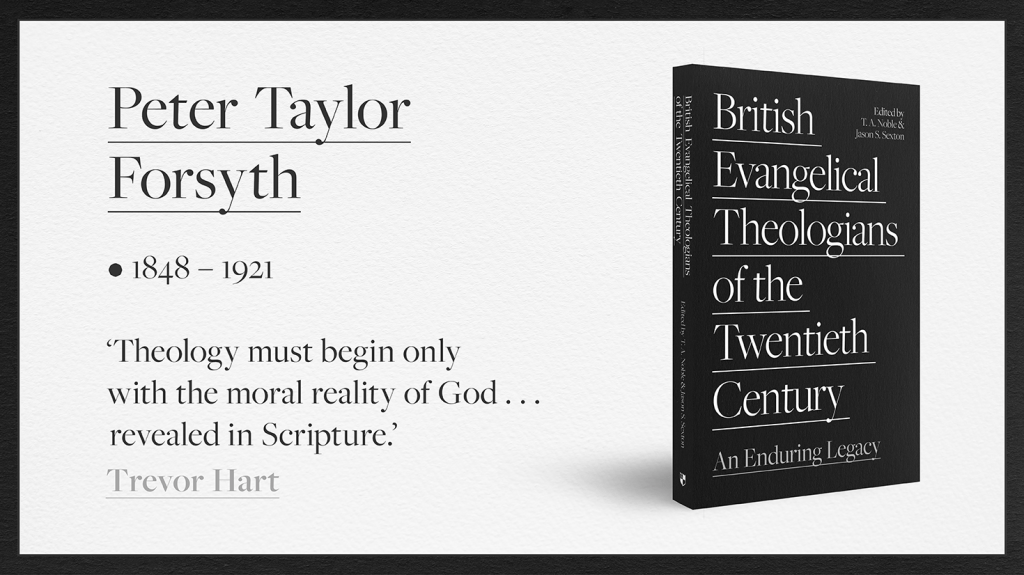
How good is it to find gems in books by authors you have never heard of. I owned and distributed Christian books for over 30 years. I purchased Christian Press in 1983 but had never heard of Scottish theologian, Peter James Forsyth or his books, The Cruciality of the Cross (1899), The Work of Christ (1910) and The Justification of God (1917) just three gems of over 100 books published.
I give you two quotes from The Justification of God:
“No reason of man can justify God for His treatment of His Son; but whatever does justify it justifies God’s whole providence with the universe, and solves its problem. He so spared not His Son as with Him to give us all things. The true theology of the Cross and its atonement is the solution of the world. There is no other. It is that or none. And that theology is that the Cross is not simply the nadir of Incarnation, but that it is God’s self-offering (under the worst conditions that love could feel for evil man) to His own holy name. The just God is the chief sufferer, and sole Doer. The holy love there is in action everywhere. The most universal thing in the universal Christ is His cross. Everywhere, according to God’s ubiquity, imminence, or what you will, His holy love is invincibly at issue with death, sin, and sorrow. Everywhere is redemption. And that is the only theodicy. The purpose of salvation is the principle of creation; and the ruling power of the world is the purpose of God.“
It is no light problem that faces the Creator in His world. There was never such a fateful experiment as when God trusted man with freedom. But our Christian faith is that He well knew what He was about. He did not do that as a mere adventure, not without knowing that He had the power to remedy any abuse of it that might occur, and to do this by a new creation more mighty, marvellous, and mysterious than the first. He had means to emancipate even freedom, to convert moral freedom, even in its ruin, into spiritual. After the first creation drew on His might, the second taxed his all-might. It revealed His power as moral majesty, as holy omnipotence, most chiefly shown in the mercy that redeems and reconciles. To redeem creation is a more creative act than it was to create it. It is the last thing omnipotence could do. What is omnipotence but the costly and inevitable action of holiness in establishing itself everywhere for ever. The supreme power in the world is not simply the power of a God but of a holy God, upon whose rule all things wait, and may wait long. It is no slack knot that the Saviour has to undo. All the energy of a perverse world in its created freedom pulled on the tangle to tighten it. And its undoing has given the supreme form to all God’s dealing with the world. But at the same time the snarl is not beyond being untied. Man is born to be redeemed. The final key to the first creation is the second; and the first was done with the second in view. If moral freedom is the crown of the first creation, spiritual, holy freedom is the goal of moral; and it is the gift in the second creation. The first creation was the prophecy of the second; the second was the first tragically ‘arrived.’ There was moral resource in the Creator equal to anything that might happen to the creature or by him. And that resource is put forth in Christ — in His overcoming of the world on the Cross, and His new creation of it in the Spirit. All God’s omnipotence is finally there. The great goal is not the mere fruitage of the first creation, but another creation more creative still. The first does not glide into the second; there is a crisis of entirely new departure. (pp. 122-124)
And the book’s final paragraph must also be shared here:
Faith is more than an individual calm; it is the Church’s collective confidence on the scale of the world for the destiny of the world. The evil world will not win at last, because it failed to win at the only time it ever could. It is a vanquished world where men play with devilries. Christ has overcome it. It can make tribulation, but desolation it can never make. (p. 223)
Jesus return to earth to restore righteousness is not too far distant. The many Biblical end times prophecies are playing out in our day. Hallelujah!
“Then I saw heaven opened, and behold, a white horse! The one sitting on it is called Faithful and True, and in righteousness He judges and makes war. His eyes are like a flame of fire, and on his head are many diadems, and He has a name written that no one knows but himself. He is clothed in a robe dipped in blood, and the name by which he is called is The Word of God. And the armies of heaven, arrayed in fine linen, white and pure, were following him on white horses. From his mouth comes a sharp sword with which to strike down the nations, and He will rule them with a rod of iron.” Revelation 19:11-13
Jesus Millennial Kingdom is next on God’s agenda for planet earth. To prepare yourself to rule with Jesus go to http://www.millennialkingdom.net
“For God so loved the world, that he gave his only Son, that whoever believes in him should not perish but have eternal life. For God did not send his Son into the world to condemn the world, but in order that the world might be saved through him.” John 3:16-17
Step 1. You need to repent of your sin of rebellion against God and His commandments, accepting Jesus as your Saviour and Lord, acknowledging the enormity of His sacrifice on the cross.
Jesus answered, “Truly, truly, I say to you, unless one is born of water and the Spirit, he cannot enter the kingdom of God.” John 3:5
Step 2. You need to be baptised (evidence you have died to self and arisen a new person in Christ) and receive the Holy Spirit as your counsellor, teacher, helper and comforter; otherwise, you cannot live the Christian life.
“‘For I know the plans I have for you’, says the Lord. ‘They are plans for good and not for disaster, to give you a future and a hope.’” Jeremiah 29:11
Step 3. Know that God has a plan for your life, but you must allow the Holy Spirit to guide your every step. Do not grieve Him or quench His work in your life.
“And do not grieve the Holy Spirit of God, by whom you were sealed for the day of redemption.” Ephesians 4:30
Sarah Holliday, reporter at The Washington Stand looks at possible reasons why in a country that has been increasingly turning away from God and His values.
The Wall Street Journal wrote that “Bible sales are up 22% in the U.S. through the end of October, compared with the same period last year.” According to the outlet, there are several potential factors for why this is the case. Jeff Crosby, president of the Evangelical Christian Publishers Association, believes “people are experiencing anxiety … related to artificial intelligence [and] election cycles.” All of which “feeds a desire for assurance that we’re going to be okay.” Maybe Crosby is right. People want to know they’re going to be okay, and so they’re turning to the Bible.
Others have speculated that the rise in Bible sales can be attributed to influencers on social media. Cely Vazquez, whom WSJ described as an artist and influencer, has used her platform to share that she “recently bought her first Bible.” Likewise, the outlet highlighted Amber Cimiotti, another social media figure who thinks podcasters and TikTokers play a major role in the growing number of people buying Bibles.
WSJ also noted how several publishing houses found the customers largely responsible for the surge in Bible sales were members of Gen Z, college students, and younger people alike. And it’s not just religious publishers seeing the Bibles fly off the shelves, but mainstream retailers too — including Amazon. Observers are puzzling over what’s causing it in light of recent surveys that have found that at least 28% of American adults claim to be religiously unaffiliated. That doesn’t exactly scream an increased demand for religious material.
Ultimately, it’s more than likely that all of these factors laid out by WSJ played a part in the increase of people buying Bibles. Rev. Blaine Crawford of Irvington Presbyterian Church told WSJ that he has seen a recent increase in Scripture study groups. He remarked that God’s word is a “grand epic story of the great questions of life. What do we do with grief or anger, what are we here for, where is the world going? The Bible provides a counterpart in a conversation about what we’re doing at this time.”
As people made in the image of God, we were never meant to be away from Him. The reigning theme in the book of Ecclesiastes is not that life has no meaning, but that apart from Christ, the source from which our purpose derives, there is no meaning. As The Post Millennial wrote, “Experts and industry insiders attribute the growth in Bible sales to societal anxieties and a search for hope.” But I don’t think the experts are the only ones who could have figured this out. Rather, Christians should understand this to be the case better than almost anyone. After all, Christians are to be the people who understand their sin and need of a Savior. We ought to be at the frontlines of an anxious culture offering them the hope of the gospel.
Family Research Council President Tony Perkins put it this way: “Obtaining a Bible is the first step; the second step is to read it and then understand it. As Philip helped the Ethiopian leader understand the Word, pray that those who are turning to the truth for hope will have others who can help them understand the Good News contained within the pages of the Bible.” Guest host Jody Hice also commented on the news that the Bible is in higher demand on Monday’s episode of “Washington Watch.” Simply put, he stated, it’s “tremendous news!”
Pastor Jay Johnson, FRC’s National Prayer Director, agreed. As he emphasized, “I certainly rejoice at that news, and [I’m] just grateful that … there’s a demand” for the word of God. “There [are]people all over looking for hope, and people are guiding them to God’s word.” But according to Johnson, “it’s not just to know the Bible [and] not just to read the Bible, but to know God. And I think that’s the beauty of God’s word.” He also referenced FRC’s Bible reading plan, Stand on the Word, noting that it’s “a great resource for people to engage in reading God’s word.”
Both agreed that it’s important to read and study the Bible, but beyond Scripture, Johnson urged that “it’s also very vital to find a church that is teaching and preaching the word of God.” It’s important “to get engaged with a local church where they can study with others.” Especially because, as Hice and Johnson agreed, it can be difficult to stay focused when reading the Bible. It can be hard to get started, particularly for people who are new to picking up God’s word like the 22% or so this year. “I just want to encourage people,” Johnson said, “to start out by praying and asking for divine guidance.”
On behalf of everyone here at FRC, we believe in the life-giving, soul-saving power of God’s word. It’s the reason we start every morning as an organization in prayer and Bible study. And so, whether you’re new to reading the Bible or have been reading it nearly your whole life, now is the time to open it up and study it, know it, and ask the Holy Spirit to write it on your heart. And as we read of the 22% increase of people who are cracking open the pages of Scripture, let us pray that God opens their eyes, ears, and hearts to the glorious truth of the gospel.
It’s no wonder this fallen world is full of broken people looking for hope, answers, and truth. And this hope, these answers, and the truth we all crave is found in the Bible. The riches are there, free of charge. All you have to do is read and, by God’s grace, believe.
8.3 million minors in the USA received mental care in 2023, highlighting a ‘Decaying Culture’.
The family unit, social interaction, and politics are a few of the many variables that impact a developing adolescent. When a child’s family unit is broken, social life is in shambles, or the political public square becomes unavoidable, it can have consequences on who they become as their worldview takes shape. As evidenced by previous reports, as well as one published last month, mental health concerns are exploding in the younger generation.
The Substance Abuse and Mental Health Services Administration (SAMHSA) conducted a July survey that analyzed the amount of counseling, medication, or other forms of mental health therapy minors underwent in 2023. According to the results, 8.3 million youth ages 12 to 17 received mental health care, which The Epoch Times noted “is equivalent to nearly one-third of the adolescents in the U.S. undergoing treatment for mental health issues.”
The National Survey on Drug Use and Health (NSDUH), which is the title of SAMHSA’s annual survey, found that the results were in line with the trend they’ve seen since 2009, namely, that “the percentage of teenagers who receive treatment for mental health has climbed practically every year.” As ET highlighted, “Authorities from SAMHSA said that they considered the increase to be a positive development, highlighting efforts to mainstream and remove the stigma associated with getting treatment for mental health issues.”
The survey included statistics concerning the underage and their use of alcohol and drugs, as well as the rates of suicidal thoughts, plans, and attempts among adolescents. To accompany those statistics in greater detail are countless other studies accentuating what causes children to engage in such harmful behaviors and acts — all of which often lead to mental health issues.
For instance, The Washington Stand highlighted a report from last year “that compared dozens of studies conducted between 1987 and 2022,” emphasizing the way fatherlessness impacts children. In analyzing the results, the America First Policy Institute (AFPI) noted there were “clear correlations between children raised in fatherless homes and developmental challenges ranging from bad grades, anxiety, and suicide to violent behavior, drug use, and criminality.”
Additionally, the Adolescent Brain Cognitive Development Study from 2022 examined 7,111 children “who did not identify as anything other than their biological sex, as well as 58 transgender-identifying children between the ages of 9 and 10.” As the report emphasized, “Children who identified as transgender at this young age were more likely to experience depression … anxiety … conduct problems … and suicidality.” The study also pointed out that trans-identifying children were more likely to have endured “significant psychological trauma” such as “exposure to domestic violence, mental illness, alcohol or drug use in the home, physical or emotional abuse or neglect, sexual abuse, and parental divorce.”
Needless to say, there are many factors involved in the “recipe” of “despair, hopelessness, nihilism, [and] disaffection,” as Marlo Slayback, national director of Student Programs at the Intercollegiate Studies Institute, previously shared with The College Fix. According to Slayback, Generation Z is surrounded by a “decaying culture,” which inevitably affects them as they try to navigate through it. But to further break down how this all relates to the most recent findings, Joseph Backholm, Family Research Council’s senior fellow for Biblical Worldview and Strategic Engagement, shared his insight with TWS.
“It’s beyond dispute at this point that social media is harming the mental health of young people,” he said. Especially among the youth, the technological realm is “creating constant comparison which leads to a lack of contentment.” Not to mention, he added, it’s replacing real-life relationships with the appearance of virtual relationships.” But beyond social media, Backholm urged that our analysis should consider that “the way we talk and think about mental health may explain some of this as well.”
He continued, “We have destigmatized mental health in ways that are good, but we have almost glamorized certain mental health ways that make young people want a diagnosis.” Numerous instances prove that “adults are rushing children into mental health treatments in ways that have never happened before.”
“Abigail Shrier does a good job documenting this in her recent book Bad Therapy,” where she “argues that the problem isn’t the kids — it’s the mental health experts.”
It appears, Backholm stated, that “in an attempt to make sure we don’t ignore a child’s struggles, adults may inadvertently be encouraging children to fixate on them which could make things worse.” In addition to that, “if children receive special attention for having a mental health challenge, we inadvertently encourage children to have them, or at least claim to.” According to Backholm, “Mental health challenges are real, but they are also invisible, which makes diagnosing them more difficult and more susceptible to cultural and personal factors rather than scientific ones.”
From a biblical worldview, Backholm explained how “a sinful world is full of challenges,” and really, “Christians understand why.” Ultimately, “When we live and think the way God intended, in relationship with Him and others, our minds will be better for it.” But the truth is, Backholm contended, “We live in a broken world, and no one escapes the consequences fully.” As a result, we are incapable of living completely as God intended us to live.
A major influence is that most young people have been taught in schools and universities that God does not exist, they evolved from monkeys and therefore there’s no meaning or purpose to life. They have no hope. God’s commandments have been jettisoned: homosexuality, gay marriage, transgenderism, and abortion are acceptable. Christians who hold to God’s standards are bigots, homophobes, and worse.
The true history of the world is no longer taught even by our Bible Colleges. Due to the acceptance of evolution, they have abandoned Genesis, its creation account, and the worldwide flood of Noah’s day. Fortunately, God’s Word, the Bible tells us that this would happen in the last days before Jesus’ second coming.
“Knowing this, first of all, that scoffers will come in the last days with scoffing, following their own sinful desires. They will say, “Where is the promise of his coming? For ever since the fathers fell asleep, all things are continuing as they were from the beginning of creation.” For they deliberately overlook this fact, that the heavens existed long ago, and the earth was formed out of water and through water by the word of God, and that by means of these, the world that then existed was deluged with water and perished.” 2 Peter 3:3-6
Christians know how the story of this world ends. Jesus in his Olivet Discourse, given in three of the Gospels, provides a lot of detail as does Revelation. In the O.T. the revelation given to Daniel was for the end times. Three times Daniel was told, “Go your way, Daniel, for the words are shut up and sealed until the time of the end.” Daniel 12:9
Daniel, like no other book, reaches all the way back to Israel’s beginnings and outlines the whole sweep of Israel’s history of crisis and covenant discipline, reaching its glorious resolution in the kingdom that has come on earth as it is in heaven.Daniel is the key to organizing the whole of scripture around the main themes of kingdom, covenant, and mystery. But it is Jesus’ Olivet prophecy in particular, and the emphasis He puts on one centermost event (abomination of desolation), that becomes the key that opens not only Daniel but also sets all the prophecies spoken concerning the coming day of the Lord in clearest covenant context.
We must remember that the NT revelation of the mystery of the gospel is built around Christ’s first coming, His departure, and His return to Israel, specifically to the Mount of Olives from whence He ascended. He must return to the place where He was crucified under the placard that said, “This is Jesus of Nazareth, the King of the Jews.”
Why end the age just there, in that physical locality? Why has God constructed the end of the age around an ancient land dispute that is divinely calculated to plunge the nations into an insoluble crisis from which none will be able to extricate themselves? (Zech 12:2-3). Why would God bind together the issue of the mystery of the gospel with the mystery of Israel?
Part of the answer regards His deliberate intention that both comings would be surrounded by an element of mystery is to elude the pride of self-reliance (Mt. 11:25-26), just as Paul warns in Ro. 11:25. Just as the mystery of Christ’s twofold coming so deeply searched and tested Jewish hearts, just so, the mystery of Israel is designed to test and sift the hearts of the nations, even gentile believers.
But there is one important difference: The mystery of Christ’s cross and twofold coming was not only hidden from Peter and the disciples (Mt 16:22; Lk 18:34); it was hidden even from the angelic powers (1 Cor 2:7-8). Not so the mystery surrounding the Lord’s return.
Those well-marked days will only come “as a thief” upon the unregenerate church and the unbelieving world, but not upon the faithful children of the light (1 Thess. 5:4). We know this because Daniel’s prophecy is clear that the vision will be unsealed and known to the wise at the time of the end. They will be doing great exploits, instructing many, and turning many to righteousness. A countless number will be saved out of, “the great tribulation (Rev 7:14).
But the larger answer to the question has all to do with the completion of an ancient covenant promise. It is the age-ending climax of the “everlasting covenant” that forms the framework of the future. In the larger context of God’s eternal purpose in Christ, this is what defines how and why the age ends just as the prophecy of both testaments so fully describes.
Reggie Kellie of Mystery of Israel (www.mysteryofisrael.org) says, “Towards the goal of seeing the big picture, I believe the Lord Jesus Himself has given us the key to establish what I like to call a “plumbline of simplicity” that will align and pull many of the strands together into a coherent clarity. The object will not only be to know what is most important to know, but how best to show others how to make the case from scripture without getting bogged down in details, in a way that will equip others to equip others.
If observed, God has given us an amazing, and now especially timely, provision to equip the body, not only to escape the manifold forms of end-time deception but to have the Lord’s own, personally commended key of interpretation that will enable them to “instruct many” and “turn many” to righteousness” (Dan 11:32-33; 12:3, 10).
We’ve lost an understanding of the reality of suffering as a consequence of the fall and neglected to see how God overrules evil for his greater purposes. We need to understand this so our feet land on the solid foundation of God’s Word and the God of that Word—and there find understanding and hope. All other ground is sinking sand.
If you’ve trusted in Christ as the Savior and Lord of your life, you can rest in the truth that your afflictions and sufferings come to you for your ultimate good and his ultimate glory.
Let’s look at four specific biblical reasons why God ordains suffering for His people.
1. To Kill Sin and Grow Godliness
God uses suffering to expose the sin that clings so closely to our hearts. When we suddenly bear an affliction, our pride, impatience, and unbelief will often surface. Pain has a way of cracking open the heart, laying it bare. When I’ve faced suffering, I’ve responded with anger. Though the suffering itself isn’t evil, it illuminates the evil residing within me. Sometimes it reveals my lack of faith in God’s promises. I begin questioning God: How could you let this happen?
If we’re prone to love something in this world—house, spouse, children, job—more than God, He may sometimes remove the idol. And it will hurt. In doing so, though, we are freed to refocus our primary love on him alone. King David saw a woman bathing, sent for her, slept with her, then had her husband killed. When the prophet Nathan confronted David about his sin, he responded with Psalm 51. Suffering serves as a cleanser, revealing and killing our present sin, and deterring us from greater sin.
2. To Relinquish the Temporal for the Eternal
God also uses suffering to wean us from a love of this world and redirect our thoughts and affections toward that which is eternal: “Set your minds on things that are above, not on things that are on earth” (Col. 3:2). Jesus told the rich young ruler to sell all he had and give it to the poor. Then, he said, you will have treasure in heaven. The young man went away sorrowful. Sometimes, God will simply remove those treasures for our greater good; it’s better to lose an eye than to face God’s judgement. (Matthew. 5:29).
As Christians, the afflictions we experience in this life should point us to the reality that we’re “sojourners and exiles” (1 Pet. 2:11; Heb. 11:13) here on earth, journeying toward the ultimate city. Our citizenship is in God’s Kingdom (Phil. 3:20). This fallen world is not our home, and the afflictions we experience along the way serve as arrows directing us to release what’s fading and grasp what’s unending.
Paul declares that God “comforts us in all our afflictions,” adding: “For as we share abundantly in Christ’s sufferings, so through Christ, we share abundantly in comfort too” (2 Cor. 1:3–5). As the Lord of true comfort, we are to see our pain as “preparing us for an eternal weight of glory beyond all comparison” (2 Cor. 4:17).
“Though our outer self is wasting away, our inner self is being renewed day by day. For this light momentary affliction is preparing for us an eternal weight of glory beyond all comparison, as we look not to the things that are seen but to the things that are unseen. For the things that are seen are transient, but the things that are unseen are eternal.” 2 Corinthians 4:16-18
3. To Produce a Hypocrisy-Free Faith
God also uses suffering is to refine us, as fire refines gold by burning away the impurities (Jer. 9:7; Zech. 13:9; Mal. 3:3). Suffering will often distinguish the true believer from the hypocrite by the response of each. In our suffering, we are given the opportunity to discover the sincerity of our love, hope, and faith in God.
Are there areas of dishonesty or insincerity in your heart? A plunge into a season of affliction can reveal these. When suffering falls on a church—whether through illness or persecution—“Christ’s summer friends” flee, as the Puritan John Flavel put it. Affliction causes the believer to cling to God and the unbeliever to forsake him. In this way, it comes as a sort of revealing test to separate sheep from goats and refine his precious people through fire.
4. To Bear Witness to the World
Under the rod of affliction we’re given the unique opportunity to bear witness to the gospel’s power in our lives—which effectively calls others to repent and believe. The believer’s own endurance under trial serves as a shining public witness to the truth of God’s Word.
I’ve known believers who have suffered so well that onlookers have asked about the unshakable hope and peace the sufferer enjoys. God uses the suffering of his people to display his grace in securing their salvation. Our frequent trials prove our hope and faith is not in vain, and serve as a platform to showcase gospel hope.
Our Father in heaven ordains suffering for us because he loves us (Heb. 12:6). He is weaning us from a love of this world, transforming us by the renewing of our minds (Rom. 12:2), and will complete the good work he began in us (Phil. 1:6). May we rest in the surety of his covenant promise that, even amid suffering and trial, he will never leave us nor forsake us (Heb. 13:5).
If there was ever a time that our kids needed to hear the message that God created them, loves them, and they have a future, now is the time. We all need hope. Without it, this world is all there is and all I have to look forward to is growing old and death.There is no purpose or meaning to life, after all the world says I am a descendant of apes.
No wonder only 45% of young Americans say they feel in good mental health. At least 10% have thought of suicide in the past year. There has been a 56% increase in suicide rates from 2007 to 2023. 42% have been diagnosed with a mental disorder. (Stress in America: Gen. Z, American Psychology Assoc. Dec 12th, 2023)
If your entire view of self and life is subjective, then it is inherently unstable and uncertain. Is there anything less stable than a teenager’s feelings?
One of my favourite Scriptures is Romans 15:13
“May the God of hope fill you with all joy and peace in believing, so that by the power of the Holy Spirit you may abound in hope.” Romans 15:13
Do you want joy and peace? Do you want to abound in hope? Do you want eternal life? God gives them all to those who accept the gift of His Son, Jesus Christ and are prepared to repent of their rebellion, and past sins and accept Jesus Christ as their Lord and Saviour. Note you have all joy and peace in believing by the power of the Holy Spirit. To all those who accept Jesus as their Lord and Saviour our heavenly Father sends the third person of the Trinity to be their counsellor, teacher, comforter and helper. He will produce the fruit of the Spirit in your life. joy, peace, patience, faithfulness, gentleness, goodness, kindness and self-control. He also provides the gifts of the Spirit for ministry.
MinistryGifts (1 Corinthians 12:8-10, 1 Corinthians 12:27-31): Wisdom, Knowledge, Faith, Healing, Miracles, Prophecy, Distinguishing Spirits, Speaking in Tongues, and Interpreting Tongues. These are the tools that the Holy Spirit utilizes for the church’s ongoing ministry.
You need to be aware that when you accept Jesus as your Lord and Saviour you become an enemy of Satan who is Prince of this world. You are in spiritual warfare big time so you need to put on the full armour of the Lord daily. Note that the only piece of armour that is not defensive is the Sword of the Spirit.
“And even if our gospel is veiled, it is veiled to those who are perishing. In their case the god of this world has blinded the minds of the unbelievers, to keep them from seeing the light of the gospel of the glory of Christ, who is the image of God.” 2 Corinthians 4:3-4
There is only one answer to the identity problem we need the truth and there is only one solid foundation for the truth, our Creator’s revelation of who we are and how we got to where we are now. The Bible provides the true history of this world. Evolution is a failed theory. The discovery of DNA which is complex information that controls all of the functions in living cells rang the death knell for evolution. There is only one source of information and that is an intelligent designer. Also, the electron microscope revealed complex machinery in each cell that manufactures all the molecules needed to fuel and maintain life. It also revealed transport devices taking the chemicals to where they are needed. All of this equipment is controlled by the information on the DNA and needs to be correct on day one. It could not have evolved.
“But those who hope in the LORD will renew their strength. They will soar on wings like eagles; they will run and not grow weary, they will walk and not be faint.” Isaiah 40:31
“For I know the plans I have for you, declares the Lord, plans for welfare and not for evil, to give you a future and a hope.” Jeremiah 29:11
Pastor Voddie T. Baucham warned that the pervasive sexual sins of the prevailing culture are signs of divine judgment, but that the Gospel still offers hope and that American Christians should plead with God for revival while preparing for persecution.
Baucham, who is on leave in the U.S. from his position as Dean of Theology at African Christian University in Lusaka, Zambia, preached from Romans 1 during an event last Saturday at Lamar Baptist Church outside Dallas.
Noting that the Apostle Paul ultimately spends much of the first chapter of Romans explaining how the wrath of God manifests in the world by giving mankind over to sexual depravity and “a debased mind,” Baucham also observed that Paul lays the foundation of his difficult arguments on the hope and reality of the Gospel.
Starting at Romans 1:16, Baucham read: “For I am not ashamed of the gospel, for it is the power of God for salvation to everyone who believes, to the Jew first and also to the Greek. For in it the righteousness of God is revealed from faith for faith, as it is written, ‘The righteous shall live by faith.'”
“That’s the foundation for all of this,” Baucham said. “That’s our foundation for thinking about all of these issues. We start there. We start with the reality of the Gospel and our need for the Gospel. We start with the reality that the righteous shall live by faith.”
“We are living in a time, in an era when there are people who are desperately wicked, and in desperate need of repentance and faith, in desperate need of the Gospel. And we’re being told that the wickedness is, in fact, the Gospel,” Baucham said.
Baucham noted that such a worldview is destructive because it not only calls good evil and evil good but also “alienates people from the only hope they have.”
Despite the culture’s clarion call for people to embrace the supposed freedom of sexual liberation, he said the evidence suggests that such behavior is enslaving even children at this point.
Lifting up his phone, Baucham added, “We’re giving them to 9- and 10-year-olds. Number one use of the internet is still pornography, and we’re giving unlimited, unfettered access to it to 9- and 10-year-olds in the palm of their hands.”
“So we’ve got a generation of people who’ve been raised with sexual material, who have been raised with libertine views towards sex, who are engaging in sex younger and younger, and we’ve got young people entering into marriage who can’t even enjoy sex anymore, because their ability to enjoy it has nearly been destroyed.”
Baucham further explained that a deeper layer of the destruction includes “willing Christians” who attempt to accommodate the idea of sexual sin as an identity by claiming the Bible failed to understand the complexity of sexual orientation and that dishonorable passions are not actually dishonorable.
Baucham said rampant transgenderism is another consequence of such depravity and went on to warn that the push for pedophilia “is just a matter of time.” He also urged Christians to steel themselves for the last stage of a culture under judgment, which involves the wicked attempting to suppress the truth of God by approving of those who are evil while condemning and trying to silence those who resist.
Baucham concluded his remarks by urging his listeners to pray for revival, but conceded that he cannot personally see any way out of the spiritual darkness into which the culture has plunged itself.
“We’re going to have to pray that God would send revival, because He’s already sent judgment,” Baucham concluded. The wrath of God is here; the judgment of God is here. Plead with Him for His mercy. Plead with Him that all would not be lost.”
Baucham failed to say that God has told us in advance that what is playing out in the world precedes Jesus’ return to restore righteousness. Incredible detail is given by the Old Testament prophets, Jesus in the Olivet Discourse, and Revelation of the events that precede Jesus’ return. The good news is our redemption is close so we need to make sure we like Jesus are saying to God not my will but yours be done each day. Do not grieve the Holy Spirit, He has work for you to do if you are in prayer and attentive.
Fifty-three years back, in 1971, 87 percent of Australians identified as religious, and overwhelmingly as Christian. Now it’s just 54 percent. It is a similar decline as in the U.S.A.
And here’s the really striking feature: only five years ago, 52 percent of us identified as Christian. Now it’s just 44 percent. That’s an almost 20 percent decline in Christian belief in just five years. Some of that will be people who don’t worship regularly anymore and feel fraudulent in ticking the religion box even though their faith is still with them. For others, it represents a clear rejection of organised religion. Five years back, only 30 percent of Australians identified as having no religion. Now it’s 39 percent. That’s a 30 percent leap in just five years, making no religion the fastest-growing “creed” in the country. Why does that matter? It may not be fashionable to say so but in reality, our culture is built on a Christian foundation. Our democracy, for instance, rests on the notion that everyone is equal in rights and dignity, something that’s come down to us through the Christian gospels. Elsewhere in our culture, our justice system rests on the notion that we should treat others as we’d be treated; again that comes from Christian teaching. Our sense of community too rests on the notion that we should “love our neighbours as we love ourselves”. It’s a commandment at the heart of our volunteerism and philanthropy. Then there’s the significant matter of what religious organisations contribute to social uplift. Beyond a values-based education, they run many health and community services. To reference the largest Christian denomination, the Catholic Church, as an example, there are 80 Catholic hospitals across the country and 25,000-plus aged-care beds in Catholic nursing homes, as well as social welfare bodies and charities with a broader Christian inspiration – from the Salvation Army to the St Vincent de Paul Society, to Anglicare, to Lifeline, and Alcoholics Anonymous – all organisations that are generally thought to be serving Australians well, however, discredited the zeitgeist might find the faith which inspires their good works.
When people believe there is no God then of course they make up their own rules. It is survival of the fittest and truth is what you make it. Your truth may not be my truth. Gay marriage, homosexuality, and transgenderism are just the start. The only true reality is built on the first sentence of the Bible: “In the beginning God created”. Our Creator has given us the truth about the origins of our Cosmos and humankind. If you want answers to the big questions: Who Am I? then there is only one place to go God’s Word. Can I also suggest Martyn Isles book Who Am I?
Evolution and billions of years is the God of this World, Satan’s, greatest strategy. He has convinced even our learned scholars, our educators that the Cosmos did not need a Creator. It is absurd as nothing comes from nothing. This highly complex universe with its laws and interconnectedness had to have an omnipotent designer but, our learned scholars cannot countenance the supernatural yet, it is the obvious, in fact, the only possible solution.
Our godless schools and universities have taught this generation that this Cosmos came into existence through a Big Bang and evolution. Despite the overwhelming evidence for an intricately designed universe, they cannot and will not countenance God.
Why? “The heart is deceitful above all things and desperately wicked. Who can know it? Jeremiah 17:9 and they have been blinded by the god of this world, our supernatural enemy, Satan. “And even if our gospel is veiled, it is veiled to those who are perishing. In their case the god of this world has blinded the minds of the unbelievers, to keep them from seeing the light of the gospel of the glory of Christ, who is the image of God.” 2 Corinthians 4:3-4
By definition, hope is beyond us and bigger than us. True Hope is given by God. Gen Z is a generation that has no hope. It is destined for hopelessness and depression.
“May the God of hope fill you with all joy and peace in believing, so that by the power of the Holy Spirit you may abound in hope.” Romans 15:13
“For the grace of God has appeared, bringing salvation for all people, training us to renounce ungodliness and worldly passions, and to live self-controlled, upright, and godly lives in the present age, waiting for our blessed hope, the appearing of the glory of our great God and Savior Jesus Christ… ” Titus 2:12-14
This post was inspired by my reading Martyn Iles’s book WHO AM I? SOLVING THE IDENTITY PUZZLE. I love his challenge in the book:
I challenge any reader to find me positive feedback on the human condition outside of Jesus Christ, after THE FALL OF MAN (Genesis 3), anywhere in Scripture. You and I frequently do the wrong thing because our hearts are corrupted by all kinds of sin. That has always been the human predicament after Adam and Eve disobeyed God.
Fortunately, our Heavenly Father has provided a way back into the right relationship with Him.
“For God so loved the world, that he gave his only Son, that whoever believes in him should not perish but have eternal life. For God did not send his Son into the world to condemn the world, but in order that the world might be saved through him. Whoever believes in him is not condemned, but whoever does not believe is condemned already, because he has not believed in the name of the only Son of God. And this is the judgment: the light has come into the world, and people loved the darkness rather than the light because their works were evil. For everyone who does wicked things hates the light and does not come to the light, lest his works should be exposed. But whoever does what is true comes to the light, so that it may be clearly seen that his works have been carried out in God.”John 3:16-21
Brand says many returning to Christianity as the world crumbles.
Actor and comedian Russell Brand announced Friday that he is going to be baptized this weekend, the culmination of his months-long public wrestling with the tenets of Christianity.
“This Sunday, I’m taking the plunge,” Brand, 48, said in a video he posted to X. “I’m getting baptized.”
Listen to what he has to say. I think you will be pleasantly surprised. I was.





 LIVING ETERNAL NOW