WHAT GOD IS DOING IN IRAN PART 3

Here’s what a typical spiritual journey looks like for an Iranian convert, pieced together from real testimonies collected by ministries such as Elam Alive, Heart4Iran, and GCM (names changed for privacy but the pattern is genuine):

Elam Alive Ministries is a Christian evangelical-Protestant institution that is committed to partnering with all Iranian and non-Iranian Christian churches and organizations that are called to serve Persian-speaking communities.

1. The Awakening

It often begins with an inner restlessness. Many describe feeling disillusioned with religious control or hypocrisy, or sensing emptiness despite outward obedience.

  • Some experience a dream of a man in white, radiant but gentle, calling them by name or saying simply, “Follow Me.”
  • Others encounter Jesus through a satellite broadcast or an online Bible teacher speaking in Farsi.

One man from Shiraz said, “In my dream, I saw a light that filled the room. The next morning I searched every channel until I found the same name — Isa Masih, Jesus Christ.”

2. The Search for Truth

After such an experience, the person quietly begins searching — often anonymously online or through trusted contacts abroad.

  • They might download a Farsi Bible (often from a VPN-protected link).
  • They begin to read the Gospels, sometimes secretly at night. Many say John’s Gospel touches them most deeply. Why? Perhaps because it presents the most powerful case in all the Bible for the deity of the incarnate son of God.
  • Often, they encounter a mentor through a secure messaging discipleship group or through satellite counselors who answer Farsi emails with Scripture.

In the beginning was the Word, and the Word was with God, and the Word was God. He was in the beginning with God. All things were made through him, and without him was not any thing made that was made. In him was life, and the life was the light of men. The light shines in the darkness, and the darkness has not overcome it.” John 1:1-4

but these (signs and miracles) are written so that you may believe that Jesus is the Christ, the Son of God, and that by believing you may have life in his name.John 20:31

3. The Conversion Moment

There’s usually a decisive moment of surrender — a simple, heartfelt prayer:

“Jesus, I believe You are alive. I belong to You now.”
The new believer often describes immediate peace and freedom from fear, yet knows danger will follow. Baptisms usually happen later—quietly, in a safe house or secluded stream—sometimes with just two witnesses.

4. Early Discipleship under Pressure

They are soon invited into a house fellowship, where they learn to:

  • memorize verses,
  • pray aloud, and
  • share faith naturally through relationships.

The cost is real. Many face rejection by family or lose jobs. Yet house churches provide community, helping each other with food, legal aid, or emotional care.

A convert named Farah put it this way:

“I walked into that small living room and found myself at home. I lost my family, but gained a bigger one.”

5. Multiplication & Leadership

Disciples quickly become disciplers. Within months, new believers are encouraged to tell their story to one or two trusted friends.
Their courage is contagious. One leader said: “Every Iranian believer is a missionary. We can’t help it — we found freedom, and we must tell someone.”

Even imprisonment often becomes ministry. Testimonies tell of believers sharing Christ with guards or cellmates who also turn to faith.

6. Perseverance & Hope

Over time, their faith matures into deep resilience. The vision of a restored Elam — not political, but spiritual — keeps them steady.
Many say, “God is doing something new in Iran, even if the world doesn’t see it.”

They pray not for safety, but for boldness, echoing the early apostles.

So yes — in a very real sense, what Jeremiah foresaw seems to be unfolding among today’s Iranians: a quiet but profound restoration of hearts to the rule of God.

Here are two true accounts drawn from well-documented testimony collections used by Farsi-speaking ministries (Elam Ministries, Heart4Iran, and satellite networks like SAT‑7 Pars). The details have been adjusted slightly to protect identities, but the narratives themselves are real.


1. Nasrin – The Dream That Wouldn’t Fade

Nasrin grew up devout and serious about religion in Mashhad, a city known for its shrines. During her final year at university she began feeling that something was missing.

One night she dreamed of a man in dazzling white standing beside a spring. He looked at her with compassion and said only, “I chose you.” She woke shaken—but with deep peace.

Weeks later, while flipping TV channels late at night, she found a Farsi satellite program where the speaker said almost the same words Jesus speaks in John 15 — that He chose us. She wrote down the address on the screen, emailed the producers, and received a digital New Testament.

She read in secret for months. When she reached the story of the woman caught in adultery, she said,

“I felt He was forgiving me personally. I knelt on my carpet and told Jesus He could have my life.”

Through encrypted chat she met another believer who trained her privately in Scripture memory and prayer. Today Nasrin quietly disciples three women in her city. Her family still doesn’t know.


2. Reza – The Prison Pastor

Reza was a police trainee from a conservative background near Shiraz. He first encountered the name “Isa Masih” while listening to shortwave radio to practice English. The preacher’s description of unconditional love intrigued him; he began emailing questions under a false name.

Months later, authorities arrested him on unrelated charges. In prison he met a man serving time for “house-church activity.” The prisoner had such calm confidence that Reza asked him his secret.

The man replied, “Because Jesus is here, even in this cell.”

Reza remembered those broadcasts, prayed to know that peace, and says his heart changed that night. When eventually released, he contacted the underground network and asked for baptism. Within a year he began leading prayer meetings for former inmates.

He later said:

“They took away my gun, but gave me the sword of the Spirit.”


Both testimonies mirror hundreds of others circulating inside and outside Iran—different people, same pattern: a personal encounter with Christ, quiet discipleship amid danger, and transformation that multiplies.
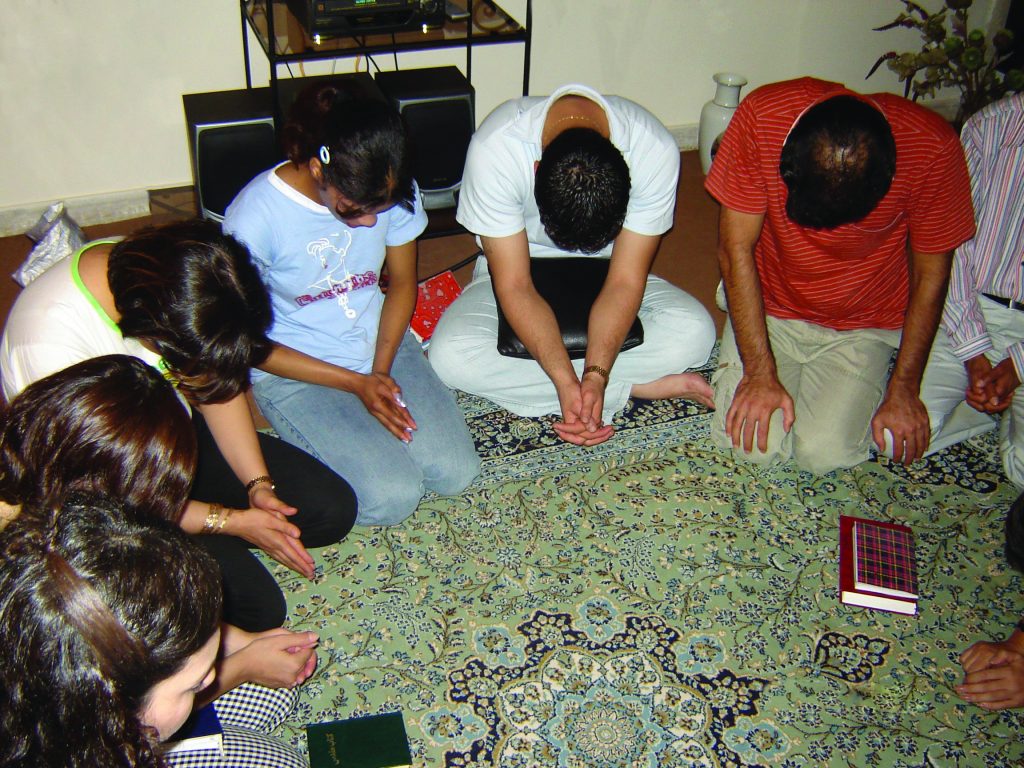
WHAT GOD IS DOING IN IRAN PART 2

Despite heavy surveillance, imprisonment, and harassment, the Iranian church continues to grow through decentralized, relational, and spiritually resilient models of discipleship. Here’s how they do it:

1. House–Based Networks, Not Hierarchies

  • The church operates as a web of small, autonomous groups, often in homes or workplaces.
  • Each group typically consists of 3–10 believers, with no central structure that can be easily infiltrated or shut down.
  • Leadership is shared, emphasizing mentoring and multiplication rather than formal titles or institutions.
  • This mirrors the early church model in Acts, where communities met quietly but multiplied rapidly.

2. Discipleship through Relationship

  • Discipleship happens through one-on-one mentorship, family-like trust, and personal accountability.
  • Older believers help newer converts learn Scripture, prayer, and how to share their faith — often memorizing key passages since printed or digital Bibles can be confiscated.
  • Deep brotherhood and vulnerability take the place of formal church programs.

As one underground leader put it, “We are not building churches; we are making disciples who make disciples.”

3. Use of Secure Technology

  • Encrypted apps (like Signal or Telegram) are used for Bible studies, prayer meetings, and training sessions.
  • Satellite TV and radio broadcasts (especially from ministries like SAT-7 Pars, Heart4Iran, and Mohabat TV https://mohabat.tv/) serve as lifelines for teaching and worship.
  • Believers also use VPNs to access online discipleship courses provided by Iranian ministries abroad.
  • Small USB drives or SD cards often circulate preloaded with worship songs, teaching videos, and the Farsi Bible.

4. Training for Persecution

  • Discipleship includes preparing new believers to suffer, not escape hardship.
  • Converts learn how to respond to interrogation, care for imprisoned members’ families, and forgive oppressors.
  • There’s a conscious focus on character over comfort — seeing persecution as participation in Christ’s sufferings (Philippians 3:10).

5. Women as Key Discipleship Leaders

  • Studies (including from organizations like Open Doors and GCM Ministries) show many small groups are led by women — a striking contrast to the surrounding culture.
  • Women often pioneer new communities, especially among families and neighbors, discipling others quietly but effectively.

6. Global and Diaspora Support

  • Iranian Christians outside Iran (in Türkiye, Europe, or the U.S.) maintain secure training pipelines — online Bible schools, mentoring networks, print distribution, and humanitarian aid.
  • These diaspora partners supply spiritual and emotional support, while Iranians inside the country lead the movement themselves.

7. The Spiritual Core

At bottom, what sustains them isn’t technology or organization — it’s their deep personal faith and daily reliance on the Holy Spirit.

  • They focus on hearing God, obeying immediately, and passing on what they’ve learned.
  • This “discipleship through obedience” approach allows even young believers to become disciplers within months.

In short:
The underground church in Iran thrives not by avoiding risk but by spreading resilience — through shared life, simple obedience, and multiplying disciples faster than authorities can identify them.

https://mohabat.tv/

Next what a typical journey looks like for a Iranian Christian convert.

WHAT GOD IS DOING IN IRAN PART 1

This post follows my earlier post “What is God Doing in Iran?“. If you have not read it, I suggest you do so before reading this one. There is no doubt that God is converting Iranians supernaturally through dreams and visions and the movement is now widespread. I mentioned the following Scripture in the previous post as this  prophecy about Elam (Iran) in Jeremiah 49:34–39 is fairly unique. It foretells both judgment (the sword, dispersion, destruction of leadership) and restoration “in the latter days.” This is one of the few places where Elam specifically receives that kind of dual prophecy.

I will terrify Elam (Iran) before their enemies and before those who seek their life. I will bring disaster upon them, my fierce anger, declares the Lord. I will send the sword after them, until I have consumed them, and I will set my throne in Elam and destroy their king and officials, declares the Lord. “But in the latter days I will restore the fortunes of Elam, declares the Lord.” Jeremiah 49:37-39

 Jesus is appearing to many Iranians in visions and dreams resulting in many converts to Christianity. Reports have indeed circulated widely, especially from missionaries, Iranian Christian networks, and ministries that serve believers from Muslim backgrounds.

What’s known with reasonable confidence is this:

  • Christianity has grown rapidly in Iran over the past two decades — one of the fastest growth rates in the world, despite official restrictions and persecution.
  • Many Iranian converts—both inside Iran and in the diaspora—personally testify that their first awareness of Jesus came through a dream or vision.
  • These stories are hard to verify scientifically, but they are consistent across numerous independent testimonies, including from former Muslims who later joined underground churches.

From a theological standpoint:

  • Scripture records God sometimes revealing Himself through dreams and visions (e.g., to Daniel, Cornelius, and Paul).
  • Many Christians understand these modern experiences as ways God personally draws people in regions where the Gospel is suppressed and other means of hearing about Christ are restricted.
  • Others are more cautious, viewing such accounts as sincere experiences best tested against Scripture and the message of the Gospel itself.

In simple terms:
Yes — numerous reliable witnesses describe such encounters among Iranians, and the resulting conversions are widely documented. Whether one sees that as “Jesus personally appearing” or as God using visions to awaken faith, the movement toward Christianity in Iran is real, large, and ongoing.

 Growth & Scale of the Underground Church

  • Estimates vary, but most credible sources place the number of Christian converts from Islam in Iran between 300,000 and 3 million. This movement is regarded as one of the fastest-growing in the Middle East. (buzzbeatmedia.com)
  • The U.S. State Department, academic studies, and the World Watch List provide more conservative figures:
  • Between 250,000 and 300,000 ethnic Christians remain in Iran, largely from recognized Armenian and Assyrian communities. (buzzbeatmedia.com)
  • Open Doors estimated about 800,000 Christians in total for 2026. (opendoors.org.au)
  • Iran Alive Ministries, an evangelical network, puts the number of Muslim-background believers around 2 million and suggests the real figure may be even higher. (mbcpathway.com)

2. Nature & Dynamics of the Movement

  • House churches are the core expression of the movement—small, unregistered gatherings that meet in private homes. These meet without legal protection and face relentless surveillance and risk. (buzzbeatmedia.com)
  • Digital evangelism plays a pivotal role. Converts often come to faith through satellite TV programsencrypted messaging apps, and online Bible studies—tools that offer relative safety and privacy. (terreneglobe.com)

3. Dreams & Visions: A Common Testimony

  • Numerous testimonies report Iranians encountering Jesus through dreams or visions—often described as deeply personal and transformative experiences. (aquinas.ac)
  • A survey referenced on social media notes that 25–27% of Muslim-to-Christian converts in the Middle East cite dreams or visions, with the figure rising to 40% in Iran. (x.com)

4. Persecution & Government Response

  • The Iranian regime views the movement as a serious threat, frequently prosecuting converts and targeting underground leaders. Arrests of Christians have increased dramatically—up sixfold between 2024 and 2025 in Tehran alone. (religionnews.com)
  • Despite the dangers, the underground church remains resilient, continuing to expand through digital discipleship tools, mentorship, and discreet gatherings. (transformiran.com)

Summary Table

TopicInsight
Scale of MovementEstimates range between 500,000 to 3 million believers, including converts
Form of ChurchPredominantly underground house churches and online platforms
Dreams & VisionsUp to 40% of Iranian converts cite visions of Jesus as catalyst
Government PersecutionLegal repression and arrests are increasing, yet the church persists

In short: While precise numbers are hard to verify, the evidence points to a significant movement of Persians discovering faith despite persecution. The prevalence of dreams and visions in these conversions echoes patterns seen throughout Scripture—miraculous, personal encounters that awaken faith where traditional evangelism struggles to penetrate. Hallelujah!

IRAN’S IS EXPERIENCING A SPIRITUAL REVOLUTION

On Monday, June 23, Israeli missiles tore through the gates of Evin Prison, sending concrete and steel flying into the afternoon sky. For 45 years, those gates had swallowed Iran’s finest minds, bravest souls and most faithful hearts.

Since 1979, Evin Prison has served as the beating heart of Iran’s persecution machine. In its cells, tens of thousands of Christians have faced extreme torture, solitary confinement and death for the crime of following Jesus. The names of eight pastors who were martyred within its walls are whispered in house churches across the nation like prayers of remembrance. The regime designed Evin to permanently break spirits and minds, to make examples of those who dared believe in something beyond the ayatollahs’ iron grip.

Every cell in Evin is meant to send a message: this is what happens to those who choose light over darkness, who call for freedom over tyranny. Yet the ayatollahs’ greatest miscalculation was believing they could kill what they couldn’t understand. The harder they squeezed, the more their revolution slipped through their fingers.

The numbers tell an impossible story. Over the past couple of decades, despite facing perhaps the world’s most systematic Christian persecution, Iran has become home to the fastest-growing church on earth. Conservative estimates suggest more than one million Iranians have converted to Christianity, transforming from a few hundred believers before 1979 to a movement that now dwarfs the regime’s own support. While the government demands adherence to Islam through violence and law, 50,000 of Iran’s 75,000 mosques have closed their doors due to empty “pews.” The people have voted with their feet, and they have chosen Jesus.

Violence in the name of Islam has caused widespread disillusionment with the regime. When your government promises paradise but delivers poverty, corruption and oppression, people begin searching for something real. Many have found it in the underground house churches, where believers risk everything gathering in small apartments, singing softly so neighbours cannot hear, studying Bibles that could cost them their freedom and even their lives. The same happened in China when Mao persecuted Christians., the house church movement grew with miracles abounding.

The regime’s persecution of Christians has transformed Christianity into something they never anticipated: the ultimate form of resistance. When everything else fails, when politics offers no hope and economics promise only poverty, faith becomes both hope and rebellion. Iranian women share the Gospel with strangers in bazaars. Taxi drivers turn their cars into mobile prayer meetings. Students risk expulsion to attend house churches. They do this knowing the consequences, knowing that Evin Prison waits for those most effective in spreading the faith.

No wonder God brings persecution so He can truly grow His church. These Christians are totally dependent upon and trust God regardless of their circumstances. Can this be said of the church in the west?

CHRISTIANITY IS SURGING IN IRAN

As the conflict between Israel and Iran’s terrorist proxy group Hezbollah in Lebanon widens, reports continue to surface of a growing division between the Iranian people and the Islamist regime of Ali Khamenei. Even as anti-Israel and anti-America protests get most of the attention in Iran, a burgeoning Christian movement is occurring under the surface, an expert on Iranian Christians says.

In Iran, Christianity is intensely persecuted, except small historical Armenian and Assyrian communities. Conversion from Islam to Christianity is considered apostasy and can be punished with death. Still, some reports suggest that conversions to Christianity and support for democracy are on the rise, with as many as 80% of Iranian citizens anonymously supporting a democratic government. In addition, some outlets have reported that hundreds of mosques have closed due to the rising number of Iranians leaving Islam.

Hormoz Shariat is the president of Iran Alive Ministries. It broadcasts the gospel message via satellite TV programs in the Farsi language in predominantly Muslim countries like Iran, Tajikistan, Afghanistan, Turkmenistan, and Uzbekistan. On Monday, he joined “Washington Watch with Tony Perkins” to discuss how an increasing number of Iranians do not support the Islamist regime’s attacks on Israel and are converting to Christianity.

“[Iranians] have experienced Islam and Islamic rule firsthand for over 40 years,” he noted. “And they’ve come to the conclusion, if the problem is not just the government, the problem is Islam itself. That’s why we see a high number of Iranian Muslims come to Christ because they have not just rejected the government, they have rejected Islam. There is such a gap … between the government and the people. So when the government puts on these rallies saying, ‘Death to Israel, death to America,’ the people of Iran say, ‘We love Israel, we love America.’ And that’s the trend.”

Shariat also pointed out that there were also many Iranian Americans who came out in support of Israel after the October 7 Hamas attack.

“We know that the media covered … the pro-Palestine, pro-Hamas demonstrations in America,” he noted. “You saw it everywhere. You saw it on campuses. You saw it on the street. You saw it in Washington, D.C. But you did not see all the Iranians who came on the streets even in America, Los Angeles, Washington, D.C., and San Diego, everywhere. Iranians came out pro-Israel. Not even one Iranian rally was pro-Palestine, and the media did not cover that. Iranians are pro-Israel.”

Shariat further described how his ministry has spread. “[W]e … have a 24/7 satellite broadcast going over the heads of the mullahs — they cannot stop the signal from the sky. We go into people’s homes, millions of homes. [A]n independent survey [found] that we have seven million viewers daily. So we go into people’s homes, tell them about God’s love, and guess what? They are ready. Iranians are rejecting Islam. They’re ready for the message of the gospel.”

According to Shariat, a spiritual awakening is currently occurring in Iran. “It’s a move of God, and God uses suffering, and Iranians have suffered for 40-some years. … So there is an openness among Iranians. … God has used [suffering] to open their minds, open their eyes towards Islam. They … have rejected Islam [but] not [out] of emotion and [not from making an] overnight decision.”

Shariat asked for continued prayers for his ministry and Christians in Iran.

HOW DOES GOD REACH MUSLIMS IN MUSLIM COUNTRIES?

The founder of a ministry devoted to serving the Iranian underground church says that many people in the restrictive nation have encountered Jesus through dreams and visions — something that might seem foreign to those living in Western cultures.

The Rev. Lazarus Yeghnazar, founder of Transform Iran, an organization preaching the Gospel in Iran and planting churches, told CBN’s Faithwire how many Iranians find themselves enraptured by Christ following these apparitions. “They know it was real and they cannot stop talking about it, hence the severe persecution, the severity of the brutality,” Yeghnazar said of the persecution many Iranian Christians face. “[Believers will say], ‘I saw a vision of a man in a white robe, with a cross on his shoulder or on his heart, and he says, ‘I am Jesus.'”

While many Christians in the West might meet Jesus as the result of others sharing the Gospel, these dreams and visions are the touchpoints in Iran that spark life-change and heart transformation. Yeghnazar pointed back to Scripture to show how God has used visions to communicate with humanity in the past and explained why Iranians might be having this spiritual experience today. “In the Middle East, people see visions,” he said. “In the Western understanding, we want everything to be tangible, verifiable, accountable.” But he said the dynamic is quite different in the Middle East, where these experiences deeply resonate with those who have them. “In Iran, people see a vision — they will wake up sweating and shaking,” Yeghnazar said. He cited specific biblical examples of when God spoke to prominent figures through dreams, delivering life-altering and important messages. “You know, paving that way from Abraham to Moses, to Daniel, to Joseph, to Mary, the mother of Christ … all of them see dreams,” Yeghnazar said. “Peter, at the beginning of his ministry, started seeing dreams.” The preacher said people might be surprised to see the juxtaposition when it comes to the prevalence of God speaking through dreams for Westerners versus those in the Middle East. “Any gathering of Iranians or Afghan Christians, if you say, ‘How many have seen dreams that have been touched, if not radically, transformed because of a vision,’ 90% will raise their hands,” he said. “If you ask a church in Wisconsin, or in Maryland, or Boston, ‘How many people have come to Christ through a dream?’ they would say, ‘What is a dream?'” Sadly, we also know that many of these people are not born again and do not have the Holy Spirit indwelling their spirit. When the prophesied “last days” tribulation comes upon us many will fall away. However, many will cry out to God and He will turn up in dreams and visions as He is in Iran. Watch for the full discussion.

PREFER AWAKENING TO JESUS OVER FREEDOM

“I would rather see millions of [Iranians] come to Jesus than have freedom and democracy. If freedom was such a great thing for the Kingdom, then why is America and Europe in the state it is now?” —Leader in the Iranian underground church

This is why the West will see more persecution before Jesus returns. God wants more people to start living there life in the light of eternity not for a better life here.

Listen to this video and learn from Iranian Christians on how to live life.

IRANIANS FINDING SALVATION IN JESUS CHRIST

Iran is facing a wave of internal turmoil and covert attacks that are undermining the radical regime’s nefarious plans. Even as the violence escalates, hope is rising among Iranian citizens who are finding salvation in Jesus Christ.

Whether it’s the exploding coronavirus, mysterious fires at nuclear and military facilities or protests, Iran’s ruling Islamic clerics are facing unprecedented challenges as the regime tries to maintain an iron grip on the nation.

All this comes against the backdrop of ongoing government protests and a remarkable revival that’s witnessing thousands of Muslims turning to Christianity in the midst of COVID-19.

That’s why we are calling this a pandemic of hope,” said Mike Ansari, who runs Mohabat TV, one of the most popular Christian satellite channels in Iran.

Ansari told CBN News that Mohabat TV is recording 10 times more online salvation’s than this time last year.

We are registering around 3,000 personal decisions by Iranian Muslims to leave Islam for Christianity during this revival,” Ansari said.

That’s 3,000 people each month who’ve decided to follow Jesus Christ since the pandemic began in March.

“People in Iran are just not happy the way their economy is going, the way the government is robbing them of their national resources and exporting Shia Islam to the neighboring countries, so they just don’t trust their government,” said Ansari.

The large number of people leaving Islam is causing a backlash against the church. Dozens of Christians have been arrested and imprisoned for responding to the gospel message since March.

“During these critical times for the regime, there’s a tendency, historically, for the regime to really crack down on religious communities like Christian converts, and we see that today,” Nader told CBN News.

Iran is one of the world’s most dangerous places for Christians. Yet, Christianity is growing faster in Iran than in any other country in the world.

“And this gospel of the kingdom will be proclaimed throughout the whole world as a testimony to all nations, and then the end will come.” Matthew 24:14

GROWTH OF CHRISTIANITY IN IRAN

Report from CBN News on Christians in Iran. Watch this short video and be encouraged. You will see Dylan Thomas of FAI talking about what God is doing in Iran. If you haven’t viewed the first “Sheep in Wolves Clothing” video that I recently posted then can I suggest you do so, if you want to learn more.