PhD SCIENTIST ON CHEMICAL EVOLUTION

Don Batten interviews professional scientist Dr Royal Truman as reported in Creation Magazine, Volume 46. Issue 3, 2024

Royal Truman has bachelor’s degrees in chemistry and computer science from State University New York, Buffalo, an MBA from the University of Michigan, a PhD in organic chemistry from Michigan State University, plus post-doctoral studies in bioinformatics from the universities of Heidelberg and Mannheim, Germany. He has many professional certifications in such fields as cyber security, supply chain logistics, cloud technology, and project management. He has worked for 40 years for the largest chemical company in the world.

Royal is married to Petra, who worked as a lawyer, and later as a full-time homemaker. They have two grown sons; one has a law degree and the other is working on a PhD in computer science. Raised by missionary parents in Chile, training in North America, and then working in Germany, Dr Truman speaks five languages. He also plays multiple musical instruments and is very artistic (oil and acrylic painting, drawings, ink, and watercolour). He says his home looks like a museum. He trained in several forms of martial arts, attaining a brown belt in a North Korean style of Taekwondo. There is a lake in front of their house in Germany where Royal swims year-round (ice swimming!). He is one interesting guy!

Dr Truman shared, throughout my career, I worked with very clever and conscientious scientists who accepted evolution as a given, although this was not related to their own scientific training. But nothing I learned about evolution made any sense based on my own areas of expertise. But how could such clever people all be wrong? What was I overlooking? To find out, Royal devoted more than 35 years to learning all he could about molecular biology and systems biology. This is the chemistry of the machinery of life (proteins, nucleic acids, etc.). This included taking formal courses in bioinformatics. Such training assisted in analyzing the vast amounts of complex data involved—for example, the human DNA has over 3 billion ‘letters’. Even a relatively simple protein requires hundreds of DNA letters that specify how to make it.

First, Dr Truman had to understand the biological reality that needs explaining. What is it about the simplest living things that needs to be explained? For example, all self-reproducing (‘living’) cells have a set of very complex chemical units called tRNAs (‘transfer RNAs’). There must be at least one unique tRNA for each of the ~20 amino acids that make up proteins.

These tRNAs are essential for the manufacture of all proteins since the cell’s machinery uses them to interpret from the DNA code which amino acid is to be used at each position of a protein. But these are just a small component of the genetic equipment needed! Dr Truman researched the biochemical source of tRNAs and noted that their manufacture was coded for on DNA and they must be extracted by special proteins. But these proteins could only exist if functional tRNAs were already available to help decode instructions for their manufacture. He concluded that tRNAs and proteins could never arise by any natural (evolutionary) process.

Irreducible complexity describes biological systems with multiple interacting parts that would not function if any one of the parts was removed. Dr Truman discovered many examples of ‘irreducible complexity’. These include dozens of ‘molecular machines’, such as polymerases, helicases, isomerases, ribosomes, and ATP synthase. Each of these is a stupendously complex and efficient ‘nano-machine’, f lawlessly repeating indispensable services over and over. But not only is each one irreducibly complex, all these, and much more, must be present together for cells to function, to reproduce. Dr Truman comments, “How are all these multiple irreducibly complex components to come together without a Planner?”

Royal discovered that cells share properties with computers—he published two papers on this. Display footnote number:2 He is uniquely qualified to understand this, having been responsible for several years to identify all new computing technologies (hardware and software) which could someday be applicable to the chemical industry. This underlined again how cells are designed; they could not have come about by a natural (evolutionary) process.

Dr Truman shares how “I quickly discovered that evolutionary explanations were only vague imaginings; there was nothing solid enough to research, and the speculative narratives were easy to disprove.”

The origin of life?

Being a chemist, it was almost inevitable that Royal should examine origin of life (OoL) publications. He read hundreds of chemical publications that tried to explain the OoL and concluded that “all were nothing but wishful thinking.”

For example, thousands of complex proteins are needed for cells to work. However, not one of even the simplest proteins could be created naturally. Some of the problems he noted are: 1. Racemization, 2. Side-chain reactions, 3. Reactions with other chemicals, 4. Wrong proportions of biologically relevant amino acids, 5. Obtaining long chains in water,

If simply obtaining a long, linear random amino acid polymer (i.e., a ‘protein’) isn’t possible, how in the world were thousands of different proteins, each having the correct sequence of amino acids, supposed to have arisen? Natural selection can’t operate until you already have something that makes copies of itself.

According to Dr Truman: Origin of Life research is spinning its wheels. Experiments are designed with a specific goal in mind and the laboratory setup is never plausible; it never mimics something feasible in nature. When chemists such as I evaluate the results, we find them to be inconsistent with the claim that life made itself by natural processes.

Royal noted that there is no feasible path from simple chemicals obtained naturally to a biological cell controlled by DNA-encoded information.

Instead, there is an assumption that ‘life’ can be defined as any process involving some form of chemical replication and then with enough time a cell must inevitably arise. This has nothing to do with science; is it pure speculation with no mechanistic basis.

I have concluded that no chemist ever became an evolutionist because this is what the data showed them. Instead, clever people decided to believe in evolution, and then went about cherry-picking the data to support this notion and ignoring what is inconvenient.

NATURAL LAWS EXIST BECAUSE THE UNIVERSE HAS A CREATOR

Democracy without the Ten Commandments, without God’s morality, is destined to fail. Whilst Americans were Bible-based, democracy was great but without it, America is becoming lawless. The professors at prestige universities that were started by Bible-believing Christians are now morally bankrupt including those teaching Theology. The Bible is no longer considered to be God’s Word and therefore inerrant. Evolution and the Big Bang are considered adequate to explain the origins of the Cosmos and yet the evidence of complex design, irreducible complexity, and the universe obeys certain rules—laws to which all things must adhere, prove they are totally inadequate. These laws are precise, and many of them are mathematical in nature. The law of biogenesis states that life always comes from life. Both observational science and Genesis 1 tell us that organisms reproduce after their own kind.

Natural laws are hierarchical in nature; secondary laws of nature are based on primary laws of nature, which have to be just right in order for our universe to be possible. But, where did these laws come from, and why do they exist? If the universe were merely the accidental by-product of a big bang, then why should it obey orderly principles—or any principles at all for that matter? Such laws are consistent with Biblical creation. Natural laws exist because the universe has a Creator God who is logical and who has imposed order on His universe.

Despite billions of dead things buried in rocks all over the world and the abundance of fossil fuels the worldwide flood of Noah’s day is considered a myth. Also, stories about a worldwide flood are found in historical records all over the world? According to Dr. Duane Gish in his popular book Dinosaurs by Design, there are more than 270 such stories, most of which share a common theme and similar characters. So many flood stories with such similarities surely prove they come from the Flood of Noah’s day.

It is important to remember why God destroyed all of mankind with a worldwide flood.

Now the earth was corrupt in God’s sight, and the earth was filled with violence. And God saw the earth, and behold, it was corrupt, for all flesh had corrupted their way on the earth. And God said to Noah, “I have determined to make an end of all flesh, for the earth is filled with violence through them. Behold, I will destroy them with the earth” Genesis 6:11-13

It is also important to remember that the Bible tells us that in the last days before Jesus returns, scoffers will deliberately overlook the fact that God destroyed mankind except for eight people by the flood of Noah’s day. Moreover, He tells us how the story ends.

Knowing this, first of all, that scoffers will come in the last days with scoffing, following their own sinful desires. They will say, “Where is the promise of his coming? For ever since the fathers fell asleep, all things are continuing as they were from the beginning of creation.” For they deliberately overlook this fact… the world that then existed was deluged with water and perished. But by the same word, the heavens and earth that now exist are stored up for fire, being kept until the day of judgment and destruction of the ungodly.2 Peter 3:3-5

DNA DESTROYS EVOLUTION

DNA must have been created. It is impossible it evolved. It is the instruction code for all living things.

Science continues to reveal more complexity at the smallest levels of life. As a result, the evolutionary account of life’s origins is rapidly trending toward mythology. May God receive the glory for His incredible creation!

Moreover, Jesus Christ changed history from BC to AD. No other person in history has impacted the world as this God/man did. Jesus confirmed the Torah as God’s Word revealed to man by His prophets.

Jesus said to him, if they do not hear Moses and the Prophets, neither will they be convinced if someone should rise from the dead.’” Luke 16:31

The Bible gives us an accurate history of this world. Creation by God in six days was a real event. The Fall of man was a real event that brought death into this world. The worldwide flood of Noah’s day that killed all mankind except eight people (God’s judgement on a world in rebellion against Him) was a real event. It buried millions of dead things all over the world, fossils and produced all the fossil fuels not billions of years. The world is just 6000 years old. God created the nations when He confused the languages at the Tower of Babel. Jesus entered history to provide a way back into a right relationship with our Heavenly Father. He paid the price for our rebellion, He died that we might live. The Bible also tells us that Jesus is returning soon to rule and reign for the last 1000 years before God destroys this Earth and creates a new Earth where only the righteous dwell.

I am the way, and the truth, and the life. No one comes to the Father except through me. John 14:6

What a loving God (but also Holy God) that we have that He would send His ony Son to redeem us. And how good is Jesus, God’s Son that He would come to die in our place. God requires us to repent of our rebellion against Him and His commandments and accept Jesus as our Lord and Saviour to come back into His family. It’s an offer of eternal life. It is beyond me why people do not want to get back into a right relationship with their Creator and experience this new eternal life in Christ. What about you?

Related articles: The four-dimensional human genome defies naturalistic explanations (https://creation.com/four-dimensional…) Splicing and dicing the human genome (https://creation.com/splicing-and-dic…) Life’s irreducible structure—Part 1: autopoiesis (https://creation.com/lifes-irreducibl…) Related resources: The High-Tech Cell (https://creation.com/s/35-6-624)

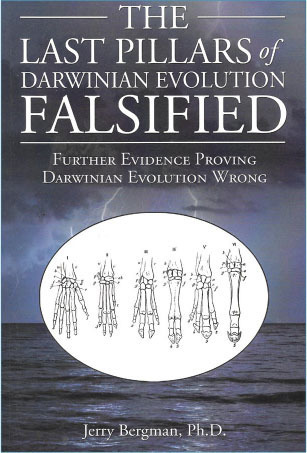
DARWINIAN EVOLUTION FALSIFIED

Jerry Bergman is a famous creationist author who has extensively published over many decades and who has taught at several universities. He describes the research that went into this book:

“This project has been for me a lifelong study for which this book is a summary. It is the culmination of four decades of research on the issue of evolution, 41 years of teaching life science at the college level, and over 1,700 publications in 2,400 college libraries in 65 nations and 13 languages” (p. xvii).

In terms of specifics, this work focuses on taxonomy, so-called convergent evolution, irreducible complexity, pseudogenes, and antibiotic resistance. Bergman goes into considerable detail on all of these.

Bacterial resistance to antibiotics: not evolutionary novelties

Evolutionists often cite antibiotic resistance in bacteria as evidence for evolution. It is not. It is a product of the ‘tweaking’ of pre-existing features in the bacteria, which raises the question of how these features arose in the first place

Bergman has examined and deconstructed a variety of ‘pillars’ of evolution. Each one of them contains major flaws. Neither taxonomy nor genetics, for example, compel belief in evolution.

Irreducible Complexity

Evolutionists have caricatured, but not overcome, the fatal problem of irreducible complexity. The best explanation for living things, whether somebody likes it or not, remains an intelligent designer.

Evolutionists have argued that biological systems only appear to be irreducibly complex because these systems once possessed numerous redundancies that enabled the components to function independently from each other. These redundancies have since been removed by evolutionary processes, leaving the remaining components in a state of lockstep dependence upon each other—hence the apparent irreducible complexity.

To begin with, the explanation is ad hoc. There is no evidence for any such one-time grand redundancies, and, if they are going to pooh-pooh the Intelligent Design explanation, the burden of proof is on the evolutionists to show that they once existed. Note also that spot redundancies should not be confused with the hypothesized grand redundancies that presumably governed the whole. In the Krebs cycle, for example, a few of the compounds can be synthesized by alternative pathways. The fact that parts of the Krebs cycle are redundant is very different from saying that the Krebs cycle as a whole is, or once was, redundant. The fact that there are ‘shortcuts’ within the Krebs cycle is very different from suggesting that the entire Krebs cycle can be bypassed by a shortcut. Bergman quips: “Reducing the cycle by one step does not negate the fact that it still requires the remaining parts of the cycle. It would not be irreducibly complex only if a single quark were responsible for the biochemical results that the Krebs cycle achieves” (p. 123).

An analogy with the automobile may help. The car thief can do a ‘shortcut’ around the key-starting system by short-circuiting the wires that lead to the starter motor and driving away the car. This means that, from a mechanical point of view, the keystarting system is redundant. However, this individual redundancy certainly does not mean that the automobile as a whole is a redundant system, much less that the automobile could spontaneously arise, step-by-step, without intelligent design.

DARWINIAN EVOLUTION FALSIFIED

The Last Pillars of Darwinian Evolution Falsified: Further evidence proving Darwinian evolution wrong
by Jerry Bergman

Dr. Jerry Bergman is a famous creationist author who has extensively published over many decades and who has taught at several universities. He describes the research that went into this book:

“This project has been for me a lifelong study for which this book is a summary. It is the culmination of four decades of research on the issue of evolution, 41 years of teaching life science at the college level, and over 1,700 publications in 2,400 college libraries in 65 nations and 13 languages” (p. xvii).

In terms of specifics, this work focuses on taxonomy, so-called convergent evolution, irreducible complexity, pseudogenes, and antibiotic resistance. Bergman goes into considerable detail on all of these.

Irreducible complexity is the fatal problem for evolution

Bergman touches on some of the challenges facing commonly believed evolutionary explanations for the origins of complex structures, resulting from the co-option of components originally having different functions. He comments:

“… the availability of these parts would have to be synchronized … the parts must be correctly and properly positioned in 3-D space so they can be properly assembled … . Even if all of the parts are available at the proper time, the vast majority of assembly variations will be nonfunctional or dysfunctional” (pp. 145–146).

Some evolutionists have vulgarized the Intelligent Design explanation as a ‘jackpot or nothing’ one. But that is exactly what it is, and evolutionists have failed to show how the emergence of a complex biological structure can be anything other than ‘jackpot or nothing’.

Bergman has examined and deconstructed a variety of ‘pillars’ of evolution. Each one of them contains major flaws. Neither taxonomy nor genetics, for example, compel belief in evolution. Evolutionists have caricatured, but not overcome, the fatal problem of irreducible complexity. The best explanation for living things, whether somebody likes it or not, remains an intelligent designer.

A condensed version of a review of Dr. Bergmans book in the latest edition of The Creation Journal Volume 37, Issue 1, 2023

IS DESIGN DENIAL OF LIVING THINGS DEFENSIBLE?

Living things certainly look designed. Some people are surprised to learn that even well-known, militant atheists and evolutionists will admit this fact, as the following three cases illustrate. Let’s hear first from British biologist Richard Dawkins: An increasing number of people in our secular society … are persuaded that design denial is an entirely sensible position. “Living things are not designed, but Darwinian natural selection licenses a version of the design stance for them. We get a shortcut to understanding the heart if we assume that it is ‘designed’ to pump blood.”2

Director of The Skeptics Society (US) Michael Shermer agrees: “The design inference comes naturally. The reason people think that a Designer created the world is because it looks designed.”3

So does American evolutionary biologist and Intelligent Design critic Jerry Coyne: “If anything is true about nature, it is that plants and animals seem intricately and almost perfectly designed for living their lives.”4

In the above instances, Dawkins, Shermer, and Coyne had living organisms in mind. But on a cosmic scale, too, top scientists affirm design. Charles Townes (1915–2015), who shared the Nobel Prize for Physics in 1964, unashamedly affirmed the universe was God-made: “Intelligent design, as one sees it from the scientific point of view, seems to be quite real. This is a very special universe: it’s remarkable that it came out just this way. If the laws of physics weren’t just the way they are, we couldn’t be here at all. The sun couldn’t be there, the laws of gravity and nuclear laws and magnetic theory, quantum mechanics, and so on have to be just the way they are for us to be here.”5

So, to repeat, wherever we care to look we observe design. This being so, why is it that many people today seem unable (or unwilling) to accept the evidence of their eyes?

Living things certainly look designed—like the intricacies of a peacock’s tail.

Design denial

Recall that Richard Dawkins actually admits that “a shortcut to understanding” living things is gained by assuming that they are designed—even though he emphatically rejects that any designing intelligence was involved; and certainly not the God of the Bible. He is very insistent upon this point, but also inconsistent! And those who disagree with him—who believe instead that the Creator God is behind all the design we see—he calls deluded. Of course, not all atheists and skeptics go as far as Dawkins in their rhetoric. Nevertheless, an increasing number of people in our secular society are buying into the lie that design denial is synonymous with (even necessary for) scientific integrity. They are persuaded that design denial is an entirely sensible position.

In their case the god of this world (Satan) has blinded the minds of the unbelievers, to keep them from seeing the light of the gospel of the glory of Christ, who is the image of God.2 Corinthians 4:4

For they loved the glory that comes from man more than the glory that comes from God.John 12:43

‘Talk about design if you really must, but whatever you do, don’t bring God into the discussion.’ That, they claim, is bad science! I am reminded of the line from Shakespeare’s Hamlet, “The lady doth protest too much, methinks.” You can substitute “lady” with any spokesperson for the secular scientific establishment who claims that it is unscientific to follow the trail from designed things to the Designer—a claim that is contrary to the Bible (e.g. Romans 1:20). No, we really should follow where the scientific evidence leads us. We have nothing to fear from facts, only fact-denying dogma. Beware of those who say otherwise, whatever their credentials.

For his invisible attributes, namely, his eternal power and divine nature, have been clearly perceived, ever since the creation of the world, in the things that have been made. So they are without excuse.Romans 1:20

The Maker’s marks

The hallmarks of design are everywhere we care to look. In making the point that Jesus was far greater than Moses, one Bible writer wisely affirmed, “For every house is built by someone, but the builder of all things is God” (Hebrews 3:4). This is not the place to delve further into that passage, but don’t miss the message: if the architect and construction workers are the ones who deserve the credit for an impressive house, the One who is “builder of all things” even more so. When something “looks designed” (Shermer), even “perfectly designed” (Coyne), we do indeed get “a shortcut to understanding” (Dawkins) if we acknowledge it to be so. Trying to avoid this leads to a sort of cognitive dissonance

When something “looks designed” (Shermer), even “perfectly designed” (Coyne), we do indeed get “a short cut to understanding” (Dawkins) if we acknowledge it to be so. Trying to avoid this leads to a sort of cognitive dissonance, a conflict between two contradictory ideas—as in, ‘it looks designed, let’s pretend it’s designed as it’ll help us understand it, but let’s be sure to keep telling ourselves it is not designed.’

In his most recent book, Return of the God Hypothesis (2021),7 Stephen Meyer reminds his readers that: “… many of the founders of modern science did not just assume that the universe had been designed by an intelligent agent. They also argued for this hypothesis based on discoveries in their fields of study. Johannes Kepler … Robert Boyle … Carl Linnaeus. Many other individual scientists made specific design arguments based upon empirical discoveries in their fields.”8

These great scientists of the past, rather than denying the design that stared them in the face (and suffering cognitive dissonance), delighted in it! This was a vital factor in their fruitfulness as outstanding scientists.

‘Delighting in design’ is certainly true of the editorial team of CMI’s Creation magazine, as well as the many authors and graphic artists who contribute to each new issue. Consider subscribing if you don’t already receive it—read, learn, and share it with others.

Let us avoid the foolish mistake of ascribing greatness to the things that are made. Christians should also help friends, colleagues, and family members to avoid this pitfall. Instead, we must be sure to worship the Maker whose marks we have observed in His manufactured creatures—evidence for God’s Grand Design is all around us. Merely to delight in the created designs themselves, while robbing our Creator of the glory that is rightfully His, is sheer idolatry (see Romans 1:25).

Therefore God gave them up in the lusts of their hearts to impurity, to the dishonoring of their bodies among themselves, because they exchanged the truth about God for a lie and worshiped and served the creature rather than the Creator, who is blessed forever! Amen.Romans 1:24-25

References and notes

  1. This first appeared in CreationExtra, CMI-UK/Europe, March 2022.
  2. Dawkins, R., The God Delusion, Bantam Press, London, p. 182, 2006 (emphasis added). 
  3. Shermer, M., Why Darwin Matters, Henry Holt and Company, New York, p. 65, 2006 (emphasis original).
  4. Coyne, J., Why Evolution is True, Viking, New York, p. 1, 2009. 
  5. Quoted in: Meyer, S.C., Return of the God Hypothesis: Three scientific discoveries that reveal the mind behind the universe, HarperOne, New York, p. 146, 2021.
  6. Bell, P. (ed) and 10 others, Does Evolution Explain Everything About Life? Answers from Ph.D. scientists, Creation Book Publishers, Power Springs, GA, 2020.
  7. See Woodmorappe, J., The existence of specified information in the universe points to a creator God, A review of Return of the God Hypothesis: Three scientific discoveries that reveal the mind behind the universe (Stephen C. Meyer), J. Creation 36(1):26–29, April 2022.
  8. Meyer, ref. 5, p. 47.

adapted from a CMI article Delighting in Design – and in its Originator by Philip Bell1 Check out http://www.creation.com

COMPLEXITY OF THE GENOME

Although evolutionary theory says all creatures descended from a common ancestor, when one looks at animals today (or in the fossil record), they appear to be unique creations with the ability to change to fit their environments. 

A creature’s ability to live and change is programmed at the deepest levels of the genome in ways we do not fully understand. It is inconceivable that it could have evolved by random chance.

What we can now see with an electron microscope is that the human genome works as a four-dimensional ‘computer’: our three billion letter sequence of DNA is able to turn sections of itself on and off; it is coiled into 3D fractal spheres where sections folded near each other combine to create new levels of information; it changes shape over time to expose different areas of DNA needed to create tens of thousands of different proteins.

This level of complexity is not just limited to the genome, but can be seen in the interdependent relationships between living creatures throughout every ecosystem. Such highly-engineered structures and relationships can only exist if they are created simultaneously in a short space of time — which is exactly how Genesis says God created in six normal days.

DIVINE DESIGN

A clinical look at life’s complexity, design, and ultimate causation

The universe, our planet, and life itself have the appearance of being designed. Even many atheists acknowledge this. But they are quick to dismiss it as an illusion—the product of time, chance, and the laws of nature. They say the science is settled: Everything just evolved; there was no intelligent input, and no design.

However, the scientific consensus is terribly wrong, as distinguished surgeon, David Galloway, shows in this new book about intelligent design. Drawing on extensive clinical experience with the human body, Galloway examines its complex, integrated systems, demonstrating that intelligent design is the only reasonable explanation. Galloway goes on to show how the idea that life and consciousness arose spontaneously is deeply unscientific and contrary to the evidence. He also helpfully explores the question, How can ‘science’ get things so terribly wrong?

Filled with fascinating examples (both from history, and Galloway’s own long medical experience), illustrated in full colour, and with a short ‘take home message’ at the end of every chapter, Design Dissected is an engaging read. It is written from an Intelligent Design perspective (i.e. it doesn’t directly discuss God or the Bible), and comes highly recommended by some of the biggest names in the Intelligent Design movement.

OVERVIEW (excerpt from the Introduction)
The structure of the book is built around three sections. Firstly, in Enigmata, I have outlined the means by which the great questions of science have been tackled. We will see how scientific truth has sometimes even been ridiculed before finding acceptance. We’ll discover how scientific conclusions can be contaminated by presuppositions of various kinds and consider reductionism as an enterprise to uncovering causation. To put it another way, we need to address the question of whether we can support the idea that natural processes are entirely sufficient to produce what we find in the living world, or not. I also offer a warning about the dangers of scientism – that is, the assumption that science is equipped to answer every ultimate question.
The second section, Layers of Perplexity, aims to reveal why the conventional understanding of the origin of life and of biological complexity fails to carry the intellectual weight it is required to bear. I have used examples from human systems and even considered the discipline of origin of life chemistry. Each of these demonstrates that a naturalistic understanding offers a completely inadequate explanation for the intricate and nuanced systems that underpin our existence.
The final section, Thinking about Thinking, opens the mystery of the origin of consciousness and asks the questions of ultimate reality that, for many, seem to be just too difficult and are therefore consigned to the ‘consider it later’ pile!
RECOMMENDATIONS
“[Galloway] argues that explaining the origin of such systematic organization [in the human body] as a result of purely unguided natural processes stretches the limits of credulity. Instead, he makes a compelling case that this integrated and informational complexity provides powerful evidence of real, not just apparent, design. A fresh and original discussion of the evidence of intelligent design in the living system. Highly recommended.” — Dr. Stephen C. Meyer
“By far the strongest evidence that a system was deliberately designed is the very structure of the system itself. … David Galloway regales the reader with tale after tale of the wonders of the human body—and of the disasters that result when a part fails. By the end of the book, his conclusion that the body was purposely designed becomes self-evident.” — Dr. Michael J. Behe
“I strongly recommend this most impressive and thought-provoking book.” — Prof. Frank G. Dunn
 AUTHOR – David Galloway is a Scottish surgeon who trained in Glasgow, London, and New York City. He conducted original research in the causes and cellular mechanisms of some common cancers and developed a specialist practice in their surgical treatment. He was a Consultant Surgeon in Glasgow and a Former President of the Royal College of Physicians and Surgeons of Glasgow. He is also a Fellow of numerous medical and surgical Colleges and has held academic appointments in Glasgow, Kuala Lumpur, and Hong Kong.

Available from Creation Ministries International – http://www.creation.com

DEBATING INTELLIGENT DESIGN

There’s no better tribute to the power of ideas than a changed mind. Erik Strandness is a physician in Spokane, WA, practicing neonatal medicine. He watched a new exchange between biochemist Michael Behe and computational biologist Joshua Swamidass on the excellent and always thoughtful series Unbelievable? with Justin Brierley. He writes to differ with Swamidass and to describe his own change of ideas, from theistic evolution to intelligent design.

Joshua Swamidass is a biologist and Christian who is strongly critical of ID. He engages with Behe on the Kitzmiller-Dover case and the ID proponent’s most recent book ‘Darwin Devolves’ which critiques evolutionary theory.

The timing and circumstances of Erik Strandness intellectual evolution aren’t totally clear from the article. It preceded the Behe/Swamidass discussion. But his account is a valuable read nevertheless. As Dr. Strandness points out, Professor Swamidass doesn’t call himself a theistic evolutionist, but “he seems to share its favorable stance towards evolution and its opposition to intelligent design.”

God in a Box

Strandness reflects on his Lutheran upbringing. He “always had a place for God in my life, but that was exactly my problem: I had a place for God in my life….Part of the reason I compartmentalized my faith was because I was a science guy and science told me I was just an evolved chemical.” The compartmentalization, characteristic of theistic evolution, was unsatisfying to him. “While Swamidass’ goal is admirably to harmonize Christianity and science, I feel like all he has really done is say it’s OK to live with the tension.”

The theme of disappointment with a theistic evolutionary approach runs throughout his essay:

Interestingly, many theistic evolutionists don’t find God under the microscope but do in the courtroom. It appears they are more convinced of God’s existence by the moral argument than the scientific argument. 

I’m glad that they find assurance for their faith in this minimalist approach, but it leaves a huge chasm between an awe-inspiring Big Bang and the appearance of morality and consciousness in human beings. A gap which they fill with a rather bland series of naturally selected mutations. 

They give God credit for the big-ticket items, but don’t want to bother Him with the mundane task of speciation. Sadly, they reduce the book of nature to a Rorschach ink blot that offers us a vague psychological rendering of God’s subconscious rather than fine biological literature that reveals the sharpness of His mind. 

Common Ground with Intelligent Design

On the other hand, Strandness, as a physician, finds common ground with Professor Behe and his arguments for the irreducible complexity of certain biological structures. Swamidass in the discussion on Brierley’s show says he believes “God was involved in the rise of humans but I don’t actually see any biochemical evidence of God’s design there.” Dr. Strandness does see that evidence, however.

I have to respectfully disagree with him because I treat my patients based on an irreducibly complex physiological template that I didn’t create, but which I dismiss at my own peril. I’m able to successfully practice medicine because my patients are fearfully and wonderfully made, not because they were naturally selected to survive.

Interestingly, a whole field of science called biomimetics has emerged that takes the superior design of irreducibly complex biological machines and tries to replicate them at the macro level. It appears that rather than dismissing design, science is beginning to imitate it as the sincerest form of divine flattery. 

Swamidass made the case that biological machines are not machines in the traditional sense. However, I think he would get some push back from the biomimeticists who know that nature has given them a template for a better mousetrap, which, if successfully replicated, will inspire the world to beat a path to their door. 

Strandness concludes:

Richard Dawkins famously said that Charles Darwin made it possible for him to be an intellectually fulfilled atheist, but I found that [intelligent design] made it possible for me to be an intellectually fulfilled Christian.

For me, it was sad to observe that both Behe and Swamidass were comfortable with man evolving from some apelike creature, and yet both claim to be Christians. It is obvious from this belief that both do not believe in the inerrancy of God’s Word nor do they spend much time reading God’s Word. It is difficult to comprehend how Swamidass believes that man is made in God’s image and at the same time could have evolved from an ape.

LIFE: OVERWHELMING EVIDENCE FOR DESIGN

Stuart Burgess is a Design Engineer. In this short video he presents the case for our planet being the result of intelligent design. Evolution is a failed theory to explain the complex systems that make up this universe. There is no mechanism to go from GOO to YOU. Natural selection can only choose from what is already created. It does not create any new structures. Mutations are loss of information not adding new information. Moreover, DNA that controls all the functions of cells is complex information and complex information has only one source intelligence.

https://youtu.be/K2ylNQeqT_8