There is no political Islam; no moderate Islam; no Islamism; no extremist militant Islamism; no Jihadism; no Wahhabism; no self-radicalised Islamism; no radical Islam; no radical Islamism. There is only Islam. Countless Islamic leaders and scholars have said so. Only Westerners come up with euphemisms to protect Islam as though the latter fictitious terms are something distinct from Islam.”
In order for the West to win this civilizational battle, it must: 1) Proudly and unequivocally defend Western values; 2) Reject cultural relativism and the unicornia vision of multiculturalism; 3) Recommit to individual dignity over the celebration of collective identity politics; 4) Recognise that all cultures are not equal; 5) Recognise that all religious beliefs are not equally consistent with Western values; 6) Recognise that all immigrants are not equally likely to assimilate and adopt Western values; 7) Recognise that immigrants who espouse intolerable values that seek to destroy our civilisation will be deported (en masse); 8) Implement a rational immigration policy that recognises the importance of cultural homophily (choosing immigrants who hail from cultures that possess similar values to those of the host nations); 9) Exhibit zero tolerance for seditious belief systems; such systems can be criminalised if they constitute an existential threat to our freedoms and liberties.”
“For the first time in recorded history, a civilisation has decided that the most enlightened virtue is to surrender its culture, heritage, women, and children without putting up any defence. Suicidal empathy shall prove to be the demise of the West.
Danny Burmawi is a Jordanian-born author, analyst, and public intellectual specializing in comparative religions, Theology, and Middle East Affairs. He is the founder and executive director of the Ideological Defense Institute (IDI), a U.S.-based research and public-education institute.
Born and raised in a Muslim family in Jordan, Burmawi converted to Christianity in 2007. As a result, he was forced to leave his home country and relocate to Lebanon, where he lived and worked for approximately fifteen years. During this period, he founded and led multiple Christian organizations across the Middle East, traveled to more than forty countries and delivered lectures, seminars, and training programs across the Middle East, Europe, and North America. Due to the sensitivity of his work, much of it was conducted under a low public profile. Danny says, “fear of Islam is the symptom of a healthy society that wants to survive. The less a society fears Islam, the faster it will vanish.” “I have lived in five different countries and visited over forty. I lived as a Muslim and I lived as a Christian. And after twenty years, one conclusion has become impossible to escape: Christian culture is superior to all others.”
Every single day, Muslims are quite open about their hostility and hatred toward what the West stands for, and they do not hide their plans and goals for living in the West. They might be Islamic preachers or leaders or imams or just your garden-variety Muslims. When someone says they hate you and want to kill you, you better stand up and take notice. When someone says they want to take over your country, you should pay attention. When someone says the West must be destroyed, you should start listening carefully. When someone says women are second-class citizens, we should take note. When someone says they want to see all Jews killed, followed by Christians, you better not ignore them. When someone says they have come to obliterate our way of life, we should be alert and attentive.
The only thing that really matters is this: when will we start listening to them and start believing them? Or will we wait till they have fulfilled all their promises and plans about us and the West? Only a fool ignores such things and seeks to keep his head in the sand.
In North America
Muslim immigrants in Dearborn, Michigan, openly declare they want to destroy America. “This American empire must fall. People are willing to fight and put their lives on the line to bring these Western empires down.”
Texas imam Main Al Qudah: “We Are Here to Impact & Establish Islam in America.” “The communal obligation is to make sure that Islam is well established in this society… to integrate Islam in the USA… to impact the American identity… We are here to impact the community at large… establishing Islam in this society… building more masjids.”
An imam in Alabama, Ragab Abdelmoneim of the Islamic Academy of Huntsville, openly told his audience that Muslims must be ready to sacrifice their lives through jihad in order to establish “the religion of Allah” in the United States. He claimed that victory over America is closer than ever.
Muslim Student Association (MSA), at the University of Illinois Chicago (UIC). “Muhammad promised us that Islamic caliphate will be established on earth, and we will fight and die for that cause”.
Residents in a neighborhood in Brooklyn, NY, are complaining that they are forced to listen to the Islamic call to prayer 5 times a day, starting as early as 5 a.m.
25 years ago, New York suffered the deadliest Islamic terrorist attack in history. Since then, the Muslim population in the U.S. has grown from under a million to nearly 5 million. Now, Muslims who have openly stated that America deserved 9/11 are being elected to positions such as Mayor of New York.
Meanwhile in Dearborn, Muslims are reportedly demanding that churches stop ringing their bells on Sunday. “This is a Muslim-majority city and you have to respect us. According to Sharia, church bells cannot be louder than our Islamic call to prayer.”
American Muslim: “First we elect Muslim mayors and soon we will have a Muslim president.”
A guy from Somalia living in the US: “Haha, you work all f***ing day, you don’t got s***. Thank you for working so hard so I can be home all day free. Go to work for me white boy, white girl. Yeah, go to work for me you fu*king white animals.”
Islamic scholar Mohammad Nusairat in Chicago drops the mask: “We did NOT come here to coexist. We are superior to everyone else and will not be surpassed. No one is above us. If other religions want to live with us, they have to worship Allah.”
California Islamic scholar Moustafa Qazwini: “I pray I exit this life as a martyr, just like Ayatollah Khamenei. I want to die with martyrdom, not in a hospital bed. We ask Allah every day that we are killed and martyred in his path.”
“Dirty f***ing slut, shut your mouth, disgusting dog-faced whore. I’ll buy you and make you my slave.” This video of a Muslim migrant in Montreal, Canada, berating a female officer is still one of the most disgusting things I’ve ever seen. It shows how they view non-Muslim women.
Muslim woman to Nick Shirley: “Islam will take over America and the whole world. That is our plan because of our religion.”
Muslims should ‘Sacrifice Their Blood for the Sake of Allah,’ Says Imam Ragab Abdelmoneim in Maryland.
TERRIFYING: These are Muslim Imams in FLORIDA “I want the governor of Florida to be Muslim. I want Muslims in the House, Muslim senators.” “We don’t apologize about jihad. We are not afraid of jihad. Jihad is who we are.”
This video of a Muslim man lashing out and saying, “Are you jealous that we’re taking over,” to Christians holding crosses has gone viral.
Zul Mohammed, a Pakistani immigrant, ran for mayor of Carrollton, Texas: “I do not support the United States.”
‘Islam to Dominate’: Europe and the UK
Islamic cleric in the UK: “Islam is not here to coexist. We were sent to dominate the world, to extinguish and wipe out every other religion. We are superior to everyone else. We should not be shy to say it. And if that requires fighting, so be it.”
Shocking data reveals: Out of 50 million Muslims in Europe, 40 million are on welfare and receive social benefits
Sharia law implemented in Belgium. A Muslim woman was attacked by Muslim men for showing her arms in public, it is forbidden in Islam!
Imam: “The future is ours. Every nightmare of a Muslim Europe will come through… Islam will enter every house.”
UK Under Threat! An Imam openly brags about exploiting freedoms to push Sharia and take over. He mocks the West: “You guys are the idiots, letting it happen”.
Syrian migrant in Germany “Since the majority of Germans are non-Muslim, they are infidels… The Germans are obliged to welcome us because they are our servants.”
“Sharia for UK, Allah Akbar”, shout Muslim immigrants in UK.
Muslim refugee on Italian TV brags “We have RIGHT to stab people with knives, rob & run!”
An Islamic scholar said: “This is our country. We don’t like the cross on the England flag. You should replace it with a plain white flag with just ‘England’ on it.”
French Islamic scholar Mehdi Kabir says in Paris: “Women have no right to go out if they wear makeup, perfume, and do not wear Islamic clothes. Women must walk on the low side of the road and leave the middle path for men.”
13-year-old Muslim boy in Germany says: “This is a land of infidels, and they are obliged to take and welcome us Muslims because we are superior.” Integration is a myth. This is the radicalised mindset they are brought up with.
Muslim refugee in Germany: “I’ve been here for three years and I hate everyone. This is a country of infidels. I don’t care that they accepted me as refugee. A Muslim who doesn’t accept me is a million times better than a non-Muslim who accepts me.”
Translated from Spanish — Islamic preacher: “When Muslims become the majority in the West in 40 years, non-Muslims will have to convert, pay the jizya, or die, because sharia rules.”
An imam in France claims that Muslim men cannot control themselves around women who wear perfume.
A Shia Muslim procession in Manchester sparked outrage after horsemen dressed as jihadi warriors galloped through Wilmslow Road in Rusholme. The event, named Muharram, is a commemoration of Imam Hussein’s martyrdom with black flags. British police officers were seen escorting hundreds of Shia Muslims marching through the street.
Islamic scholar Mohammad Nusairat in Chicago lays out plan:
“We did NOT come here to coexist. We are superior to everyone else and will not be surpassed. No one is above us. If other religions want to live with us, they have to worship Allah” pic.twitter.com/II5qSuJI1H
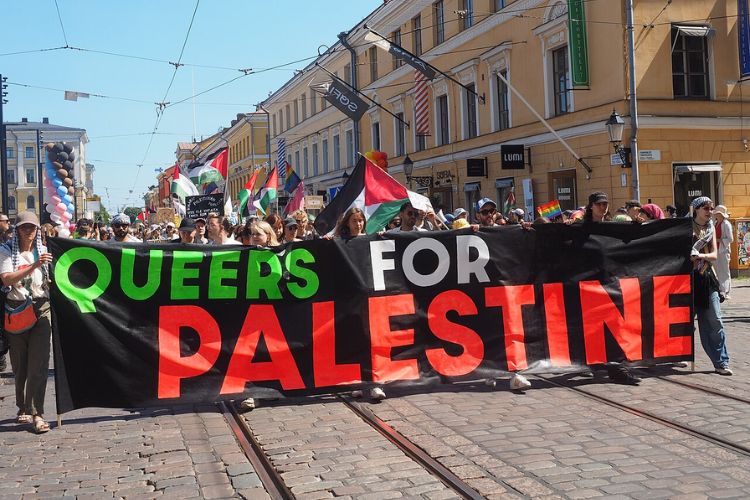
Queers for Palestine. How crazy is this? Don’t they know that Islamists kill Queers? And yet, one of the best examples of this is what scholars call the Red-Green Alliance, which is an alliance between secular progressives (‘Red’) and Islamists (‘Green’).
The progressive movement promotes secularism, feminism, LGBTQ rights, and individual autonomy, while Islamists want to order public life according to the Qur’an and the Sharia. Despite these profound ideological differences, the two find common ground in their hatred towards the West, nationalism, and of course, Israel.
Given their ideological differences, it is inevitable that one side will exercise greater influence over the coalition than the other. It’s true that political alliances begin with shared grievances, but over time the movement with the more comprehensive moral framework is more likely to shape the coalition’s direction.
Progressivism and Suicidal Empathy
I will begin by looking at the progressive side of the coalition by looking to Gad Saad who offers an important insight into one dimension of this phenomenon through his concept of “suicidal empathy.”
His theory helps explain why some progressives are reluctant to subject what are labelled marginalised groups or ideologies to the same level of moral scrutiny that they apply to others. Groups viewed as historically marginalised therefore acquire a degree of moral immunity from criticism because disagreement itself is interpreted as hostility towards victims. In many Western institutions, identity and historical oppression go hand in hand.
These frameworks define the boundaries of working relationships, which helps to explain why progressive activists excuse illiberal positions with Islamists, but are unwilling to do it with Christian conservatives. Within their moral framework, the decisive issue is not the content of a group’s beliefs, but where the group is located within perceived structures of power and oppression.
Islamists are granted the baffling courtesy of being part of marginalised groups, despite the overwhelming evidence to the contrary. At the same time, conservative Christians are viewed as part of the privileged of society. As a result, any criticism of Islam is often treated as reinforcing oppression, whereas criticism of the latter is regarded as an act of justice. This results in an asymmetrical moral landscape in which two groups with comparable views on issues such as sexuality or gender are judged according to different standards because of the identities they represent — rather than the ideas they advocate.
Two Competing Moral Structures
The asymmetry within the coalition reflects a deeper difference than political strategy. It arises from the moral architecture of the two movements themselves.
To be sure, empathy is very important as a moral virtue, but it cannot serve as an organising principle of civilisation. Every society must answer questions that extend beyond compassion if it hopes to make consistent moral judgments. Among the questions every society must answer are these: What is a society’s source of authority? After all, every society needs a final standard that determines what is true, good, and morally binding. For many progressives, moral authority is frequently located in lived experience, identity, and an evolving moral consensus, whereas Islamists locate ultimate authority in divine revelation as expressed through Sharia Law. Every moral framework must also explain how competing values should be prioritised.
Socialist Leftist Morality
Every political movement tells a story about the source of human suffering. For the progressive left, oppression functions as the central explanatory framework. History is understood largely as a struggle between marginalised groups and systems of power based on race, gender, sexuality, colonialism, or economic inequality. In this narrative, injustice persists because dominant institutions perpetuate unequal power relationships. The moral task, therefore, is to dismantle oppressive structures, amplify marginalised voices, and create more equitable social arrangements.
Islamist Morality
The Green Alliance operates from a fundamentally different theodicy. Islamist movements generally locate the world’s disorder not primarily in social structures but in humanity’s rebellion against God’s revealed will. This is a fundamental difference that sometimes Westerners are not aware of. Over time, much progressive thought has shifted from grounding morality in universal reason to grounding it in lived experience, identity, and moral sentiment. Islamists reject both approaches. For them, divine revelation — not autonomous reason or subjective feeling — remains the ultimate source of authority. Revelation trumps both reason and feelings.
From their perspective, the solution is not merely political reform but submission to God through the implementation of Sharia Law and the restoration of a rightly ordered Islamic society. In this framework, justice is achieved when human life conforms to divine revelation rather than autonomous human judgment.
This differs fundamentally from the progressive account of oppression, which seeks liberation through the transformation of social structures rather than submission to divine authority.
The More Robust Moral System: Islamism
This is where Islamism has a more robust source of continued influence. It has a comprehensive understanding of authority, community, sacrifice, and moral obligation. It provides the moral framework capable of sustaining long-term political and social movements rather than a postmodern understanding that merely reacts to changing cultural conditions. t can form institutions that educate future generations and sustain long-term commitments because its members understand themselves as participating in something larger than the political moment. They are working on behalf of God, which supplies them with a divine purpose.
By contrast, movements organised primarily around feelings and changing cultural priorities often revise their priorities as cultural circumstances evolve. This explains why Islamists are good at influencing political organisations and universities. Their political vision is not limited to protest or social reform but is rooted in a comprehensive religious worldview that includes concepts such as jihad, understood by many Islamist thinkers as the obligation to struggle for the establishment and defence of God’s order in society. Whether pursued through political, social, or, in some cases, violent means, jihad functions as part of an integrated moral and theological framework rather than as a temporary political slogan.
Red Suicidal Empathy and the Death of Critical Thinking
By contrast, what Gad Saad describes as “suicidal empathy” encourages an unwillingness to critically evaluate the goals and assumptions of groups perceived as marginalised or historically oppressed.
If criticism is treated as a form of victimisation, progressive activists may become reluctant to examine ideological commitments — including Islamist conceptions of jihad — that conflict with their own stated commitments to liberal democracy, individual rights, or gender equality. In this sense, a coalition driven primarily by empathy may gradually yield intellectual leadership to a movement whose objectives are defined by a more comprehensive and internally coherent vision of political and religious life.
Contrasting Red and Green Worldviews
The contrast becomes even clearer when the two movements are viewed side by side. Progressive movements often derive their moral language from concepts such as equality, liberation, and historical redress. Islamist political movements derive their political vision from religious commitments that they understand to possess transcendent authority. These traditions should not be collapsed into simplistic categories, nor should all Muslim individuals or organisations be treated as sharing identical political goals. Nevertheless, where Islamist movements explicitly seek to organise political life according to religious principles, they operate from a framework that integrates theology, law, ethics, community, and political purpose into a unified vision. That comprehensive character gives such movements a different kind of organisational coherence than movements whose moral vocabulary is more fluid and responsive to changing cultural conditions.
The Red-Green Alliance therefore illustrates a broader principle about political coalitions that are at work. Alliances are not sustained merely by shared enemies, but by the moral frameworks that animate them.
Movements organised primarily around empathy often struggle to resist partners whose vision — such as Islamism’s — is destructive. The long-term question is not whether the alliance will survive but which moral framework will ultimately define it. The answer to that question should be obvious. Progressives that champion their cause for justice will have blood on their hands.
Whenever you see statements repeated in Scripture (especially if they are close together in the same text), then the writer is emphasizing the message and telling us we really need to pay attention.
A good example is Jesus’ Olivet Discourse found in Matthew 24, which is prophetic in nature and covers the end times. It starts off with Jesus warning, “See to it that no one misleads you. For many will come in My name, saying, ‘I am the Christ,’ and will mislead many” (vv. 4–5). Then, just a few verses later, He says: “Many false prophets will arise and will mislead many” (vs. 11).
Skip down just a little more, and then there’s this: “Then if anyone says to you, ‘Behold, here is the Christ,’ or ‘There He is,’ do not believe him. For false Christs and false prophets will arise and will show great signs and wonders, so as to mislead, if possible, even the elect” (vv. 23–24).
I don’t know about you, but to me, it sure looks like Jesus wants us to be on the lookout for false messiahs and their mouthpieces. You might think such a thing is rare and only happens today with a handful of people who get snookered now and then by some religious charlatan, the events of which get portrayed on some Netflix documentary.
But you’d be wrong. For example, let me introduce you to the false messiah figure that’s influencing the nation of Iran’s actions towards the world at large, and especially at Israel and the United States.
Iran’s counterfeit savior
About 20 years ago, then-president of Iran, Mahmoud Ahmadinejad, stated in an interview that he experienced a supernatural experience during a speech he gave at the United Nations. Ahmadinejad claimed that he was bathed in a light from Heaven at the outset of his talk, with the light remaining on him for the full length of the speech.
Ahmadinejad made several references during that U.N. speech to a “mighty Lord” who will hasten the emergence of “the promised one,” a person who “will fill this world with justice and peace.” Any guesses as to who Ahmadinejad was referring to?
During that time, CNN national security analyst Peter Bergen pointed out that groups such as ISIS have similar hopes based on their belief in Islamic prophecy. Believing that their actions hasten a supposed final battle at a small, obscure Syrian town named Dabiq between “Rome” and Islam (where the forces of true Islam triumph), Bergan noted: “Members devoutly believe that they are fighting in a cosmic war in which they are on the side of good, which allows them to kill anyone they perceive to be standing in their way with no compunction. This is, of course, a serious delusion, but serious it is.”
The Islamic State holds the imminent fulfilment of prophecy as a matter of dogma at least tells us the mettle of our opponent. It is ready to cheer its own near-obliteration, and to remain confident, even when surrounded, that it will receive divine succour if it stays true to the Prophetic model.”
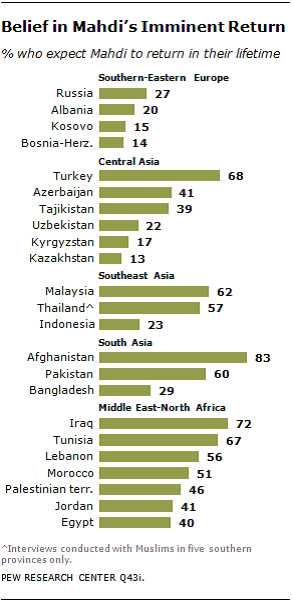
And to Iran, that “model” includes a messianic-type figure known as the “Mahdi”; the “mighty lord” Ahmadinejad was referring to in his U.N. speech. During another talk Ahmadinejad gave that same year, he stated that his main mission was to “pave the path for the glorious reappearance of Imam Mahdi, may Allah hasten his reappearance.”
It’s a good bet you’ve never heard of the Mahdi, unless you’ve studied some of Islam’s prophetic literature. The figure is emphasized especially on the Shi’a side of the Islamic faith (the other side being Sunni), which makes up the vast majority of Iran’s practicing Muslims, including their Islamic Revolutionary Guard Corps (IRGC).
In fact, the IRGC’s worldview focuses on “Mahdism” and the return of the 12th divinely ordained Shi’a imam, Muhammad al-Mahdi (or the Hidden Imam). They believe the Mahdi was hidden by God into a miraculous state in 874 CE, and that he will one day return to rid the world of evil and injustice. His coming, they believe, will bring about “one final apocalyptic battle” between two armies, in which Shi’as say that the Mahdi and his forces will prevail over evil.
Twenty years ago, Ahmadinejad urged his countrymen to prepare for the coming of the Mahdi by turning the country into a mighty and advanced Islamic society, and by avoiding the corruption and excesses of the West. While sounding innocent, it’s important to understand that part of the preparation has to do with the elimination of Islam’s enemies and those who stand in the way of the Mahdi’s return. Topping the list is the United States, and the chief enemy of Islam, Israel.
In a report issued by the Middle East Institute just a few years ago, researchers Saeid Golkar and Kasra Aarabi noted that the IRGC’s leadership sees the world divided between the “will of the essence of transcendence” and “the arrogant powers.” The former is led by “the people and the leadership of Iran,” and the latter includes “Zionism, Wahhabi Zionism, and Christian Zionism.”
They go on to say:
“The IRGC is increasingly understanding and communicating its official policy of eradicating Israel and Zionism through the doctrine of Mahdism. While the destruction of Israel has been the IRGC’s working objective since its inception, like other Islamist groups this hostility was borne out of viewing the Jewish state an illegitimate, oppressive, and usurping entity for the West to achieve its supposed colonial goals across the Muslim world. More recently, however, the existence of Israel is being viewed and understood as the ‘greatest barrier’ to the reappearance of the 12th Imam. According to the doctrine of Mahdism, part of preparing for the reappearance of the 12th Imam is removing all obstacles and barriers to his return. Against this backdrop, Iran’s hardline clergy affiliated with the IRGC claim religious hadiths state that the ‘Jewish state will be destroyed before Mahdi’s arrival.’”
We shouldn’t be dismissive of such thinking. Golkar and Aarabi highlight the real danger of all this when they write:
“At present the doctrine of Mahdism in the IRGC remains a complete blind spot for Western policymakers, yet it could have major implications for the Islamic Republic’s militia network, ballistic missile program, and even its nuclear program.”
That’s a bit concerning, wouldn’t you say?
At present, our governments spend enormous resources analyzing Iran’s economy, military capabilities, and nuclear ambitions, all of that being good.
But maybe it’s time they devote equal attention to understanding the theological convictions that motivate many of the regime’s politicians. History has repeatedly shown that leaders driven by deeply held religious beliefs cannot always be deterred by conventional assumptions and actions. Ignoring those beliefs doesn’t make them disappear; it simply makes strategic miscalculation more likely.
Our leaders need to heed Jesus’ warning about false messiahs and understand it wasn’t merely a religious observation. It was a reminder that false hopes and false saviors have real-world consequences, both spiritually and politically.
What did Christ say again? “See to it that no one misleads you.”
What does the Bible really say about the future of Islam—and why are so many people shocked when they examine the prophecies closely? In this eye-opening video, we explore key biblical passages that many believe speak directly to the rise, influence, and ultimate end of Islamic power in the Middle East. Using Scripture, historical context, and careful interpretation, this episode challenges popular assumptions and invites viewers to rethink long-held narratives. Rather than speculation, we focus on what the Bible explicitly reveals about end-times events, regional powers, and God’s final plan for history. Whether you are a student of prophecy, a believer seeking clarity, or simply curious about biblical eschatology, this video will stretch your understanding and spark serious reflection. Watch to discover why these prophecies matter—and why the conclusions may surprise you.
EZEKIEL 38 & 39 are key end times prophecies that Joel Richardson covers in this presentation. Ezekiel understood, in his day, Magog was the land of Turkey it certainly was not Russia. All of the nations Ezekiel describes that come against Israel in the last days are Muslim nations that surround Israel.
Historian and author Raymond Ibrahim joins The Winston Marshall Show for a powerful, eye-opening conversation on the hidden history of Islam’s conquest of the Christian world—and why so few dare to speak about it today. Raymond traces the rapid Islamic expansion following Muhammad’s death, showing how, within just one century, Muslim armies had violently overrun three-quarters of the original Christian world—from Syria and Egypt to Spain and deep into Europe. He dismantles the myth of Andalusian “tolerance,” reveals the brutal realities behind the so-called Islamic Golden Age, and explains how the Islamic conquests shattered the Mediterranean world, plunging Europe into the Dark Ages. Raymond explores the modern censorship around Christian persecution, the resurgence of historical jihadist rhetoric in groups like ISIS, and the urgent lessons today’s leaders refuse to learn. All this—the real story of the Crusades, the lost Christian heartlands, the enduring legacy of conquest, and the history the mainstream media won’t touch…
Key takeaways from the interview with Winston Marshall include:
Within the space of 100 years, after the death of Mohammed, by 732, Muslims were overtaking Europe by violent conquest. There was no tolerance, harmony between Judaism, Christians and Muslims. Christianity was denigrated, and it was convert, pay Jizya, or die. Jizya is money paid by non- Muslims so that they can keep practising their religion. (Under Islamic law, if the money is not paid, the people are to be enslaved or killed.)
Three-quarters of the Christian world was conquered and has not been recovered.
Once a Territory is taken by Islam, even though they are defeated and expelled from that region, Islam believes it always belongs to them and must be retaken.
The Eastern world included Egypt, Syria, Lebanon, Turkey, and Morocco. They were more Christian in numbers and belief than Europe at that time. (In fact, the Coptic Christians from Egypt were instrumental in spreading the Gospel in Europe.) Each country was violently conquered. As was Israel.
The Slavic nations got their name from the fact that Islam conquered the area and enslaved the populace. Slavery was their bread and butter.
The Vikings supplied white slaves to the Muslims.
The exploration of the New World by Christopher Columbus came about because of the constant threat of Muslim invasion of Spain. The quest was a fallback plan if all else failed.
The very first war fought by the new United States of America was against the barbarism of the Barbary Pirates. A series of two wars were fought from 1801-1805. The North African slave traders ramped up their aggressive posture by shifting their focus to KIDNAPPING and holding for ransom. The pirates, based in modern-day Tunisia, Libya, and Morocco, demanded tribute for ‘safe passage’ through the Mediterranean. The newly minted American nation refused to negotiate with terrorists and defeated them.
The times may change. The playbook remains the same.
As the conflict between Israel and Iran’s terrorist proxy group Hezbollah in Lebanon widens, reports continue to surface of a growing division between the Iranian people and the Islamist regime of Ali Khamenei. Even as anti-Israel and anti-America protests get most of the attention in Iran, a burgeoning Christian movement is occurring under the surface, an expert on Iranian Christians says.
In Iran, Christianity is intensely persecuted, except small historical Armenian and Assyrian communities. Conversion from Islam to Christianity is considered apostasy and can be punished with death. Still, some reports suggest that conversions to Christianity and support for democracy are on the rise, with as many as 80% of Iranian citizens anonymously supporting a democratic government. In addition, some outlets have reported that hundreds of mosques have closed due to the rising number of Iranians leaving Islam.
Hormoz Shariat is the president of Iran Alive Ministries. It broadcasts the gospel message via satellite TV programs in the Farsi language in predominantly Muslim countries like Iran, Tajikistan, Afghanistan, Turkmenistan, and Uzbekistan. On Monday, he joined “Washington Watch with Tony Perkins” to discuss how an increasing number of Iranians do not support the Islamist regime’s attacks on Israel and are converting to Christianity.
“[Iranians] have experienced Islam and Islamic rule firsthand for over 40 years,” he noted. “And they’ve come to the conclusion, if the problem is not just the government, the problem is Islam itself. That’s why we see a high number of Iranian Muslims come to Christ because they have not just rejected the government, they have rejected Islam. There is such a gap … between the government and the people. So when the government puts on these rallies saying, ‘Death to Israel, death to America,’ the people of Iran say, ‘We love Israel, we love America.’ And that’s the trend.”
Shariat also pointed out that there were also many Iranian Americans who came out in support of Israel after the October 7 Hamas attack.
“We know that the media covered … the pro-Palestine, pro-Hamas demonstrations in America,” he noted. “You saw it everywhere. You saw it on campuses. You saw it on the street. You saw it in Washington, D.C. But you did not see all the Iranians who came on the streets even in America, Los Angeles, Washington, D.C., and San Diego, everywhere. Iranians came out pro-Israel. Not even one Iranian rally was pro-Palestine, and the media did not cover that. Iranians are pro-Israel.”
Shariat further described how his ministry has spread. “[W]e … have a 24/7 satellite broadcast going over the heads of the mullahs — they cannot stop the signal from the sky. We go into people’s homes, millions of homes. [A]n independent survey [found] that we have seven million viewers daily. So we go into people’s homes, tell them about God’s love, and guess what? They are ready. Iranians are rejecting Islam. They’re ready for the message of the gospel.”
According to Shariat, a spiritual awakening is currently occurring in Iran. “It’s a move of God, and God uses suffering, and Iranians have suffered for 40-some years. … So there is an openness among Iranians. … God has used [suffering] to open their minds, open their eyes towards Islam. They … have rejected Islam [but] not [out] of emotion and [not from making an] overnight decision.”
Shariat asked for continued prayers for his ministry and Christians in Iran.
Ayaan Hirsi Ali, a former Muslim and renowned critic of Islam, has revealed her conversion to Christianity, describing her journey from Islam to atheism and ultimately to Christianity.
On Nov. 11, 2024, activist and author Ayaan Hirsi Ali published an essay titled “Why I am Now a Christian.” Her declaration has understandably made waves. For 20 years, Ali has written, spoken, and acted as a committed atheist. Rejecting the Islamic teachings she was indoctrinated with during her teenage years, she has long argued for secularism as the needed lens for furthering humanity and countering the world’s evils so often perpetrated by religious dogma. Hence, her conversion to Christianity is not being well received by the media.
Ali grounds the explanation for her conversion on the usefulness of Christianity. I do not mean “useful” in a trite way, as one might find a spoon more helpful to eat soup than a fork. Ali sees the use of Christianity as fundamental on a societal and personal level. In this way, Ali grounds her turn to Christianity on the same principles that led her to reject God and organized religion. She now sees Christianity not as a foe to her cause but as a needed ally.
Hirsi Ali traces her initial disillusionment with Islam following the 9/11 terrorist attacks when she questioned the justifications for the attacks in the name of Islam. During her teenage years in Nairobi, Hirsi Ali says she was influenced by the Muslim Brotherhood, which instilled in her a strict interpretation of Islam.- This period was characterized by a strict adherence to religious practices and a deep-seated disdain for non-Muslims, particularly Jews. However, her later exposure to atheism through figures like Christopher Hitchens and Richard Dawkins provided a stark contrast to her previous beliefs.
Hirsi Ali attributes her turn to Christianity to a broader concern for the challenges facing Western civilization. She cites threats from authoritarian regimes, global Islamism, and “woke” ideology as catalysts for seeking a unifying force. Christianity, in her view, offers a foundation of values and traditions that uphold human life, freedom, and dignity, and counters the divisiveness she associates with atheism.
Responding to her embrace of the Christian faith, conservative Christian philosopher Dr. Robert George wrote on Facebook: “Two decades ago, under the influence of the writings of Bertrand Russell, she became an atheist. Her thought was that atheism was smart and sophisticated — it was allegedly what really intelligent people believed (the ‘brights,’ as Daniel Dennett embarrassingly labeled himself and his fellow unbelievers). It was the way to a world of rationality and civil liberty. Hirsi Ali is not the first to have gone down that misguided path. She now sees that it is indeed misguided and that there is, if I may quote scripture, a more excellent way.
Hirsi Ali’s embrace of Christianity also stems from a personal quest for spiritual solace and meaning in life.
Hirsi Ali critiques atheism as leaving a “God hole,” which she believes has led to the rise of irrational ideologies and the erosion of Western values. She argues that Christianity provides a unifying story and foundational texts, similar to those in Islam, that can engage and mobilize people.
Christians should be thankful for Ali’s essay. It no doubt took plenty of courage to make, given her past commitments and social circle. The author of this article Adam Carrington, an associate professor of politics at Hillsdale College made the following comment. “We also should exercise cautious support of her. She mentions at the end of her essay that “I still have a great deal to learn about Christianity. I discover a little more at church each Sunday.” Judging by her essay, she still might need guidance in seeing the centrality of grace in Christianity and how that grace is most manifest in the person and work of the Son of God, made flesh. Sometimes, those truths take time to know and to feel. In some sense, we spend our entire lives trying to rest in God’s grace, not save ourselves as is the normal human inclination.
But we also should be thankful that Ali sees the political and social goods of Christianity, historically and today. In its witness, we see the dignity of humanity made in the image of its Creator. In its doctrine, we see the need for politics that protects the innocent, punishes the guilty, and guards the right. In Christianity, we also see the need for mercy, not just from God, but with each other as neighbors and citizens.
That such commitments to dignity, law, and mercy seem obvious to so many of us is not the insight of secular humanism. Ali has joined us in seeing its origins in the God revealed in the Bible.
The Revolutionary Court of Tehran has sentenced an Iranian-Armenian Christian man to 10 years in prison for establishing a house church, which the judge called “propaganda contrary to and disturbing to the holy religion of Islam,” according to reports.
Saba Kord Afshari is just 22 years old. In August 2019, the Revolutionary Court of Tehran sentenced her to 24 years in prison for opposing the compulsory hijab.
Branch 26 of the Revolutionary Court of Tehran, headed by Judge Afshari, sentenced Anooshavan Avedian, 60, to 10 years of imprisonment, alongside two others who are members of his house church — Abbas Soori, 45, and Maryam Mohammadi, 46 — both of whom are converts to Christianity, Human Rights Activists News Agency reported.
Article 18, a U.K.-based organization that promotes religious freedom in Iran, reported that Soori and Mohammadi received a range of non-custodial punishments, including a fine of about $2,000 (500 million rials) and a 10-year ban from membership in social and political groups as well as a two-year exile outside Tehran. In addition, they must regularly report to the offices of the Ministry of Intelligence.
The three were convicted on the charge of “organizing and running an Evangelical ‘Zionist’ home church with the intention to act against national security” and “maintaining satellite dish and receivers.”
They were first arrested in August 2020 when about 30 intelligence agents raided a private gathering at Avedian’s home in Narmak are in northeastern Tehran, but their case came to light only recently.
The agents confiscated all the Bibles and communication devices with passwords.
In Tehran’s Evin Prison, the three were subjected to psychological torture during several intense interrogation sessions.
Judge Afshari pronounced Avedian guilty of “establishing and leading an illegal group with the aim of disrupting the security of the country through education and propaganda activities contrary to and disturbing to the holy religion of Islam, through the dissemination of false claims … as well as contact with foreign countries, or organisational guidance from abroad.”
The Christians’ defense was met with “disrespectful remarks toward their character, and insults to their faith,” according to Article 18, which also said that over the past decade, authorities in Iran have closed down nearly all churches that offered services in Persian, the national language, or insisted they teach only in the ethnic minority languages.
The Islamic Republic is ranked as the ninth-worst country in the world when it comes to Christian persecution, according to Open Doors USA’s World Watch List.
“Converts from Islam to Christianity are most at risk of persecution, especially by the government and to a lesser extent by society and their own families,” it says.
“The government sees the growth of the church in Iran as an attempt by Western countries to undermine Islam and the Islamic regime of Iran. House groups made up of converts from Muslim backgrounds are often raided, and both their leaders and members have been arrested, prosecuted, and given long prison sentences for “crimes against national security.”
The Muslim religion is an antichrist religion and Biblical prophecy reveals the Antichrist (Little Horn) arises out of one of four Muslim nations when the revived Ottoman Empire is broken up (perhaps by the U.N. or Russia) into four nations.
“Then the goat (revived Ottoman Empire) became exceedingly great, but when he was strong, the great horn was broken, and instead of it there came up four conspicuous horns toward the four winds of heaven. Out of one of them came a little horn (Antichrist), which grew exceedingly great toward the south, toward the east, and toward the glorious land. It grew great, even to the host of heaven. And some of the host and some of the stars it threw down to the ground and trampled on them. It became great, even as great as the Prince of the host” Daniel 8:8-11