The reason a young former pastor renounced his Christian faith and rejected God was because: “How could a loving God reject people who were sincere in whatever faith they held? Would He truly condemn them because they understood Him differently than those professing faith in Jesus Christ as their Savior and Lord?”
This young man’s issue was not the historical credibility of the resurrection of Jesus or the reliability of the Genesis narrative regarding the Fall of Man. Instead, he was offended by the idea that a God of mercy would not welcome into eternal life everyone who seemed to be earnest in whatever faith they have. Put simply, this former pastor decided to create a new god, one in his own image.
Former evangelical pastor Rob Bell turned from biblical faith several years ago by denying the reality of Hell. He like so many leaders of denominational churches believe the Bible teaches non-believers will be tormented for all eternity in the Lake of Fire and yet the Bible clearly teaches that after the White Throne judgement, there is a second death in the Lake of Fire.
“For the wages of sin is death, but the free gift of God is eternal life in Christ Jesus our Lord.” Romans 6:23
Bell was right in believing eternity in Hell is hardly just, and is inconsistent with the nature of the God – Who is love. This belief cost him eternal life with his Creator.
My book on the Lake of Fire is available as an ebook on Amazon.
“But as for the cowardly, the faithless, the detestable, as for murderers, the sexually immoral, sorcerers, idolaters, and all liars, their portion will be in the lake that burns with fire and sulfur, which is the second death.” Revelation 21:8 (also see Revelation 2:11, 20:6, and 20:14)
In reading various “de-conversion” stories, accounts by and about people who have left their Christian faith, there is a persistent theme. It’s not about the reasonableness of Christianity, its intellectual coherence, or the credibility of its propositional claims. Rather, they come to a point where their dislike of certain doctrines or practices leads them to abandon their walk with Christ. They jettison their faith because it does not comport with their preferences. Or, put another way, the God of Scripture is not Who they want Him to be.
I often wonder if these people were been born again by the Holy Spirit. Jesus made it possible for God the Father to send the Holy Spirit to indwell our Spirit to be our Counsellor, our Teacher, and our Comforter. Jesus said He will bring us into all truth if we let Him.
We need to know God is not like us. He cannot denigrate the purity of His character by acting as though our transgressions really aren’t a big deal. And that’s the sticking point: the eternal Triune God is not concerned with conforming to our expectations. His character is not malleable, and He is not accountable to us for what He does.
Consider the story of Job. God allows Job’s entire family to be murdered, his vast wealth stolen, and his health broken. Job calls out to God, demanding to know why He has permitted these things given that he, Job, has been so faithful to Him. God is uncompelled to justify Himself to Job. Instead, He says, “Will the faultfinder (Job) contend with the Almighty? Let him who reproves God answer it” (Job 40:1).
Similarly, when Paul debates with an imaginary rhetorical opponent about God’s sovereignty and human free will, the apostle does not try to dissect something beyond man’s grasp. Instead, he affirms that “there is no injustice with God” and asks, “Who are you, o man, to answer back to God?” (Romans 9:14, 20).
But this same God is infinitely loving and desires no one to perish but all to come to repentance and faith in His Son (2 Peter 3:9). This is why He invites us into a relationship with Himself. In His great, undeserved kindness, God has revealed Himself to us. “His invisible attributes, namely, His eternal power and divine nature, have been clearly perceived, ever since the creation of the world, in the things that have been made,” Paul asserts (Romans 1:20). His power, intelligence, and love are displayed in a world that is complex, ordered, and abundant. The heavens, “the work of His fingers,” declare His glory (Psalms 8:4, 19:1).
He has revealed Himself in our very natures, with the weight of moral duty “written on our hearts” (Romans 2:15) and eternity placed within them (Ecclesiastes 3:11). He has revealed His character and desires, His demands, and His offer of everlasting life, in the pages of text composed by numerous men over the course of many centuries. The Bible is His written revelation.
Most profoundly, He has revealed Himself in the person of Jesus of Nazareth, the Son of Man and Son of God, sinless and righteous, Who took the penalty for sin we deserve as He died on the cross, and whose resurrection heralded His victory over sin, death, and the devil. Trusting in Him and Him alone for forgiveness, we receive life, eternal life, that He alone can give. Moreover, Jesus made it possible for us to receive the third person of the Trinity, the Holy Spirit into our Spirit to enable us to live the Christian life.
This is news so grand that it invites adoration of the One offering it. It should create in us a longing to know and follow Him, not turn our backs on Him because He does not seek to appease our finite indignation about things we can’t grasp. Would you really want to serve a God so eager to be liked He debases His Majesty to plead for our approval?
“A man can no more diminish God’s glory by refusing to worship Him,” wrote C.S. Lewis, “than a lunatic can put out the sun by scribbling the word ‘darkness’ on the walls of his cell.” He is Who He is and invites us to know Him — and that’s the best news of all.



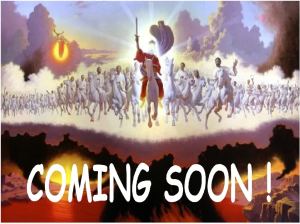 Jesus return to this earth with the saints, restoring Israel to salvation which begins Christ’s earthly reign on this earth for a thousand years. Curse is not lifted off the entire earth. People still die. At the end of Jesus thousand year reign, Satan is released and deceives the nations and a final battle occurs which God ends with fire from heaven. Satan is cast into the Lake of Fire and God’s word says he, the beast and the false prophet will be tormented forever and ever.
 LIVING ETERNAL NOW