THE TRUTH ABOUT ISLAM

Historian and author Raymond Ibrahim joins The Winston Marshall Show for a powerful, eye-opening conversation on the hidden history of Islam’s conquest of the Christian world—and why so few dare to speak about it today. Raymond traces the rapid Islamic expansion following Muhammad’s death, showing how, within just one century, Muslim armies had violently overrun three-quarters of the original Christian world—from Syria and Egypt to Spain and deep into Europe. He dismantles the myth of Andalusian “tolerance,” reveals the brutal realities behind the so-called Islamic Golden Age, and explains how the Islamic conquests shattered the Mediterranean world, plunging Europe into the Dark Ages. Raymond explores the modern censorship around Christian persecution, the resurgence of historical jihadist rhetoric in groups like ISIS, and the urgent lessons today’s leaders refuse to learn. All this—the real story of the Crusades, the lost Christian heartlands, the enduring legacy of conquest, and the history the mainstream media won’t touch…

Key takeaways from the interview with Winston Marshall include:

  1. Within the space of 100 years, after the death of Mohammed, by 732, Muslims were overtaking Europe by violent conquest. There was no tolerance, harmony between Judaism,  Christians and Muslims.  Christianity was denigrated, and it was convert, pay Jizya, or die. Jizya is money paid by non- Muslims so that they can keep practising their religion.  (Under Islamic law,  if the money is not paid, the people are to be enslaved or killed.) 
  2. Three-quarters of the Christian world was conquered and has not been recovered.  
  3. Once a Territory is taken by Islam, even though they are defeated and expelled from that region, Islam believes it always belongs to them and must be retaken.  
  4. The Eastern world included Egypt, Syria, Lebanon, Turkey, and Morocco. They were more Christian in numbers and belief than Europe at that time. (In fact, the Coptic Christians from Egypt were instrumental in spreading the Gospel in Europe.) Each country was violently conquered. As was Israel.  
  5. The Slavic nations got their name from the fact that Islam conquered the area and enslaved the populace. Slavery was their bread and butter.  
  6. The Vikings supplied white slaves to the Muslims.  
  7. The exploration of the New World by Christopher Columbus came about because of the constant threat of Muslim invasion of Spain. The quest was a fallback plan if all else failed.  
  8. The very first war fought by the new United States of America was against the barbarism of the Barbary Pirates. A series of two wars were fought from 1801-1805. The North African slave traders ramped up their aggressive posture by shifting their focus to KIDNAPPING and holding for ransom. The pirates, based in modern-day Tunisia, Libya, and Morocco, demanded tribute for ‘safe passage’ through the Mediterranean. The newly minted American nation refused to negotiate with terrorists and defeated them.  
  9. The times may change. The playbook remains the same.  

MUSLIM TURNED RIGHTS ACTIVIST AYAAN HIRSI ALI NOW A CHRISTIAN

Ayaan Hirsi Ali, a former Muslim and renowned critic of Islam, has revealed her conversion to Christianity, describing her journey from Islam to atheism and ultimately to Christianity.

On Nov. 11, 2024, activist and author Ayaan Hirsi Ali published an essay titled “Why I am Now a Christian.” Her declaration has understandably made waves. For 20 years, Ali has written, spoken, and acted as a committed atheist. Rejecting the Islamic teachings she was indoctrinated with during her teenage years, she has long argued for secularism as the needed lens for furthering humanity and countering the world’s evils so often perpetrated by religious dogma. Hence, her conversion to Christianity is not being well received by the media.

Ali grounds the explanation for her conversion on the usefulness of Christianity. I do not mean “useful” in a trite way, as one might find a spoon more helpful to eat soup than a fork. Ali sees the use of Christianity as fundamental on a societal and personal level. In this way, Ali grounds her turn to Christianity on the same principles that led her to reject God and organized religion. She now sees Christianity not as a foe to her cause but as a needed ally.

Hirsi Ali traces her initial disillusionment with Islam following the 9/11 terrorist attacks when she questioned the justifications for the attacks in the name of Islam. During her teenage years in Nairobi, Hirsi Ali says she was influenced by the Muslim Brotherhood, which instilled in her a strict interpretation of Islam.- This period was characterized by a strict adherence to religious practices and a deep-seated disdain for non-Muslims, particularly Jews. However, her later exposure to atheism through figures like Christopher Hitchens and Richard Dawkins provided a stark contrast to her previous beliefs.

Hirsi Ali attributes her turn to Christianity to a broader concern for the challenges facing Western civilization. She cites threats from authoritarian regimes, global Islamism, and “woke” ideology as catalysts for seeking a unifying force. Christianity, in her view, offers a foundation of values and traditions that uphold human life, freedom, and dignity, and counters the divisiveness she associates with atheism.

Responding to her embrace of the Christian faith, conservative Christian philosopher Dr. Robert George wrote on Facebook: “Two decades ago, under the influence of the writings of Bertrand Russell, she became an atheist. Her thought was that atheism was smart and sophisticated — it was allegedly what really intelligent people believed (the ‘brights,’ as Daniel Dennett embarrassingly labeled himself and his fellow unbelievers). It was the way to a world of rationality and civil liberty. Hirsi Ali is not the first to have gone down that misguided path. She now sees that it is indeed misguided and that there is, if I may quote scripture, a more excellent way.

Hirsi Ali’s embrace of Christianity also stems from a personal quest for spiritual solace and meaning in life.

Hirsi Ali critiques atheism as leaving a “God hole,” which she believes has led to the rise of irrational ideologies and the erosion of Western values. She argues that Christianity provides a unifying story and foundational texts, similar to those in Islam, that can engage and mobilize people.

Christians should be thankful for Ali’s essay. It no doubt took plenty of courage to make, given her past commitments and social circle. The author of this article Adam Carrington, an associate professor of politics at Hillsdale College made the following comment. “We also should exercise cautious support of her. She mentions at the end of her essay that “I still have a great deal to learn about Christianity. I discover a little more at church each Sunday.” Judging by her essay, she still might need guidance in seeing the centrality of grace in Christianity and how that grace is most manifest in the person and work of the Son of God, made flesh. Sometimes, those truths take time to know and to feel. In some sense, we spend our entire lives trying to rest in God’s grace, not save ourselves as is the normal human inclination.

But we also should be thankful that Ali sees the political and social goods of Christianity, historically and today. In its witness, we see the dignity of humanity made in the image of its Creator. In its doctrine, we see the need for politics that protects the innocent, punishes the guilty, and guards the right. In Christianity, we also see the need for mercy, not just from God, but with each other as neighbors and citizens.

That such commitments to dignity, law, and mercy seem obvious to so many of us is not the insight of secular humanism. Ali has joined us in seeing its origins in the God revealed in the Bible.

GOD ANSWERS PRAYER

God is behind a massive wave of Muslims coming to Christ in the past 30 years according to David Garrison, executive director of the evangelical missions group Global Gates and author of A Wind in the House of Islam. Garrison has described his three years traveling the Islamic world and interviewing more than 1,000 Muslim-background believers. What I discovered was this remarkable surge and movement towards Jesus Christ coincided with the beginning of 30 Days of Prayer for the Muslim world, 28 years ago this year,” Garrison said. He travelled 250,000 miles investigating movements where at least 1,000 Muslims in a community had been baptized into the Christian faith, but he never made the prayer link until he shared his findings with Paul Filidis of World Christian Concern, who helped launch the 30-Days of Prayer for the Muslim World in 1993.

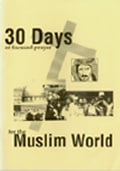
1st 30 Days prayer guide
THE VERY FIRST EDITION OF THE 30 DAYS PRAYER GUIDE, FROM 1993

“I’d come back home and sit down with my friend Paul and I told him about these movements that we’re seeing probably 84% of all the movements that have ever happened in history have happened in the last 30 years, and that’s when Paul looked at me and said, ‘David that’s when we began 30 Days of Prayer for the Muslim world.‘” While Muslims might not know that Christians are praying for them, God knows and He’s listening, Garrison said. “And as He promised our prayers are tearing down strongholds, they’re opening up hearts and they’re aligning us as Christians with God’s desire for the Muslim world to know His Son, Jesus Christ.”

All About 30 Days of Prayer

The purpose of 30 Days is to call Christians to pray with love and respect for Muslims around the world. In doing so, we hope to see:

+ Christians gain a better understanding about Muslim people, their faith and their various, diverse cultures.
+ An increase in efforts to respond with love and compassion to the needs of Muslims around the world.
+ A greater interest in Jesus among Muslim peoples.

We do this by hosting an annual prayer event coinciding with Ramadan each year, and creating prayer guide that enable Christians to pray regularly.

‘ONE WORLD RELIGION’ Event Gathers Muslims, Jews and Christians to Pray

‘Unprecedented and potentially historic. That’s how organisers are billing the 2016 Mekudeshet Festival just around the corner this fall.

It might more accurately be dubbed a predecessor of the ‘one world religion’ prophesied in the Bible. Certainly an ‘end times’ event.

Christians, Jews and Muslims are expected to flock to the Holy City for a “spiritual gathering” dubbed Amen—A House of Prayer For All Believers. The self-stated goal is to create “a single home for the world’s three major religions to harness the city’s ancient powers to inspire artists, musicians and cultural figures from around the world to redefine their art and traditions and connect amid troubling times.”

“We will study, argue—yes, this is also allowed—and pray, together and alone,” says Mekudeshet artistic director Itay Mautner. “We will see if it is possible, despite all the corporeal difficulties and earthly obstacles, to create a new reality.”

You mean to create a one world religion?

Expect to see more of these kinds of gatherings in the months ahead. Although we should seek opportunities to love people of all faiths, events like Amen typically breed compromise in the name of unity.

As I’ve said before, dialogue is one thing. Compromising the tenets of Christianity is altogether different. Using art and culture as a shill, Amen appears to be nothing more than an attempt to redefine religion.

This reminds me of Pope Francis’ recent move to gather Christians, Muslims, Jews and Hindus together in prayer.

Disturbing video footage shows the pope receiving a demonic statue from a Buddhist and bending down to pray according to Muslim tradition.

“Many think differently, feel differently, seeking God or meeting God in different ways,” he says. “In this crowd, in this range of religions, there is only one certainty we have for all: We are all children of God.”

Here’s the problem: You can seek God in many ways, but there’s only one way to the Father. There is only one way to meet God, and His name is Jesus Christ. To even hint at anything else causes confusion at best and deceives many at worst. Events like Amen are a tool in the enemy’s hand to dilute the one true and living God’s gospel of salvation.

Jennifer LeClaire is senior editor of Charisma


Iranian Christian Converts’ Right to Seek Asylum Can’t Be Denied

Iranian Christian converts must be granted the right to a fair evaluation of danger by European governments before they can be denied asylum and sent back to the Islamic Republic, the top human rights court in Europe ruled last Wednesday.

Apostasy from Islam is considered a criminal offence that is punishable by death.

iranian-migrants (1)

                                                                    (Photo: Reuters/Yannis Behrakis)
A stranded Iranian woman cries as she embraces a Christian colleague who just had his mouth sewed shut during a protest at the Greek-Macedonian border near the Greek village of Idomeni, November 26, 2015. Countries along the Balkan route taken by hundreds of thousands of migrants seeking refuge in western Europe last week began filtering the flow, granting passage only to those fleeing conflict in Syria, Iraq and Afghanistan.
On the ABC 7.30 Report: the Refugee Council’s CEO, Paul Power has accused Australia of “cherry picking” Middle Eastern refugees to be resettled in Australia. Mr Power said it was wrong to respond to the Syrian refugee crisis with a programme that prioritizes persecuted minorities, when the vast majority of Syria’s nearly 5 million refugees are Muslim – many who have suffered their own persecution at the hands of the Assad regime and Shia militias because they are Sunnis.
I hope Malcolm Turnbull remains firm on his decision to give persecuted Christians priority over Muslims, as there is no doubt they are not accepted in any Muslim country, let alone go back to the Muslim country from which they came. The government did not reveal to the 7.30 Report where the extra 12,000 refugees will come from.
If you agree that Christians should receive priority, write to your local member to support Malcolm Turnbull’s original decision to give priority to persecuted Christians and other minority groups.