SPIRITUAL PRINCIPALITIES AND POWERS: AMERICA IS AT WAR

A great article by S.A. McCarthy. He serves as a news writer at The Washington Stand.

Every doctrine that Christianity preaches, leftism preaches its own perversion of it. The love advocated by Christianity is rooted in absolute truth, in “Love Himself,” as C.S. Lewis once put it. Leftism advocates “love” unmoored, anchored by nothing more absolute than the weight of fickle feelings and emotions — though, when those emotions are felt, they do reign supreme.

Christianity upholds sacrifice as virtuous — the giving of oneself for the sake of love is the zenith of the virtue of charity. Christ Himself tells His followers, “Greater love hath no man than this, that a man lay down his life for his friends” (John 15:13). Leftism also values sacrifice, but never sacrifice of the self, only the sacrificing of others. Abortion is the ultimate example of this warped anti-virtue: sacrificing one’s own child for… financial comfort, a career, no responsibility, or even just consequence-free sex.

Christianity mandates submission to the will of God, accepting His design no matter how painful or difficult. Again, Christ Himself prayed, “O my Father, if it be possible, let this cup pass from me: nevertheless not as I will, but as thou wilt” (Matthew 26:39). Leftism demands obeisance to the only god it recognizes: the self-centered self. Transgenderism is demonstrative of this: just as Christian martyrs have willingly suffered torture for the sake of their faith, so the confused, self-centered, and self-loathing suffer mutilation and torture for the sake of their own wounded and twisted egos.

Like the dominant Christianity of the Middle Ages, leftism even has its own office of the Inquisition. Those who do not toe the leftist line, who dare to question the new religion’s dogmas, are hounded out of the anti-church. The famed “Harry Potter” author J.K. Rowling is indicative of this. A multi-millionaire and self-declared feminist, Rowling was once a darling of leftist media and political activists. She supported the Labour Party in the U.K. and Barack Obama and Hillary Clinton in the U.S. Yet as soon as she voiced her concerns over transgenderism, she became a “heretic” to the church of leftism, targeted for disbarment from all the institutions controlled by leftism.

Although leftism is a uniquely 21st century phenomenon, its fundamental principles are nothing new. In fact, God has been dealing with the motivating mindset behind leftism since before the world began. The chief and unifying tenet of the leftist religion — indeed, that of all its precursors and predecessors, also — is naturalism. When first Lucifer said, in the words of the poet John Milton, “Better to reign in Hell than serve in Heaven,” naturalism was born. Naturalism is the belief, the assertion that the creature can replace the Creator, that the peasant may, if he slays the King, rule in His stead. It is the hubristic declaration that “God is dead, I am god.”

Satan was the first to declare thus, in his immense pride, galled by the humility of God’s plan to become a man, to take on the form of a mere creature — “these disgusting little human vermin,” as Lewis called them in the character of Screwtape, a hateful demon. He has declared it ever since, leading countless souls astray. In the Garden of Eden, that was the temptation offered by the Serpent: “You shall be as gods” (Genesis 3:5). Throughout Scripture and, certainly, throughout human history, that has been the great temptation, the great sin: to be as gods. When Moses ascended Mount Sinai, after God led the Hebrews out of slavery in Egypt, that temptation reared its head and the Hebrews made for themselves an idol (Exodus 32). Even then, the Hebrews fell to worshipping the demon Baal, until the prophet Elijiah proved the supremacy of God and slayed the Baalite priests (1 Kings 18).

Whether in the twilight years of the Roman Empire, throughout the Middle Ages, into the age of discovery, or even now in the modern day, men are tempted to declare themselves God, to worship their own selves over the crucified and resurrected person of Christ, to adhere to their own principles or preachings as supreme. Leftism is simply the culmination of this evil, this unbridled, unrestrained pride, brought to the fore via political prowess and instituted in American culture via institutions long ago captured by the prophets of leftism: Marxists, communists, perverts, abortionists, eugenicists, atheists, relativists, and countless other little ideologues subservient to the Luciferian sin of naturalism.

The current division in America is not ultimately a matter of Left versus Right, of Democrat versus Republican, of communist versus capitalist, but of good versus evil, of naturalism (in the form of leftism) versus Christianity, of the fallen angel Lucifer and his minions versus the crucified and resurrected Christ and the forces of Heaven. The war being waged over America at present is not a matter of differing political opinions but of diametrically opposed religions.
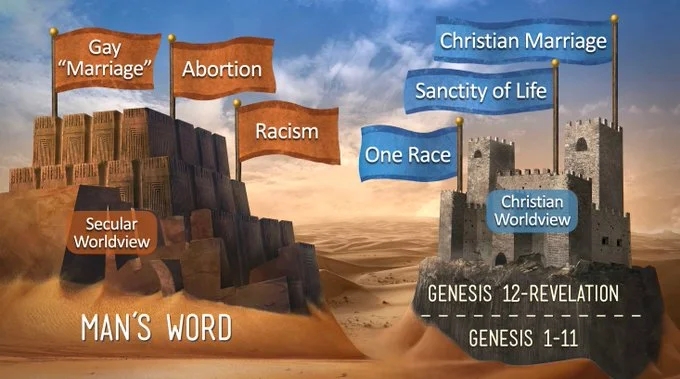
One side says that unborn babies, the most innocent of all persons, may be executed at will, torn apart and unceremoniously vacuumed out of the wombs of their mothers; that children may, on a whim, decide to ingest hormones foreign and unnatural to their bodies before subjecting themselves to irreversible surgeries so horrific that not even the most warped and depraved authors of the 19th and 20th centuries could have imagined them; that procreation is wholly unrelated to the conjugal act, that two men might sodomize one another and call it “love”; that sex-trafficking and child sexual exploitation are just the price to be paid for virtual images of increasingly perverted sex acts, readily available to young and old at the mere click of a button; that a nation has no sovereignty and must be subjected to millions of unvetted, unrestricted immigrants.

The other side says that innocence is worth preserving, that unborn children and their mothers must be cherished and protected from the evils of the abortion mill; that children must be raised to think and think critically, think well, think deeply; that the family is the basic and fundamental unit of society, that the very fabric of civilization would unravel without the family as its basis; that love necessitates self-sacrifice, not self-gratification; that nations have a God-given right to defend their borders and preserve the safety and security of their own people; that Christ is indeed King.

This present war is not between two ideological factions but between powers and principalities, between leftism and Christianity, between good and evil, and between God and Satan. “Choose you this day whom ye will serve… As for me and my house, we will serve the Lord” (Joshua 24:15).

GREAT OPERATIONAL SCIENCE VERSUS BAD HISTORICAL SCIENCE

The article, “A New Measurement Approaches Perfection” in Quantam Magazine, April 10th, 2023 by Z. Savitsky, demonstrates the electron is so round that it’s ruling out potential new particles: If the electron’s charge wasn’t perfectly round, it could reveal the existence of hidden particles.

The experiment measured the roundness of the electron with exquisite sensitivity. For comparison, “if an electron were the size of Earth, they could detect a bump on the North Pole the height of a single sugar molecule.” The experiment showed “The electron is rounder than that.” But this result in real operational science has disappointed advocates of the historical scientific theory of the big bang. Why? The big bang is the leading naturalistic cosmogony (Greek: ‘birth of the universe’). It basically states that energy appeared from nothing and turned into matter, as per Einstein’s most famous formula, E = mc2. However, The Standard Model of particle physics, among the best-attested theories in all science, throws up severe problems. In particular, any conversion of energy into matter must produce an equal amount of antimatter. Antimatter comprises antiparticles of the same mass but opposite charge (if the particle is charged) and magnetic moment as the corresponding matter particle. When an antiparticle meets its corresponding particle, both are quickly annihilated with a huge release of energy, again as per E = mc2. That is antielectron (positron) with electron, antiproton with proton, antineutron with neutron, etc.

The problem with the big bang is that the universe comprises overwhelmingly matter, with hardly any antimatter except for fleeting moments. As the article says: For one thing, our mere existence is proof that the Standard Model is incomplete since, according to the theory, the Big Bang should have produced equal parts matter and antimatter that would have annihilated each other.

How do we know that the big bang is true? Because we are here, and we got here from the big bang. But notice the logical fallacy known as begging the question (Latin: petition principii)! That is any argument where the conclusion to be proved is presupposed (‘begged’) in one of the premises. In particular, although real operational science overwhelmingly supports the Standard Model, there must be something wrong with it because it means that the Big Bang would not work. How do we know that the big bang is true? Because we are here, and we got here from the big bang. This question-begging arises from the previous question-begging: that we arose by naturalistic means—no Creator necessary.

Leading evolutionary geneticist, Professor Richard Lewontin wrote: “We take the side of [evolutionary] science in spite of the patent absurdity of some of its constructs … in spite of the tolerance of the scientific community for unsubstantiated just-so stories because we have a prior commitment, a commitment to materialism … Moreover, that materialism is absolute, for we cannot allow a Divine Foot in the door.”

Because of this question-begging a priori commitment to naturalism (only ‘nature’ exists), evolutionary cosmologists have been trying to find loopholes in the Standard Model. In particular, any asymmetry that could explain why much more matter than antimatter was produced in the big bang.

Even with the incredible sensitivity of the latest experiments, the “result is consistent with zero and improves on the previous best upper bound by a factor ∼2.4.”1 This is great support for the Standard Model but a serious problem for the big bang. As stated at the beginning of the article, the experiments have not found any deviation from a perfectly spherical electron, despite unparalleled experimental precision.

Also, trying to find tinier and tinier deviations from a sphere is equivalent to looking for particles at higher and higher energy scales. In turn, this is equivalent to looking for more and more massive particles beyond the Standard Model. This experiment is so sensitive that it’s equivalent to energies above 1013 eV (electron volts). This is over ten times the energy the Large Hadron Collider (LHC) can currently generate.

There is no question that this is excellent science: both great ingenuity and careful checking and cross-checking of data. The results back up an extremely well-supported and useful theory of particle physics. However, those committed to the big bang, regardless of real particle physics, continue to be disappointed. The best solution is: to stick to real science and abandon the naturalistic faith that demands the big bang.

Article by Jonathan Sarfati Electron is perfectly spherical – Real particle physics refutes big bang dogma: www.creation.com

YOUNG EARTH AND DISTANT STARLIGHT (PART 3)

3. Everyone believes in miracles!

Those who demand a naturalistic explanation (no miracles allowed!) for distant starlight from Christians don’t seem to realize that the standard ‘big bang’ secular view of origins entails miracles—but without a miracle worker! The problem is that the distribution of the background radiation in the universe is fairly uniform, but there has not been enough time for radiation (at the speed of light) to disperse over such a large universe. This is called the ‘horizon problem’. It is really the big bang’s very own ‘light time-travel’ problem. To ‘explain’ this, cosmologists invoked a period of super-fast expansion of the universe—much faster than the speed of light—for a brief time just after the ‘bang’. This was dubbed ‘inflation’. What started it, how it could proceed, and what stopped it are all mysteries. These are in effect naturalistic miracles, with no sufficient cause or explanation.2 They are used to prop up a theory that would not work without them.

So, it is not that miracles are not allowed in explaining origins. Ironically, they are only disallowed when it comes to biblical creation, which the Bible says is miraculous!

Bible-believing Christians are ‘streets ahead’ of secularists here because we have an all-powerful God who is able to do things beyond our ken.

Great is our Lord, and abundant in power; his understanding is beyond measure. The Lord lifts up the humble; he casts the wicked to the ground. (Psalm 147:5–6)

God calls us to humbly submit to Him and His Word.

.

WHAT AXIOMS IS YOUR WORLDVIEW BASED UPON?

The Creation/Evolution debate

The origin of our universe has never been about facts and evidence as such—we all have the same world, the same evidence, the same facts. It is the philosophical framework within which facts are interpreted which differs and philosophical frameworks are based on axioms (presuppositions, or starting beliefs). The scientific conclusions of Darwinism are squarely based on anti-biblical (naturalistic) axioms, while those of creation are based on biblical axioms. In any discussion on origins, the axioms need to be openly ‘on the table’, and it should be realized that one can discuss them in a secular setting without teaching religious doctrine as such, but without hiding or running away from the implications. The evidence concerning origins can be discussed through a critical comparison of axiom-based models (see below) without fostering the secular myth of ‘neutrality,’ i.e., that evidence ‘speaks for itself’ in some mysterious way.

There are creation and flood stories in most cultures that bear strong similarity to the Biblical accounts: ‘Why not then teach e.g. Australian Aboriginal creation and flood stories in science lessons?’ One could ask such objectors whether they are aware of any origins or flood teaching outside of the Biblical narrative which:

  • Claims to be absolute revelational truth from the Creator in documentary form
  • Has been held and believed consistently for many centuries in essentially its modern form.
  • Has been held to offer a serious historical explanation for all of reality including the origins of man and the universe and the reason why there are millions of dead things buried all around the world.
  • Is supported by a significant group of qualified scientists and other intellectuals who are convinced that it does indeed explain the data at least as well as evolution/long ages.

Extract from an article by Dr Carl Weiland: CMI’s views on the Intelligent Design Movement http://www.creation.com

ORIGIN OF FIRST SELF-REPRODUCING CELL?

A huge problem for naturalistic evolution is how life with its complex coded information could have arisen spontaneously in evolution’s very first living cell. I would suggest it is adequate proof for an Intelligent Designer and a good reason to take a look at the Bible’s account of Creation in Genesis. We learn God created a perfect world and humans made in the image of their Creator. Man’s SIN is the reason for death and suffering in this world. The Good News is that our loving Creator has provided the solution to restore our relationship with Him and overcome death. Jesus is His name.

Image result for picture of dna replication

Extract from editorial in Creation Magazine Vol 30 No.4 2017.

We have previously written about how scientists have attempted to determine the simplest self-reproducing cell (see creation.com/simple). This hypothetical cell was said to require a minimum of 256 genes. The problem for
evolutionists is that they cannot appeal to natural selection to explain the first cell. That’s because natural selection requires a living, reproducing cell to pass on any trait selected for! Further research in 2006 increased this figure to 387 protein-coding and 43 RNA-coding genes.
In 2016, the minimalist genome was once again increased with the creation of a synthetic self-reproducing bacterium: this time, to 473 genes (531,560 ‘letters’), including 65 whose function are unknown but which were essential for the survival of the cell. This is not much less than Mycoplasma genitalium (482 genes, 582,970 letters)—which itself is a parasite of even more complex organisms.

How then can evolutionists explain the origin of the very first self-reproducing cell? It is a mathematical impossibility for just one gene to have arisen by chance—much less 473.

The Bible says in John 1:1, “In the beginning was the WORD” and of course we now  know that every living thing has at its nucleus, DNA, a word of thousands of letters controlling all the functions of each cell. What follows in John 1:1  “In the beginning was the Word, and the Word was with God, and the Word was God.

Research highlights, Nature 439(7074):246–247, January 2006 | doi:10.1038/439246a.
Glass, J.I. et al., Essential genes of a minimal bacterium, Proc. Natl Acad. Sci. USA 103(2):425– 430, January 2006 | doi:10.1073/pnas.0510013103.
Hesman, T., Scientists build minimum genome bacterium, sciencenews.org, March 2016.

HOW BIOLOGY CONFIRMS LIFE BY DESIGN

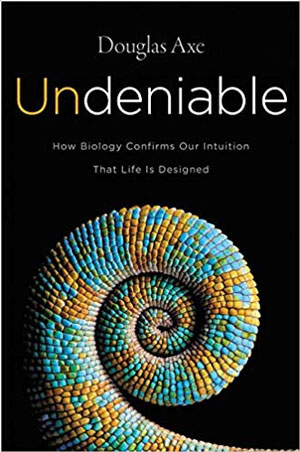
I have abbreviated the review by Joel Tray, Creation Ministries International, of the book Undeniable: How biology confirms our intuition that life is designed by Douglas Axe. For the full review go to http://www.creation.com.

undeniable

The book is written for the non scientist. For this reason, much space has been devoted to the use of elaborate analogies in order to simplify complex technical details. Interwoven between these analogies are personal stories and an overall narrative approach to the book. At times, this causes the book to come across as slow, repetitive and unnecessarily drawn out.

By comparison Jonathan Sarfati’s By Design (2008) is far more concise and easy to understand.—both books discussing design—the feel is that one chapter of Undeniable would have the same amount of scientific content as two or three pages in Sarfati’s book. Apart from the excessive wordiness, the science contained in Undeniable is sound, though it falters when it comes to its philosophy of science. However, this book will prove to be a challenge for those who hold to naturalistic evolution.

Unfortunately, as it is with most ID books, Undeniable comes across as somewhat naive from an epistemological  viewpoint. Axe correctly draws a distinction between creationists and the ID movement. At times throughout the book, Axe even appears to hold to contradicting philosophical positions. For example, he rejects scientism on the basis that our intuition tells us that design requires a designer (p. 49) yet at the same time rejects the inference to God by creationists since “Intelligent Design takes a minimalist view”, and there is a jump from intelligent designer to God (p. 50) that goes beyond science.

But if one cannot infer beyond science, then how is one not stuck with scientism? Either we infer beyond science, or we are stuck in scientism (which Axe also rejects). A naturalistic intelligent designer is still a designer within naturalism. But if the designer is not naturalistic, then one must infer beyond the boundaries of mere science. Worse, towards the end of the book, Axe himself does what he says creationists ought not to do, by saying that the designer only makes sense if it is God.

AN INESCAPABLE PROBLEM FOR EVOLUTION

All the machinery necessary to both make (in their entirety) and degrade (in their entirety) all the cell components is present in every normal living cell, and it must be so, otherwise waste products would accumulate and destroy cell function. And it must be so from the beginning, otherwise the first generation of living cells would have died from toxic waste accumulation. The inescapable consequence is that autopoiesis is, by definition, reversible, and this situation has logical consequences for life’s robustness in the face of resource limitation.

REVERSIBLE AUTOPOIESIS  IS A FOUNDATIONAL DESIGN PRINCIPLE FOR LIFE’S SURVIVAL

It must be present at the beginning in any theory of life’s origin. No simple-to-complex Darwinian scenario can meet such a standard and, once again, Genesis-style fiat creation is the only rational explanation.

active neurons

active neurons brain connections

Does John Lennon offer any answers in “IMAGINE”?

In the wake of the recent tragic terrorist attacks, a popular video on You Tube with nearly a million views shows an unnamed pianist before a crowd on the street in Paris playing a piano with a giant ‘peace sign’ painted on it. He’s playing John Lennon’s song, “Imagine”—a song with a strongly secular humanist, antireligious message. In the lyrics, Lennon writes:  Imagine there’s no heaven, It’s easy if you try, No hell below us, Above us only sky, Imagine all the people,  Paris-attack-John-LennonLiving for today …, Nothing to kill or die for, And no religion too, Imagine all the people, Living life in peace.
Lennon was blind to the implications of this humanistic worldview he was promoting. If there is no heaven or hell, that means there is no ultimate reward or punishment for anything you do while living on this earth. This was what the apostle Paul meant when he wrote, “What do I gain if, humanly speaking, I fought with beasts at Ephesus? If the dead are not raised, ‘Let us eat and drink, for tomorrow we die.’” (1 Corinthians 15:32)

What does a world look like with no moral constraints from God? Far from the peaceful paradise that Lennon ‘imagines’, the history of the 20th century bore out the results, as the Marxist, atheistic communist regimes took over and committed murder and genocide on a mass scale never before seen in history. The simple fact is, the true morality of the Bible looks absolutely nothing like the actions taken by militant Islamists.

When terrible things like this happen, people always are moved to ask why a good God would allow such evil things to take place; but what people sometimes fail to realize is the very idea of ‘good’ and ‘evil’ that they are using to judge the situation comes only from God in the first place. Take this as an opportunity to share the Good News with those who are looking for answers!

Extracted from article by Paul Price http://www.creation.com

Answering an atheist on meaning and purpose of life

I hope this article “Answering a reasonable atheist on deep philosophical questions” from Creation Ministries International (CMI) 30th September, 2012 provides helpful answers for Christians and unbelievers as well.

To demonstrate that not all of CMI’s opponents are hostile and unreasonable, we publish feedback by Tim W. of the USA to our article – Answering the ‘new atheists’ (interview with Doug Wilson). In this, Tim W. sought to defend the proposition that atheism can provide meaning and purpose. Tim W.’s email is printed in its entirety  (red), and then followed by point-by-point responses by Dr Jonathan Sarfati.

This is an interesting article. I think you are on the right track when you suggest that modern atheists are worried at the resurgence of conservative Christianity in the United States. Frankly, it concerns me that so many politicians have anti-abortion views with which I strongly disagree. Part of my moral beliefs value limited rights of women to choose the fate of their unfertilized eggs, embryos and their own bodies. Similarly, I understand that Christians have legitimate reason to be concerned that unbelievers will influence a policy or social climate that permits the destruction of actual or potential human organisms. The stakes are high so it should be no surprise that the voices of atheism rise to compete with the voices of religion.

I also agree with the author, and with Hume, that one cannot infer what ought to be, in a normative sense, from what is, was or will be the case. In this way, it is reasonable to say that naturalism or ‘scientism’ cannot suggest a specific theory or morality. However, that does not mean that morality is not compatible with materialism, naturalism or atheism. It only means that morality must come from philosophy (ethics) rather than from theology. There is no reason why an atheist cannot have a more sophisticated ‘sense’ or theory of morality than someone who bases their beliefs of right and wrong conduct (or thoughts) on the teachings of a formal religion. My own beliefs are more consistent with a general sense of basic ‘fairness,’ than obedience to the demands of a deity.

Lastly, I don’t understand the basis of a statement such as “The atheist cannot put forward, within his own framework, a justification for why reasoning is trustworthy, or even worthwhile,” or “the atheist can’t account for reason if there is no God.” These are philosophical questions that do not seem to be contingent on the existence of a God. Is reasoning trustworthy or meaningful? Those are matters of epistemology, not theology. Moreover, I think it is far from obvious that neither life, nor anything else for that matter, can have meaning unless one believes in God. God may give your life meaning, but that does not mean that nothing can provide meaning for an atheist’s life. I can imagine an atheist saying that her daughter, for example, gives her life meaning. Would you call her a liar?

Response

Dr Jonathan Sarfati replies: Thanks (on behalf of CMI and the article author).

TW: I think you are on the right track when you suggest that modern atheists are worried at the resurgence of conservative Christianity in the United States.

JS: What is really striking is how many modern atheists have become such delicate little flowers. They are hurt and offended by plastic baby Jesuses at Nativity scenes and are in danger of having a stroke if they hear a student-led prayer at a football game. (But of course, anyone objecting to obscenity or porn should just look the other way or change channels.) Even leading atheist Richard Dawkins is not such a wimp; he joins in Christmas celebrations. What a contrast the modern activists are with the far more robust atheists of yesteryear who vigorously debated the formidable G.K. Chesterton, and remained good friends even after finishing second.

TW: Frankly, it concerns me that so many politicians have anti-abortion views with which I strongly disagree.

JS: It would concern me if we didn’t have that many. Once we dehumanize one class of humanity, there is no limit. See for example article – Unborn babies may “be planning their future”: What now for the abortion lobby?

TW: Part of my moral beliefs value limited rights of women to choose the fate of their unfertilized eggs, embryos and their own bodies.

JS: Well, there’s the problem: the unborn is not part of a woman’s body. A reductio   ad absurdum I’ve explained is: this would entail that a mother carrying a son must have a penis.

TW: Similarly, I understand that Christians have legitimate reason to be concerned that unbelievers will influence a policy or social climate that permits the destruction of actual or potential human organisms.

JS: Yes, that’s exactly the issue. Without the protection of life, no other right, real or assumed, has any meaning. ‘Rights’ to private property, housing, employment, medical care, or anything else, mean nothing if one is not alive to exercise them.

TW: The stakes are high so it should be no surprise that the voices of atheism rise to compete with the voices of religion.

JS: The problem arises when voices of atheism try to silence the voices of Christianity. This includes university ‘speech codes’, ‘hate speech’, the persecution of Christians in atheistic communist regimes, and the GayStapo attacks on the Church and family. See Gay marriage, politicians, and the rights of Christians.

TW: I also agree with the author, and with Hume, that one cannot infer what ought to be, in a normative sense, from what is, was or will be the case.

JS: A key point.

TW: In this way, it is reasonable to say that naturalism or ‘scientism’ cannot suggest a specific theory or morality. However, that does not mean that morality is not compatible with materialism, naturalism or atheism. It only means that morality must come from philosophy (ethics) rather than from theology.

JS: It certainly can’t come from the axiom ‘God does not exist.’

TW: There is no reason why an atheist cannot have a more sophisticated ‘sense’ or theory of morality than someone who bases their beliefs of right and wrong conduct (or thoughts) on the teachings of a formal religion. My own beliefs are more consistent with a general sense of basic ‘fairness’, than obedience to the demands of a deity.

JS: But where does the notion of ‘fairness’ come from in an evolutionary world? Surely it’s just a delusion caused by certain neurochemical activity that happened to be useful for our ancestors to survive. Just like rape was useful to spread our genes, as two evolutionists seriously argued in a book (look how one squirmed to justify why rape should be considered ‘wrong’). Similarly, the article Bomb-building vs. the biblical foundation documents how leading atheistic philosopher/logician Bertrand Russell could not explain why right vs. wrong was any different from choosing one’s favourite colours.

Think of consistent evolutionist and atheistic philosopher Peter Singer, who justifies infanticide, euthanasia, and bestiality. It’s also notable that some critics of my article Abortion ‘after birth’? Medical ‘ethicists’ promote infanticide claimed that Singer was an anomaly among atheists. Yet I showed that his pro-infanticide views were shared by the Journal of Medical Ethics and the vocal antitheist P.Z. Myers. See also Bioethicists and Obama agree: infanticide should be legal. He also wrote the major Encyclopaedia Britannica article on Ethics (1992), and earlier this year, the Australian Government gave him Australia’s highest honour, Companion of the Order of Australia.

TW: Lastly, I don’t understand the basis of a statement such as “The atheist cannot put forward, within his own framework, a justification for why reasoning is trustworthy, or even worthwhile,” or “the atheist can’t account for reason if there is no God.” These are philosophical questions that do not seem to be contingent on the existence of a God.

JS: I would say they are, as natural selection explains only survival value, not truth and logic. In Canada, one atheistic philosophy professor argued that these things would have selective value. I responded that this is not necessarily so under his belief system. After all, he must regard theistic religion as one thing that evolved for survival value, yet he would regard this as false and illogical. Thus survival, under his perspective, can be enhanced by the false as well as the true.

TW: Is reasoning trustworthy or meaningful? Those are matters of epistemology, not theology. Moreover, I think it is far from obvious that neither life, nor anything else for that matter, can have meaning unless one believes in God. God may give your life meaning, but that does not mean that nothing can provide meaning for an atheist’s life.

JS: One of my colleagues wrote in Answering life’s big questions: Only the Bible provides the answers:

Today we are effectively told, in the evolutionary story, that life is a fluke, a cosmic accident. In this case our existence lacks any purpose, so life is a farce. And where are we going, in this view? Fertilizer! In short, life is: Fluke … farce … fertilizer.

Evolutionist Richard Dawkins said that we live in a universe that has “no design, no purpose, no evil, no good, nothing but pitiless indifference”. The evolutionists’ universe has no purpose because it is an accident; a cosmic accident. With evolution so widely taught in schools and universities, is it any wonder that so many lack any purpose or meaning to their lives?

As Susan Blackmore, psychologist and disciple of Richard Dawkins said, “If you really think about evolution and why we human beings are here, you have to come to the conclusion that we are here for absolutely no reason at all.”

TW: I can imagine an atheist saying that her daughter, for example, gives her life meaning.

JS: But hardly ultimate meaning, since both mother’s and daughter’s entire lives are just a blink of an eye in the uniformitarian cosmic scheme. Bertrand Russell said in his anti-Christian book Religion and Science:

Man, as a curious accident in a backwater, is intelligible: his mixture of virtues and vices is such as might be expected to result from fortuitous origin.

TW: Would you call her a liar?

JS: Not at all. A lie implies intentional deception, not just falsehood. As you could see from searching our site, we are very sparing with accusations of ‘lying’ (although some evolutionists justify deception and are just being consistent), as opposed to having a faulty interpretive framework. (However, we won’t deny that this prior adoption of this faulty framework is culpable according to Romans 1:20 and 2 Peter 3:3–7 and foolish (Psalm 14:1). But the point remains that a valid deduction from a faulty framework is not a lie.)

Non Christian Professor recognizes that Creation demands a Creator

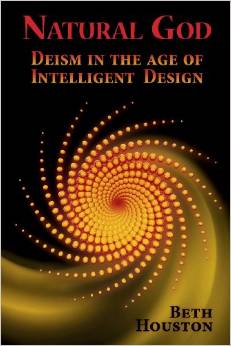
Natural God by Beth Houston


The author of NATURAL GOD – Deism in the Age of Intelligent Design, Beth Houston, is a professor of creative writing and literature at the University of California and several other universities. She covers a lot of material rarely reviewed in books critical of molecules to man evolution. What does she offer to the creation-evolution debate? The answer is a fresh approach, written in an engaging style, that reflects a good understanding of psychology, logic, biology and history. She stresses that science, especially Darwinism, has become a form of dogmatism the needs to be challenged.

One point documented is that Darwin’s central ambition was not to explore the world to let it reveal itself, but to become famous. Houston also carefully documents her position that evolution theory (no meaning, no purpose, no Creator) caused its developer to lose both his aesthetic sensibility and his appreciation of aesthetic beauty. Darwin openly admitted that his appreciation of aesthetics had dynamically changed.

“Up to the age of thirty ….poetry….such as the works of Milton, Gray, Byron, Wordsworth, Coleridge and Shelley, gave me great pleasure and even as a schoolboy I took great delight in Shakespeare. I have also said that formerly art and pictures gave me considerable pleasure and music very great delight. But now for many years I cannot endure to read a line of poetry: I have tried lately to read Shakespeare, and found it so intolerably dull that it nauseated me. I have also lost my taste for art and music.”

Darwin admitted that the ” loss of these tastes is a loss of happiness, and may possibly be injurious to the intellect, and more probable to the moral character, by enfeebling the emotional part of nature.”

Beth Houston concludes that what was wrong with Darwin was that “the dimension that gives life lived to the fullest its zing” was gone.

“By the time he had finished ORIGIN and certainly his later Autobiography, beauty had ceased to be beauty at all ….beauty was observed and used like a prostitute for a distant satisfaction of an immediate need, never for love of beauty for its own sake, never for the pleasure of intimate contact (with nature).

She goes on to say, “Mechanistic agnostics like Darwin…. know intellectually that nature is beautifully constructed while emotionally denying that it is. The aesthetic atrophies when the spirit does, or when the spirit lies dormant and inactivated. It is … mechanistic determinism and Darwinian natural selection.

There is never any death of God, only murder or suicide of the killer’s own God – given faculties.”

Houston speculates that: “Darwin’s insistence that natural selection is ultimately brutal is a projection of …. the brutal side of his own nature. Natural selection justifies brutality and sanctifies the guilt. The brutal cannot face a God who might not condone brutality. Therefore, religions create their gods in the image of their own brutality to justify and sanctify brutality, and science creates its god, natural selection, the shadow of civilized man, for the same purpose.

Summary: Professor Houston makes a convincing case that the natural world provides clear evidence for a creator. She also documents the adverse effects of Darwinism on society and persons using Darwin himself as a prime example.

Extract from book review by Jerry Bergman, Journal of Creation Vol 29, 2015