WHAT IS THE MOST COMPLEX COMPUTER OPERATING SYSTEM IN THE KNOWN UNIVERSE?

The human genome is the most complex computer operating system anywhere in the known universe.

It controls a super-complex biochemistry that acts with single-molecule precision. It controls the interaction network of hundreds of thousands of proteins. It is a wonderful testament to the creative brilliance of God and an excellent example of the scientific bankruptcy of neo-Darwinian theory. Why? Because the more complex life is, the less tenable evolutionary theory becomes. Super-complex machines cannot be tinkered with haphazardly or they will break. And super-complex machines do not arise from random changes.

The four dimensional human genome defies naturalistic explanations.

Our computer programs are essentially one-dimensional. The human genome operates in four dimensions. This is one of the greatest testimonies to the creative brilliance of God available.

ecoli-bacterium-lge

Figure 1: A comparison of the control of transcription in E. Coli (left) with the Linux call graph (right). The bacterial cell is able to control many protein-coding genes (green lines at bottom) with relatively few controls (yellow and purple lines). Linux, while obviously a result of intelligent design, falls far short in that it requires many more high-level instructions to control relatively few outputs. From Yan et al. 2010.1

I am serious when I compare the genome to a computer operating system. The only problem with this analogy is that we have no computers that can compare to the genome in terms of complexity or efficiency. It is only on the most base level that the analogy works, but that is what makes the comparison so powerful. After millions of hours of writing and debugging we have only managed to create operating systems that can run a laptop or a server, and they crash, a lot. The genome, though, runs a hyper-complex machine called the human body. The organisation of the two are radically different as well. A team made up of computer scientists, biophysicists, and experts in bioinformatics (in other words, really smart people) compared the genome of the lowly E. coli bacterium to the Linux operating system (figure 1) and have discovered that our man-made operating systems are much less efficient because they are much more “top heavy”.1 It turns out that the bacterial genome has a few high-level instructions that control a few middle-level processes, that in turn control a massive number of protein-coding genes. Linux is the opposite. It is much more top heavy and thus much less efficient at getting things done. The bacterium can do a lot more with fewer controls. I predict that the study of genomics will influence the future development of computers.

This is very brief summary of the information contained in the DVD by Dr Robert Carter  The High Tech Cell. You need to get this valuable resource and I suggest you purchase a copy from the Creation Ministries webstore.

IS THE BIBLE TOO HARD TO DEFEND? SADLY, EVANGELICAL PASTOR ANDY STANLEY THINKS SO

Evangelical pastor preaches that the Bible isn’t the foundation for the Christian faith.

Pastor Andy Stanley has a church network of over 30,000 people in the Atlanta area, and his church was rated the fastest-growing in America in 2014 and 2015.

andystanley

The Bible’s historical reliability is one of the most important considerations when it comes to whether people  will accept the Bible’s claims about Jesus—and they’re right! If the Bible is demonstrably wrong regarding its history, it is not a reliable record, and the claims the Bible makes about Jesus are so extraordinary that it requires the Bible to be a supernatural, inspired, inerrant book. This is of course what it claims to be. Creation Ministries found it necessary to counter this serious challenge to the authority of God’s Word with this excellent article by Lita Cosner and Scott Gillis.

Pastor Andy Stanley says, “If the Bible is the foundation of our faith, it’s all or nothing. Christianity becomes a ‘fragile house of cards’ religion. Christianity becomes a fragile house of cards that comes tumbling down when we discover that perhaps the walls of Jericho didn’t.”2

Stanley’s message is clear as to the ‘unnecessary reason’ youth have left the faith:

So, if you stepped away from Christianity because of something in the Bible, if you stepped away from the Christian faith because of Old Testament miracles, if you stepped away from the Christian faith because you couldn’t reconcile 6,000 years with a 4.5 billion year old earth and something you learned in biology, I want to invite you to reconsider, because the issue has never been, ‘is the Bible true?’.2 (Emphasis added)

While he hopes to persuade people to come back to church, the route he took is actually more likely to deconstruct the faith of the young people he wants so much to keep in the church. In our experience (which to be honest, is much more wide than his own—speaking in over 1000 churches of varying denominations each year), people think the Bible’s historical reliability is one of the most important considerations when it comes to whether they will accept the Bible’s claims about Jesus—and they’re right!

What most people have commented on is the third part of his sermon series. Stanley begins that message by saying:

“In Sunday School we learned the song, “Jesus loves me, this I know, for the Bible tells me so.”

He goes on to say,

“You grew up, but your faith didn’t grow up with you. You grew up, but you outgrew your faith. Your childhood god could not stand the rigors of adulthood, the questions of adulthood.”2

The reason he thinks this is a problem is:

“If the Bible is the foundation of our faith, it’s all or nothing. Christianity becomes a ‘fragile house of cards’ religion. Christianity becomes a fragile house of cards that comes tumbling down when we discover that perhaps the walls of Jericho didn’t.”2

To call Scripture a ‘house of cards’ (and elsewhere in the same sermon he calls it a ‘fragile thread’) reveals a troubling attitude for a pastor to have towards Scripture, which Jesus and the Apostles presented as the absolute foundation for our faith. After all, if he cannot be sure about Scripture, how can he be sure about the One that Scripture is ultimately all about, and moreover, the Bible’s history that necessitated Jesus becoming our Saviour.

Too hard to defend it

One reason Stanley argues we need this change in perspective is that Scripture is too hard to defend:

“What your students have discovered, and if you read broadly you’ve discovered, it is next to impossible to defend the entire Bible. But if your Christianity hangs by the thread of proving that everything in the Bible is true, you may be able to hang onto it, but your kids and your grandkids and the next generation will not. Because this puts the Bible at the center of the debate. This puts the spotlight right on the Bible. Everything rises and falls on whether not part, but all the Bible is true. And that’s unfortunate, and as we’re going to discover today, it is absolutely unnecessary.”2

Among the things he specifically states are indefensible and not supported by evidence:

  • Israel’s Exodus from Egypt
  • The walls in Jericho fell down
  • The earth is 6,000 years old
  • The chronological information in 1, 2 Kings, 1, 2 Chronicles, and 1, 2, Samuel
  • The global flood in Noah’s day

But as apologist James White pointed out in his rebuttal to Stanley, if the Bible is wrong, Christianity is untrue.4 Jesus’ own view was that the Scriptures could not be broken (John 10:35), and the New Testament authors referred to the Old Testament’s history as the foundation for New Testament theology. If the Bible is wrong about historical events, the basis for New Testament teaching vanishes. Worse still for Stanley, if Jesus is wrong about the very Scripture Stanley says is not defensible, then how can he still encourage faith in Jesus and His (historical) resurrection?

Did the early church have the Bible?

Stanley bases his argument that Christianity does not stand or fall with the Bible by his absurd claim that, for the first several hundred years of Christianity, they didn’t have the Bible: “For the first 300 years of the existence of Christianity, the debate centered on an event, not a book.” While they may not have had all the New Testament books bound together under one cover and called it ‘the Bible’, the entire Old Testament and many of the New Testament books functioned authoritatively from the beginning of the Church and were the central source of their theology, used to settle the doctrinal controversies of that time. In fact, there are over 100 references in the New Testament to the book of Genesis, let alone many other Old Testament events. So much of our Christian doctrine, and even Jesus’ own teaching, are centered on those biblical historical events.

Astonishingly, however, Stanley suggests that Peter might have responded to historical questions about the Old Testament as follows:

“Peter would have looked at you like, ‘I’m not really sure what you’re talking about, but I followed a man for three years who spoke like no other man spoke. He was arrested and crucified and we thought, Game over, because he said too much to be a good teacher, he claimed too much about himself to be a good teacher. Game over. We’re all in hiding; a bunch of women come babbling that “The tomb is empty, the tomb is empty”. I looked into an empty tomb, and do you know what I concluded? Somebody stole the body. And a few days later I had breakfast with my risen friend on the beach. So I’m not sure about 6,000-year-old earth, I’m not sure about archaeological evidence, I’m not sure about all that. The reason I’m following Jesus is because I saw him die, and I saw him alive, and I went into the streets of Jerusalem to say, God has done something among us.”2

But this does not match up with what Peter actually said in Acts 2 (by the way, it should be noted that Stanley purposely references no actual Scripture in his first several sermons). In Peter’s sermon as recorded by Luke, he included a lengthy quote from the prophet Joel and two Psalms, because he wasn’t arguing from his personal testimony and experience, but that the history they witnessed was a fulfillment of the Scriptures. And, even when he did appeal to his own eyewitness testimony, he tied this to a confirmation of the Scriptures (2 Peter 1:16–21)—the very Scriptures Stanley argues Christianity didn’t emphasize until 300 years later.

In Part 5 of the sermon series, Stanley dedicates an entire session to the reasons people leave the faith due to injustice in the world. Although Stanley does make some pertinent points, at no time does he state the foundational, historical event of Adam’s Fall as the cause of death and suffering in the world. In a self-labeled ‘footnote’, Pastor Stanley implies that a belief in evolution does not challenge the Gospel’s big picture when he states “Francis Collins actually embraces what we would consider macro-evolution and yet he is still a conservative Christian. If you didn’t think a person could believe in evolution and be an evangelical Christian, you should read this book. If science is the reason you have walked away from faith, I highly recommend his book, The Language of God [see our review].” Francis Collins would agree with Stanley when he stated in this sermon series, “And when religion and science conflict, at the end of the day if you are an honest person, science must win.” When people compromise on the historical account of creation they are unable to effectively explain the existence of death and suffering if God created a very good world. And Francis Collins along with his former organization BioLogos actually believes that Jesus could be wrong about His statements about biblical history and the historical Adam and Eve. See It’s not Christianity!.

Just another ‘New Testament Christianity’

It is interesting to note how Stanley defends the historical reliability of the New Testament and the historical trustworthiness and early composition of the New Testament documents. But as is shown by the list of Old Testament events that he claims are indefensible, he is all too ready to give up on the historical reliability of the Old Testament, which Jesus and the New Testament authors quoted constantly in all sorts of contexts, always taking it as completely authoritative and true.

We have pointed out that you can’t have a New Testament-only Christianity, because the Christians during the time of the New Testament used the Scriptures—the Old Testament.

Will this approach bring people back to the faith?

The saddest thing about this attempt to justify Christianity apart from the Scriptures is that it won’t work. We’ve come into contact with many young people with questions, and most aren’t interested in a ‘squishy’ Christianity that takes all the ‘hard’ passages of the Bible metaphorically while only holding on to some sort of a belief in Jesus.

The answer is not to so easily abandon the authority and the inerrancy of Scripture, but rather to learn how we can know that the Bible is reliable.

Andy Stanley is obviously passionate, and we would agree that a simple “the Bible tells me so” faith will likely not sustain people when they encounter objections to the faith. But the answer is not to so easily dismiss the authority and inerrancy of Scripture, but rather learn how the evidence supports the historical account of the Bible.

Many Sundays, after hearing a creation presentation, people will come up to one of our speakers and be so excited that they realize they can trust the entire Bible! By hearing that the Bible’s history is reliable, and that there are answers to all the objections that they’ve heard, believers are more confident to share their faith.

It takes effort, but it is not too hard to defend the entire Bible; we’ve been defending Scripture from the first verse for over 30 years. That is the key to keeping young people in the church. And the effort has eternal consequences. Given the wealth of scientific and archaeological support and information that is available today to support the Bible’s history, it is a shame that Stanley did not take the time to research it, before so readily abandoning the Bible as the inerrant source for the Christian faith.

JESUS ON THE AGE OF THE EARTH

Jesus believed in a young world, but leading theistic evolutionists say He is wrong. article by Dr Carl Wieland, Creation Ministries.

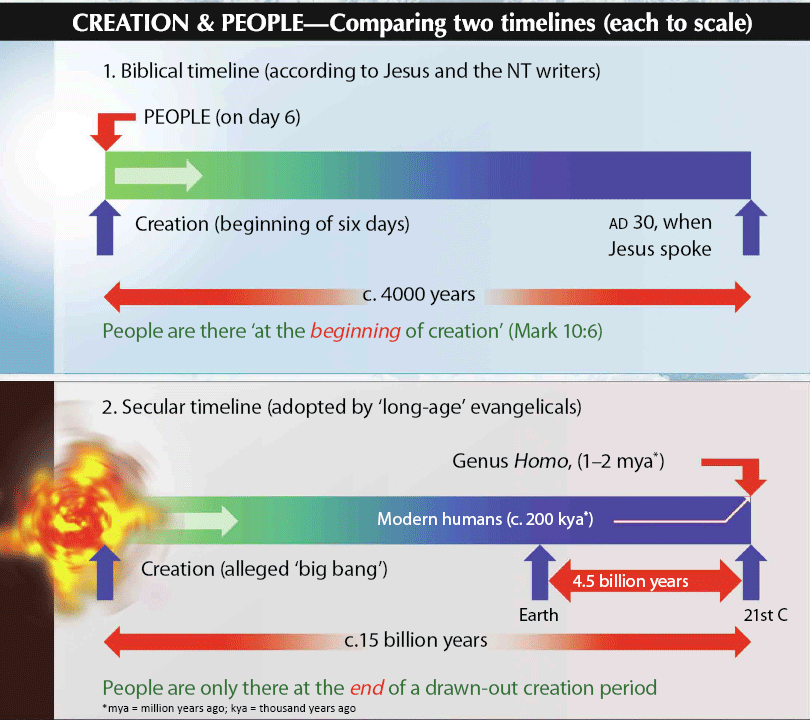
The standard secular timeline, from an alleged ‘big bang’ some 15 billion years ago to now, is accepted by most people in the evangelical Christian world, even though many would deny evolution. Some would even say that to dispute billions of years is to place an unnecessary stumbling block in the way of any scientifically-minded potential converts.

This is in contrast to the teaching of the Lord Jesus Christ, the Creator made flesh, as several of the biblical  authors, which makes it plain that this is wrong—people were there from the beginning of creation. But in the evolutionary timeline, people have only been around for one or two million years—this puts them toward the end of the timeline. This means that He is most definitely claiming that the world cannot be billions of years old.

For example, dealing with the doctrine of marriage, Jesus says in Mark 10:6 (bold emphases added):

But from the beginning of the creation, God made them male and female.

In Luke 11:50–51, Jesus also says: “That the blood of all the prophets, which was shed from the foundation of the world, may be required of this generation; From the blood of Abel to the blood of Zacharias … ”. And in Romans 1:20, the Apostle Paul says of God: “For his invisible attributes, namely, his eternal power and divine nature, have been clearly perceived, ever since the creation of the world, in the things that have been made. So they are without excuse.”.

Jesus, speaking around 4,000 years after creation, was correct to say that Day 6, when humans were created, was effectively ‘the beginning of creation’ as seen from thousands of years later.
Paul is plainly saying that people have been able to perceive these attributes of God in His creation ever since the creation of the world. Not ever since people were created.

Comparing the appearance of people on the timelines below, which are both to scale, is instructive. Jesus, speaking around 4,000 years after creation, was correct to say that Day 6, when humans were created, was effectively ‘the beginning of creation’ as seen from thousands of years later. By contrast, a creation fifteen billion years ago on the secular timescale would put humans at the end of the time scale. It shows clearly how the acceptance of the secular timeline starkly contrasts with the statements of Jesus.

Today, the vast majority of Christians in not only secular academia, but also theological institutions, Bible colleges, etc. believe—and many teach—that the secular ‘billions of years’ is fact. When one tries to find out how they deal with these repeated references, responses vary. But the ‘explaining away’ that takes place (whenever the problem is not simply ignored) invariably makes it plain that the authority being deferred to is not the Word of God, but rather current secular opinion.

Jesus and the age of the earth

The most striking (and sad) example of this switch in authority source I know of comes from a personal experience. In Melbourne, Australia, many years ago, I had arranged to sit down over a hot drink with a distinguished university professor, a Christian who was well-known for his active opposition to a straightforward view of Genesis. At that time, he was actually the head of a grouping of Christian academics which had been openly set up to provide opposition to the inroads our ministry was making. Over the years, this group has unfortunately been very effective in persuading most Christian training institutions that compromising on biblical creation in favour of secular thinking (evolution, long ages) is the only ‘respectable’ position. This professor himself, in addition to his secular science qualifications, was well regarded in the theological arena as well as being very biblically literate. He had at that time already been a frequent guest lecturer at several leading Australian evangelical training institutions.

During our courteous exchange, I asked him about the above comments by Jesus in relation to the age of the world. I asked, “Isn’t it clear that Jesus taught and believed that the world was young?”

A stunning response

I expected him to do as other Christian evolutionists have done—to try to find ways to torture the text to escape these obvious implications. Instead, he said that he totally agreed that Jesus believed in a recent creation of all things.

Somewhat taken by surprise, I said, “Well, how do you deal with that, then?” (He would of course have assumed, correctly, that I knew of the long-age position of this prominent organisation of theistic evolutionists.) His answer simply stunned me, to put it mildly. He said: “Jesus didn’t know as much science as we do today.”

His words burned themselves indelibly on my memory, while the recollection of my response has faded somewhat. But I recall saying something about Jesus being the Creator, God made flesh; He was there at creation, He does not lie, that sort of thing. To which his reply was once again unforgettable:

“Ah, but that’s where it gets very complex—it has to do with the theology of the Incarnation, where Jesus deliberately laid aside many of the things that had to do with His pre-incarnate divinity.”

Our conversation was nearing the end of its allotted period in any case, but I recall being so stunned by this that it took me till well afterwards to fully process the implications.

What it all means:

Firstly, and very importantly, the professor’s comments were a clear admission that the words of the Lord Jesus Christ Himself, as recorded in the Bible, confirm that He believed that things were recently created.

Remember that this professor was at the time the most prominent of all the professing evangelical academics that were being enthusiastically welcomed into Bible colleges and seminaries—to tell them why it was OK to believe in evolution and long ages. He obviously saw it as hopeless to try to claim other than what the Lord is clearly saying in this Bible text. And this is despite many attempts by others to ‘explain away’ this huge stumbling block for long-agers.

His way of being able to hold onto his theistic evolutionary view was to claim that Jesus was not lying, it was just that He was poorly informed. This was because when He as God the Son became flesh, laying aside aspects of His divinity included divesting Himself of all knowledge about what really happened when He had created all things.

If I had had the presence of mind, an appropriate response might have been to ask something like the following:

“OK, let’s assume for the sake of the argument that firstly, creation was by evolution, over millions of years of death and suffering—and that Jesus did perform some sort of lobotomy on Himself, so that He could no longer recall what really took place. So He just understood Genesis in the most natural straightforward way, not realising what the real truth was. What you’re claiming in that case amounts to this: That God the Father, knowing the real truth, permitted not just the Apostles, but His beloved Son, while on Earth, to believe and teach things that were utter falsehoods. Furthermore, it means that the Father permitted these false teachings to appear—repeatedly—in His revealed Word. With the result that for some 2,000 years, the vast majority of Christians were seriously misled about such things as not just the time and manner of creation, but gospel-crucial matters such as the origin of sin, and of death and suffering.”

[Added by author Nov 2014: The Lord Jesus repeatedly made it clear that His words and actions were on the Father’s authority, in all respects. Some examples are firstly John 8:28: So Jesus said to them, “When you have lifted up the Son of Man, then you will know that I am he, and that I do nothing on my own authority, but speak just as the Father taught me”. And John 12:49–50: “For I have not spoken on my own authority, but the Father who sent me has himself given me a commandment—what to say and what to speak. And I know that his commandment is eternal life. What I say, therefore, I say as the Father has told me.”]

If even Jesus’ words in Scripture can’t be trusted on some issues, how are we supposed to trust anything in the Bible at all?
One thing is very clear from all this. Namely, that the erroneous belief that ‘science’ insists that evolution and long ages are ‘fact’ is the most serious challenge to biblical authority, and thus to the faith in general, that Christendom has ever faced. If even Jesus’ words in Scripture can’t be trusted on some issues, how are we supposed to trust anything in the Bible at all? See also the box about the ‘kenotic heresy’.

Other leading theistic evolutionists have similarly made plain their belief that Jesus was mistaken. For example, on the American theistic evolutionary site BioLogos, led by Francis Collins, there appeared the following:

“If Jesus as a finite human being erred from time to time, there is no reason at all to suppose that Moses, Paul, John wrote Scripture without error. Rather, we are wise to assume that the biblical authors expressed themselves as human beings writing from the perspectives of their own finite, broken horizons.”

This is all the more serious because Jesus and the apostles used the history they taught to back up the theology that they taught. The Resurrection (1 Corinthians 15), marriage (Mark 10:1–12), atonement (Romans 5:12–21), and Heaven (Revelation 21–22:5) are only a few of the areas in which compromising Christians are theologically crippled, because they don’t have the same strong stand on Genesis that Jesus and the apostles did when they taught about these areas.

What a tragedy that so many Christian leaders have been bluffed and intimidated into assuming that secular interpretations of the evidence should dictate their understanding of God’s Word. And right at a point in history when there are more scientific reasons than ever to confirm the utter rationality of trusting the Bible, not evolutionary conclusions.

THINKING CORRECTLY ABOUT SCIENCE

Dutch philosopher Herman Dooyeweerd (1894-19770) made a major contribution towards Christian theory of reality (ontology). In his theory, Dooyeweerd proposes that we understand creation as having multiple aspects (law-spheres), where an ‘aspect’ is defined as “a basic kind of properties and laws”. Examples of such kinds are: physical, spatial, biotic, logical, sensory, linguistic, ethical, etc. He distinguishes fifteen such aspects of created reality. They are mutually irreducible both in the sense that none can be coherently eliminated in favour of another and also none can be coherently regarded as the cause of any other.

Dooyeweerd

The core idea is that all aspects are created, since there is nothing that God did not create. This includes matter and life, the laws of logic, and the laws governing all the other aspects. The theory goes on to argue that all things in creation have (active or passive) properties of every one of the aspects and so are subject to the laws of all the aspects. For example, a rock has a specific weight whether we know its weight or not. It is has this property independent of an observer. But its sensory colour is not independent. Rather it appears black in relation to a perceiver. Thus the rock’s colour is a passive property because it requires being acted upon by a perceiver to be actualised. The theory takes note of the observed fact that, as far as we know, only humans have active properties in all fifteen aspects. Second the first six (lower aspects) are governed by laws that cannot be broken such as the law of gravity. By contrast higher aspects such as “ethical” can be violated. Dooyeweerd argues that the aspects lower on the list are preconditions for aspects higher on the list, but that no aspect produces an other. For example, it is necessary for there to be things with active physical properties in order for there to be things with active biotic properties, which are in turn necessary for there to be things that have active sensory perception.

The distinctness of modal aspects is anchored in our experiences with all created things: from a molecule over algae and mammals to humans, each kingdom features new active properties that do not exist in the lower kingdoms, neither can they be imagined – as transitional- properties. A philosophy that presupposes a loving God who has given us the ability to observe, know and experience the world in a meaningful way necessarily leads us to trust our observations. The distinctness and irreducibility of modal aspects and laws tells us, then, that things could not have ’emerged’ or evolved form each other, having their origin in God and without the means of some evolutionary process that cannot account for the step changes in the properties we observe.

I would suggest that the only reason special creation is rejected as the best explanation for origins is a pre-existing bias towards materialistic evolutionary explanations.

Extract from article by Martin Tampier in Journal of  Creation Vol. 30 (2) 2016

BIG BANG MODEL OF COSMOS IS ABSURD

Secular scientists claim that our universe formed itself in a big bang event about 13.8 billion years ago. They say that the big bang is a valid scientific theory, well-supported by the evidence.
These claims are false. Not only is there abundant scientific evidence against the big bang, but the model also contradicts itself, and has absurd implications.

30-9-619_14

In this third DVD in the series, engineer and former atheist Spike Psarris explores the origin of the universe. Did it form in a Big Bang event billions of years ago? Or are the heavens consistent with the biblical account of creation instead?

Using spectacular graphics and brilliant photographs of God’s magnificent heavens, Spike demonstrates why the Big Bang fails scientifically. You’ll not only learn about the abundant scientific evidence against the Big Bang, but see why the model contradicts itself and has absurd implications. Spike makes difficult concepts easy to grasp, including redshifts, the cosmic microwave background radiation, the multiverse, and more. Plus, you’ll gain a deeper understanding of dark matter, dark energy, inflation theory, and the bizarre concept of a ‘Boltzmann brain’—all of which threaten the Big Bang’s status as a scientific theory.

https://austore.creation.com/astronomy-vol-3-our-created-universe-dvd?utm_sour  Watch the five minute preview

An objective evaluation of the evidence does not support a self-creation of the cosmos. Instead, “The heavens declare the glory of God” (Psalm 19:1).

AN INESCAPABLE PROBLEM FOR EVOLUTION

All the machinery necessary to both make (in their entirety) and degrade (in their entirety) all the cell components is present in every normal living cell, and it must be so, otherwise waste products would accumulate and destroy cell function. And it must be so from the beginning, otherwise the first generation of living cells would have died from toxic waste accumulation. The inescapable consequence is that autopoiesis is, by definition, reversible, and this situation has logical consequences for life’s robustness in the face of resource limitation.

REVERSIBLE AUTOPOIESIS  IS A FOUNDATIONAL DESIGN PRINCIPLE FOR LIFE’S SURVIVAL

It must be present at the beginning in any theory of life’s origin. No simple-to-complex Darwinian scenario can meet such a standard and, once again, Genesis-style fiat creation is the only rational explanation.

active neurons

active neurons brain connections

GOD said to Bill, “You’ve got to get this Bill”

This is a great testimony. It’s authentic, It’s for real. You will be impacted by this testimony. I was, all Christians will resonate with and be encouraged by this message. If you don’t, then you are in a dark place and need help. Why don’t you contact Bill Towns.

GOD AS A TRI-UNITY IS FUNDAMENTAL TO OUR UNDERSTANDING OF HIS UNIVERSE

God the Father, God the Son and God the Holy Spirit are each equally and eternally the one true God.

God is Love, is probably the most important claim Christians make about our Creator, and yet, without the Trinity it is incomprehensible. A perfectly loving Being cannot perfectly love if He is not sharing that love with at least one other, since perfect love exists between two distinct entities. Love demands a subject who loves and an object that is loved. Because God is immutable and self sufficient (His aseity) requires that His love is not dependent upon the existence of creatures (anything created).

By observing the Universe God created, we can see this tri-unity expressed in every aspect of that creation.

The Father is the Thought behind it, the Son is the Word calling it forth, and the Spirit is the Deed making it a reality.

We are made in God’s image and in God’s likeness so is it any wonder we are a Trinity – Spirit, Soul and Body. Is it also any wonder, that God established the family, the basic structure for mankind as a Trinity – Husband, Wife and Children.

God’s universe is a Trinity – Matter, Space and Time and each of these is a Trinity: Matter – Solid, Liquid and Gas, Space – width, height and depth and Time – past, present and future.

God has given us so many wonderful examples in His creation of ONE being a TRINITY.

Water is two atoms of Hydrogen and one atom of Oxygen (H2O) and it can be a solid – ice, liquid – water and gas- steam.

Light – white is made up of three primary colours, red, green and blue.
8764-trinity-color

The three Persons of the Trinity appear in a logical, causal order . The Father is the unseen, omnipresent Source of all being, revealed in and by the Son, experienced in and by the Holy Spirit. The Son proceeds from the Father, and the Spirit from the Son.

We “see” God and His great salvation by the Father sending the Son of God, our Lord Jesus Christ, we then “experience” their reality by faith, through the indwelling presence of His Holy Spirit. 

The truth of God’s tri-unity is ingrained in man’s very nature, but sadly he has often distorted it and substituted a false god or gods in its place.

IS IT POSSIBLE TO HAVE SCIENCE, IF FACTS OF THE UNIVERSE ARE UNORDERED?

Basic to the unbeliever’s worldview is a denial of creation – the ordered arrangement of the universe according to the mind of God.

The Christian worldview is that not one piece of the created order is where it is, at the time it is, and the size it is , that is not the result of God’s ultimate plan for His creation.

Knowledge requires the ability to differentiate between individual objects (One- and- Many question). This is done by means of universals, or what we might call categories. Examples of categories would be horse, cat, chair, trees, plants and so forth. In the Christian worldview, categories or universals, are part of the creation act of God. This is what unifies everything in the universe (unity and diversity), otherwise we just have a lot of  ‘abstract particulars’ that don’t relate to anything else. Particulars (things, events, words) need something that connects them to something else that will provide meaning to the particular whatever it might be. Right at the foundation of the universe (Genesis 1) God created particulars and kinds (universals), ” The earth brought forth vegetation, plants yielding seed, each according to its kind …” Genesis 1:11-12.

8764-trinity-color

In God’s own being, the Trinity, we find both unity and diversity. Christian philosopher, Cornelius Van Til recognized the question of the One-and-Many as a metaphysical issue. “Using the language of the One-and-Many question we contend that in God the one and the many are equally ultimate. Unity in God is no more fundamental than diversity and diversity in God is no more fundamental than unity.”

The doctrine of the Trinity provides a solution to the problem of knowledge , the one-and-many or universals and particulars, and therefore a solution to the issues of relationships, or community. In the Trinity the absolute self-sufficient God is both unity and diversity. Creation reveals a one-and-many universe brought into existence by a one-and-many triune God.

The universe is not an accumulation of unknowable abstractions but a creative act of God. Without such a belief in a unifying principle in the universe, science is not possible. It is the unifying principle, the common denominator, that provides order and coherence – rationality – to the universe. This is one of the unproven assumptions of science. It is no coincidence that science has grown on the back of a Christian culture and worldview.

Extracted from article by Ian Hodge “Trinity’s Truth Reflected in Creation”, http://www.creation.com


Relevance of Creation to sharing your faith

Dynamic street evangelist Henry De Roos gives practical advice on how to use evidence about God’s creation to share the Gospel of Jesus Christ.

Listen to the first five minutes of this video to get Henry De Roos testimony. A Science teacher with two degrees who discovered he was unable to defend his faith and decided to do something about it.